1
Classification by
Back Propagation
Artificial Neural Networks
 A neural network: A set of connected input/output units where
each connection has a weight associated with it
 Computer Programs
 Pattern detection and machine learning algorithms
 Build predictive models from large databases
 Modeled on human nervous system
 Offshoot of AI
 McCulloch and Pitt
 Originally targeted
 Image Understanding, Human Learning, Computer Speech
2
Features
 Highly accurate predictive models for a large number of
different types of problems
 Ease of use and deployment – poor
 Connection between nodes
 Number of units
 Training level
 Learning Capability
 Model is built one record at a time
3
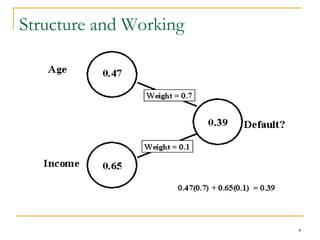
Structure and Working
4
Neural Network model
 Model
 Specified by weights
 Training modifies weights
 Complex models
 Fully interconnected
 Multiple hidden layers
5
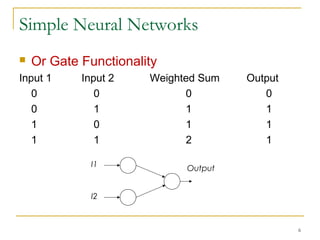
Simple Neural Networks
 Or Gate Functionality
Input 1 Input 2 Weighted Sum Output
0 0 0 0
0 1 1 1
1 0 1 1
1 1 2 1
6
I1
I2
Output
7
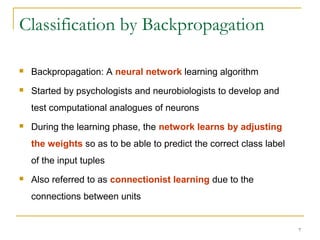
Classification by Backpropagation
 Backpropagation: A neural network learning algorithm
 Started by psychologists and neurobiologists to develop and
test computational analogues of neurons
 During the learning phase, the network learns by adjusting
the weights so as to be able to predict the correct class label
of the input tuples
 Also referred to as connectionist learning due to the
connections between units
8
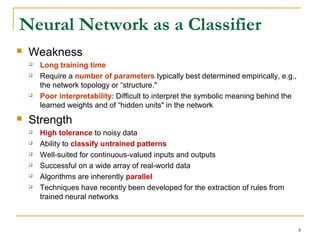
Neural Network as a Classifier
 Weakness
 Long training time
 Require a number of parameters typically best determined empirically, e.g.,
the network topology or “structure."
 Poor interpretability: Difficult to interpret the symbolic meaning behind the
learned weights and of “hidden units" in the network
 Strength
 High tolerance to noisy data
 Ability to classify untrained patterns
 Well-suited for continuous-valued inputs and outputs
 Successful on a wide array of real-world data
 Algorithms are inherently parallel
 Techniques have recently been developed for the extraction of rules from
trained neural networks
9
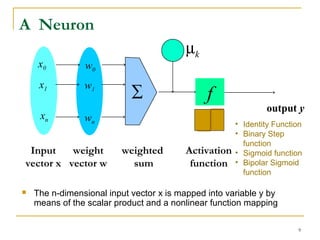
A Neuron
 The n-dimensional input vector x is mapped into variable y by
means of the scalar product and a nonlinear function mapping
µk-
f
weighted
sum
Input
vector x
output y
Activation
function
weight
vector w
∑
w0
w1
wn
x0
x1
xn
• Identity Function
• Binary Step
function
• Sigmoid function
• Bipolar Sigmoid
function
10
A Multi-Layer Feed-Forward Neural Network
Output layer
Input layer
Hidden
layer
Output vector
Input vector: X
wij
11
Multi-Layer Neural Network
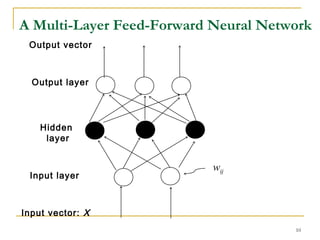
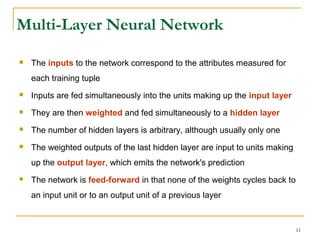
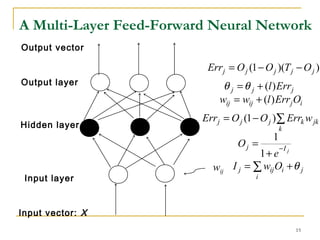
 The inputs to the network correspond to the attributes measured for
each training tuple
 Inputs are fed simultaneously into the units making up the input layer
 They are then weighted and fed simultaneously to a hidden layer
 The number of hidden layers is arbitrary, although usually only one
 The weighted outputs of the last hidden layer are input to units making
up the output layer, which emits the network's prediction
 The network is feed-forward in that none of the weights cycles back to
an input unit or to an output unit of a previous layer
12
Defining a Network Topology
 First decide the network topology: # of units in the input layer, # of
hidden layers (if > 1), # of units in each hidden layer, and # of units in the
output layer
 Normalizing the input values for each attribute measured in the training
tuples to [0.0—1.0]
 One input unit per domain value, each initialized to 0
 Output, if for classification and more than two classes, one output unit per
class is used
 Once a network has been trained and its accuracy is unacceptable,
repeat the training process with a different network topology or a different
set of initial weights
13
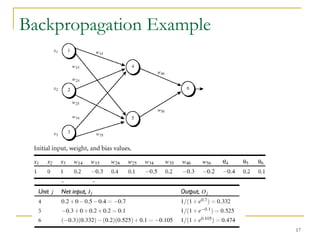
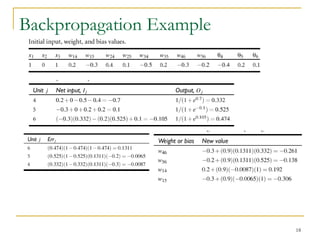
Backpropagation
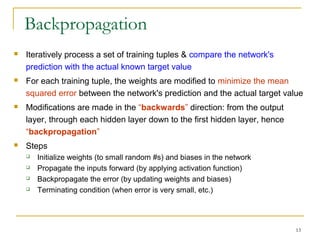
 Iteratively process a set of training tuples & compare the network's
prediction with the actual known target value
 For each training tuple, the weights are modified to minimize the mean
squared error between the network's prediction and the actual target value
 Modifications are made in the “backwards” direction: from the output
layer, through each hidden layer down to the first hidden layer, hence
“backpropagation”
 Steps
 Initialize weights (to small random #s) and biases in the network
 Propagate the inputs forward (by applying activation function)
 Backpropagate the error (by updating weights and biases)
 Terminating condition (when error is very small, etc.)
14
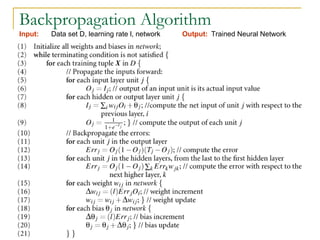
Backpropagation Algorithm
Input: Data set D, learning rate l, network Output: Trained Neural Network
15
A Multi-Layer Feed-Forward Neural Network
Output layer
Input layer
Hidden layer
Output vector
Input vector: X
wij ∑ +=
i
jiijj OwI θ
jIj
e
O −
+
=
1
1
))(1( jjjjj OTOOErr −−=
jk
k
kjjj wErrOOErr ∑−= )1(
ijijij OErrlww )(+=
jjj Errl)(+=θθ
16
Backpropagation Algorithm
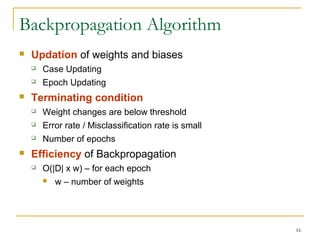
 Updation of weights and biases
 Case Updating
 Epoch Updating
 Terminating condition
 Weight changes are below threshold
 Error rate / Misclassification rate is small
 Number of epochs
 Efficiency of Backpropagation
 O(|D| x w) – for each epoch
 w – number of weights
17
Backpropagation Example
18
Backpropagation Example
19
Backpropagation and Interpretability
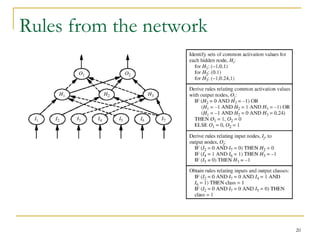
 Rule extraction from networks: network pruning
 Simplify the network structure by removing weighted links that have
the least effect on the trained network
 Then perform link, unit, or activation value clustering
 The set of input and activation values are studied to derive rules
describing the relationship between the input and hidden unit layers
 Sensitivity analysis: assess the impact that a given input variable
has on a network output. The knowledge gained from this analysis
can be represented in rules
20
Rules from the network

2.5 backpropagation

  • 1.
  • 2.
    Artificial Neural Networks A neural network: A set of connected input/output units where each connection has a weight associated with it  Computer Programs  Pattern detection and machine learning algorithms  Build predictive models from large databases  Modeled on human nervous system  Offshoot of AI  McCulloch and Pitt  Originally targeted  Image Understanding, Human Learning, Computer Speech 2
  • 3.
    Features  Highly accuratepredictive models for a large number of different types of problems  Ease of use and deployment – poor  Connection between nodes  Number of units  Training level  Learning Capability  Model is built one record at a time 3
  • 4.
  • 5.
    Neural Network model Model  Specified by weights  Training modifies weights  Complex models  Fully interconnected  Multiple hidden layers 5
  • 6.
    Simple Neural Networks Or Gate Functionality Input 1 Input 2 Weighted Sum Output 0 0 0 0 0 1 1 1 1 0 1 1 1 1 2 1 6 I1 I2 Output
  • 7.
    7 Classification by Backpropagation Backpropagation: A neural network learning algorithm  Started by psychologists and neurobiologists to develop and test computational analogues of neurons  During the learning phase, the network learns by adjusting the weights so as to be able to predict the correct class label of the input tuples  Also referred to as connectionist learning due to the connections between units
  • 8.
    8 Neural Network asa Classifier  Weakness  Long training time  Require a number of parameters typically best determined empirically, e.g., the network topology or “structure."  Poor interpretability: Difficult to interpret the symbolic meaning behind the learned weights and of “hidden units" in the network  Strength  High tolerance to noisy data  Ability to classify untrained patterns  Well-suited for continuous-valued inputs and outputs  Successful on a wide array of real-world data  Algorithms are inherently parallel  Techniques have recently been developed for the extraction of rules from trained neural networks
  • 9.
    9 A Neuron  Then-dimensional input vector x is mapped into variable y by means of the scalar product and a nonlinear function mapping µk- f weighted sum Input vector x output y Activation function weight vector w ∑ w0 w1 wn x0 x1 xn • Identity Function • Binary Step function • Sigmoid function • Bipolar Sigmoid function
  • 10.
    10 A Multi-Layer Feed-ForwardNeural Network Output layer Input layer Hidden layer Output vector Input vector: X wij
  • 11.
    11 Multi-Layer Neural Network The inputs to the network correspond to the attributes measured for each training tuple  Inputs are fed simultaneously into the units making up the input layer  They are then weighted and fed simultaneously to a hidden layer  The number of hidden layers is arbitrary, although usually only one  The weighted outputs of the last hidden layer are input to units making up the output layer, which emits the network's prediction  The network is feed-forward in that none of the weights cycles back to an input unit or to an output unit of a previous layer
  • 12.
    12 Defining a NetworkTopology  First decide the network topology: # of units in the input layer, # of hidden layers (if > 1), # of units in each hidden layer, and # of units in the output layer  Normalizing the input values for each attribute measured in the training tuples to [0.0—1.0]  One input unit per domain value, each initialized to 0  Output, if for classification and more than two classes, one output unit per class is used  Once a network has been trained and its accuracy is unacceptable, repeat the training process with a different network topology or a different set of initial weights
  • 13.
    13 Backpropagation  Iteratively processa set of training tuples & compare the network's prediction with the actual known target value  For each training tuple, the weights are modified to minimize the mean squared error between the network's prediction and the actual target value  Modifications are made in the “backwards” direction: from the output layer, through each hidden layer down to the first hidden layer, hence “backpropagation”  Steps  Initialize weights (to small random #s) and biases in the network  Propagate the inputs forward (by applying activation function)  Backpropagate the error (by updating weights and biases)  Terminating condition (when error is very small, etc.)
  • 14.
    14 Backpropagation Algorithm Input: Dataset D, learning rate l, network Output: Trained Neural Network
  • 15.
    15 A Multi-Layer Feed-ForwardNeural Network Output layer Input layer Hidden layer Output vector Input vector: X wij ∑ += i jiijj OwI θ jIj e O − + = 1 1 ))(1( jjjjj OTOOErr −−= jk k kjjj wErrOOErr ∑−= )1( ijijij OErrlww )(+= jjj Errl)(+=θθ
  • 16.
    16 Backpropagation Algorithm  Updationof weights and biases  Case Updating  Epoch Updating  Terminating condition  Weight changes are below threshold  Error rate / Misclassification rate is small  Number of epochs  Efficiency of Backpropagation  O(|D| x w) – for each epoch  w – number of weights
  • 17.
  • 18.
  • 19.
    19 Backpropagation and Interpretability Rule extraction from networks: network pruning  Simplify the network structure by removing weighted links that have the least effect on the trained network  Then perform link, unit, or activation value clustering  The set of input and activation values are studied to derive rules describing the relationship between the input and hidden unit layers  Sensitivity analysis: assess the impact that a given input variable has on a network output. The knowledge gained from this analysis can be represented in rules
  • 20.