k-means Clustering
Papers We Love
Bucharest Chapter
February 22, 2016
I am Adrian Florea
Architect Lead @ IBM Bucharest Software Lab
Hello!
What is clustering?
◉branch of Machine Learning (unsupervised learning i.e. find
underlying patterns in the data)
◉method for identifying data items that closely resemble one
another, assembling them into clusters [ODS]
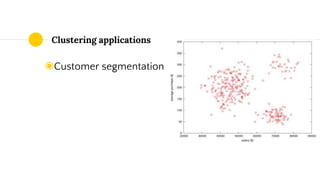
Clustering applications
◉Customer segmentation
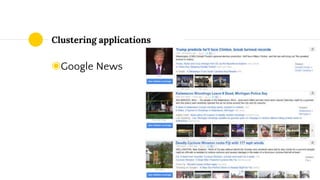
Clustering applications
◉Google News
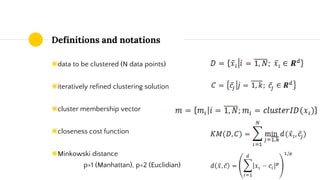
Definitions and notations
◉data to be clustered (N data points)
◉iteratively refined clustering solution
◉cluster membership vector
◉closeness cost function
◉Minkowski distance
p=1 (Manhattan), p=2 (Euclidian)
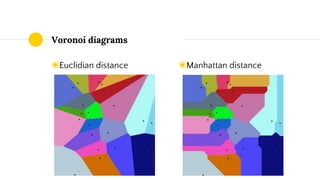
Voronoi diagrams
◉Euclidian distance ◉Manhattan distance
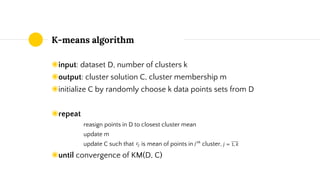
K-means algorithm
◉input: dataset D, number of clusters k
◉output: cluster solution C, cluster membership m
◉initialize C by randomly choose k data points sets from D
◉repeat
reasign points in D to closest cluster mean
update m
update C such that is mean of points in cluster,
◉until convergence of KM(D, C)
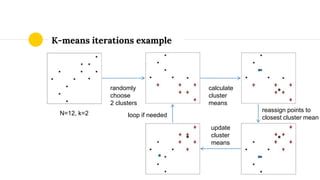
K-means iterations example
N=12, k=2
randomly
choose
2 clusters
calculate
cluster
means
reassign points to
closest cluster mean
update
cluster
means
loop if needed
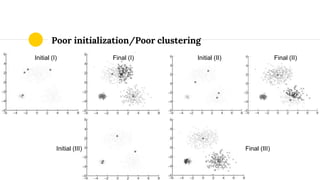
Poor initialization/Poor clustering
Initial (I) Final (I) Initial (II) Final (II)
Initial (III) Final (III)
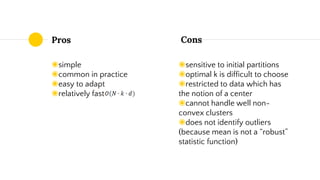
Pros
◉simple
◉common in practice
◉easy to adapt
◉relatively fast
◉sensitive to initial partitions
◉optimal k is difficult to choose
◉restricted to data which has
the notion of a center
◉cannot handle well non-
convex clusters
◉does not identify outliers
(because mean is not a “robust”
statistic function)
Cons
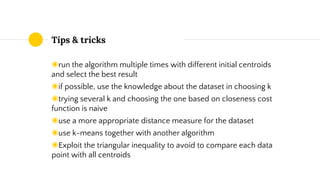
Tips & tricks
◉run the algorithm multiple times with different initial centroids
and select the best result
◉if possible, use the knowledge about the dataset in choosing k
◉trying several k and choosing the one based on closeness cost
function is naive
◉use a more appropriate distance measure for the dataset
◉use k-means together with another algorithm
◉Exploit the triangular inequality to avoid to compare each data
point with all centroids
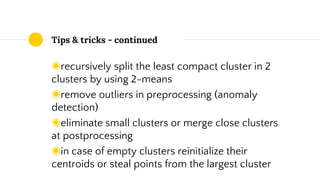
Tips & tricks - continued
◉recursively split the least compact cluster in 2
clusters by using 2-means
◉remove outliers in preprocessing (anomaly
detection)
◉eliminate small clusters or merge close clusters
at postprocessing
◉in case of empty clusters reinitialize their
centroids or steal points from the largest cluster
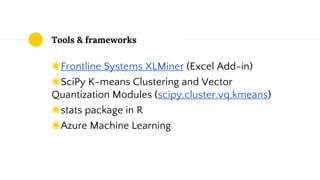
Tools & frameworks
◉Frontline Systems XLMiner (Excel Add-in)
◉SciPy K-means Clustering and Vector
Quantization Modules (scipy.cluster.vq.kmeans)
◉stats package in R
◉Azure Machine Learning
Bibliography
◉ H.-H. Bock, "Origins and extensions of the k-means algorithm in cluster analysis", JEHPS, Vol.
4, No. 2, December 2008
◉ D. Chappell, “Understanding Machine Learning”, PluralSight.com, 4 February 2016
◉ J. Ghosh, A. Liu, "K-Means", pp. 21-35 in X. Wu, V. Kumar (Eds.), "The Top Ten Algorithms in
Data Mining", Chapman & Hall/CRC, 2009
◉ G.J. Hamerly, "Learning structure and concepts in data through data clustering", PhD Thesis,
University of California, San Diego, 2003
◉ J. Han, M. Kamber, J. Pei, "Chapter 10. Cluster Analysis: Basic Concepts and Methods" in "Data
Mining: Concepts and Techniques", Morgan Kaufmann, 2011
◉ S.P. Lloyd, "Least Squares Quantization in PCM", IEEE Transactions on Information Theory, Vol.
28, No. 2, 1982
◉ J. MacQueen, “Some Methods for Classification and Analysis of Multivariate Observations”, 5th
Berkeley Symposium, 1967
◉ J. McCaffrey, "Machine Learning Using C# Succinctly", Syncfusion, 2014
◉ [ODS] G. Upton, I. Cook, “A Dictionary of Statistics”, 3rd Ed., Oxford University Press, 2014
◉ ***, “k-means clustering”, Wikipedia
◉ ***, “Voronoi diagram”, Wikipedia
Any questions ?
You can find me at
Thanks!

"k-means-clustering" presentation @ Papers We Love Bucharest

  • 1.
    k-means Clustering Papers WeLove Bucharest Chapter February 22, 2016
  • 2.
    I am AdrianFlorea Architect Lead @ IBM Bucharest Software Lab Hello!
  • 3.
    What is clustering? ◉branchof Machine Learning (unsupervised learning i.e. find underlying patterns in the data) ◉method for identifying data items that closely resemble one another, assembling them into clusters [ODS]
  • 4.
  • 5.
  • 6.
    Definitions and notations ◉datato be clustered (N data points) ◉iteratively refined clustering solution ◉cluster membership vector ◉closeness cost function ◉Minkowski distance p=1 (Manhattan), p=2 (Euclidian)
  • 7.
  • 8.
    K-means algorithm ◉input: datasetD, number of clusters k ◉output: cluster solution C, cluster membership m ◉initialize C by randomly choose k data points sets from D ◉repeat reasign points in D to closest cluster mean update m update C such that is mean of points in cluster, ◉until convergence of KM(D, C)
  • 9.
    K-means iterations example N=12,k=2 randomly choose 2 clusters calculate cluster means reassign points to closest cluster mean update cluster means loop if needed
  • 10.
    Poor initialization/Poor clustering Initial(I) Final (I) Initial (II) Final (II) Initial (III) Final (III)
  • 11.
    Pros ◉simple ◉common in practice ◉easyto adapt ◉relatively fast ◉sensitive to initial partitions ◉optimal k is difficult to choose ◉restricted to data which has the notion of a center ◉cannot handle well non- convex clusters ◉does not identify outliers (because mean is not a “robust” statistic function) Cons
  • 12.
    Tips & tricks ◉runthe algorithm multiple times with different initial centroids and select the best result ◉if possible, use the knowledge about the dataset in choosing k ◉trying several k and choosing the one based on closeness cost function is naive ◉use a more appropriate distance measure for the dataset ◉use k-means together with another algorithm ◉Exploit the triangular inequality to avoid to compare each data point with all centroids
  • 13.
    Tips & tricks- continued ◉recursively split the least compact cluster in 2 clusters by using 2-means ◉remove outliers in preprocessing (anomaly detection) ◉eliminate small clusters or merge close clusters at postprocessing ◉in case of empty clusters reinitialize their centroids or steal points from the largest cluster
  • 14.
    Tools & frameworks ◉FrontlineSystems XLMiner (Excel Add-in) ◉SciPy K-means Clustering and Vector Quantization Modules (scipy.cluster.vq.kmeans) ◉stats package in R ◉Azure Machine Learning
  • 15.
    Bibliography ◉ H.-H. Bock,"Origins and extensions of the k-means algorithm in cluster analysis", JEHPS, Vol. 4, No. 2, December 2008 ◉ D. Chappell, “Understanding Machine Learning”, PluralSight.com, 4 February 2016 ◉ J. Ghosh, A. Liu, "K-Means", pp. 21-35 in X. Wu, V. Kumar (Eds.), "The Top Ten Algorithms in Data Mining", Chapman & Hall/CRC, 2009 ◉ G.J. Hamerly, "Learning structure and concepts in data through data clustering", PhD Thesis, University of California, San Diego, 2003 ◉ J. Han, M. Kamber, J. Pei, "Chapter 10. Cluster Analysis: Basic Concepts and Methods" in "Data Mining: Concepts and Techniques", Morgan Kaufmann, 2011 ◉ S.P. Lloyd, "Least Squares Quantization in PCM", IEEE Transactions on Information Theory, Vol. 28, No. 2, 1982 ◉ J. MacQueen, “Some Methods for Classification and Analysis of Multivariate Observations”, 5th Berkeley Symposium, 1967 ◉ J. McCaffrey, "Machine Learning Using C# Succinctly", Syncfusion, 2014 ◉ [ODS] G. Upton, I. Cook, “A Dictionary of Statistics”, 3rd Ed., Oxford University Press, 2014 ◉ ***, “k-means clustering”, Wikipedia ◉ ***, “Voronoi diagram”, Wikipedia
  • 16.
    Any questions ? Youcan find me at Thanks!

Editor's Notes

  • #5 - partition the customer database into several groups, where customers in each group have similar purchasing history and demographics