POINTS TO BE COVERED IN THIS
PRESENTATION
 K-MEAN
 CLUSTERING
 INTRODUCTION OF K-MEAN CLUSTERING
 ALGORITHM
 WORKING OF ALGORITHM
 EXAMPLE
 APPLICATION OF K-MEANS CLUSTERING
 REFERENCES
CLUSTERING
Clustering is the process of partitioning a
group of data points into a small number of
clusters.
K-MEAN
K is the number of clusters.
And we randomly take center point which
is generally known as centroid.
And find the mean of the points comes in
that cluster which become centroid.
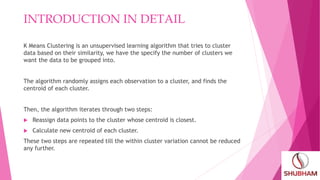
INTRODUCTION IN DETAIL
K Means Clustering is an unsupervised learning algorithm that tries to cluster
data based on their similarity, we have the specify the number of clusters we
want the data to be grouped into.
The algorithm randomly assigns each observation to a cluster, and finds the
centroid of each cluster.
Then, the algorithm iterates through two steps:
 Reassign data points to the cluster whose centroid is closest.
 Calculate new centroid of each cluster.
These two steps are repeated till the within cluster variation cannot be reduced
any further.
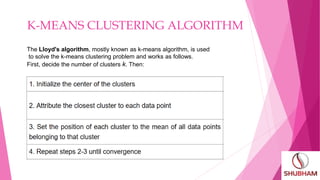
The Lloyd's algorithm, mostly known as k-means algorithm, is used
to solve the k-means clustering problem and works as follows.
First, decide the number of clusters k. Then:
K-MEANS CLUSTERING ALGORITHM
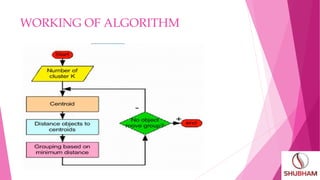
WORKING OF ALGORITHM
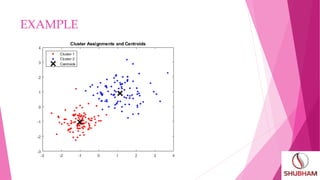
EXAMPLE
APPLICATIONS
 K-means clustering is rather easy to implement and apply even on large data
sets, particularly when using heuristics such as Lloyd's algorithm .
 It has been successfully used in various topics:
i. Market segmentation
ii. Computer vision
iii. Astronomy
iv. Agriculture.
REFERENCES
 Tutorial website:
https://home.deib.polimi.it/matteucc/Clustering/tutorial_html/kmeans.html
 OnMyPhD website:
http://onmyphd.com/?p=k-means.clustering
 Math works website:
https://in.mathworks.com/help/stats/kmeans.html
 Wikipedia
 YouTube
K MEANS CLUSTERING

K MEANS CLUSTERING

  • 2.
    POINTS TO BECOVERED IN THIS PRESENTATION  K-MEAN  CLUSTERING  INTRODUCTION OF K-MEAN CLUSTERING  ALGORITHM  WORKING OF ALGORITHM  EXAMPLE  APPLICATION OF K-MEANS CLUSTERING  REFERENCES
  • 3.
    CLUSTERING Clustering is theprocess of partitioning a group of data points into a small number of clusters. K-MEAN K is the number of clusters. And we randomly take center point which is generally known as centroid. And find the mean of the points comes in that cluster which become centroid.
  • 4.
    INTRODUCTION IN DETAIL KMeans Clustering is an unsupervised learning algorithm that tries to cluster data based on their similarity, we have the specify the number of clusters we want the data to be grouped into. The algorithm randomly assigns each observation to a cluster, and finds the centroid of each cluster. Then, the algorithm iterates through two steps:  Reassign data points to the cluster whose centroid is closest.  Calculate new centroid of each cluster. These two steps are repeated till the within cluster variation cannot be reduced any further.
  • 5.
    The Lloyd's algorithm,mostly known as k-means algorithm, is used to solve the k-means clustering problem and works as follows. First, decide the number of clusters k. Then: K-MEANS CLUSTERING ALGORITHM
  • 6.
  • 7.
  • 8.
    APPLICATIONS  K-means clusteringis rather easy to implement and apply even on large data sets, particularly when using heuristics such as Lloyd's algorithm .  It has been successfully used in various topics: i. Market segmentation ii. Computer vision iii. Astronomy iv. Agriculture.
  • 9.
    REFERENCES  Tutorial website: https://home.deib.polimi.it/matteucc/Clustering/tutorial_html/kmeans.html OnMyPhD website: http://onmyphd.com/?p=k-means.clustering  Math works website: https://in.mathworks.com/help/stats/kmeans.html  Wikipedia  YouTube