Manual Work
E. N. Sathishkumar M.Sc., M.Phil., [Ph.d]
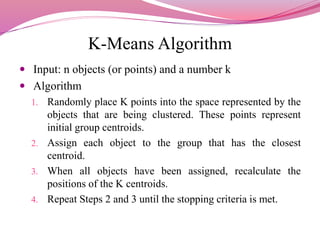
K-Means Algorithm
 Input: n objects (or points) and a number k
 Algorithm
1. Randomly place K points into the space represented by the
objects that are being clustered. These points represent
initial group centroids.
2. Assign each object to the group that has the closest
centroid.
3. When all objects have been assigned, recalculate the
positions of the K centroids.
4. Repeat Steps 2 and 3 until the stopping criteria is met.
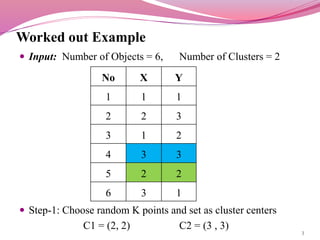
Worked out Example
 Input: Number of Objects = 6, Number of Clusters = 2
 Step-1: Choose random K points and set as cluster centers
C1 = (2, 2) C2 = (3 , 3) 3
No X Y
1 1 1
2 2 3
3 1 2
4 3 3
5 2 2
6 3 1
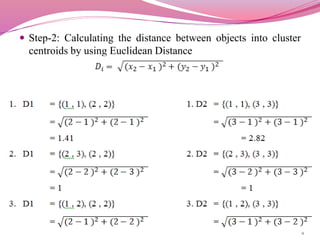
 Step-2: Calculating the distance between objects into cluster
centroids by using Euclidean Distance
4
5
 Step-3: Recalculating the position of the centroid
 Step-4: Go back to Step 2, unless the centroids are not
changing.
6
No X Y
1 1 1
2 2 3
3 1 2
4 3 3
5 2 2
6 3 1

K-Means manual work

  • 1.
    Manual Work E. N.Sathishkumar M.Sc., M.Phil., [Ph.d]
  • 2.
    K-Means Algorithm  Input:n objects (or points) and a number k  Algorithm 1. Randomly place K points into the space represented by the objects that are being clustered. These points represent initial group centroids. 2. Assign each object to the group that has the closest centroid. 3. When all objects have been assigned, recalculate the positions of the K centroids. 4. Repeat Steps 2 and 3 until the stopping criteria is met.
  • 3.
    Worked out Example Input: Number of Objects = 6, Number of Clusters = 2  Step-1: Choose random K points and set as cluster centers C1 = (2, 2) C2 = (3 , 3) 3 No X Y 1 1 1 2 2 3 3 1 2 4 3 3 5 2 2 6 3 1
  • 4.
     Step-2: Calculatingthe distance between objects into cluster centroids by using Euclidean Distance 4
  • 5.
  • 6.
     Step-3: Recalculatingthe position of the centroid  Step-4: Go back to Step 2, unless the centroids are not changing. 6 No X Y 1 1 1 2 2 3 3 1 2 4 3 3 5 2 2 6 3 1