Recommender Systems
Class Algorithmic Methods of Data Mining
Program M. Sc. Data Science
University Sapienza University of Rome
Semester Fall 2015
Lecturer Carlos Castillo http://chato.cl/
Sources:
● Ricci, Rokach and Shapira: Introduction to Recommender
Systems Handbook [link]
● Bobadilla et al. Survey 2013 [link]
● Xavier Amatriain 2014 tutorial on rec systems [link]
● Ido Guy 2011 tutorial on social rec systems [link]
● Alex Smola's tutorial on recommender systems [link]
2
Why recommender systems?
3
Definition
Recommender systems are software tools
and techniques providing suggestions for
items to be of use to a user.
4
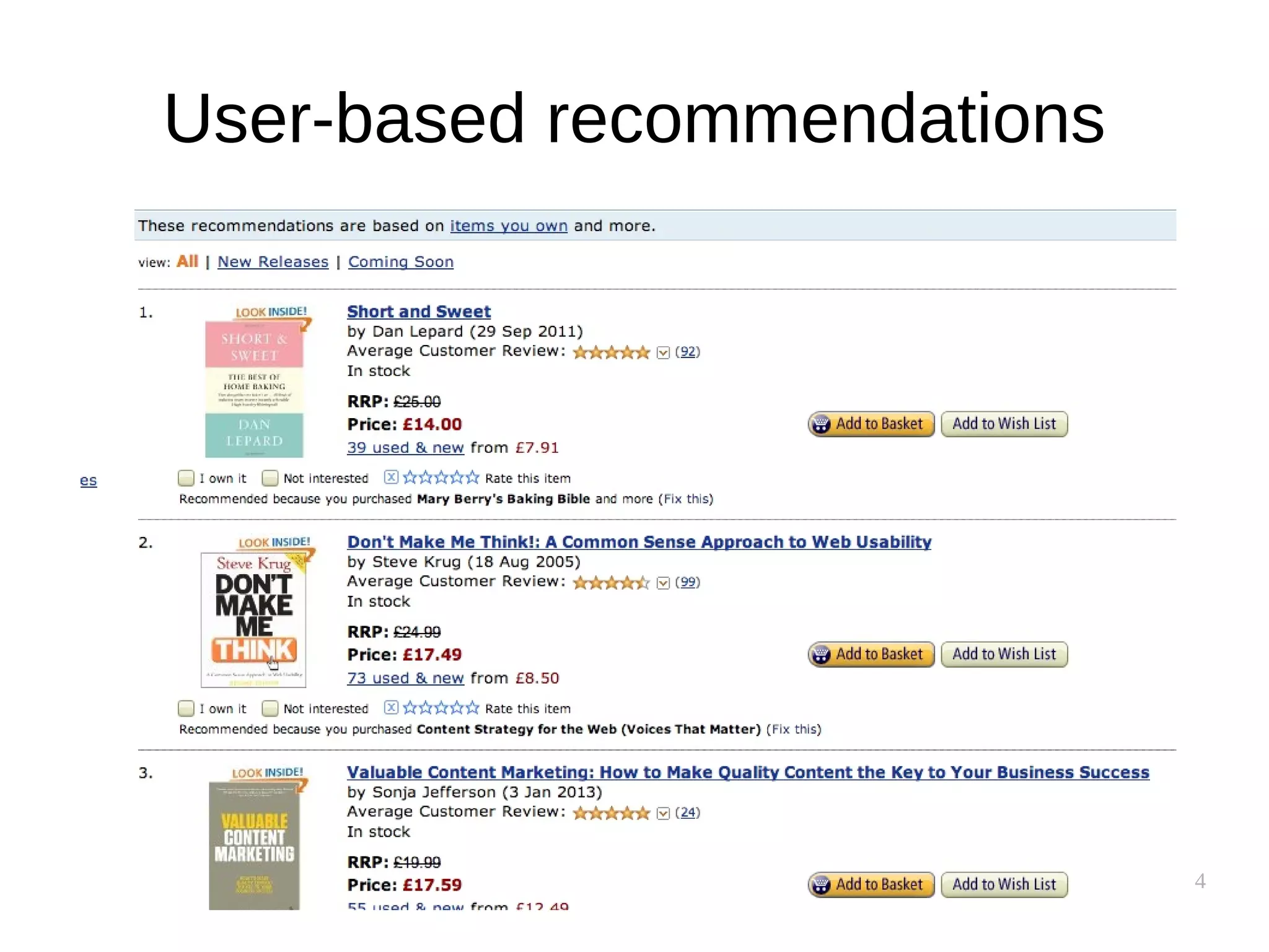
User-based recommendations
5
6
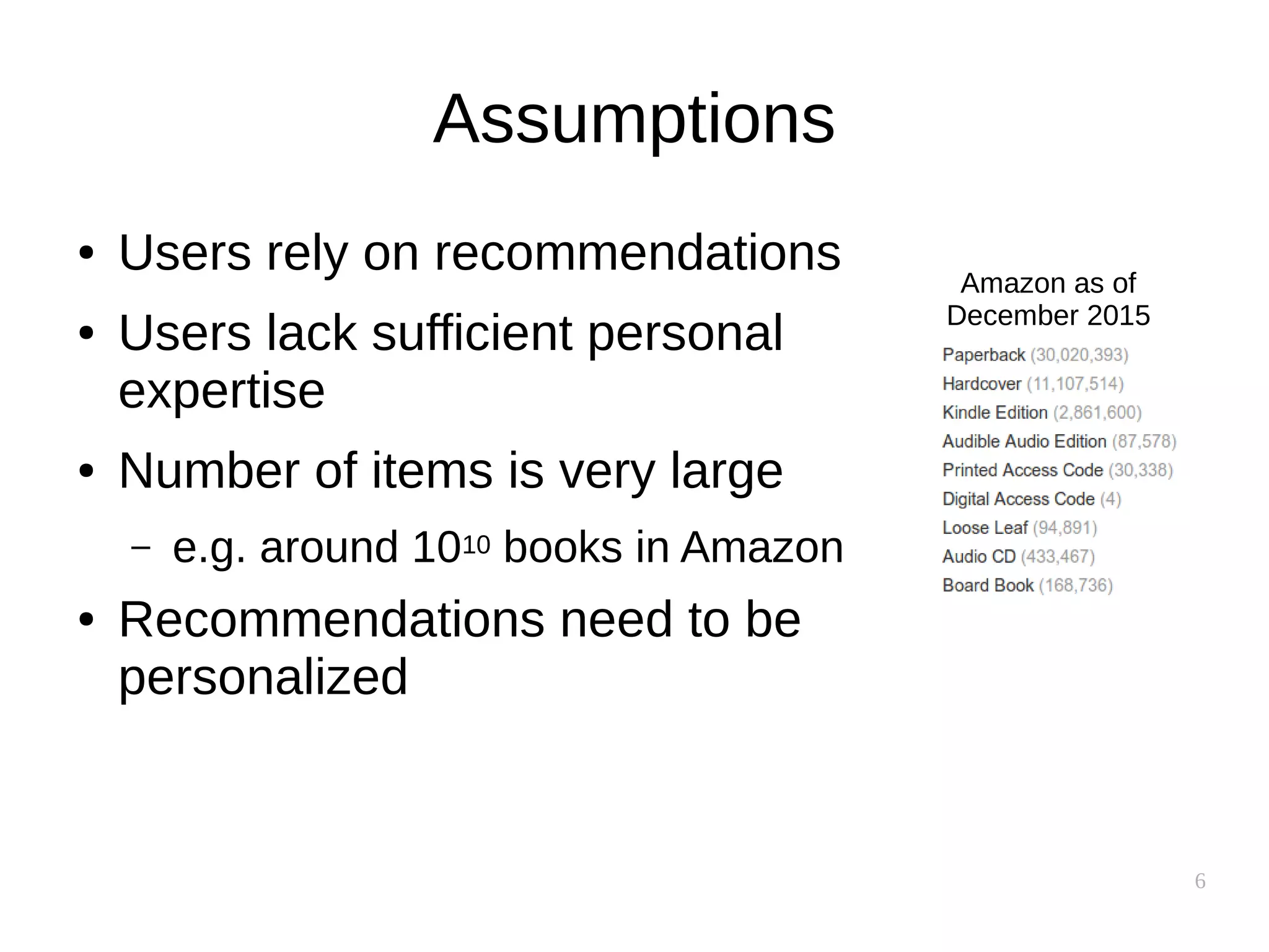
Assumptions
● Users rely on recommendations
● Users lack sufficient personal
expertise
● Number of items is very large
– e.g. around 1010 books in Amazon
● Recommendations need to be
personalized
Amazon as of
December 2015
7
Who uses recommender systems?
● Retailers and e-commerce in general
– Amazon, Netflix, etc.
● Service sites, e.g. travel sites
● Media organizations
● Dating apps
● ...
8
Why?
● Increase number of items sold
– 2/3 of Netflix watched are recommendations
– 1/3 of Amazon sales are from recommendations
– ...
9
Why? (cont.)
● Sell more diverse items
● Increase user satisfaction
– Users enjoy the recommendations
● Increase user fidelity
– Users feel recognized (but not creeped out)
● Understand users (see next slides)
10
By-products
● Recommendations generate by-products
● Recommending requires understanding users
and items, which is valuable by itself
● Some recommender systems are very good at
this (e.g. factorization methods)
● Automatically identify marketing profiles
● Describe users to better understand them
11
The recommender system problem
Estimate the utility for a user of an item for
which the user has not expressed utility
What information can be used?
12
Types of problem
● Find some good items (most common)
● Find all good items
● Annotate in context (why I would like this)
● Recommend a sequence (e.g. tour of a city)
● Recommend a bundle (camera+lens+bag)
● Support browsing (seek longer session)
● ...
13
Data sources
● Items, Users
– Structured attributes, semi-structured or
unstructured descriptions
● Transactions
– Appraisals
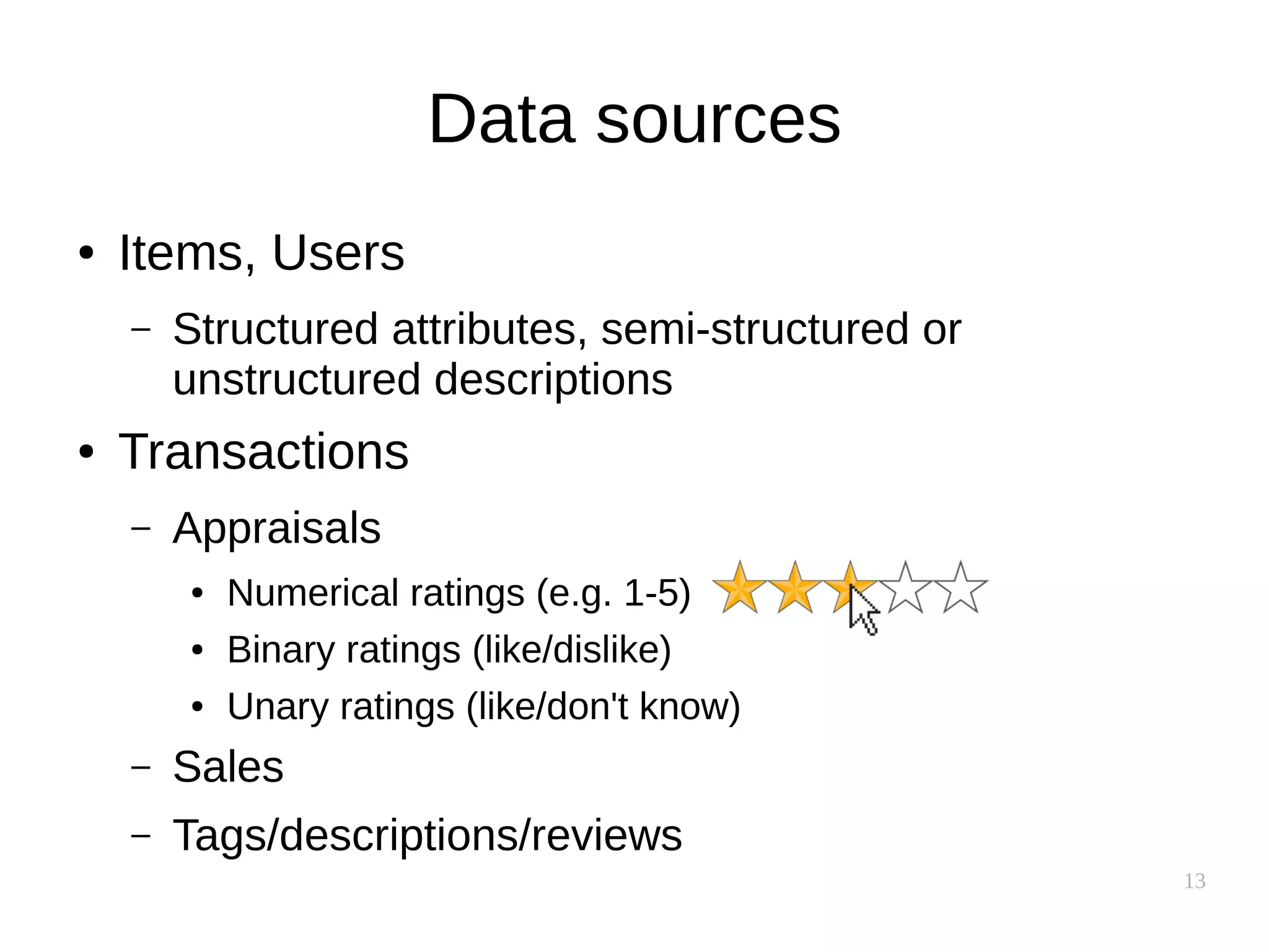
● Numerical ratings (e.g. 1-5)
● Binary ratings (like/dislike)
● Unary ratings (like/don't know)
– Sales
– Tags/descriptions/reviews
14
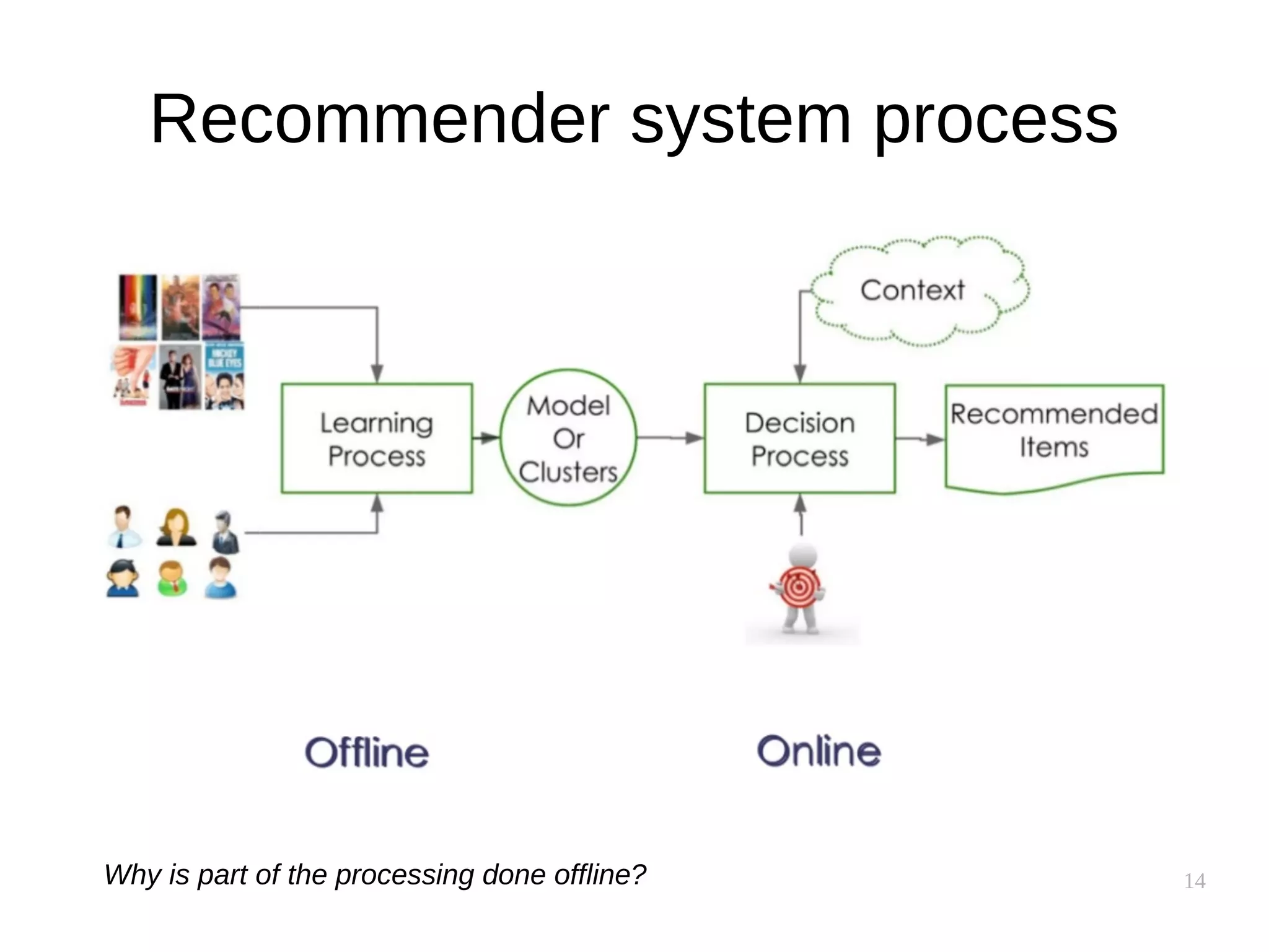
Recommender system process
Why is part of the processing done offline?
15
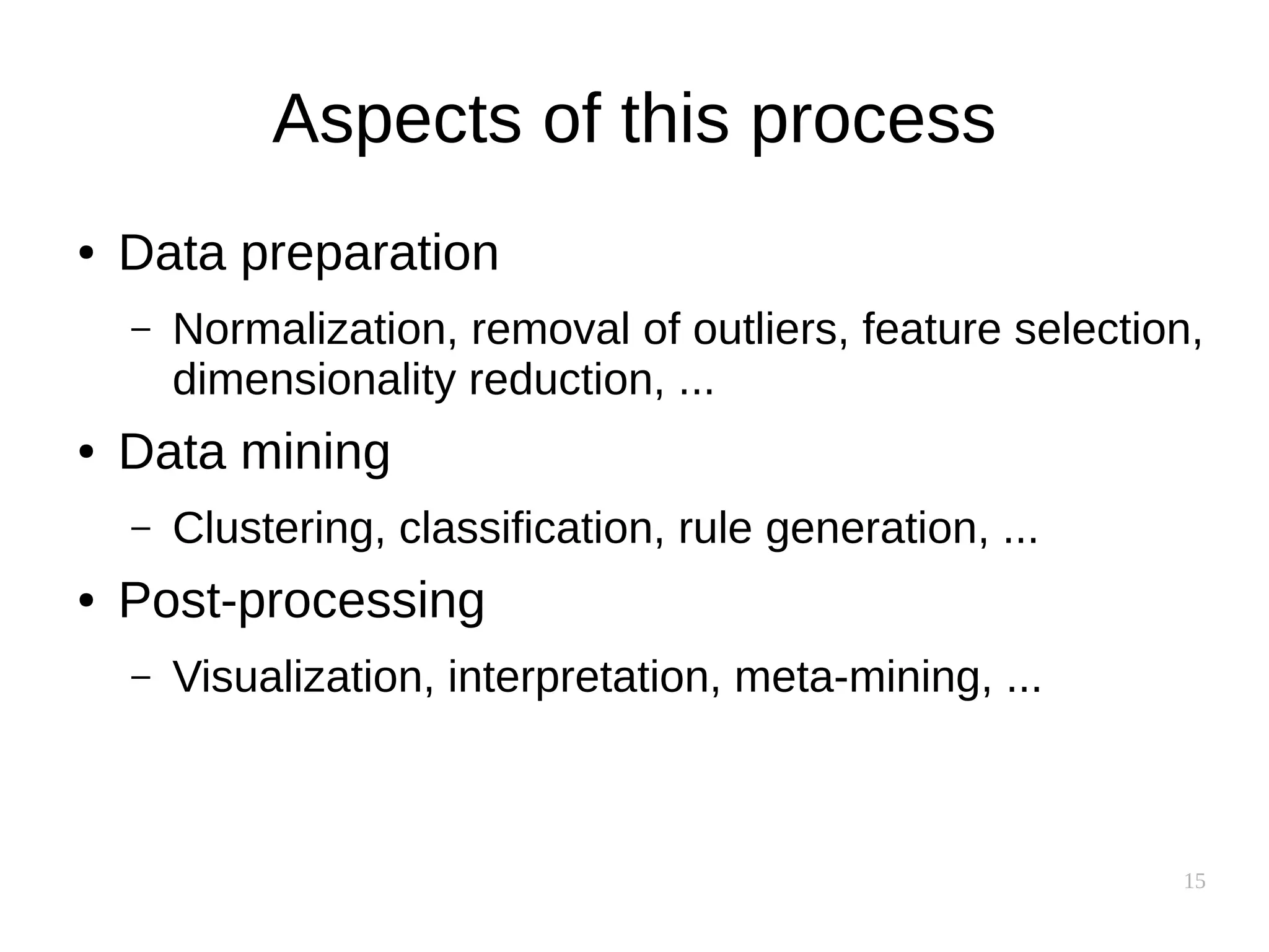
Aspects of this process
● Data preparation
– Normalization, removal of outliers, feature selection,
dimensionality reduction, ...
● Data mining
– Clustering, classification, rule generation, ...
● Post-processing
– Visualization, interpretation, meta-mining, ...
16
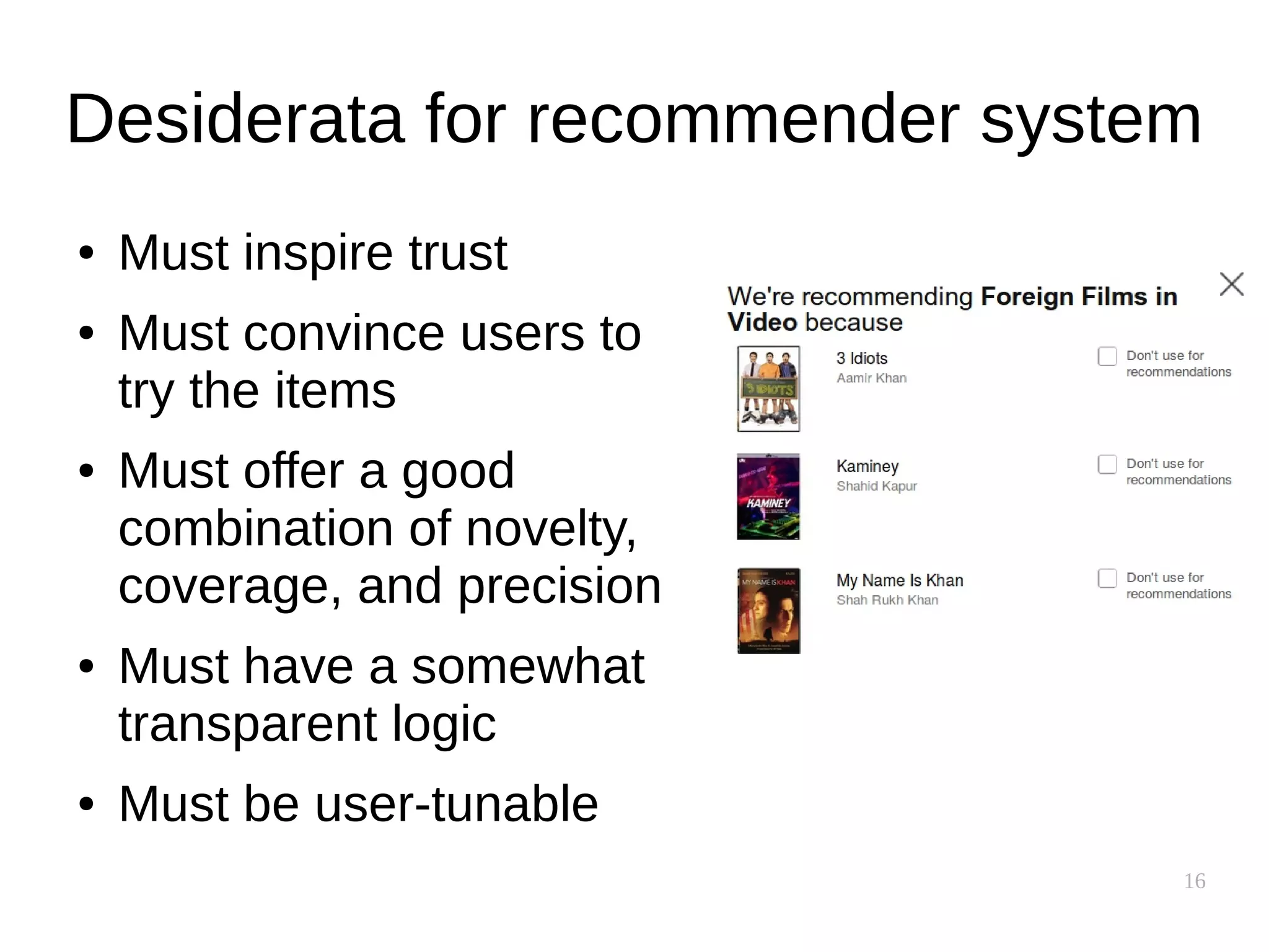
Desiderata for recommender system
● Must inspire trust
● Must convince users to
try the items
● Must offer a good
combination of novelty,
coverage, and precision
● Must have a somewhat
transparent logic
● Must be user-tunable
17
Human factors
● Advanced systems are conversational
● Transparency and scrutability
– Explain users how the system works
– Allow users to tell the system it is wrong
● Help users make a good decision
● Convince users in a persuasive manner
● Increase enjoyment to users
● Provide serendipity
18
Serendipity
● “An aptitude for making desirable discoveries
by accident”
● Don't recommend items the user already knows
● Delight users by expanding their taste
– But still recommend them something somewhat
familiar
● It can be controlled by specific parameters
Peregrinaggio di tre giovani figliuoli del re di Serendippo; Michele Tramezzino, Venice, 1557. Tramezzino claimed to have heard the story from
one Christophero Armeno who had translated the Persian fairy tale into Italian adapting Book One of Amir Khusrau's Hasht-Bihisht of 1302 [link]
19
High-level approaches
● Memory-based
– Use data from the past in a somewhat “raw” form
● Model-based
– Use models built from data from the past
20
Approaches
● Collaborative filtering
● Content-based (item features)
● Knowledge-based (expert system)
● Personalized learning to rank
– Estimate ranking function
● Demographic
● Social/community based
– Based on connections
● Hybrid (combination of some of the above)
21
Collaborative filtering
22
Collaborative Filtering approach
● User has seen/liked certain items
● Community has seen/liked certain items
● Recommend to users items similar to the ones
they have seen/liked
– Based on finding similar users
– Based on finding similar items
23
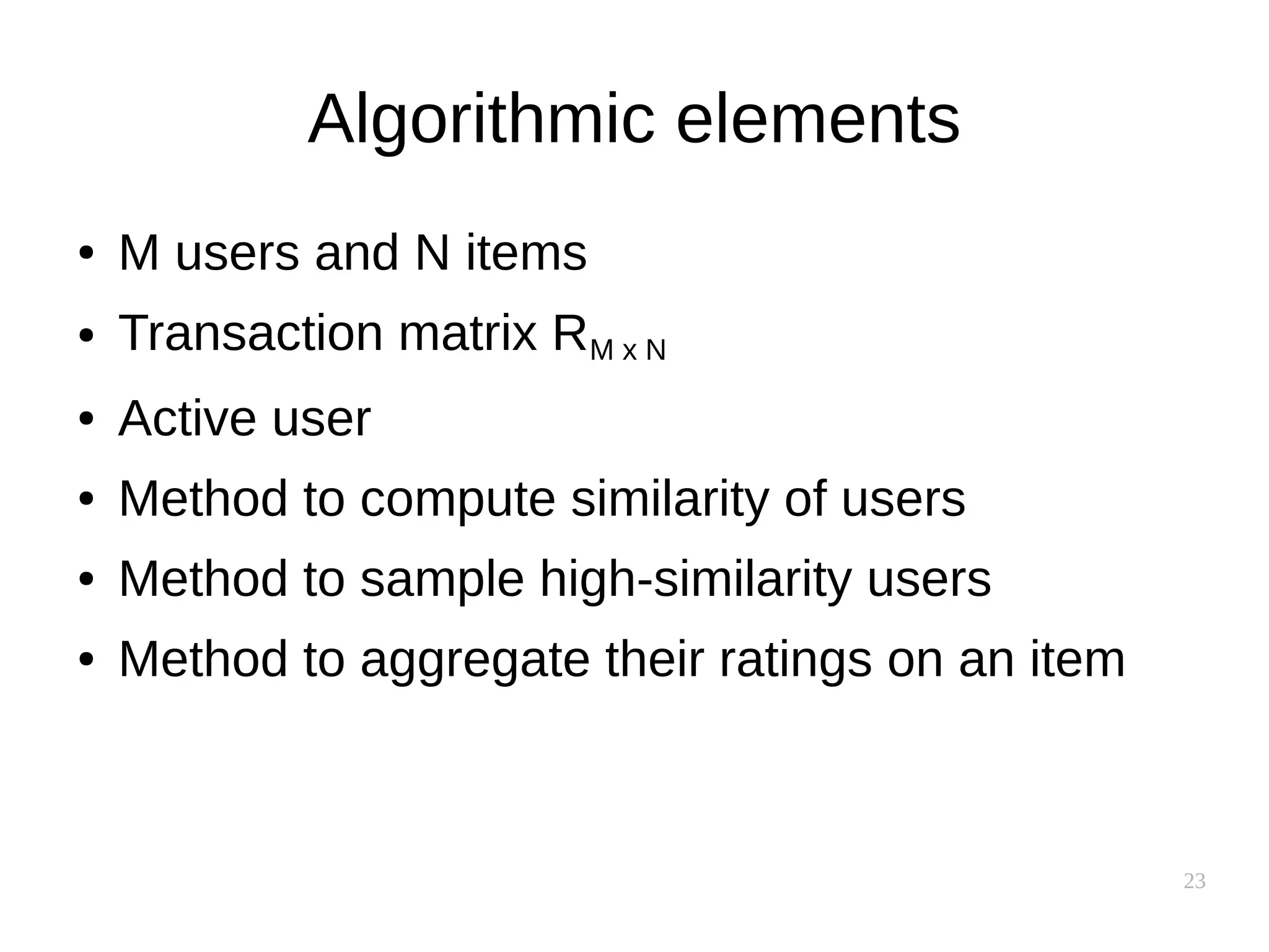
Algorithmic elements
● M users and N items
● Transaction matrix RM x N
● Active user
● Method to compute similarity of users
● Method to sample high-similarity users
● Method to aggregate their ratings on an item
24
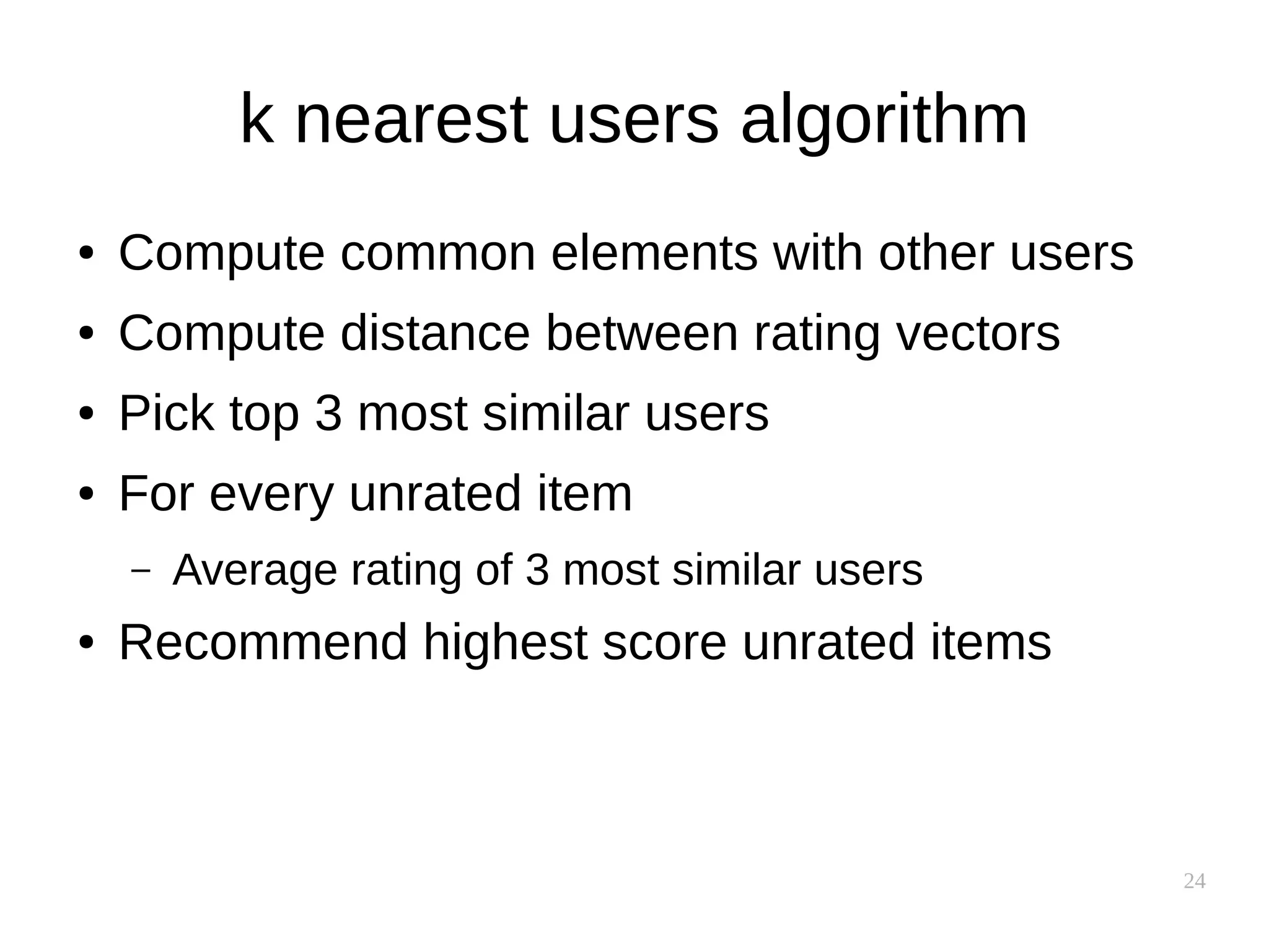
k nearest users algorithm
● Compute common elements with other users
● Compute distance between rating vectors
● Pick top 3 most similar users
● For every unrated item
– Average rating of 3 most similar users
● Recommend highest score unrated items
25
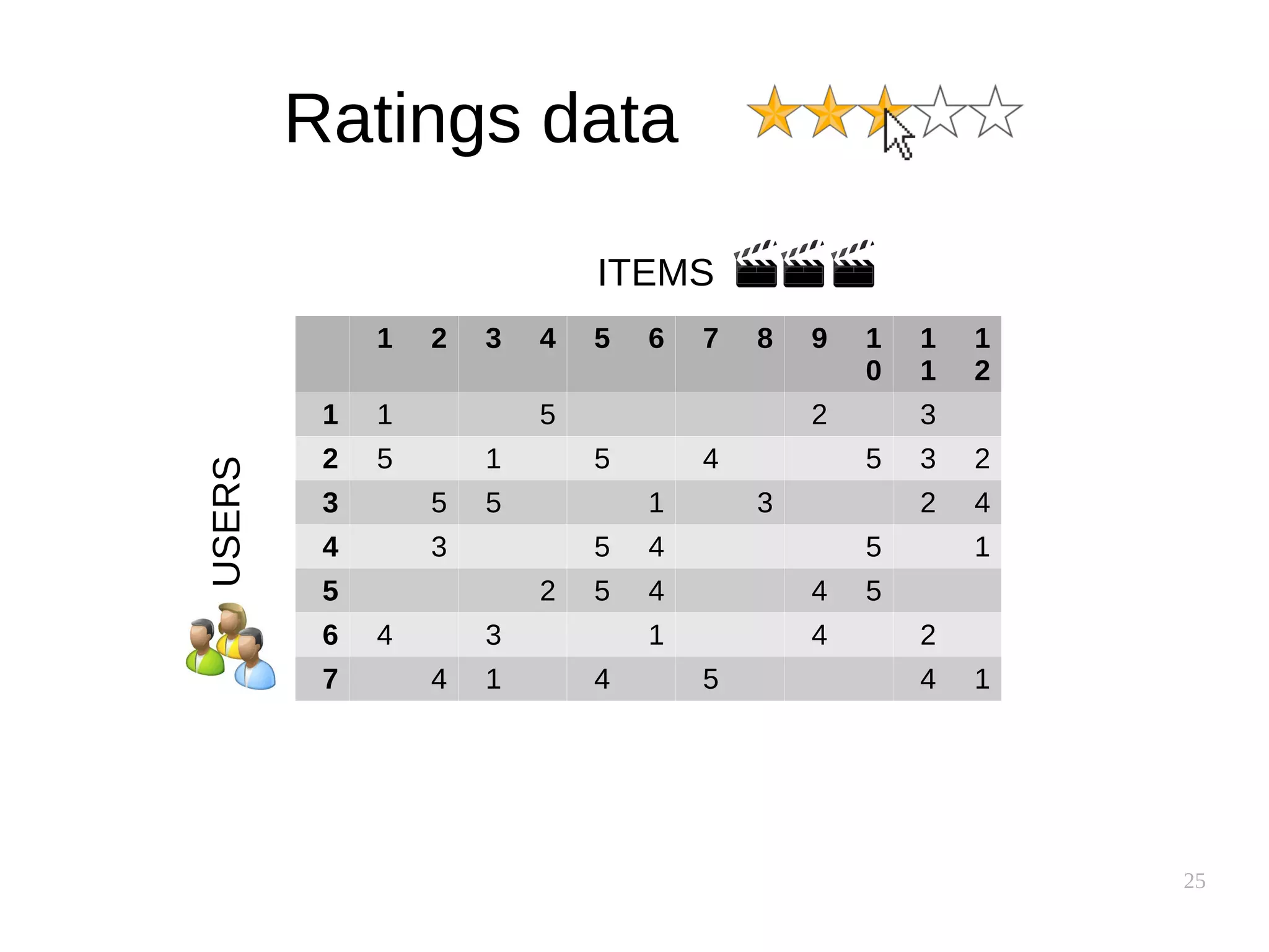
Ratings data
1 2 3 4 5 6 7 8 9 1
0
1
1
1
2
1 1 5 2 3
2 5 1 5 4 5 3 2
3 5 5 1 3 2 4
4 3 5 4 5 1
5 2 5 4 4 5
6 4 3 1 4 2
7 4 1 4 5 4 1
ITEMS
USERS
26
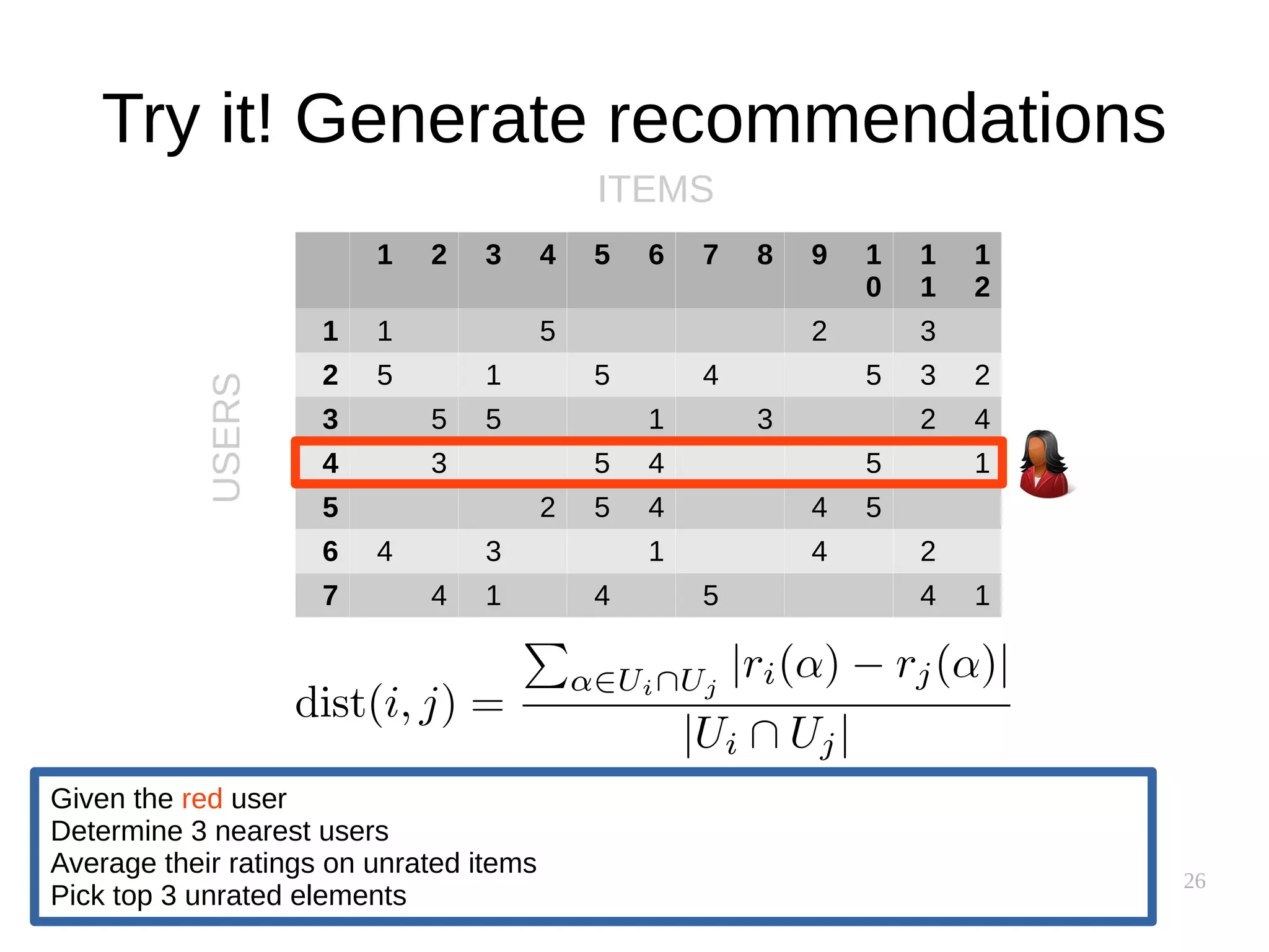
Try it! Generate recommendations
1 2 3 4 5 6 7 8 9 1
0
1
1
1
2
1 1 5 2 3
2 5 1 5 4 5 3 2
3 5 5 1 3 2 4
4 3 5 4 5 1
5 2 5 4 4 5
6 4 3 1 4 2
7 4 1 4 5 4 1
ITEMS
USERS
Given the red user
Determine 3 nearest users
Average their ratings on unrated items
Pick top 3 unrated elements
27
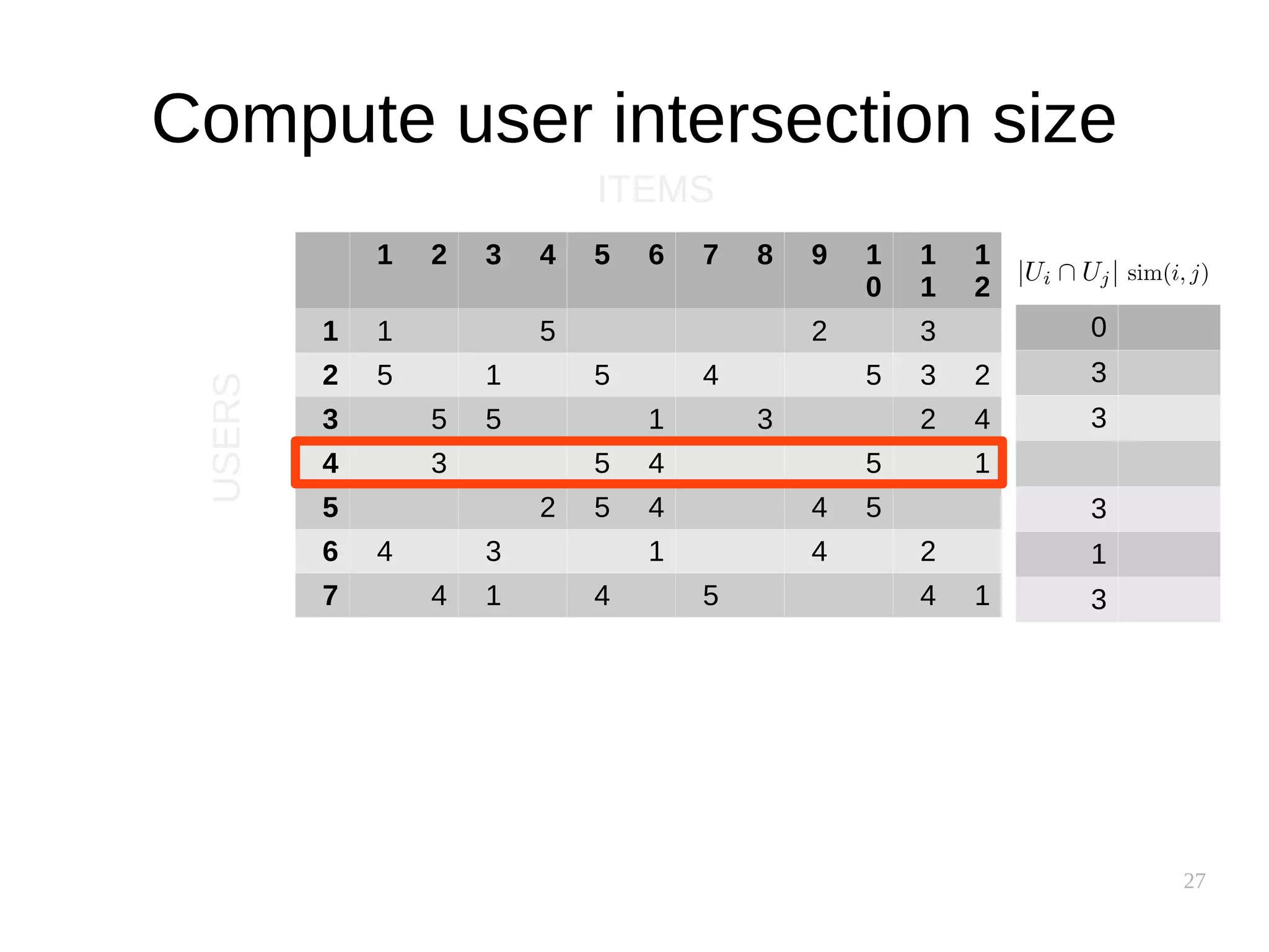
Compute user intersection size
1 2 3 4 5 6 7 8 9 1
0
1
1
1
2
1 1 5 2 3
2 5 1 5 4 5 3 2
3 5 5 1 3 2 4
4 3 5 4 5 1
5 2 5 4 4 5
6 4 3 1 4 2
7 4 1 4 5 4 1
ITEMS
USERS
0
3
3
3
1
3
28
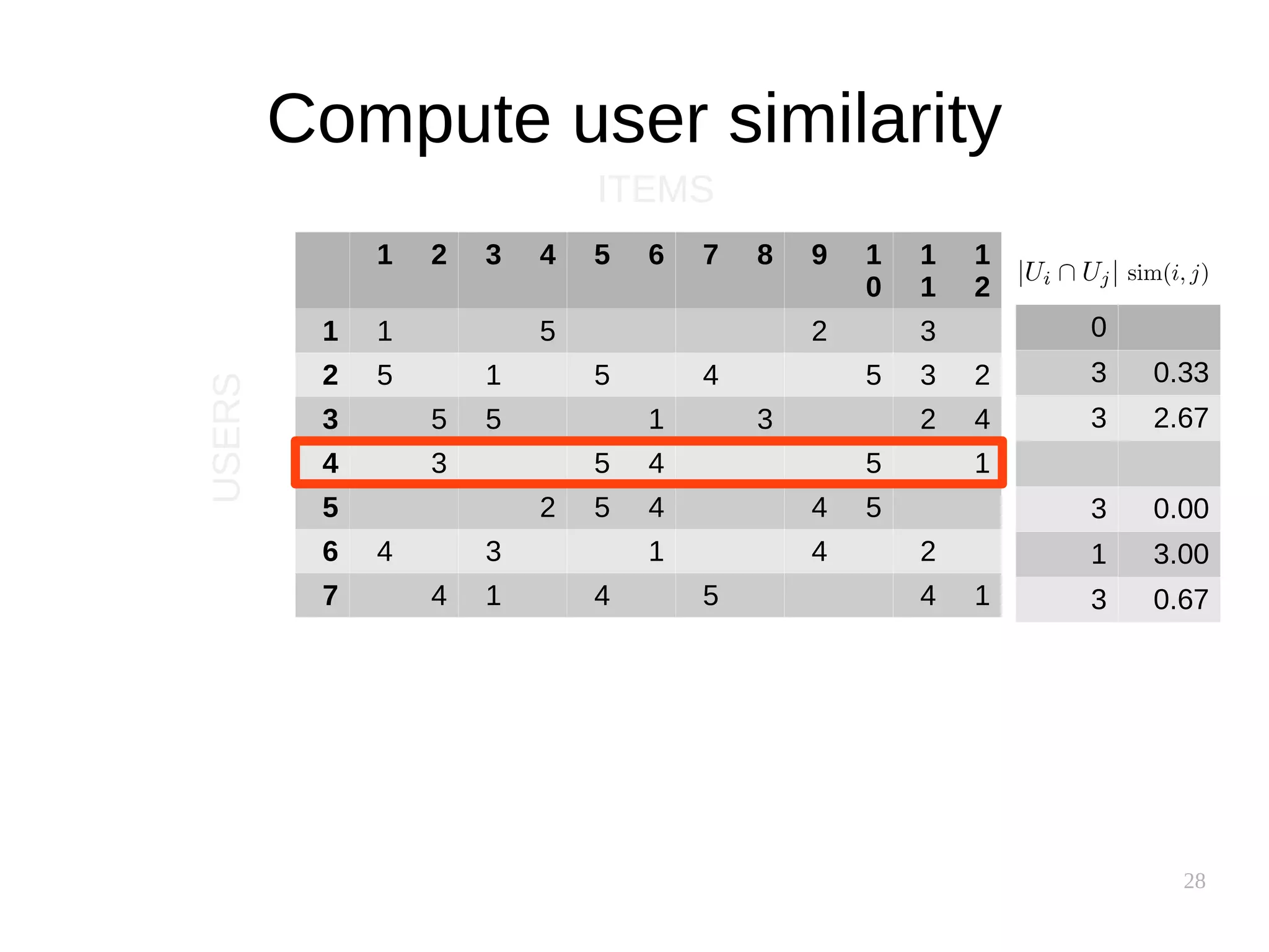
Compute user similarity
1 2 3 4 5 6 7 8 9 1
0
1
1
1
2
1 1 5 2 3
2 5 1 5 4 5 3 2
3 5 5 1 3 2 4
4 3 5 4 5 1
5 2 5 4 4 5
6 4 3 1 4 2
7 4 1 4 5 4 1
ITEMS
USERS
0
3 0.33
3 2.67
3 0.00
1 3.00
3 0.67
29
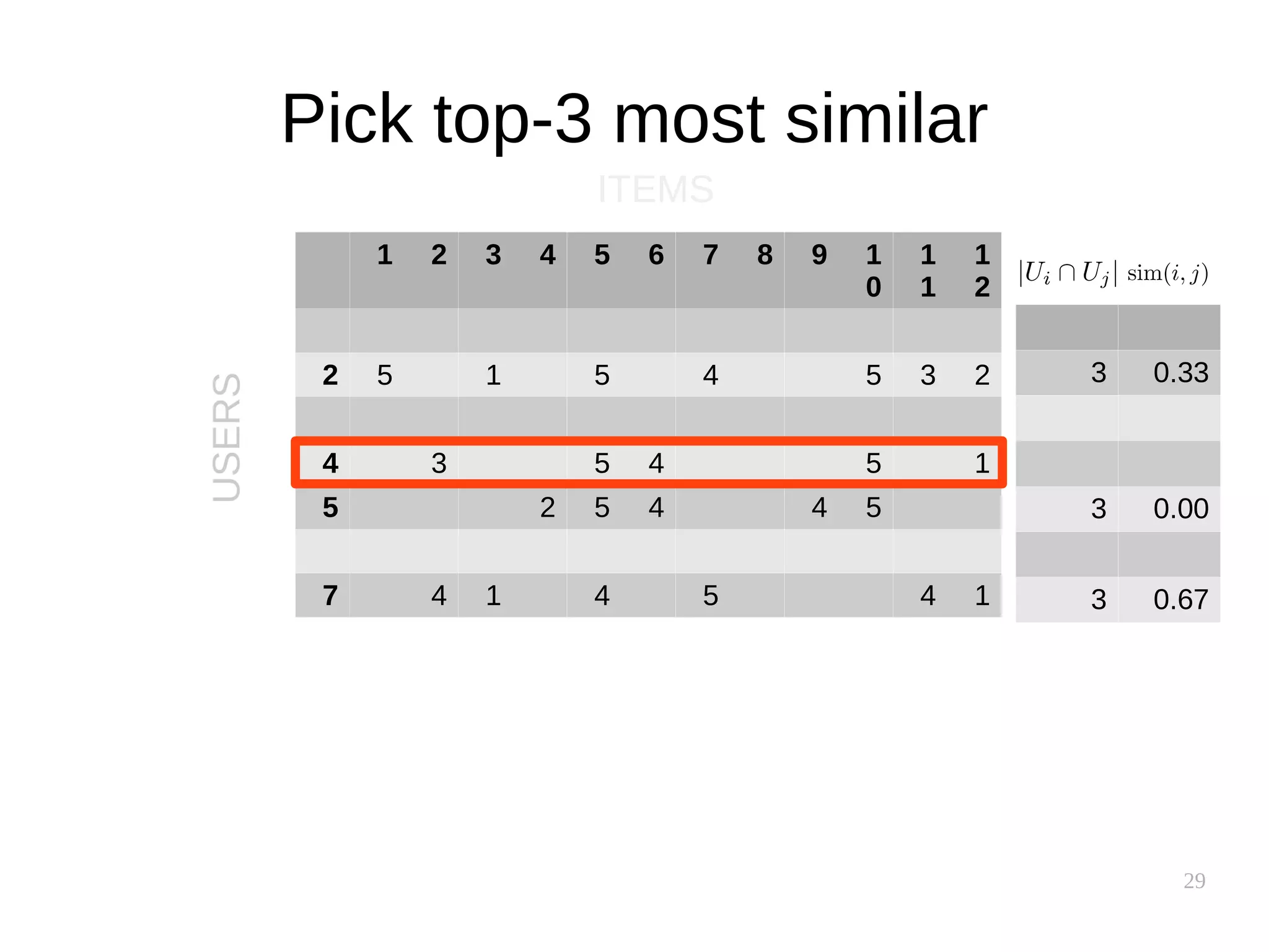
Pick top-3 most similar
1 2 3 4 5 6 7 8 9 1
0
1
1
1
2
2 5 1 5 4 5 3 2
4 3 5 4 5 1
5 2 5 4 4 5
7 4 1 4 5 4 1
ITEMS
USERS
3 0.33
3 0.00
3 0.67
30
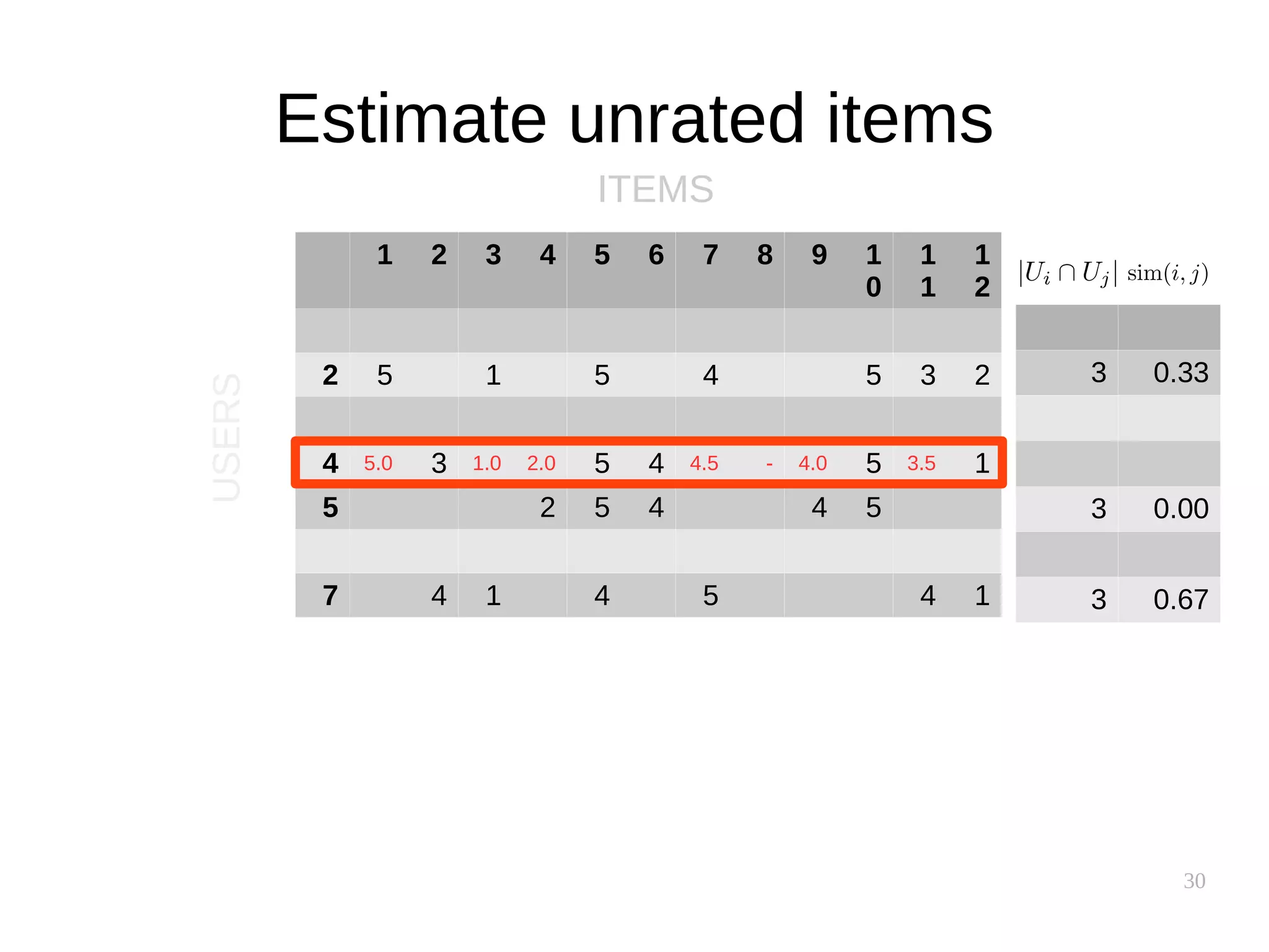
Estimate unrated items
1 2 3 4 5 6 7 8 9 1
0
1
1
1
2
2 5 1 5 4 5 3 2
4 5.0 3 1.0 2.0 5 4 4.5 - 4.0 5 3.5 1
5 2 5 4 4 5
7 4 1 4 5 4 1
ITEMS
USERS
3 0.33
3 0.00
3 0.67
31
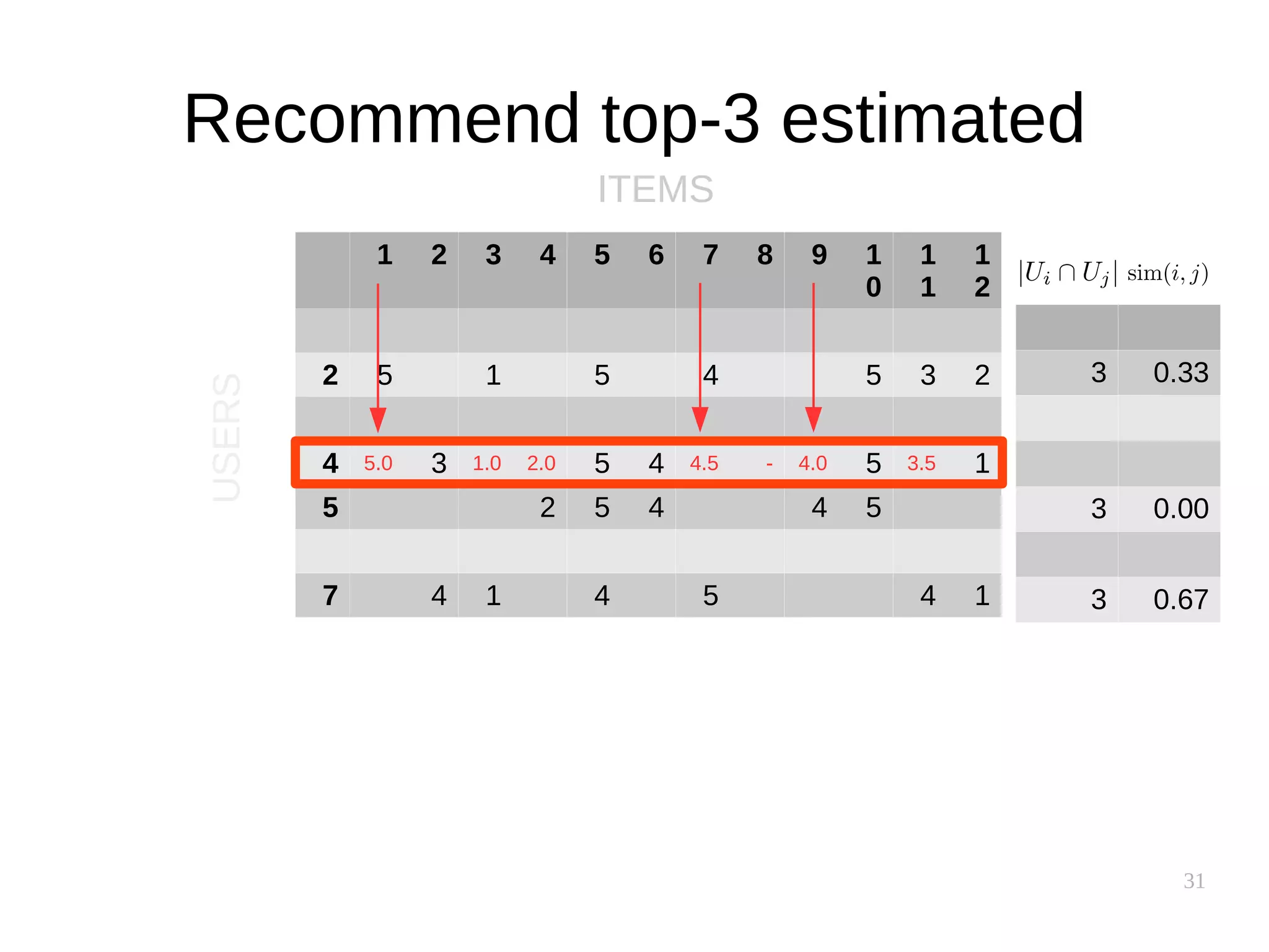
Recommend top-3 estimated
1 2 3 4 5 6 7 8 9 1
0
1
1
1
2
2 5 1 5 4 5 3 2
4 5.0 3 1.0 2.0 5 4 4.5 - 4.0 5 3.5 1
5 2 5 4 4 5
7 4 1 4 5 4 1
ITEMS
USERS
3 0.33
3 0.00
3 0.67
32
Improvements?
● How would you improve the algorithm?
● How would you provide explanations?
33
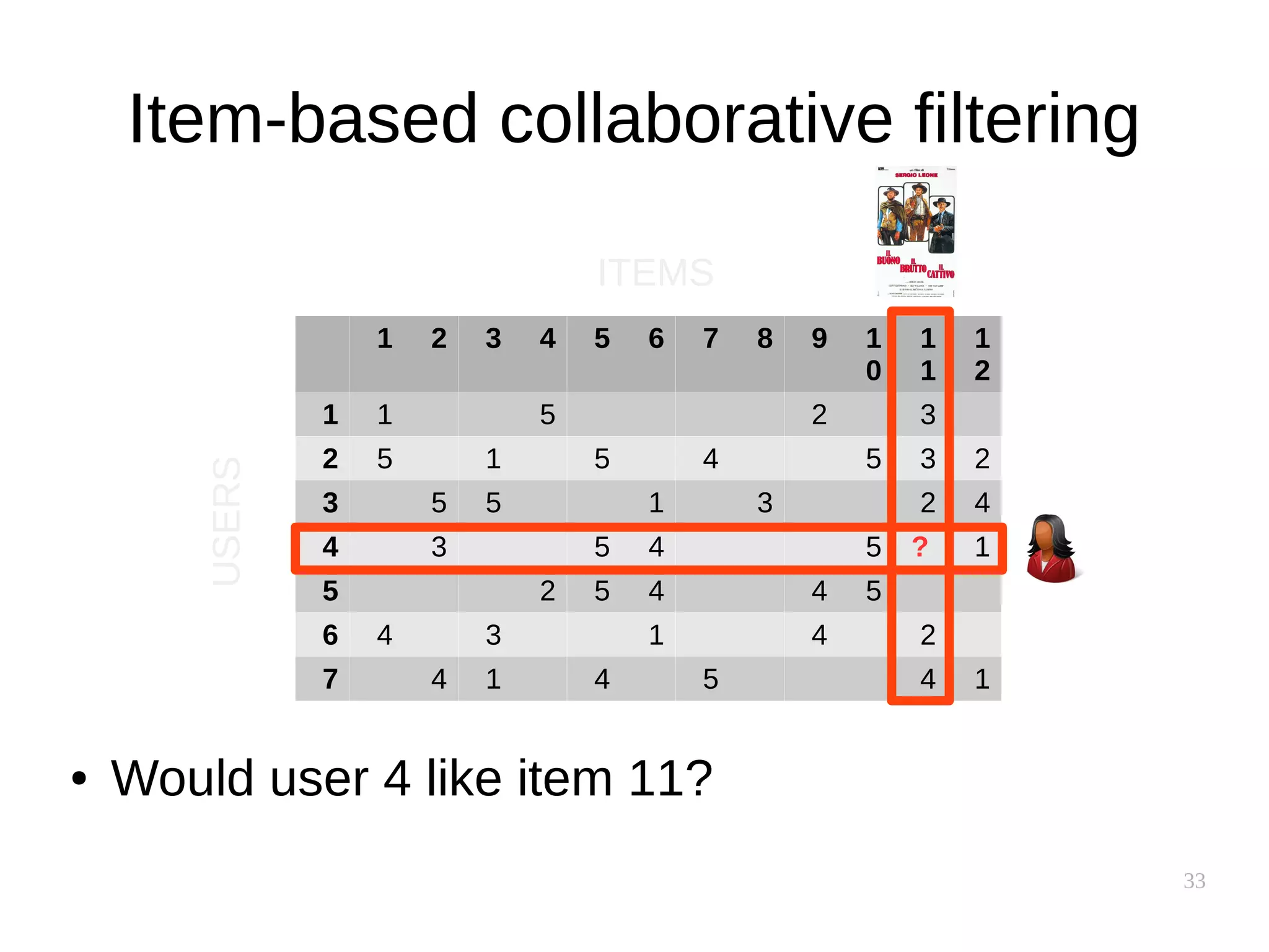
Item-based collaborative filtering
1 2 3 4 5 6 7 8 9 1
0
1
1
1
2
1 1 5 2 3
2 5 1 5 4 5 3 2
3 5 5 1 3 2 4
4 3 5 4 5 ? 1
5 2 5 4 4 5
6 4 3 1 4 2
7 4 1 4 5 4 1
ITEMS
USERS
● Would user 4 like item 11?
34
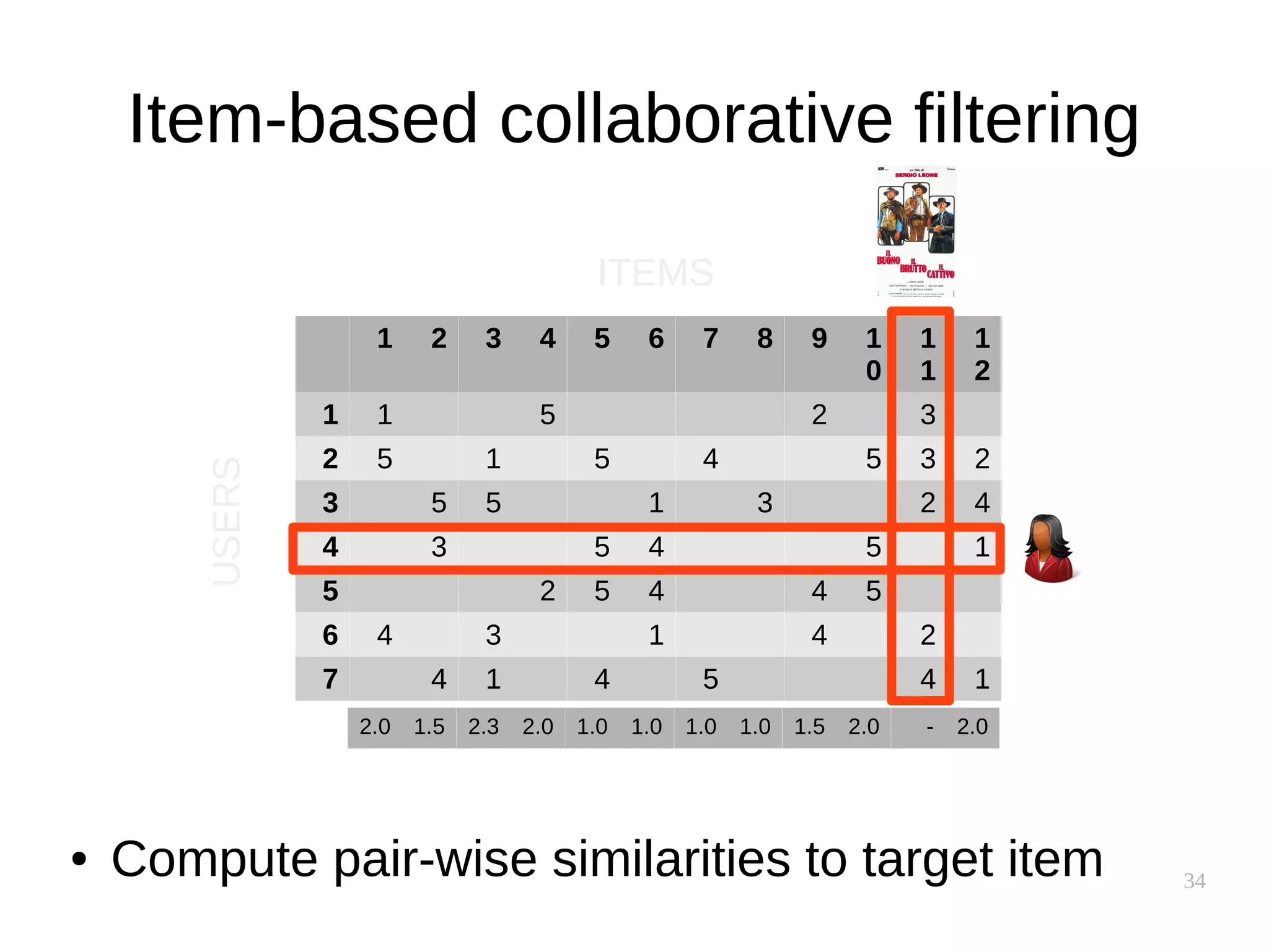
Item-based collaborative filtering
1 2 3 4 5 6 7 8 9 1
0
1
1
1
2
1 1 5 2 3
2 5 1 5 4 5 3 2
3 5 5 1 3 2 4
4 3 5 4 5 1
5 2 5 4 4 5
6 4 3 1 4 2
7 4 1 4 5 4 1
ITEMS
USERS
● Compute pair-wise similarities to target item
2.0 1.5 2.3 2.0 1.0 1.0 1.0 1.0 1.5 2.0 - 2.0
35
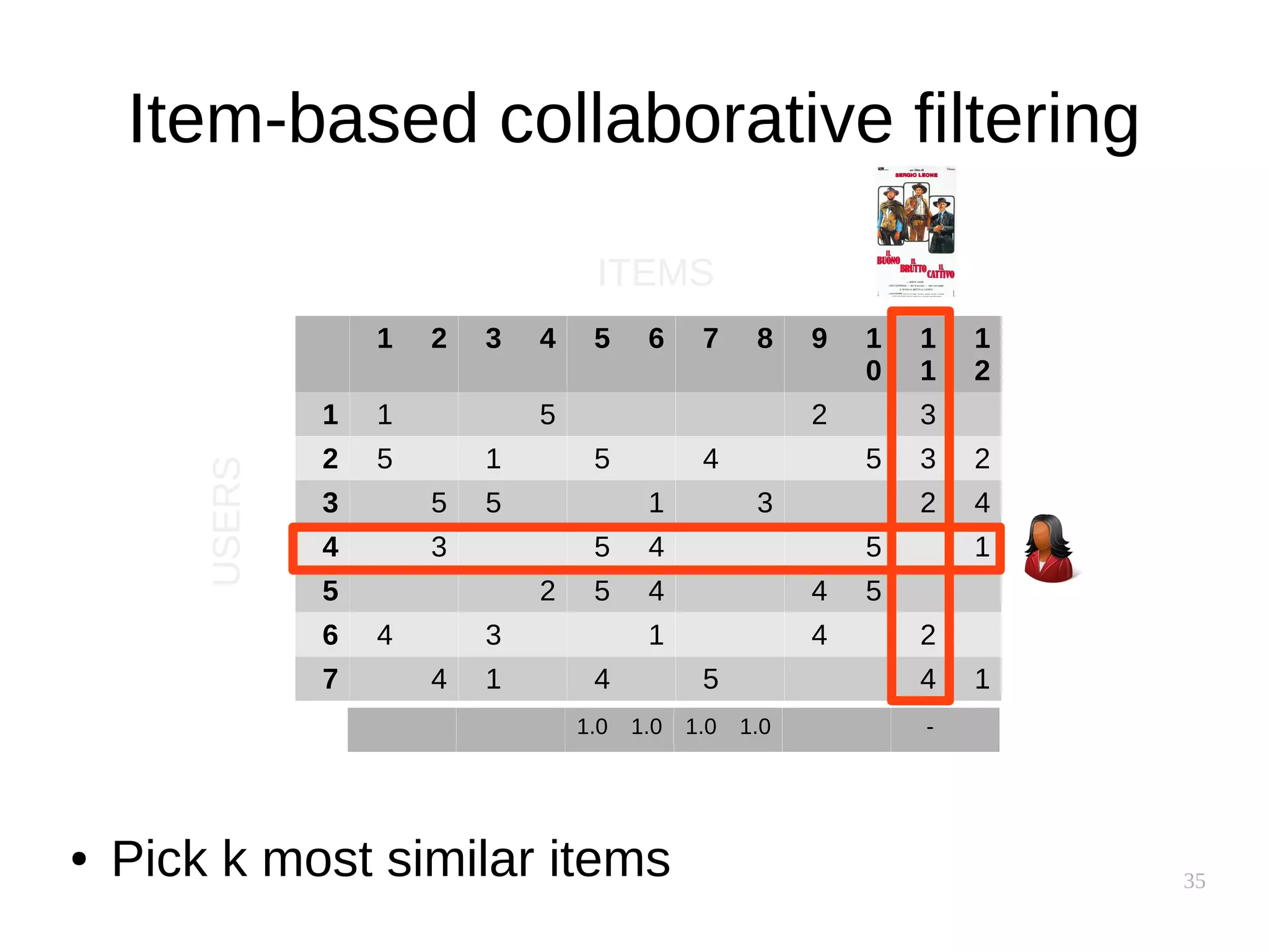
Item-based collaborative filtering
1 2 3 4 5 6 7 8 9 1
0
1
1
1
2
1 1 5 2 3
2 5 1 5 4 5 3 2
3 5 5 1 3 2 4
4 3 5 4 5 1
5 2 5 4 4 5
6 4 3 1 4 2
7 4 1 4 5 4 1
ITEMS
USERS
● Pick k most similar items
1.0 1.0 1.0 1.0 -
36
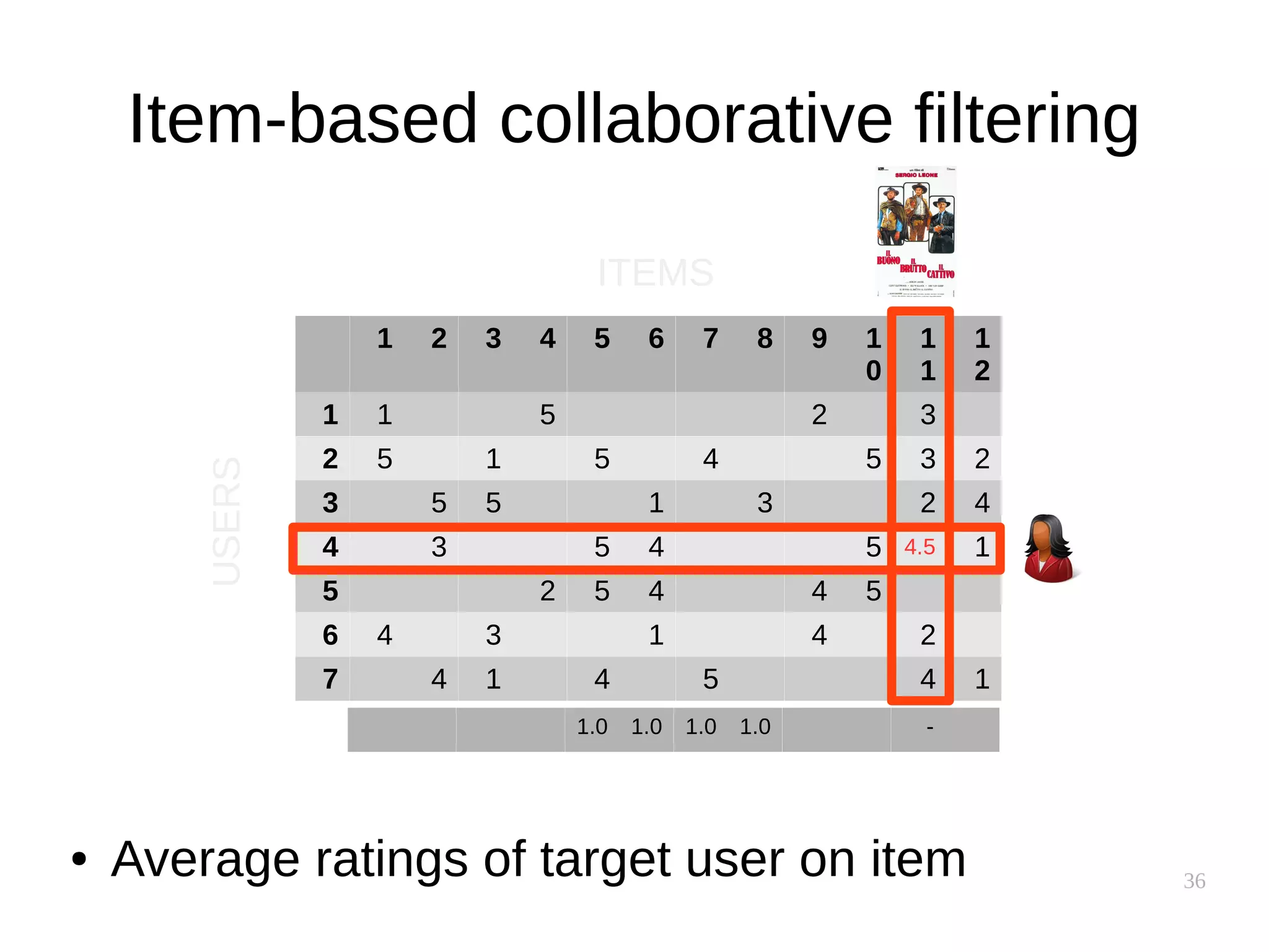
Item-based collaborative filtering
1 2 3 4 5 6 7 8 9 1
0
1
1
1
2
1 1 5 2 3
2 5 1 5 4 5 3 2
3 5 5 1 3 2 4
4 3 5 4 5 4.5 1
5 2 5 4 4 5
6 4 3 1 4 2
7 4 1 4 5 4 1
ITEMS
USERS
● Average ratings of target user on item
1.0 1.0 1.0 1.0 -
37
Performance implications
● Similarity between users is uncovered slowly
● Similarity between items is supposedly static
– Can be precomputed!
● Item-based clusters can also be precomputed
[source]
38
Weaknesses
● Assumes standardized products
– E.g. a touristic destination at any time of the year
and under any circumstance is the same item
● Does not take into account context
● Requires a relatively large number of
transactions to yield reasonable results
39
Cold-start problem
● What to do with a new item?
● What to do with a new user?
40
Assumptions
● Collaborative filtering assumes the following:
– We take recommendations from friends
– Friends have similar tastes
– A person who have similar tastes to you, could be
your friend
– Discover people with similar tastes, use them as
friends
● BUT, people's tastes are complex!
41
Ordinary people and
extraordinary tastes
[Goel et al. 2010]
Distribution of user eccentricity: the median rank of consumed items.
In the null model, users select items proportional to item popularity
42
Matrix factorization approaches
43
2D projection of interests
[Koren et al. 2009]
44
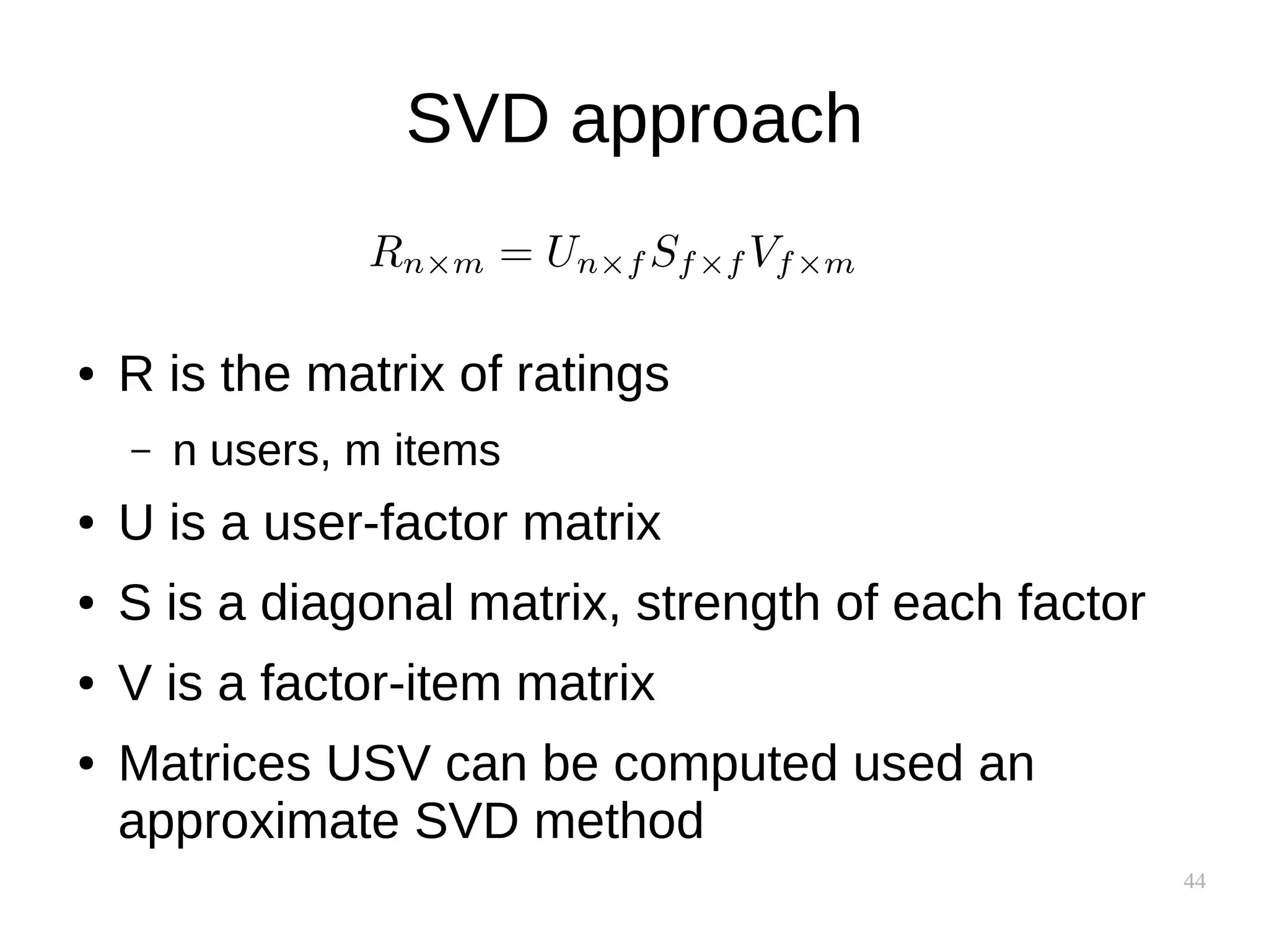
SVD approach
● R is the matrix of ratings
– n users, m items
● U is a user-factor matrix
● S is a diagonal matrix, strength of each factor
● V is a factor-item matrix
● Matrices USV can be computed used an
approximate SVD method
45
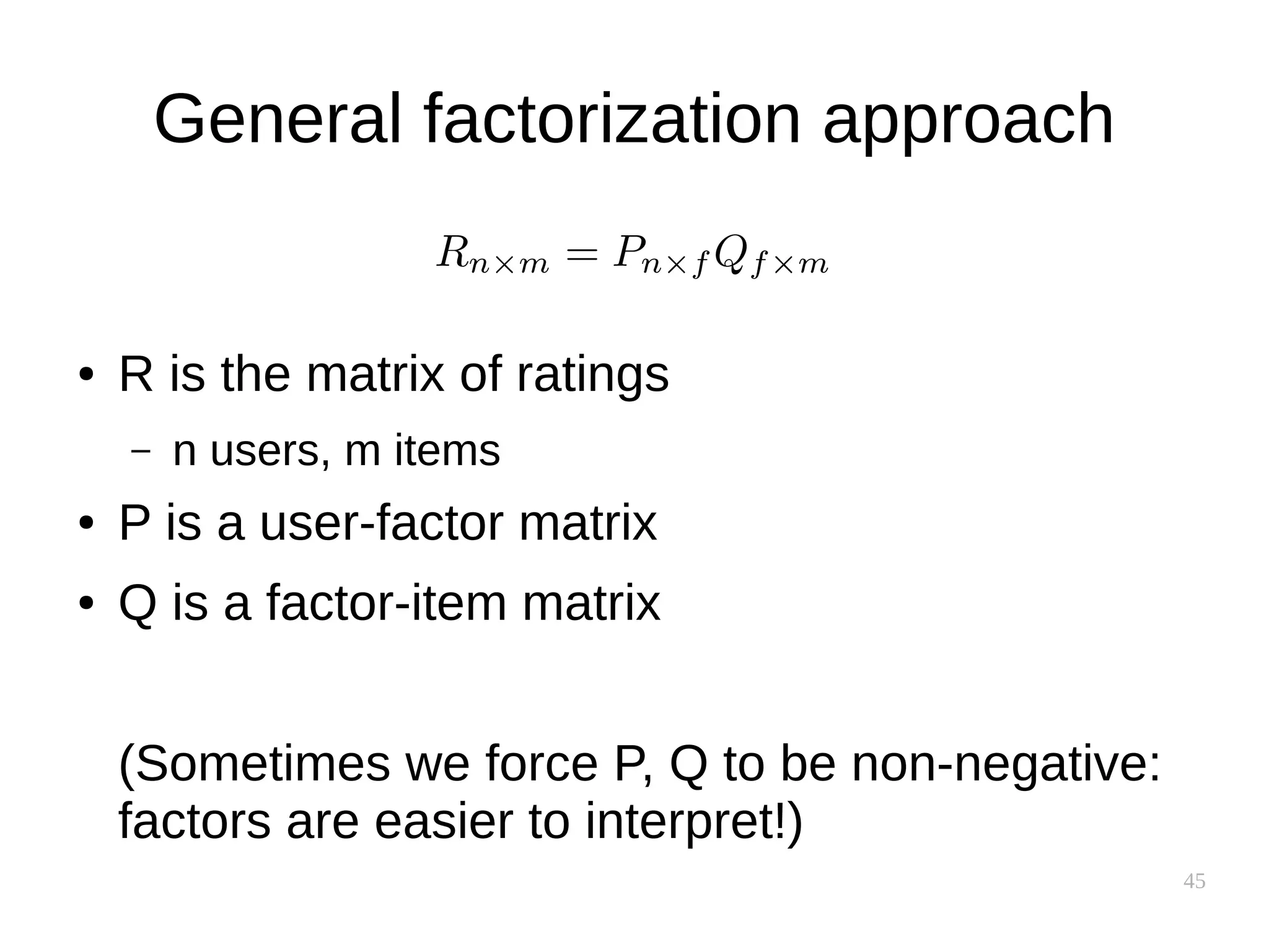
General factorization approach
● R is the matrix of ratings
– n users, m items
● P is a user-factor matrix
● Q is a factor-item matrix
(Sometimes we force P, Q to be non-negative:
factors are easier to interpret!)
46
What is this plot?
[Koren et al. 2009]
47
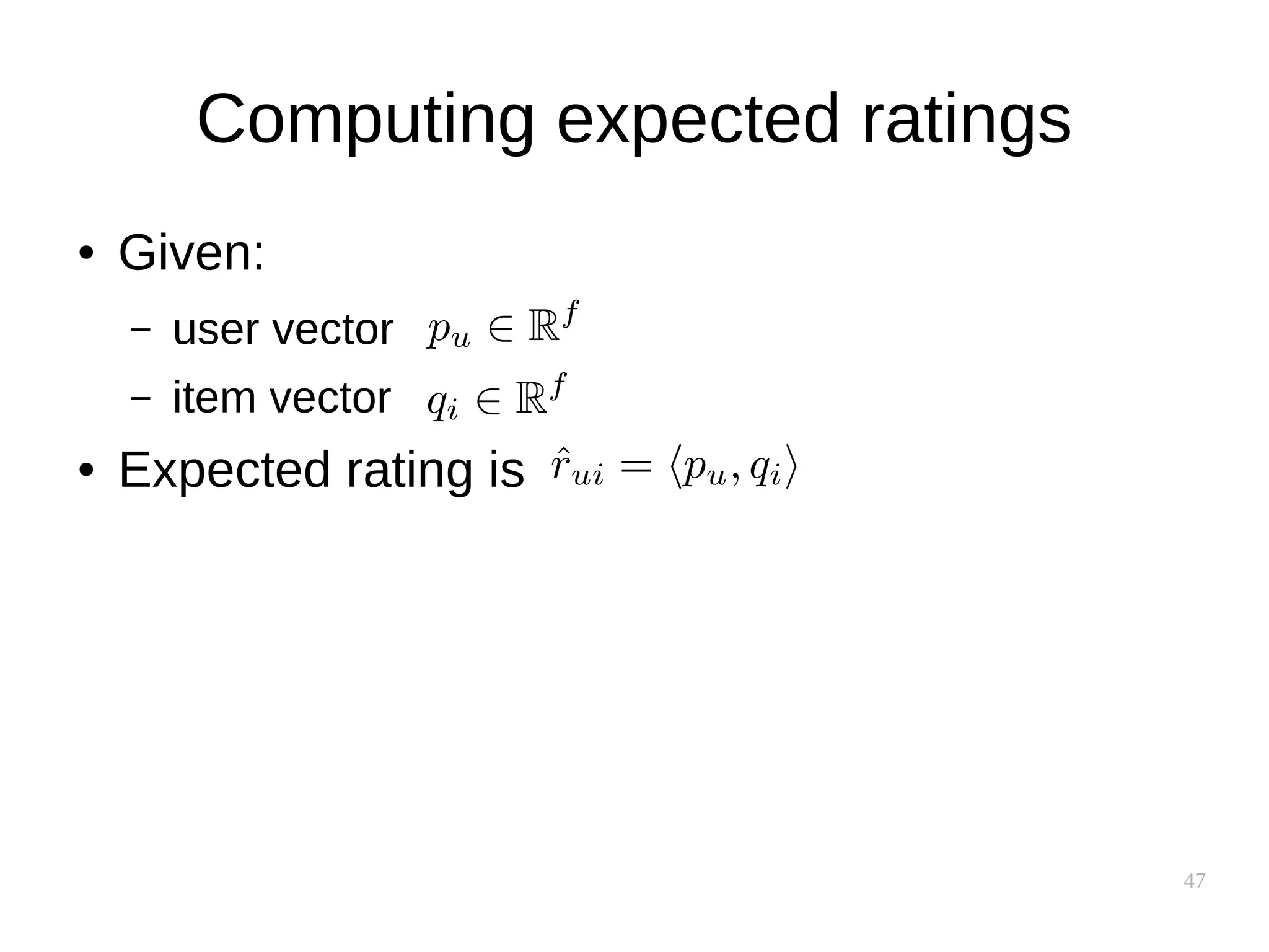
Computing expected ratings
● Given:
– user vector
– item vector
● Expected rating is
48
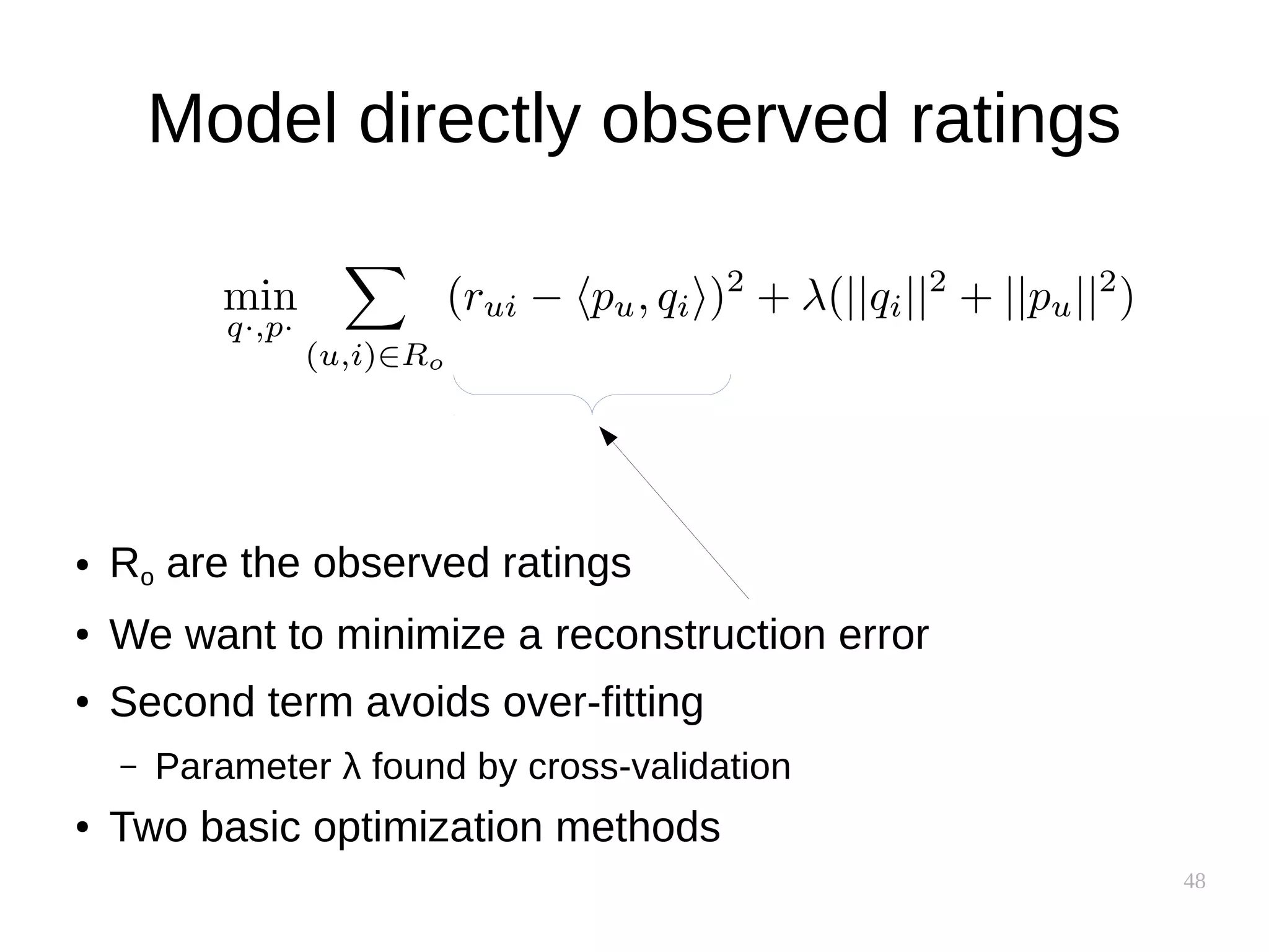
Model directly observed ratings
● Ro are the observed ratings
● We want to minimize a reconstruction error
● Second term avoids over-fitting
– Parameter λ found by cross-validation
● Two basic optimization methods
49
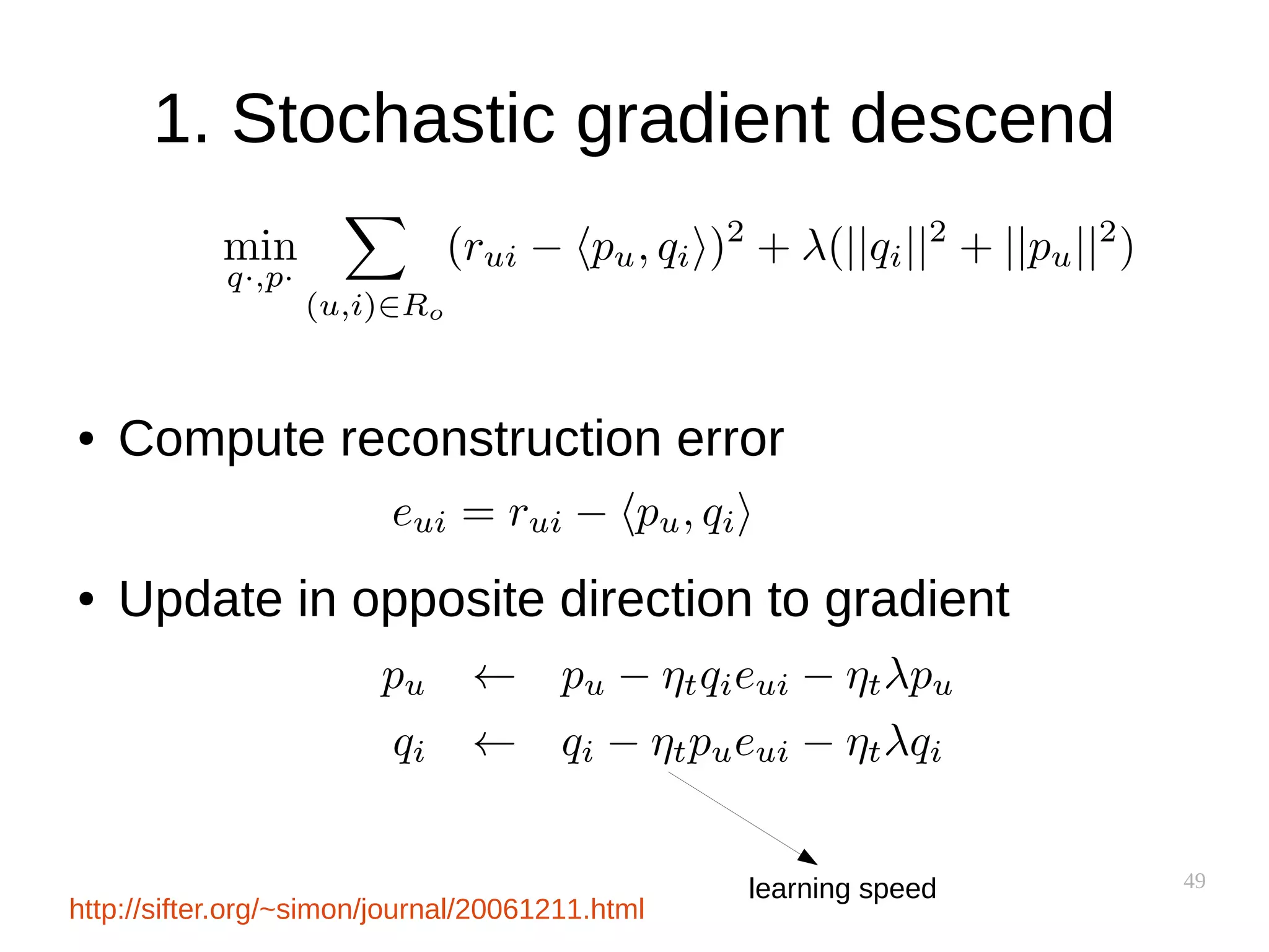
1. Stochastic gradient descend
● Compute reconstruction error
● Update in opposite direction to gradient
http://sifter.org/~simon/journal/20061211.html
learning speed
50
Illustration: batch gradient descent
vs stochastic gradient descent
Batch: gradient Stochastic: single-example gradient
[source]
51
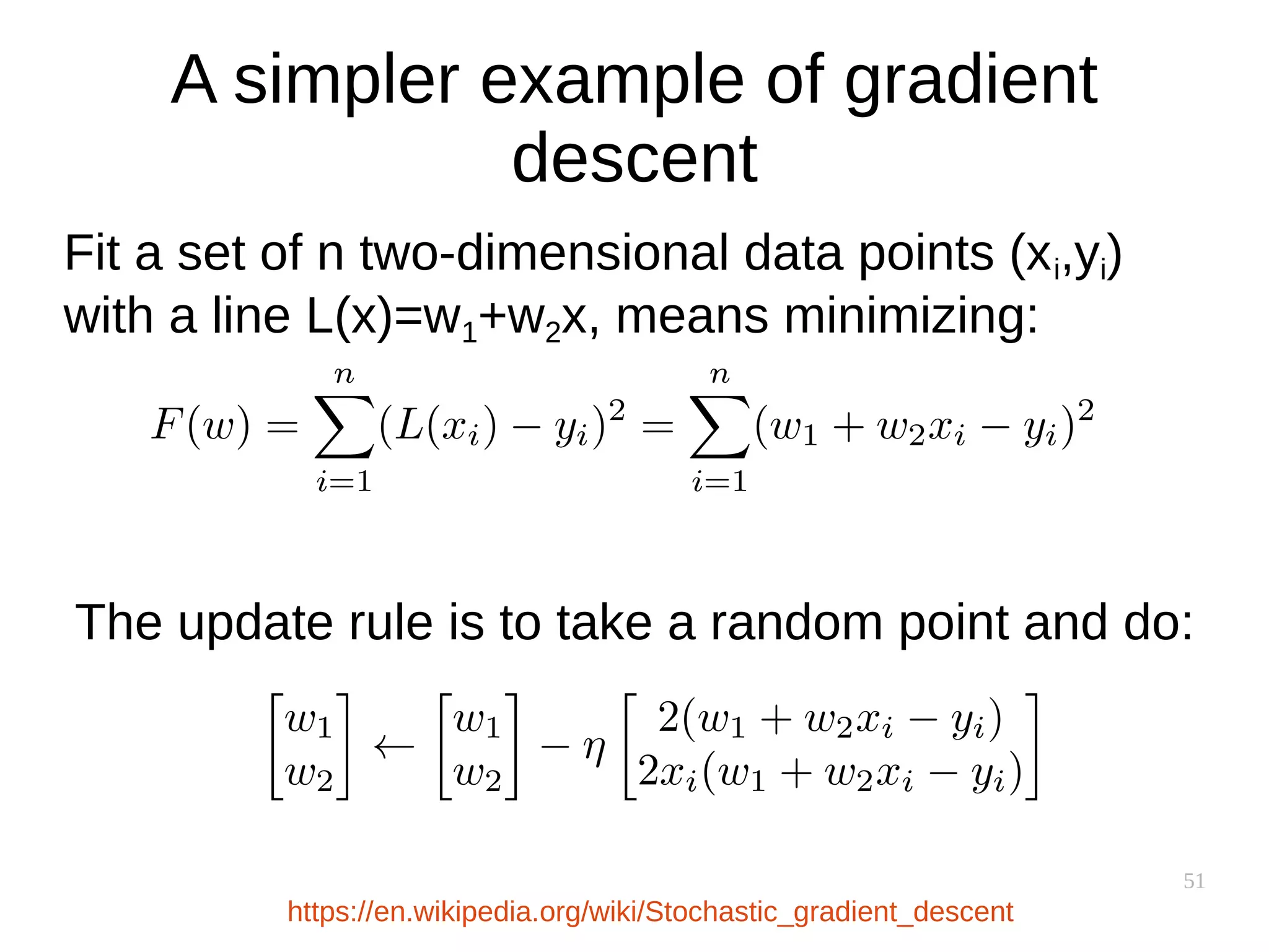
A simpler example of gradient
descent
Fit a set of n two-dimensional data points (xi,yi)
with a line L(x)=w1+w2x, means minimizing:
The update rule is to take a random point and do:
https://en.wikipedia.org/wiki/Stochastic_gradient_descent
52
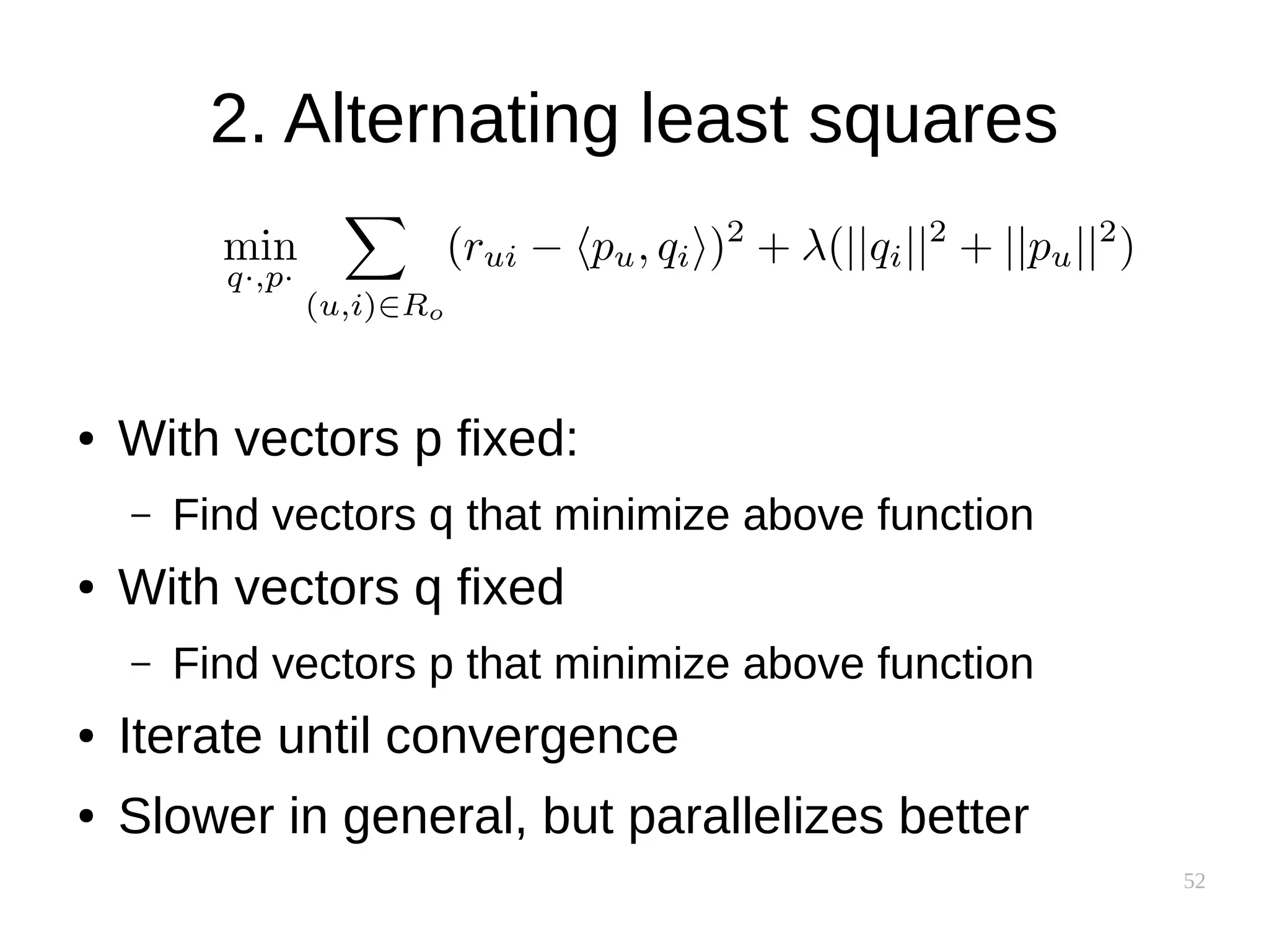
2. Alternating least squares
● With vectors p fixed:
– Find vectors q that minimize above function
● With vectors q fixed
– Find vectors p that minimize above function
● Iterate until convergence
● Slower in general, but parallelizes better
53
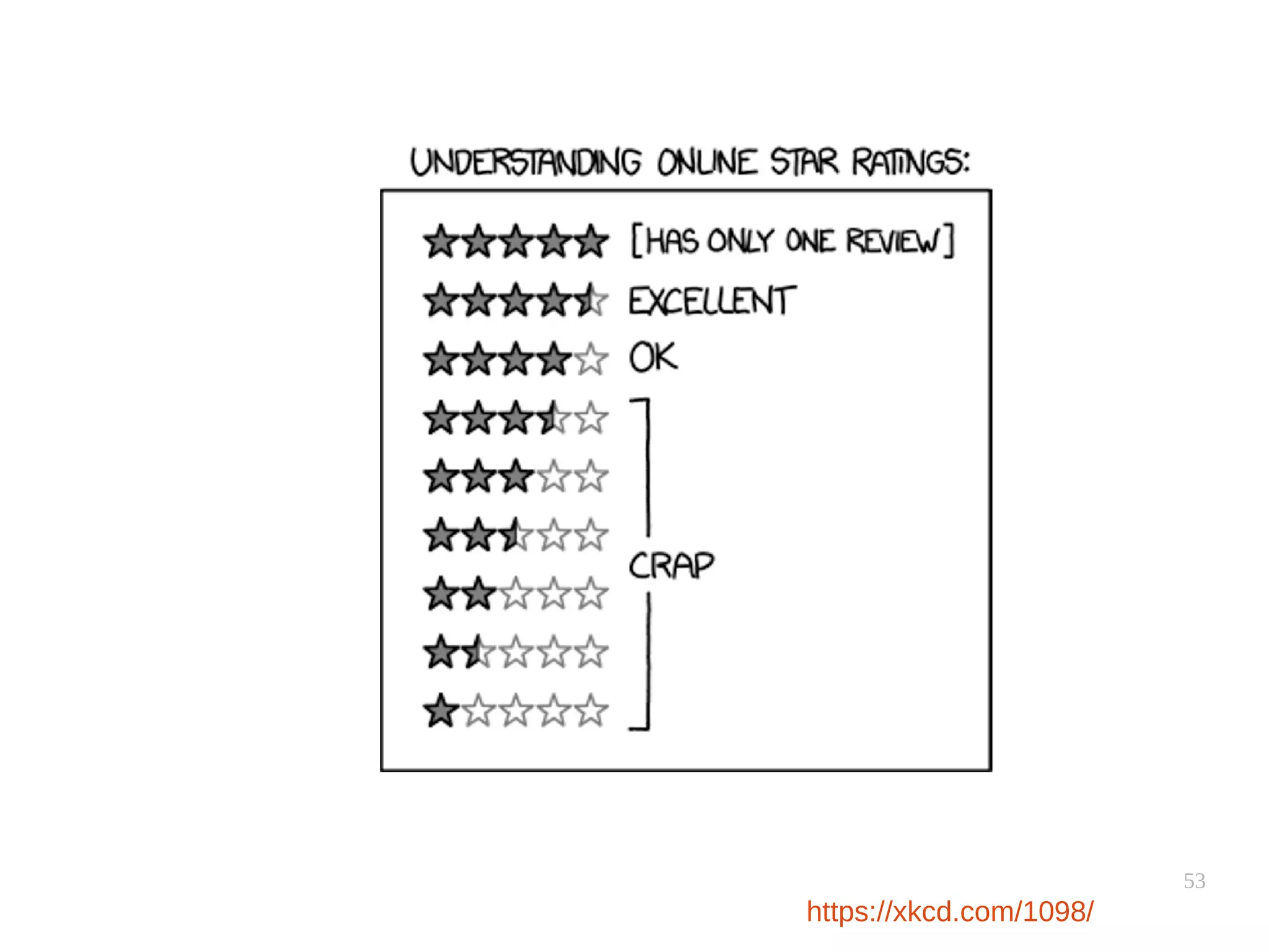
https://xkcd.com/1098/
54
Ratings are not normally-distributed
[Marlin et al. 2007, Hu et al. 2009]
Sometimes referred to as the “J” distribution of ratings
Amazon
(DVDs, Videos, Books)
55
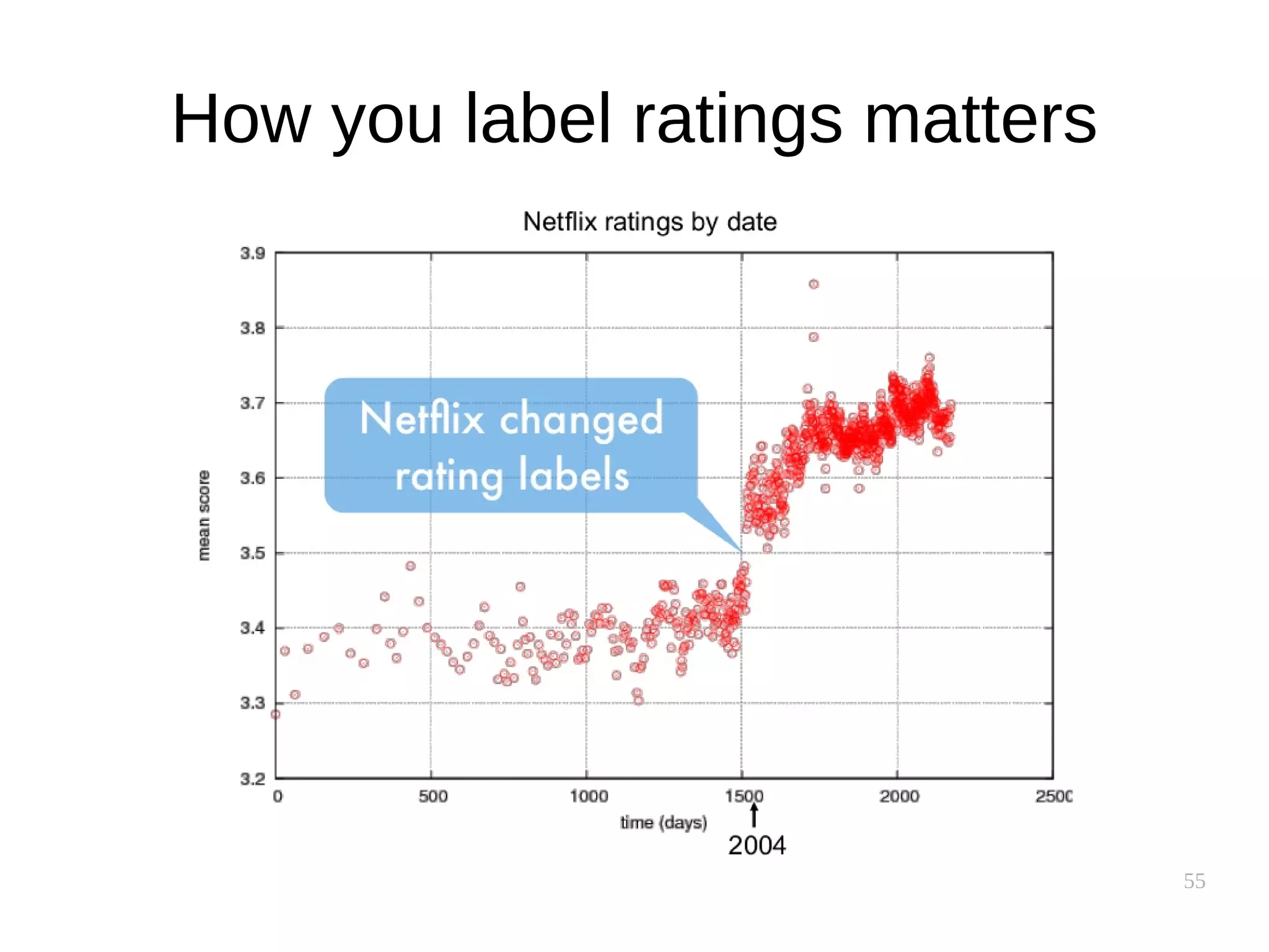
How you label ratings matters
56
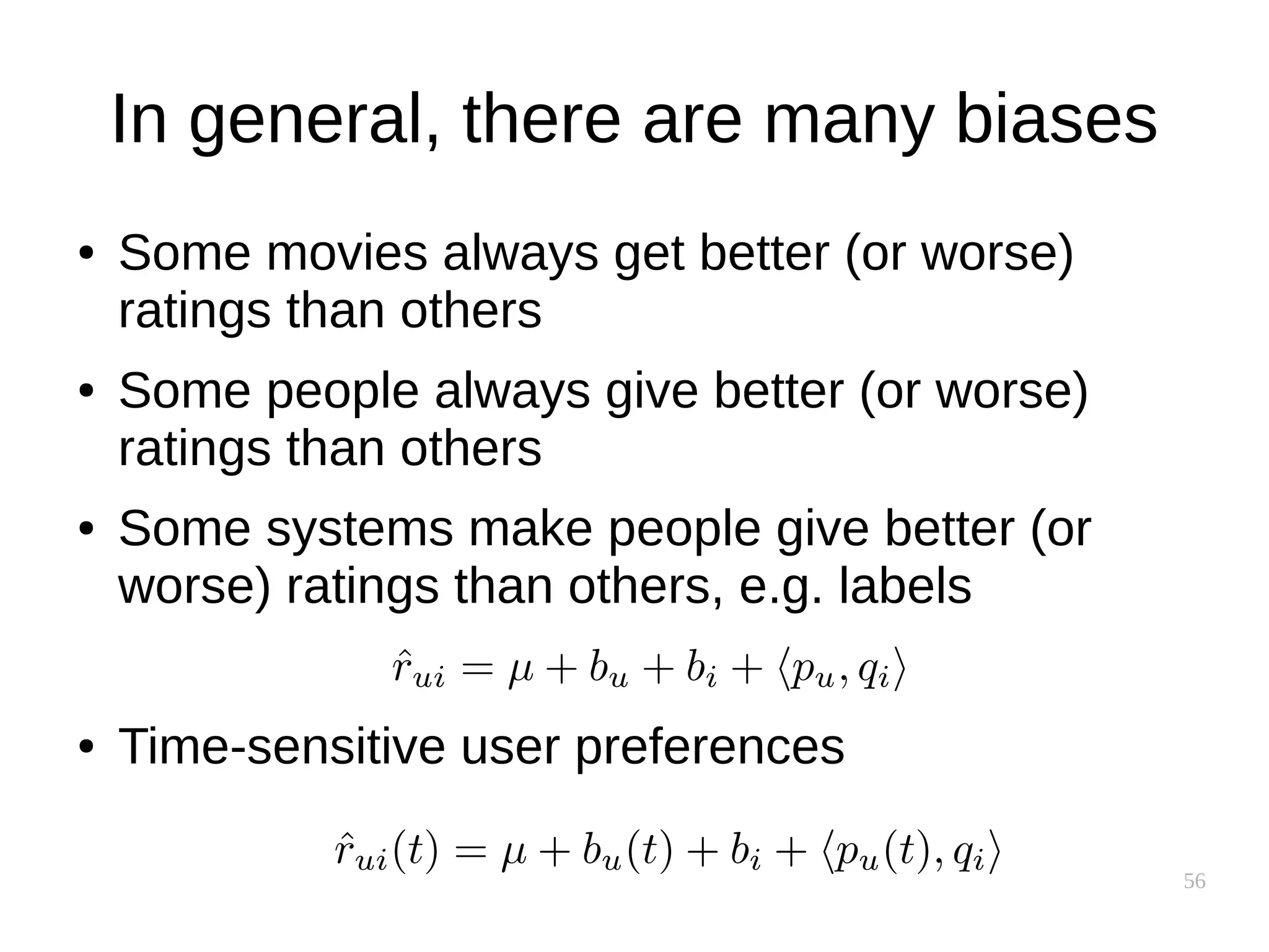
In general, there are many biases
● Some movies always get better (or worse)
ratings than others
● Some people always give better (or worse)
ratings than others
● Some systems make people give better (or
worse) ratings than others, e.g. labels
● Time-sensitive user preferences
57
Other approaches
58
Other approaches
● Association rules (sequence-mining based)
● Regression (e.g. using a neural network)
– e.g. based on user characteristics, number of
ratings in different tags/categories
● Clustering
● Learning-to-rank
59
Hybrid methods (some types)
● Weighted
– E.g. average recommended scores of two methods
● Switching
– E.g. use one method when little info is available, a
different method when more info is available
● Cascade
– E.g. use a clustering-based approach, then refine
using a collaborative filtering approach
60
Context-sensitive methods
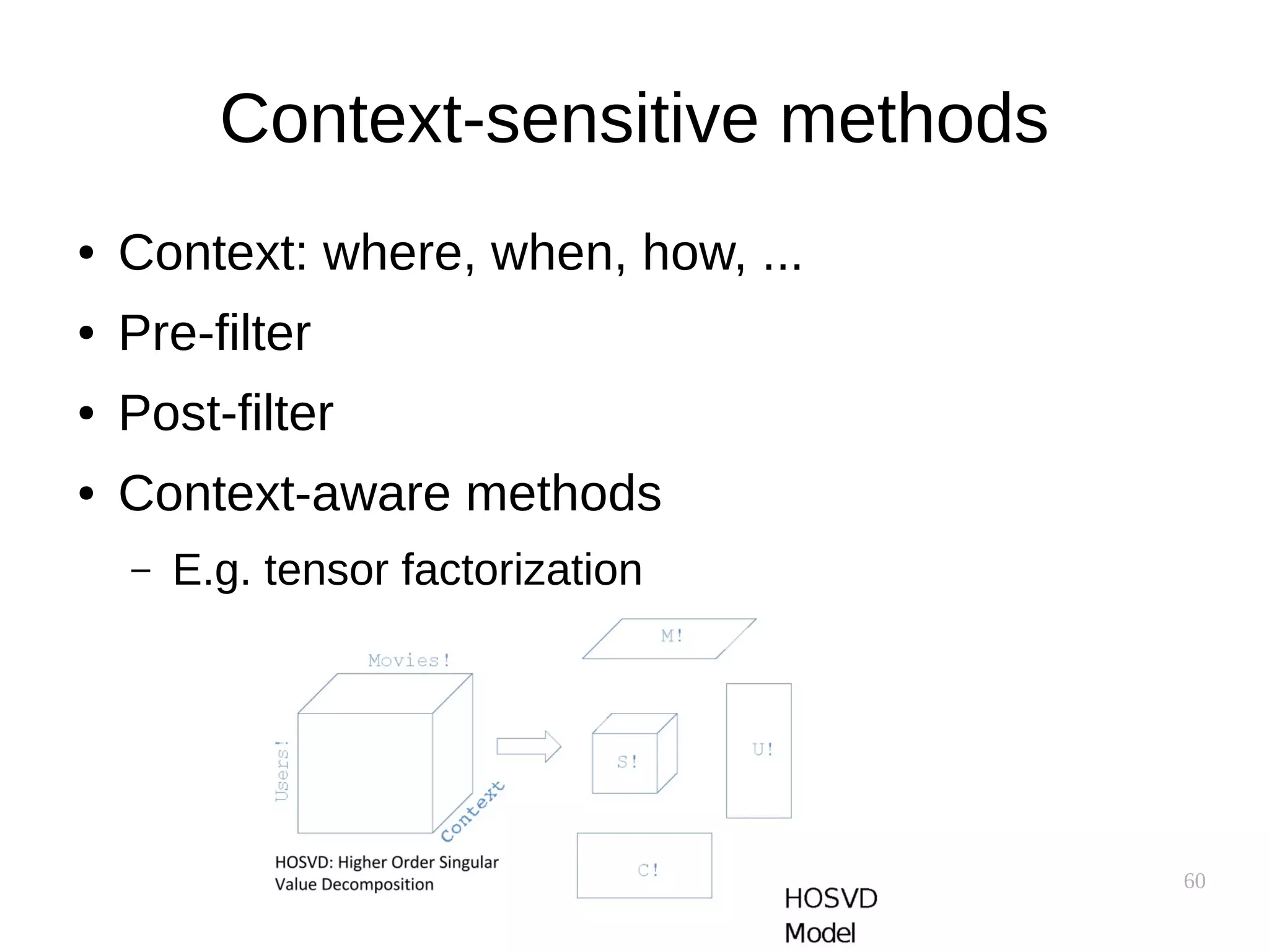
● Context: where, when, how, ...
● Pre-filter
● Post-filter
● Context-aware methods
– E.g. tensor factorization
61
Evaluation
62
Evaluation methodologies
● User experiments
● Precision @ Cut-off
● Ranking-based metrics
– E.g. Kendall's Tau
● Score-based metrics
– E.g. RMSE
http://www-users.cs.umn.edu/~cosley/research/gl/evaluating-herlocker-tois2004.pdf
63
Example user testing
● [Liu et al. IUI 2010] News recommender
64
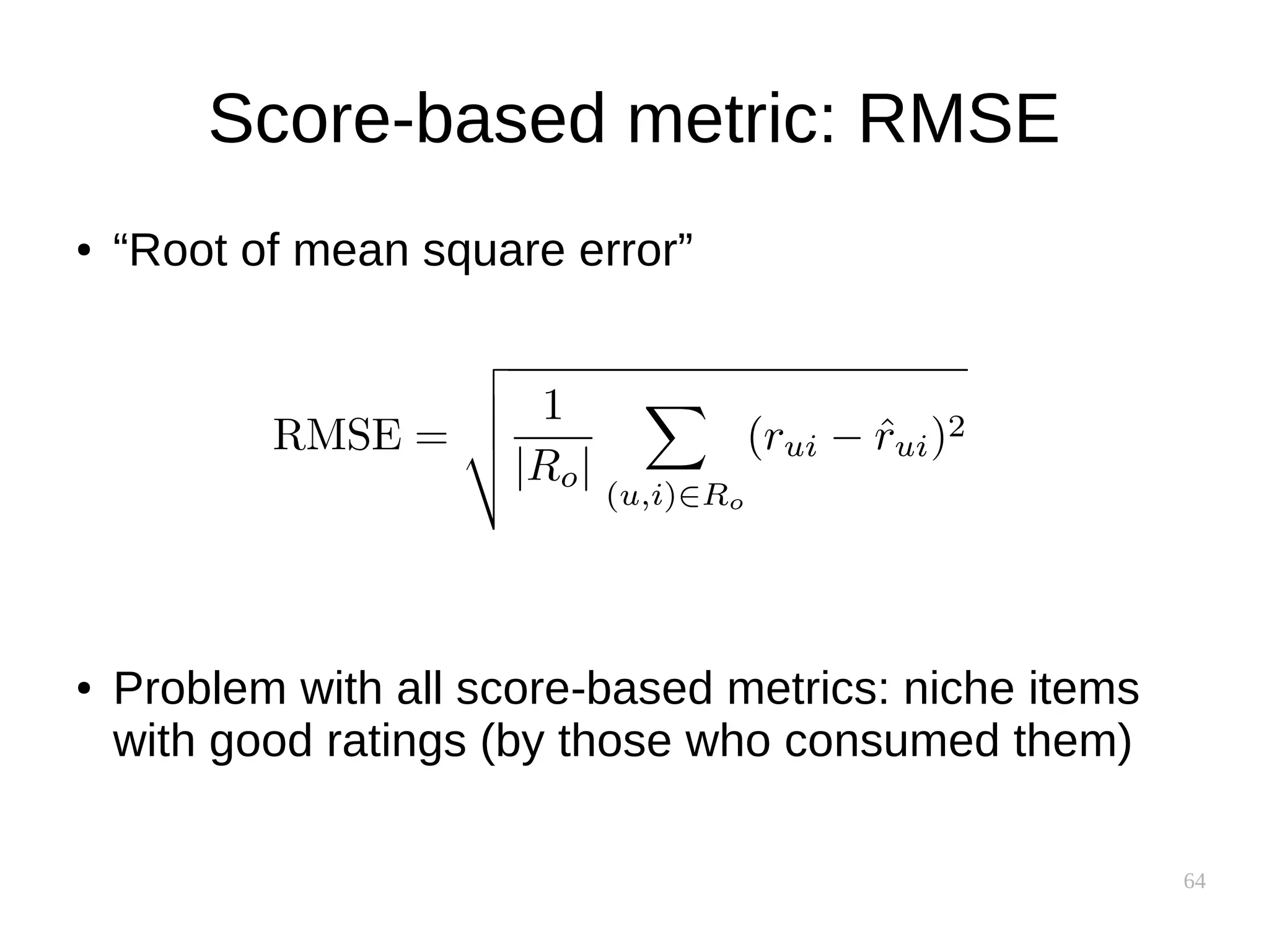
Score-based metric: RMSE
● “Root of mean square error”
● Problem with all score-based metrics: niche items
with good ratings (by those who consumed them)
65
Evaluation by RMSE
[Slide from Smola 2012]
66
Evaluation by RMSE
BIAS
TEMPORAL
FACTORS
[Slide from Smola 2012]
67
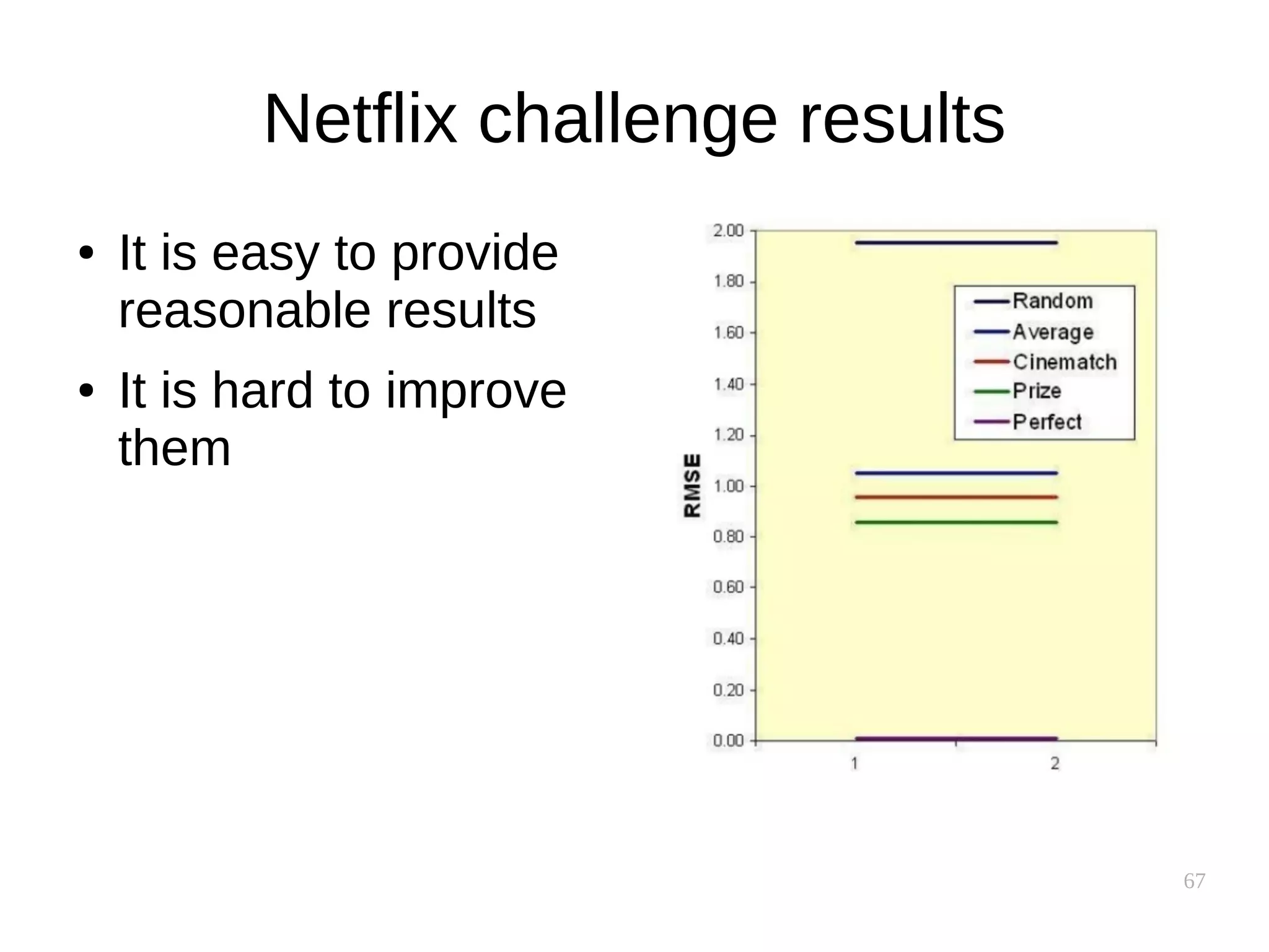
Netflix challenge results
● It is easy to provide
reasonable results
● It is hard to improve
them

Recommender Systems

  • 1.
    Recommender Systems Class AlgorithmicMethods of Data Mining Program M. Sc. Data Science University Sapienza University of Rome Semester Fall 2015 Lecturer Carlos Castillo http://chato.cl/ Sources: ● Ricci, Rokach and Shapira: Introduction to Recommender Systems Handbook [link] ● Bobadilla et al. Survey 2013 [link] ● Xavier Amatriain 2014 tutorial on rec systems [link] ● Ido Guy 2011 tutorial on social rec systems [link] ● Alex Smola's tutorial on recommender systems [link]
  • 2.
  • 3.
    3 Definition Recommender systems aresoftware tools and techniques providing suggestions for items to be of use to a user.
  • 4.
  • 5.
  • 6.
    6 Assumptions ● Users relyon recommendations ● Users lack sufficient personal expertise ● Number of items is very large – e.g. around 1010 books in Amazon ● Recommendations need to be personalized Amazon as of December 2015
  • 7.
    7 Who uses recommendersystems? ● Retailers and e-commerce in general – Amazon, Netflix, etc. ● Service sites, e.g. travel sites ● Media organizations ● Dating apps ● ...
  • 8.
    8 Why? ● Increase numberof items sold – 2/3 of Netflix watched are recommendations – 1/3 of Amazon sales are from recommendations – ...
  • 9.
    9 Why? (cont.) ● Sellmore diverse items ● Increase user satisfaction – Users enjoy the recommendations ● Increase user fidelity – Users feel recognized (but not creeped out) ● Understand users (see next slides)
  • 10.
    10 By-products ● Recommendations generateby-products ● Recommending requires understanding users and items, which is valuable by itself ● Some recommender systems are very good at this (e.g. factorization methods) ● Automatically identify marketing profiles ● Describe users to better understand them
  • 11.
    11 The recommender systemproblem Estimate the utility for a user of an item for which the user has not expressed utility What information can be used?
  • 12.
    12 Types of problem ●Find some good items (most common) ● Find all good items ● Annotate in context (why I would like this) ● Recommend a sequence (e.g. tour of a city) ● Recommend a bundle (camera+lens+bag) ● Support browsing (seek longer session) ● ...
  • 13.
    13 Data sources ● Items,Users – Structured attributes, semi-structured or unstructured descriptions ● Transactions – Appraisals ● Numerical ratings (e.g. 1-5) ● Binary ratings (like/dislike) ● Unary ratings (like/don't know) – Sales – Tags/descriptions/reviews
  • 14.
    14 Recommender system process Whyis part of the processing done offline?
  • 15.
    15 Aspects of thisprocess ● Data preparation – Normalization, removal of outliers, feature selection, dimensionality reduction, ... ● Data mining – Clustering, classification, rule generation, ... ● Post-processing – Visualization, interpretation, meta-mining, ...
  • 16.
    16 Desiderata for recommendersystem ● Must inspire trust ● Must convince users to try the items ● Must offer a good combination of novelty, coverage, and precision ● Must have a somewhat transparent logic ● Must be user-tunable
  • 17.
    17 Human factors ● Advancedsystems are conversational ● Transparency and scrutability – Explain users how the system works – Allow users to tell the system it is wrong ● Help users make a good decision ● Convince users in a persuasive manner ● Increase enjoyment to users ● Provide serendipity
  • 18.
    18 Serendipity ● “An aptitudefor making desirable discoveries by accident” ● Don't recommend items the user already knows ● Delight users by expanding their taste – But still recommend them something somewhat familiar ● It can be controlled by specific parameters Peregrinaggio di tre giovani figliuoli del re di Serendippo; Michele Tramezzino, Venice, 1557. Tramezzino claimed to have heard the story from one Christophero Armeno who had translated the Persian fairy tale into Italian adapting Book One of Amir Khusrau's Hasht-Bihisht of 1302 [link]
  • 19.
    19 High-level approaches ● Memory-based –Use data from the past in a somewhat “raw” form ● Model-based – Use models built from data from the past
  • 20.
    20 Approaches ● Collaborative filtering ●Content-based (item features) ● Knowledge-based (expert system) ● Personalized learning to rank – Estimate ranking function ● Demographic ● Social/community based – Based on connections ● Hybrid (combination of some of the above)
  • 21.
  • 22.
    22 Collaborative Filtering approach ●User has seen/liked certain items ● Community has seen/liked certain items ● Recommend to users items similar to the ones they have seen/liked – Based on finding similar users – Based on finding similar items
  • 23.
    23 Algorithmic elements ● Musers and N items ● Transaction matrix RM x N ● Active user ● Method to compute similarity of users ● Method to sample high-similarity users ● Method to aggregate their ratings on an item
  • 24.
    24 k nearest usersalgorithm ● Compute common elements with other users ● Compute distance between rating vectors ● Pick top 3 most similar users ● For every unrated item – Average rating of 3 most similar users ● Recommend highest score unrated items
  • 25.
    25 Ratings data 1 23 4 5 6 7 8 9 1 0 1 1 1 2 1 1 5 2 3 2 5 1 5 4 5 3 2 3 5 5 1 3 2 4 4 3 5 4 5 1 5 2 5 4 4 5 6 4 3 1 4 2 7 4 1 4 5 4 1 ITEMS USERS
  • 26.
    26 Try it! Generaterecommendations 1 2 3 4 5 6 7 8 9 1 0 1 1 1 2 1 1 5 2 3 2 5 1 5 4 5 3 2 3 5 5 1 3 2 4 4 3 5 4 5 1 5 2 5 4 4 5 6 4 3 1 4 2 7 4 1 4 5 4 1 ITEMS USERS Given the red user Determine 3 nearest users Average their ratings on unrated items Pick top 3 unrated elements
  • 27.
    27 Compute user intersectionsize 1 2 3 4 5 6 7 8 9 1 0 1 1 1 2 1 1 5 2 3 2 5 1 5 4 5 3 2 3 5 5 1 3 2 4 4 3 5 4 5 1 5 2 5 4 4 5 6 4 3 1 4 2 7 4 1 4 5 4 1 ITEMS USERS 0 3 3 3 1 3
  • 28.
    28 Compute user similarity 12 3 4 5 6 7 8 9 1 0 1 1 1 2 1 1 5 2 3 2 5 1 5 4 5 3 2 3 5 5 1 3 2 4 4 3 5 4 5 1 5 2 5 4 4 5 6 4 3 1 4 2 7 4 1 4 5 4 1 ITEMS USERS 0 3 0.33 3 2.67 3 0.00 1 3.00 3 0.67
  • 29.
    29 Pick top-3 mostsimilar 1 2 3 4 5 6 7 8 9 1 0 1 1 1 2 2 5 1 5 4 5 3 2 4 3 5 4 5 1 5 2 5 4 4 5 7 4 1 4 5 4 1 ITEMS USERS 3 0.33 3 0.00 3 0.67
  • 30.
    30 Estimate unrated items 12 3 4 5 6 7 8 9 1 0 1 1 1 2 2 5 1 5 4 5 3 2 4 5.0 3 1.0 2.0 5 4 4.5 - 4.0 5 3.5 1 5 2 5 4 4 5 7 4 1 4 5 4 1 ITEMS USERS 3 0.33 3 0.00 3 0.67
  • 31.
    31 Recommend top-3 estimated 12 3 4 5 6 7 8 9 1 0 1 1 1 2 2 5 1 5 4 5 3 2 4 5.0 3 1.0 2.0 5 4 4.5 - 4.0 5 3.5 1 5 2 5 4 4 5 7 4 1 4 5 4 1 ITEMS USERS 3 0.33 3 0.00 3 0.67
  • 32.
    32 Improvements? ● How wouldyou improve the algorithm? ● How would you provide explanations?
  • 33.
    33 Item-based collaborative filtering 12 3 4 5 6 7 8 9 1 0 1 1 1 2 1 1 5 2 3 2 5 1 5 4 5 3 2 3 5 5 1 3 2 4 4 3 5 4 5 ? 1 5 2 5 4 4 5 6 4 3 1 4 2 7 4 1 4 5 4 1 ITEMS USERS ● Would user 4 like item 11?
  • 34.
    34 Item-based collaborative filtering 12 3 4 5 6 7 8 9 1 0 1 1 1 2 1 1 5 2 3 2 5 1 5 4 5 3 2 3 5 5 1 3 2 4 4 3 5 4 5 1 5 2 5 4 4 5 6 4 3 1 4 2 7 4 1 4 5 4 1 ITEMS USERS ● Compute pair-wise similarities to target item 2.0 1.5 2.3 2.0 1.0 1.0 1.0 1.0 1.5 2.0 - 2.0
  • 35.
    35 Item-based collaborative filtering 12 3 4 5 6 7 8 9 1 0 1 1 1 2 1 1 5 2 3 2 5 1 5 4 5 3 2 3 5 5 1 3 2 4 4 3 5 4 5 1 5 2 5 4 4 5 6 4 3 1 4 2 7 4 1 4 5 4 1 ITEMS USERS ● Pick k most similar items 1.0 1.0 1.0 1.0 -
  • 36.
    36 Item-based collaborative filtering 12 3 4 5 6 7 8 9 1 0 1 1 1 2 1 1 5 2 3 2 5 1 5 4 5 3 2 3 5 5 1 3 2 4 4 3 5 4 5 4.5 1 5 2 5 4 4 5 6 4 3 1 4 2 7 4 1 4 5 4 1 ITEMS USERS ● Average ratings of target user on item 1.0 1.0 1.0 1.0 -
  • 37.
    37 Performance implications ● Similaritybetween users is uncovered slowly ● Similarity between items is supposedly static – Can be precomputed! ● Item-based clusters can also be precomputed [source]
  • 38.
    38 Weaknesses ● Assumes standardizedproducts – E.g. a touristic destination at any time of the year and under any circumstance is the same item ● Does not take into account context ● Requires a relatively large number of transactions to yield reasonable results
  • 39.
    39 Cold-start problem ● Whatto do with a new item? ● What to do with a new user?
  • 40.
    40 Assumptions ● Collaborative filteringassumes the following: – We take recommendations from friends – Friends have similar tastes – A person who have similar tastes to you, could be your friend – Discover people with similar tastes, use them as friends ● BUT, people's tastes are complex!
  • 41.
    41 Ordinary people and extraordinarytastes [Goel et al. 2010] Distribution of user eccentricity: the median rank of consumed items. In the null model, users select items proportional to item popularity
  • 42.
  • 43.
    43 2D projection ofinterests [Koren et al. 2009]
  • 44.
    44 SVD approach ● Ris the matrix of ratings – n users, m items ● U is a user-factor matrix ● S is a diagonal matrix, strength of each factor ● V is a factor-item matrix ● Matrices USV can be computed used an approximate SVD method
  • 45.
    45 General factorization approach ●R is the matrix of ratings – n users, m items ● P is a user-factor matrix ● Q is a factor-item matrix (Sometimes we force P, Q to be non-negative: factors are easier to interpret!)
  • 46.
    46 What is thisplot? [Koren et al. 2009]
  • 47.
    47 Computing expected ratings ●Given: – user vector – item vector ● Expected rating is
  • 48.
    48 Model directly observedratings ● Ro are the observed ratings ● We want to minimize a reconstruction error ● Second term avoids over-fitting – Parameter λ found by cross-validation ● Two basic optimization methods
  • 49.
    49 1. Stochastic gradientdescend ● Compute reconstruction error ● Update in opposite direction to gradient http://sifter.org/~simon/journal/20061211.html learning speed
  • 50.
    50 Illustration: batch gradientdescent vs stochastic gradient descent Batch: gradient Stochastic: single-example gradient [source]
  • 51.
    51 A simpler exampleof gradient descent Fit a set of n two-dimensional data points (xi,yi) with a line L(x)=w1+w2x, means minimizing: The update rule is to take a random point and do: https://en.wikipedia.org/wiki/Stochastic_gradient_descent
  • 52.
    52 2. Alternating leastsquares ● With vectors p fixed: – Find vectors q that minimize above function ● With vectors q fixed – Find vectors p that minimize above function ● Iterate until convergence ● Slower in general, but parallelizes better
  • 53.
  • 54.
    54 Ratings are notnormally-distributed [Marlin et al. 2007, Hu et al. 2009] Sometimes referred to as the “J” distribution of ratings Amazon (DVDs, Videos, Books)
  • 55.
    55 How you labelratings matters
  • 56.
    56 In general, thereare many biases ● Some movies always get better (or worse) ratings than others ● Some people always give better (or worse) ratings than others ● Some systems make people give better (or worse) ratings than others, e.g. labels ● Time-sensitive user preferences
  • 57.
  • 58.
    58 Other approaches ● Associationrules (sequence-mining based) ● Regression (e.g. using a neural network) – e.g. based on user characteristics, number of ratings in different tags/categories ● Clustering ● Learning-to-rank
  • 59.
    59 Hybrid methods (sometypes) ● Weighted – E.g. average recommended scores of two methods ● Switching – E.g. use one method when little info is available, a different method when more info is available ● Cascade – E.g. use a clustering-based approach, then refine using a collaborative filtering approach
  • 60.
    60 Context-sensitive methods ● Context:where, when, how, ... ● Pre-filter ● Post-filter ● Context-aware methods – E.g. tensor factorization
  • 61.
  • 62.
    62 Evaluation methodologies ● Userexperiments ● Precision @ Cut-off ● Ranking-based metrics – E.g. Kendall's Tau ● Score-based metrics – E.g. RMSE http://www-users.cs.umn.edu/~cosley/research/gl/evaluating-herlocker-tois2004.pdf
  • 63.
    63 Example user testing ●[Liu et al. IUI 2010] News recommender
  • 64.
    64 Score-based metric: RMSE ●“Root of mean square error” ● Problem with all score-based metrics: niche items with good ratings (by those who consumed them)
  • 65.
  • 66.
  • 67.
    67 Netflix challenge results ●It is easy to provide reasonable results ● It is hard to improve them