Link-Based Ranking
Class Algorithmic Methods of Data Mining
Program M. Sc. Data Science
University Sapienza University of Rome
Semester Fall 2015
Lecturer Carlos Castillo http://chato.cl/
Sources:
● Fei Li's lecture on PageRank
● Evimaria Terzi's lecture on link analysis.
● Paolo Boldi, Francesco Bonchi, Carlos Castillo, and Sebastiano
Vigna. 2011. Viscous democracy for social networks. Commun.
ACM 54, 6 (June 2011), 129-137. [link]
2
Purpose of Link-Based Ranking
● Static (query-independent) ranking
● Dynamic (query-dependent) ranking
● Applications:
– Search in social networks
– Search on the web
3
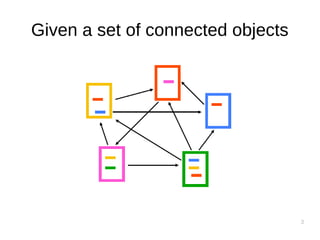
Given a set of connected objects
4
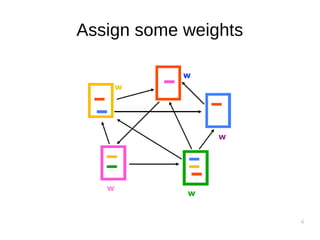
Assign some weights
5
Alternatives
● Various centrality metrics
– Degree, betweenness, ...
● Classical algorithms
– HITS / Hubs and Authorities
– PageRank
6
HITS (Hubs and Authorities)
7
HITS
● Jon M. Kleinberg. 1999. Authoritative sources in
a hyperlinked environment. J. ACM 46, 5
(September 1999), 604-632. [DOI]
● Query-dependent algorithm
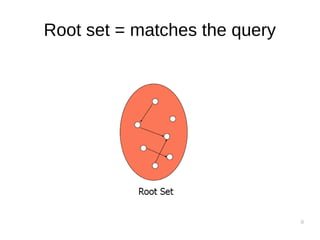
– Get pages matching the query
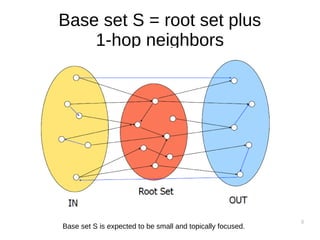
– Expand to 1-hop neighborhood
– Find pages with good out-links (“hubs”)
– Find pages with good in-links (“authorities”)
8
Root set = matches the query
9
Base set S = root set plus
1-hop neighbors
Base set S is expected to be small and topically focused.
10
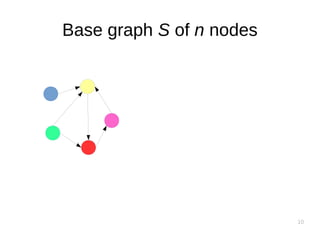
Base graph S of n nodes
11
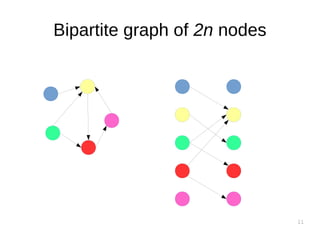
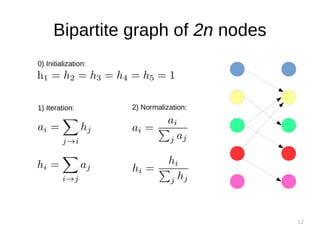
Bipartite graph of 2n nodes
12
Bipartite graph of 2n nodes
0) Initialization:
1) Iteration: 2) Normalization:
13
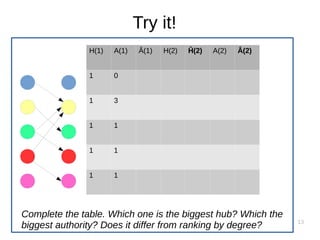
Try it!
H(1) A(1) Â(1) H(2) Ĥ(2) A(2) Â(2)
1 0
1 3
1 1
1 1
1 1
Complete the table. Which one is the biggest hub? Which the
biggest authority? Does it differ from ranking by degree?
14
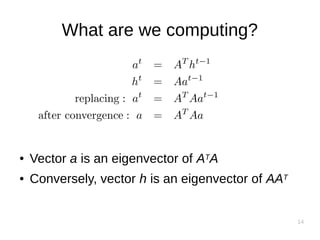
What are we computing?
● Vector a is an eigenvector of ATA
● Conversely, vector h is an eigenvector of AAT
15
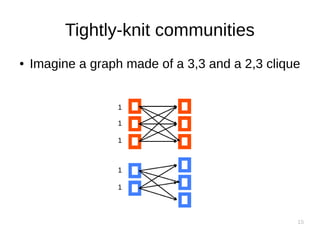
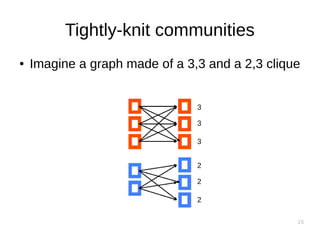
Tightly-knit communities
● Imagine a graph made of a 3,3 and a 2,3 clique
1
1
1
1
1
16
Tightly-knit communities
● Imagine a graph made of a 3,3 and a 2,3 clique
3
3
3
2
2
2
17
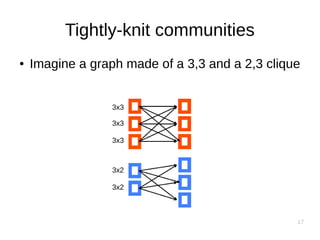
Tightly-knit communities
● Imagine a graph made of a 3,3 and a 2,3 clique
3x3
3x3
3x3
3x2
3x2
18
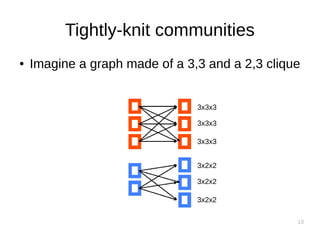
Tightly-knit communities
● Imagine a graph made of a 3,3 and a 2,3 clique
3x3x3
3x3x3
3x3x3
3x2x2
3x2x2
3x2x2
19
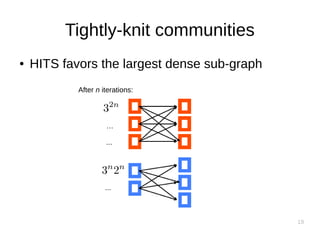
Tightly-knit communities
● HITS favors the largest dense sub-graph
…
...
...
After n iterations:
20
PageRank
21
PageRank
● The pagerank citation algorithm: bringing order
to the web by L Page, S Brin, R Motwani, T
Winograd - 7th World Wide Web Conference,
1998 [link].
● Designed by Page & Brin as part of a research
project that started in 1995 and ended in 1998
… with the creation of Google
22
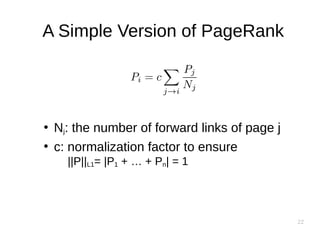
A Simple Version of PageRank
●
Nj: the number of forward links of page j
●
c: normalization factor to ensure
||P||L1= |P1 + … + Pn| = 1
23
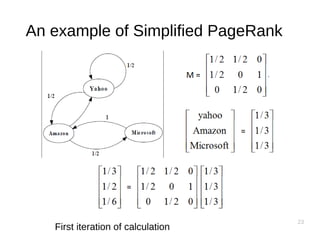
An example of Simplified PageRank
First iteration of calculation
24
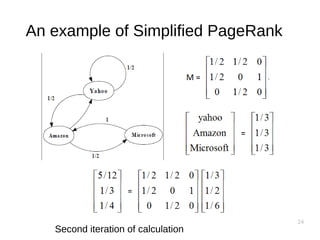
An example of Simplified PageRank
Second iteration of calculation
25
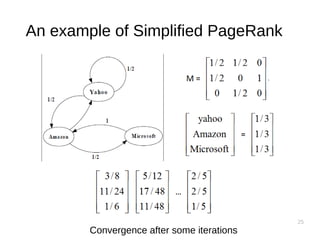
An example of Simplified PageRank
Convergence after some iterations
26
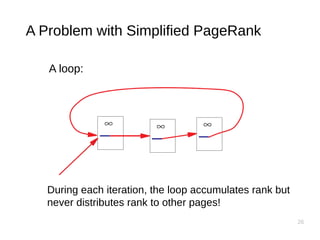
A Problem with Simplified PageRank
A loop:
During each iteration, the loop accumulates rank but
never distributes rank to other pages!
27
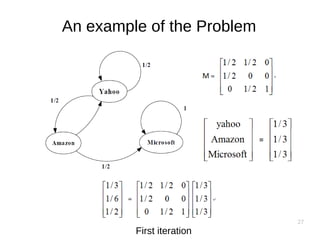
An example of the Problem
First iteration
28
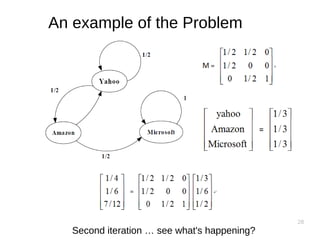
An example of the Problem
Second iteration … see what's happening?
29
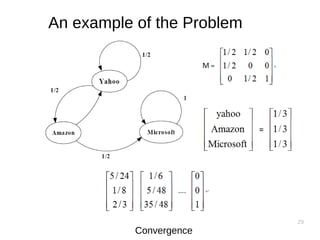
An example of the Problem
Convergence
30
What are we computing?
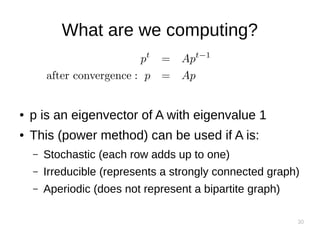
● p is an eigenvector of A with eigenvalue 1
● This (power method) can be used if A is:
– Stochastic (each row adds up to one)
– Irreducible (represents a strongly connected graph)
– Aperiodic (does not represent a bipartite graph)
31
Markov Chains
● Discrete process over a set of states
● Next state determined by current state and
current state only (no memory of older states)
– Higher-order Markov chains can be defined
● Stationary distribution of Markov chain is a
probability distribution such that p = Ap
● Intuitively, p represents “the average time spent”
at each node if the process continues forever
32
Random Walks in Graphs
●
Random Surfer Model
– The simplified model: the standing probability distribution of a
random walk on the graph of the web. simply keeps clicking
successive links at random
●
Modified Random Surfer
– The modified model: the “random surfer” simply keeps clicking
successive links at random, but periodically “gets bored” and
jumps to a random page based on the distribution of E
– This guarantees irreducibility
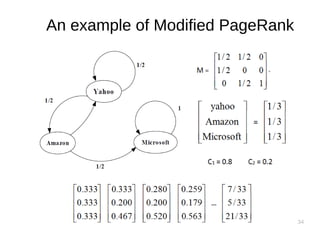
– Pages without out-links (dangling nodes) are a row of zeros,
can be replaced by E, or by a row of 1/n
33
Modified Version of PageRank
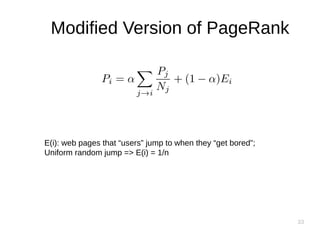
E(i): web pages that “users” jump to when they “get bored”;
Uniform random jump => E(i) = 1/n
34
An example of Modified PageRank
35
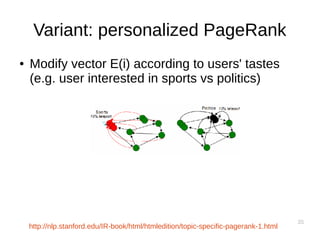
Variant: personalized PageRank
● Modify vector E(i) according to users' tastes
(e.g. user interested in sports vs politics)
http://nlp.stanford.edu/IR-book/html/htmledition/topic-specific-pagerank-1.html
36
PageRank and internal linking
● A website has a maximum amount of Page Rank
that is distributed between its pages by internal
links [depends on internal links]
● The maximum amount of Page Rank in a site
increases as the number of pages in the site
increases.
● By linking poorly, it is possible to fail to reach the
site's maximum Page Rank, but it is not possible
to exceed it.
http://www.cs.sjsu.edu/faculty/pollett/masters/Semesters/Fall11/tanmayee/Deliverable3.pdf
37
PageRank as a form of actual voting
(liquid democracy)
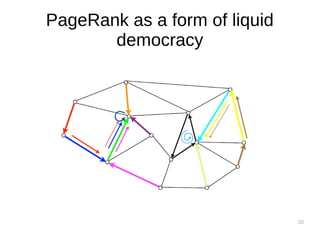
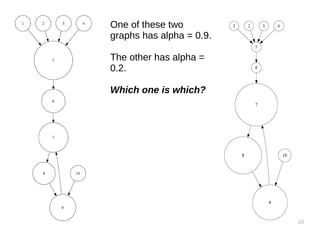
● If alpha = 1, we can implement liquid
democracy
– In liquid democracy, people chose to either vote or
to delegate their vote to somebody else
● If alpha < 1, we have a sort of “viscous”
democracy where delegation is not total
38
PageRank as a form of liquid
democracy
39
One of these two
graphs has alpha = 0.9.
The other has alpha =
0.2.
Which one is which?
40
PageRank Implementation
●
Suppose there are n pages and m links
●
Trivial implementation of PageRank requires O(m+n) memory
●
Streaming implementation requires O(n) memory … how?
●
More on PageRank to follow in another lecture ...

Link-Based Ranking

  • 1.
    Link-Based Ranking Class AlgorithmicMethods of Data Mining Program M. Sc. Data Science University Sapienza University of Rome Semester Fall 2015 Lecturer Carlos Castillo http://chato.cl/ Sources: ● Fei Li's lecture on PageRank ● Evimaria Terzi's lecture on link analysis. ● Paolo Boldi, Francesco Bonchi, Carlos Castillo, and Sebastiano Vigna. 2011. Viscous democracy for social networks. Commun. ACM 54, 6 (June 2011), 129-137. [link]
  • 2.
    2 Purpose of Link-BasedRanking ● Static (query-independent) ranking ● Dynamic (query-dependent) ranking ● Applications: – Search in social networks – Search on the web
  • 3.
    3 Given a setof connected objects
  • 4.
  • 5.
    5 Alternatives ● Various centralitymetrics – Degree, betweenness, ... ● Classical algorithms – HITS / Hubs and Authorities – PageRank
  • 6.
    6 HITS (Hubs andAuthorities)
  • 7.
    7 HITS ● Jon M.Kleinberg. 1999. Authoritative sources in a hyperlinked environment. J. ACM 46, 5 (September 1999), 604-632. [DOI] ● Query-dependent algorithm – Get pages matching the query – Expand to 1-hop neighborhood – Find pages with good out-links (“hubs”) – Find pages with good in-links (“authorities”)
  • 8.
    8 Root set =matches the query
  • 9.
    9 Base set S= root set plus 1-hop neighbors Base set S is expected to be small and topically focused.
  • 10.
    10 Base graph Sof n nodes
  • 11.
  • 12.
    12 Bipartite graph of2n nodes 0) Initialization: 1) Iteration: 2) Normalization:
  • 13.
    13 Try it! H(1) A(1)Â(1) H(2) Ĥ(2) A(2) Â(2) 1 0 1 3 1 1 1 1 1 1 Complete the table. Which one is the biggest hub? Which the biggest authority? Does it differ from ranking by degree?
  • 14.
    14 What are wecomputing? ● Vector a is an eigenvector of ATA ● Conversely, vector h is an eigenvector of AAT
  • 15.
    15 Tightly-knit communities ● Imaginea graph made of a 3,3 and a 2,3 clique 1 1 1 1 1
  • 16.
    16 Tightly-knit communities ● Imaginea graph made of a 3,3 and a 2,3 clique 3 3 3 2 2 2
  • 17.
    17 Tightly-knit communities ● Imaginea graph made of a 3,3 and a 2,3 clique 3x3 3x3 3x3 3x2 3x2
  • 18.
    18 Tightly-knit communities ● Imaginea graph made of a 3,3 and a 2,3 clique 3x3x3 3x3x3 3x3x3 3x2x2 3x2x2 3x2x2
  • 19.
    19 Tightly-knit communities ● HITSfavors the largest dense sub-graph … ... ... After n iterations:
  • 20.
  • 21.
    21 PageRank ● The pagerankcitation algorithm: bringing order to the web by L Page, S Brin, R Motwani, T Winograd - 7th World Wide Web Conference, 1998 [link]. ● Designed by Page & Brin as part of a research project that started in 1995 and ended in 1998 … with the creation of Google
  • 22.
    22 A Simple Versionof PageRank ● Nj: the number of forward links of page j ● c: normalization factor to ensure ||P||L1= |P1 + … + Pn| = 1
  • 23.
    23 An example ofSimplified PageRank First iteration of calculation
  • 24.
    24 An example ofSimplified PageRank Second iteration of calculation
  • 25.
    25 An example ofSimplified PageRank Convergence after some iterations
  • 26.
    26 A Problem withSimplified PageRank A loop: During each iteration, the loop accumulates rank but never distributes rank to other pages!
  • 27.
    27 An example ofthe Problem First iteration
  • 28.
    28 An example ofthe Problem Second iteration … see what's happening?
  • 29.
    29 An example ofthe Problem Convergence
  • 30.
    30 What are wecomputing? ● p is an eigenvector of A with eigenvalue 1 ● This (power method) can be used if A is: – Stochastic (each row adds up to one) – Irreducible (represents a strongly connected graph) – Aperiodic (does not represent a bipartite graph)
  • 31.
    31 Markov Chains ● Discreteprocess over a set of states ● Next state determined by current state and current state only (no memory of older states) – Higher-order Markov chains can be defined ● Stationary distribution of Markov chain is a probability distribution such that p = Ap ● Intuitively, p represents “the average time spent” at each node if the process continues forever
  • 32.
    32 Random Walks inGraphs ● Random Surfer Model – The simplified model: the standing probability distribution of a random walk on the graph of the web. simply keeps clicking successive links at random ● Modified Random Surfer – The modified model: the “random surfer” simply keeps clicking successive links at random, but periodically “gets bored” and jumps to a random page based on the distribution of E – This guarantees irreducibility – Pages without out-links (dangling nodes) are a row of zeros, can be replaced by E, or by a row of 1/n
  • 33.
    33 Modified Version ofPageRank E(i): web pages that “users” jump to when they “get bored”; Uniform random jump => E(i) = 1/n
  • 34.
    34 An example ofModified PageRank
  • 35.
    35 Variant: personalized PageRank ●Modify vector E(i) according to users' tastes (e.g. user interested in sports vs politics) http://nlp.stanford.edu/IR-book/html/htmledition/topic-specific-pagerank-1.html
  • 36.
    36 PageRank and internallinking ● A website has a maximum amount of Page Rank that is distributed between its pages by internal links [depends on internal links] ● The maximum amount of Page Rank in a site increases as the number of pages in the site increases. ● By linking poorly, it is possible to fail to reach the site's maximum Page Rank, but it is not possible to exceed it. http://www.cs.sjsu.edu/faculty/pollett/masters/Semesters/Fall11/tanmayee/Deliverable3.pdf
  • 37.
    37 PageRank as aform of actual voting (liquid democracy) ● If alpha = 1, we can implement liquid democracy – In liquid democracy, people chose to either vote or to delegate their vote to somebody else ● If alpha < 1, we have a sort of “viscous” democracy where delegation is not total
  • 38.
    38 PageRank as aform of liquid democracy
  • 39.
    39 One of thesetwo graphs has alpha = 0.9. The other has alpha = 0.2. Which one is which?
  • 40.
    40 PageRank Implementation ● Suppose thereare n pages and m links ● Trivial implementation of PageRank requires O(m+n) memory ● Streaming implementation requires O(n) memory … how? ● More on PageRank to follow in another lecture ...