Graph Models
Class Algorithmic Methods of Data Mining
Program M. Sc. Data Science
University Sapienza University of Rome
Semester Fall 2015
Lecturer Carlos Castillo http://chato.cl/
Sources:
● Frieze, Gionis, Tsourakakis: “Algorithmic techniques for modeling
and mining large graphs (AMAzING)” [Tutorial]
● Lada Adamic: Zipf, Power-Laws and Pareto [Tutorial]
● Giorgios Cheliotis: Social Network Analysis [Tutorial]
2
Network characteristics
● Static networks
– Power-law degree distribution
– Small diameter
● Time-evolving networks
– Densification
– Shrinking diameters
3
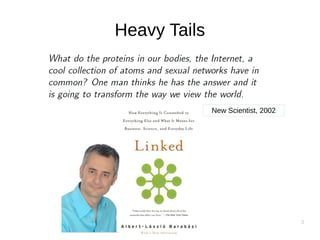
Heavy Tails
New Scientist, 2002
4
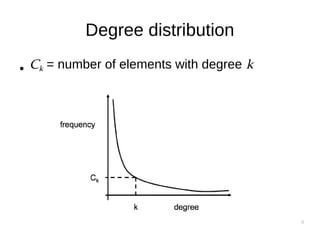
Degree distribution
● Ck = number of elements with degree k
5
Power-law degree distribution
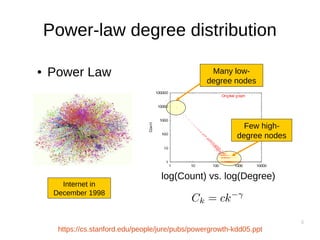
● In a log-log plot, this looks like a straight line,
descending with slope γ
6
Power-law degree distribution
https://cs.stanford.edu/people/jure/pubs/powergrowth-kdd05.ppt
● Power Law
log(Count) vs. log(Degree)
Many low-
degree nodes
Few high-
degree nodes
Internet in
December 1998
7
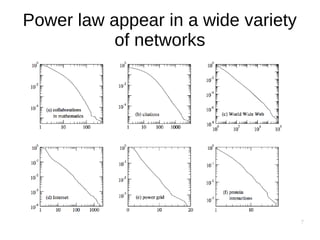
Power law appear in a wide variety
of networks
8
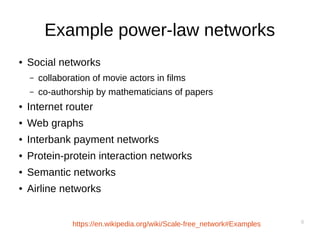
Example power-law networks
● Social networks
– collaboration of movie actors in films
– co-authorship by mathematicians of papers
● Internet router
● Web graphs
● Interbank payment networks
● Protein-protein interaction networks
● Semantic networks
● Airline networks
https://en.wikipedia.org/wiki/Scale-free_network#Examples
9
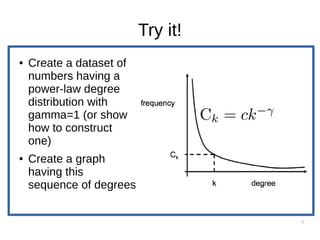
Try it!
● Create a dataset of
numbers having a
power-law degree
distribution with
gamma=1 (or show
how to construct
one)
● Create a graph
having this
sequence of degrees
10
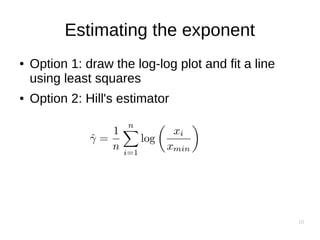
Estimating the exponent
● Option 1: draw the log-log plot and fit a line
using least squares
● Option 2: Hill's estimator
11
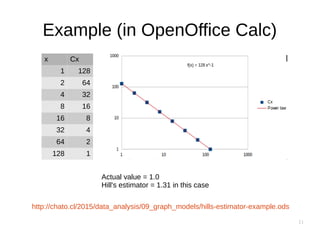
Example (in OpenOffice Calc)
x Cx
1 128
2 64
4 32
8 16
16 8
32 4
64 2
128 1
Actual value = 1.0
Hill's estimator = 1.31 in this case
http://chato.cl/2015/data_analysis/09_graph_models/hills-estimator-example.ods
12
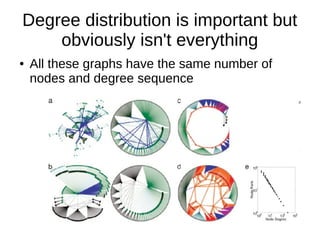
Degree distribution is important but
obviously isn't everything
● All these graphs have the same number of
nodes and degree sequence
13
How to obtain a power law?
● Preferential attachment is a frequently-used
model for graph evolution
● At every time step, a new node arrives and
connects to existing nodes with probability
proportional to their degree
14
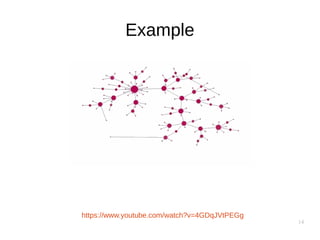
Example
https://www.youtube.com/watch?v=4GDqJVtPEGg
15
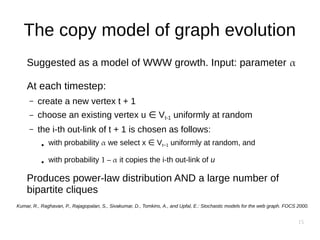
The copy model of graph evolution
Suggested as a model of WWW growth. Input: parameter α
At each timestep:
– create a new vertex t + 1
– choose an existing vertex u V∈ t-1 uniformly at random
– the i-th out-link of t + 1 is chosen as follows:
● with probability α we select x V∈ t−1 uniformly at random, and
● with probability 1 – α it copies the i-th out-link of u
Produces power-law distribution AND a large number of
bipartite cliques
Kumar, R., Raghavan, P., Rajagopalan, S., Sivakumar, D., Tomkins, A., and Upfal, E.: Stochastic models for the web graph. FOCS 2000.
16
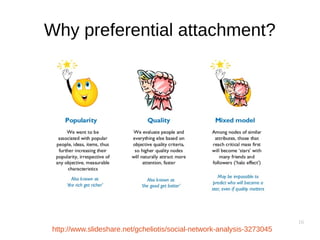
Why preferential attachment?
http://www.slideshare.net/gcheliotis/social-network-analysis-3273045
17
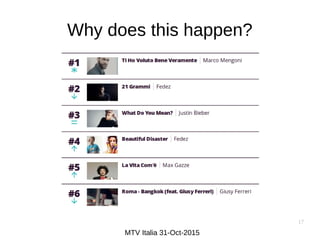
Why does this happen?
MTV Italia 31-Oct-2015
18
An experiment
● Matthew J. Salganik, Peter Sheridan Dodds,
Duncan J. Watts: Experimental Study of
Inequality and Unpredictability in an Artificial
Cultural Market. Science 10 February 2006.
Vol. 311 no. 5762 pp. 854-856 [link]
19
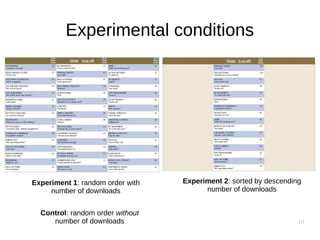
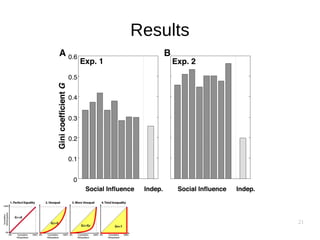
Experimental conditions
Experiment 1: random order with
number of downloads
Experiment 2: sorted by descending
number of downloads
Control: random order without
number of downloads
20
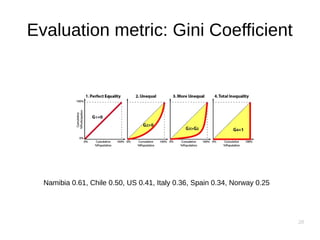
Evaluation metric: Gini Coefficient
Namibia 0.61, Chile 0.50, US 0.41, Italy 0.36, Spain 0.34, Norway 0.25
21
Results
22
Graph diameter
23
Ways to characterize diameter
● diameter: largest shortest-path over all pairs.
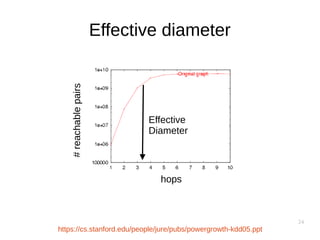
● effective diameter: upper bound of the shortest path of
90% of the pairs of vertices.
● average shortest path : average of the shortest paths over
all pairs of vertices.
● characteristic path length : median of the shortest paths
over all pairs of vertices.
● hop-plots : plot of |Nh(u)|, the number of neighbors of u at
distance at most h, as a function of h [Faloutsos et al.,
1999]
24
Effective diameter
hops
Effective
Diameter
#reachablepairs
https://cs.stanford.edu/people/jure/pubs/powergrowth-kdd05.ppt
27
Temporal evolution of graphs
● Jure Leskovec, Jon Kleinberg, and Christos
Faloutsos: “Graphs over time: densification
laws, shrinking diameters and possible
explanations.” In KDD 2005. [DOI][Slides]
● Two main findings:
– Diameter tends to shrink
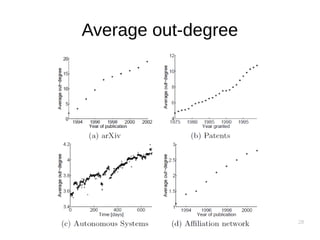
– Average degree tends to increase
28
Average out-degree
29
Temporal Evolution of the Graphs
●
Densification Power Law
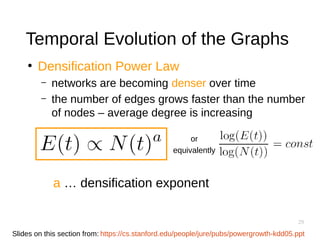
– networks are becoming denser over time
– the number of edges grows faster than the number
of nodes – average degree is increasing
a … densification exponent
or
equivalently
https://cs.stanford.edu/people/jure/pubs/powergrowth-kdd05.pptSlides on this section from:
30
Graph Densification – A closer look
●
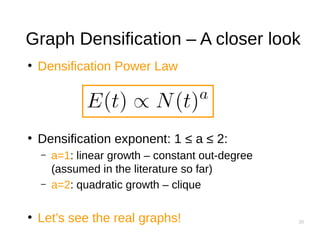
Densification Power Law
●
Densification exponent: 1 ≤ a ≤ 2:
– a=1: linear growth – constant out-degree
(assumed in the literature so far)
– a=2: quadratic growth – clique
●
Let’s see the real graphs!
31
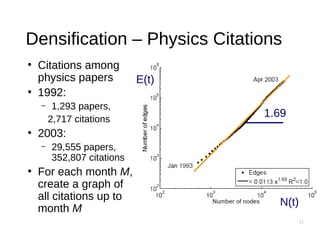
Densification – Physics Citations
●
Citations among
physics papers
●
1992:
– 1,293 papers,
2,717 citations
●
2003:
– 29,555 papers,
352,807 citations
●
For each month M,
create a graph of
all citations up to
month M
N(t)
E(t)
1.69
32
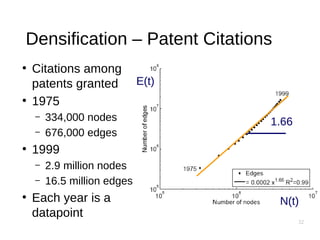
Densification – Patent Citations
●
Citations among
patents granted
●
1975
– 334,000 nodes
– 676,000 edges
●
1999
– 2.9 million nodes
– 16.5 million edges
●
Each year is a
datapoint
N(t)
E(t)
1.66
33
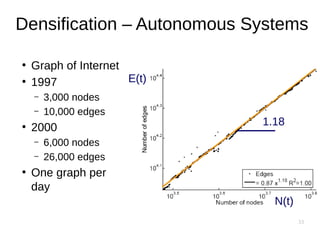
Densification – Autonomous Systems
●
Graph of Internet
●
1997
– 3,000 nodes
– 10,000 edges
●
2000
– 6,000 nodes
– 26,000 edges
●
One graph per
day
N(t)
E(t)
1.18
34
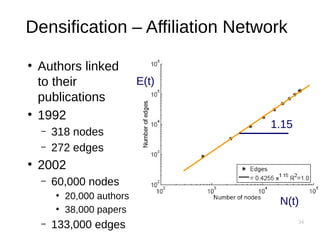
Densification – Affiliation Network
●
Authors linked
to their
publications
●
1992
– 318 nodes
– 272 edges
●
2002
– 60,000 nodes
●
20,000 authors
●
38,000 papers
– 133,000 edges
N(t)
E(t)
1.15
35
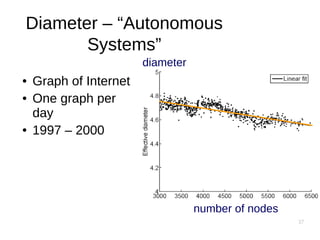
Effective diameter over time
● As the network grows, distances among nodes
slowly decrease...
36
Diameter – ArXiv citation graph
● Citations among
physics papers
● 1992 –2003
● One graph per
year
time [years]
diameter
https://cs.stanford.edu/people/jure/pubs/powergrowth-kdd05.pptSlides on this section from:
37
Diameter – “Autonomous
Systems”
● Graph of Internet
● One graph per
day
● 1997 – 2000
number of nodes
diameter
38
Diameter – “Affiliation Network”
●
Graph of
collaborations in
physics –
authors linked to
papers
●
10 years of data
time [years]
diameter
39
Diameter – “Patents”
●
Patent citation
network
●
25 years of data
time [years]
diameter
40
Other characteristics of graphs
● Giant connected component size
● Assortativity
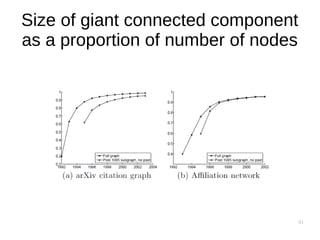
41
Size of giant connected component
as a proportion of number of nodes
42
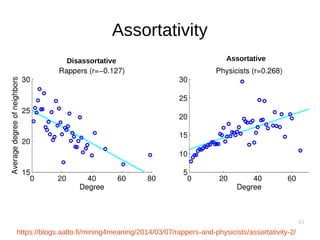
Assortativity
● “Similarly-linked people are together”
● Perfect assortativity if everyone is only
connected to people of the same degree
● Perfect disassortativity if everyone is only
connected to people of different degree
43
Assortativity
Disassortative
https://blogs.aalto.fi/mining4meaning/2014/03/07/rappers-and-physicists/assortativity-2/
Assortative
44
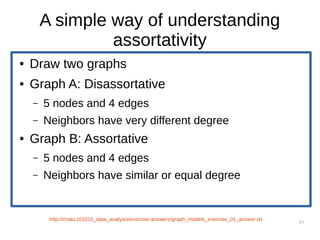
A simple way of understanding
assortativity
● Draw two graphs
● Graph A: Disassortative
– 5 nodes and 4 edges
– Neighbors have very different degree
● Graph B: Assortative
– 5 nodes and 4 edges
– Neighbors have similar or equal degree
http://chato.cl/2015_data_analysis/exercise-answers/graph_models_exercise_01_answer.txt

Graph Evolution Models

  • 1.
    Graph Models Class AlgorithmicMethods of Data Mining Program M. Sc. Data Science University Sapienza University of Rome Semester Fall 2015 Lecturer Carlos Castillo http://chato.cl/ Sources: ● Frieze, Gionis, Tsourakakis: “Algorithmic techniques for modeling and mining large graphs (AMAzING)” [Tutorial] ● Lada Adamic: Zipf, Power-Laws and Pareto [Tutorial] ● Giorgios Cheliotis: Social Network Analysis [Tutorial]
  • 2.
    2 Network characteristics ● Staticnetworks – Power-law degree distribution – Small diameter ● Time-evolving networks – Densification – Shrinking diameters
  • 3.
  • 4.
    4 Degree distribution ● Ck= number of elements with degree k
  • 5.
    5 Power-law degree distribution ●In a log-log plot, this looks like a straight line, descending with slope γ
  • 6.
    6 Power-law degree distribution https://cs.stanford.edu/people/jure/pubs/powergrowth-kdd05.ppt ●Power Law log(Count) vs. log(Degree) Many low- degree nodes Few high- degree nodes Internet in December 1998
  • 7.
    7 Power law appearin a wide variety of networks
  • 8.
    8 Example power-law networks ●Social networks – collaboration of movie actors in films – co-authorship by mathematicians of papers ● Internet router ● Web graphs ● Interbank payment networks ● Protein-protein interaction networks ● Semantic networks ● Airline networks https://en.wikipedia.org/wiki/Scale-free_network#Examples
  • 9.
    9 Try it! ● Createa dataset of numbers having a power-law degree distribution with gamma=1 (or show how to construct one) ● Create a graph having this sequence of degrees
  • 10.
    10 Estimating the exponent ●Option 1: draw the log-log plot and fit a line using least squares ● Option 2: Hill's estimator
  • 11.
    11 Example (in OpenOfficeCalc) x Cx 1 128 2 64 4 32 8 16 16 8 32 4 64 2 128 1 Actual value = 1.0 Hill's estimator = 1.31 in this case http://chato.cl/2015/data_analysis/09_graph_models/hills-estimator-example.ods
  • 12.
    12 Degree distribution isimportant but obviously isn't everything ● All these graphs have the same number of nodes and degree sequence
  • 13.
    13 How to obtaina power law? ● Preferential attachment is a frequently-used model for graph evolution ● At every time step, a new node arrives and connects to existing nodes with probability proportional to their degree
  • 14.
  • 15.
    15 The copy modelof graph evolution Suggested as a model of WWW growth. Input: parameter α At each timestep: – create a new vertex t + 1 – choose an existing vertex u V∈ t-1 uniformly at random – the i-th out-link of t + 1 is chosen as follows: ● with probability α we select x V∈ t−1 uniformly at random, and ● with probability 1 – α it copies the i-th out-link of u Produces power-law distribution AND a large number of bipartite cliques Kumar, R., Raghavan, P., Rajagopalan, S., Sivakumar, D., Tomkins, A., and Upfal, E.: Stochastic models for the web graph. FOCS 2000.
  • 16.
  • 17.
    17 Why does thishappen? MTV Italia 31-Oct-2015
  • 18.
    18 An experiment ● MatthewJ. Salganik, Peter Sheridan Dodds, Duncan J. Watts: Experimental Study of Inequality and Unpredictability in an Artificial Cultural Market. Science 10 February 2006. Vol. 311 no. 5762 pp. 854-856 [link]
  • 19.
    19 Experimental conditions Experiment 1:random order with number of downloads Experiment 2: sorted by descending number of downloads Control: random order without number of downloads
  • 20.
    20 Evaluation metric: GiniCoefficient Namibia 0.61, Chile 0.50, US 0.41, Italy 0.36, Spain 0.34, Norway 0.25
  • 21.
  • 22.
  • 23.
    23 Ways to characterizediameter ● diameter: largest shortest-path over all pairs. ● effective diameter: upper bound of the shortest path of 90% of the pairs of vertices. ● average shortest path : average of the shortest paths over all pairs of vertices. ● characteristic path length : median of the shortest paths over all pairs of vertices. ● hop-plots : plot of |Nh(u)|, the number of neighbors of u at distance at most h, as a function of h [Faloutsos et al., 1999]
  • 24.
  • 25.
    27 Temporal evolution ofgraphs ● Jure Leskovec, Jon Kleinberg, and Christos Faloutsos: “Graphs over time: densification laws, shrinking diameters and possible explanations.” In KDD 2005. [DOI][Slides] ● Two main findings: – Diameter tends to shrink – Average degree tends to increase
  • 26.
  • 27.
    29 Temporal Evolution ofthe Graphs ● Densification Power Law – networks are becoming denser over time – the number of edges grows faster than the number of nodes – average degree is increasing a … densification exponent or equivalently https://cs.stanford.edu/people/jure/pubs/powergrowth-kdd05.pptSlides on this section from:
  • 28.
    30 Graph Densification –A closer look ● Densification Power Law ● Densification exponent: 1 ≤ a ≤ 2: – a=1: linear growth – constant out-degree (assumed in the literature so far) – a=2: quadratic growth – clique ● Let’s see the real graphs!
  • 29.
    31 Densification – PhysicsCitations ● Citations among physics papers ● 1992: – 1,293 papers, 2,717 citations ● 2003: – 29,555 papers, 352,807 citations ● For each month M, create a graph of all citations up to month M N(t) E(t) 1.69
  • 30.
    32 Densification – PatentCitations ● Citations among patents granted ● 1975 – 334,000 nodes – 676,000 edges ● 1999 – 2.9 million nodes – 16.5 million edges ● Each year is a datapoint N(t) E(t) 1.66
  • 31.
    33 Densification – AutonomousSystems ● Graph of Internet ● 1997 – 3,000 nodes – 10,000 edges ● 2000 – 6,000 nodes – 26,000 edges ● One graph per day N(t) E(t) 1.18
  • 32.
    34 Densification – AffiliationNetwork ● Authors linked to their publications ● 1992 – 318 nodes – 272 edges ● 2002 – 60,000 nodes ● 20,000 authors ● 38,000 papers – 133,000 edges N(t) E(t) 1.15
  • 33.
    35 Effective diameter overtime ● As the network grows, distances among nodes slowly decrease...
  • 34.
    36 Diameter – ArXivcitation graph ● Citations among physics papers ● 1992 –2003 ● One graph per year time [years] diameter https://cs.stanford.edu/people/jure/pubs/powergrowth-kdd05.pptSlides on this section from:
  • 35.
    37 Diameter – “Autonomous Systems” ●Graph of Internet ● One graph per day ● 1997 – 2000 number of nodes diameter
  • 36.
    38 Diameter – “AffiliationNetwork” ● Graph of collaborations in physics – authors linked to papers ● 10 years of data time [years] diameter
  • 37.
    39 Diameter – “Patents” ● Patentcitation network ● 25 years of data time [years] diameter
  • 38.
    40 Other characteristics ofgraphs ● Giant connected component size ● Assortativity
  • 39.
    41 Size of giantconnected component as a proportion of number of nodes
  • 40.
    42 Assortativity ● “Similarly-linked peopleare together” ● Perfect assortativity if everyone is only connected to people of the same degree ● Perfect disassortativity if everyone is only connected to people of different degree
  • 41.
  • 42.
    44 A simple wayof understanding assortativity ● Draw two graphs ● Graph A: Disassortative – 5 nodes and 4 edges – Neighbors have very different degree ● Graph B: Assortative – 5 nodes and 4 edges – Neighbors have similar or equal degree http://chato.cl/2015_data_analysis/exercise-answers/graph_models_exercise_01_answer.txt