1
Hierarchical Clustering
Class Algorithmic Methods of Data Mining
Program M. Sc. Data Science
University Sapienza University of Rome
Semester Fall 2015
Lecturer Carlos Castillo http://chato.cl/
Sources:
● Mohammed J. Zaki, Wagner Meira, Jr., Data Mining and Analysis:
Fundamental Concepts and Algorithms, Cambridge University
Press, May 2014. Chapter 14. [download]
● Evimaria Terzi: Data Mining course at Boston University
http://www.cs.bu.edu/~evimaria/cs565-13.html
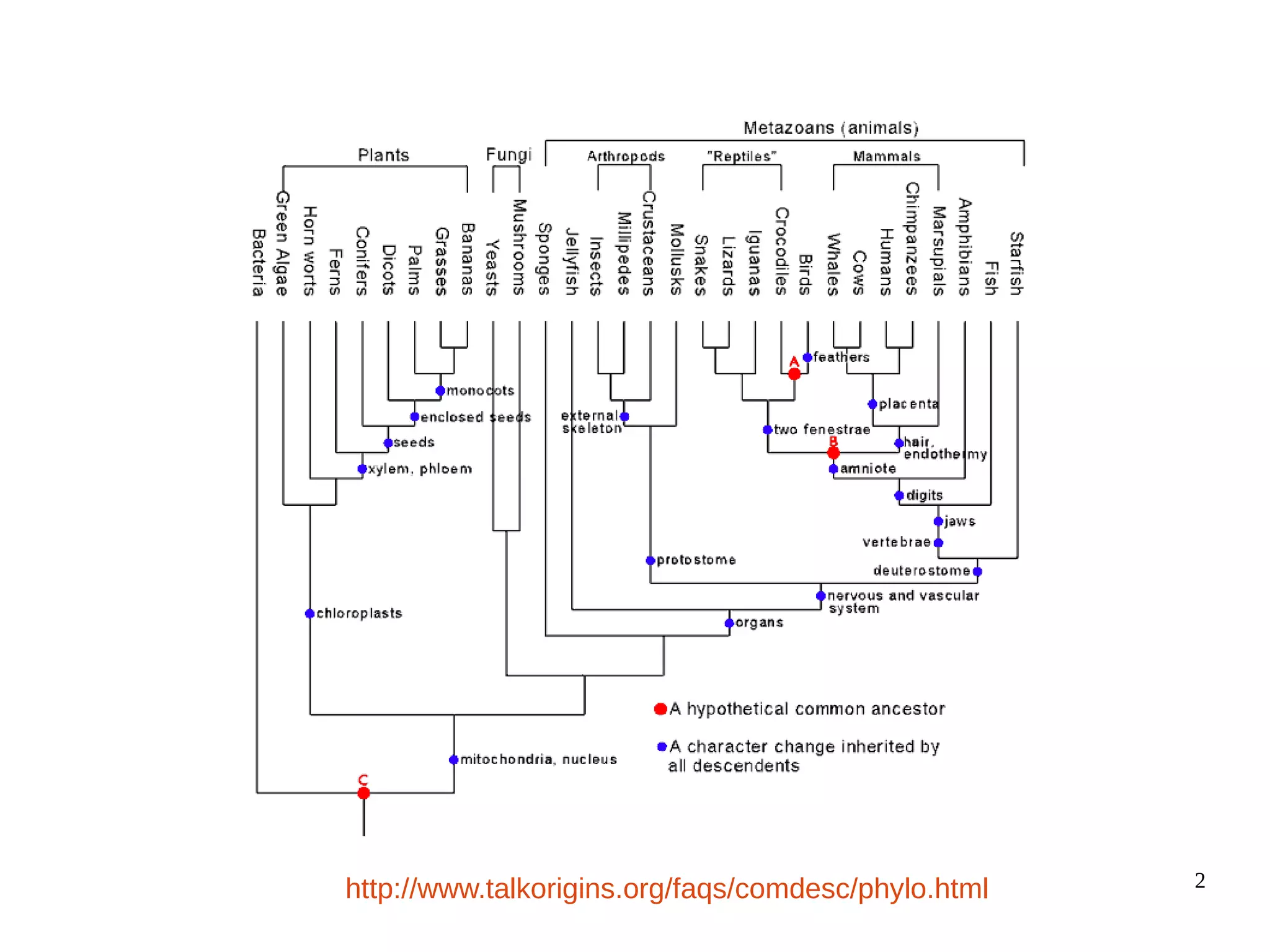
2http://www.talkorigins.org/faqs/comdesc/phylo.html
3
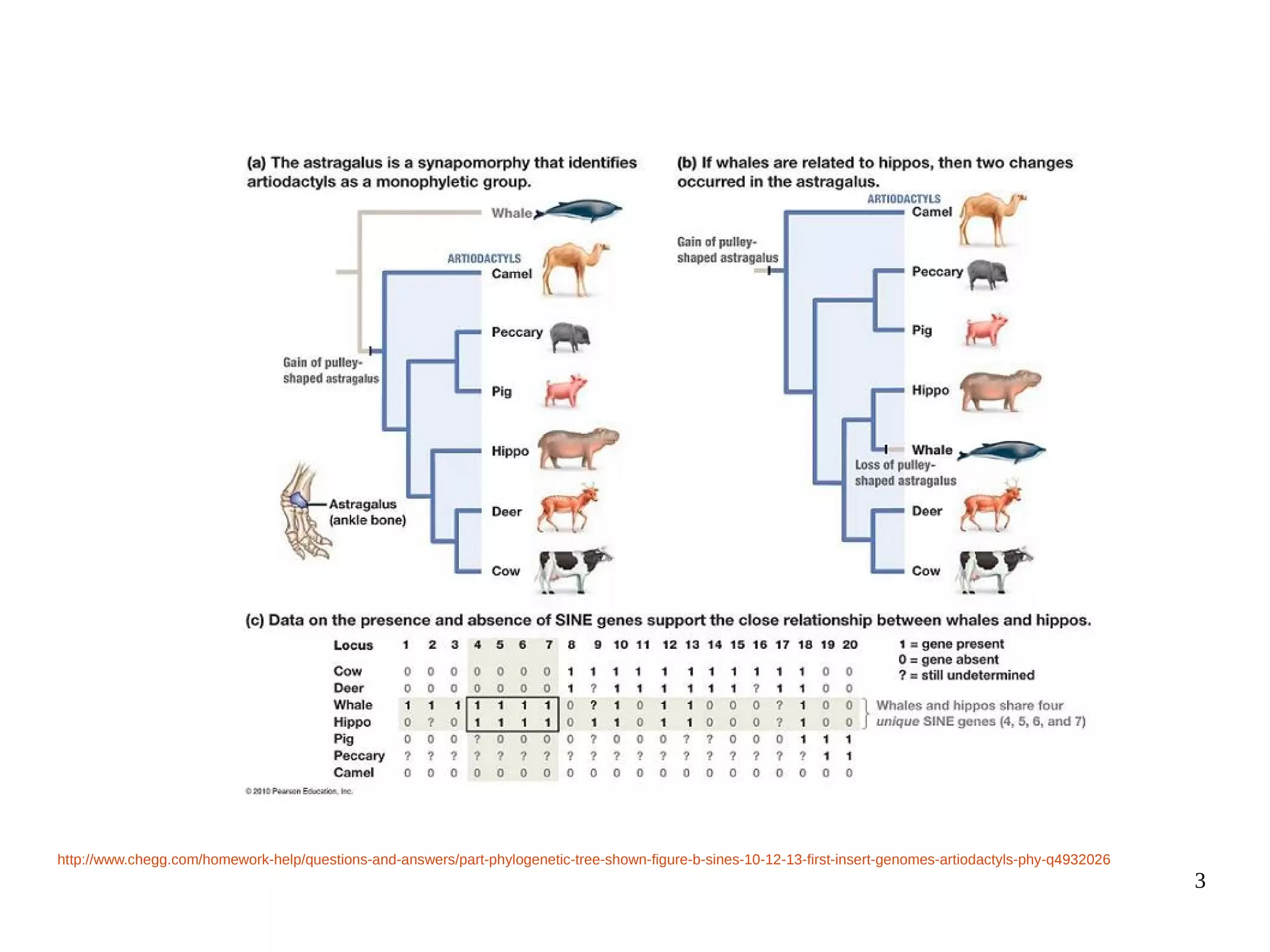
http://www.chegg.com/homework-help/questions-and-answers/part-phylogenetic-tree-shown-figure-b-sines-10-12-13-first-insert-genomes-artiodactyls-phy-q4932026
Hierarchical Clustering
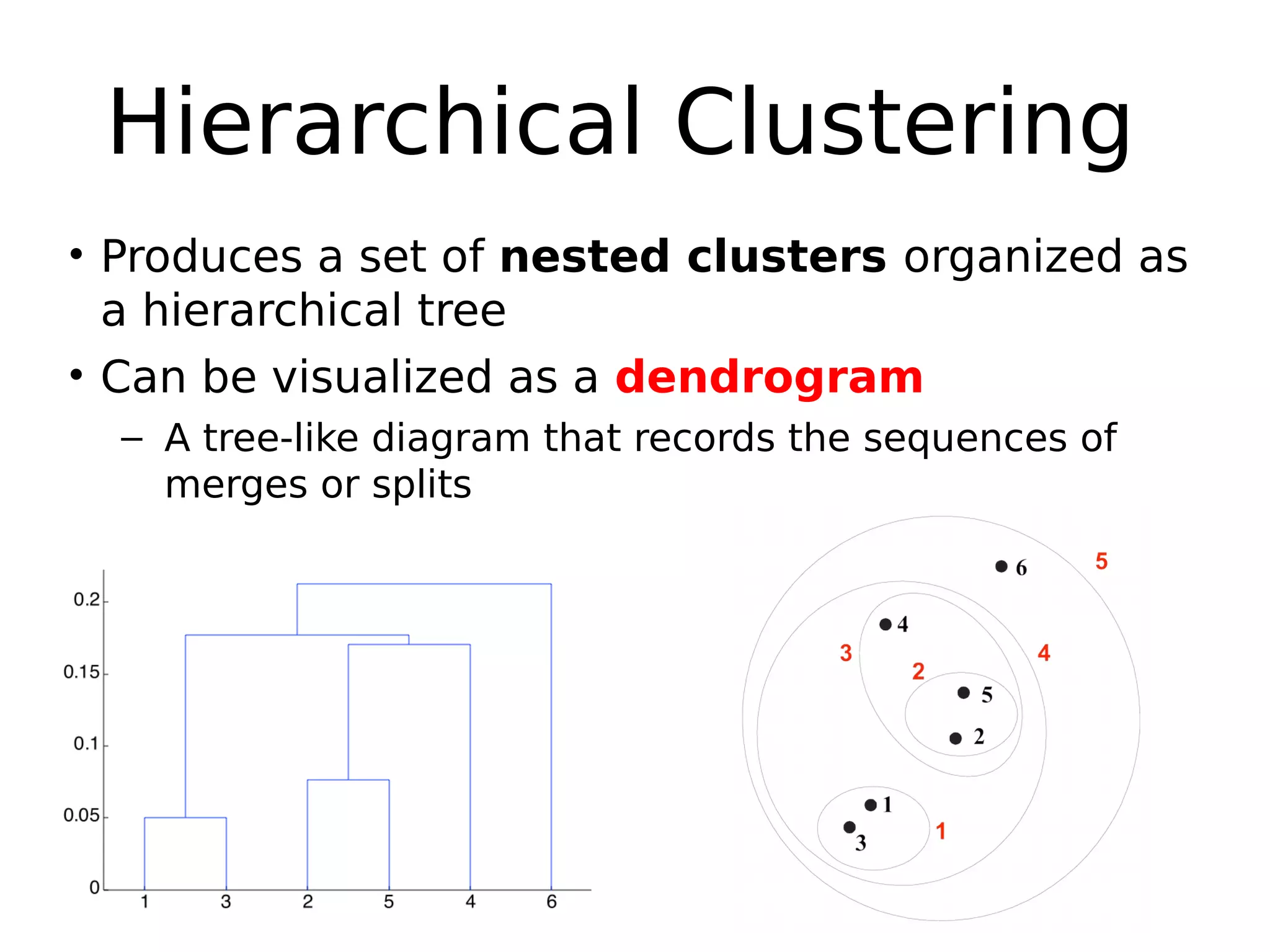
• Produces a set of nested clusters organized as
a hierarchical tree
• Can be visualized as a dendrogram
– A tree-like diagram that records the sequences of
merges or splits
Strengths of Hierarchical
Clustering
• No assumptions on the number of clusters
– Any desired number of clusters can be obtained by
‘cutting’ the dendogram at the proper level
• Hierarchical clusterings may correspond to
meaningful taxonomies
– Example in biological sciences (e.g., phylogeny
reconstruction, etc), web (e.g., product catalogs) etc
Hierarchical Clustering
Algorithms
• Two main types of hierarchical clustering
– Agglomerative:
• Start with the points as individual clusters
• At each step, merge the closest pair of clusters until only one cluster
(or k clusters) left
– Divisive:
• Start with one, all-inclusive cluster
• At each step, split a cluster until each cluster contains a point (or
there are k clusters)
• Traditional hierarchical algorithms use a similarity or
distance matrix
– Merge or split one cluster at a time
Complexity of hierarchical
clustering
• Distance matrix is used for deciding which
clusters to merge/split
• At least quadratic in the number of data points
• Not usable for large datasets
Agglomerative clustering algorithm
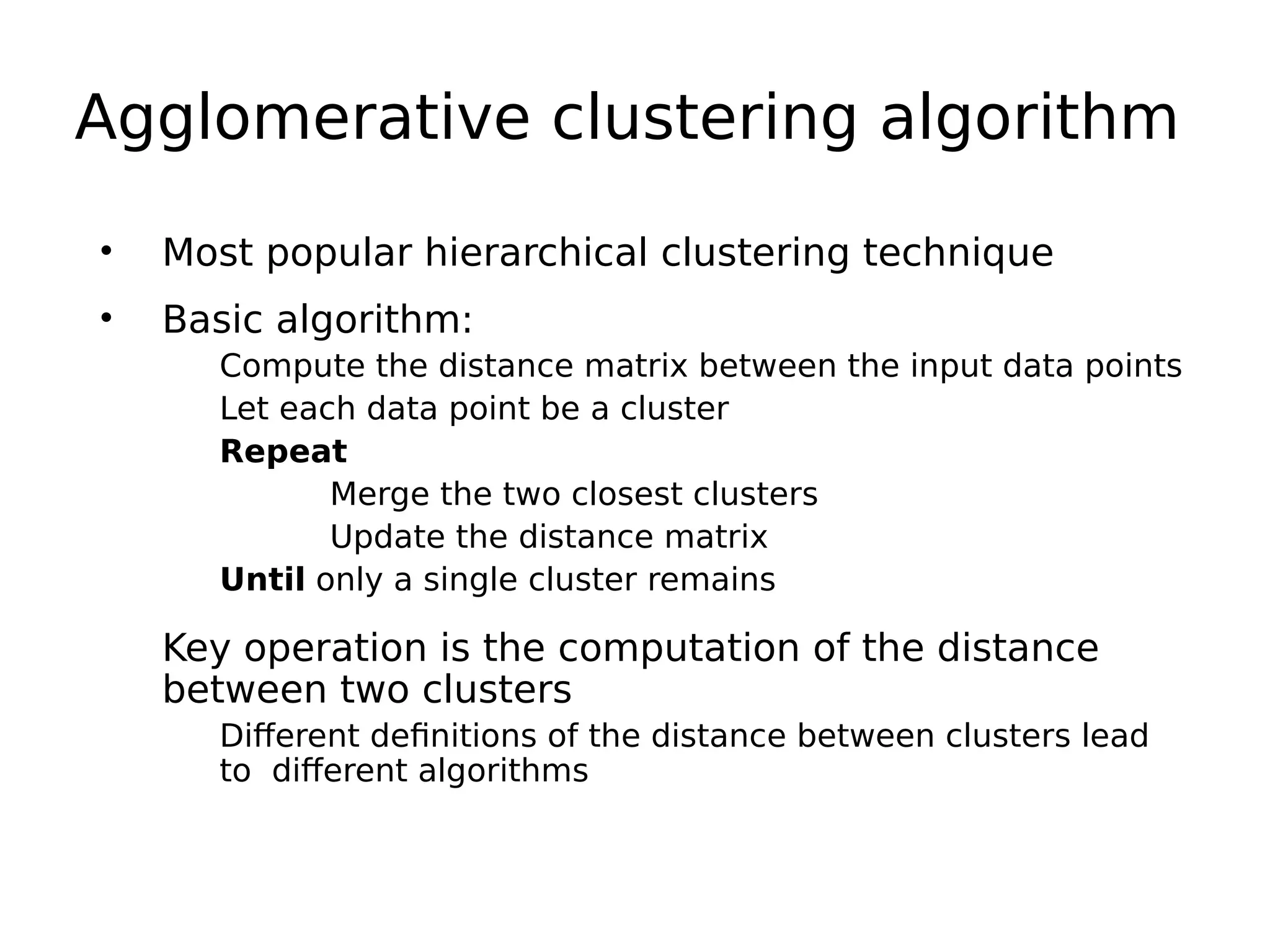
• Most popular hierarchical clustering technique
• Basic algorithm:
Compute the distance matrix between the input data points
Let each data point be a cluster
Repeat
Merge the two closest clusters
Update the distance matrix
Until only a single cluster remains
Key operation is the computation of the distance
between two clusters
Different definitions of the distance between clusters lead
to different algorithms
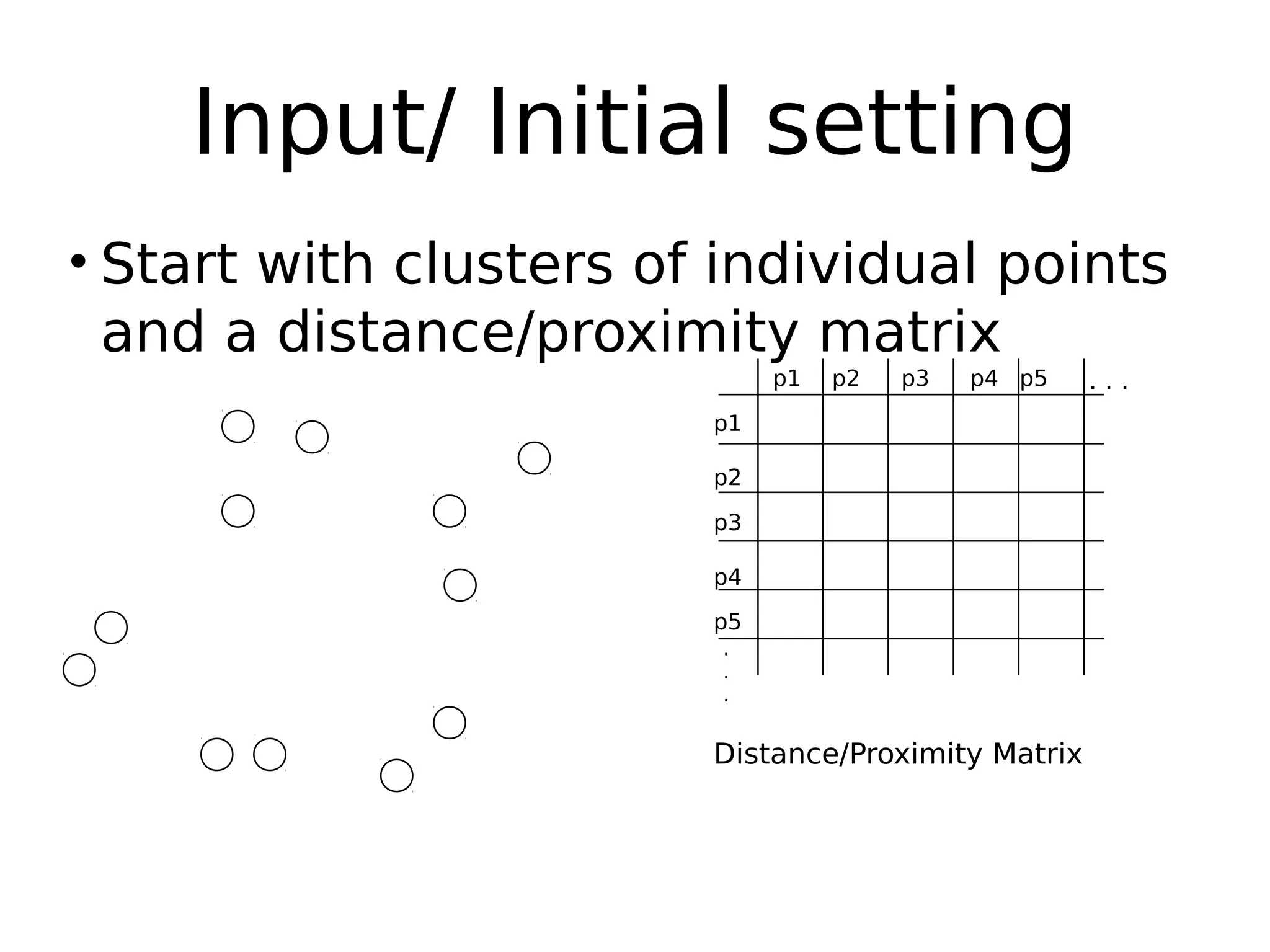
Input/ Initial setting
• Start with clusters of individual points
and a distance/proximity matrix
p1
p3
p5
p4
p2
p1 p2 p3 p4 p5 . . .
.
.
.
Distance/Proximity Matrix
Intermediate State
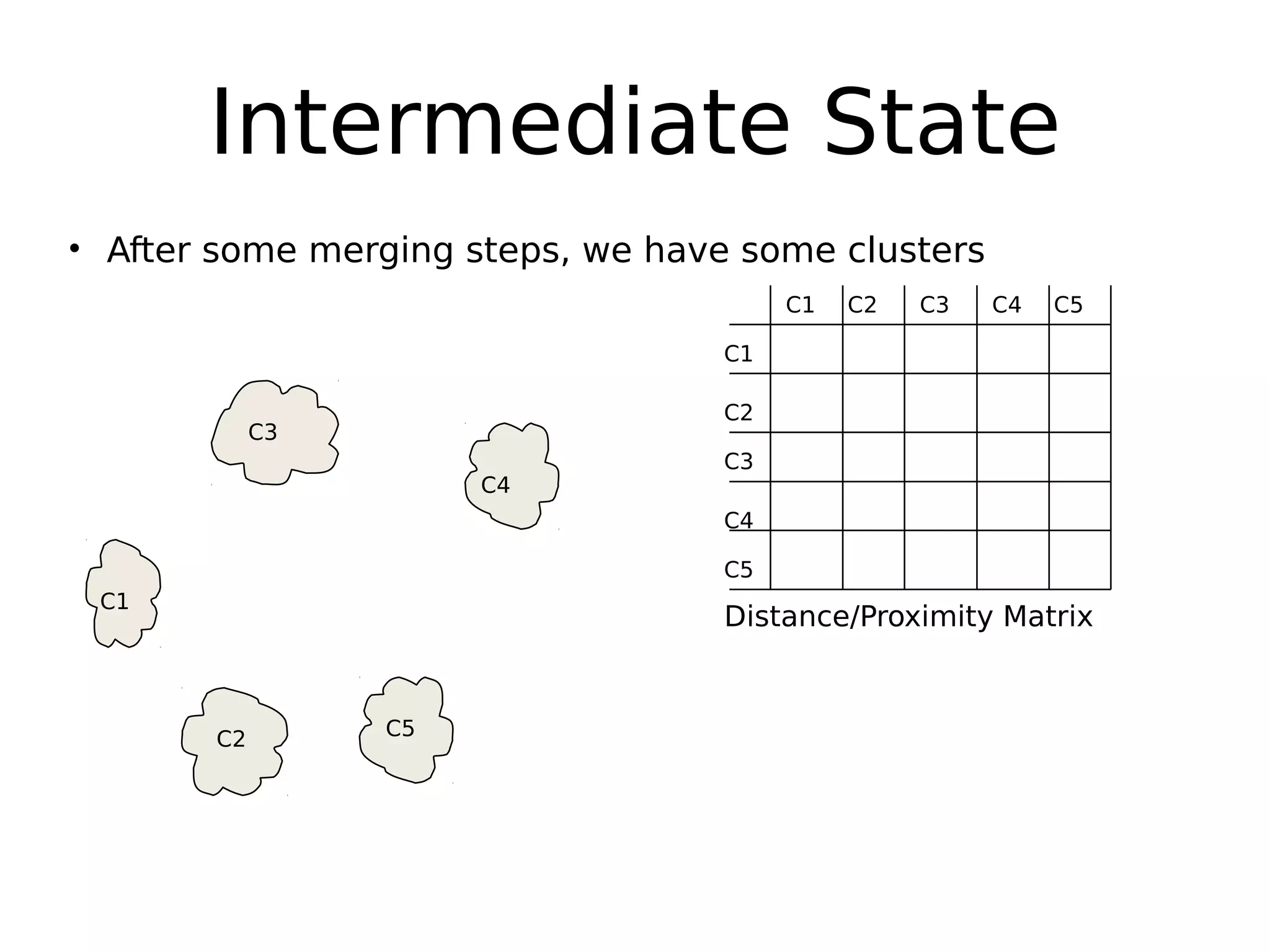
• After some merging steps, we have some clusters
C1
C4
C2 C5
C3
C2C1
C1
C3
C5
C4
C2
C3 C4 C5
Distance/Proximity Matrix
Intermediate State
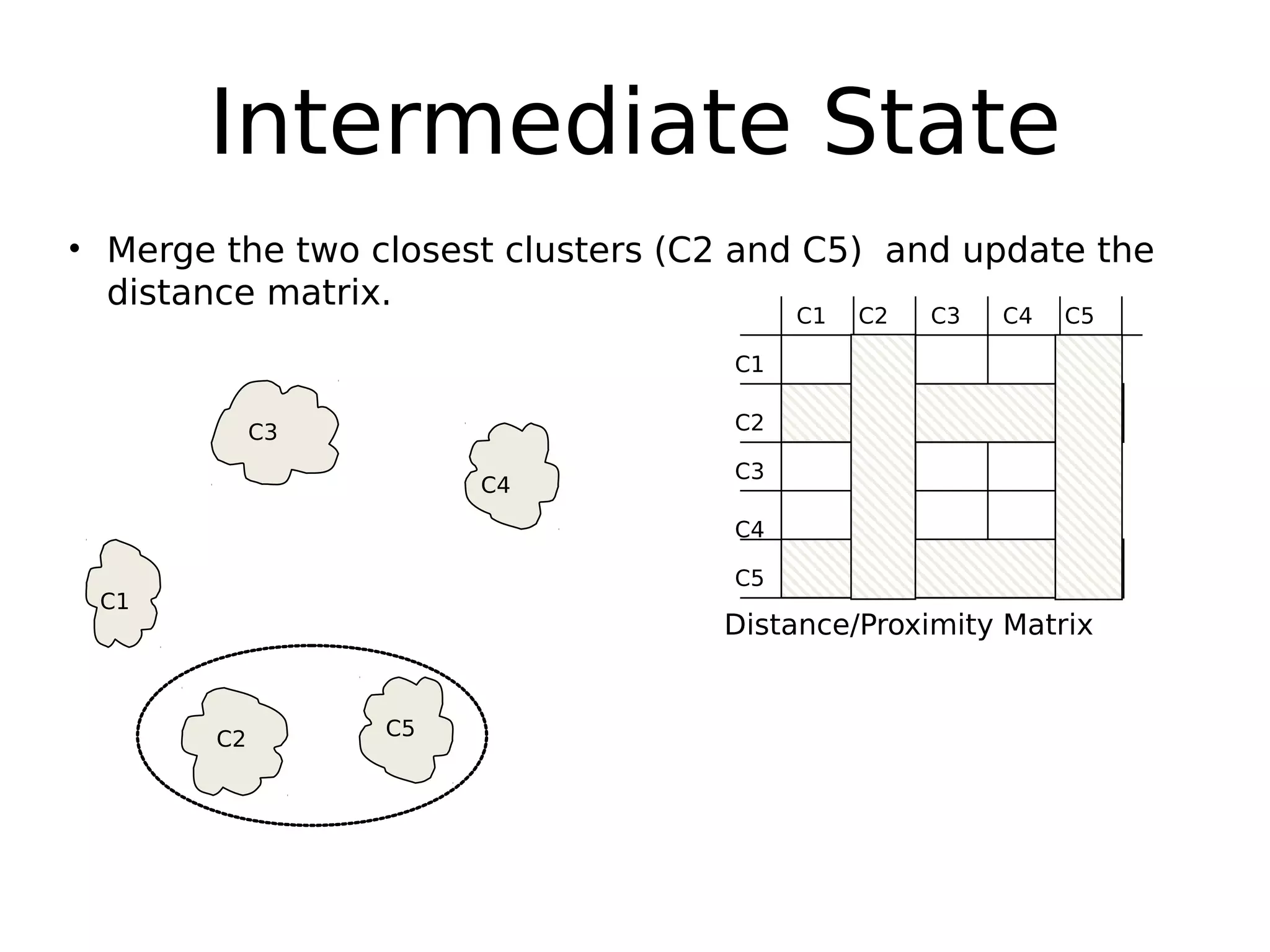
• Merge the two closest clusters (C2 and C5) and update the
distance matrix.
C1
C4
C2 C5
C3
C2C1
C1
C3
C5
C4
C2
C3 C4 C5
Distance/Proximity Matrix
After Merging
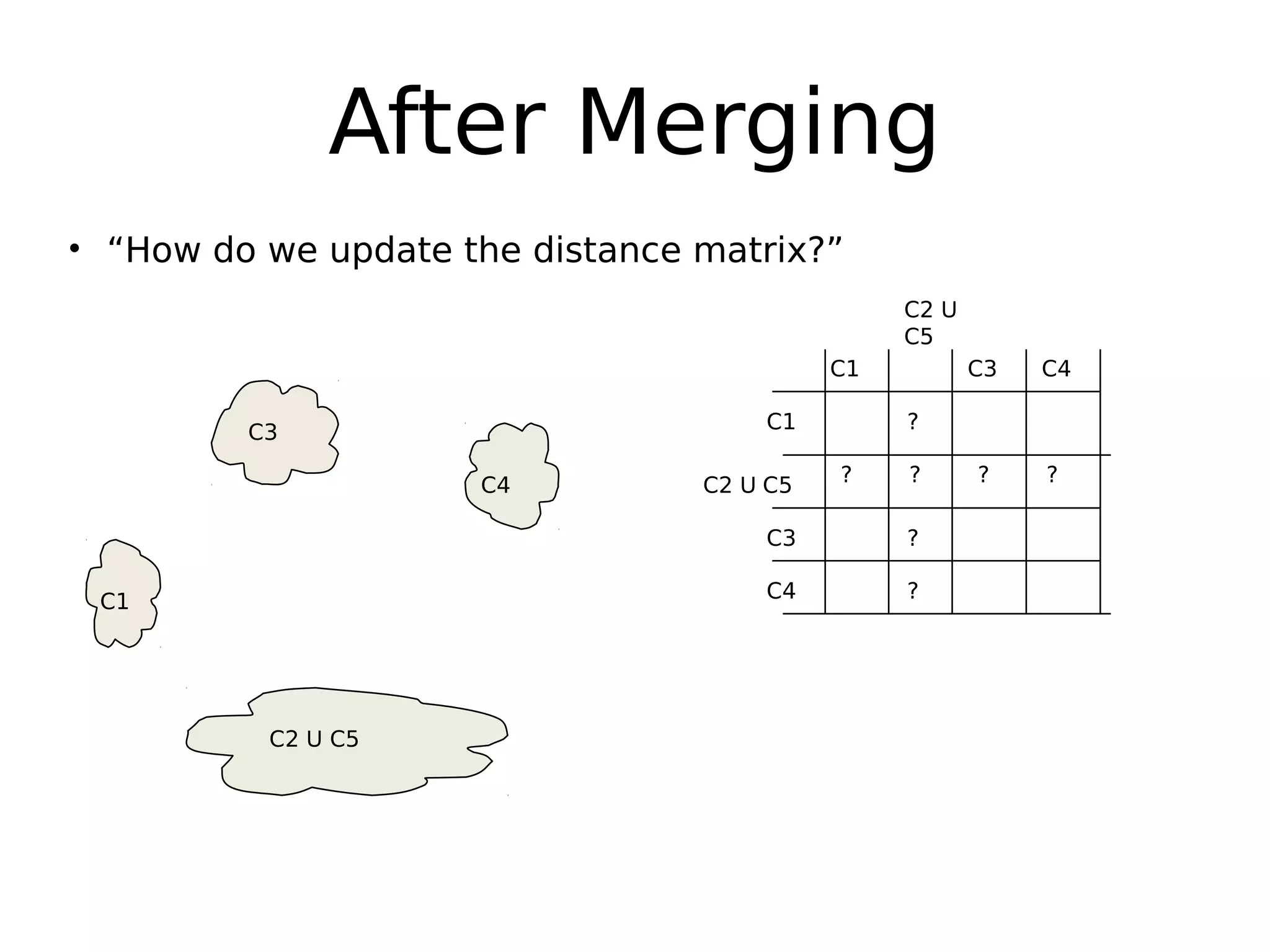
• “How do we update the distance matrix?”
C1
C4
C2 U C5
C3
? ? ? ?
?
?
?
C2 U
C5
C1
C1
C3
C4
C2 U C5
C3 C4
Distance between two
clusters
• Each cluster is a set of points
• How do we define distance between
two sets of points
– Lots of alternatives
– Not an easy task
Distance between two
clusters
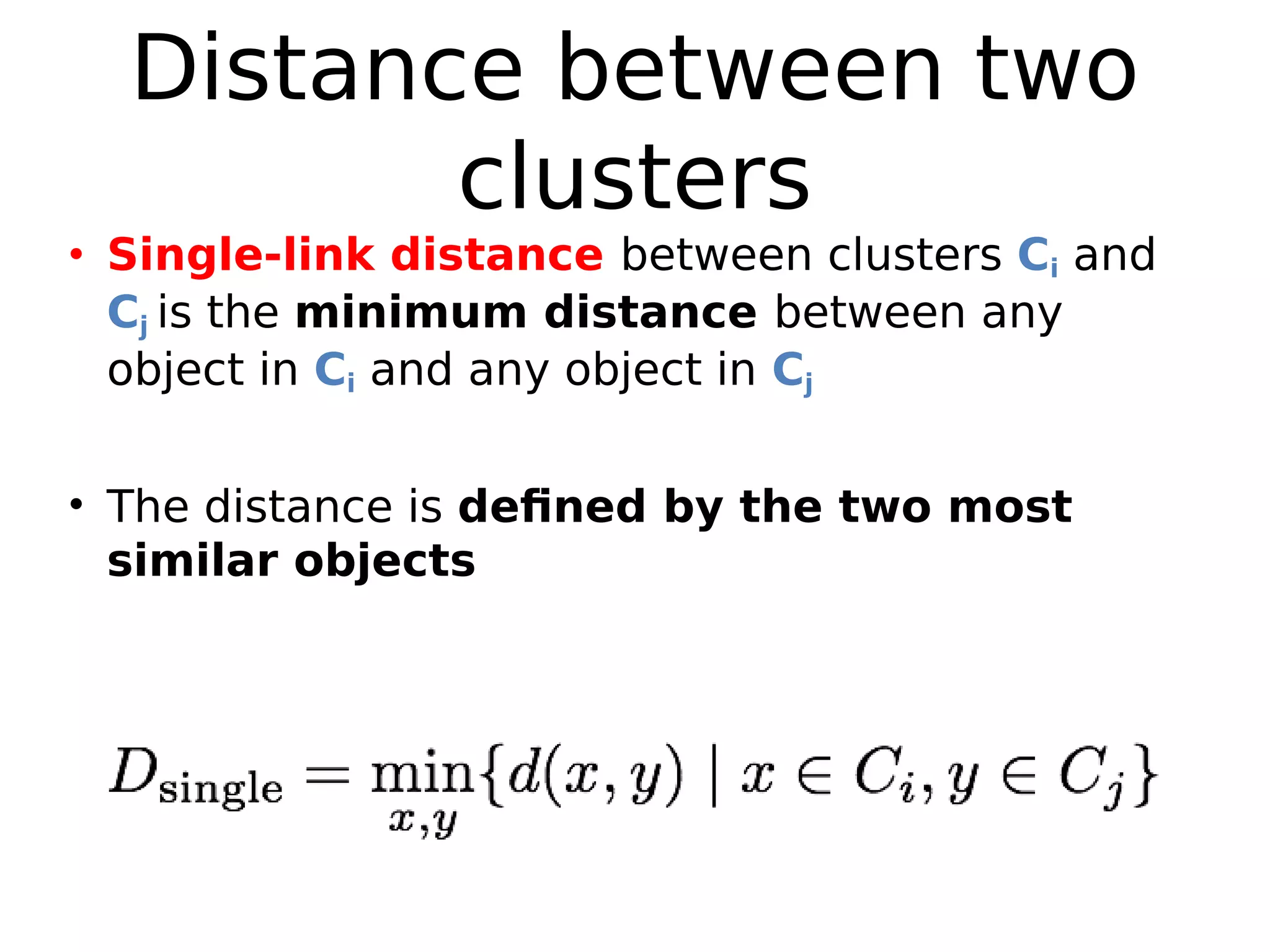
• Single-link distance between clusters Ci and
Cj is the minimum distance between any
object in Ci and any object in Cj
• The distance is defined by the two most
similar objects
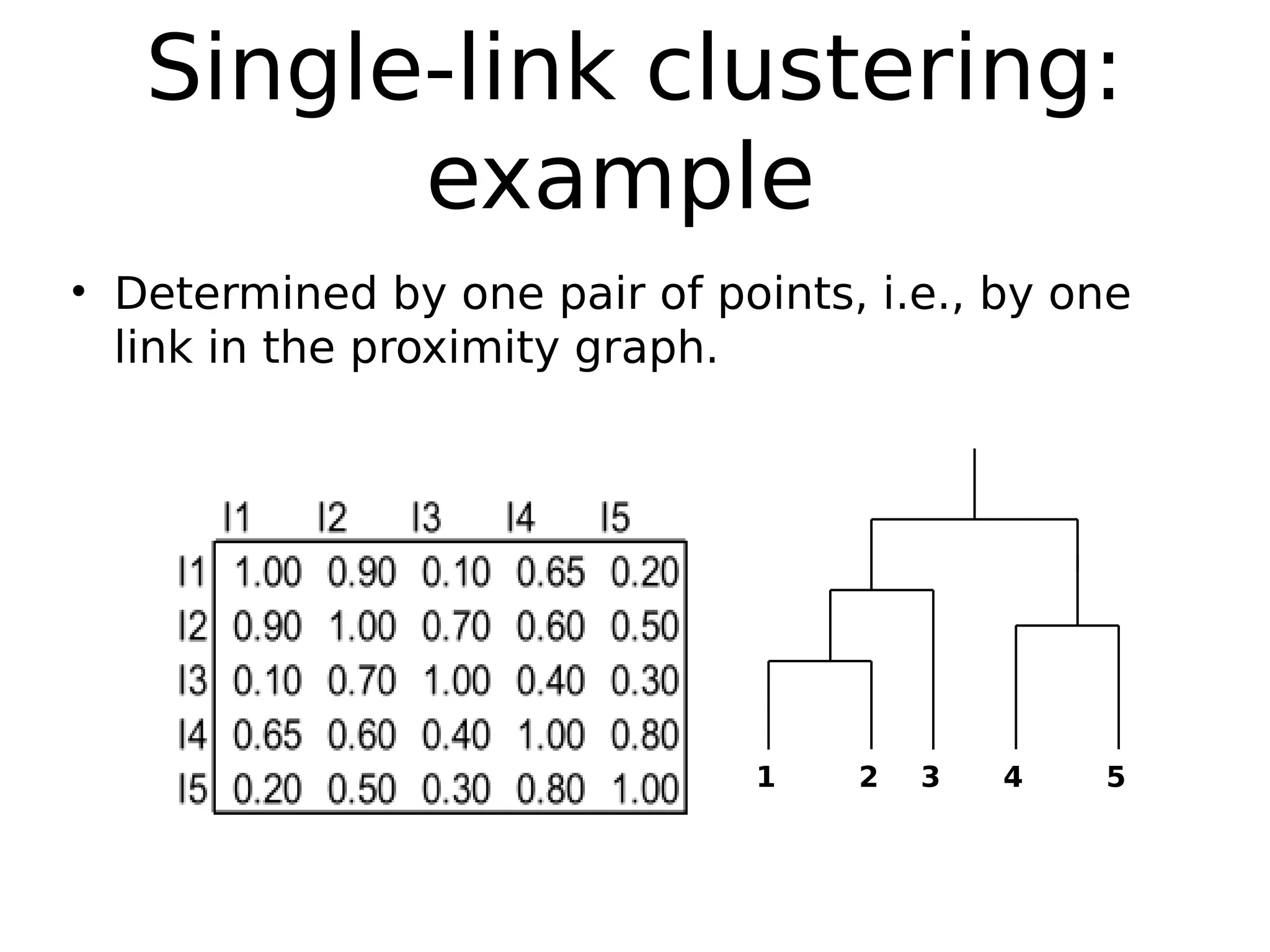
Single-link clustering:
example
• Determined by one pair of points, i.e., by one
link in the proximity graph.
1 2 3 4 5
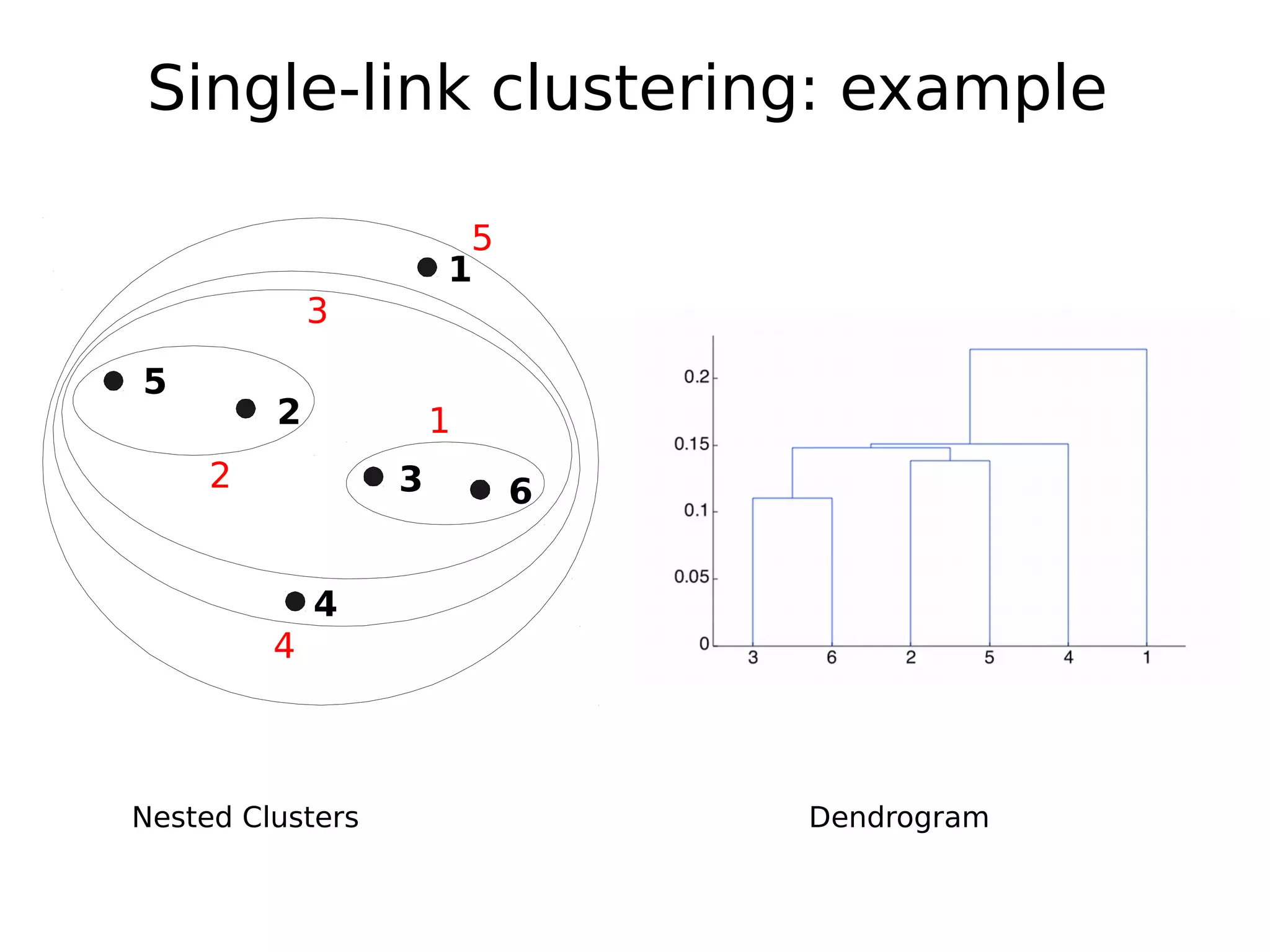
Single-link clustering: example
Nested Clusters Dendrogram
1
2
3
4
5
6
1
2
3
4
5
17
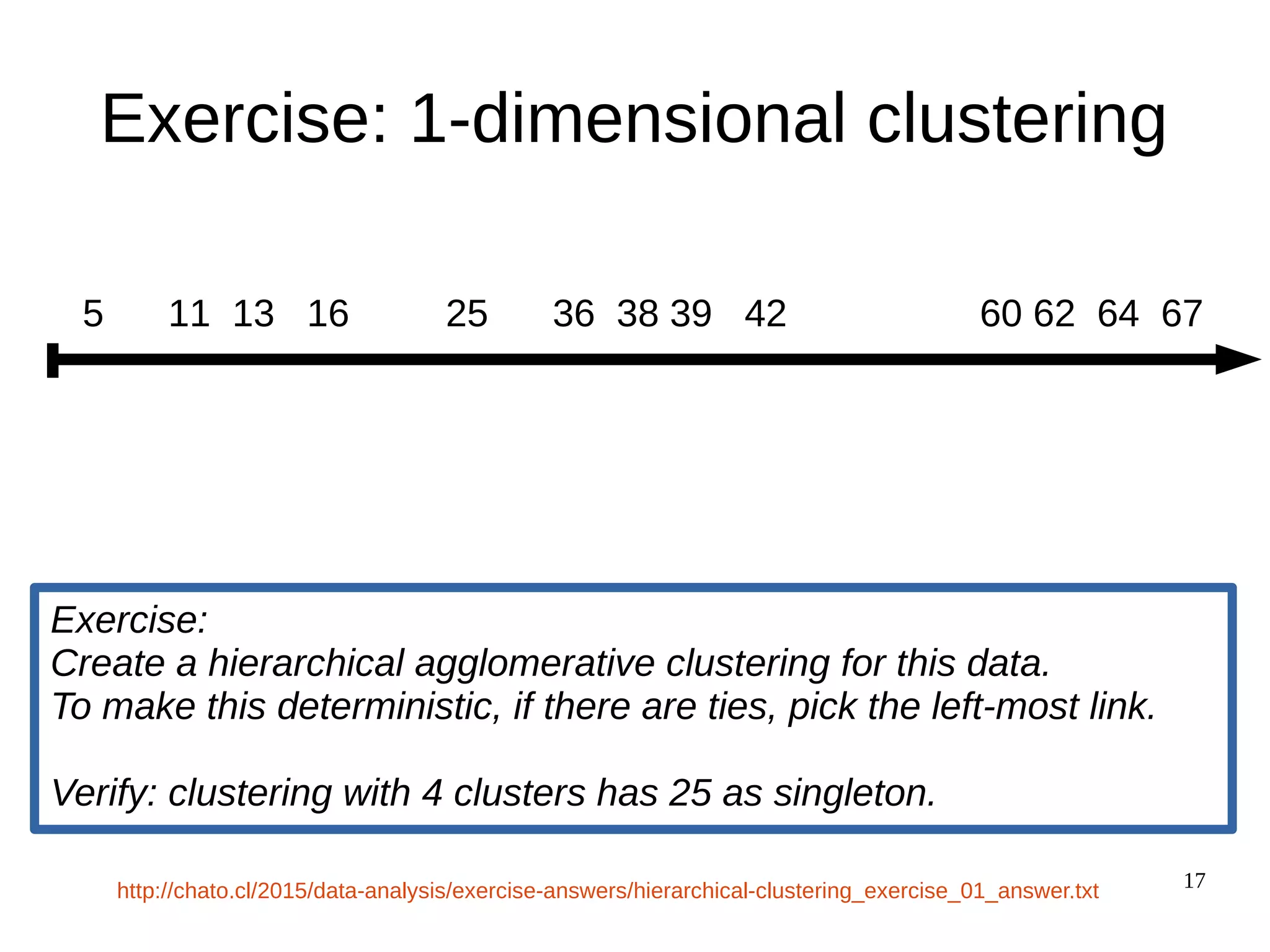
Exercise: 1-dimensional clustering
5 11 13 16 25 36 38 39 42 60 62 64 67
Exercise:
Create a hierarchical agglomerative clustering for this data.
To make this deterministic, if there are ties, pick the left-most link.
Verify: clustering with 4 clusters has 25 as singleton.
http://chato.cl/2015/data-analysis/exercise-answers/hierarchical-clustering_exercise_01_answer.txt
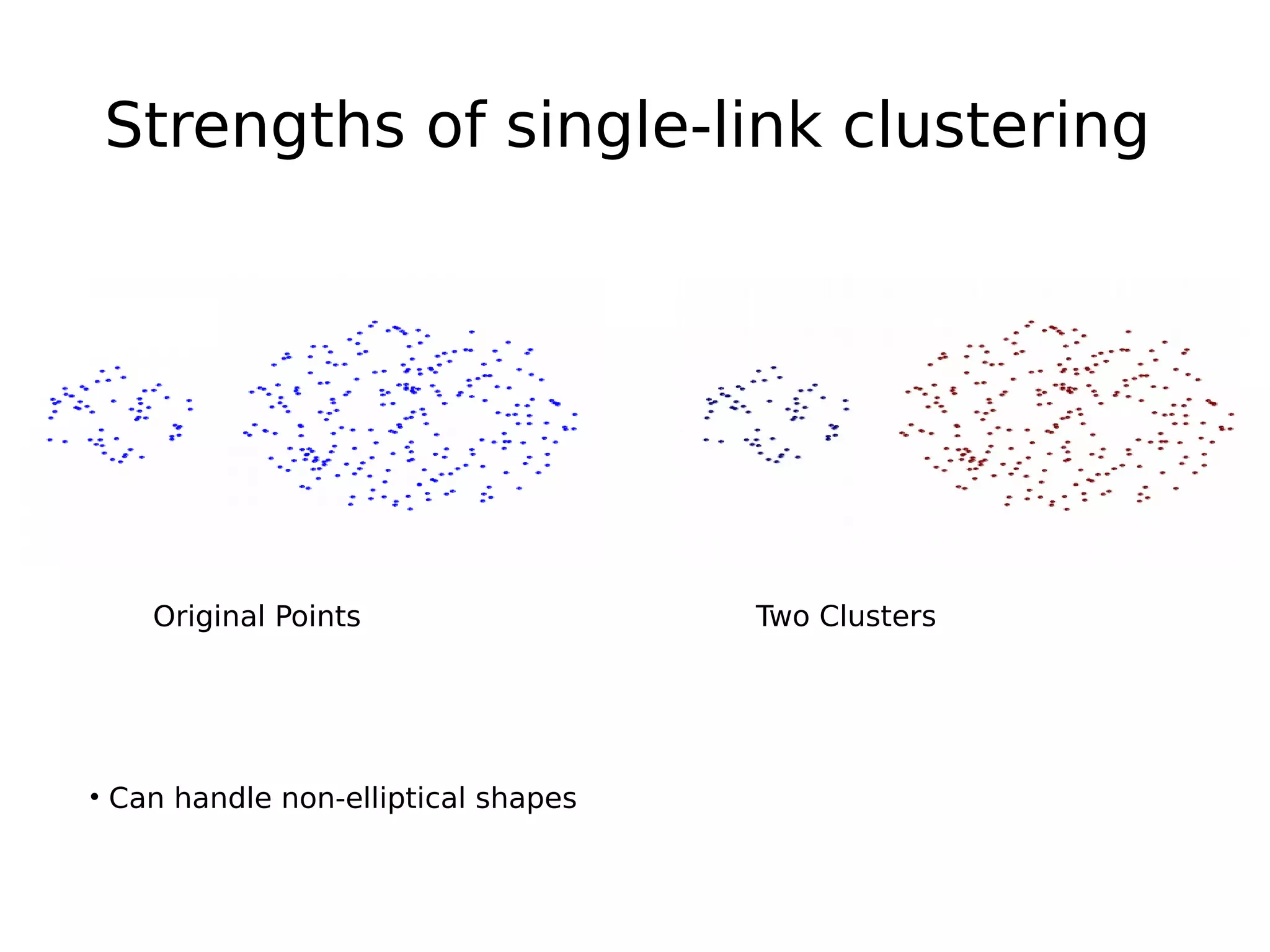
Strengths of single-link clustering
Original Points Two Clusters
• Can handle non-elliptical shapes
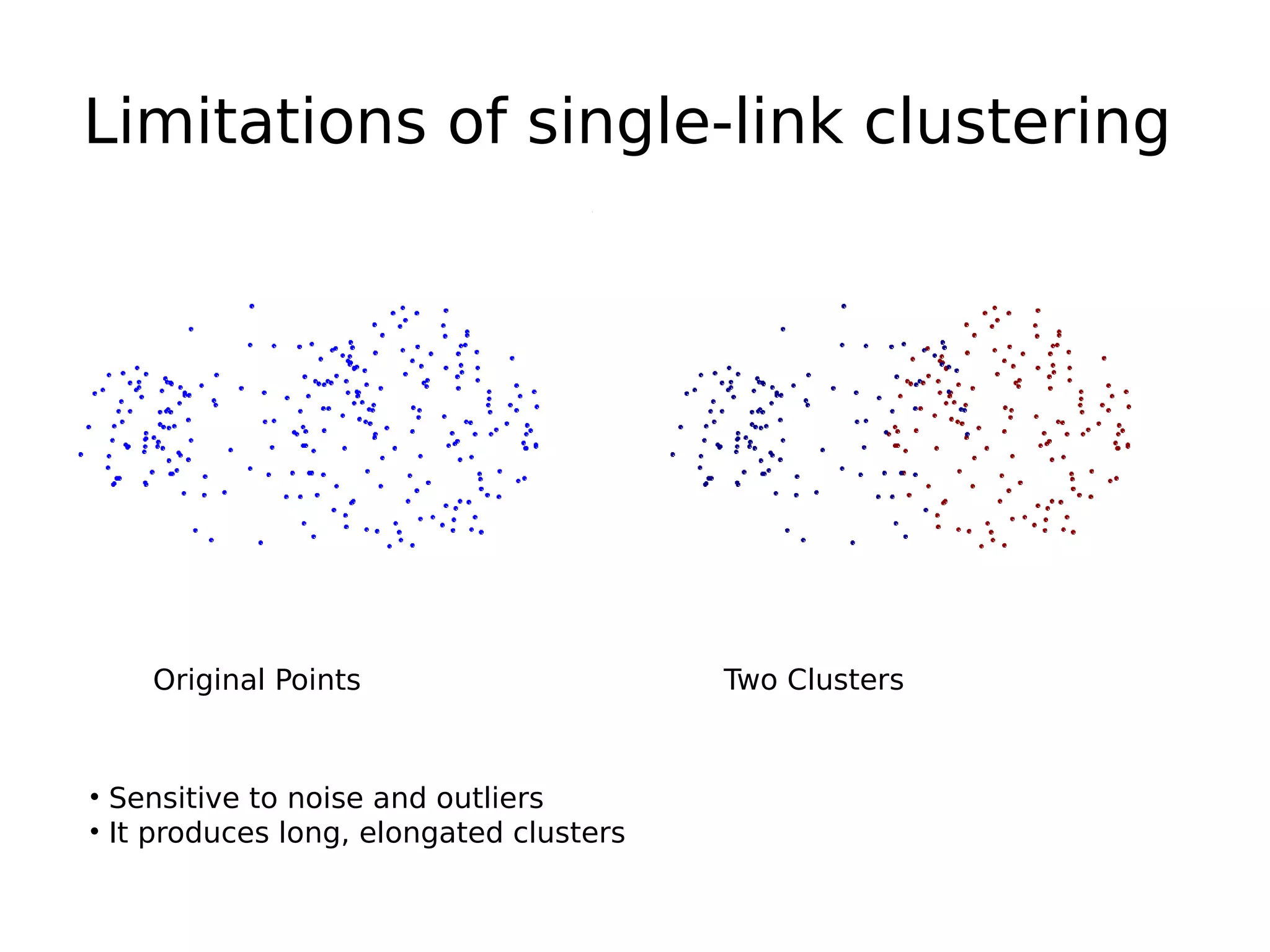
Limitations of single-link clustering
Original Points Two Clusters
• Sensitive to noise and outliers
• It produces long, elongated clusters
Distance between two
clusters
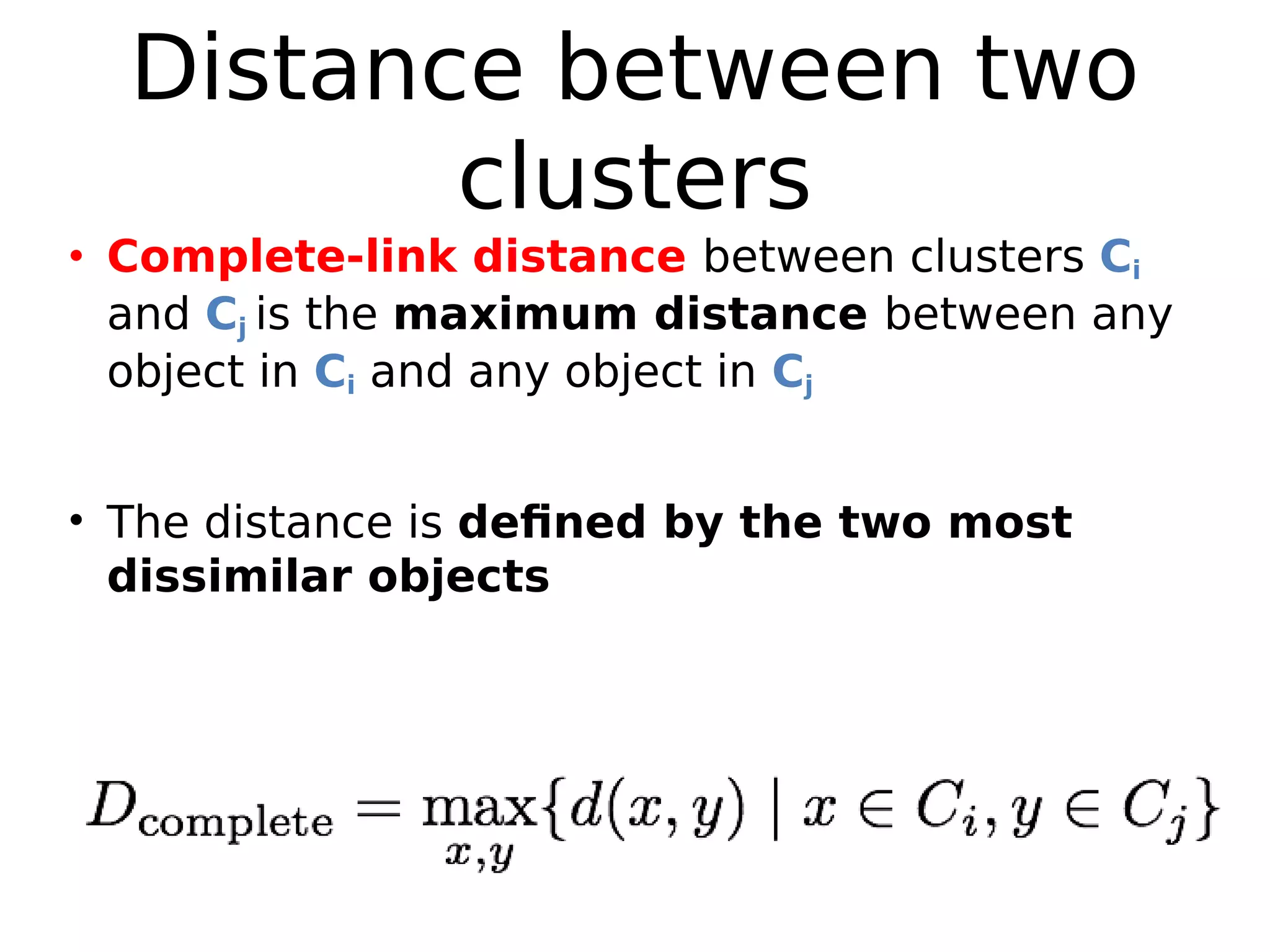
• Complete-link distance between clusters Ci
and Cj is the maximum distance between any
object in Ci and any object in Cj
• The distance is defined by the two most
dissimilar objects
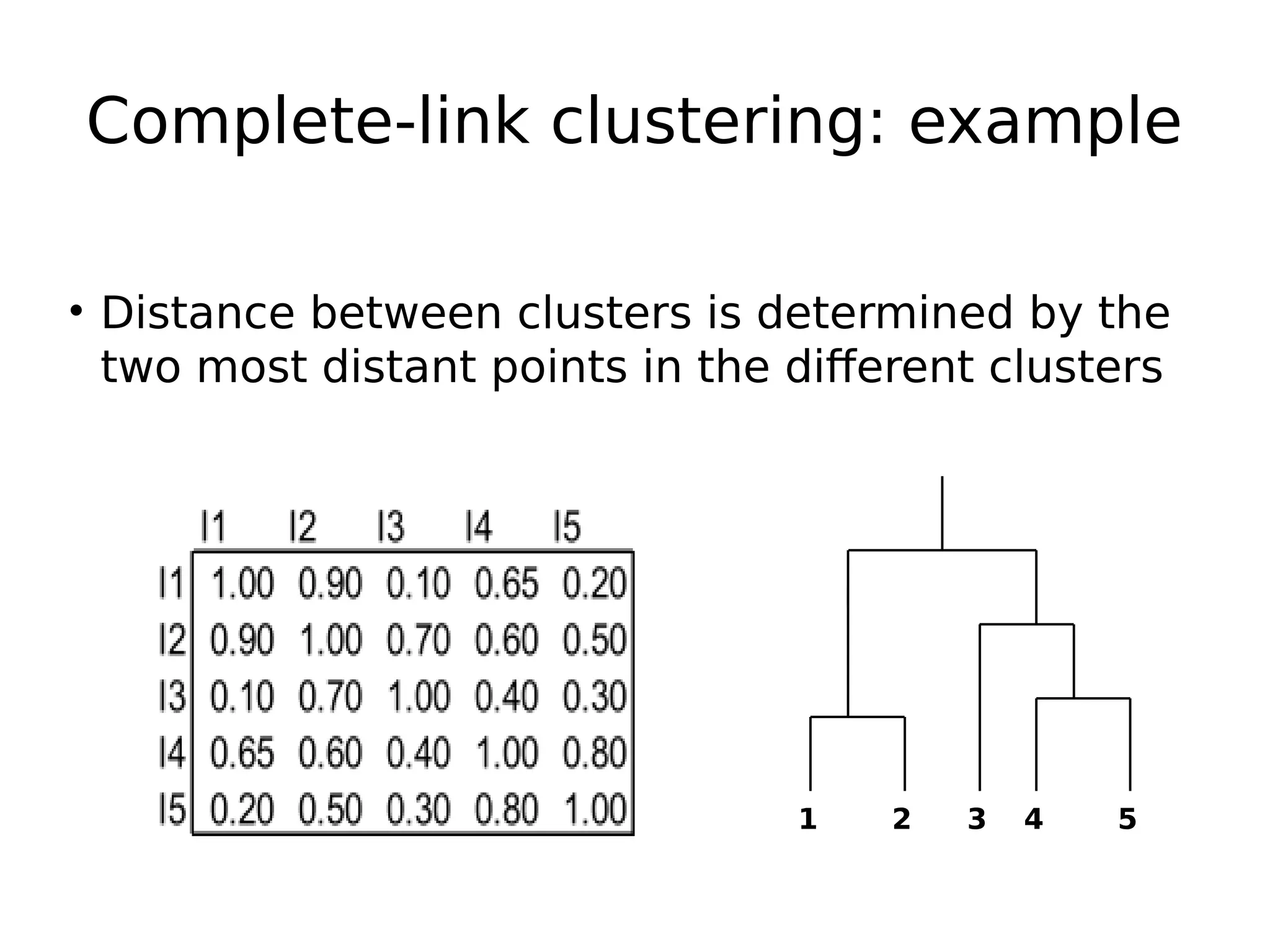
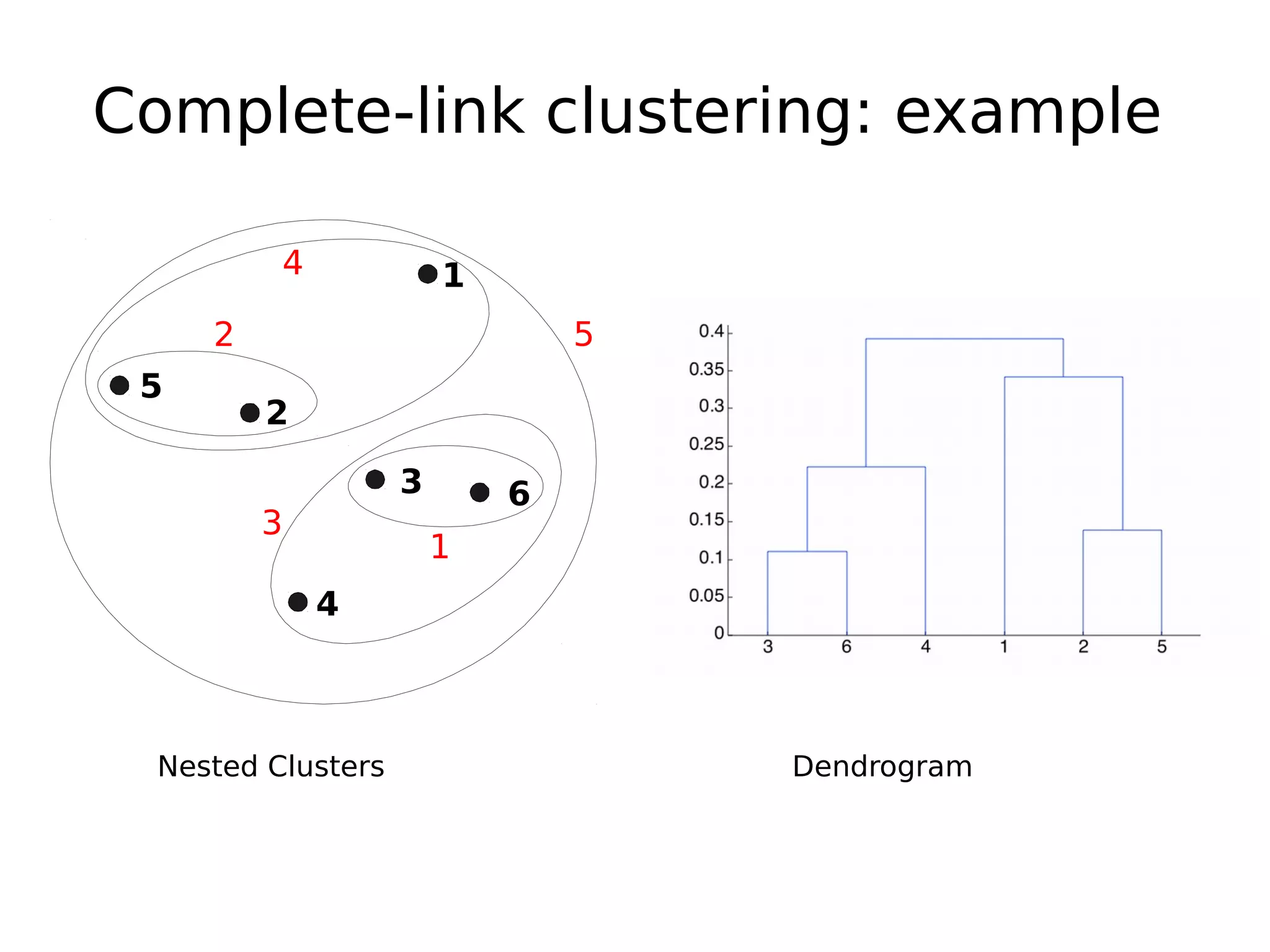
Complete-link clustering: example
• Distance between clusters is determined by the
two most distant points in the different clusters
1 2 3 4 5
Complete-link clustering: example
Nested Clusters Dendrogram
1
2
3
4
5
6
1
2 5
3
4
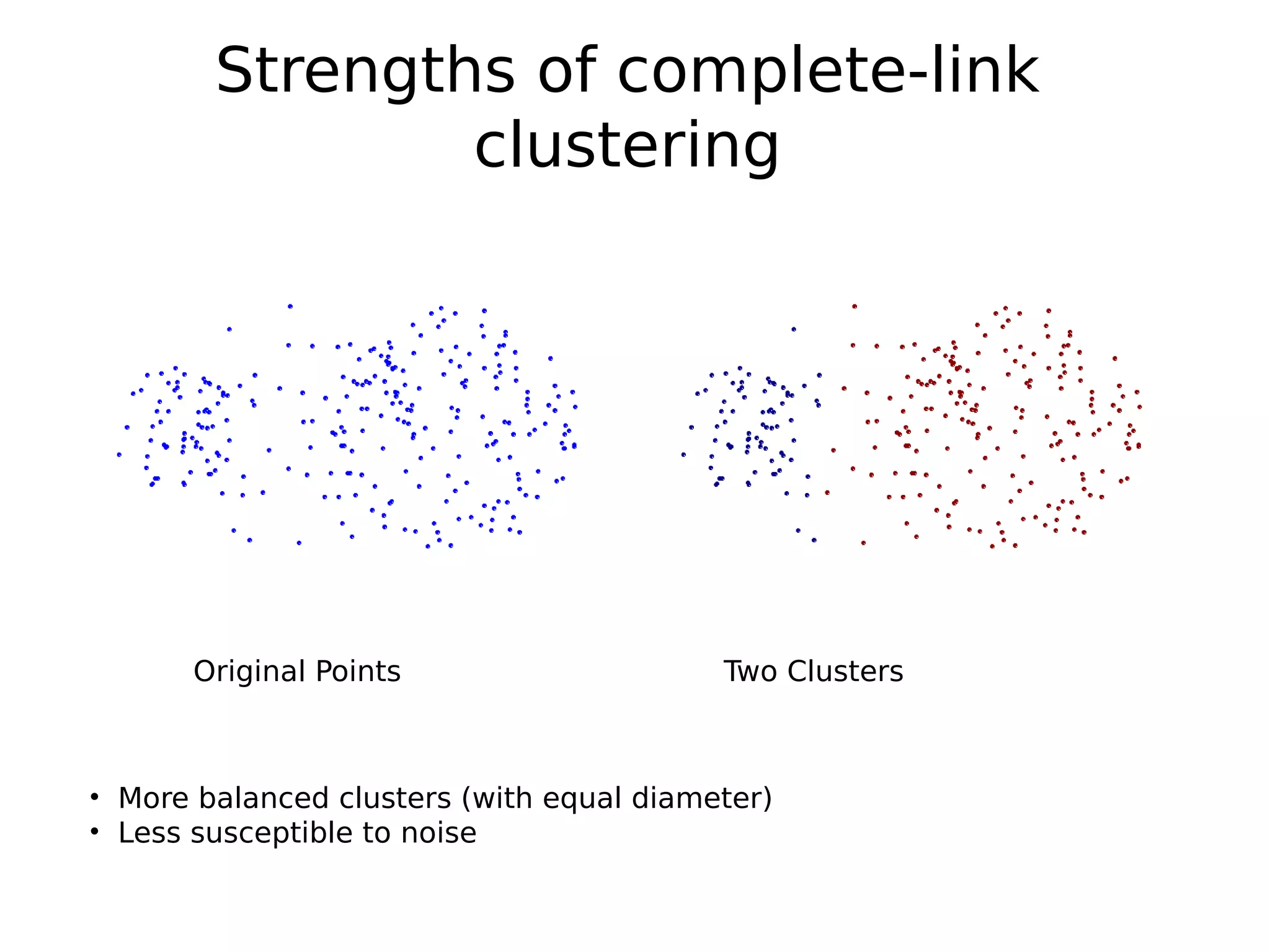
Strengths of complete-link
clustering
Original Points Two Clusters
• More balanced clusters (with equal diameter)
• Less susceptible to noise
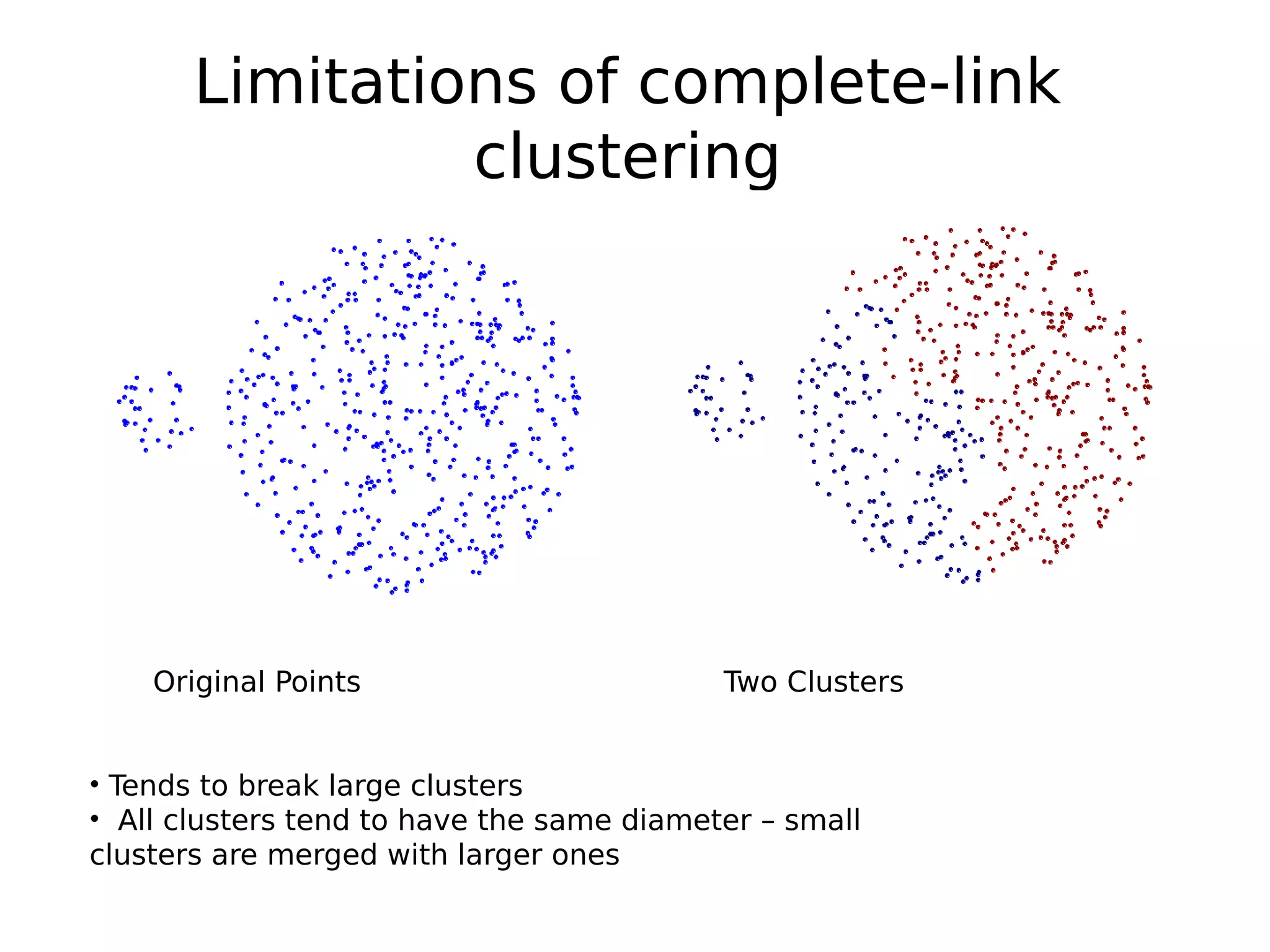
Limitations of complete-link
clustering
Original Points Two Clusters
• Tends to break large clusters
• All clusters tend to have the same diameter – small
clusters are merged with larger ones
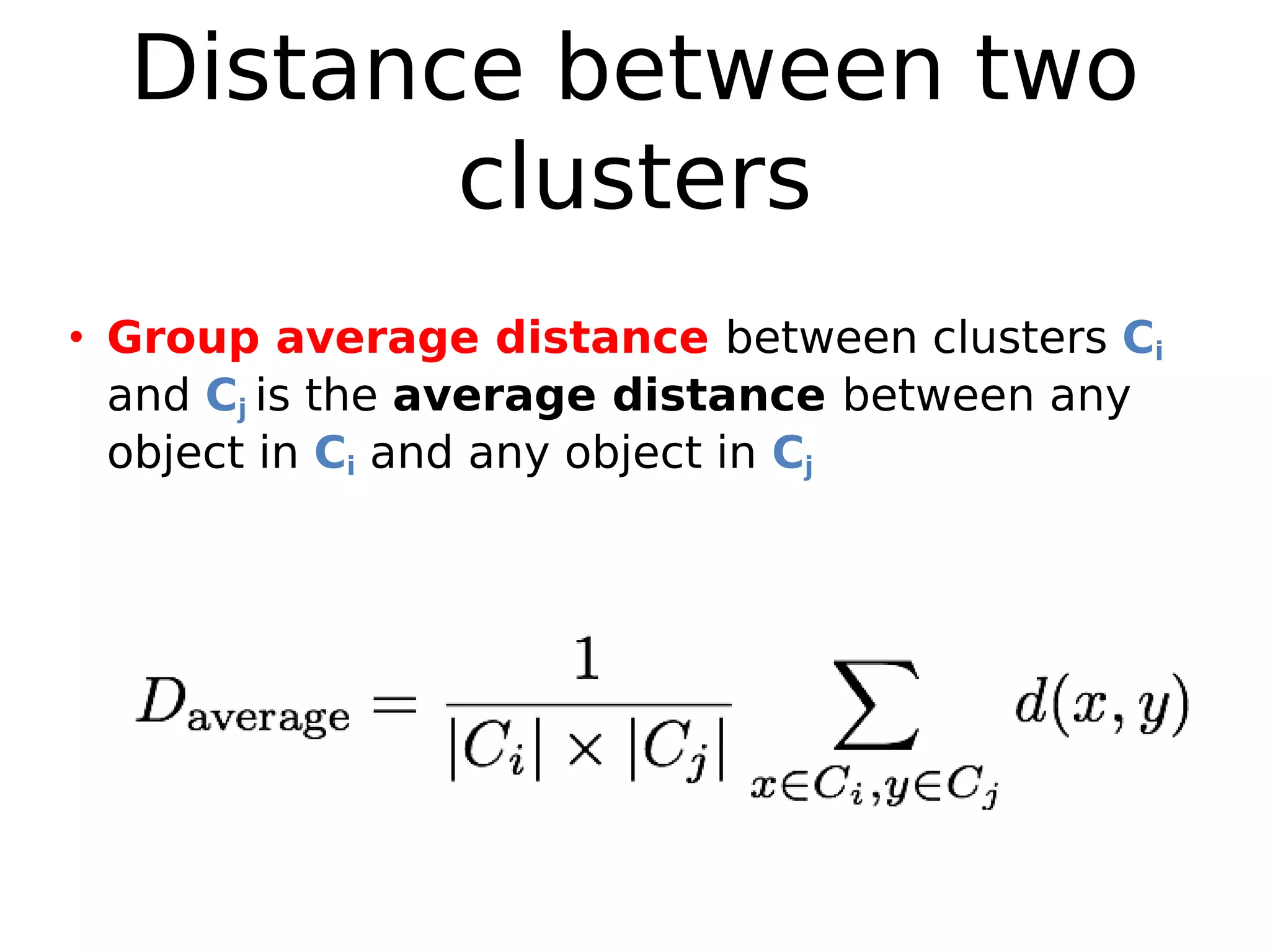
Distance between two
clusters
• Group average distance between clusters Ci
and Cj is the average distance between any
object in Ci and any object in Cj
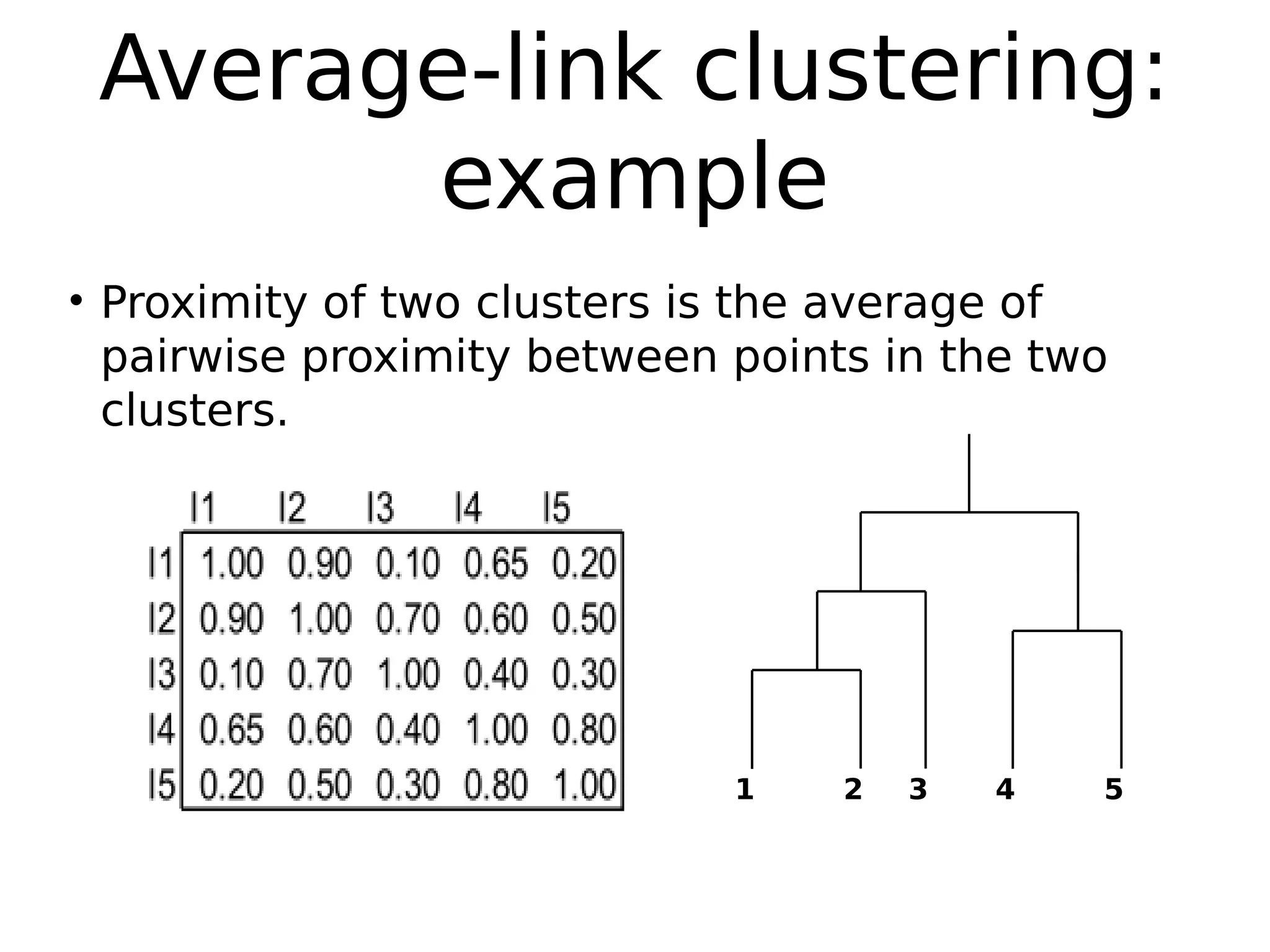
Average-link clustering:
example
• Proximity of two clusters is the average of
pairwise proximity between points in the two
clusters.
1 2 3 4 5
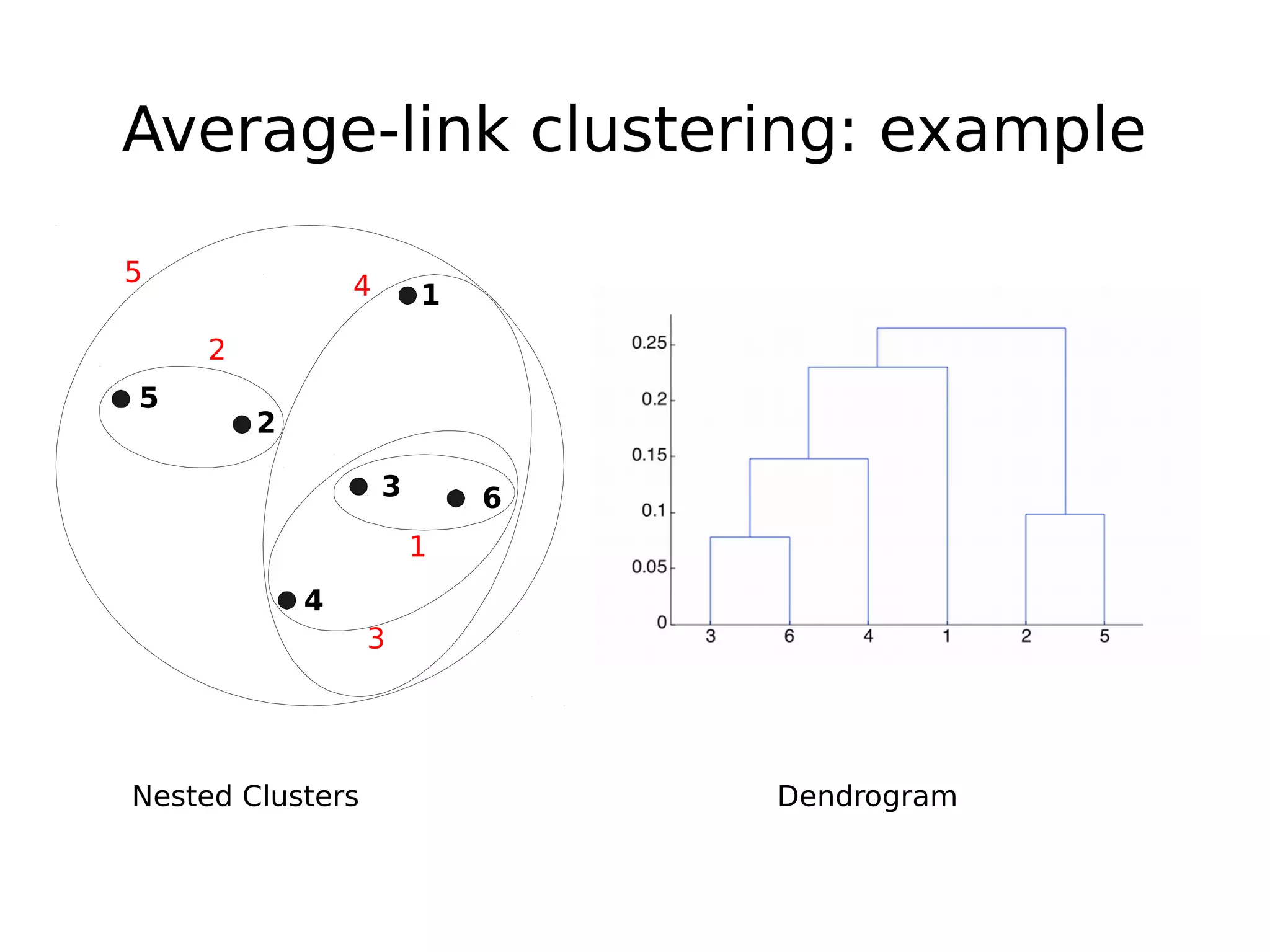
Average-link clustering: example
Nested Clusters Dendrogram
1
2
3
4
5
6
1
2
5
3
4
Average-link clustering:
discussion
• Compromise between Single and
Complete Link
• Strengths
– Less susceptible to noise and outliers
• Limitations
– Biased towards globular clusters
Distance between two
clusters
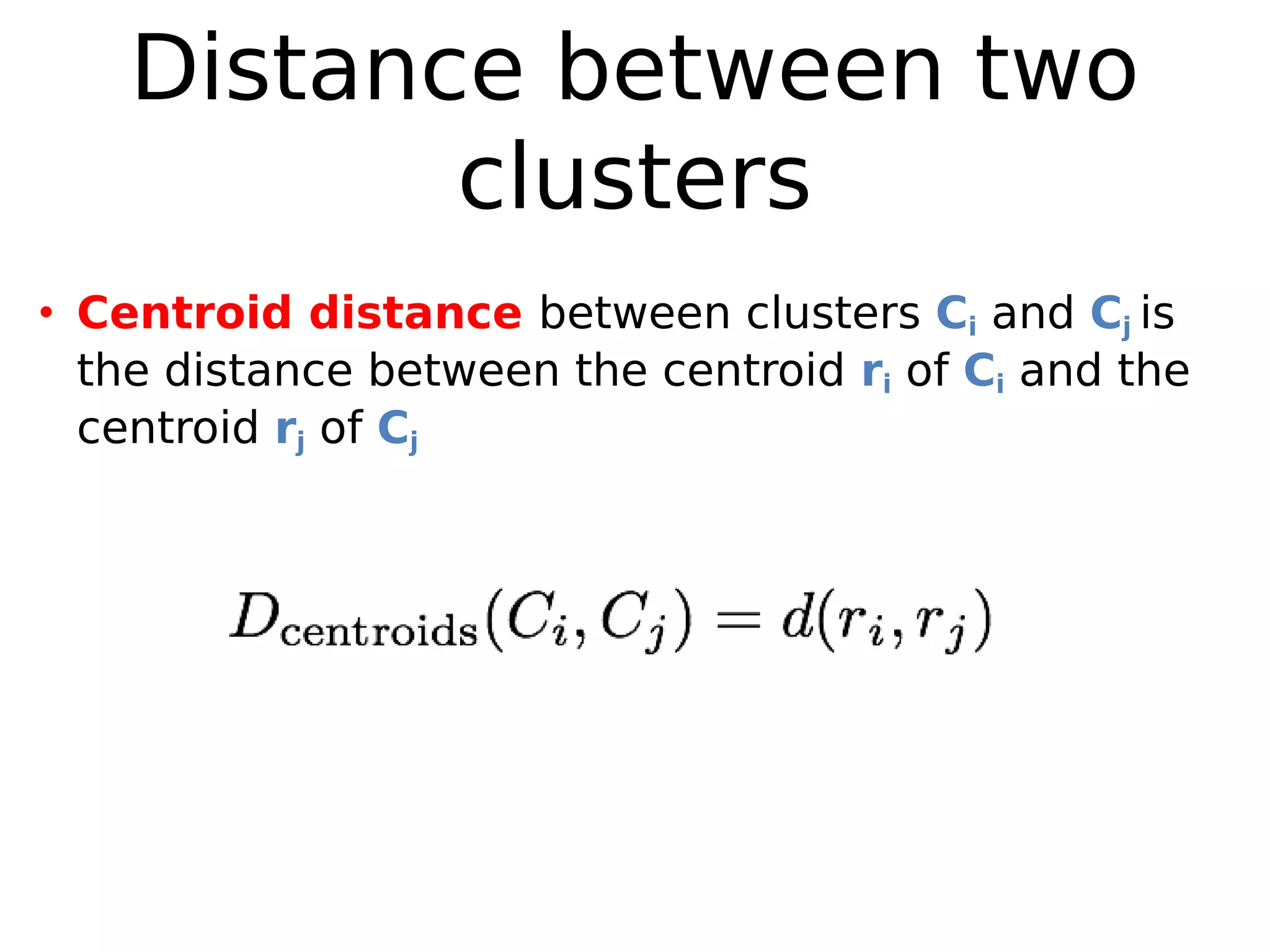
• Centroid distance between clusters Ci and Cj is
the distance between the centroid ri of Ci and the
centroid rj of Cj
Distance between two
clusters
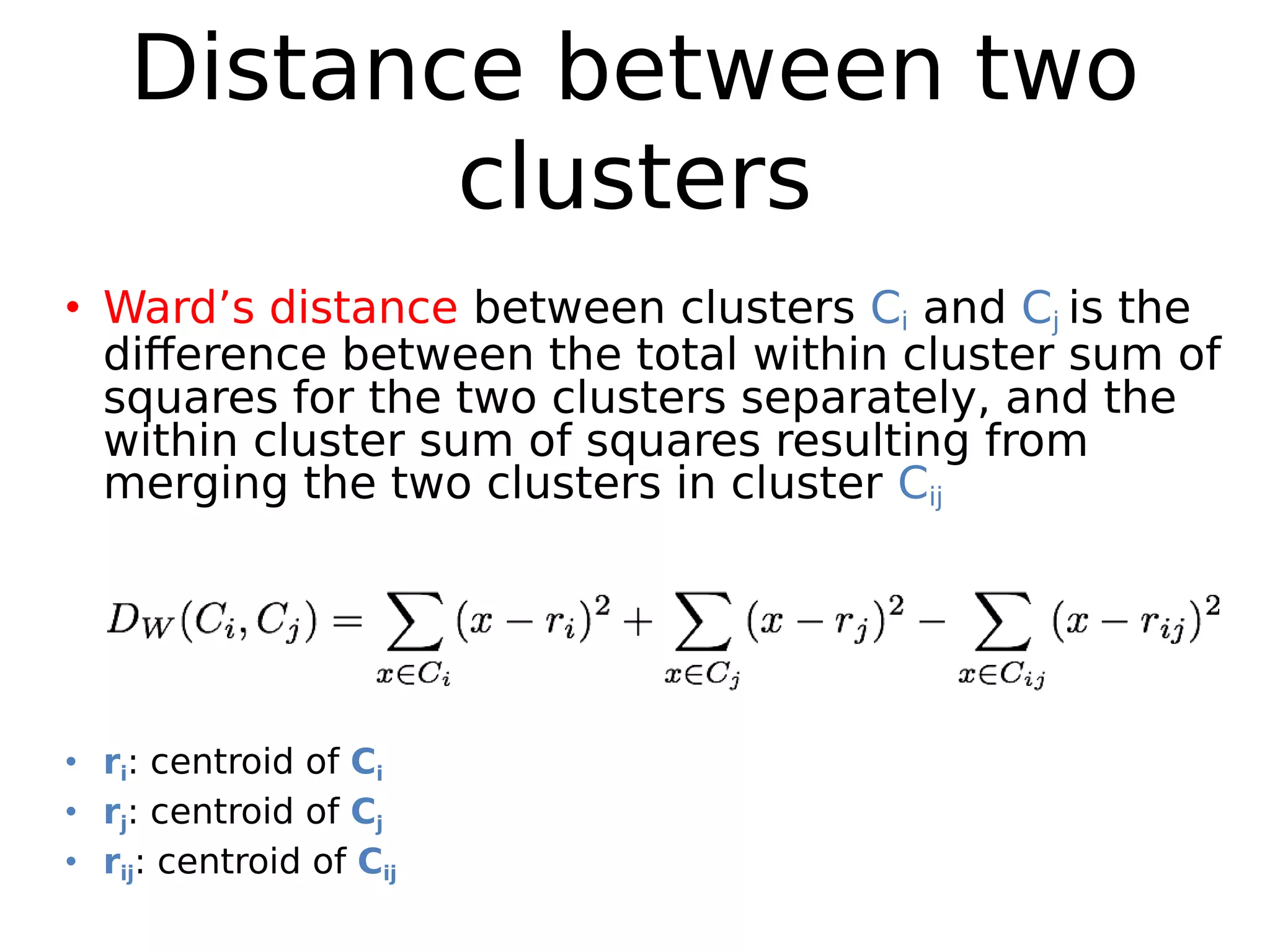
• Ward’s distance between clusters Ci and Cj is the
difference between the total within cluster sum of
squares for the two clusters separately, and the
within cluster sum of squares resulting from
merging the two clusters in cluster Cij
• ri: centroid of Ci
• rj: centroid of Cj
• rij: centroid of Cij
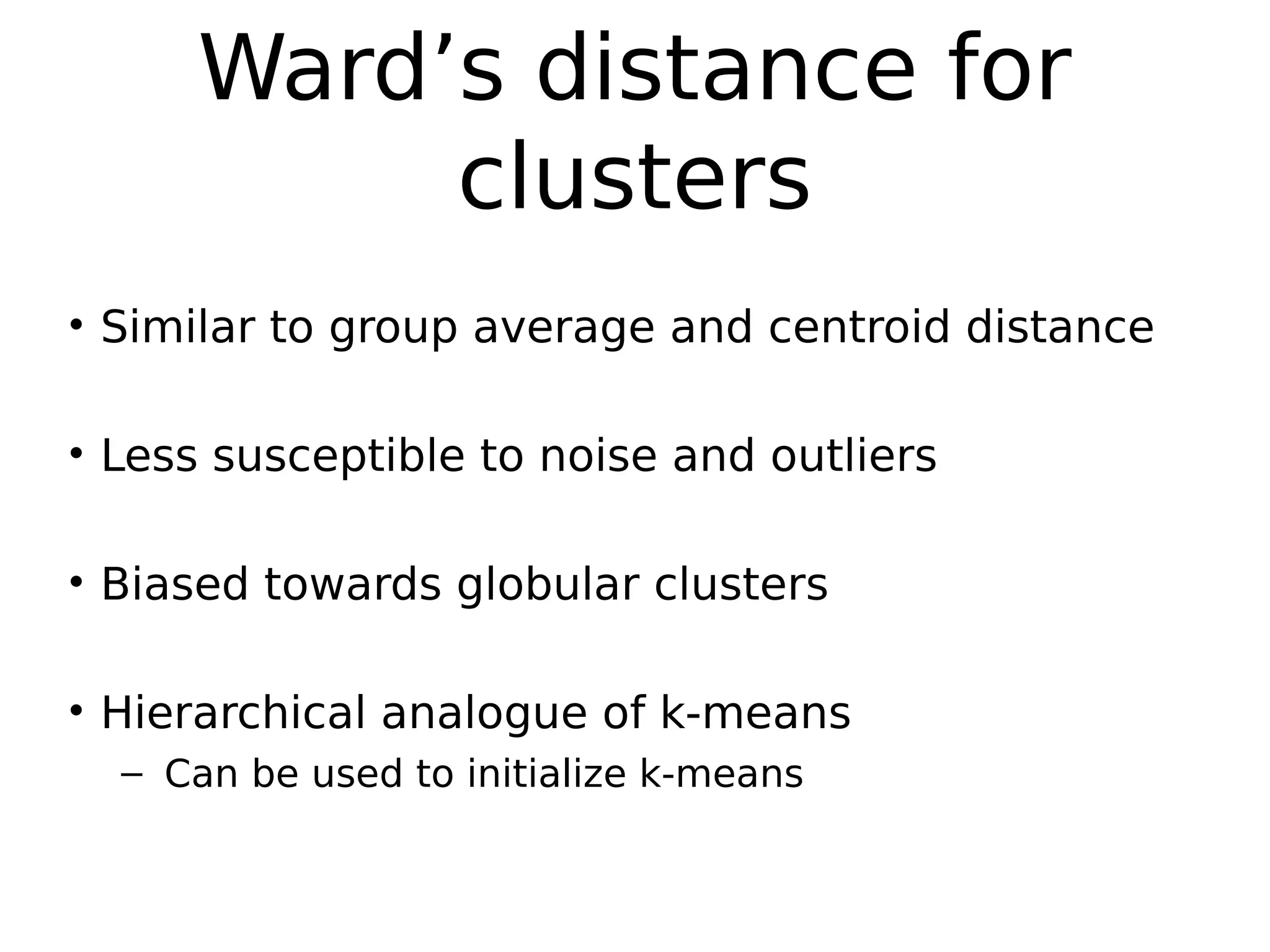
Ward’s distance for
clusters
• Similar to group average and centroid distance
• Less susceptible to noise and outliers
• Biased towards globular clusters
• Hierarchical analogue of k-means
– Can be used to initialize k-means
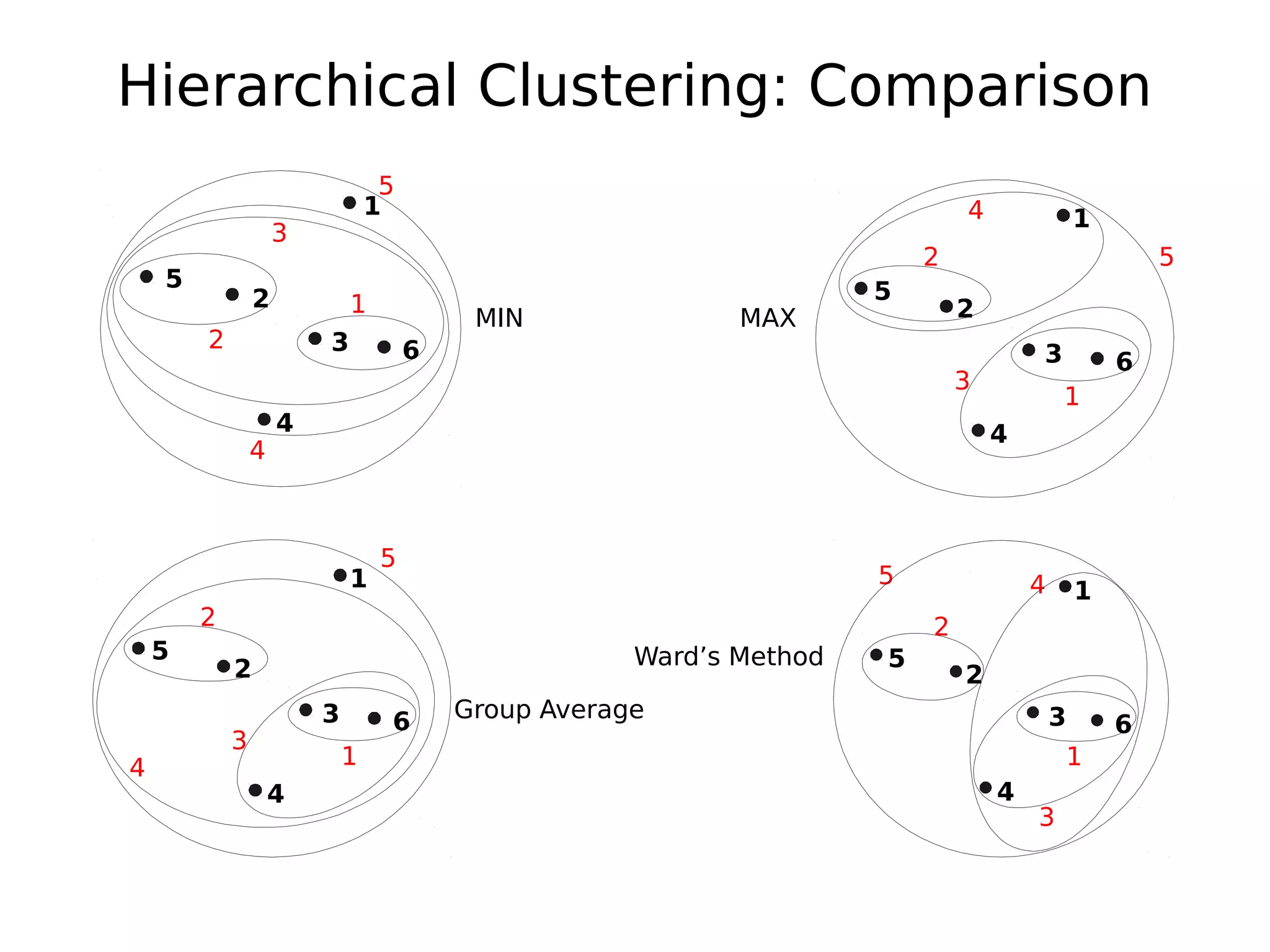
Hierarchical Clustering: Comparison
Group Average
Ward’s Method
1
2
3
4
5
6
1
2
5
3
4
MIN MAX
1
2
3
4
5
6
1
2
5
3
4
1
2
3
4
5
6
1
2 5
3
41
2
3
4
5
6
1
2
3
4
5
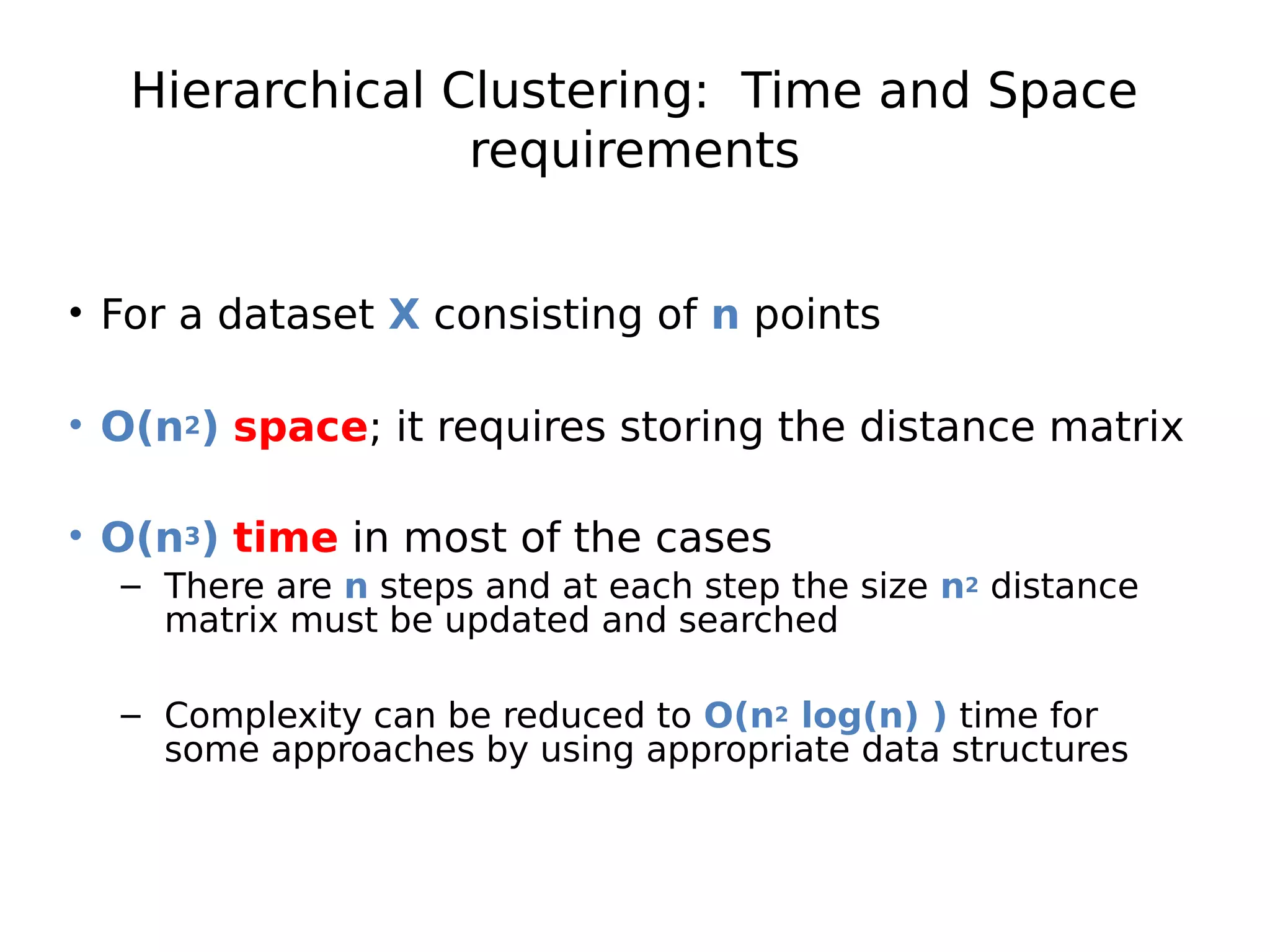
Hierarchical Clustering: Time and Space
requirements
• For a dataset X consisting of n points
• O(n2) space; it requires storing the distance matrix
• O(n3) time in most of the cases
– There are n steps and at each step the size n2 distance
matrix must be updated and searched
– Complexity can be reduced to O(n2 log(n) ) time for
some approaches by using appropriate data structures

Hierarchical Clustering

  • 1.
    1 Hierarchical Clustering Class AlgorithmicMethods of Data Mining Program M. Sc. Data Science University Sapienza University of Rome Semester Fall 2015 Lecturer Carlos Castillo http://chato.cl/ Sources: ● Mohammed J. Zaki, Wagner Meira, Jr., Data Mining and Analysis: Fundamental Concepts and Algorithms, Cambridge University Press, May 2014. Chapter 14. [download] ● Evimaria Terzi: Data Mining course at Boston University http://www.cs.bu.edu/~evimaria/cs565-13.html
  • 2.
  • 3.
  • 4.
    Hierarchical Clustering • Producesa set of nested clusters organized as a hierarchical tree • Can be visualized as a dendrogram – A tree-like diagram that records the sequences of merges or splits
  • 5.
    Strengths of Hierarchical Clustering •No assumptions on the number of clusters – Any desired number of clusters can be obtained by ‘cutting’ the dendogram at the proper level • Hierarchical clusterings may correspond to meaningful taxonomies – Example in biological sciences (e.g., phylogeny reconstruction, etc), web (e.g., product catalogs) etc
  • 6.
    Hierarchical Clustering Algorithms • Twomain types of hierarchical clustering – Agglomerative: • Start with the points as individual clusters • At each step, merge the closest pair of clusters until only one cluster (or k clusters) left – Divisive: • Start with one, all-inclusive cluster • At each step, split a cluster until each cluster contains a point (or there are k clusters) • Traditional hierarchical algorithms use a similarity or distance matrix – Merge or split one cluster at a time
  • 7.
    Complexity of hierarchical clustering •Distance matrix is used for deciding which clusters to merge/split • At least quadratic in the number of data points • Not usable for large datasets
  • 8.
    Agglomerative clustering algorithm •Most popular hierarchical clustering technique • Basic algorithm: Compute the distance matrix between the input data points Let each data point be a cluster Repeat Merge the two closest clusters Update the distance matrix Until only a single cluster remains Key operation is the computation of the distance between two clusters Different definitions of the distance between clusters lead to different algorithms
  • 9.
    Input/ Initial setting •Start with clusters of individual points and a distance/proximity matrix p1 p3 p5 p4 p2 p1 p2 p3 p4 p5 . . . . . . Distance/Proximity Matrix
  • 10.
    Intermediate State • Aftersome merging steps, we have some clusters C1 C4 C2 C5 C3 C2C1 C1 C3 C5 C4 C2 C3 C4 C5 Distance/Proximity Matrix
  • 11.
    Intermediate State • Mergethe two closest clusters (C2 and C5) and update the distance matrix. C1 C4 C2 C5 C3 C2C1 C1 C3 C5 C4 C2 C3 C4 C5 Distance/Proximity Matrix
  • 12.
    After Merging • “Howdo we update the distance matrix?” C1 C4 C2 U C5 C3 ? ? ? ? ? ? ? C2 U C5 C1 C1 C3 C4 C2 U C5 C3 C4
  • 13.
    Distance between two clusters •Each cluster is a set of points • How do we define distance between two sets of points – Lots of alternatives – Not an easy task
  • 14.
    Distance between two clusters •Single-link distance between clusters Ci and Cj is the minimum distance between any object in Ci and any object in Cj • The distance is defined by the two most similar objects
  • 15.
    Single-link clustering: example • Determinedby one pair of points, i.e., by one link in the proximity graph. 1 2 3 4 5
  • 16.
    Single-link clustering: example NestedClusters Dendrogram 1 2 3 4 5 6 1 2 3 4 5
  • 17.
    17 Exercise: 1-dimensional clustering 511 13 16 25 36 38 39 42 60 62 64 67 Exercise: Create a hierarchical agglomerative clustering for this data. To make this deterministic, if there are ties, pick the left-most link. Verify: clustering with 4 clusters has 25 as singleton. http://chato.cl/2015/data-analysis/exercise-answers/hierarchical-clustering_exercise_01_answer.txt
  • 18.
    Strengths of single-linkclustering Original Points Two Clusters • Can handle non-elliptical shapes
  • 19.
    Limitations of single-linkclustering Original Points Two Clusters • Sensitive to noise and outliers • It produces long, elongated clusters
  • 20.
    Distance between two clusters •Complete-link distance between clusters Ci and Cj is the maximum distance between any object in Ci and any object in Cj • The distance is defined by the two most dissimilar objects
  • 21.
    Complete-link clustering: example •Distance between clusters is determined by the two most distant points in the different clusters 1 2 3 4 5
  • 22.
    Complete-link clustering: example NestedClusters Dendrogram 1 2 3 4 5 6 1 2 5 3 4
  • 23.
    Strengths of complete-link clustering OriginalPoints Two Clusters • More balanced clusters (with equal diameter) • Less susceptible to noise
  • 24.
    Limitations of complete-link clustering OriginalPoints Two Clusters • Tends to break large clusters • All clusters tend to have the same diameter – small clusters are merged with larger ones
  • 25.
    Distance between two clusters •Group average distance between clusters Ci and Cj is the average distance between any object in Ci and any object in Cj
  • 26.
    Average-link clustering: example • Proximityof two clusters is the average of pairwise proximity between points in the two clusters. 1 2 3 4 5
  • 27.
    Average-link clustering: example NestedClusters Dendrogram 1 2 3 4 5 6 1 2 5 3 4
  • 28.
    Average-link clustering: discussion • Compromisebetween Single and Complete Link • Strengths – Less susceptible to noise and outliers • Limitations – Biased towards globular clusters
  • 29.
    Distance between two clusters •Centroid distance between clusters Ci and Cj is the distance between the centroid ri of Ci and the centroid rj of Cj
  • 30.
    Distance between two clusters •Ward’s distance between clusters Ci and Cj is the difference between the total within cluster sum of squares for the two clusters separately, and the within cluster sum of squares resulting from merging the two clusters in cluster Cij • ri: centroid of Ci • rj: centroid of Cj • rij: centroid of Cij
  • 31.
    Ward’s distance for clusters •Similar to group average and centroid distance • Less susceptible to noise and outliers • Biased towards globular clusters • Hierarchical analogue of k-means – Can be used to initialize k-means
  • 32.
    Hierarchical Clustering: Comparison GroupAverage Ward’s Method 1 2 3 4 5 6 1 2 5 3 4 MIN MAX 1 2 3 4 5 6 1 2 5 3 4 1 2 3 4 5 6 1 2 5 3 41 2 3 4 5 6 1 2 3 4 5
  • 33.
    Hierarchical Clustering: Timeand Space requirements • For a dataset X consisting of n points • O(n2) space; it requires storing the distance matrix • O(n3) time in most of the cases – There are n steps and at each step the size n2 distance matrix must be updated and searched – Complexity can be reduced to O(n2 log(n) ) time for some approaches by using appropriate data structures