LEAF
Structure , Adaptions and
Development
Kamaljit
Sidhu
Associate
professor
Deptt. Of Botany
KCW , Civil
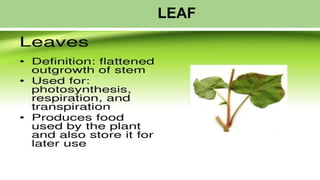
LEAF
Characteristics of Leaf
•Leaf is an exogenous lateral
outgrowth
•It develops from the shoot meristems
of leaf primordia
•It has limited growth as the
intercalary meristem from which it
develops is consumed in growth
•Borne at the node of the stem
•Bears an axillary bud in its axil
•Green in colour due to photosynthesis
•Apical bud absent in the leaf
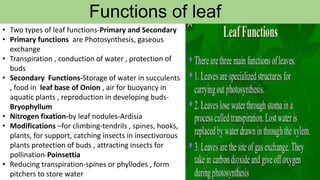
Functions of leaf
• Two types of leaf functions-Primary and Secondary
• Primary functions are Photosynthesis, gaseous
exchange
• Transpiration , conduction of water , protection of
buds
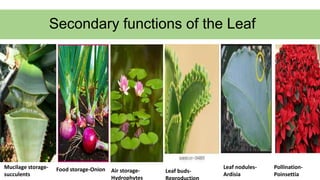
• Secondary Functions-Storage of water in succulents
, food in leaf base of Onion , air for buoyancy in
aquatic plants , reproduction in developing buds-
Bryophyllum
• Nitrogen fixation-by leaf nodules-Ardisia
• Modifications –for climbing-tendrils , spines, hooks,
plants, for support, catching insects in insectivorous
plants protection of buds , attracting insects for
pollination-Poinsettia
• Reducing transpiration-spines or phyllodes , form
pitchers to store water
Secondary functions of the Leaf
Mucilage storage-
succulents
Food storage-Onion Air storage-
Hydrophytes
Leaf buds-
Reproduction
Leaf nodules-
Ardisia
Pollination-
Poinsettia
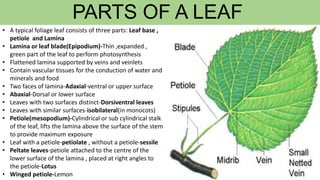
PARTS OF A LEAF
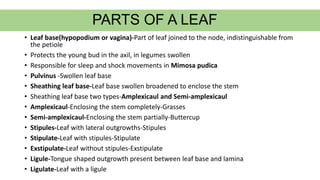
• A typical foliage leaf consists of three parts: Leaf base ,
petiole and Lamina
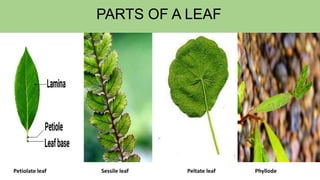
• Lamina or leaf blade(Epipodium)-Thin ,expanded ,
green part of the leaf to perform photosynthesis
• Flattened lamina supported by veins and veinlets
• Contain vascular tissues for the conduction of water and
minerals and food
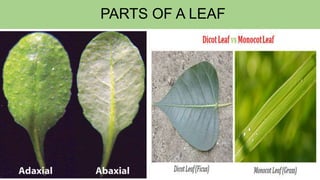
• Two faces of lamina-Adaxial-ventral or upper surface
• Abaxial-Dorsal or lower surface
• Leaves with two surfaces distinct-Dorsiventral leaves
• Leaves with similar surfaces-isobilateral(in monocots)
• Petiole(mesopodium)-Cylindrical or sub cylindrical stalk
of the leaf, lifts the lamina above the surface of the stem
to provide maximum exposure
• Leaf with a petiole-petiolate , without a petiole-sessile
• Peltate leaves-petiole attached to the centre of the
lower surface of the lamina , placed at right angles to
the petiole-Lotus
• Winged petiole-Lemon
PARTS OF A LEAF
PARTS OF A LEAF
Petiolate leaf Sessile leaf Peltate leaf Phyllode
PARTS OF A LEAF
• Leaf base(hypopodium or vagina)-Part of leaf joined to the node, indistinguishable from
the petiole
• Protects the young bud in the axil, in legumes swollen
• Responsible for sleep and shock movements in Mimosa pudica
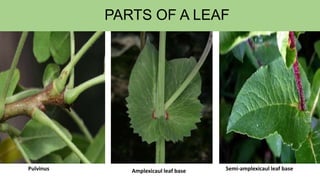
• Pulvinus -Swollen leaf base
• Sheathing leaf base-Leaf base swollen broadened to enclose the stem
• Sheathing leaf base two types-Amplexicaul and Semi-amplexicaul
• Amplexicaul-Enclosing the stem completely-Grasses
• Semi-amplexicaul-Enclosing the stem partially-Buttercup
• Stipules-Leaf with lateral outgrowths-Stipules
• Stipulate-Leaf with stipules-Stipulate
• Exstipulate-Leaf without stipules-Exstipulate
• Ligule-Tongue shaped outgrowth present between leaf base and lamina
• Ligulate-Leaf with a ligule
PARTS OF A LEAF
Pulvinus Amplexicaul leaf base Semi-amplexicaul leaf base
PARTS OF A LEAF
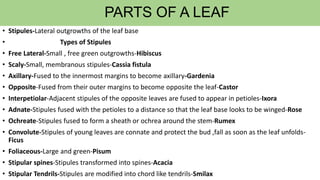
• Stipules-Lateral outgrowths of the leaf base
• Types of Stipules
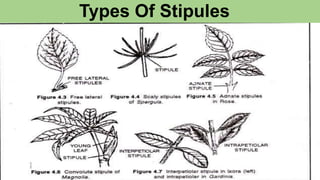
• Free Lateral-Small , free green outgrowths-Hibiscus
• Scaly-Small, membranous stipules-Cassia fistula
• Axillary-Fused to the innermost margins to become axillary-Gardenia
• Opposite-Fused from their outer margins to become opposite the leaf-Castor
• Interpetiolar-Adjacent stipules of the opposite leaves are fused to appear in petioles-Ixora
• Adnate-Stipules fused with the petioles to a distance so that the leaf base looks to be winged-Rose
• Ochreate-Stipules fused to form a sheath or ochrea around the stem-Rumex
• Convolute-Stipules of young leaves are connate and protect the bud ,fall as soon as the leaf unfolds-
Ficus
• Foliaceous-Large and green-Pisum
• Stipular spines-Stipules transformed into spines-Acacia
• Stipular Tendrils-Stipules are modified into chord like tendrils-Smilax
Types Of Stipules
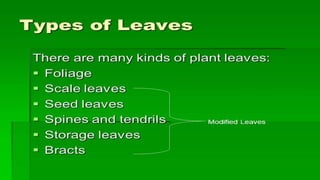
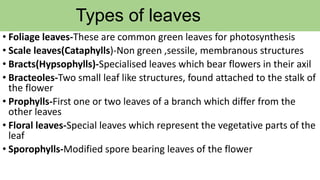
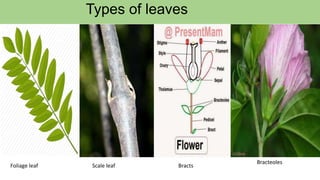
Types of leaves
• Foliage leaves-These are common green leaves for photosynthesis
• Scale leaves(Cataphylls)-Non green ,sessile, membranous structures
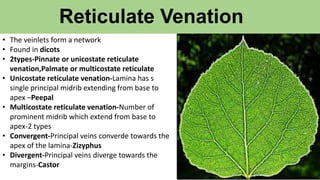
• Bracts(Hypsophylls)-Specialised leaves which bear flowers in their axil
• Bracteoles-Two small leaf like structures, found attached to the stalk of
the flower
• Prophylls-First one or two leaves of a branch which differ from the
other leaves
• Floral leaves-Special leaves which represent the vegetative parts of the
leaf
• Sporophylls-Modified spore bearing leaves of the flower
Types of leaves
Foliage leaf Scale leaf Bracts
Bracteoles
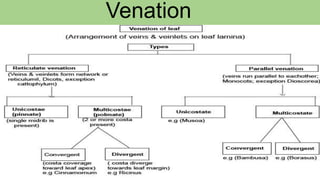
Venation
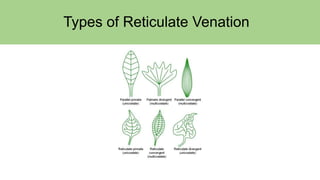
Reticulate Venation
• The veinlets form a network
• Found in dicots
• 2types-Pinnate or unicostate reticulate
venation,Palmate or multicostate reticulate
• Unicostate reticulate venation-Lamina has s
single principal midrib extending from base to
apex –Peepal
• Multicostate reticulate venation-Number of
prominent midrib which extend from base to
apex-2 types
• Convergent-Principal veins converde towards the
apex of the lamina-Zizyphus
• Divergent-Principal veins diverge towards the
margins-Castor
Types of Reticulate Venation
Parallel Venation
• Veins are inconspicuous ,veins run parallel to each other
• Characteristic of monocots exceptions-Smilax,Colocasia
• 2 types- Unicostate parallel venation, Multicostate parallel venation
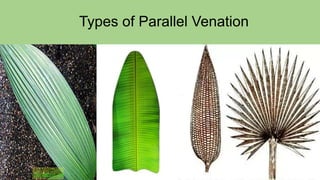
• Unicostate parallel venation-Single principal midrib runs to of
lamina-Banana
• Palmate or Multicostate parallel-Several parallel arise from base of
the lamina
• 2 types-Convergent,Divergent
• Convergent-The principal veins converge towards the apex-Bamboo
• Divergent-The principal veins proceed toward the margins-Fan palm
Types of Parallel Venation
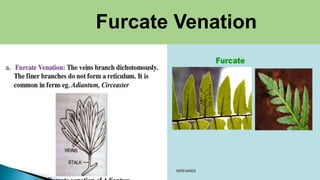
Furcate Venation
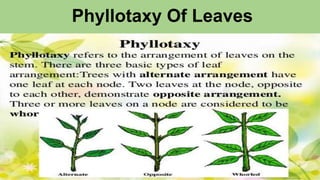
Phyllotaxy Of Leaves
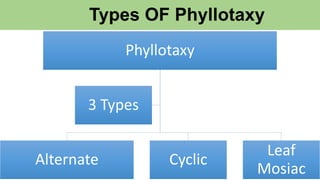
Types OF Phyllotaxy
Phyllotaxy
Alternate Cyclic
Leaf
Mosiac
3 Types
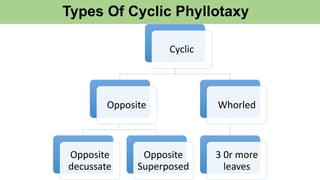
Types Of Cyclic Phyllotaxy
Cyclic
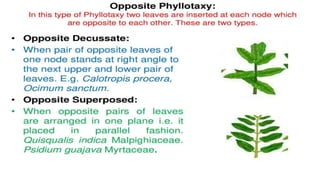
Opposite
Opposite
decussate
Opposite
Superposed
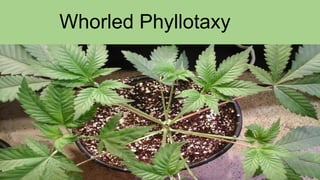
Whorled
3 0r more
leaves
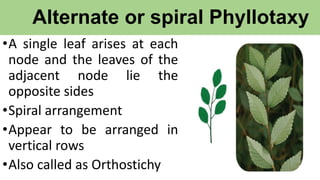
Alternate or spiral Phyllotaxy
•A single leaf arises at each
node and the leaves of the
adjacent node lie the
opposite sides
•Spiral arrangement
•Appear to be arranged in
vertical rows
•Also called as Orthostichy
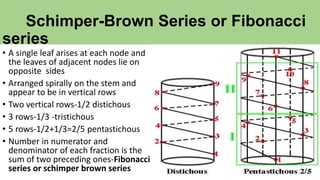
Schimper-Brown Series or Fibonacci
series
• A single leaf arises at each node and
the leaves of adjacent nodes lie on
opposite sides
• Arranged spirally on the stem and
appear to be in vertical rows
• Two vertical rows-1/2 distichous
• 3 rows-1/3 -tristichous
• 5 rows-1/2+1/3=2/5 pentastichous
• Number in numerator and
denominator of each fraction is the
sum of two preceding ones-Fibonacci
series or schimper brown series
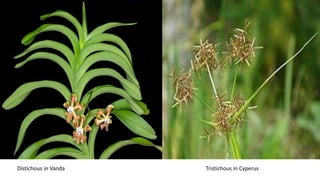
Distichous in Vanda Tristichous in Cyperus
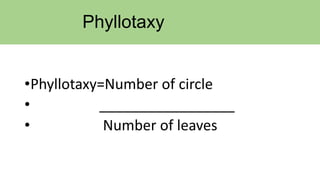
Phyllotaxy
•Phyllotaxy=Number of circle
• _________________
• Number of leaves
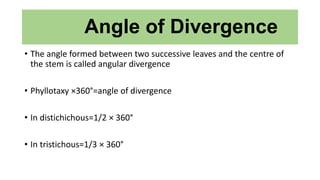
Angle of Divergence
• The angle formed between two successive leaves and the centre of
the stem is called angular divergence
• Phyllotaxy ×360°=angle of divergence
• In distichichous=1/2 × 360°
• In tristichous=1/3 × 360°
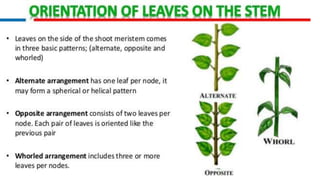
Whorled Phyllotaxy
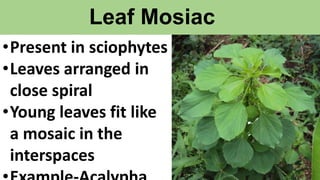
Leaf Mosiac
•Present in sciophytes
•Leaves arranged in
close spiral
•Young leaves fit like
a mosaic in the
interspaces
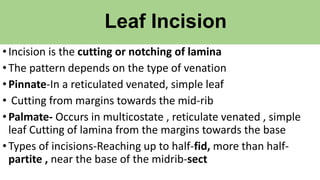
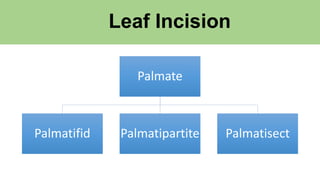
Leaf Incision
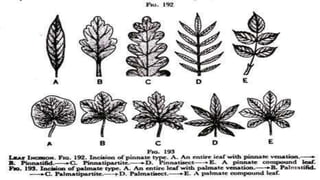
•Incision is the cutting or notching of lamina
•The pattern depends on the type of venation
•Pinnate-In a reticulated venated, simple leaf
• Cutting from margins towards the mid-rib
•Palmate- Occurs in multicostate , reticulate venated , simple
leaf Cutting of lamina from the margins towards the base
•Types of incisions-Reaching up to half-fid, more than half-
partite , near the base of the midrib-sect
Leaf Incision
Leaf
Incision
Pinnate Palmate
Leaf Incision
Pinnate
Pinnatifid Pinnatipartite Pinnatisect
Leaf Incision
Palmate
Palmatifid Palmatipartite Palmatisect
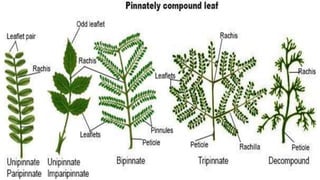
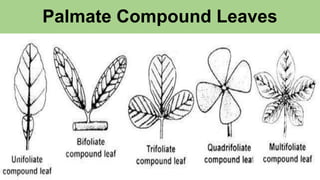
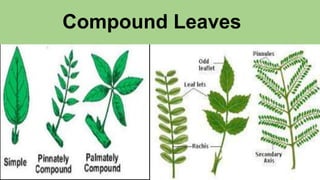
Compound Leaves
Palmate Compound Leaves
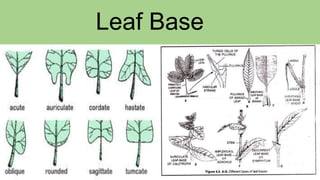
Leaf Base
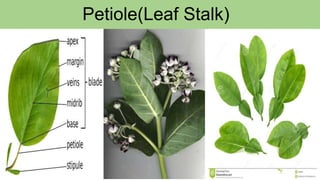
Petiole(Leaf Stalk)
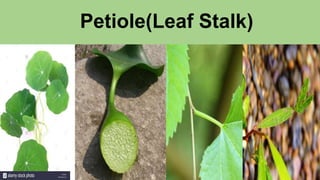
Petiole(Leaf Stalk)
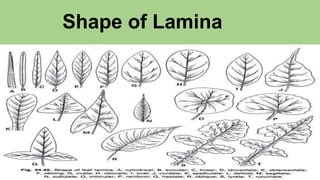
Shape of Lamina
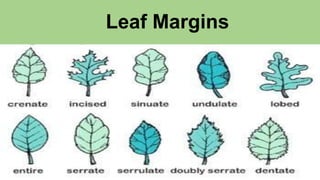
Leaf Margins
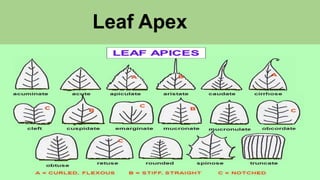
Leaf Apex
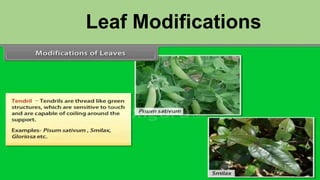
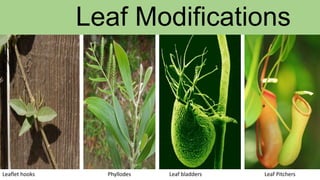
Leaf Modifications
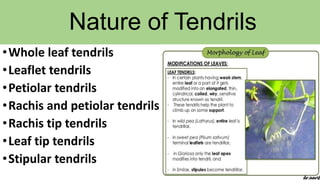
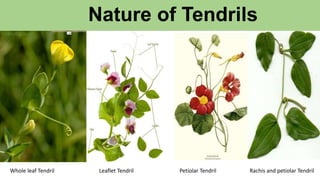
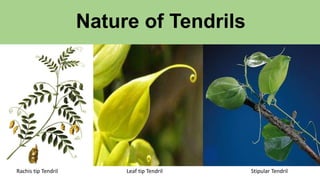
Nature of Tendrils
•Whole leaf tendrils
•Leaflet tendrils
•Petiolar tendrils
•Rachis and petiolar tendrils
•Rachis tip tendrils
•Leaf tip tendrils
•Stipular tendrils
Nature of Tendrils
Whole leaf Tendril Leaflet Tendril Petiolar Tendril Rachis and petiolar Tendril
Nature of Tendrils
Leaf tip TendrilRachis tip Tendril Stipular Tendril
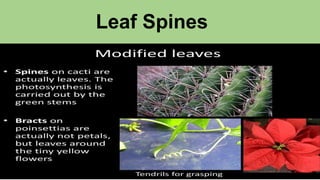
Leaf Spines
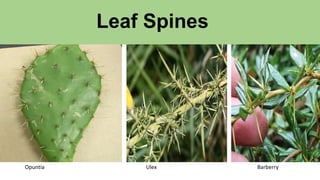
Leaf Spines
Opuntia Ulex Barberry
Leaf Modifications
Leaflet hooks Phyllodes Leaf bladders Leaf Pitchers
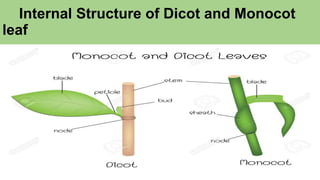
Internal Structure of Dicot and Monocot
leaf
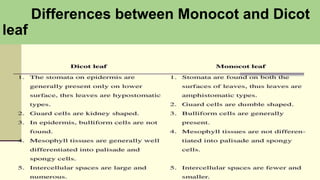
Differences between Monocot and Dicot
leaf
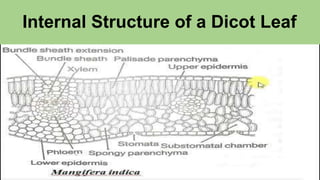
Internal Structure of a Dicot Leaf
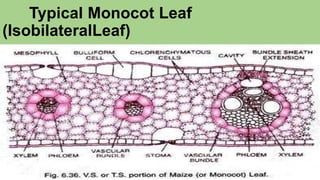
Typical Monocot Leaf
(IsobilateralLeaf)