•We will learn the plant classification
•We will learn to label the parts of a plant
and flower.
•We will learn that plants produce flowers
which have male and female organs.
•We will learn that seeds are formed when
pollen from the male organ fertilises the
female organ.
•And finally, we will learn how plants get
nutrients and how they reproduce
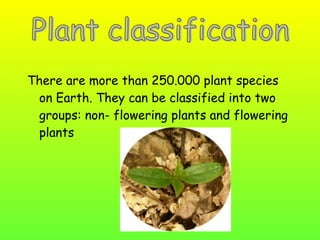
There are more than 250.000 plant species
on Earth. They can be classified into two
groups: non- flowering plants and flowering
plants
Non flowering plants are the smallest group. They
never produce flowers or seeds. They reproduce
with spores.
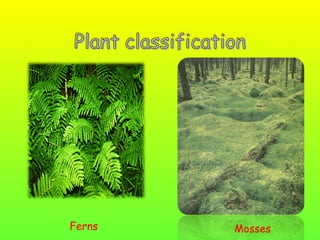
1. Mosses: are very short plants with tiny stems,
leaf and root structures. They live on rocks, on
tree trunks and on the ground.
2. Ferns are much longer than mosses. They have
thick, underground stems and large leaves.
Non- flowering plants grow in dark, humid forests.
Ferns

Mosses
Flowering plants are the most numerous. They
produce flowers and seeds to reproduce. They can
be classifies into two groups:
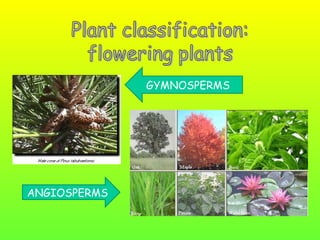
1. Gymnosperms: have small, simple flowers. They
don’t produce fruit. The seeds are grouped
together in cones.
Most gymnosperms are trees which have leaves all
year. As a result, they are called evergreen.
Cypress trees, pines are gymnosperms.
2. Angiosperms have large, beautiful flowers.
They produce seeds and fruit
This is the largest plant group. It includes
trees, bushes and grasses. Chestnuts trees
are angiosperms. Angiosperms which lose all
their leaves in autumn are called deciduous
plants.
GYMNOSPERMS

ANGIOSPERMS
1. R oots
2. Stem
3. L eaves
4. F lower
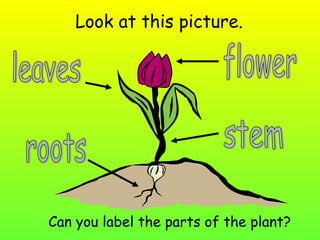
Look at this picture.

Can you label the parts of the plant?
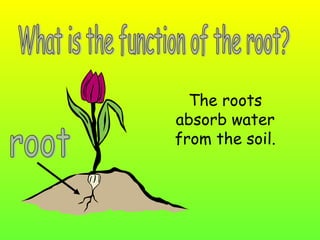
The roots
absorb water
from the soil.
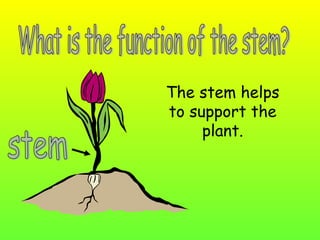
The stem helps
to support the
plant.
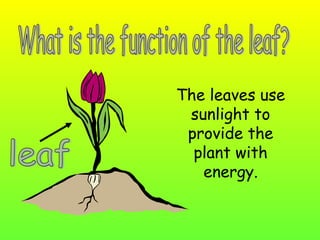
The leaves use
sunlight to
provide the
plant with
energy.
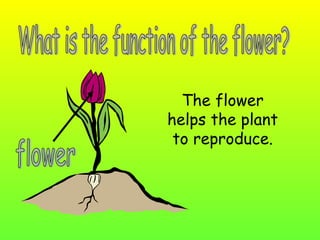
The flower
helps the plant
to reproduce.
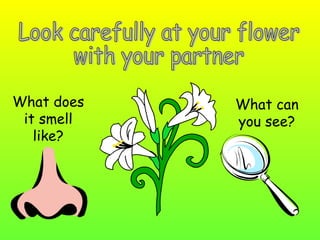
What does
it smell
like?

What can
you see?
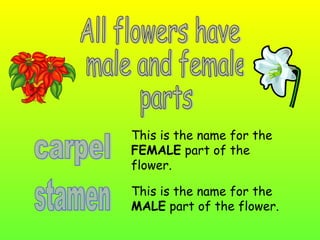
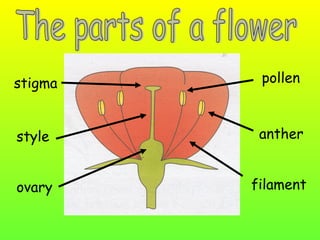
This is the name for the
FEMALE part of the
flower.
This is the name for the
MALE part of the flower.
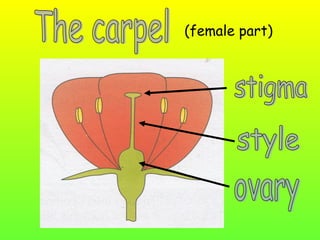
(female part)
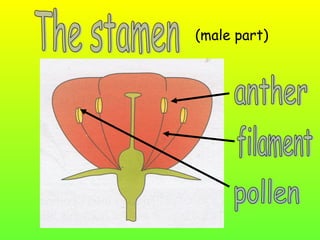
(male part)
stigma

pollen

style

anther

ovary

filament
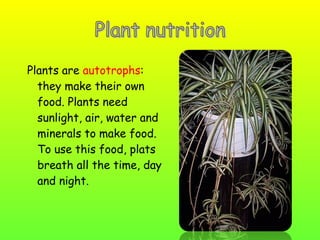
Plants are autotrophs:
they make their own
food. Plants need
sunlight, air, water and
minerals to make food.
To use this food, plats
breath all the time, day
and night.
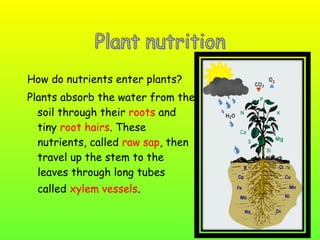
How do nutrients enter plants?
Plants absorb the water from the
soil through their roots and
tiny root hairs. These
nutrients, called raw sap, then
travel up the stem to the
leaves through long tubes
called xylem vessels.
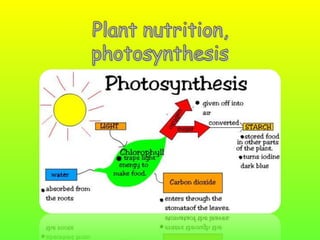
Photosynthesis is the process which
enables plants to manufacture food
from water, carbon dioxide and sunlight.
It takes place in the leaves and other
green plant cells.
Chlorophyll is the green substance in the
leaves which traps sunlight.
Plants give off oxygen
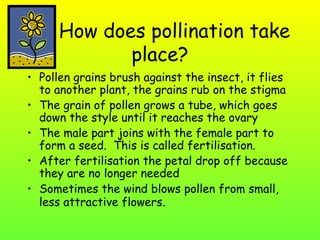
How does pollination take
place?
• Pollen grains brush against the insect, it flies
to another plant, the grains rub on the stigma
• The grain of pollen grows a tube, which goes
down the style until it reaches the ovary
• The male part joins with the female part to
form a seed. This is called fertilisation.
• After fertilisation the petal drop off because
they are no longer needed
• Sometimes the wind blows pollen from small,
less attractive flowers.
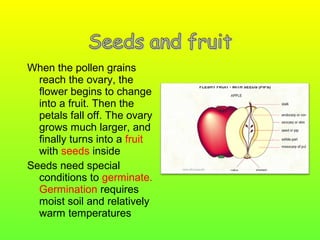
When the pollen grains
reach the ovary, the
flower begins to change
into a fruit. Then the
petals fall off. The ovary
grows much larger, and
finally turns into a fruit
with seeds inside
Seeds need special
conditions to germinate.
Germination requires
moist soil and relatively
warm temperatures
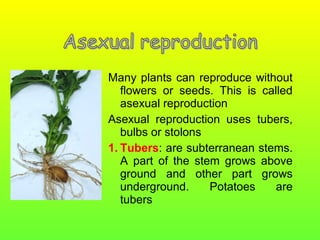
Many plants can reproduce without
flowers or seeds. This is called
asexual reproduction
Asexual reproduction uses tubers,
bulbs or stolons
1. Tubers: are subterranean stems.
A part of the stem grows above
ground and other part grows
underground.
Potatoes
are
tubers
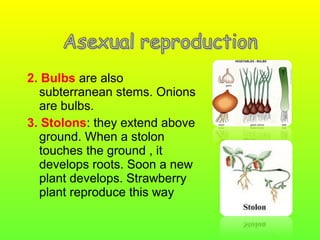
2. Bulbs are also
subterranean stems. Onions
are bulbs.
3. Stolons: they extend above
ground. When a stolon
touches the ground , it
develops roots. Soon a new
plant develops. Strawberry
plant reproduce this way

Plants classification

  • 2.
    •We will learnthe plant classification •We will learn to label the parts of a plant and flower. •We will learn that plants produce flowers which have male and female organs. •We will learn that seeds are formed when pollen from the male organ fertilises the female organ. •And finally, we will learn how plants get nutrients and how they reproduce
  • 3.
    There are morethan 250.000 plant species on Earth. They can be classified into two groups: non- flowering plants and flowering plants
  • 4.
    Non flowering plantsare the smallest group. They never produce flowers or seeds. They reproduce with spores. 1. Mosses: are very short plants with tiny stems, leaf and root structures. They live on rocks, on tree trunks and on the ground. 2. Ferns are much longer than mosses. They have thick, underground stems and large leaves. Non- flowering plants grow in dark, humid forests.
  • 5.
  • 6.
    Flowering plants arethe most numerous. They produce flowers and seeds to reproduce. They can be classifies into two groups: 1. Gymnosperms: have small, simple flowers. They don’t produce fruit. The seeds are grouped together in cones. Most gymnosperms are trees which have leaves all year. As a result, they are called evergreen. Cypress trees, pines are gymnosperms.
  • 7.
    2. Angiosperms havelarge, beautiful flowers. They produce seeds and fruit This is the largest plant group. It includes trees, bushes and grasses. Chestnuts trees are angiosperms. Angiosperms which lose all their leaves in autumn are called deciduous plants.
  • 8.
  • 9.
    1. R oots 2.Stem 3. L eaves 4. F lower
  • 10.
    Look at thispicture. Can you label the parts of the plant?
  • 11.
  • 12.
    The stem helps tosupport the plant.
  • 13.
    The leaves use sunlightto provide the plant with energy.
  • 14.
    The flower helps theplant to reproduce.
  • 15.
  • 16.
    This is thename for the FEMALE part of the flower. This is the name for the MALE part of the flower.
  • 18.
  • 19.
  • 20.
  • 21.
    Plants are autotrophs: theymake their own food. Plants need sunlight, air, water and minerals to make food. To use this food, plats breath all the time, day and night.
  • 22.
    How do nutrientsenter plants? Plants absorb the water from the soil through their roots and tiny root hairs. These nutrients, called raw sap, then travel up the stem to the leaves through long tubes called xylem vessels.
  • 23.
    Photosynthesis is theprocess which enables plants to manufacture food from water, carbon dioxide and sunlight. It takes place in the leaves and other green plant cells. Chlorophyll is the green substance in the leaves which traps sunlight. Plants give off oxygen
  • 25.
    How does pollinationtake place? • Pollen grains brush against the insect, it flies to another plant, the grains rub on the stigma • The grain of pollen grows a tube, which goes down the style until it reaches the ovary • The male part joins with the female part to form a seed. This is called fertilisation. • After fertilisation the petal drop off because they are no longer needed • Sometimes the wind blows pollen from small, less attractive flowers.
  • 26.
    When the pollengrains reach the ovary, the flower begins to change into a fruit. Then the petals fall off. The ovary grows much larger, and finally turns into a fruit with seeds inside Seeds need special conditions to germinate. Germination requires moist soil and relatively warm temperatures
  • 27.
    Many plants canreproduce without flowers or seeds. This is called asexual reproduction Asexual reproduction uses tubers, bulbs or stolons 1. Tubers: are subterranean stems. A part of the stem grows above ground and other part grows underground. Potatoes are tubers
  • 28.
    2. Bulbs arealso subterranean stems. Onions are bulbs. 3. Stolons: they extend above ground. When a stolon touches the ground , it develops roots. Soon a new plant develops. Strawberry plant reproduce this way