1
© Jnana Prabodhini Educational Resource
Centre
Natural Resources
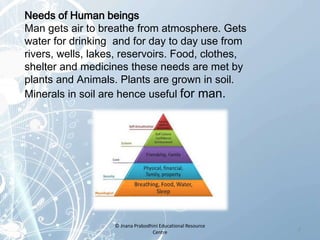
Needs of Human beings
Man gets air to breathe from atmosphere. Gets
water for drinking and for day to day use from
rivers, wells, lakes, reservoirs. Food, clothes,
shelter and medicines these needs are met by
plants and Animals. Plants are grown in soil.
Minerals in soil are hence useful for man.
2
© Jnana Prabodhini Educational Resource
Centre
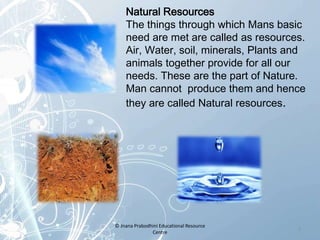
Natural Resources
The things through which Mans basic
need are met are called as resources.
Air, Water, soil, minerals, Plants and
animals together provide for all our
needs. These are the part of Nature.
Man cannot produce them and hence
they are called Natural resources.
3
© Jnana Prabodhini Educational Resource
Centre
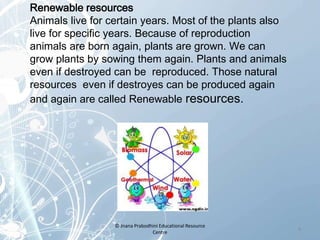
Renewable resources
Animals live for certain years. Most of the plants also
live for specific years. Because of reproduction
animals are born again, plants are grown. We can
grow plants by sowing them again. Plants and animals
even if destroyed can be reproduced. Those natural
resources even if destroyes can be produced again
and again are called Renewable resources.
4
© Jnana Prabodhini Educational Resource
Centre
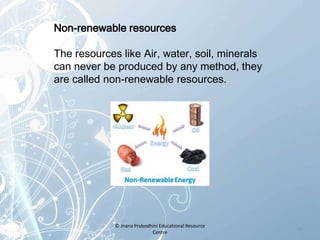
Non-renewable resources
The resources like Air, water, soil, minerals
can never be produced by any method, they
are called non-renewable resources.
5
© Jnana Prabodhini Educational Resource
Centre
Use of Natural resources
We all human beings make use of
Natural resources for meeting our
needs. Sometimes even when there is
no need just for leisure purpose we
make use of them. Examples like
having things, food, clothes. Notebooks,
pencils, boxes, Water bottles more then
we need. Natural resources should be
used sparingly, they should not pollute
the environment, is our utmost
responsibility to ensure it.
6
© Jnana Prabodhini Educational Resource
Centre
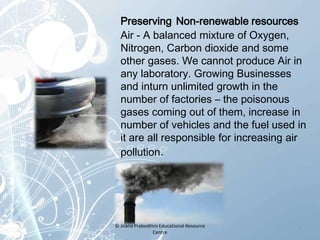
Preserving Non-renewable resources
Air - A balanced mixture of Oxygen,
Nitrogen, Carbon dioxide and some
other gases. We cannot produce Air in
any laboratory. Growing Businesses
and inturn unlimited growth in the
number of factories – the poisonous
gases coming out of them, increase in
number of vehicles and the fuel used in
it are all responsible for increasing air
pollution.
7
© Jnana Prabodhini Educational Resource
Centre
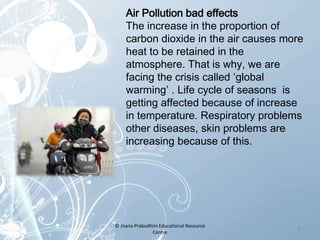
Air Pollution bad effects
The increase in the proportion of
carbon dioxide in the air causes more
heat to be retained in the
atmosphere. That is why, we are
facing the crisis called ‘global
warming’ . Life cycle of seasons is
getting affected because of increase
in temperature. Respiratory problems
other diseases, skin problems are
increasing because of this.
8
© Jnana Prabodhini Educational Resource
Centre
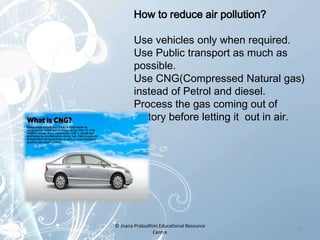
How to reduce air pollution?
Use vehicles only when required.
Use Public transport as much as
possible.
Use CNG(Compressed Natural gas)
instead of Petrol and diesel.
Process the gas coming out of
factory before letting it out in air.
9
© Jnana Prabodhini Educational Resource
Centre
Water – Why to conserve water ?
Water Non-renewable resource–
Because of water cycle water on earth
itself comes back to earth.
Limited reserves of water.
Available reserves of water are getting
polluted.
Melting of ice due to increasing
temperature which in turn evaporates
and becomes a part of water cycle
creating pollution.
10
© Jnana Prabodhini Educational Resource
Centre
How to conseve water ?
To prevent rainwater from flowing
away,allow it to percolate into the earth.
To build dams for the same.
Use water sparingly only as much it is
needed.
Not to waste water.
Prevent the sources of water from
getting polluted.
11
© Jnana Prabodhini Educational Resource
Centre
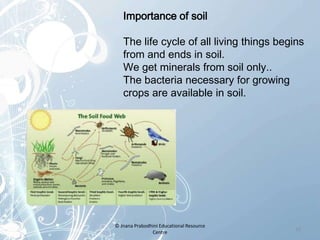
Importance of soil
The life cycle of all living things begins
from and ends in soil.
We get minerals from soil only..
The bacteria necessary for growing
crops are available in soil.
12
© Jnana Prabodhini Educational Resource
Centre
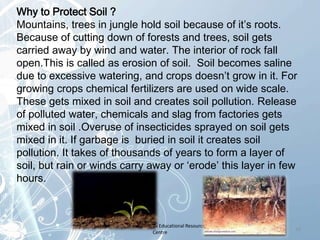
Why to Protect Soil ?
Mountains, trees in jungle hold soil because of it’s roots.
Because of cutting down of forests and trees, soil gets
carried away by wind and water. The interior of rock fall
open.This is called as erosion of soil. Soil becomes saline
due to excessive watering, and crops doesn’t grow in it. For
growing crops chemical fertilizers are used on wide scale.
These gets mixed in soil and creates soil pollution. Release
of polluted water, chemicals and slag from factories gets
mixed in soil .Overuse of insecticides sprayed on soil gets
mixed in it. If garbage is buried in soil it creates soil
pollution. It takes of thousands of years to form a layer of
soil, but rain or winds carry away or ‘erode’ this layer in few
hours.
13
© Jnana Prabodhini Educational Resource
Centre
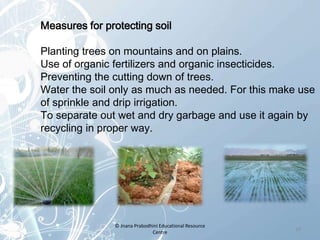
Measures for protecting soil
Planting trees on mountains and on plains.
Use of organic fertilizers and organic insecticides.
Preventing the cutting down of trees.
Water the soil only as much as needed. For this make use
of sprinkle and drip irrigation.
To separate out wet and dry garbage and use it again by
recycling in proper way.
14
© Jnana Prabodhini Educational Resource
Centre
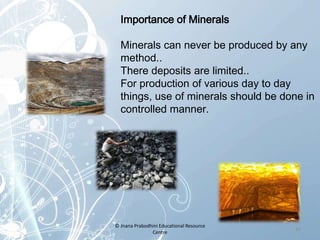
Importance of Minerals
Minerals can never be produced by any
method..
There deposits are limited..
For production of various day to day
things, use of minerals should be done in
controlled manner.
15
© Jnana Prabodhini Educational Resource
Centre
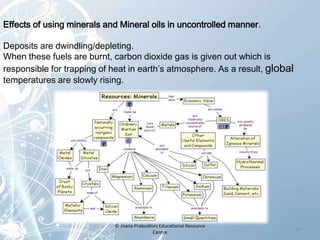
Effects of using minerals and Mineral oils in uncontrolled manner.
Deposits are dwindling/depleting.
When these fuels are burnt, carbon dioxide gas is given out which is
responsible for trapping of heat in earth’s atmosphere. As a result, global
temperatures are slowly rising.
16
© Jnana Prabodhini Educational Resource
Centre
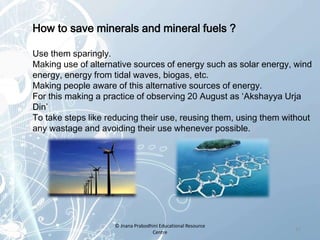
How to save minerals and mineral fuels ?
Use them sparingly.
Making use of alternative sources of energy such as solar energy, wind
energy, energy from tidal waves, biogas, etc.
Making people aware of this alternative sources of energy.
For this making a practice of observing 20 August as ‘Akshayya Urja
Din’
To take steps like reducing their use, reusing them, using them without
any wastage and avoiding their use whenever possible.
17
© Jnana Prabodhini Educational Resource
Centre
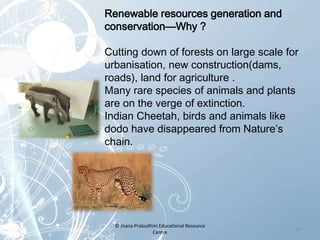
Renewable resources generation and
conservation—Why ?
Cutting down of forests on large scale for
urbanisation, new construction(dams,
roads), land for agriculture .
Many rare species of animals and plants
are on the verge of extinction.
Indian Cheetah, birds and animals like
dodo have disappeared from Nature’s
chain.
18
© Jnana Prabodhini Educational Resource
Centre
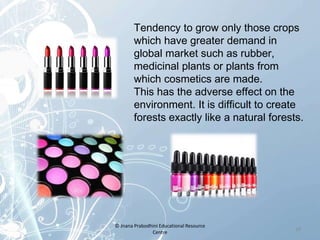
Tendency to grow only those crops
which have greater demand in
global market such as rubber,
medicinal plants or plants from
which cosmetics are made.
This has the adverse effect on the
environment. It is difficult to create
forests exactly like a natural forests.
19
© Jnana Prabodhini Educational Resource
Centre
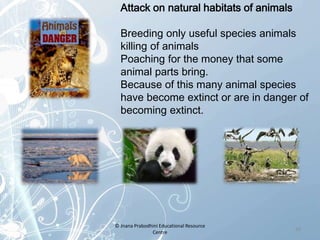
Attack on natural habitats of animals
Breeding only useful species animals
killing of animals
Poaching for the money that some
animal parts bring.
Because of this many animal species
have become extinct or are in danger of
becoming extinct.
20
© Jnana Prabodhini Educational Resource
Centre
Biotechnology
By studing genes of plants and
animals and using scientific
experiment it is possible to save and
conserve certain desired
characteristics. Using this, it is now
possible to produce any plant ,
animals too in a laboratory. This is
called ‘biotechnology’.
21
© Jnana Prabodhini Educational Resource
Centre
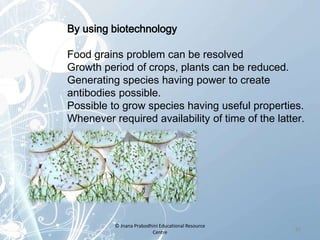
By using biotechnology
Food grains problem can be resolved
Growth period of crops, plants can be reduced.
Generating species having power to create
antibodies possible.
Possible to grow species having useful properties.
Whenever required availability of time of the latter.
22
© Jnana Prabodhini Educational Resource
Centre
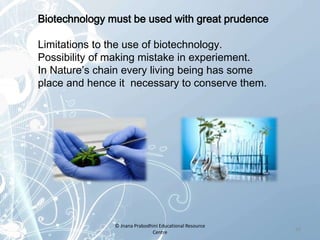
Biotechnology must be used with great prudence
Limitations to the use of biotechnology.
Possibility of making mistake in experiement.
In Nature’s chain every living being has some
place and hence it necessary to conserve them.
23
© Jnana Prabodhini Educational Resource
Centre
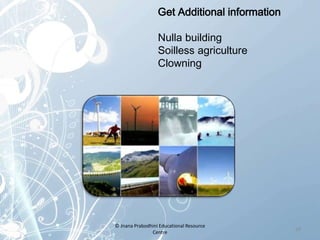
Get Additional information
Nulla building
Soilless agriculture
Clowning
24
© Jnana Prabodhini Educational Resource
Centre

Natural Resources

  • 1.
    1 © Jnana PrabodhiniEducational Resource Centre Natural Resources
  • 2.
    Needs of Humanbeings Man gets air to breathe from atmosphere. Gets water for drinking and for day to day use from rivers, wells, lakes, reservoirs. Food, clothes, shelter and medicines these needs are met by plants and Animals. Plants are grown in soil. Minerals in soil are hence useful for man. 2 © Jnana Prabodhini Educational Resource Centre
  • 3.
    Natural Resources The thingsthrough which Mans basic need are met are called as resources. Air, Water, soil, minerals, Plants and animals together provide for all our needs. These are the part of Nature. Man cannot produce them and hence they are called Natural resources. 3 © Jnana Prabodhini Educational Resource Centre
  • 4.
    Renewable resources Animals livefor certain years. Most of the plants also live for specific years. Because of reproduction animals are born again, plants are grown. We can grow plants by sowing them again. Plants and animals even if destroyed can be reproduced. Those natural resources even if destroyes can be produced again and again are called Renewable resources. 4 © Jnana Prabodhini Educational Resource Centre
  • 5.
    Non-renewable resources The resourceslike Air, water, soil, minerals can never be produced by any method, they are called non-renewable resources. 5 © Jnana Prabodhini Educational Resource Centre
  • 6.
    Use of Naturalresources We all human beings make use of Natural resources for meeting our needs. Sometimes even when there is no need just for leisure purpose we make use of them. Examples like having things, food, clothes. Notebooks, pencils, boxes, Water bottles more then we need. Natural resources should be used sparingly, they should not pollute the environment, is our utmost responsibility to ensure it. 6 © Jnana Prabodhini Educational Resource Centre
  • 7.
    Preserving Non-renewable resources Air- A balanced mixture of Oxygen, Nitrogen, Carbon dioxide and some other gases. We cannot produce Air in any laboratory. Growing Businesses and inturn unlimited growth in the number of factories – the poisonous gases coming out of them, increase in number of vehicles and the fuel used in it are all responsible for increasing air pollution. 7 © Jnana Prabodhini Educational Resource Centre
  • 8.
    Air Pollution badeffects The increase in the proportion of carbon dioxide in the air causes more heat to be retained in the atmosphere. That is why, we are facing the crisis called ‘global warming’ . Life cycle of seasons is getting affected because of increase in temperature. Respiratory problems other diseases, skin problems are increasing because of this. 8 © Jnana Prabodhini Educational Resource Centre
  • 9.
    How to reduceair pollution? Use vehicles only when required. Use Public transport as much as possible. Use CNG(Compressed Natural gas) instead of Petrol and diesel. Process the gas coming out of factory before letting it out in air. 9 © Jnana Prabodhini Educational Resource Centre
  • 10.
    Water – Whyto conserve water ? Water Non-renewable resource– Because of water cycle water on earth itself comes back to earth. Limited reserves of water. Available reserves of water are getting polluted. Melting of ice due to increasing temperature which in turn evaporates and becomes a part of water cycle creating pollution. 10 © Jnana Prabodhini Educational Resource Centre
  • 11.
    How to consevewater ? To prevent rainwater from flowing away,allow it to percolate into the earth. To build dams for the same. Use water sparingly only as much it is needed. Not to waste water. Prevent the sources of water from getting polluted. 11 © Jnana Prabodhini Educational Resource Centre
  • 12.
    Importance of soil Thelife cycle of all living things begins from and ends in soil. We get minerals from soil only.. The bacteria necessary for growing crops are available in soil. 12 © Jnana Prabodhini Educational Resource Centre
  • 13.
    Why to ProtectSoil ? Mountains, trees in jungle hold soil because of it’s roots. Because of cutting down of forests and trees, soil gets carried away by wind and water. The interior of rock fall open.This is called as erosion of soil. Soil becomes saline due to excessive watering, and crops doesn’t grow in it. For growing crops chemical fertilizers are used on wide scale. These gets mixed in soil and creates soil pollution. Release of polluted water, chemicals and slag from factories gets mixed in soil .Overuse of insecticides sprayed on soil gets mixed in it. If garbage is buried in soil it creates soil pollution. It takes of thousands of years to form a layer of soil, but rain or winds carry away or ‘erode’ this layer in few hours. 13 © Jnana Prabodhini Educational Resource Centre
  • 14.
    Measures for protectingsoil Planting trees on mountains and on plains. Use of organic fertilizers and organic insecticides. Preventing the cutting down of trees. Water the soil only as much as needed. For this make use of sprinkle and drip irrigation. To separate out wet and dry garbage and use it again by recycling in proper way. 14 © Jnana Prabodhini Educational Resource Centre
  • 15.
    Importance of Minerals Mineralscan never be produced by any method.. There deposits are limited.. For production of various day to day things, use of minerals should be done in controlled manner. 15 © Jnana Prabodhini Educational Resource Centre
  • 16.
    Effects of usingminerals and Mineral oils in uncontrolled manner. Deposits are dwindling/depleting. When these fuels are burnt, carbon dioxide gas is given out which is responsible for trapping of heat in earth’s atmosphere. As a result, global temperatures are slowly rising. 16 © Jnana Prabodhini Educational Resource Centre
  • 17.
    How to saveminerals and mineral fuels ? Use them sparingly. Making use of alternative sources of energy such as solar energy, wind energy, energy from tidal waves, biogas, etc. Making people aware of this alternative sources of energy. For this making a practice of observing 20 August as ‘Akshayya Urja Din’ To take steps like reducing their use, reusing them, using them without any wastage and avoiding their use whenever possible. 17 © Jnana Prabodhini Educational Resource Centre
  • 18.
    Renewable resources generationand conservation—Why ? Cutting down of forests on large scale for urbanisation, new construction(dams, roads), land for agriculture . Many rare species of animals and plants are on the verge of extinction. Indian Cheetah, birds and animals like dodo have disappeared from Nature’s chain. 18 © Jnana Prabodhini Educational Resource Centre
  • 19.
    Tendency to growonly those crops which have greater demand in global market such as rubber, medicinal plants or plants from which cosmetics are made. This has the adverse effect on the environment. It is difficult to create forests exactly like a natural forests. 19 © Jnana Prabodhini Educational Resource Centre
  • 20.
    Attack on naturalhabitats of animals Breeding only useful species animals killing of animals Poaching for the money that some animal parts bring. Because of this many animal species have become extinct or are in danger of becoming extinct. 20 © Jnana Prabodhini Educational Resource Centre
  • 21.
    Biotechnology By studing genesof plants and animals and using scientific experiment it is possible to save and conserve certain desired characteristics. Using this, it is now possible to produce any plant , animals too in a laboratory. This is called ‘biotechnology’. 21 © Jnana Prabodhini Educational Resource Centre
  • 22.
    By using biotechnology Foodgrains problem can be resolved Growth period of crops, plants can be reduced. Generating species having power to create antibodies possible. Possible to grow species having useful properties. Whenever required availability of time of the latter. 22 © Jnana Prabodhini Educational Resource Centre
  • 23.
    Biotechnology must beused with great prudence Limitations to the use of biotechnology. Possibility of making mistake in experiement. In Nature’s chain every living being has some place and hence it necessary to conserve them. 23 © Jnana Prabodhini Educational Resource Centre
  • 24.
    Get Additional information Nullabuilding Soilless agriculture Clowning 24 © Jnana Prabodhini Educational Resource Centre