What are Gymnosperms?

  Gymnosperms are seed bearing vascular plants

  Gymnosperm means “naked seed”(From the
  Greek: gymnos = naked; sperm = seed)

  Seeds are formed naked

 The seeds of the gymnosperms lack a protective
  enclosure (unlike flowering plants which have
  flowers and fruit)
  Seeds are produced on the scales of cones

  More advanced than ferns because they do
  not have spores, they have seeds
General Features

  Most of the gymnosperms are trees


  Some are evergreen, i.e. pine


  All gymnosperms have exposed seeds


  All of them don’t posses flowers


  Mostly massive
Scientific Classification


 Gymnosperms belong to 4 different phyla which are


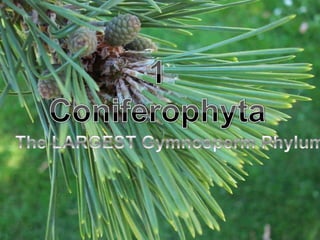
      1. Coniferophyta

      2. Cycadophyta

       3. Ginkgophyta

       4.   And Gnetophyta
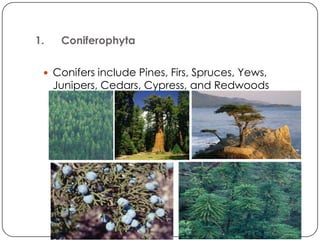
1.    Coniferophyta

  Conifers include Pines, Firs, Spruces, Yews,
     Junipers, Cedars, Cypress, and Redwoods
1.     Coniferophyta

  The      term     conifer   comes  from    the
     reproductive structure, the cone, which is a
     cluster of scalelike sporophylls

  About 550 species
1.   Coniferophyta

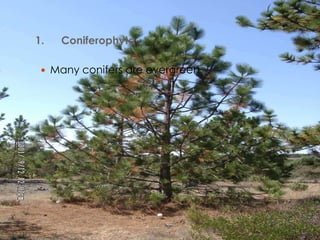
  Many conifers are evergreen
1.   Coniferophyta

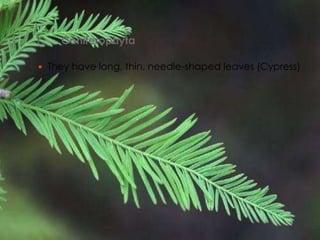
 They have long, thin, needle-shaped leaves (Cypress)
1.   Coniferophyta

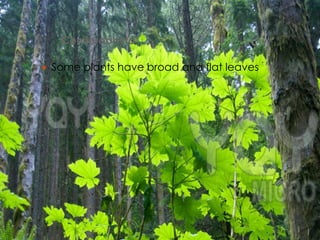
  Some plants have broad and flat leaves
1.   Coniferophyta

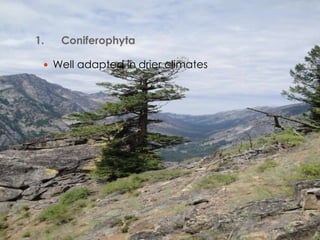
  Well adapted in drier climates
2.     Cycadophyta

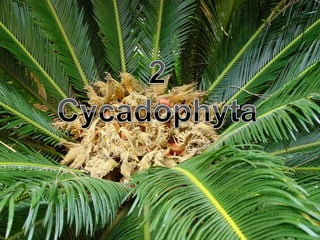
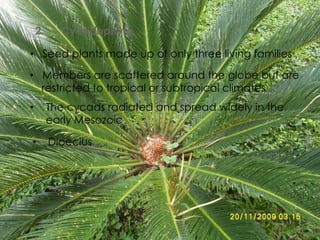
• Seed plants made up of only three living families

• Members are scattered around the globe but are
  restricted to tropical or subtropical climates
•        The cycads radiated and spread widely in the
         early Mesozoic

•        Dioecius
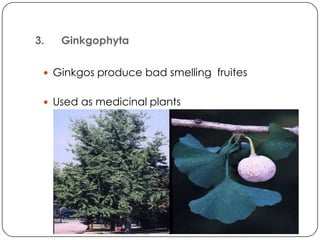
3.   Ginkgophyta

  Ginkgos produce bad smelling fruites


  Used as medicinal plants
4.     Gnetophyta

  They are closely related with conifers


  This likeness leads scientists to believe that gnetales
     are evolved from conifers


  This theory is supported by extensive fossil records,
     some dating back to the Palezoic era

  Though they are non-flowering plants, gnetales
     have a reproductive structure similiar to that of
     flowering plants
Habitat of Gymnosperms


   Occupy large areas of the Earth's surface

   Can grow in drier conditions


   Gnetophytes grow at high altitudes

    Cycads are distributed throughout the world but
    are concentrated in equatorial regions
Habitat of Gymnosperms. Cont…

 Gymnosperms that occupy areas of the world with
 severe climatic conditions     are   adapted      to
 conserving water;
    leaves are covered with a heavy, waxy cuticle
    and pores (stomata) are sunken below the leaf
     surface to decrease the rate of evaporation
Lifecycle
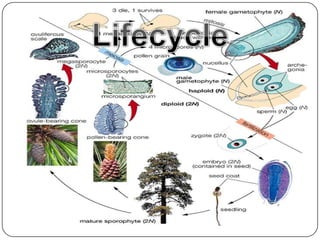
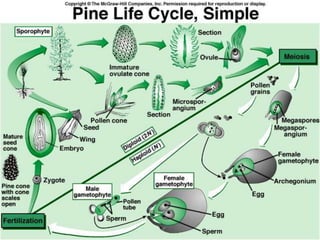
  The gymnosperm (pine tree) life cycle takes about
   two years to complete
  Exhibits alternation of generation
  The dominant photosynthetic part of the life cycle
   is the sporophyte
  Sporophyte is diploid (2n)
  Gametophyte (n) is dependent on sporophyte
  Cones are reproductive structures(Gametophytes)
  Pollen grains are produced by male cones and
   carried to female cone by wind where fertilization
   occurs
  After fertilization, a sporophyte is formed which is
   enclosed in a seed. It germinates to produce a
   sporophytic plant once again
Ecological Importance

   Provide food and habitat for wild life

   Forests prevent soil erosion

   Reduce green house gases

   Conifers are often featured in gardens

   Junipers are low-growing shrubs and are cultivated
    to cover grounds

   Conifers are affective wind breakers
Economical Importance

   They are major source of lumber, paper pulp,
    turpentine and resins

   They are used as fuel

   They are major source of world’s timber


   Used as medicines (Ginkgos)


   Source of food (Pine Nuts)

   Gymnospermous     plants     are   widely   used   as
   ornamentals
Gymnosperms
Gymnosperms

Gymnosperms

  • 3.
    What are Gymnosperms?  Gymnosperms are seed bearing vascular plants  Gymnosperm means “naked seed”(From the Greek: gymnos = naked; sperm = seed)  Seeds are formed naked  The seeds of the gymnosperms lack a protective enclosure (unlike flowering plants which have flowers and fruit)  Seeds are produced on the scales of cones  More advanced than ferns because they do not have spores, they have seeds
  • 5.
    General Features Most of the gymnosperms are trees  Some are evergreen, i.e. pine  All gymnosperms have exposed seeds  All of them don’t posses flowers  Mostly massive
  • 7.
    Scientific Classification  Gymnospermsbelong to 4 different phyla which are 1. Coniferophyta 2. Cycadophyta 3. Ginkgophyta 4. And Gnetophyta
  • 9.
    1. Coniferophyta  Conifers include Pines, Firs, Spruces, Yews, Junipers, Cedars, Cypress, and Redwoods
  • 10.
    1. Coniferophyta  The term conifer comes from the reproductive structure, the cone, which is a cluster of scalelike sporophylls  About 550 species
  • 11.
    1. Coniferophyta  Many conifers are evergreen
  • 12.
    1. Coniferophyta  They have long, thin, needle-shaped leaves (Cypress)
  • 13.
    1. Coniferophyta  Some plants have broad and flat leaves
  • 14.
    1. Coniferophyta  Well adapted in drier climates
  • 16.
    2. Cycadophyta • Seed plants made up of only three living families • Members are scattered around the globe but are restricted to tropical or subtropical climates • The cycads radiated and spread widely in the early Mesozoic • Dioecius
  • 18.
    3. Ginkgophyta  Ginkgos produce bad smelling fruites  Used as medicinal plants
  • 20.
    4. Gnetophyta  They are closely related with conifers  This likeness leads scientists to believe that gnetales are evolved from conifers  This theory is supported by extensive fossil records, some dating back to the Palezoic era  Though they are non-flowering plants, gnetales have a reproductive structure similiar to that of flowering plants
  • 22.
    Habitat of Gymnosperms  Occupy large areas of the Earth's surface  Can grow in drier conditions  Gnetophytes grow at high altitudes  Cycads are distributed throughout the world but are concentrated in equatorial regions
  • 23.
    Habitat of Gymnosperms.Cont…  Gymnosperms that occupy areas of the world with severe climatic conditions are adapted to conserving water;  leaves are covered with a heavy, waxy cuticle  and pores (stomata) are sunken below the leaf surface to decrease the rate of evaporation
  • 25.
    Lifecycle  Thegymnosperm (pine tree) life cycle takes about two years to complete  Exhibits alternation of generation  The dominant photosynthetic part of the life cycle is the sporophyte  Sporophyte is diploid (2n)  Gametophyte (n) is dependent on sporophyte  Cones are reproductive structures(Gametophytes)  Pollen grains are produced by male cones and carried to female cone by wind where fertilization occurs  After fertilization, a sporophyte is formed which is enclosed in a seed. It germinates to produce a sporophytic plant once again
  • 28.
    Ecological Importance  Provide food and habitat for wild life  Forests prevent soil erosion  Reduce green house gases  Conifers are often featured in gardens  Junipers are low-growing shrubs and are cultivated to cover grounds  Conifers are affective wind breakers
  • 29.
    Economical Importance  They are major source of lumber, paper pulp, turpentine and resins  They are used as fuel  They are major source of world’s timber  Used as medicines (Ginkgos)  Source of food (Pine Nuts)  Gymnospermous plants are widely used as ornamentals