By
Sijo.A,
B.Sc Botany & Biotechnology
Equisetum popularly known a the ‘horse-
tail’ or ‘scouring rush’.
It is now represented by nearly 30 species
which are seen world wide except in
Australia and New Zealand.
Some species prefer damp and shady
places while others grow in marshes,
ponds or stream banks
Some are found in xerophytic habitats
 Some common Indian species are E. arvense, E.
debile, E. elongatum, E. diffusum, E.dubium etc
 They are used as indicators of minerals in the
soil.Some can absorb gold from the soil.
 Deposition of silica on the outer wall of the
epidermal cells make the plant surface rough in
texture.
 By virtue of this property, the plants are often used
as abrasives.
 Silica forms a protective covering against
pathogens and predators
 Some species are used in ayurvedic medicines as
diuretics.
External features
 The plant body is differentiated into stem, root
and leaves.
 It consists of a perennial, prostrate, branched
and creeping underground rhizome from
which arise erect and aerial annual branches.
 Some of the aerial branches are sterile ,
whereas some others are fertile.
 The aerial branches are usually thin, vine-like
and climb over adjacent trees and are
herbaceous.
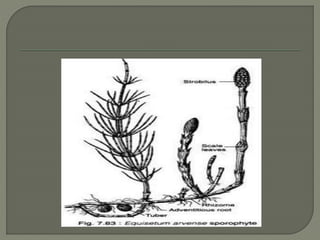
 The stem is represented by the much branched,
creeping and perennial underground rhizome.
 The rhizome is differentiated into nodes and
internodes.
 At each node there is a whorl of small scaly
leaves.
 At the axil of each scale leaf, there is a branch
bud. It may develop into an aerial or underground
branch.
 In some species it may form a short and round
tuber. On separation from the parent rhizome this
tuber develops to a new plant.
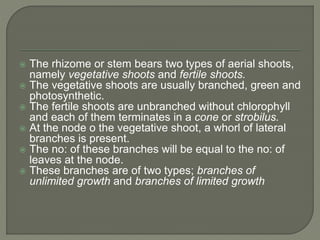
 The rhizome or stem bears two types of aerial shoots,
namely vegetative shoots and fertile shoots.
 The vegetative shoots are usually branched, green and
photosynthetic.
 The fertile shoots are unbranched without chlorophyll
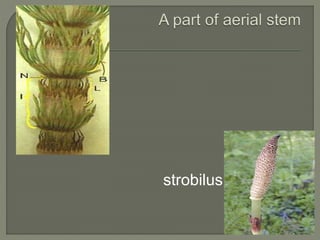
and each of them terminates in a cone or strobilus.
 At the node o the vegetative shoot, a whorl of lateral
branches is present.
 The no: of these branches will be equal to the no: of
leaves at the node.
 These branches are of two types; branches of
unlimited growth and branches of limited growth
strobilus
 These are similar to the main vegetative shoot.
 Their growth is unlimited
 They are branched and differentiatd into nodes and
internodes.
Branches of limited growth
 They have only limited growth. They are unbranched
and differentiated into nodes and internodes.
 Due to this the rhizome and aerial shoots have a
jointed appearance.
 The internodes are hollow and have longitudinal ridges
and grooves.
 The ridges of successive internodes alternate with
each other. The no: of ridges is equal to the no: of
leaves at the node.
 Leaves are minute, scaly and isophyllous.
 They arise in whorls at the nodes of both
underground rhizome and aerial branches
 They fuse at their base to form a distinct sheath
around the node. Their free distal ends give a frill-
like appearance.
 The leaves have only a single median vein.
 Chlorophyll is absent and hence they are non-
photosynthetic.
 Their main function is to protect the branch buds at
the node.
 Photosynthesis is carried out by the green and
sterile aerial branches of the rhizome.
All roots of the Equisetum, other than first
or primary root of the embryo are
adventitious.
They are slender and fibrous and arise
either from the node of rhizome or from the
base of upright branches.
They are brached and their branches arise
endogenously from the pericycle.
(1) Anatomy of stem
 The anatomy of the stem shows both hydrophytic
and xerophytic characters.
 Also the anatomy of nodes is diferent from that of
internodes
a) Anatomy of internode
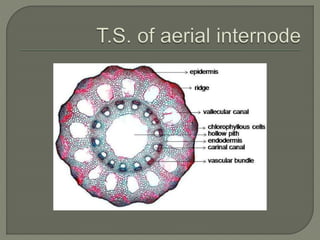
 The T.S of a node is wavy in outline due to
the presence of ridges and grooves.
 It has distinct epidermis and well-
developed cortex and stele, with a ring of
vascular bundles and a large central pith
cavity.
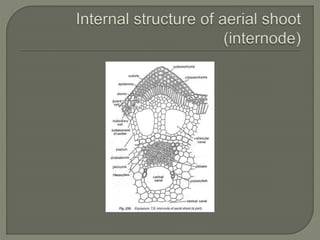
 Epidermis is uniseriate with heavy silica
deposition on the outer and radial walls.
 Epidermis is interrupted by sunken stomata.
 The stomatal apparatus consists of four cells,
arranged in two tiers of two cells each.
 The cells of the lower tier are guard cells and
those of the upper tier are subsidiary or
accessory cells.
 A series of siliceous thickening bands develop
on the lower surface of the accessory cells.
 Cortex is differentiated into outer cortex and
inner cortex.
 Outer cortex consist of sclerenchymatous
hypodermis. It is multilayered below the
ridges and 1 or 2 layered in the grooves.
 Below the stomata there is no sclerenchyma.
 Sclerenchyma is followed by a band of
chlorenchyma. These cells are photosynthetic
in function.
 Inner cortex is composed of thin walled
parenchyma cells.
 Beneath the furrows it has large schizolysigenous
canals, known as vallecular canals.
 These canals are are continous in the internode
portion and form a distinct aerating system.
 In between the stele and the cortex is the endodermis.
It may be single layered or two-layered.
 Endodermis is followed by a single layered
parenchymatous pericycle.
 Vascular cylinder is a siphonostele in which vascular
bundles are arranged in a ring around the large pith.
 The no: of vascular bundles is equal to the no: of
ridges and also to the no: of leaves.
 The bundles alternate with the vallecular canals.
 The vascular bundles are conjoint, collateral
and endarch.
 Cambium is altogether absent
 Phloem is well-developed whereas xylem is
poorly developed
 Protoxylem consists of annular and spiral
tracheids
 Metaxylem consists of scalariform, reticulate
or pitted tracheids.
 In mature bundles, protoxylem disintegrate to
form a protoxylem lacuna, called carinal canal
 Carinal canal forms an inner ring of
intercellular spaces. They are filled with water
and probably they help in the conduction of
water.
 Phloem lies outside the xylem in radial
arrangement with the carinal canal.It is
formed of phloem parenchyma and sieve
tubes.
 The central part of the internode of the aerial
shoot is occupied by a large pith cavity.
 The internode has both xerophytic and
hydrophytic anatomical features.
Presence of ridges and furrows
Epidermal cells with silica deposition
Presence of sunken stomata
Presence of well-developed
sclerenchymatous hypodermis
Presence of reduced scaly leaves
Photosynthetic stem
Well developed vascular cylinder
 Presence of a well developed aerating
system, formed of vallecular canals and
central pith cavity.
 Presence of reduced xylem.
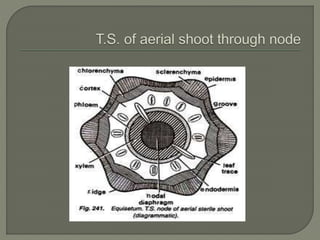
b) Anatomy of node
The anatomy of the node differs from that of the
internode in the following features.
 Pith is not hollow, but it is solid diaphragm,
called nodal diaphragm.
 Vallecular canals are absent.
 Carinal canals are absent
 Vascular bundles fuse together to form a vascular
cylinder around the nodal diaphragm.
 Leaf and branch traces arise from the vascular cylinder
of the node.
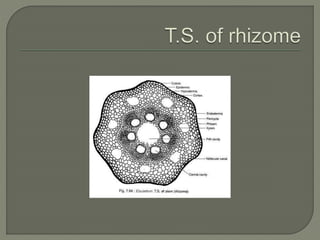
(2) Anatomy of rhizome
Anatomically rhizome is almost similar to aerial shoot.
However, it differs from the aerial shoot in the following
features.
 No stomata in the epidermis
 Outer cortex has less sclerenchyma
 Presence of chlorenchyma cells in the cortex
 Vallecular, carinal and central canals are narrower than
those of the aerial shoot.
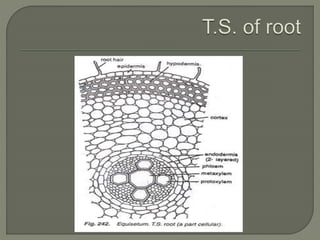
 Root has three anatomical parts, namely
epidermis, cortex and stele.
 Root epidermis or piliferous layer is uniseriate
and formed of thin walle cells.It is protective
in function.
 Some epidermal hairs give rise to elongated
root hairs.
 Cortex is differentiated into sclerenchymatous
outer cortex and parenchymatous inner
cortex.
 Intercellular spaces are absent in the outer
cortex but present in the inner cortex
 The innermost part of the cortex is the endodermis.
It is two-layered.
 The cells of its outer layer are large and they
posses casparian bands.
 A true pericycle is absent in the stelar region.
 The inner endodermal layer behaves as a
pericycle by giving out lateral roots.
 In the centre of the stelar region, a protostele is
present, with diarch to hexarch xylem.
 A large metaxylem tracheid is present in the centre
and the protoxylem strands lie around it.
 Phloem bundles alternate with xylem strands.
 Pith is absent.
 Apical growth involves the elongation of stem (
rhizome and aerial shoots ) and roots.
 The apical growth of the stem takes place by the
activity of a large and pyramidal apical cell which
has three cutting faces.
 It cuts off segments on its three sides.
 Each segment divides anticlinally forming two
upper and two lower segments
 Both these segments undergo repeated division,
forming upper and lower tiers of cells.
 The upper cells give rise to node and thelower
cells give rise to internode.
 The apical growth of roots also take place by the
activity of a tetrahedral apical cell which has four
cutting faces, instead of the three in the apical
cell of stem.
 The cells cut off from its three lateral faces, form
the epidermis, cortex and stele, and those cut off
from its outer face form the root cap.
Vegetative characters of equisetum

Vegetative characters of equisetum

  • 1.
  • 3.
    Equisetum popularly knowna the ‘horse- tail’ or ‘scouring rush’. It is now represented by nearly 30 species which are seen world wide except in Australia and New Zealand. Some species prefer damp and shady places while others grow in marshes, ponds or stream banks Some are found in xerophytic habitats
  • 4.
     Some commonIndian species are E. arvense, E. debile, E. elongatum, E. diffusum, E.dubium etc  They are used as indicators of minerals in the soil.Some can absorb gold from the soil.  Deposition of silica on the outer wall of the epidermal cells make the plant surface rough in texture.  By virtue of this property, the plants are often used as abrasives.  Silica forms a protective covering against pathogens and predators  Some species are used in ayurvedic medicines as diuretics.
  • 5.
    External features  Theplant body is differentiated into stem, root and leaves.  It consists of a perennial, prostrate, branched and creeping underground rhizome from which arise erect and aerial annual branches.  Some of the aerial branches are sterile , whereas some others are fertile.  The aerial branches are usually thin, vine-like and climb over adjacent trees and are herbaceous.
  • 6.
     The stemis represented by the much branched, creeping and perennial underground rhizome.  The rhizome is differentiated into nodes and internodes.  At each node there is a whorl of small scaly leaves.  At the axil of each scale leaf, there is a branch bud. It may develop into an aerial or underground branch.  In some species it may form a short and round tuber. On separation from the parent rhizome this tuber develops to a new plant.
  • 8.
     The rhizomeor stem bears two types of aerial shoots, namely vegetative shoots and fertile shoots.  The vegetative shoots are usually branched, green and photosynthetic.  The fertile shoots are unbranched without chlorophyll and each of them terminates in a cone or strobilus.  At the node o the vegetative shoot, a whorl of lateral branches is present.  The no: of these branches will be equal to the no: of leaves at the node.  These branches are of two types; branches of unlimited growth and branches of limited growth
  • 9.
  • 10.
     These aresimilar to the main vegetative shoot.  Their growth is unlimited  They are branched and differentiatd into nodes and internodes. Branches of limited growth  They have only limited growth. They are unbranched and differentiated into nodes and internodes.  Due to this the rhizome and aerial shoots have a jointed appearance.  The internodes are hollow and have longitudinal ridges and grooves.  The ridges of successive internodes alternate with each other. The no: of ridges is equal to the no: of leaves at the node.
  • 11.
     Leaves areminute, scaly and isophyllous.  They arise in whorls at the nodes of both underground rhizome and aerial branches  They fuse at their base to form a distinct sheath around the node. Their free distal ends give a frill- like appearance.  The leaves have only a single median vein.  Chlorophyll is absent and hence they are non- photosynthetic.  Their main function is to protect the branch buds at the node.  Photosynthesis is carried out by the green and sterile aerial branches of the rhizome.
  • 12.
    All roots ofthe Equisetum, other than first or primary root of the embryo are adventitious. They are slender and fibrous and arise either from the node of rhizome or from the base of upright branches. They are brached and their branches arise endogenously from the pericycle.
  • 13.
    (1) Anatomy ofstem  The anatomy of the stem shows both hydrophytic and xerophytic characters.  Also the anatomy of nodes is diferent from that of internodes a) Anatomy of internode  The T.S of a node is wavy in outline due to the presence of ridges and grooves.  It has distinct epidermis and well- developed cortex and stele, with a ring of vascular bundles and a large central pith cavity.
  • 16.
     Epidermis isuniseriate with heavy silica deposition on the outer and radial walls.  Epidermis is interrupted by sunken stomata.  The stomatal apparatus consists of four cells, arranged in two tiers of two cells each.  The cells of the lower tier are guard cells and those of the upper tier are subsidiary or accessory cells.  A series of siliceous thickening bands develop on the lower surface of the accessory cells.
  • 17.
     Cortex isdifferentiated into outer cortex and inner cortex.  Outer cortex consist of sclerenchymatous hypodermis. It is multilayered below the ridges and 1 or 2 layered in the grooves.  Below the stomata there is no sclerenchyma.  Sclerenchyma is followed by a band of chlorenchyma. These cells are photosynthetic in function.  Inner cortex is composed of thin walled parenchyma cells.
  • 18.
     Beneath thefurrows it has large schizolysigenous canals, known as vallecular canals.  These canals are are continous in the internode portion and form a distinct aerating system.  In between the stele and the cortex is the endodermis. It may be single layered or two-layered.  Endodermis is followed by a single layered parenchymatous pericycle.  Vascular cylinder is a siphonostele in which vascular bundles are arranged in a ring around the large pith.  The no: of vascular bundles is equal to the no: of ridges and also to the no: of leaves.  The bundles alternate with the vallecular canals.
  • 19.
     The vascularbundles are conjoint, collateral and endarch.  Cambium is altogether absent  Phloem is well-developed whereas xylem is poorly developed  Protoxylem consists of annular and spiral tracheids  Metaxylem consists of scalariform, reticulate or pitted tracheids.  In mature bundles, protoxylem disintegrate to form a protoxylem lacuna, called carinal canal
  • 20.
     Carinal canalforms an inner ring of intercellular spaces. They are filled with water and probably they help in the conduction of water.  Phloem lies outside the xylem in radial arrangement with the carinal canal.It is formed of phloem parenchyma and sieve tubes.  The central part of the internode of the aerial shoot is occupied by a large pith cavity.  The internode has both xerophytic and hydrophytic anatomical features.
  • 21.
    Presence of ridgesand furrows Epidermal cells with silica deposition Presence of sunken stomata Presence of well-developed sclerenchymatous hypodermis Presence of reduced scaly leaves Photosynthetic stem Well developed vascular cylinder
  • 22.
     Presence ofa well developed aerating system, formed of vallecular canals and central pith cavity.  Presence of reduced xylem. b) Anatomy of node The anatomy of the node differs from that of the internode in the following features.  Pith is not hollow, but it is solid diaphragm, called nodal diaphragm.  Vallecular canals are absent.  Carinal canals are absent
  • 24.
     Vascular bundlesfuse together to form a vascular cylinder around the nodal diaphragm.  Leaf and branch traces arise from the vascular cylinder of the node. (2) Anatomy of rhizome Anatomically rhizome is almost similar to aerial shoot. However, it differs from the aerial shoot in the following features.  No stomata in the epidermis  Outer cortex has less sclerenchyma  Presence of chlorenchyma cells in the cortex  Vallecular, carinal and central canals are narrower than those of the aerial shoot.
  • 26.
     Root hasthree anatomical parts, namely epidermis, cortex and stele.  Root epidermis or piliferous layer is uniseriate and formed of thin walle cells.It is protective in function.  Some epidermal hairs give rise to elongated root hairs.  Cortex is differentiated into sclerenchymatous outer cortex and parenchymatous inner cortex.  Intercellular spaces are absent in the outer cortex but present in the inner cortex
  • 28.
     The innermostpart of the cortex is the endodermis. It is two-layered.  The cells of its outer layer are large and they posses casparian bands.  A true pericycle is absent in the stelar region.  The inner endodermal layer behaves as a pericycle by giving out lateral roots.  In the centre of the stelar region, a protostele is present, with diarch to hexarch xylem.  A large metaxylem tracheid is present in the centre and the protoxylem strands lie around it.  Phloem bundles alternate with xylem strands.  Pith is absent.
  • 29.
     Apical growthinvolves the elongation of stem ( rhizome and aerial shoots ) and roots.  The apical growth of the stem takes place by the activity of a large and pyramidal apical cell which has three cutting faces.  It cuts off segments on its three sides.  Each segment divides anticlinally forming two upper and two lower segments  Both these segments undergo repeated division, forming upper and lower tiers of cells.  The upper cells give rise to node and thelower cells give rise to internode.
  • 30.
     The apicalgrowth of roots also take place by the activity of a tetrahedral apical cell which has four cutting faces, instead of the three in the apical cell of stem.  The cells cut off from its three lateral faces, form the epidermis, cortex and stele, and those cut off from its outer face form the root cap.