Electric Charge
© Jnana Prabodhini Educational Resource
Centre
1
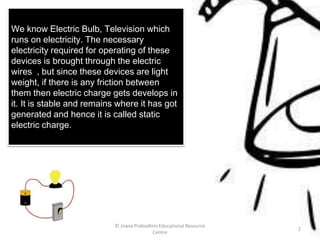
We know Electric Bulb, Television which
runs on electricity. The necessary
electricity required for operating of these
devices is brought through the electric
wires , but since these devices are light
weight, if there is any friction between
them then electric charge gets develops in
it. It is stable and remains where it has got
generated and hence it is called static
electric charge.
© Jnana Prabodhini Educational Resource
Centre
2
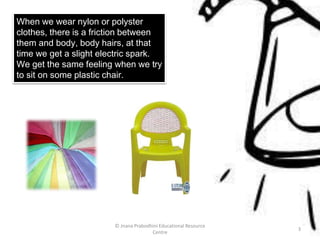
When we wear nylon or polyster
clothes, there is a friction between
them and body, body hairs, at that
time we get a slight electric spark.
We get the same feeling when we try
to sit on some plastic chair.
© Jnana Prabodhini Educational Resource
Centre
3
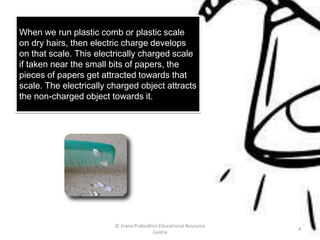
When we run plastic comb or plastic scale
on dry hairs, then electric charge develops
on that scale. This electrically charged scale
if taken near the small bits of papers, the
pieces of papers get attracted towards that
scale. The electrically charged object attracts
the non-charged object towards it.
© Jnana Prabodhini Educational Resource
Centre
4
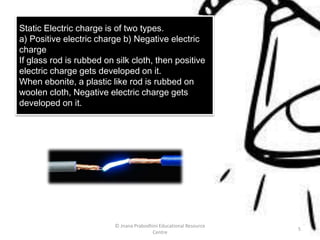
Static Electric charge is of two types.
a) Positive electric charge b) Negative electric
charge
If glass rod is rubbed on silk cloth, then positive
electric charge gets developed on it.
When ebonite, a plastic like rod is rubbed on
woolen cloth, Negative electric charge gets
developed on it.
© Jnana Prabodhini Educational Resource
Centre
5
Two ebonite rods when rubbed on woolen cloth,
negative electric charge gets develop on both of
them.
If both of these rods are brought near each other,
they try to go away.
Similarly , two glass rods positively charged when
brought near each other, they try to be apart. This
going apart is called as repulsion.
© Jnana Prabodhini Educational Resource
Centre
6
But negatively charged ebonite rod and positively
charged glass rod if brought near each other, they
gets pulled towards each other. This is called as
attraction.
Hence it is observed that like charges that is between
two similar charges, two positive or two negative
charges there is repulsion.
Different that is unlike, one positive and one negative
charges attract each other.
© Jnana Prabodhini Educational Resource
Centre
7
Every substance is made up of small particles called
atoms.
In every atom there is positive and negative charged small
particle.
They are equal in numbers and hence these charges do
not have any effect on each other. Hence atom as such
doesn’t have any charge on it.
Every substance has different atomic structure and
different atomic number, but still the positive and negative
charges on the atom in it neutralises each other and
hence normally there is no electric charge on the
substance.
© Jnana Prabodhini Educational Resource
Centre
8
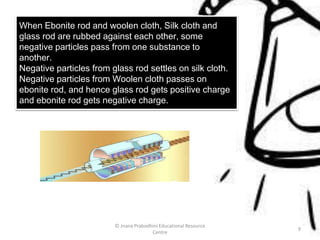
When Ebonite rod and woolen cloth, Silk cloth and
glass rod are rubbed against each other, some
negative particles pass from one substance to
another.
Negative particles from glass rod settles on silk cloth.
Negative particles from Woolen cloth passes on
ebonite rod, and hence glass rod gets positive charge
and ebonite rod gets negative charge.
© Jnana Prabodhini Educational Resource
Centre
9
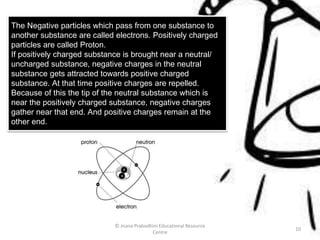
The Negative particles which pass from one substance to
another substance are called electrons. Positively charged
particles are called Proton.
If positively charged substance is brought near a neutral/
uncharged substance, negative charges in the neutral
substance gets attracted towards positive charged
substance. At that time positive charges are repelled.
Because of this the tip of the neutral substance which is
near the positively charged substance, negative charges
gather near that end. And positive charges remain at the
other end.
© Jnana Prabodhini Educational Resource
Centre
10
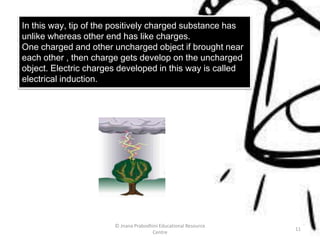
In this way, tip of the positively charged substance has
unlike whereas other end has like charges.
One charged and other uncharged object if brought near
each other , then charge gets develop on the uncharged
object. Electric charges developed in this way is called
electrical induction.
© Jnana Prabodhini Educational Resource
Centre
11
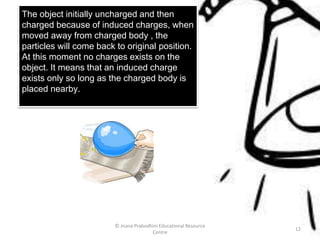
The object initially uncharged and then
charged because of induced charges, when
moved away from charged body , the
particles will come back to original position.
At this moment no charges exists on the
object. It means that an induced charge
exists only so long as the charged body is
placed nearby.
© Jnana Prabodhini Educational Resource
Centre
12
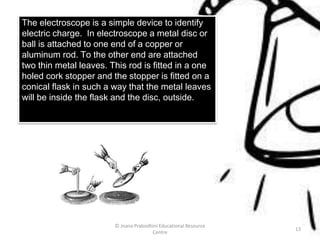
The electroscope is a simple device to identify
electric charge. In electroscope a metal disc or
ball is attached to one end of a copper or
aluminum rod. To the other end are attached
two thin metal leaves. This rod is fitted in a one
holed cork stopper and the stopper is fitted on a
conical flask in such a way that the metal leaves
will be inside the flask and the disc, outside.
© Jnana Prabodhini Educational Resource
Centre
13
Sometimes, to make the electroscope
more sensitive, gold leaves are
attached to the end inside the flask.
The moving apart of the leaves of the
electroscope is the test for finding out
if the body is charged.
© Jnana Prabodhini Educational Resource
Centre
14
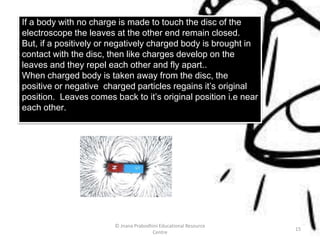
If a body with no charge is made to touch the disc of the
electroscope the leaves at the other end remain closed.
But, if a positively or negatively charged body is brought in
contact with the disc, then like charges develop on the
leaves and they repel each other and fly apart..
When charged body is taken away from the disc, the
positive or negative charged particles regains it’s original
position. Leaves comes back to it’s original position i.e near
each other.
© Jnana Prabodhini Educational Resource
Centre
15
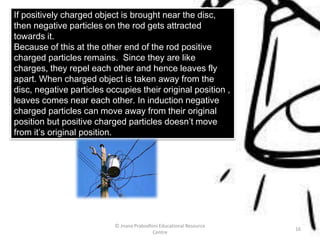
If positively charged object is brought near the disc,
then negative particles on the rod gets attracted
towards it.
Because of this at the other end of the rod positive
charged particles remains. Since they are like
charges, they repel each other and hence leaves fly
apart. When charged object is taken away from the
disc, negative particles occupies their original position ,
leaves comes near each other. In induction negative
charged particles can move away from their original
position but positive charged particles doesn’t move
from it’s original position.
© Jnana Prabodhini Educational Resource
Centre
16
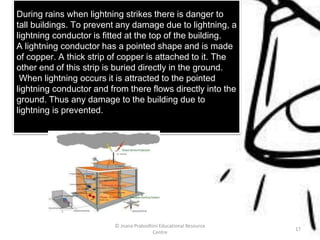
During rains when lightning strikes there is danger to
tall buildings. To prevent any damage due to lightning, a
lightning conductor is fitted at the top of the building.
A lightning conductor has a pointed shape and is made
of copper. A thick strip of copper is attached to it. The
other end of this strip is buried directly in the ground.
When lightning occurs it is attracted to the pointed
lightning conductor and from there flows directly into the
ground. Thus any damage to the building due to
lightning is prevented.
© Jnana Prabodhini Educational Resource
Centre
17

Electric Charge

  • 1.
    Electric Charge © JnanaPrabodhini Educational Resource Centre 1
  • 2.
    We know ElectricBulb, Television which runs on electricity. The necessary electricity required for operating of these devices is brought through the electric wires , but since these devices are light weight, if there is any friction between them then electric charge gets develops in it. It is stable and remains where it has got generated and hence it is called static electric charge. © Jnana Prabodhini Educational Resource Centre 2
  • 3.
    When we wearnylon or polyster clothes, there is a friction between them and body, body hairs, at that time we get a slight electric spark. We get the same feeling when we try to sit on some plastic chair. © Jnana Prabodhini Educational Resource Centre 3
  • 4.
    When we runplastic comb or plastic scale on dry hairs, then electric charge develops on that scale. This electrically charged scale if taken near the small bits of papers, the pieces of papers get attracted towards that scale. The electrically charged object attracts the non-charged object towards it. © Jnana Prabodhini Educational Resource Centre 4
  • 5.
    Static Electric chargeis of two types. a) Positive electric charge b) Negative electric charge If glass rod is rubbed on silk cloth, then positive electric charge gets developed on it. When ebonite, a plastic like rod is rubbed on woolen cloth, Negative electric charge gets developed on it. © Jnana Prabodhini Educational Resource Centre 5
  • 6.
    Two ebonite rodswhen rubbed on woolen cloth, negative electric charge gets develop on both of them. If both of these rods are brought near each other, they try to go away. Similarly , two glass rods positively charged when brought near each other, they try to be apart. This going apart is called as repulsion. © Jnana Prabodhini Educational Resource Centre 6
  • 7.
    But negatively chargedebonite rod and positively charged glass rod if brought near each other, they gets pulled towards each other. This is called as attraction. Hence it is observed that like charges that is between two similar charges, two positive or two negative charges there is repulsion. Different that is unlike, one positive and one negative charges attract each other. © Jnana Prabodhini Educational Resource Centre 7
  • 8.
    Every substance ismade up of small particles called atoms. In every atom there is positive and negative charged small particle. They are equal in numbers and hence these charges do not have any effect on each other. Hence atom as such doesn’t have any charge on it. Every substance has different atomic structure and different atomic number, but still the positive and negative charges on the atom in it neutralises each other and hence normally there is no electric charge on the substance. © Jnana Prabodhini Educational Resource Centre 8
  • 9.
    When Ebonite rodand woolen cloth, Silk cloth and glass rod are rubbed against each other, some negative particles pass from one substance to another. Negative particles from glass rod settles on silk cloth. Negative particles from Woolen cloth passes on ebonite rod, and hence glass rod gets positive charge and ebonite rod gets negative charge. © Jnana Prabodhini Educational Resource Centre 9
  • 10.
    The Negative particleswhich pass from one substance to another substance are called electrons. Positively charged particles are called Proton. If positively charged substance is brought near a neutral/ uncharged substance, negative charges in the neutral substance gets attracted towards positive charged substance. At that time positive charges are repelled. Because of this the tip of the neutral substance which is near the positively charged substance, negative charges gather near that end. And positive charges remain at the other end. © Jnana Prabodhini Educational Resource Centre 10
  • 11.
    In this way,tip of the positively charged substance has unlike whereas other end has like charges. One charged and other uncharged object if brought near each other , then charge gets develop on the uncharged object. Electric charges developed in this way is called electrical induction. © Jnana Prabodhini Educational Resource Centre 11
  • 12.
    The object initiallyuncharged and then charged because of induced charges, when moved away from charged body , the particles will come back to original position. At this moment no charges exists on the object. It means that an induced charge exists only so long as the charged body is placed nearby. © Jnana Prabodhini Educational Resource Centre 12
  • 13.
    The electroscope isa simple device to identify electric charge. In electroscope a metal disc or ball is attached to one end of a copper or aluminum rod. To the other end are attached two thin metal leaves. This rod is fitted in a one holed cork stopper and the stopper is fitted on a conical flask in such a way that the metal leaves will be inside the flask and the disc, outside. © Jnana Prabodhini Educational Resource Centre 13
  • 14.
    Sometimes, to makethe electroscope more sensitive, gold leaves are attached to the end inside the flask. The moving apart of the leaves of the electroscope is the test for finding out if the body is charged. © Jnana Prabodhini Educational Resource Centre 14
  • 15.
    If a bodywith no charge is made to touch the disc of the electroscope the leaves at the other end remain closed. But, if a positively or negatively charged body is brought in contact with the disc, then like charges develop on the leaves and they repel each other and fly apart.. When charged body is taken away from the disc, the positive or negative charged particles regains it’s original position. Leaves comes back to it’s original position i.e near each other. © Jnana Prabodhini Educational Resource Centre 15
  • 16.
    If positively chargedobject is brought near the disc, then negative particles on the rod gets attracted towards it. Because of this at the other end of the rod positive charged particles remains. Since they are like charges, they repel each other and hence leaves fly apart. When charged object is taken away from the disc, negative particles occupies their original position , leaves comes near each other. In induction negative charged particles can move away from their original position but positive charged particles doesn’t move from it’s original position. © Jnana Prabodhini Educational Resource Centre 16
  • 17.
    During rains whenlightning strikes there is danger to tall buildings. To prevent any damage due to lightning, a lightning conductor is fitted at the top of the building. A lightning conductor has a pointed shape and is made of copper. A thick strip of copper is attached to it. The other end of this strip is buried directly in the ground. When lightning occurs it is attracted to the pointed lightning conductor and from there flows directly into the ground. Thus any damage to the building due to lightning is prevented. © Jnana Prabodhini Educational Resource Centre 17