Pharmacokinetics Pharmacokinetics is the study of those rate processes involved in the  absorption, distribution ,  metabolism, and excretion  of drugs (drug disposition) and their relationship to the pharmacological, therapeutic or toxic response  in animals and man.  Metabolism + Excretion = Elimination
A bsorption  - D istribution -M etabolism -E xcretion  ABSORPTION i.v. DISTRIBUTION DISTRIBUTION LIVER: M + BE KIDNEY: Ur. E
Pharmacokinetics techniques Pharmacokinetic techniques attempt  to mathematically define the  time course for drug  in the body  by assaying for drug and metabolites  in readilly accesible fluids such as blood and urine.
Pharmacokinetics techniques The goal is to quantitatively account for  the amount of drug which has entered the body (bioavailable dose)  and to estimate  the rate  by which it is cleared from the body .
Pharmacokinetics techniques The mathematical descriptions use PK variables ( PK parameters ) for modelling of the time-course of a drug in plasma or other fluids (concentration versus time curves). PK parameters are than used to calculate the rate of dosing.
Pharmacokinetic parameters apparent volume of distribution  V d total clearance Cl elimination half-life t 1/2 bioavailability F
Distribution Drug distribution means the reversible transfer of drug from one location to another within the body. Once a drug has entered  the vascular system it becomes distributed throughout the various tissues and body fluids in a pattern that reflects the physico-chemical nature of the drug and the ease with which it penetrates different membranes.
Factors affecting drug distribution: Rate of distribution   - Membrane permeability   - Blood perfusion of organs and tissues Extent of Distribution   - Lipid Solubility   - pH - pKa  (pH-partition theory    for ionizable molecules)   - Plasma protein binding   - Intracellular binding
Plasma protein binding:   Extensive plasma protein binding will cause more drug to stay in the blood compartment. Therefore drugs which bind strongly to plasma protein tend  to have lower distribution.   Of these plasma proteins, albumin, which comprises 50 % of the total proteins binds the widest range  of drugs. Acidic drugs commonly bind to albumin, while basic drugs often bind to alpha 1 -acid glycoproteins and lipoproteins.
Apparent Volume of Distribution (V d ) Definition:   The apparent volume  of distribution indicates into how large  a volume the drug distributes if it were  at the same concentration as that in plasma  (or in other reference fluid which is sampled - blood, serum).
Apparent Volume of Distribution (V d ) This apparent volume of distribution is not  a physiological volume. It won't be lower than blood or plasma volume but it can be much larger than body volume for some drugs.  It is a mathematical  factor relating the amount  of drug in the body and the concentration of drug in the measured compartment, usually plasma:  V d  =  AMOUNT of drug in the body     CONCENTRATION in plasma
Apparent volume of distribution V d  =  AMOUNT OF DRUG IN THE BODY     CONCENTRATION IN PLASMA V d  =  F x Dose  - AMOUNT eliminated      CONCENTRATION IN PLASMA F…. .. absolute bioavailability (bioavailable  fraction of the dose) Units:  volume (L, L/kg of TBW)
Rapid (bolus) i.v. injection and uniform mixing  of the amount administered throughout  the volume of  total  body water:  V d =V total body water  V d = 0.6 L/kg BW Dose = c plasma .  V d V d =Dose/c plasma Fat !!! 0,2-0,35 L water  per 1 kg of weight
Vd =  Amount / Concentration in plasma         Most drugs are distributed unevenly  into the body. Some drugs (digoxin) are extensively distributed and bound in tissues, leaving low concentrations in the plasma, thus the body as a whole  appears  to have a large volume of distribution.
Volumes of some compartments of the adult human body in relation to V D : Total body water   0.6 L/kg BW  Intracellular water  0.4 L/kg BW  Extracellular water  0.2 L/kg  BW      Plasma   0.04  L/kg BW  V D  0.05 L/kg the drug remains in the blood (heparine) V D   0.1-0.3 L/kg distribution from blood into extracellular    fluid (gentamicin  - polar drugs). V D   0.6 L/kg distribution from blood into intracelular and    extracellular fluid (methotrexate) V D   >>0.6 L/kg distribution intracellularly and high binding  in tissues  ( amiodarone - 350 L/kg)
Use of Vd: 1/   V d  in conjunction with  a target concentration C T  can be used to compute  a loading dose  D L : D L  = V D  . C T
L. Dose Loading dose = C P  x V D
Use of Vd: EXAMPLE:  J.K.(TBW = 90 kg)was admitted to the ICU for pneumonia caused by Gram-negative bacteria. Calculate the loading dose of tobramycin for this patient to achieve the target average concentration of 4 mg/l.  Tobramycin V D  is 0.2 l/kg of TBW. Loading Dose = ? Loading Dose = 0.2 . TBW . Concentration  Loading Dose = 0.2 . 90 . 4  = 72 mg
Use of Vd: 2) It can be usefull in case of overdoses and in certain medico-legal cases to estimate the amount of drug in the body: Amount in the body = Vd . C actual, measured
Use of Vd: 3/ To assess feasibility of using hemoperfusion or dialysis for drug removal from the body: The larger the V D  the smaller fraction of the dose is in plasma, the less is plasma concentration and the less efficient is any drug removal through extracorporeal mechanisms.
Clearance (CL) Definition : Clearance of a drug is the ratio of the rate of elimination by all routs to the concentration of drug in plasma. CL =  Rate of eliminination   [mg / h ]   C  in plasma   [mg /L ] Unit:  Volume/Time  [L/h] or adjusted for body weight [l/h/kg]
Clearance (CL) Rate of eliminination = CL x  C  in plasma   (Amount / Unit of time)= (Volume / Unit of time) x  C in  plasma   Unit: Volume/Time  [L/h]  Another possible way of understanding clearance:  Clearance is the volume of plasma completly cleared  of the drug per unit of time by all routes - by the liver, the kidney…).
Rate of elimination  Elimination of most drugs from the body after therapeutically relevant doses follows  first-order kinetics. To illustrate first order kinetics we might consider what would happen if we were  to give a drug by i.v. bolus injection, collect blood samples at various times and measure  the plasma concentrations of the drug. We might see a decrease in concentration as the drug is eliminated.
Rate of elimination Elimination which follows first-order kinetics: dC/dt = - k el  . C  k el  ….   rate constant  of elimination  rate of change  is proportional to concentration and is therefore decreasing with time as the conc. decreases
Rate of elimination half-life : t 1/2  C= C 0  / 2 t= t 1/2  = ln2 / kel  = 0.693/ kel after 4 half-lives:  6% remaining,  94% eliminated monoexponential decay: C(t) = C 0  . e - kel . t
Rate of elimination Elimination which follows first-order kinetics:  semi-log graph.  t  1/2  = 0.693/ k el k el  can be estimated by means of the linear-regression analysis
Clearance (CL) Clearance has an additive character: it is the sum  of clearences in all eliminating organs CL = CL RENAL  + CL HEPATIC  +CL pulmonary  ...other    renal  +  nonrenal
The principle of linear pharmacokinetics Linear (first-order) pharmacokinetics: For most drugs, clearance is constant over the plasma concentration range used in clinical practice. Elimination is not saturable (non-capacity-limited) and the rate of drug elimination is directly proporcionate to the concentration: Rate of elimin. = CL . Concentration
Nonlinear pharmacokinetics Nonlinear pharmacokinetics: (capacity-limited, dose or concentration dependent, saturable) CL varies depending on the concentration of a drug.  Rate of elimination =  Vmax . C  /Michaelis- Menten/   K m  + C CL  =  Vmax    K m  + C ethanol, phenytoin, theofylline
Use of clearance: 1/ Total clearance determines the average steady-state concentration of a drug during continuous drug administration (multiple intermittent dosing or constant rate i.v. infusion: at the steady-state: Rate of dosing = Rate of elimination  = CL . Cpss continuous i.v. infusion:  Cpss  = Rate of inf./ CL
 
Use of clearance: 2/ Total clearance, when multiplied by a target steady-state concentration C SS,TARGET  , can be used to calculate the dosing rate required to maintain plasma C SS,TARGET  (the maintenance dose)  Rate of dosing = C SS,TARGET  . CL Rate of dosing ….. Rate of i.v. infusion (mg/h)   ……Oral dose / Dosing interval …… i.v. dose / Dosing interval
Calculation of the maintenance dose J.K.was admitted to the ICU for pneumonia caused by Gram-negative bacteria. Calculate the maintenance dose (i.v.-infusion in 6 h intervals)of tobramycin for this patient to achive the target average concentration of 4 mg/l. Clearance of tobramycin was estimated to be 70 ml/min. Rate of dosing = Dose / Interval Rate of dosing = Rate of elimination = CL.c T Rate  of dosing  = 4.70.60 / 1000 = 16.8 mg/h  Dose = Rate of dosing . Interval = 6 . 16.8 = 101 mg
Multiple i.v. bolus dose administration :  drug accu- mulation in plasma until the steady state is achieved
 
Use of clearance: 3/ The numerical value of total clearance and its two principal components  (hepatic and renal)  provide important insights into  the elimination processes and into the potential needs for dosage adjustments in case of liver or kidney impairment.
Biliary clearance CLh   Q… hepatic blood flow per 1 min: 1.5 L/min,  Q . C out  Amount excreted in bile = Amount extracted=  Q.(C in -   C out )  LIVER CL h  = rate of elimin. / C in  = Q .  (C in -   C out ) / C in   CL= Q .  E  hepatic extraction ratio Q . C in bile
Hepatic extraction ratio (E) E = (C in -   C out ) / C in A/ High extraction: C out    0,  E    1  ( >0.7) After oral administration, drug is efficiently extracted by the liver and less is available in the systemic circulation  -  high first-pass effect . The elimination of the drug from the systemic circulation is flow limited: (clearance = Q.E = Q ). B/ Low extraction: C out    C in  , E    0  ( <0.3) Small first-pass, high systemic availability after oral administration, hepatic clearance is sensitive to change  in E (inhibition and induction of metabolism).
Renal clearance CL R     Amount  excreted  =  V U  . C U   KIDNEY CL R  = rate of elim. / C  in plasma   = V U  . C U / C  in plasma   GFR , C  in plasma   V U  , C U GFR   100 -150    ml/min   URINE V U  =  volume collected / urine collection period
Renal clearance CL R     CL R  = rate of elim. / C  in plasma   = V U  . C U / C  in plasma   Renal clearance of a drug is the ratio of the rate of elimination of the drug by the kidney divided by its concentration in plasma.
Renal clearance of the drug    CL R  = GFR x f unbound   + Tubular secretion - Tubular      reabsorption Glomerular filtration rate is measured using endogenous creatinine: GFR    creatinine clearance = 100 - 150 ml/min 1/ CL R  >  GFR x f unbound   : filtration  + Tubular    secretion 2/ CL R  <  GFR x f unbound   : filtration - Tubular    reabsorption 3/  CL R    GFR x f unbound   : filtration
Elimination half-life (t 1/2 )   Definition:   Elimination half-life is the time it takes  the drug concentration in the blood to decline to one half of its initial value. It is a secondary parameter :  The elimination half-life is dependent on the ratio  of V D  and CL.  Unit :  time (min, h, day)
Use of t 1/2 : 1/ t 1/2  can be used to predict how long it will take  for the drug to be eliminated from plasma.
Use of t 1/2 : 2/ t 1/2  can be used to predict how long it will take from the start of dosing to reach steady-state levels during multiple dosing or continuous i.v. infusion.  No. of t 1/2    Concentration achieved      (% of steady conc.)  1 50 2 75 3 87.5 4 94 5 97
 
Important During continuous (infusion) or continuous intermittent dosing (oral dosing): The steady-concentration depends on the rate  of dosing (the dose/dosing interval) and the clearance. Time required to achieve steady-state depends on the half-life and is independent of the rate  of dosing and the clearance..
Use of  t 1/2 : 3/ the relationship between t 1/2  and dosing interval    can be used to predict the degree of accumulation of  a drug in the blood. The longer  t 1/2  and the shorter   , the more drug accumulates.       t 1/2   Moderate accumulation during  dosing 2-times)    < t 1/2 Significant accumulation during  dosing ( > 2-times)    > t 1/2   Insignificant accumulation during  dosing ( < 2-times)
Use of  t 1/2 : 4/ t 1/2  (the relationship between t 1/2  and dosing interval   ) can be used to predict the degree of fluctuation of a drug concentration within a dosing interval.        t 1/2   C ss,min  levels at steady state are  aprox. 50% of C ss,max . Moderate fluctuation.    < t 1/2 C ss,min  levels at steady state are more than 50% of C ss,max . Small fluctuation.     > t 1/2   C ss,min  levels at steady state are less than 50% of C ss,max . Wide fluctuation.
Multiple short i.v. infusions of amikacin:  the rate of dosing is constant but interdose interval is changing, t 1/2 = 6 h
Use of  t 1/2 : 5/ t 1/2  can be used to predict how long it will take a drug concentration to decline from one specific value to another. t = t 1/2  . ln(C1/C2) / 0.7  It can be usefull in overdoses and dosage adjustments.
Fundamental relationships between various PK parameters Elimination which follows first-order kinetics can be described by rate constants (or half-lives).  If we assume rapid transfer of drug from other parts of the body into plasma, the drug is cleared from its total distribution volume in the body:  Rate of elimination = V D  . Rate of removal from the unit volume = V D   . dC/dt = V d  . k el  . C CL =  Rate of elimination / C =  V d  . k el  =  V d  . 0.7 / t 1/2
Fundamental relationships between various PK parameters Elimination which follows first-order kinetics can be described by rate constants (or half-lives).  If we assume rapid transfer of drug from other parts of the body into plasma, the drug is cleared from its total distribution volume in the body:  Rate of elimination = Distr. Volume . Rate of removal from the unit volume = V d  . dC/dt = V d  . k el  . C Clearance = Rate of elimination / C = V d  . k el  = V d  . 0.7 / t 1/2   AUC = Dose / (V d  . k el )     Clearance = Dose / AUC
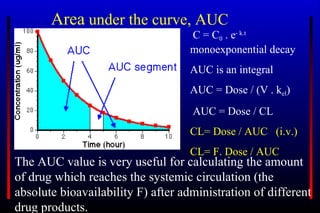
Area  under the curve, AUC C = C 0  . e - k.t  monoexponential decay AUC is an integral AUC = Dose / (V . k el ) AUC = Dose / CL CL= Dose / AUC  (i.v.) CL= F. Dose / AUC The AUC value is very useful for calculating the amount  of drug which reaches the systemic circulation (the absolute bioavailability F) after administration of different drug products.
Pharmacokinetics after extravascular administration Most of the routes of administration are extravascular; for example IM, SC, and most importantly oral.  With this type of drug administration the drug isn't placed in the systemic circulation but must be absorbed through at least one membrane. This has a considerable effect on drug pharmacokinetics and may cause  a reduction in the actual amount of drug which is absorbed and reaches the systemic circulation.
Pharmacokinetics after extravascular administration Bioavailable dose = F . Dose F…absolute bioavailability  (0  < F  <  1) … .after i.v. administration  F = 1 Most commonly the absorption process follows first order kinetics. Even though many oral dosage forms are solids, which must dissolve  before being absorbed,  the overall absorption process can often be considered to be a single first order process.
Pharmacokinetics after extravascular administration. Bioavailability AUC C max   T max
Absorption rate constant (k a )
Bioavailable fraction of the dose (F)
Bioavailability F must be determined by comparison with another dose administration. If the other dosage form is an intravenous form then the  F  value is termed the  absolute  bioavailability. In the case where the reference dosage form is another oral product, the value for  F R  is termed the  relative  bioavailability.  CL = (D/AUC)  i.v.   = F. (D/AUC) oral
Bioavailability Bioavailability  indicates a measurement of the rate and extent (amount) of therapeutically active drug which reaches the general circulation.  Absolute bioavailability  is the absolute fraction of dose which is available from a drug formulation in general circulation. It is measured by comparing AUC after i.v. and extravascular administration. Relative bioavailability  is a relative amount and relative rate of availability if two formulations (other than i.v.) are compared.
Bioequivalence  Two drug formulations are bioequivalent if the extent and rate of bioavailability of a drug is comparable (within certain limits). Bioequivalence study:  new drug formulation of  a known active drug is compared to the reference (original formulation or another marketed formulation) in a study with healthy volunteers. Original product, Generic copies
Bioequivalence  Two drug formulations are bioequivalent if the extent and rate of bioavailability of a drug is comparable (within certain limits). Cross-over study with 2 periods Group 1: Test  Reference Group 2:  Reference  Test AUC, c max , T max ,
Some definitions Brand Name   is the trade name of the drug.  Chemical Name   is the name used by the organic chemist to indicate the chemical structure of the drug.  Drug Product   means a finished dosage form,  e.g., tablet, capsule, or solution, that contains the active drug ingredient, generally, but not necessarily, in association with inactive ingredients.  Generic Name   is the established, common name  of the active drug in a drug product.

Kinetika En 2002

  • 1.
    Pharmacokinetics Pharmacokinetics isthe study of those rate processes involved in the absorption, distribution , metabolism, and excretion of drugs (drug disposition) and their relationship to the pharmacological, therapeutic or toxic response in animals and man. Metabolism + Excretion = Elimination
  • 2.
    A bsorption - D istribution -M etabolism -E xcretion ABSORPTION i.v. DISTRIBUTION DISTRIBUTION LIVER: M + BE KIDNEY: Ur. E
  • 3.
    Pharmacokinetics techniques Pharmacokinetictechniques attempt to mathematically define the time course for drug in the body by assaying for drug and metabolites in readilly accesible fluids such as blood and urine.
  • 4.
    Pharmacokinetics techniques Thegoal is to quantitatively account for the amount of drug which has entered the body (bioavailable dose) and to estimate the rate by which it is cleared from the body .
  • 5.
    Pharmacokinetics techniques Themathematical descriptions use PK variables ( PK parameters ) for modelling of the time-course of a drug in plasma or other fluids (concentration versus time curves). PK parameters are than used to calculate the rate of dosing.
  • 6.
    Pharmacokinetic parameters apparentvolume of distribution V d total clearance Cl elimination half-life t 1/2 bioavailability F
  • 7.
    Distribution Drug distributionmeans the reversible transfer of drug from one location to another within the body. Once a drug has entered the vascular system it becomes distributed throughout the various tissues and body fluids in a pattern that reflects the physico-chemical nature of the drug and the ease with which it penetrates different membranes.
  • 8.
    Factors affecting drugdistribution: Rate of distribution - Membrane permeability - Blood perfusion of organs and tissues Extent of Distribution - Lipid Solubility - pH - pKa (pH-partition theory for ionizable molecules) - Plasma protein binding - Intracellular binding
  • 9.
    Plasma protein binding: Extensive plasma protein binding will cause more drug to stay in the blood compartment. Therefore drugs which bind strongly to plasma protein tend to have lower distribution. Of these plasma proteins, albumin, which comprises 50 % of the total proteins binds the widest range of drugs. Acidic drugs commonly bind to albumin, while basic drugs often bind to alpha 1 -acid glycoproteins and lipoproteins.
  • 10.
    Apparent Volume ofDistribution (V d ) Definition: The apparent volume of distribution indicates into how large a volume the drug distributes if it were at the same concentration as that in plasma (or in other reference fluid which is sampled - blood, serum).
  • 11.
    Apparent Volume ofDistribution (V d ) This apparent volume of distribution is not a physiological volume. It won't be lower than blood or plasma volume but it can be much larger than body volume for some drugs. It is a mathematical factor relating the amount of drug in the body and the concentration of drug in the measured compartment, usually plasma: V d = AMOUNT of drug in the body CONCENTRATION in plasma
  • 12.
    Apparent volume ofdistribution V d = AMOUNT OF DRUG IN THE BODY CONCENTRATION IN PLASMA V d = F x Dose - AMOUNT eliminated CONCENTRATION IN PLASMA F…. .. absolute bioavailability (bioavailable fraction of the dose) Units: volume (L, L/kg of TBW)
  • 13.
    Rapid (bolus) i.v.injection and uniform mixing of the amount administered throughout the volume of total body water: V d =V total body water V d = 0.6 L/kg BW Dose = c plasma . V d V d =Dose/c plasma Fat !!! 0,2-0,35 L water per 1 kg of weight
  • 14.
    Vd = Amount / Concentration in plasma Most drugs are distributed unevenly into the body. Some drugs (digoxin) are extensively distributed and bound in tissues, leaving low concentrations in the plasma, thus the body as a whole appears to have a large volume of distribution.
  • 15.
    Volumes of somecompartments of the adult human body in relation to V D : Total body water 0.6 L/kg BW Intracellular water 0.4 L/kg BW Extracellular water 0.2 L/kg BW Plasma 0.04 L/kg BW V D 0.05 L/kg the drug remains in the blood (heparine) V D 0.1-0.3 L/kg distribution from blood into extracellular fluid (gentamicin - polar drugs). V D 0.6 L/kg distribution from blood into intracelular and extracellular fluid (methotrexate) V D >>0.6 L/kg distribution intracellularly and high binding in tissues ( amiodarone - 350 L/kg)
  • 16.
    Use of Vd:1/ V d in conjunction with a target concentration C T can be used to compute a loading dose D L : D L = V D . C T
  • 17.
    L. Dose Loadingdose = C P x V D
  • 18.
    Use of Vd:EXAMPLE: J.K.(TBW = 90 kg)was admitted to the ICU for pneumonia caused by Gram-negative bacteria. Calculate the loading dose of tobramycin for this patient to achieve the target average concentration of 4 mg/l. Tobramycin V D is 0.2 l/kg of TBW. Loading Dose = ? Loading Dose = 0.2 . TBW . Concentration Loading Dose = 0.2 . 90 . 4 = 72 mg
  • 19.
    Use of Vd:2) It can be usefull in case of overdoses and in certain medico-legal cases to estimate the amount of drug in the body: Amount in the body = Vd . C actual, measured
  • 20.
    Use of Vd:3/ To assess feasibility of using hemoperfusion or dialysis for drug removal from the body: The larger the V D the smaller fraction of the dose is in plasma, the less is plasma concentration and the less efficient is any drug removal through extracorporeal mechanisms.
  • 21.
    Clearance (CL) Definition: Clearance of a drug is the ratio of the rate of elimination by all routs to the concentration of drug in plasma. CL = Rate of eliminination [mg / h ] C in plasma [mg /L ] Unit: Volume/Time [L/h] or adjusted for body weight [l/h/kg]
  • 22.
    Clearance (CL) Rateof eliminination = CL x C in plasma (Amount / Unit of time)= (Volume / Unit of time) x C in plasma Unit: Volume/Time [L/h] Another possible way of understanding clearance: Clearance is the volume of plasma completly cleared of the drug per unit of time by all routes - by the liver, the kidney…).
  • 23.
    Rate of elimination Elimination of most drugs from the body after therapeutically relevant doses follows first-order kinetics. To illustrate first order kinetics we might consider what would happen if we were to give a drug by i.v. bolus injection, collect blood samples at various times and measure the plasma concentrations of the drug. We might see a decrease in concentration as the drug is eliminated.
  • 24.
    Rate of eliminationElimination which follows first-order kinetics: dC/dt = - k el . C k el …. rate constant of elimination rate of change is proportional to concentration and is therefore decreasing with time as the conc. decreases
  • 25.
    Rate of eliminationhalf-life : t 1/2 C= C 0 / 2 t= t 1/2 = ln2 / kel = 0.693/ kel after 4 half-lives: 6% remaining, 94% eliminated monoexponential decay: C(t) = C 0 . e - kel . t
  • 26.
    Rate of eliminationElimination which follows first-order kinetics: semi-log graph. t 1/2 = 0.693/ k el k el can be estimated by means of the linear-regression analysis
  • 27.
    Clearance (CL) Clearancehas an additive character: it is the sum of clearences in all eliminating organs CL = CL RENAL + CL HEPATIC +CL pulmonary ...other renal + nonrenal
  • 28.
    The principle oflinear pharmacokinetics Linear (first-order) pharmacokinetics: For most drugs, clearance is constant over the plasma concentration range used in clinical practice. Elimination is not saturable (non-capacity-limited) and the rate of drug elimination is directly proporcionate to the concentration: Rate of elimin. = CL . Concentration
  • 29.
    Nonlinear pharmacokinetics Nonlinearpharmacokinetics: (capacity-limited, dose or concentration dependent, saturable) CL varies depending on the concentration of a drug. Rate of elimination = Vmax . C /Michaelis- Menten/ K m + C CL = Vmax K m + C ethanol, phenytoin, theofylline
  • 30.
    Use of clearance:1/ Total clearance determines the average steady-state concentration of a drug during continuous drug administration (multiple intermittent dosing or constant rate i.v. infusion: at the steady-state: Rate of dosing = Rate of elimination = CL . Cpss continuous i.v. infusion: Cpss = Rate of inf./ CL
  • 31.
  • 32.
    Use of clearance:2/ Total clearance, when multiplied by a target steady-state concentration C SS,TARGET , can be used to calculate the dosing rate required to maintain plasma C SS,TARGET (the maintenance dose) Rate of dosing = C SS,TARGET . CL Rate of dosing ….. Rate of i.v. infusion (mg/h) ……Oral dose / Dosing interval …… i.v. dose / Dosing interval
  • 33.
    Calculation of themaintenance dose J.K.was admitted to the ICU for pneumonia caused by Gram-negative bacteria. Calculate the maintenance dose (i.v.-infusion in 6 h intervals)of tobramycin for this patient to achive the target average concentration of 4 mg/l. Clearance of tobramycin was estimated to be 70 ml/min. Rate of dosing = Dose / Interval Rate of dosing = Rate of elimination = CL.c T Rate of dosing = 4.70.60 / 1000 = 16.8 mg/h Dose = Rate of dosing . Interval = 6 . 16.8 = 101 mg
  • 34.
    Multiple i.v. bolusdose administration : drug accu- mulation in plasma until the steady state is achieved
  • 35.
  • 36.
    Use of clearance:3/ The numerical value of total clearance and its two principal components (hepatic and renal) provide important insights into the elimination processes and into the potential needs for dosage adjustments in case of liver or kidney impairment.
  • 37.
    Biliary clearance CLh Q… hepatic blood flow per 1 min: 1.5 L/min, Q . C out Amount excreted in bile = Amount extracted= Q.(C in - C out ) LIVER CL h = rate of elimin. / C in = Q . (C in - C out ) / C in CL= Q . E hepatic extraction ratio Q . C in bile
  • 38.
    Hepatic extraction ratio(E) E = (C in - C out ) / C in A/ High extraction: C out  0, E  1 ( >0.7) After oral administration, drug is efficiently extracted by the liver and less is available in the systemic circulation - high first-pass effect . The elimination of the drug from the systemic circulation is flow limited: (clearance = Q.E = Q ). B/ Low extraction: C out  C in , E  0 ( <0.3) Small first-pass, high systemic availability after oral administration, hepatic clearance is sensitive to change in E (inhibition and induction of metabolism).
  • 39.
    Renal clearance CLR Amount excreted = V U . C U KIDNEY CL R = rate of elim. / C in plasma = V U . C U / C in plasma GFR , C in plasma V U , C U GFR 100 -150 ml/min URINE V U = volume collected / urine collection period
  • 40.
    Renal clearance CLR CL R = rate of elim. / C in plasma = V U . C U / C in plasma Renal clearance of a drug is the ratio of the rate of elimination of the drug by the kidney divided by its concentration in plasma.
  • 41.
    Renal clearance ofthe drug CL R = GFR x f unbound + Tubular secretion - Tubular reabsorption Glomerular filtration rate is measured using endogenous creatinine: GFR  creatinine clearance = 100 - 150 ml/min 1/ CL R > GFR x f unbound : filtration + Tubular secretion 2/ CL R < GFR x f unbound : filtration - Tubular reabsorption 3/ CL R  GFR x f unbound : filtration
  • 42.
    Elimination half-life (t1/2 ) Definition: Elimination half-life is the time it takes the drug concentration in the blood to decline to one half of its initial value. It is a secondary parameter : The elimination half-life is dependent on the ratio of V D and CL. Unit : time (min, h, day)
  • 43.
    Use of t1/2 : 1/ t 1/2 can be used to predict how long it will take for the drug to be eliminated from plasma.
  • 44.
    Use of t1/2 : 2/ t 1/2 can be used to predict how long it will take from the start of dosing to reach steady-state levels during multiple dosing or continuous i.v. infusion. No. of t 1/2 Concentration achieved (% of steady conc.) 1 50 2 75 3 87.5 4 94 5 97
  • 45.
  • 46.
    Important During continuous(infusion) or continuous intermittent dosing (oral dosing): The steady-concentration depends on the rate of dosing (the dose/dosing interval) and the clearance. Time required to achieve steady-state depends on the half-life and is independent of the rate of dosing and the clearance..
  • 47.
    Use of t 1/2 : 3/ the relationship between t 1/2 and dosing interval  can be used to predict the degree of accumulation of a drug in the blood. The longer t 1/2 and the shorter  , the more drug accumulates.   t 1/2 Moderate accumulation during dosing 2-times)  < t 1/2 Significant accumulation during dosing ( > 2-times)  > t 1/2 Insignificant accumulation during dosing ( < 2-times)
  • 48.
    Use of t 1/2 : 4/ t 1/2 (the relationship between t 1/2 and dosing interval  ) can be used to predict the degree of fluctuation of a drug concentration within a dosing interval.   t 1/2 C ss,min levels at steady state are aprox. 50% of C ss,max . Moderate fluctuation.  < t 1/2 C ss,min levels at steady state are more than 50% of C ss,max . Small fluctuation.  > t 1/2 C ss,min levels at steady state are less than 50% of C ss,max . Wide fluctuation.
  • 49.
    Multiple short i.v.infusions of amikacin: the rate of dosing is constant but interdose interval is changing, t 1/2 = 6 h
  • 50.
    Multiple short i.v.infusions of amikacin: the rate of dosing is constant but interdose interval is changing, t 1/2 = 6 h
  • 51.
    Use of t 1/2 : 5/ t 1/2 can be used to predict how long it will take a drug concentration to decline from one specific value to another. t = t 1/2 . ln(C1/C2) / 0.7 It can be usefull in overdoses and dosage adjustments.
  • 52.
    Fundamental relationships betweenvarious PK parameters Elimination which follows first-order kinetics can be described by rate constants (or half-lives). If we assume rapid transfer of drug from other parts of the body into plasma, the drug is cleared from its total distribution volume in the body: Rate of elimination = V D . Rate of removal from the unit volume = V D . dC/dt = V d . k el . C CL = Rate of elimination / C = V d . k el = V d . 0.7 / t 1/2
  • 53.
    Fundamental relationships betweenvarious PK parameters Elimination which follows first-order kinetics can be described by rate constants (or half-lives). If we assume rapid transfer of drug from other parts of the body into plasma, the drug is cleared from its total distribution volume in the body: Rate of elimination = Distr. Volume . Rate of removal from the unit volume = V d . dC/dt = V d . k el . C Clearance = Rate of elimination / C = V d . k el = V d . 0.7 / t 1/2 AUC = Dose / (V d . k el )  Clearance = Dose / AUC
  • 54.
    Area underthe curve, AUC C = C 0 . e - k.t monoexponential decay AUC is an integral AUC = Dose / (V . k el ) AUC = Dose / CL CL= Dose / AUC (i.v.) CL= F. Dose / AUC The AUC value is very useful for calculating the amount of drug which reaches the systemic circulation (the absolute bioavailability F) after administration of different drug products.
  • 55.
    Pharmacokinetics after extravascularadministration Most of the routes of administration are extravascular; for example IM, SC, and most importantly oral. With this type of drug administration the drug isn't placed in the systemic circulation but must be absorbed through at least one membrane. This has a considerable effect on drug pharmacokinetics and may cause a reduction in the actual amount of drug which is absorbed and reaches the systemic circulation.
  • 56.
    Pharmacokinetics after extravascularadministration Bioavailable dose = F . Dose F…absolute bioavailability (0 < F < 1) … .after i.v. administration F = 1 Most commonly the absorption process follows first order kinetics. Even though many oral dosage forms are solids, which must dissolve before being absorbed, the overall absorption process can often be considered to be a single first order process.
  • 57.
    Pharmacokinetics after extravascularadministration. Bioavailability AUC C max T max
  • 58.
  • 59.
  • 60.
    Bioavailability F mustbe determined by comparison with another dose administration. If the other dosage form is an intravenous form then the F value is termed the absolute bioavailability. In the case where the reference dosage form is another oral product, the value for F R is termed the relative bioavailability. CL = (D/AUC) i.v. = F. (D/AUC) oral
  • 61.
    Bioavailability Bioavailability indicates a measurement of the rate and extent (amount) of therapeutically active drug which reaches the general circulation. Absolute bioavailability is the absolute fraction of dose which is available from a drug formulation in general circulation. It is measured by comparing AUC after i.v. and extravascular administration. Relative bioavailability is a relative amount and relative rate of availability if two formulations (other than i.v.) are compared.
  • 62.
    Bioequivalence Twodrug formulations are bioequivalent if the extent and rate of bioavailability of a drug is comparable (within certain limits). Bioequivalence study: new drug formulation of a known active drug is compared to the reference (original formulation or another marketed formulation) in a study with healthy volunteers. Original product, Generic copies
  • 63.
    Bioequivalence Twodrug formulations are bioequivalent if the extent and rate of bioavailability of a drug is comparable (within certain limits). Cross-over study with 2 periods Group 1: Test Reference Group 2: Reference Test AUC, c max , T max ,
  • 64.
    Some definitions BrandName is the trade name of the drug. Chemical Name is the name used by the organic chemist to indicate the chemical structure of the drug. Drug Product means a finished dosage form, e.g., tablet, capsule, or solution, that contains the active drug ingredient, generally, but not necessarily, in association with inactive ingredients. Generic Name is the established, common name of the active drug in a drug product.