CLINICAL
PHARMACOKINETICS
Presented by
Dr. Sajeena Jose. C
Department of Pharmacology
Amala Institute of Medical Sciences
AN OVERVIEW
• The term Pharmacokinetics is derived from the
ancient Greek words “pharmakon” means “drug” and
“kinetikos” means “putting in motion”.
• Pharmacokinetics is the study of the time course of a
drug’s movement in the body as affected by the
absorption, distribution, metabolism and elimination.
It is the understanding of what body does to the drug.
• Clinical Pharmacokinetics is the application of
pharmacokinetic principles to the safe and effective
therapeutic management of drugs in an individual
patient.
• It helps to enhance the efficacy and decrease the
toxicity of a patient’s therapy.
NEED OF PHARMACOKINETICS
• Individualize patient drug therapy.
• Monitor medication with narrow therapeutic index.
• Decrease the risk of adverse effects while maximizing
pharmacologic response of medications.
• Evaluate PK/PD as a diagnostic tool for underlying
disease.
PHARMACOKINETIC PRINCIPLES
• Absorption
• Distribution
• Metabolism
• Elimination
ABSORPTION
• Absorption is the movement of the drug from its site
of administration in to the circulation.
• Not only the fraction of the administered dose that
gets absorbed, but also the rate of absorption
Factors affecting absorption are:
• Aqueous solubility:
Drugs given in solid form must dissolve in the aqueous
biophase before they are absorbed.
For poorly water soluble drugs rate of dissolution
governs rate of absorption.
A drug given as watery solution is absorbed faster than
when it is given as solid form or as oily solution.
• Concentration:
• Area of absorbing surface:
• Vascularity of the absorbing surface:
• Route of administration:
• Drugs can be administered by a variety of routes. The
choice of appropriate route in a given situation
depends both on drug as well patient related factors.
Routes can be broadly divided into those for ;
 Local action
 Systemic action
 Local routes:
Topical, Deeper tissues, Arterial supply
 Systemic routes:
• Oral
• Sublingual or buccal
• Rectal
• Cutaneous
• Inhalation
• Nasal
• Parenteral – Subcutaneous
Intramuscular
Intravenous
Intradermal
Absorption in oral route
Nonionized lipid soluble drugs are readily absorbed from
stomach as well a s from the intestine.
Acidic drugs are predominantly unionized in the acid
gastric juice and are absorbed from the stomach. Basic
drugs are largely ionized and are absorbed only on
reaching the duodenum.
Presence of food dilutes the drug and retard the absorption.
DISTRIBUTION
• Membrane Permeability
cross membrane to site of action.
• Plasma protein binding
bound drugs do not cross membranes
malnutrition – albumin = free drug
• Lipophilic drugs accumulate in adipose tissue.
• Volume of distribution.
METABOLISM
• Drugs can undergo metabolism in the lungs, blood
and liver.
• Body works to convert drugs to less active forms and
increase water solubility to enhance elimination.
• Liver – primary route of drug metabolism.
• Liver may be used to convert pro- drugs
(inactive) to an active state.
• Types of reactions.
Phase I (Cytochrome P450 system)
Phase II
ELIMINATION
• Pulmonary – expired in the air
• Bile – excreted in feces
enterohepatic circulation
• Renal – glomerular filtration
tubular reabsorption
tubular secretion
BASIC PARAMETERS
• In pharmacokinetics body is represented as a single or
multiple compartments into which the drug is distributed.
Volume of distribution
Clearance
Elimination rate constant
Half life
Bioavailability
AUC
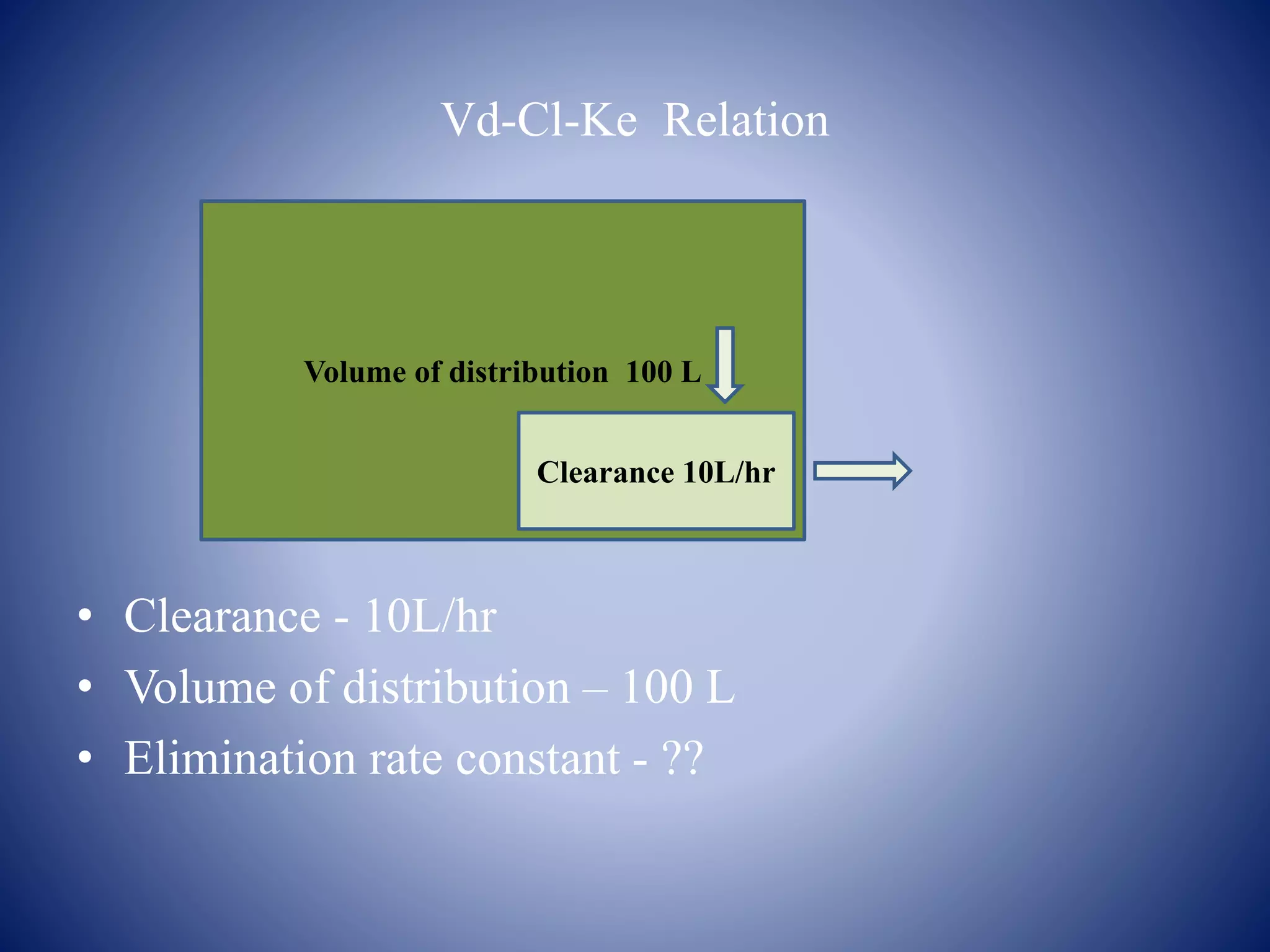
Vd-Cl-Ke Relation
• Clearance - 10L/hr
• Volume of distribution – 100 L
• Elimination rate constant - ??
Volume of distribution 100 L
Clearance 10L/hr
CL = K Vd
• K = CL / Vd
so, 10 / 100 = 0.1 hr -1
• CL= K Vd
if V increases then K must decrease as CL is constant.
IMPORTANT CONCEPTS
• Vd is a theoretical volume and determines the loading
dose.
• Clearance is a constant and it determines the
maintenance dose.
• CL = K Vd
• CL and Vd are independent variables.
• K is a dependant variable.
Volume of distribution
It is defined as the distribution of a medication
between plasma and the rest of the body after oral
or parentarel dosing.
Gives information on how the drug is distributed in
the body.
Used to calculate the loading dose.
• Loading dose
Dose = Cp (target) x Vd (volume of distribution)
? What is the loading dose required for drug A if ,
Target concentration is 10 mg/L
Vd is 0.75 L/kg
Patient body weight is 75 kg.
CLEARANCE
• Ability of organs of elimination like kidney, liver to
clear drug from the bloodstream.
• Volume of fluid which is completely cleared of drug
per unit time. Units are in L/hr or L/hr/kg
• Used in determination of maintenance doses.
• Maintenance dose will be in mg/hr so for total daily
dose will need multiplying by 24.
• Maintenance dose
Dose = CL x CpSSav
? What maintenance dose is required for drug A if
Target average SS concentration is 10 mg/L
CL of drug A is 0.015 L/kg/hr
Patient weight is 75 kg
HALF LIFE – t1/2
• The time taken by the serum concentrations to decrease
by its 1/2 is called the half-life (t1/2).
• t1/2 = 0.693
Ke
STEADY STATE
• Its defined as the amount of drug administered is
equal to the amount of drug eliminated within one
dosing interval resulting in a constant serum level
• Drugs with short half life will attain steady state
rapidly, whereas drugs with long half life will take
days to week to attain steady state.
LINEAR & NON LINEAR
PHARMACOKINETICS
• When doses are increased for most drugs, steady-state
concentrations increase in a proportional fashion leading
to linear pharmacokinetics .
• When steady-state concentrations change in a
disproportionate fashion after the dose is altered, drug is
said to follow nonlinear pharmacokinetics.
• Steady-state concentrations increase more than expected
after a dosage increase, the most likely explanation is
that the processes removing the drug from the body have
become saturated.
• When steady-state concentrations increase less than
expected after a dosage increase, there are two typical
explanations –
Saturable plasma protein
Auto induction.
PROBLEM
Dose
DRUG A
STEADY-STATE
CONCENTRATIONS
(mg/L)
DRUG B
STEADY-STATE
CONCENTRATIONS
(mg/L)
0 0 0
100 15 25
250 37.5 62.5
500 75 190
1000 150 510
PARMACOKINETIC MODELS
• A basic type of model used in pharmacokinetics is the
compartmental model.
• Compartmental models are categorized by the
number of compartments needed to describe the
drug's behavior in the body.
• There are one- compartment, two-compartment, and
multicompartment models.
COMPARTMENT MODELS
• The one compartment model assumes that the drug is
evenly distributed throughout the body into a single
compartment.
• This model is only appropriate for drugs which rapidly
and readily distribute between the plasma and other
body tissues.
• Drugs which exhibit a slow equilibration with
peripheral tissues, are best described with a two
compartment model.
• The solid line shows the serum concentration/time graph
for a drug that follows one-compartment model
pharmacokinetics.
• The dashed line represents the serum concentration/time
plot for a drug that follows two- compartment model
pharmacokinetics after an intravenous bolus is given.
THERAPEUTIC DRUG MONITORING
• Its based on the principle that for some drugs there is
a close relationship between the plasma level of the
drug and its clinical effect.
• Indications of TDM
• Clinical uses of TDM
NEONATES
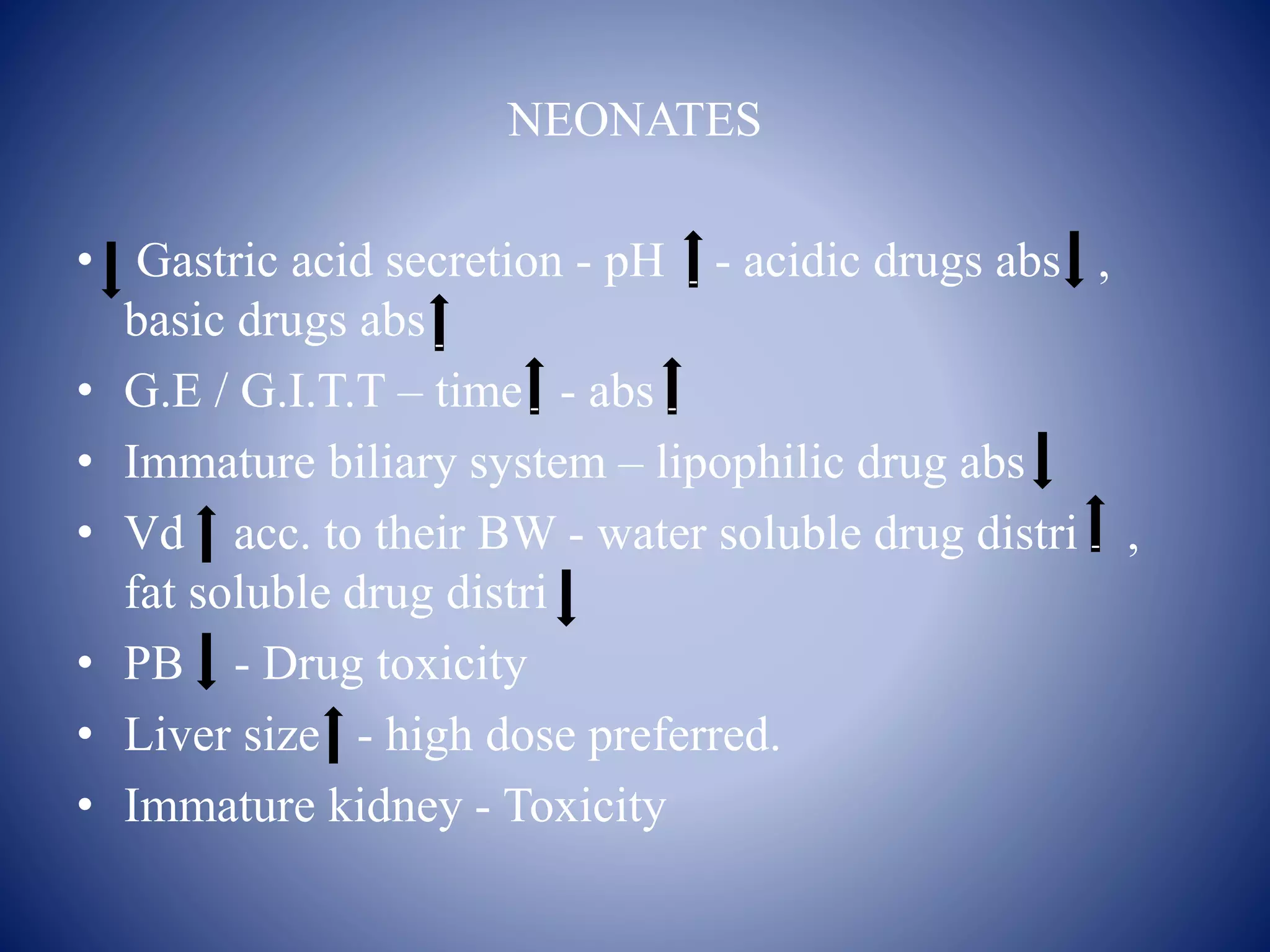
• Gastric acid secretion - pH - acidic drugs abs ,
basic drugs abs
• G.E / G.I.T.T – time - abs
• Immature biliary system – lipophilic drug abs
• Vd acc. to their BW - water soluble drug distri ,
fat soluble drug distri
• PB - Drug toxicity
• Liver size - high dose preferred.
• Immature kidney - Toxicity
-
-
- -
-
• Dosage Calculation
Young’s rule (For children 2 years and above ):
( Age (yr) ) × adult dose
Age (yr)+12
Clark’s rule:
( Weight (lb) ) × Adult dose
150
Fried’s rule (For infants upto 2 years old):
( Age (month) ) × adult dose
150
Square meter surface area OR Mosteller’s equation
SA in m2 = ( height × weight ) ½
60
• The child’s maintenance dose can be calculated from adult dose by
using the following equation :
Child’s Dose = SA of Child in m2 × Adult dose
1.73
Where 1.73 is surface area in m2 of an average 70 Kg adult.
• Since the surface area of a child is in proportion to the body weight
according to equation,
SA ( in m2 ) = Body weight (in Kg ) ^ 0.7
• The following relationship can also be written for child’s dose :
Child’s Dose = [ Weight of child in Kg ] ^ 0.7 × Adult dose
70
ELDERLY
• GI motility - Abs
• Acid secretion - acidic drug abs
• Vd - Loading dose should
• Lipid soluble drug distri , water soluble drug distri
• PB - Toxicity
• Fat soluble drug distri - dose should be increased.
• Hepatic blood flow, mass, intrinsic metabolic activity
- meta - half life - acc – toxicity.
• Renal function - R. blood flow, mass - elimi. - half
life - acc – toxicity.
-
-
-
-
-
-
PREGNANCY
• Weight gain – Vd - Loading dose should be high
(important at rapid drug effect)
• Plasma albumin - unbound drug - acc – toxicity.
• GFR - clearance - higher maintenance dose
• Hepatic metabolism - due to enzyme induction –
high maintenance dose
• Dose of a drug given at any stage should low as
possible to minimize toxic effects to the foetus.
• Antidepressants & antipsychotics dose should be
reduced slowly to parturition.
-
-
- -
-
RENAL DISEASE
• In patients with renal disease, there is a functional
loss of nephron.
• The method recommended by FDA to estimate renal
function for the purposes of drug dosing is to measure
creatinine clearance .
• The most widely used method to estimate creatinine
clearance , is by Cockcroft and Gault formula.
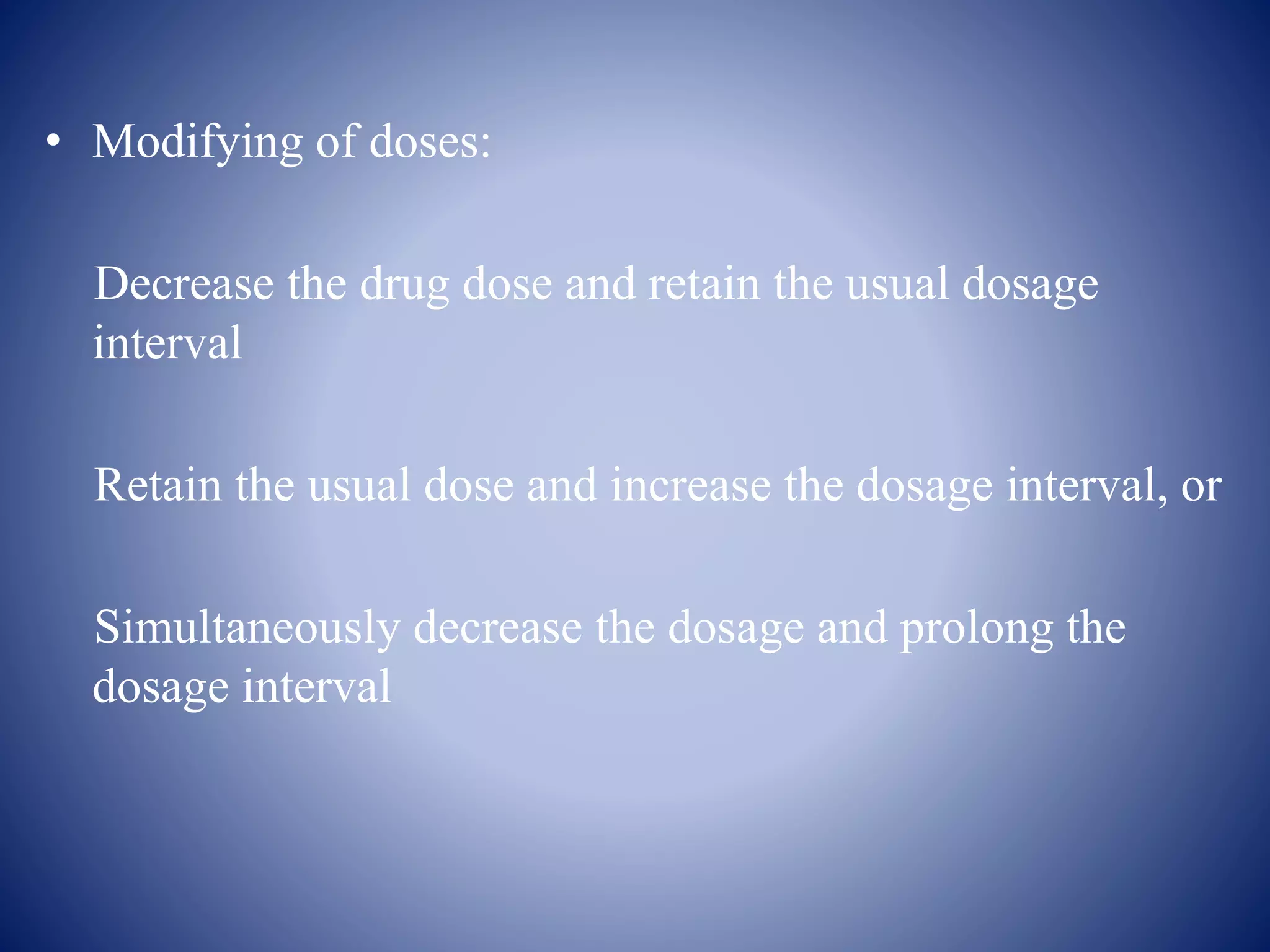
• Modifying of doses:
Decrease the drug dose and retain the usual dosage
interval
Retain the usual dose and increase the dosage interval, or
Simultaneously decrease the dosage and prolong the
dosage interval
HEPATIC DISEASE
• Hepatocyte damage - Liver blood flow - free drug
- Vd - hepatic clearance of the drug
• A decrease in liver first-pass effect results in
extremely large increases in steady-state
concentrations for orally administered drugs.
-
-
• Child-Pugh Scores
• A Child-Pugh score equal to 8–9- decrease (~25%) in
initial daily drug dose
• A score of 10 or greater indicates that a significant
decrease in initial daily dose (~ 50%) is required for
drugs that are mostly liver metabolized
OBESE
• Ideal body weight (IBW) is calculated as follows:
IBW Men = 50 kg ± 1 kg /2.5 cm above or below
150cm in height
IBW Women = 45 kg ± 1 kg/2.5 cm above or below
150cm in height
• Any person is considered as obese if the body weight
is more than 25% above the IBW
PHARMACOKINETIC STUDIES
• Design of dosage regimen
• - various approaches
- dose size, frequency
• Drug accumulation during. multiple dosing.
• Conversion from intravenous infusion to oral dosing
• Determination of dose.
REFERENCE
• Giacomini KM, et al. The effect of saturable binding to plasma proteins on
the pharmackinetic properties of disopyramide. J Pharmacokinet Biopharm.
1982 Feb;10(1): 1-14.
• Biopharmaceutics & Pharmacokinetics a Treatise D.M. Brahmankar &
Sunil b. Jaiswal,Vallabh Prakashan Pitampura, Delhi.

Clinical pharmackokinetics

  • 1.
    CLINICAL PHARMACOKINETICS Presented by Dr. SajeenaJose. C Department of Pharmacology Amala Institute of Medical Sciences
  • 2.
    AN OVERVIEW • Theterm Pharmacokinetics is derived from the ancient Greek words “pharmakon” means “drug” and “kinetikos” means “putting in motion”. • Pharmacokinetics is the study of the time course of a drug’s movement in the body as affected by the absorption, distribution, metabolism and elimination. It is the understanding of what body does to the drug.
  • 3.
    • Clinical Pharmacokineticsis the application of pharmacokinetic principles to the safe and effective therapeutic management of drugs in an individual patient. • It helps to enhance the efficacy and decrease the toxicity of a patient’s therapy.
  • 4.
    NEED OF PHARMACOKINETICS •Individualize patient drug therapy. • Monitor medication with narrow therapeutic index. • Decrease the risk of adverse effects while maximizing pharmacologic response of medications. • Evaluate PK/PD as a diagnostic tool for underlying disease.
  • 5.
    PHARMACOKINETIC PRINCIPLES • Absorption •Distribution • Metabolism • Elimination
  • 6.
    ABSORPTION • Absorption isthe movement of the drug from its site of administration in to the circulation. • Not only the fraction of the administered dose that gets absorbed, but also the rate of absorption
  • 7.
    Factors affecting absorptionare: • Aqueous solubility: Drugs given in solid form must dissolve in the aqueous biophase before they are absorbed. For poorly water soluble drugs rate of dissolution governs rate of absorption. A drug given as watery solution is absorbed faster than when it is given as solid form or as oily solution.
  • 8.
    • Concentration: • Areaof absorbing surface: • Vascularity of the absorbing surface: • Route of administration:
  • 9.
    • Drugs canbe administered by a variety of routes. The choice of appropriate route in a given situation depends both on drug as well patient related factors. Routes can be broadly divided into those for ;  Local action  Systemic action
  • 10.
     Local routes: Topical,Deeper tissues, Arterial supply  Systemic routes: • Oral • Sublingual or buccal • Rectal • Cutaneous • Inhalation • Nasal • Parenteral – Subcutaneous Intramuscular Intravenous Intradermal
  • 11.
    Absorption in oralroute Nonionized lipid soluble drugs are readily absorbed from stomach as well a s from the intestine. Acidic drugs are predominantly unionized in the acid gastric juice and are absorbed from the stomach. Basic drugs are largely ionized and are absorbed only on reaching the duodenum. Presence of food dilutes the drug and retard the absorption.
  • 12.
    DISTRIBUTION • Membrane Permeability crossmembrane to site of action. • Plasma protein binding bound drugs do not cross membranes malnutrition – albumin = free drug • Lipophilic drugs accumulate in adipose tissue. • Volume of distribution.
  • 13.
    METABOLISM • Drugs canundergo metabolism in the lungs, blood and liver. • Body works to convert drugs to less active forms and increase water solubility to enhance elimination. • Liver – primary route of drug metabolism.
  • 14.
    • Liver maybe used to convert pro- drugs (inactive) to an active state. • Types of reactions. Phase I (Cytochrome P450 system) Phase II
  • 15.
    ELIMINATION • Pulmonary –expired in the air • Bile – excreted in feces enterohepatic circulation • Renal – glomerular filtration tubular reabsorption tubular secretion
  • 16.
    BASIC PARAMETERS • Inpharmacokinetics body is represented as a single or multiple compartments into which the drug is distributed. Volume of distribution Clearance Elimination rate constant Half life Bioavailability AUC
  • 17.
    Vd-Cl-Ke Relation • Clearance- 10L/hr • Volume of distribution – 100 L • Elimination rate constant - ?? Volume of distribution 100 L Clearance 10L/hr
  • 18.
    CL = KVd • K = CL / Vd so, 10 / 100 = 0.1 hr -1 • CL= K Vd if V increases then K must decrease as CL is constant.
  • 19.
    IMPORTANT CONCEPTS • Vdis a theoretical volume and determines the loading dose. • Clearance is a constant and it determines the maintenance dose. • CL = K Vd • CL and Vd are independent variables. • K is a dependant variable.
  • 20.
    Volume of distribution Itis defined as the distribution of a medication between plasma and the rest of the body after oral or parentarel dosing. Gives information on how the drug is distributed in the body. Used to calculate the loading dose.
  • 21.
    • Loading dose Dose= Cp (target) x Vd (volume of distribution) ? What is the loading dose required for drug A if , Target concentration is 10 mg/L Vd is 0.75 L/kg Patient body weight is 75 kg.
  • 22.
    CLEARANCE • Ability oforgans of elimination like kidney, liver to clear drug from the bloodstream. • Volume of fluid which is completely cleared of drug per unit time. Units are in L/hr or L/hr/kg • Used in determination of maintenance doses. • Maintenance dose will be in mg/hr so for total daily dose will need multiplying by 24.
  • 23.
    • Maintenance dose Dose= CL x CpSSav ? What maintenance dose is required for drug A if Target average SS concentration is 10 mg/L CL of drug A is 0.015 L/kg/hr Patient weight is 75 kg
  • 24.
    HALF LIFE –t1/2 • The time taken by the serum concentrations to decrease by its 1/2 is called the half-life (t1/2). • t1/2 = 0.693 Ke
  • 25.
    STEADY STATE • Itsdefined as the amount of drug administered is equal to the amount of drug eliminated within one dosing interval resulting in a constant serum level • Drugs with short half life will attain steady state rapidly, whereas drugs with long half life will take days to week to attain steady state.
  • 26.
    LINEAR & NONLINEAR PHARMACOKINETICS
  • 27.
    • When dosesare increased for most drugs, steady-state concentrations increase in a proportional fashion leading to linear pharmacokinetics . • When steady-state concentrations change in a disproportionate fashion after the dose is altered, drug is said to follow nonlinear pharmacokinetics. • Steady-state concentrations increase more than expected after a dosage increase, the most likely explanation is that the processes removing the drug from the body have become saturated.
  • 28.
    • When steady-stateconcentrations increase less than expected after a dosage increase, there are two typical explanations – Saturable plasma protein Auto induction.
  • 29.
  • 30.
    PARMACOKINETIC MODELS • Abasic type of model used in pharmacokinetics is the compartmental model. • Compartmental models are categorized by the number of compartments needed to describe the drug's behavior in the body. • There are one- compartment, two-compartment, and multicompartment models.
  • 31.
    COMPARTMENT MODELS • Theone compartment model assumes that the drug is evenly distributed throughout the body into a single compartment. • This model is only appropriate for drugs which rapidly and readily distribute between the plasma and other body tissues. • Drugs which exhibit a slow equilibration with peripheral tissues, are best described with a two compartment model.
  • 33.
    • The solidline shows the serum concentration/time graph for a drug that follows one-compartment model pharmacokinetics. • The dashed line represents the serum concentration/time plot for a drug that follows two- compartment model pharmacokinetics after an intravenous bolus is given.
  • 34.
    THERAPEUTIC DRUG MONITORING •Its based on the principle that for some drugs there is a close relationship between the plasma level of the drug and its clinical effect. • Indications of TDM • Clinical uses of TDM
  • 35.
    NEONATES • Gastric acidsecretion - pH - acidic drugs abs , basic drugs abs • G.E / G.I.T.T – time - abs • Immature biliary system – lipophilic drug abs • Vd acc. to their BW - water soluble drug distri , fat soluble drug distri • PB - Drug toxicity • Liver size - high dose preferred. • Immature kidney - Toxicity - - - - -
  • 36.
    • Dosage Calculation Young’srule (For children 2 years and above ): ( Age (yr) ) × adult dose Age (yr)+12 Clark’s rule: ( Weight (lb) ) × Adult dose 150 Fried’s rule (For infants upto 2 years old): ( Age (month) ) × adult dose 150 Square meter surface area OR Mosteller’s equation SA in m2 = ( height × weight ) ½ 60
  • 37.
    • The child’smaintenance dose can be calculated from adult dose by using the following equation : Child’s Dose = SA of Child in m2 × Adult dose 1.73 Where 1.73 is surface area in m2 of an average 70 Kg adult. • Since the surface area of a child is in proportion to the body weight according to equation, SA ( in m2 ) = Body weight (in Kg ) ^ 0.7 • The following relationship can also be written for child’s dose : Child’s Dose = [ Weight of child in Kg ] ^ 0.7 × Adult dose 70
  • 38.
    ELDERLY • GI motility- Abs • Acid secretion - acidic drug abs • Vd - Loading dose should • Lipid soluble drug distri , water soluble drug distri • PB - Toxicity • Fat soluble drug distri - dose should be increased. • Hepatic blood flow, mass, intrinsic metabolic activity - meta - half life - acc – toxicity. • Renal function - R. blood flow, mass - elimi. - half life - acc – toxicity. - - - - - -
  • 39.
    PREGNANCY • Weight gain– Vd - Loading dose should be high (important at rapid drug effect) • Plasma albumin - unbound drug - acc – toxicity. • GFR - clearance - higher maintenance dose • Hepatic metabolism - due to enzyme induction – high maintenance dose • Dose of a drug given at any stage should low as possible to minimize toxic effects to the foetus. • Antidepressants & antipsychotics dose should be reduced slowly to parturition. - - - - -
  • 40.
    RENAL DISEASE • Inpatients with renal disease, there is a functional loss of nephron. • The method recommended by FDA to estimate renal function for the purposes of drug dosing is to measure creatinine clearance . • The most widely used method to estimate creatinine clearance , is by Cockcroft and Gault formula.
  • 41.
    • Modifying ofdoses: Decrease the drug dose and retain the usual dosage interval Retain the usual dose and increase the dosage interval, or Simultaneously decrease the dosage and prolong the dosage interval
  • 42.
    HEPATIC DISEASE • Hepatocytedamage - Liver blood flow - free drug - Vd - hepatic clearance of the drug • A decrease in liver first-pass effect results in extremely large increases in steady-state concentrations for orally administered drugs. - -
  • 43.
    • Child-Pugh Scores •A Child-Pugh score equal to 8–9- decrease (~25%) in initial daily drug dose • A score of 10 or greater indicates that a significant decrease in initial daily dose (~ 50%) is required for drugs that are mostly liver metabolized
  • 45.
    OBESE • Ideal bodyweight (IBW) is calculated as follows: IBW Men = 50 kg ± 1 kg /2.5 cm above or below 150cm in height IBW Women = 45 kg ± 1 kg/2.5 cm above or below 150cm in height • Any person is considered as obese if the body weight is more than 25% above the IBW
  • 46.
    PHARMACOKINETIC STUDIES • Designof dosage regimen • - various approaches - dose size, frequency • Drug accumulation during. multiple dosing. • Conversion from intravenous infusion to oral dosing • Determination of dose.
  • 47.
    REFERENCE • Giacomini KM,et al. The effect of saturable binding to plasma proteins on the pharmackinetic properties of disopyramide. J Pharmacokinet Biopharm. 1982 Feb;10(1): 1-14. • Biopharmaceutics & Pharmacokinetics a Treatise D.M. Brahmankar & Sunil b. Jaiswal,Vallabh Prakashan Pitampura, Delhi.

Editor's Notes

  • #3 PD- what drug does to the body
  • #12 Nonionized – ethanol, acidic – salycilate, barbiturate, basic – morphine, tetra with calcium in milk, highly inonized – gentamycin, insulin
  • #13 Ws – atenolol, ls - clorazepate
  • #22 Vd = 0.75 x 75 = 56.25 L, dose = 10 x 56.25 = 565, rounded as 560 or 500 mg.
  • #24 CL = 0.015 x 75 = 1.125 L/hr, Dose = 1.125 x 10 = 11.25, so will need 11.25 x 24 = 270 mg.
  • #29 Saturable plasma protien- disopyramide, autoinduction – carbamazepine. renal cl of ub diso is indep of ub fractn, while tot disi is dep of ub frctn.
  • #36 kernictres
  • #39 IMA – relative ability of drug – receptor complex to produce a maximum functional response.