P glycoprotein
Dr. Uma Advani
Assistant Professor Pharmacology
SMS MC Jaipur
Learning Objectives
• Introduction
• Cellular localization of P-gp
• Structure of P-gp
• Drug/substrate recognition
• Substrates for P-gp
• Inhibition of P-gp
• Pharmacological relevance
• Pharmacokinetic implications of P-gp
• Conclusion
Introduction
• P-glycoproteins are part of a larger family of
efflux transporters
• They appear to have developed as a mechanism
to protect the body from harmful substances
• They transport certain hydrophobic substances in
the following directions
– into the gut
– into urine
– into bile
– out of the brain
– out of the gonads
– out of other organs
Contd…
• Considered as apart of the 1st pass metabolism
• P-glycoprotein has also recently been designated
CD(Cluster Differentiation)243.
• In humans, P-glycoprotein is encoded by the
ABCB1(ATP Binding Cassette Subfamily B) gene
• It functionally protects the body against toxic
xenobiotics & drugs by excreting these compound into
the bile, urine & the intestine
• It is also called Hydrophobic vaccum cleaner/flippase:
transporting drug from inner leaflet of plasma
membrane to lipid bilayer to outer leaflet or to
external medium.
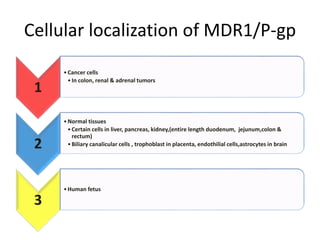
Cellular localization of MDR1/P-gp
1
•Cancer cells
•In colon, renal & adrenal tumors
2
•Normal tissues
•Certain cells in liver, pancreas, kidney,(entire length duodenum, jejunum,colon &
rectum)
•Biliary canalicular cells , trophoblast in placenta, endothilial cells,astrocytes in brain
3
•Human fetus
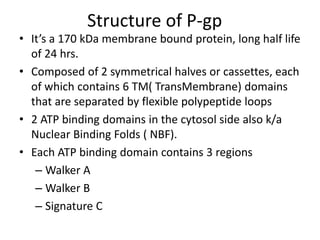
Structure of P-gp
• It’s a 170 kDa membrane bound protein, long half life
of 24 hrs.
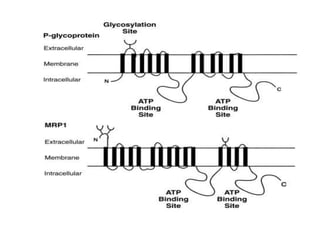
• Composed of 2 symmetrical halves or cassettes, each
of which contains 6 TM( TransMembrane) domains
that are separated by flexible polypeptide loops
• 2 ATP binding domains in the cytosol side also k/a
Nuclear Binding Folds ( NBF).
• Each ATP binding domain contains 3 regions
– Walker A
– Walker B
– Signature C
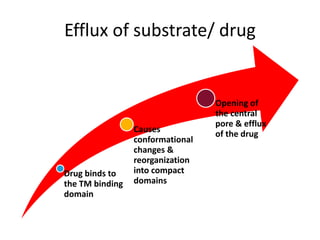
Efflux of substrate/ drug
Drug binds to
the TM binding
domain
Causes
conformational
changes &
reorganization
into compact
domains
Opening of
the central
pore & efflux
of the drug
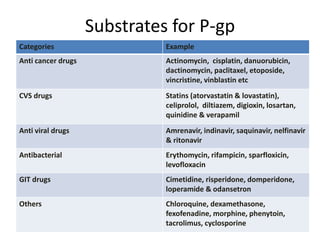
Substrates for P-gp
Categories Example
Anti cancer drugs Actinomycin, cisplatin, danuorubicin,
dactinomycin, paclitaxel, etoposide,
vincristine, vinblastin etc
CVS drugs Statins (atorvastatin & lovastatin),
celiprolol, diltiazem, digioxin, losartan,
quinidine & verapamil
Anti viral drugs Amrenavir, indinavir, saquinavir, nelfinavir
& ritonavir
Antibacterial Erythomycin, rifampicin, sparfloxicin,
levofloxacin
GIT drugs Cimetidine, risperidone, domperidone,
loperamide & odansetron
Others Chloroquine, dexamethasone,
fexofenadine, morphine, phenytoin,
tacrolimus, cyclosporine
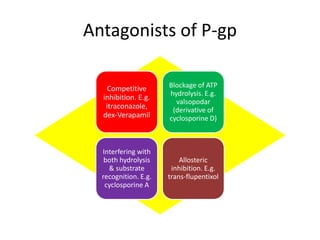
Antagonists of P-gp
Competitive
inhibition. E.g.
itraconazole,
dex-Verapamil
Blockage of ATP
hydrolysis. E.g.
valsopodar
(derivative of
cyclosporine D)
Interfering with
both hydrolysis
& substrate
recognition. E.g.
cyclosporine A
Allosteric
inhibition. E.g.
trans-flupentixol
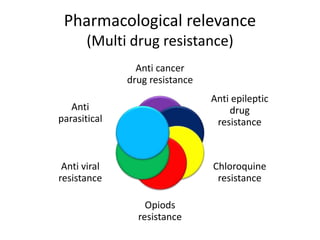
Pharmacological relevance
(Multi drug resistance)
Anti cancer
drug resistance
Anti epileptic
drug
resistance
Chloroquine
resistance
Opiods
resistance
Anti viral
resistance
Anti
parasitical
Anti cancer therapy
• Over expression of MDR 1 gene conferred
resistance to multiple drugs such as vinca
alkoloids(Vincristine,vinblastine),
anthracyclines(Daunorubicin,doxorubicin) &
taxanes(Paclitaxel &Docetaxel).
• Tumors arising from tissues where MDR1/P-gp is
highly expressed show intrinsic resistance to
chemotherapy
• Recent theory suggest that there is intracellular
transfer of P-gp
• Poor brain penetration of drug like imitanib
mesylate(TKI used in CML,GISTs) is due to P-gp
Anti cancer contd…
• 4-aryl-1, 4- dihydropyridines & aromatized 4-
arylpyridines have been synthesized to
increase the MDR resistance reversal of
vinblastine are Chemo sensitizers
• Lamellarin D a marine alkaloid developed for
prostate cancer is a newer cytotoxic drug
insensitive to P-gp
Others
• Antiepileptics: like Valproate which is substrate for
Pgp results in pharmacoresistant epilepsy,studies
using Pgp inhibitor like tariquidar increased its
effect.
• Antimalarials:
– Mechanism is controversial for Mefloquine &
Artesunate
– Chloroquine resistant plasmodium falciparum strains
– In vitro can be modulated by verapamil & calcium
Contd…
• Opiods
– Due to induction of P-gp
– Increase the efflux from brain
• Antiviral
– Over expression of multidrug transporters is the key
mechanism for resistance to protease inhibitors
– Also involved in development of resistance against
antibiotics
– Biricodar & timcodar ( MDR inhibitors) are effective in
when use with antibiotics like fluoroquinolones
Biological barrier to xenobiotics
• P-gp protects us from the harmful effects of
xenobiotics & their toxic metabolites
E.g. DDT is an organochlorine pesticides
• Its metabolite p,p-DDE is an environmental
containment accumulates in animals
• Both induce the MDR1/P-gp gene expression
leading to their clearance
Pharmacokinetic implications of
P-gp
Role of Transporters
• Transporters mediate tissue specific drug
distribution (drug targeting).
• Transporters serve as protective barriers to
organs and cell types.
• P- glycoprotein in blood brain barriers protects
CNS through efflux mechanisms also.
• Relevant transporters to drug response also
control distribution, absorption and
elimination as well.
Absorption
• Intestinal Pgp:reduce absorption of various drugs
like protease inhibitors and anti cancer drugs that
are substrates for P-gp,limits their bioavailability
• Both the passive diffusion & the P-gp operate in
opposite directions
• E.g. Bioavailability of digoxin & cyclosporine is
enhanced by inhibitors & reduced by inducers like
Phenytoin & Rifampicin
– Quinidine(Pgp inhibitor): increases the absorption &
plasma concentrations of morphine
– The bioavailability of Saquinavir is reduced with alcohol
due to excessive expression of P-gp
Drug distribution
• Blood brain barrier (BBB)
– Protects the brain from the harmful endogenous &
exogenous substances
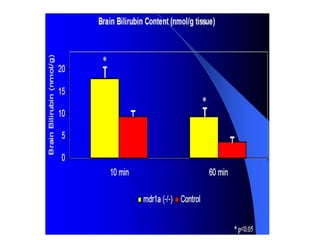
– P-gp is the key element of BBB
– Limits the central distribution of beneficial drugs. E.g.
TCA’s, risperidone & antiepileptic drugs
– Combined inhibitory effect of P-gp inhibitors like
cyclosporin A, verapamil are useful approach to increase
the drug concentrations
– Parkinson's & Alzheimer's patients have dysfunctional P-
gp in BBB
contd…
• Placental barrier
– Extrusion of drugs toxins & thus helps protect the
fetal malformations
– Poor maternal- fetal transfer of Indinavir has been
shown due to P-gp
– Verapamil or quinidine do not inhibit P-gp activity
in term human placenta
Metabolism
• It has been postulated that both the CYP3A4
& P-gp acts in concert to limit the
bioavailability of the drug
• They can "set up" or act as "gatekeepers" for
later P450 cytochrome actions
• There is a substantial overlapping of
substrates between CY3A4 & P-gp
P-gp inhibition
• Verapamil an inhibitor of metabolizing enzyme
CYP3A4 & P-gp increases the effect of
paclitaxel
• Less potent P-gp inhibitors such as valspodar,
cyclosporin A and ketoconazole had modest
effect on the brain plasma ratios of nelfinavir
• Piperine (component of black pepper) has
shown to inhibit both CY3A4 & P-gp in rodents
& increase the concentration of various drugs
P-gp induction
• Both CYP3A4 & P-gp have overlapping inducers in vitro
• A chronic treatment with rifampicin induces expression of
transport proteins & CYP3A4
• Protease inhibitor( ritonavir) & dexamethasone
• Others include
– Phenobarbitone
– Doxorubicin
– Atazanavir
– Prazocin
– Spiranolactone
– St John’s Wort( hypericum perforatum)
Drug excretion
• Renal excretion:Modest role in elimination
,expression of Pgp on luminal proximal tubule cells
in kidney pumps out drug into urine.
– Various drug interactions can result
• Digoxin + Clarithromycin
• Digoxin + Verapamil increased levels of digoxin
• Digoxin + cyclosporine
• Pazufloxacin + cyclosporine
• Cimitedine + itraconazole
Modulation Pgp by herbal drugs
• St. Johns’ wort
– Commonly used as anti depressant
– Potent inducer of CYP3A4 & P-gp: causes OCP failure &
serotonin syndrome
– Decreases the concentrations of amitriptyline, cyclosporine,
digoxin, fexofenadine, indinavir, metahdone, midazolam etc
• Piperine
– Inhibitor of P-gp & CYP3A4
• Grapefruit
– Inhibitor of P-gp & CYP3A4
Polymorphism of P-gp
• Mutations at 2677 & 3435 have been associated
with alterations P g expression & function
• MDR1 polymorphism also effect the drugs
associated with it.E.g. the non linear PK’s with
large inter individual differences of phenytoin
• MDR1 is highly polymorphic ,may effect the entry
of various drugs across the BBB or the placental
barrier leading to accumulation of toxic
substances
• MDR1 polymorphism may have an influence on
the disease activity in cases of RA ,IBS &
colchicine resistance.
Drug interactions: Pgp
• Also involved in many drug interactions
• Loperamide sustrate for Pgp which is used over
the counter for diarrhea, if given with Pgp
inhibitor it crosses BBB increase concentration in
brain& results in respiratory depression.
• Dabidatran (Anticoagulant :Direct thrombin
inhibitor) sustrate for Pgp if given with Pgp
inhibitors like verapamil , clarithromycin&
ticagrelor like drugs there will be increase
concentration and haemorrhage.
Conclusion
• P-glycoproteins are part of a larger family of efflux
transporters
• They form an important component of the BBB & the
placental barrier
• Have a protective role in preventing the accumulation
of harmful substances within the body
• Have been found to be a cause for the MDR in varous
diseases especially cancers
• Alterations in P-gp can lead to increased susceptibility
for development of certain diseases like Alzheimer's &
Parkinson’s
• Awareness of potential transporter related drug-drug
interaction for safe medication is need of time.
References
• Tandon VR, Kapoor B, Bano G, Gupta S et.al; P-
glycoprotein: Pharmacological relevance. IJP
feb 2006; 38:13-24

P- glycoproteins

  • 1.
    P glycoprotein Dr. UmaAdvani Assistant Professor Pharmacology SMS MC Jaipur
  • 2.
    Learning Objectives • Introduction •Cellular localization of P-gp • Structure of P-gp • Drug/substrate recognition • Substrates for P-gp • Inhibition of P-gp • Pharmacological relevance • Pharmacokinetic implications of P-gp • Conclusion
  • 3.
    Introduction • P-glycoproteins arepart of a larger family of efflux transporters • They appear to have developed as a mechanism to protect the body from harmful substances • They transport certain hydrophobic substances in the following directions – into the gut – into urine – into bile – out of the brain – out of the gonads – out of other organs
  • 4.
    Contd… • Considered asapart of the 1st pass metabolism • P-glycoprotein has also recently been designated CD(Cluster Differentiation)243. • In humans, P-glycoprotein is encoded by the ABCB1(ATP Binding Cassette Subfamily B) gene • It functionally protects the body against toxic xenobiotics & drugs by excreting these compound into the bile, urine & the intestine • It is also called Hydrophobic vaccum cleaner/flippase: transporting drug from inner leaflet of plasma membrane to lipid bilayer to outer leaflet or to external medium.
  • 5.
    Cellular localization ofMDR1/P-gp 1 •Cancer cells •In colon, renal & adrenal tumors 2 •Normal tissues •Certain cells in liver, pancreas, kidney,(entire length duodenum, jejunum,colon & rectum) •Biliary canalicular cells , trophoblast in placenta, endothilial cells,astrocytes in brain 3 •Human fetus
  • 6.
    Structure of P-gp •It’s a 170 kDa membrane bound protein, long half life of 24 hrs. • Composed of 2 symmetrical halves or cassettes, each of which contains 6 TM( TransMembrane) domains that are separated by flexible polypeptide loops • 2 ATP binding domains in the cytosol side also k/a Nuclear Binding Folds ( NBF). • Each ATP binding domain contains 3 regions – Walker A – Walker B – Signature C
  • 8.
    Efflux of substrate/drug Drug binds to the TM binding domain Causes conformational changes & reorganization into compact domains Opening of the central pore & efflux of the drug
  • 9.
    Substrates for P-gp CategoriesExample Anti cancer drugs Actinomycin, cisplatin, danuorubicin, dactinomycin, paclitaxel, etoposide, vincristine, vinblastin etc CVS drugs Statins (atorvastatin & lovastatin), celiprolol, diltiazem, digioxin, losartan, quinidine & verapamil Anti viral drugs Amrenavir, indinavir, saquinavir, nelfinavir & ritonavir Antibacterial Erythomycin, rifampicin, sparfloxicin, levofloxacin GIT drugs Cimetidine, risperidone, domperidone, loperamide & odansetron Others Chloroquine, dexamethasone, fexofenadine, morphine, phenytoin, tacrolimus, cyclosporine
  • 10.
    Antagonists of P-gp Competitive inhibition.E.g. itraconazole, dex-Verapamil Blockage of ATP hydrolysis. E.g. valsopodar (derivative of cyclosporine D) Interfering with both hydrolysis & substrate recognition. E.g. cyclosporine A Allosteric inhibition. E.g. trans-flupentixol
  • 11.
    Pharmacological relevance (Multi drugresistance) Anti cancer drug resistance Anti epileptic drug resistance Chloroquine resistance Opiods resistance Anti viral resistance Anti parasitical
  • 12.
    Anti cancer therapy •Over expression of MDR 1 gene conferred resistance to multiple drugs such as vinca alkoloids(Vincristine,vinblastine), anthracyclines(Daunorubicin,doxorubicin) & taxanes(Paclitaxel &Docetaxel). • Tumors arising from tissues where MDR1/P-gp is highly expressed show intrinsic resistance to chemotherapy • Recent theory suggest that there is intracellular transfer of P-gp • Poor brain penetration of drug like imitanib mesylate(TKI used in CML,GISTs) is due to P-gp
  • 13.
    Anti cancer contd… •4-aryl-1, 4- dihydropyridines & aromatized 4- arylpyridines have been synthesized to increase the MDR resistance reversal of vinblastine are Chemo sensitizers • Lamellarin D a marine alkaloid developed for prostate cancer is a newer cytotoxic drug insensitive to P-gp
  • 14.
    Others • Antiepileptics: likeValproate which is substrate for Pgp results in pharmacoresistant epilepsy,studies using Pgp inhibitor like tariquidar increased its effect. • Antimalarials: – Mechanism is controversial for Mefloquine & Artesunate – Chloroquine resistant plasmodium falciparum strains – In vitro can be modulated by verapamil & calcium
  • 15.
    Contd… • Opiods – Dueto induction of P-gp – Increase the efflux from brain • Antiviral – Over expression of multidrug transporters is the key mechanism for resistance to protease inhibitors – Also involved in development of resistance against antibiotics – Biricodar & timcodar ( MDR inhibitors) are effective in when use with antibiotics like fluoroquinolones
  • 16.
    Biological barrier toxenobiotics • P-gp protects us from the harmful effects of xenobiotics & their toxic metabolites E.g. DDT is an organochlorine pesticides • Its metabolite p,p-DDE is an environmental containment accumulates in animals • Both induce the MDR1/P-gp gene expression leading to their clearance
  • 17.
  • 18.
    Role of Transporters •Transporters mediate tissue specific drug distribution (drug targeting). • Transporters serve as protective barriers to organs and cell types. • P- glycoprotein in blood brain barriers protects CNS through efflux mechanisms also. • Relevant transporters to drug response also control distribution, absorption and elimination as well.
  • 19.
    Absorption • Intestinal Pgp:reduceabsorption of various drugs like protease inhibitors and anti cancer drugs that are substrates for P-gp,limits their bioavailability • Both the passive diffusion & the P-gp operate in opposite directions • E.g. Bioavailability of digoxin & cyclosporine is enhanced by inhibitors & reduced by inducers like Phenytoin & Rifampicin – Quinidine(Pgp inhibitor): increases the absorption & plasma concentrations of morphine – The bioavailability of Saquinavir is reduced with alcohol due to excessive expression of P-gp
  • 20.
    Drug distribution • Bloodbrain barrier (BBB) – Protects the brain from the harmful endogenous & exogenous substances – P-gp is the key element of BBB – Limits the central distribution of beneficial drugs. E.g. TCA’s, risperidone & antiepileptic drugs – Combined inhibitory effect of P-gp inhibitors like cyclosporin A, verapamil are useful approach to increase the drug concentrations – Parkinson's & Alzheimer's patients have dysfunctional P- gp in BBB
  • 22.
    contd… • Placental barrier –Extrusion of drugs toxins & thus helps protect the fetal malformations – Poor maternal- fetal transfer of Indinavir has been shown due to P-gp – Verapamil or quinidine do not inhibit P-gp activity in term human placenta
  • 23.
    Metabolism • It hasbeen postulated that both the CYP3A4 & P-gp acts in concert to limit the bioavailability of the drug • They can "set up" or act as "gatekeepers" for later P450 cytochrome actions • There is a substantial overlapping of substrates between CY3A4 & P-gp
  • 24.
    P-gp inhibition • Verapamilan inhibitor of metabolizing enzyme CYP3A4 & P-gp increases the effect of paclitaxel • Less potent P-gp inhibitors such as valspodar, cyclosporin A and ketoconazole had modest effect on the brain plasma ratios of nelfinavir • Piperine (component of black pepper) has shown to inhibit both CY3A4 & P-gp in rodents & increase the concentration of various drugs
  • 25.
    P-gp induction • BothCYP3A4 & P-gp have overlapping inducers in vitro • A chronic treatment with rifampicin induces expression of transport proteins & CYP3A4 • Protease inhibitor( ritonavir) & dexamethasone • Others include – Phenobarbitone – Doxorubicin – Atazanavir – Prazocin – Spiranolactone – St John’s Wort( hypericum perforatum)
  • 26.
    Drug excretion • Renalexcretion:Modest role in elimination ,expression of Pgp on luminal proximal tubule cells in kidney pumps out drug into urine. – Various drug interactions can result • Digoxin + Clarithromycin • Digoxin + Verapamil increased levels of digoxin • Digoxin + cyclosporine • Pazufloxacin + cyclosporine • Cimitedine + itraconazole
  • 27.
    Modulation Pgp byherbal drugs • St. Johns’ wort – Commonly used as anti depressant – Potent inducer of CYP3A4 & P-gp: causes OCP failure & serotonin syndrome – Decreases the concentrations of amitriptyline, cyclosporine, digoxin, fexofenadine, indinavir, metahdone, midazolam etc • Piperine – Inhibitor of P-gp & CYP3A4 • Grapefruit – Inhibitor of P-gp & CYP3A4
  • 28.
    Polymorphism of P-gp •Mutations at 2677 & 3435 have been associated with alterations P g expression & function • MDR1 polymorphism also effect the drugs associated with it.E.g. the non linear PK’s with large inter individual differences of phenytoin • MDR1 is highly polymorphic ,may effect the entry of various drugs across the BBB or the placental barrier leading to accumulation of toxic substances • MDR1 polymorphism may have an influence on the disease activity in cases of RA ,IBS & colchicine resistance.
  • 29.
    Drug interactions: Pgp •Also involved in many drug interactions • Loperamide sustrate for Pgp which is used over the counter for diarrhea, if given with Pgp inhibitor it crosses BBB increase concentration in brain& results in respiratory depression. • Dabidatran (Anticoagulant :Direct thrombin inhibitor) sustrate for Pgp if given with Pgp inhibitors like verapamil , clarithromycin& ticagrelor like drugs there will be increase concentration and haemorrhage.
  • 30.
    Conclusion • P-glycoproteins arepart of a larger family of efflux transporters • They form an important component of the BBB & the placental barrier • Have a protective role in preventing the accumulation of harmful substances within the body • Have been found to be a cause for the MDR in varous diseases especially cancers • Alterations in P-gp can lead to increased susceptibility for development of certain diseases like Alzheimer's & Parkinson’s • Awareness of potential transporter related drug-drug interaction for safe medication is need of time.
  • 32.
    References • Tandon VR,Kapoor B, Bano G, Gupta S et.al; P- glycoprotein: Pharmacological relevance. IJP feb 2006; 38:13-24