PHARMACODYNAMICS
OPTOM FASLU MUHAMMED
 It covers all the aspects relating to “What a drug
does to the body”
 It is the study of the mechanism by which the drug
produces a response.
 Action: How and Where the effect is produced is
called as Action.
 Effect: The type of response producing by drug.
TYPES OF DRUG ACTION
EFFECT (Type of responses):-
1.Stimulation-
it is selective enhancement of the
level of activity of specialized cells.
Eg; adrenaline stimulate the heart.
2.Inhibition/Depression-
it is selective diminution of activity
of specialized cells. Eg: quinidine
depresses heart.
• 3.Replacement-
This refers to the use of natural
metabolites, hormones in deficiency
states. Eg; iron in anaemia.
• 4.Irritation-
This refers a nonselective, often
noxious effect and is particularly
applied to less specialized cells. Eg:
counterirritants increase blood flow
to the site.
 Cytotoxic action-
For invading parasites or cancer cells. Eg: penicillin
Mechanism of Drug Action:
 A drug may produce its effects through various
mechanisms:
 1- Physical action:
 Osmosis:
 Drug retains water by osmosis as osmotic diuretics (Mannitol) and osmotic
purgatives (Lactulose).
 Adsorption:
 Drug adsorbs diverse substances including toxins and fluid on its
surface thereby inactivating them (activated charcoal).
 2- Chemical action:
 - Antacids neutralize gastric acidity (e.g. NaHCO3)
 - Chelating agents form biologically inactive complex
with other substances
 3- Regulatory Proteins (Body Control systems):
- Enzymes:
 Drugs may inhibit or activate certain enzymes.
-Carrier Molecules:
 Drugs may increase their synthesis or block their recognition site.
-Ion Channels:
 Drugs may open ion channels by acting on specific receptor which forms the
channel or drugs may physically close the channel
Receptors:
 Responses to drug-receptor interaction can be as Agonist
(substance binds and activates the receptor) or
Antagonist (substance blocks the receptor.)
 Receptors are macromolecules
 Most are proteins
 Present either on the cell surface, cytoplasm or in
the nucleus
Drug(D) +Receptor® Drug receptor complex
Response
Drug receptor interaction:-
1. Selectivity:- Degree of complimentary co relation between
drug and receptor.
Ex:- Adrenaline Selectivity for α, ß Receptor
2. Affinity:- Ability of drug to get bound to the receptor.
3. Intrinsic activity (IA) or Efficacy:- Ability of drug to produce a
pharmacological response after making the drug receptor
complex.
Response No response
RECEPTOR FAMILIES
Four types of receptors families
1. Receptors with intrinsic ion channels.
2.G-protien coupled receptor
3. Enzymatic receptors
4 intracellular receptor
 Receptors with intrinsic ion channels
 -located on the cell surface
 -they enclose ion selective channels for
Na,K,Ca,Cl.
 -when an agonist is bound to these receptors they
convey signals.
 Eg: nicotinic cholinergic receptors
 2.G-protien coupled receptor
 located on the cell membrane
 G protein is a connecting link between receptor and
effector systems ,like enzymes, carrier molecules
etc.
 They are called so because of their link with GDP
AND GTP
3.intracellular receptor
 Present either in cytoplasm or nucleus of the cell.
 Vit A ,corticosteroids etc act through these
receptors.
4.Enzymatic receptors
These are enzyme molecules themselves
Eg: tyrosine protein kinase.
SPECIAL TYPE OF RECEPTORS
SPARE RECEPTORS
Even when a receptor is blocked by irreversible
blocker ,an agonist is still capable of producing
undiminished maximum response.
Eg: if beta adrenergic receptors are blocked
irreversibly and then adrenaline is pushed , there is
still production of an undiminished maximum
inotropic response.
SILENT RECEPTORS
A drug when bound to such receptors, exhibits no
pharmacological response.
Eg: silent tissue receptors.
PRESYNAPTIC RECEPTORS
Usually found in axonal terminals and on cell
bodies of neurons.
If these receptors are stimulated , usually there
occurs a inhibitory response.
It is due to inhibition of release of excitatory
neurotransmitter.
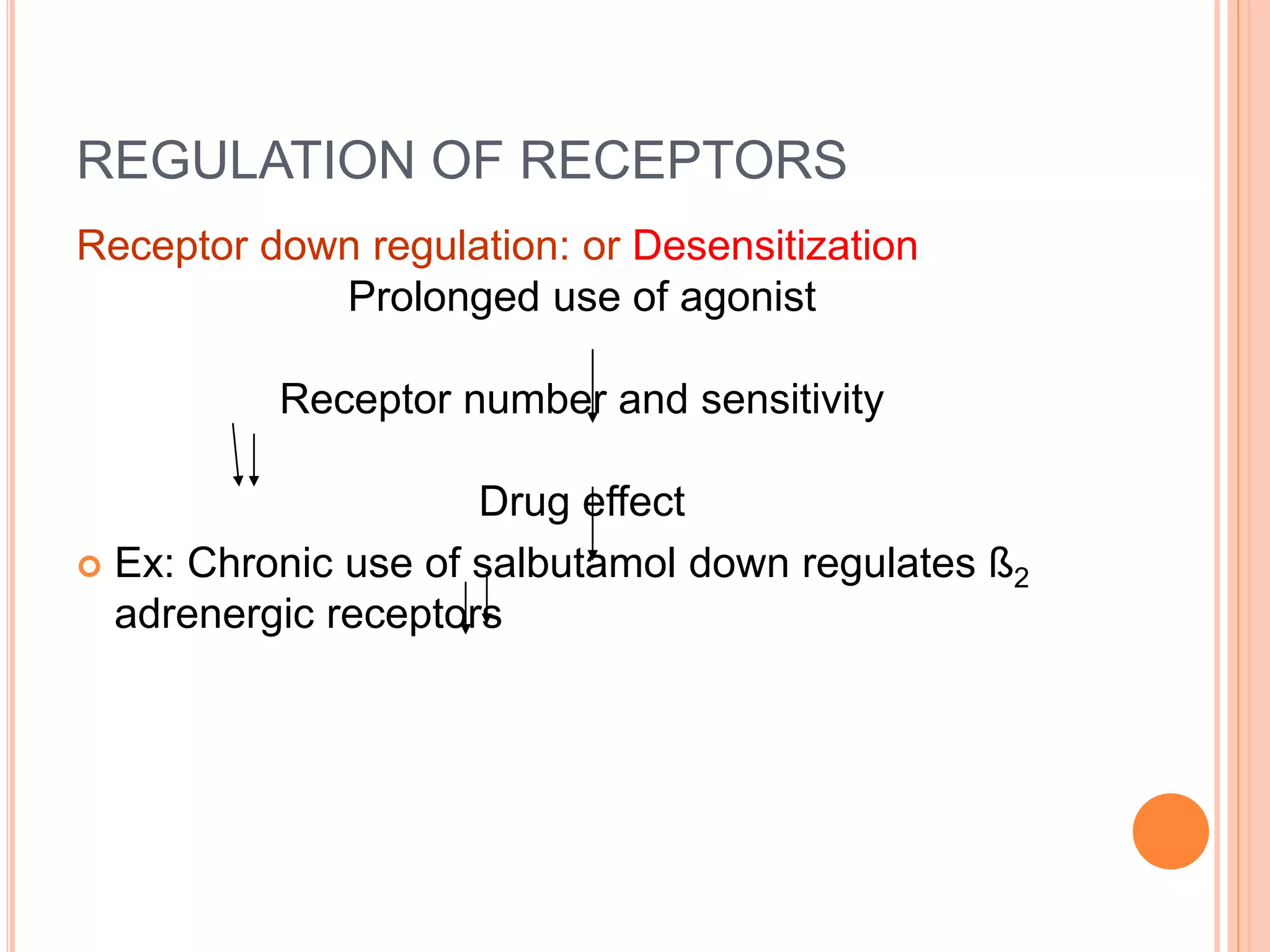
REGULATION OF RECEPTORS
Receptor down regulation: or Desensitization
Prolonged use of agonist
Receptor number and sensitivity
Drug effect
 Ex: Chronic use of salbutamol down regulates ß2
adrenergic receptors
 Receptor up regulation: or Super sensitivity
Prolonged use of antagonist
Receptor number and sensitivity
Drug effect
 Eg:- if timolol is stopped after prolong use, produce
withdrawal symptoms. Rise iop.
DOSE RESPONSE CURVE
 When a drug is administered, it produces a response and
this response shows alteration with change in dose.
 The change can be plotted with dose as abscissa and
response as ordinate.
 The resulting curve is known as DOSE RESPONSE
CURVE.
 GRADED RESPONSE
 The dose response curve rises steeply at first, but after
that it become steady as the dose is increased.
 Curve is popularly known as hyperbolic or exponential
curve.
 Such a curve can be shown by plotting dose against
percent response.
 QUANTAL RESPONSE
 Initially no appreciable response until a particular
threshold is obtained.
 Thereafter the curve rises steeply until a maximum
response is attained.
 But after this there is no appreciable change in the curve
even with increased dose.
 This is called sigmoid or s shaped curve (log dose is
plotted against percent data)
Potency
 It is used to indicate the amount of drug required to
produce a specific response.
 EFFICACY
Efficacy is the maximal effect produced by a drug . This is
important to know when deciding between two drugs that have
similar action. For example, two antibiotics may effectively kill
the same organism, but one may take more doses than another,
making the other more effective.
Drug A is more potent than B
Drug A is less effective than B
Median effective dose(ED50 ).
 Is a dose of the drug that gives a response equals to 50% of the
maximal response.
Median lethal dose(LD50 ).
Is the dose of a drug required to produce
toxicity in 50 % of patients.
THERAPEUTIC INDEX(TI)
 It is a measure of the relative safety of a drug for a
particular treatment.
 Therapeutic index = LD50 / ED50
 Large value - a wide margin of safety. Eg:Penicillin
 Small value - a narrow margin of safety Eg:
warfarin
COMBINED EFFECT OF DRUGS
 When two or more drugs are given simultaneously or
directly after each other, they may be either indifferent to
each other or exhibit synergism or antagonism
SYNERGISM
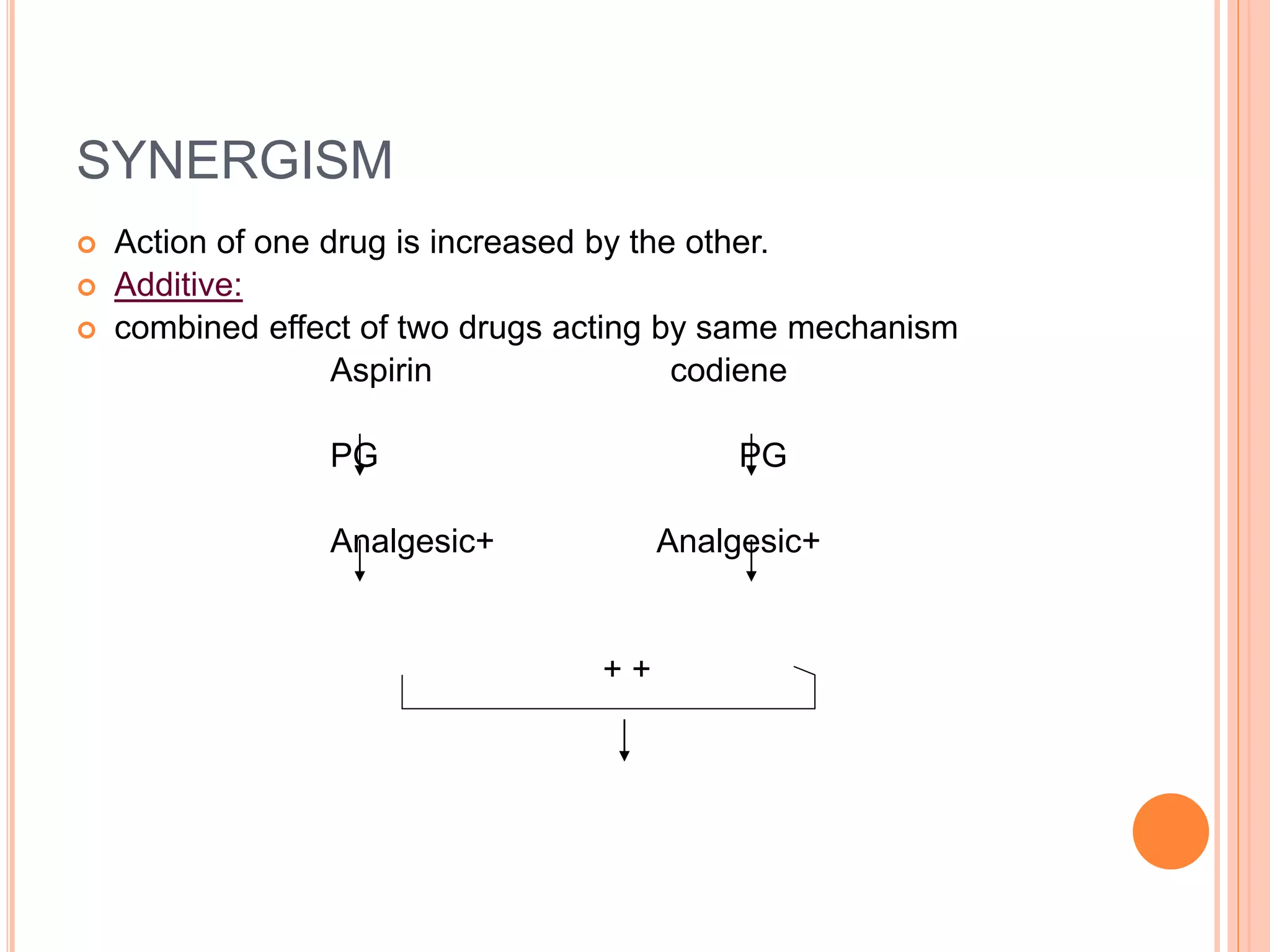
 Action of one drug is increased by the other.
 Additive:
 combined effect of two drugs acting by same mechanism
Aspirin codiene
PG PG
Analgesic+ Analgesic+
+ +
 Synergism (Supra additive):- (1+1=3)
The combined effect of two drug effect is higher than either
individual effect.
Ex:-
1.Sulfamethaxazole+ Trimethoprim
2. Levodopa + Carbidopa.
ANTAGONISM
When one drug decreases or abolishes the action of another.
Effect of drug A+ B < Effect of drug A+ Effect of drug B
Types :
 Physical antagonism
 Chemical antagonist.
 Physiological antagonist.
 Pharmacological antagonist.
1) Physical Antagonism
 Based on physical property.
Examples
 Charcoal adsorbs alkaloids and can prevent their
absorption used in alkaloid poisoning.
2) Chemical Antagonism
 Two drugs react chemically and form an inactive
product.
Examples
KMnO4 oxidizes alkaloid used for gastric lavage in
poisoning.
3) Physiological Antagonism
 Two drugs acting on different receptors by different
mechanism, have opposite effect on the same
physiological function.
 Glucagon & insulin on blood sugar.
4) Pharmacological Antagonism
Two drugs compete for the same receptor.
The antagonist partially or completely
prevents the pharmacological agonist effect.
Pharmacological antagonist
Competitive
• Reversible
Non-competitive
• Irreversible
Competitive Antagonist
 The antagonist dissociates rapidly from the receptor.
 The antagonist effect can be overcome by increasing the
agonist concentration.
 e.g. morphine & naloxone
Noncompetitive Antagonist
 The antagonist dissociates very slowly or not at all from
the receptor .
 The action of antagonist cannot be overcome by
increasing the agonist concentration .
Dose
 Appropriate amount of drug required to produce a
desired pharmacological action.
 LOADING DOSE
 Dose required to achieve a target concentration rapidly.
 MAINTENANCE DOSE
 used to retain the target level by balancing the
elimination.
 Loading dose of doxycycline is 200 mg and maintenance
dose is 100 mg/day.
 PLACEBO

Pharmacodynamics

  • 1.
  • 2.
     It coversall the aspects relating to “What a drug does to the body”  It is the study of the mechanism by which the drug produces a response.
  • 3.
     Action: Howand Where the effect is produced is called as Action.  Effect: The type of response producing by drug.
  • 4.
    TYPES OF DRUGACTION EFFECT (Type of responses):- 1.Stimulation- it is selective enhancement of the level of activity of specialized cells. Eg; adrenaline stimulate the heart. 2.Inhibition/Depression- it is selective diminution of activity of specialized cells. Eg: quinidine depresses heart.
  • 5.
    • 3.Replacement- This refersto the use of natural metabolites, hormones in deficiency states. Eg; iron in anaemia. • 4.Irritation- This refers a nonselective, often noxious effect and is particularly applied to less specialized cells. Eg: counterirritants increase blood flow to the site.
  • 6.
     Cytotoxic action- Forinvading parasites or cancer cells. Eg: penicillin
  • 7.
    Mechanism of DrugAction:  A drug may produce its effects through various mechanisms:
  • 8.
     1- Physicalaction:  Osmosis:  Drug retains water by osmosis as osmotic diuretics (Mannitol) and osmotic purgatives (Lactulose).  Adsorption:  Drug adsorbs diverse substances including toxins and fluid on its surface thereby inactivating them (activated charcoal).
  • 9.
     2- Chemicalaction:  - Antacids neutralize gastric acidity (e.g. NaHCO3)  - Chelating agents form biologically inactive complex with other substances
  • 10.
     3- RegulatoryProteins (Body Control systems): - Enzymes:  Drugs may inhibit or activate certain enzymes. -Carrier Molecules:  Drugs may increase their synthesis or block their recognition site. -Ion Channels:  Drugs may open ion channels by acting on specific receptor which forms the channel or drugs may physically close the channel
  • 11.
    Receptors:  Responses todrug-receptor interaction can be as Agonist (substance binds and activates the receptor) or Antagonist (substance blocks the receptor.)
  • 12.
     Receptors aremacromolecules  Most are proteins  Present either on the cell surface, cytoplasm or in the nucleus
  • 13.
    Drug(D) +Receptor® Drugreceptor complex Response Drug receptor interaction:- 1. Selectivity:- Degree of complimentary co relation between drug and receptor. Ex:- Adrenaline Selectivity for α, ß Receptor 2. Affinity:- Ability of drug to get bound to the receptor. 3. Intrinsic activity (IA) or Efficacy:- Ability of drug to produce a pharmacological response after making the drug receptor complex.
  • 14.
  • 15.
    RECEPTOR FAMILIES Four typesof receptors families 1. Receptors with intrinsic ion channels. 2.G-protien coupled receptor 3. Enzymatic receptors 4 intracellular receptor
  • 16.
     Receptors withintrinsic ion channels  -located on the cell surface  -they enclose ion selective channels for Na,K,Ca,Cl.  -when an agonist is bound to these receptors they convey signals.  Eg: nicotinic cholinergic receptors
  • 17.
     2.G-protien coupledreceptor  located on the cell membrane  G protein is a connecting link between receptor and effector systems ,like enzymes, carrier molecules etc.  They are called so because of their link with GDP AND GTP
  • 18.
    3.intracellular receptor  Presenteither in cytoplasm or nucleus of the cell.  Vit A ,corticosteroids etc act through these receptors. 4.Enzymatic receptors These are enzyme molecules themselves Eg: tyrosine protein kinase.
  • 19.
    SPECIAL TYPE OFRECEPTORS SPARE RECEPTORS Even when a receptor is blocked by irreversible blocker ,an agonist is still capable of producing undiminished maximum response. Eg: if beta adrenergic receptors are blocked irreversibly and then adrenaline is pushed , there is still production of an undiminished maximum inotropic response.
  • 20.
    SILENT RECEPTORS A drugwhen bound to such receptors, exhibits no pharmacological response. Eg: silent tissue receptors. PRESYNAPTIC RECEPTORS Usually found in axonal terminals and on cell bodies of neurons. If these receptors are stimulated , usually there occurs a inhibitory response. It is due to inhibition of release of excitatory neurotransmitter.
  • 21.
    REGULATION OF RECEPTORS Receptordown regulation: or Desensitization Prolonged use of agonist Receptor number and sensitivity Drug effect  Ex: Chronic use of salbutamol down regulates ß2 adrenergic receptors
  • 22.
     Receptor upregulation: or Super sensitivity Prolonged use of antagonist Receptor number and sensitivity Drug effect  Eg:- if timolol is stopped after prolong use, produce withdrawal symptoms. Rise iop.
  • 23.
    DOSE RESPONSE CURVE When a drug is administered, it produces a response and this response shows alteration with change in dose.  The change can be plotted with dose as abscissa and response as ordinate.  The resulting curve is known as DOSE RESPONSE CURVE.
  • 25.
     GRADED RESPONSE The dose response curve rises steeply at first, but after that it become steady as the dose is increased.  Curve is popularly known as hyperbolic or exponential curve.  Such a curve can be shown by plotting dose against percent response.
  • 26.
     QUANTAL RESPONSE Initially no appreciable response until a particular threshold is obtained.  Thereafter the curve rises steeply until a maximum response is attained.  But after this there is no appreciable change in the curve even with increased dose.  This is called sigmoid or s shaped curve (log dose is plotted against percent data)
  • 28.
    Potency  It isused to indicate the amount of drug required to produce a specific response.  EFFICACY Efficacy is the maximal effect produced by a drug . This is important to know when deciding between two drugs that have similar action. For example, two antibiotics may effectively kill the same organism, but one may take more doses than another, making the other more effective.
  • 29.
    Drug A ismore potent than B Drug A is less effective than B
  • 30.
    Median effective dose(ED50).  Is a dose of the drug that gives a response equals to 50% of the maximal response. Median lethal dose(LD50 ). Is the dose of a drug required to produce toxicity in 50 % of patients.
  • 31.
    THERAPEUTIC INDEX(TI)  Itis a measure of the relative safety of a drug for a particular treatment.  Therapeutic index = LD50 / ED50  Large value - a wide margin of safety. Eg:Penicillin  Small value - a narrow margin of safety Eg: warfarin
  • 32.
    COMBINED EFFECT OFDRUGS  When two or more drugs are given simultaneously or directly after each other, they may be either indifferent to each other or exhibit synergism or antagonism
  • 33.
    SYNERGISM  Action ofone drug is increased by the other.  Additive:  combined effect of two drugs acting by same mechanism Aspirin codiene PG PG Analgesic+ Analgesic+ + +
  • 34.
     Synergism (Supraadditive):- (1+1=3) The combined effect of two drug effect is higher than either individual effect. Ex:- 1.Sulfamethaxazole+ Trimethoprim 2. Levodopa + Carbidopa.
  • 35.
    ANTAGONISM When one drugdecreases or abolishes the action of another. Effect of drug A+ B < Effect of drug A+ Effect of drug B Types :  Physical antagonism  Chemical antagonist.  Physiological antagonist.  Pharmacological antagonist.
  • 36.
    1) Physical Antagonism Based on physical property. Examples  Charcoal adsorbs alkaloids and can prevent their absorption used in alkaloid poisoning.
  • 37.
    2) Chemical Antagonism Two drugs react chemically and form an inactive product. Examples KMnO4 oxidizes alkaloid used for gastric lavage in poisoning.
  • 38.
    3) Physiological Antagonism Two drugs acting on different receptors by different mechanism, have opposite effect on the same physiological function.  Glucagon & insulin on blood sugar.
  • 39.
    4) Pharmacological Antagonism Twodrugs compete for the same receptor. The antagonist partially or completely prevents the pharmacological agonist effect. Pharmacological antagonist Competitive • Reversible Non-competitive • Irreversible
  • 40.
    Competitive Antagonist  Theantagonist dissociates rapidly from the receptor.  The antagonist effect can be overcome by increasing the agonist concentration.  e.g. morphine & naloxone
  • 41.
    Noncompetitive Antagonist  Theantagonist dissociates very slowly or not at all from the receptor .  The action of antagonist cannot be overcome by increasing the agonist concentration .
  • 42.
    Dose  Appropriate amountof drug required to produce a desired pharmacological action.  LOADING DOSE  Dose required to achieve a target concentration rapidly.  MAINTENANCE DOSE  used to retain the target level by balancing the elimination.  Loading dose of doxycycline is 200 mg and maintenance dose is 100 mg/day.
  • 43.