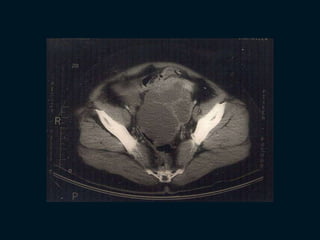
Ovarian Cancer Treatment & Management Karen A. Zempolich, M.D. Monarch Women’s Cancer Center Utah Cancer Action Network May 5, 2008
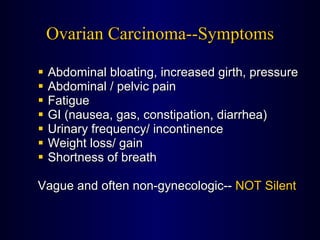
Ovarian Carcinoma--Symptoms Abdominal bloating, increased girth, pressure Abdominal / pelvic pain Fatigue GI (nausea, gas, constipation, diarrhea) Urinary frequency/ incontinence Weight loss/ gain Shortness of breath   Vague and often non-gynecologic--  NOT Silent
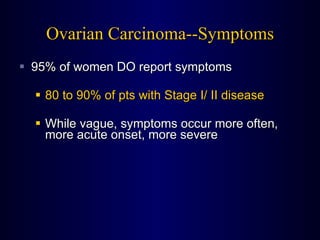
Ovarian Carcinoma--Symptoms 95% of women DO report symptoms 80 to 90% of pts with Stage I/ II disease While vague, symptoms occur more often, more acute onset, more severe
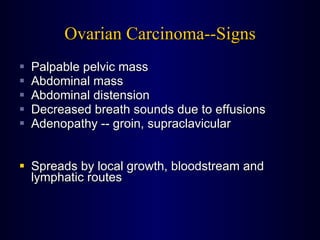
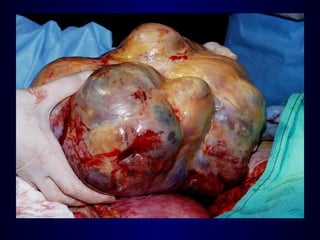
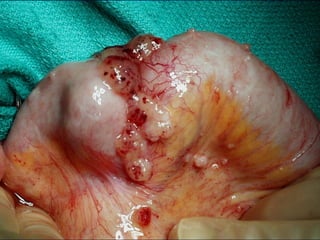
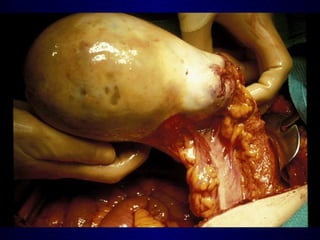
Ovarian Carcinoma--Signs Palpable pelvic mass Abdominal mass Abdominal distension Decreased breath sounds due to effusions Adenopathy -- groin, supraclavicular Spreads by local growth, bloodstream and lymphatic routes
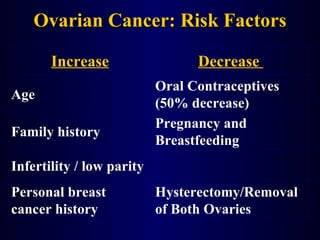
Ovarian Cancer: Risk Factors Hysterectomy/Removal of Both Ovaries Personal breast cancer history   Infertility / low parity   Pregnancy  and Breastfeeding Family history   Oral Contraceptives (50% decrease) Age   Decrease   Increase
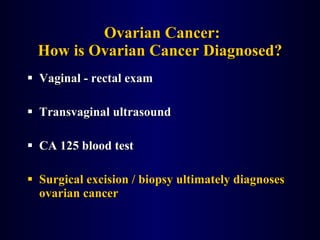
Ovarian Cancer: How is Ovarian Cancer Diagnosed? Vaginal - rectal exam Transvaginal ultrasound CA 125 blood test Surgical excision / biopsy ultimately diagnoses ovarian cancer
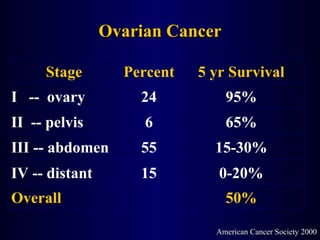
Ovarian Cancer American Cancer Society 2000 50% Overall 0-20% 15 IV -- distant 15-30% 55 III -- abdomen 65% 6 II  -- pelvis 95% 24 I  --  ovary 5 yr Survival Percent Stage
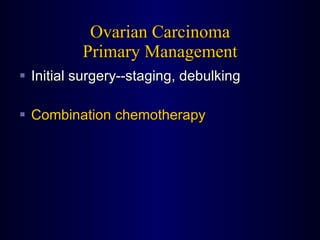
Ovarian Carcinoma Primary Management Initial surgery Thorough surgical staging Aggressive tumor resection (debulking, cytoreduction) Combination chemotherapy
Ovarian Carcinoma Initial Surgery -- Surgical Staging Bilateral Salpingo-oopherectomy / Hysterectomy Omentectomy Peritoneal biopsies Diaphragm, abdomen, pelvis, small / large  bowel mesentery Lymphadenectomy Pelvic, Abdominal (para-aortic) lymph nodes
Ovarian Carcinoma Initial Surgery -- Surgical Staging Incomplete staging  leads to choice between: 2 nd  surgery to complete staging Chemotherapy for presumed advanced stage Up to  80%  of ovarian cancer patients receive  incomplete   staging  from surgeons not trained in ovarian cancer surgery.
Ovarian Carcinoma Primary Management—Initial Surgery 9 states, 10,432 admissions for ovarian cancer Underwent oopherectomy at minimum Iowa, S Carolina Wisconsin, Florida, Colorado, Maine, New Jersey, New York, Washington Defined comprehensive surgical treatment : Lymph node dissection and omentectomy or cytoreduction Diagnosis of secondary malignancy of a specified organ (bowel / peritoneum) with omentectomy / cytoreduction Goff et al, Cancer 2007
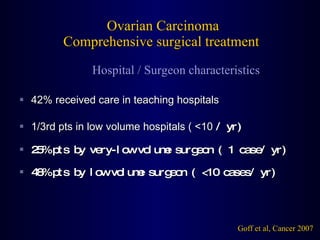
Ovarian Carcinoma Comprehensive surgical treatment  Hospital / Surgeon characteristics 42% received care in teaching hospitals 1/3rd pts in low volume hospitals ( <10  / yr) 25% pts by very-low volume surgeon ( 1 case/ yr) 48% pts by low volume surgeon ( <10 cases/ yr) Goff et al, Cancer 2007
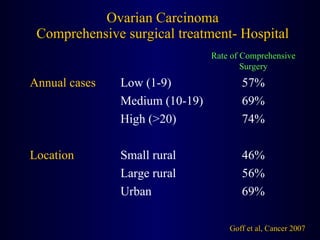
Ovarian Carcinoma Comprehensive surgical treatment- Hospital Goff et al, Cancer 2007 57% Low (1-9) Annual cases 69% Urban 56% Large rural 46% Small rural Location 74% High (>20) 69% Medium (10-19) Rate of Comprehensive Surgery
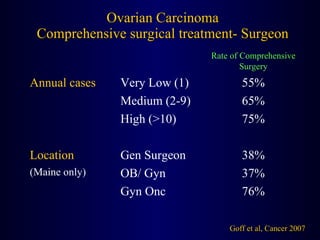
Ovarian Carcinoma Comprehensive surgical treatment- Surgeon Goff et al, Cancer 2007 55% Very Low (1) Annual cases 76% Gyn Onc 37% OB/ Gyn (Maine only) 38% Gen Surgeon Location 75% High (>10) 65% Medium (2-9) Rate of Comprehensive Surgery
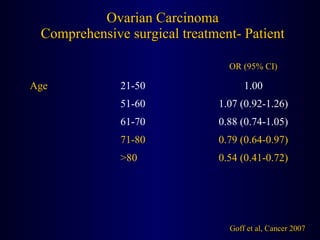
Ovarian Carcinoma Comprehensive surgical treatment- Patient Goff et al, Cancer 2007 0.54 (0.41-0.72) >80 0.79 (0.64-0.97) 71-80 0.88 (0.74-1.05) 61-70 1.07 (0.92-1.26) 51-60 1.00 21-50 Age OR (95% CI)
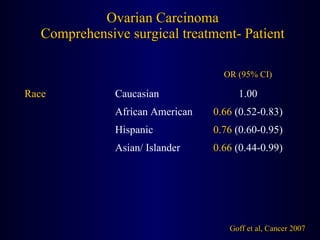
Ovarian Carcinoma Comprehensive surgical treatment- Patient Goff et al, Cancer 2007 0.66  (0.44-0.99) Asian/ Islander 0.76  (0.60-0.95) Hispanic 0.66  (0.52-0.83) African American 1.00 Caucasian Race OR (95% CI)
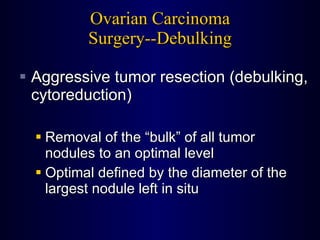
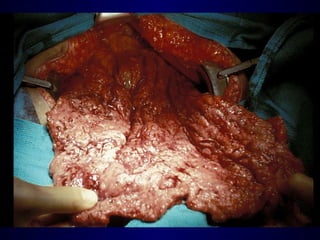
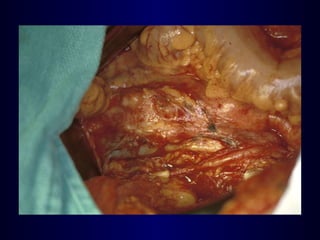
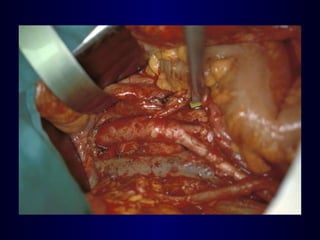
Ovarian Carcinoma Surgery--Debulking Aggressive tumor resection (debulking, cytoreduction) Removal of the “bulk” of all tumor nodules to an optimal level Optimal defined by the diameter of the largest nodule left in situ
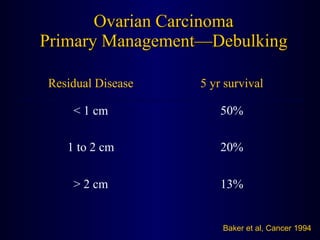
Ovarian Carcinoma Primary Management—Debulking Baker et al, Cancer 1994 13% > 2 cm 20% 1 to 2 cm 50% < 1 cm 5 yr survival Residual Disease
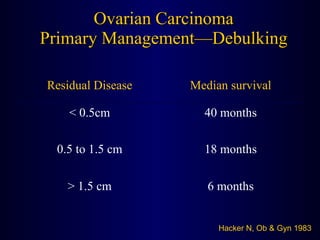
Ovarian Carcinoma Primary Management—Debulking Hacker N, Ob & Gyn 1983 6 months > 1.5 cm 18 months 0.5 to 1.5 cm 40 months < 0.5cm Median survival Residual Disease


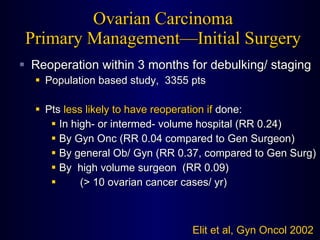
Ovarian Carcinoma Primary Management—Initial Surgery Reoperation within 3 months for debulking/ staging Population based study,  3355 pts Pts  less likely to have reoperation if  done: In high- or intermed- volume hospital (RR 0.24) By Gyn Onc (RR 0.04 compared to Gen Surgeon) By general Ob/ Gyn (RR 0.37, compared to Gen Surg) By  high volume surgeon  (RR 0.09) (> 10 ovarian cancer cases/ yr) Elit et al, Gyn Oncol 2002
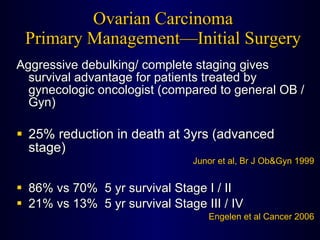
Ovarian Carcinoma Primary Management—Initial Surgery Aggressive debulking/ complete staging gives survival advantage for patients treated by gynecologic oncologist (compared to general OB / Gyn) 25% reduction in death at 3yrs (advanced stage) Junor et al, Br J Ob&Gyn 1999 86% vs 70%  5 yr survival Stage I / II 21% vs 13%  5 yr survival Stage III / IV Engelen et al Cancer 2006
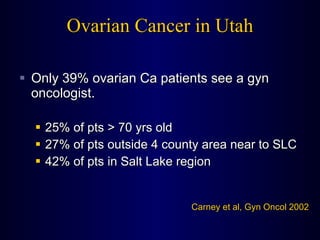
Ovarian Cancer in Utah Only 39% ovarian Ca patients see a gyn oncologist. 25% of pts > 70 yrs old 27% of pts outside 4 county area near to SLC 42% of pts in Salt Lake region Carney et al, Gyn Oncol 2002
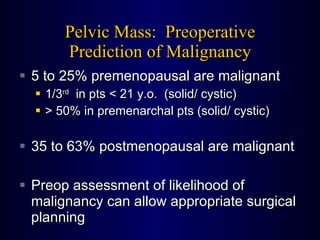
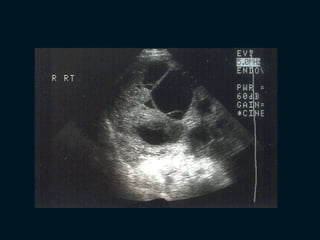
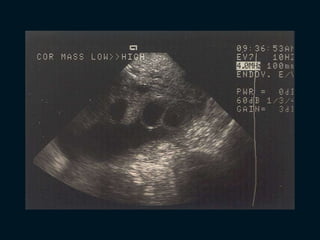
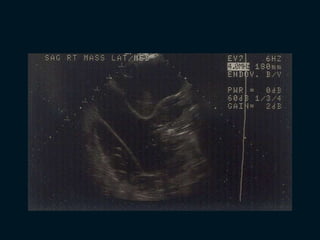
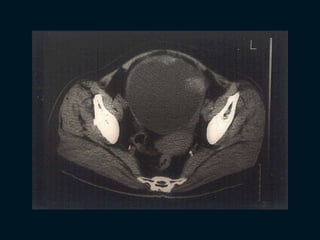
Pelvic Mass:  Preoperative Prediction of Malignancy 5 to 25% premenopausal are malignant 1/3 rd   in pts < 21 y.o.  (solid/ cystic) > 50% in premenarchal pts (solid/ cystic) 35 to 63% postmenopausal are malignant Preop assessment of likelihood of malignancy can allow appropriate surgical planning
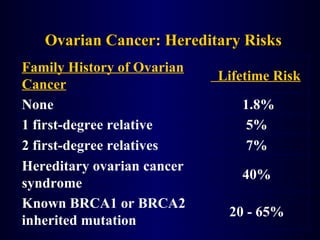
Ovarian Cancer: Hereditary Risks   20 - 65%   Known BRCA1 or BRCA2 inherited mutation   40%   Hereditary ovarian cancer  syndrome   7%   2 first-degree relatives  5%   1 first-degree relative 1.8% None Lifetime Risk Family History of Ovarian Cancer
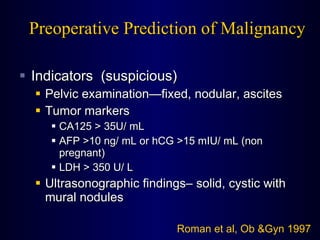
Preoperative Prediction of Malignancy Indicators  (suspicious) Pelvic examination—fixed, nodular, ascites Tumor markers CA125 > 35U/ mL AFP >10 ng/ mL or hCG >15 mIU/ mL (non pregnant) LDH > 350 U/ L Ultrasonographic findings– solid, cystic with mural nodules  Roman et al, Ob &Gyn 1997


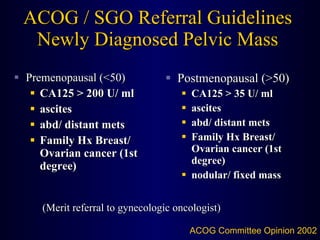
ACOG / SGO Referral Guidelines Newly Diagnosed Pelvic Mass Premenopausal (<50) CA125 > 200 U/ ml ascites abd/ distant mets Family Hx Breast/ Ovarian cancer (1st degree) Postmenopausal (>50) CA125 > 35 U/ ml ascites abd/ distant mets Family Hx Breast/ Ovarian cancer (1st degree) nodular/ fixed mass ACOG Committee Opinion 2002 (Merit referral to gynecologic oncologist)
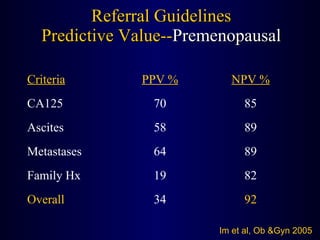
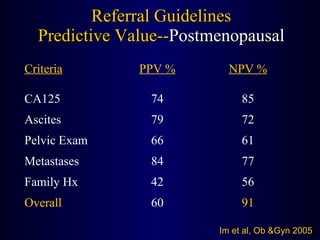
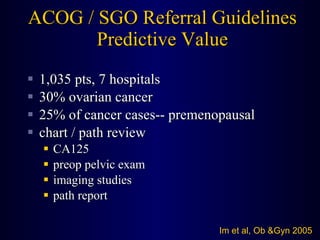
ACOG / SGO Referral Guidelines Predictive Value 1,035 pts, 7 hospitals 30% ovarian cancer 25% of cancer cases-- premenopausal chart / path review CA125 preop pelvic exam imaging studies path report Im et al, Ob &Gyn 2005
Referral Guidelines Predictive Value-- Premenopausal Im et al, Ob &Gyn 2005 92 34 Overall 82 19 Family Hx 89 64 Metastases 89 58 Ascites 85 70 CA125 NPV % PPV % Criteria
Referral Guidelines Predictive Value-- Postmenopausal Im et al, Ob &Gyn 2005 61 66 Pelvic Exam 91 60 Overall 56 42 Family Hx 77 84 Metastases 72 79 Ascites 85 74 CA125 NPV % PPV % Criteria
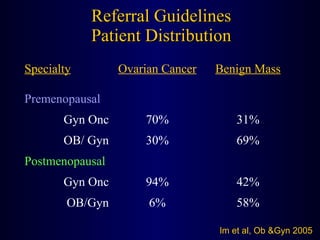
Referral Guidelines Patient Distribution Im et al, Ob &Gyn 2005 69% 30% OB/ Gyn 58% 6% OB/Gyn 42% 94% Gyn Onc Postmenopausal 31% 70% Gyn Onc Premenopausal Benign Mass Ovarian Cancer Specialty
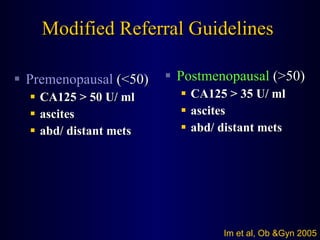
Modified Referral Guidelines Premenopausal  (<50) CA125 > 50 U/ ml ascites abd/ distant mets Postmenopausal  (>50) CA125 > 35 U/ ml ascites abd/ distant mets Im et al, Ob &Gyn 2005
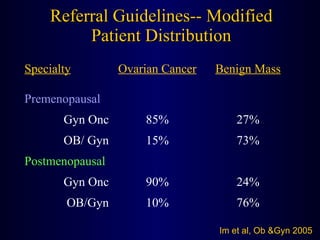
Referral Guidelines-- Modified Patient Distribution Im et al, Ob &Gyn 2005 73% 15% OB/ Gyn 76% 10% OB/Gyn 24% 90% Gyn Onc Postmenopausal 27% 85% Gyn Onc Premenopausal Benign Mass Ovarian Cancer Specialty
Ovarian Carcinoma Primary Management Initial surgery--staging, debulking Combination chemotherapy
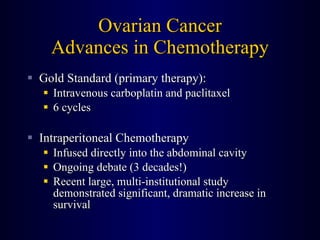
Ovarian Cancer Advances in Chemotherapy Gold Standard (primary therapy): Intravenous carboplatin and paclitaxel 6 cycles Intraperitoneal Chemotherapy Infused directly into the abdominal cavity Ongoing debate (3 decades!) Recent large, multi-institutional study demonstrated significant, dramatic increase in survival
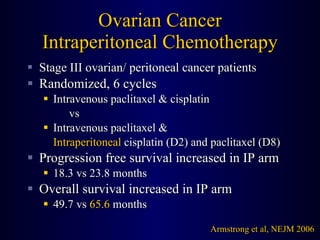
Ovarian Cancer Intraperitoneal Chemotherapy Stage III ovarian/ peritoneal cancer patients Randomized, 6 cycles Intravenous paclitaxel & cisplatin vs  Intravenous paclitaxel & Intraperitoneal  cisplatin (D2) and paclitaxel (D8) Progression free survival increased in IP arm 18.3 vs 23.8 months Overall survival increased in IP arm 49.7 vs  65.6  months Armstrong et al, NEJM 2006
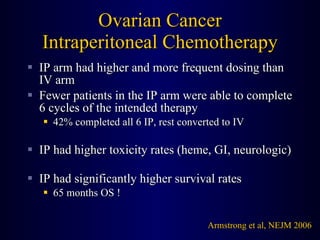
Ovarian Cancer Intraperitoneal Chemotherapy IP arm had higher and more frequent dosing than IV arm Fewer patients in the IP arm were able to complete 6 cycles of the intended therapy 42% completed all 6 IP, rest converted to IV IP had higher toxicity rates (heme, GI, neurologic) IP had significantly higher survival rates 65 months OS ! Armstrong et al, NEJM 2006
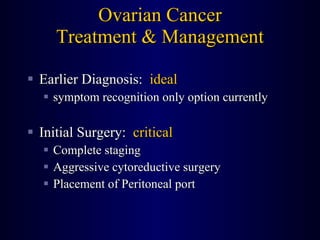
Ovarian Cancer Treatment & Management Earlier Diagnosis:  ideal symptom recognition only option currently Initial Surgery:  critical Complete staging Aggressive cytoreductive surgery Placement of Peritoneal port
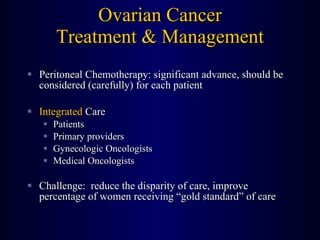
Ovarian Cancer Treatment & Management Peritoneal Chemotherapy: significant advance, should be considered (carefully) for each patient Integrated  Care Patients Primary providers Gynecologic Oncologists Medical Oncologists Challenge:  reduce the disparity of care, improve percentage of women receiving “gold standard” of care
References Armstrong et al, NEJM 2006; NEJM, 354:34-43 American College of Obstetricians & Gynecologists, Committee Opinion 2002 Baker et al, Cancer 1994;74:656-63 Carney et al, Gynecologic Oncology 2002;99:888-91 Elit et al, Gynecologic Oncology 2002;87:260-7 Engelen et al, Cancer 2006;106:589-98 Goff et al, Cancer  2007;109:2031-42 Hacker et al, Obstetrics & Gynecology 1983;61:408-12 Im et al, Obstetrics & Gynecology 2005 Junor et al, British J Obstetrics & Gynecology 1999;106:1130-6 Roman et al, Obstetrics & Gynecology 1997;89:493-500

05052008OvarianTelehealth

  • 1.
    Ovarian Cancer Treatment& Management Karen A. Zempolich, M.D. Monarch Women’s Cancer Center Utah Cancer Action Network May 5, 2008
  • 2.
    Ovarian Carcinoma--Symptoms Abdominalbloating, increased girth, pressure Abdominal / pelvic pain Fatigue GI (nausea, gas, constipation, diarrhea) Urinary frequency/ incontinence Weight loss/ gain Shortness of breath Vague and often non-gynecologic-- NOT Silent
  • 3.
    Ovarian Carcinoma--Symptoms 95%of women DO report symptoms 80 to 90% of pts with Stage I/ II disease While vague, symptoms occur more often, more acute onset, more severe
  • 4.
    Ovarian Carcinoma--Signs Palpablepelvic mass Abdominal mass Abdominal distension Decreased breath sounds due to effusions Adenopathy -- groin, supraclavicular Spreads by local growth, bloodstream and lymphatic routes
  • 5.
    Ovarian Cancer: RiskFactors Hysterectomy/Removal of Both Ovaries Personal breast cancer history Infertility / low parity Pregnancy and Breastfeeding Family history Oral Contraceptives (50% decrease) Age Decrease Increase
  • 6.
    Ovarian Cancer: Howis Ovarian Cancer Diagnosed? Vaginal - rectal exam Transvaginal ultrasound CA 125 blood test Surgical excision / biopsy ultimately diagnoses ovarian cancer
  • 7.
    Ovarian Cancer AmericanCancer Society 2000 50% Overall 0-20% 15 IV -- distant 15-30% 55 III -- abdomen 65% 6 II -- pelvis 95% 24 I -- ovary 5 yr Survival Percent Stage
  • 8.
    Ovarian Carcinoma PrimaryManagement Initial surgery Thorough surgical staging Aggressive tumor resection (debulking, cytoreduction) Combination chemotherapy
  • 9.
    Ovarian Carcinoma InitialSurgery -- Surgical Staging Bilateral Salpingo-oopherectomy / Hysterectomy Omentectomy Peritoneal biopsies Diaphragm, abdomen, pelvis, small / large bowel mesentery Lymphadenectomy Pelvic, Abdominal (para-aortic) lymph nodes
  • 10.
    Ovarian Carcinoma InitialSurgery -- Surgical Staging Incomplete staging leads to choice between: 2 nd surgery to complete staging Chemotherapy for presumed advanced stage Up to 80% of ovarian cancer patients receive incomplete staging from surgeons not trained in ovarian cancer surgery.
  • 11.
    Ovarian Carcinoma PrimaryManagement—Initial Surgery 9 states, 10,432 admissions for ovarian cancer Underwent oopherectomy at minimum Iowa, S Carolina Wisconsin, Florida, Colorado, Maine, New Jersey, New York, Washington Defined comprehensive surgical treatment : Lymph node dissection and omentectomy or cytoreduction Diagnosis of secondary malignancy of a specified organ (bowel / peritoneum) with omentectomy / cytoreduction Goff et al, Cancer 2007
  • 12.
    Ovarian Carcinoma Comprehensivesurgical treatment Hospital / Surgeon characteristics 42% received care in teaching hospitals 1/3rd pts in low volume hospitals ( <10 / yr) 25% pts by very-low volume surgeon ( 1 case/ yr) 48% pts by low volume surgeon ( <10 cases/ yr) Goff et al, Cancer 2007
  • 13.
    Ovarian Carcinoma Comprehensivesurgical treatment- Hospital Goff et al, Cancer 2007 57% Low (1-9) Annual cases 69% Urban 56% Large rural 46% Small rural Location 74% High (>20) 69% Medium (10-19) Rate of Comprehensive Surgery
  • 14.
    Ovarian Carcinoma Comprehensivesurgical treatment- Surgeon Goff et al, Cancer 2007 55% Very Low (1) Annual cases 76% Gyn Onc 37% OB/ Gyn (Maine only) 38% Gen Surgeon Location 75% High (>10) 65% Medium (2-9) Rate of Comprehensive Surgery
  • 15.
    Ovarian Carcinoma Comprehensivesurgical treatment- Patient Goff et al, Cancer 2007 0.54 (0.41-0.72) >80 0.79 (0.64-0.97) 71-80 0.88 (0.74-1.05) 61-70 1.07 (0.92-1.26) 51-60 1.00 21-50 Age OR (95% CI)
  • 16.
    Ovarian Carcinoma Comprehensivesurgical treatment- Patient Goff et al, Cancer 2007 0.66 (0.44-0.99) Asian/ Islander 0.76 (0.60-0.95) Hispanic 0.66 (0.52-0.83) African American 1.00 Caucasian Race OR (95% CI)
  • 17.
    Ovarian Carcinoma Surgery--DebulkingAggressive tumor resection (debulking, cytoreduction) Removal of the “bulk” of all tumor nodules to an optimal level Optimal defined by the diameter of the largest nodule left in situ
  • 18.
    Ovarian Carcinoma PrimaryManagement—Debulking Baker et al, Cancer 1994 13% > 2 cm 20% 1 to 2 cm 50% < 1 cm 5 yr survival Residual Disease
  • 19.
    Ovarian Carcinoma PrimaryManagement—Debulking Hacker N, Ob & Gyn 1983 6 months > 1.5 cm 18 months 0.5 to 1.5 cm 40 months < 0.5cm Median survival Residual Disease
  • 20.
  • 21.
  • 22.
  • 23.
  • 24.
  • 25.
  • 26.
    Ovarian Carcinoma PrimaryManagement—Initial Surgery Reoperation within 3 months for debulking/ staging Population based study, 3355 pts Pts less likely to have reoperation if done: In high- or intermed- volume hospital (RR 0.24) By Gyn Onc (RR 0.04 compared to Gen Surgeon) By general Ob/ Gyn (RR 0.37, compared to Gen Surg) By high volume surgeon (RR 0.09) (> 10 ovarian cancer cases/ yr) Elit et al, Gyn Oncol 2002
  • 27.
    Ovarian Carcinoma PrimaryManagement—Initial Surgery Aggressive debulking/ complete staging gives survival advantage for patients treated by gynecologic oncologist (compared to general OB / Gyn) 25% reduction in death at 3yrs (advanced stage) Junor et al, Br J Ob&Gyn 1999 86% vs 70% 5 yr survival Stage I / II 21% vs 13% 5 yr survival Stage III / IV Engelen et al Cancer 2006
  • 28.
    Ovarian Cancer inUtah Only 39% ovarian Ca patients see a gyn oncologist. 25% of pts > 70 yrs old 27% of pts outside 4 county area near to SLC 42% of pts in Salt Lake region Carney et al, Gyn Oncol 2002
  • 29.
    Pelvic Mass: Preoperative Prediction of Malignancy 5 to 25% premenopausal are malignant 1/3 rd in pts < 21 y.o. (solid/ cystic) > 50% in premenarchal pts (solid/ cystic) 35 to 63% postmenopausal are malignant Preop assessment of likelihood of malignancy can allow appropriate surgical planning
  • 30.
    Ovarian Cancer: HereditaryRisks 20 - 65% Known BRCA1 or BRCA2 inherited mutation 40% Hereditary ovarian cancer syndrome 7% 2 first-degree relatives 5% 1 first-degree relative 1.8% None Lifetime Risk Family History of Ovarian Cancer
  • 31.
    Preoperative Prediction ofMalignancy Indicators (suspicious) Pelvic examination—fixed, nodular, ascites Tumor markers CA125 > 35U/ mL AFP >10 ng/ mL or hCG >15 mIU/ mL (non pregnant) LDH > 350 U/ L Ultrasonographic findings– solid, cystic with mural nodules Roman et al, Ob &Gyn 1997
  • 32.
  • 33.
  • 34.
  • 35.
  • 36.
  • 37.
    ACOG / SGOReferral Guidelines Newly Diagnosed Pelvic Mass Premenopausal (<50) CA125 > 200 U/ ml ascites abd/ distant mets Family Hx Breast/ Ovarian cancer (1st degree) Postmenopausal (>50) CA125 > 35 U/ ml ascites abd/ distant mets Family Hx Breast/ Ovarian cancer (1st degree) nodular/ fixed mass ACOG Committee Opinion 2002 (Merit referral to gynecologic oncologist)
  • 38.
    ACOG / SGOReferral Guidelines Predictive Value 1,035 pts, 7 hospitals 30% ovarian cancer 25% of cancer cases-- premenopausal chart / path review CA125 preop pelvic exam imaging studies path report Im et al, Ob &Gyn 2005
  • 39.
    Referral Guidelines PredictiveValue-- Premenopausal Im et al, Ob &Gyn 2005 92 34 Overall 82 19 Family Hx 89 64 Metastases 89 58 Ascites 85 70 CA125 NPV % PPV % Criteria
  • 40.
    Referral Guidelines PredictiveValue-- Postmenopausal Im et al, Ob &Gyn 2005 61 66 Pelvic Exam 91 60 Overall 56 42 Family Hx 77 84 Metastases 72 79 Ascites 85 74 CA125 NPV % PPV % Criteria
  • 41.
    Referral Guidelines PatientDistribution Im et al, Ob &Gyn 2005 69% 30% OB/ Gyn 58% 6% OB/Gyn 42% 94% Gyn Onc Postmenopausal 31% 70% Gyn Onc Premenopausal Benign Mass Ovarian Cancer Specialty
  • 42.
    Modified Referral GuidelinesPremenopausal (<50) CA125 > 50 U/ ml ascites abd/ distant mets Postmenopausal (>50) CA125 > 35 U/ ml ascites abd/ distant mets Im et al, Ob &Gyn 2005
  • 43.
    Referral Guidelines-- ModifiedPatient Distribution Im et al, Ob &Gyn 2005 73% 15% OB/ Gyn 76% 10% OB/Gyn 24% 90% Gyn Onc Postmenopausal 27% 85% Gyn Onc Premenopausal Benign Mass Ovarian Cancer Specialty
  • 44.
    Ovarian Carcinoma PrimaryManagement Initial surgery--staging, debulking Combination chemotherapy
  • 45.
    Ovarian Cancer Advancesin Chemotherapy Gold Standard (primary therapy): Intravenous carboplatin and paclitaxel 6 cycles Intraperitoneal Chemotherapy Infused directly into the abdominal cavity Ongoing debate (3 decades!) Recent large, multi-institutional study demonstrated significant, dramatic increase in survival
  • 46.
    Ovarian Cancer IntraperitonealChemotherapy Stage III ovarian/ peritoneal cancer patients Randomized, 6 cycles Intravenous paclitaxel & cisplatin vs Intravenous paclitaxel & Intraperitoneal cisplatin (D2) and paclitaxel (D8) Progression free survival increased in IP arm 18.3 vs 23.8 months Overall survival increased in IP arm 49.7 vs 65.6 months Armstrong et al, NEJM 2006
  • 47.
    Ovarian Cancer IntraperitonealChemotherapy IP arm had higher and more frequent dosing than IV arm Fewer patients in the IP arm were able to complete 6 cycles of the intended therapy 42% completed all 6 IP, rest converted to IV IP had higher toxicity rates (heme, GI, neurologic) IP had significantly higher survival rates 65 months OS ! Armstrong et al, NEJM 2006
  • 48.
    Ovarian Cancer Treatment& Management Earlier Diagnosis: ideal symptom recognition only option currently Initial Surgery: critical Complete staging Aggressive cytoreductive surgery Placement of Peritoneal port
  • 49.
    Ovarian Cancer Treatment& Management Peritoneal Chemotherapy: significant advance, should be considered (carefully) for each patient Integrated Care Patients Primary providers Gynecologic Oncologists Medical Oncologists Challenge: reduce the disparity of care, improve percentage of women receiving “gold standard” of care
  • 50.
    References Armstrong etal, NEJM 2006; NEJM, 354:34-43 American College of Obstetricians & Gynecologists, Committee Opinion 2002 Baker et al, Cancer 1994;74:656-63 Carney et al, Gynecologic Oncology 2002;99:888-91 Elit et al, Gynecologic Oncology 2002;87:260-7 Engelen et al, Cancer 2006;106:589-98 Goff et al, Cancer 2007;109:2031-42 Hacker et al, Obstetrics & Gynecology 1983;61:408-12 Im et al, Obstetrics & Gynecology 2005 Junor et al, British J Obstetrics & Gynecology 1999;106:1130-6 Roman et al, Obstetrics & Gynecology 1997;89:493-500