Bhushan S. Surana
M. pharmacy (Pharmacology)
Why Study Pharmacokinetics (PK)
and Pharmacodynamics (PD)?
• Individualize patient drug therapy
• Monitor medications with a narrow
therapeutic index
• Decrease the risk of adverse effects while
maximizing pharmacologic response of
medications
• Evaluate PK/PD as a diagnostic tool for
underlying disease states
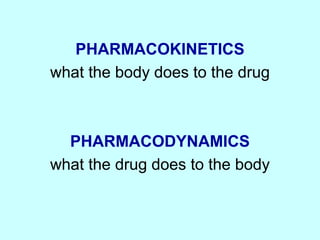
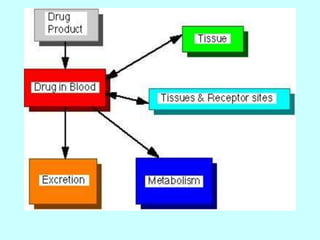
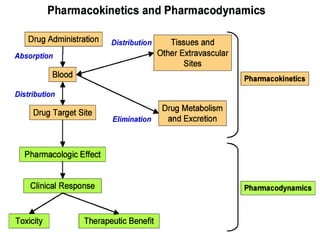
PHARMACOKINETICS
what the body does to the drug
PHARMACODYNAMICS
what the drug does to the body
Clinical Pharmacokinetics
• Absorption, distribution, metabolism and
excretion all involve the passage of drugs across
cell membranes.
• Physicochemical properties of the drug and the
membrane influence this transfer
• Various characteristics of the drug can help
predict this movement of the drug molecules.
Absorption
• Must be able to get medications into the
patient’s body
• Drug characteristics that affect absorption:
– Molecular weight, ionization, solubility, &
formulation
• Factors affecting drug absorption related
to patients:
– Route of administration, gastric pH, contents
of GI tract
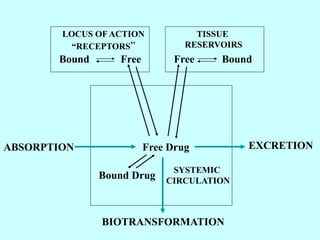
Bound Free Free Bound
LOCUS OFACTION
“RECEPTORS”
TISSUE
RESERVOIRS
SYSTEMIC
CIRCULATION
Free Drug
Bound Drug
BIOTRANSFORMATION
EXCRETION
ABSORPTION
Time to Peak Concentration
0
10
20
30
40
50
60
70
80
90
100
0 5 10 20 30 60 120 180
minutes
concentration
IV
Oral
Rectal
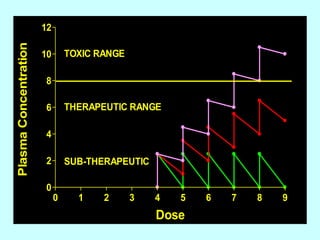
Dose
Plasma
Concentration
0 1 2 3 4 5 6 7 8 9
0
2
4
6
8
10
12
TOXIC RANGE
THERAPEUTIC RANGE
SUB-THERAPEUTIC
Bioavailability
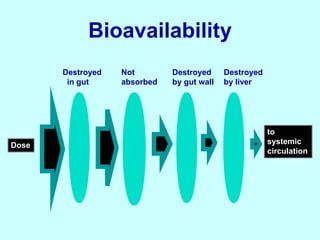
• Definition: the fraction of the administered
• dose reaching the systemic circulation
• for i.v.: 100%
• for non i.v.: ranges from 0 to 100%
• e.g. lidocaine bioavailability 35% due to
• destruction in gastric acid and liver
metabolism
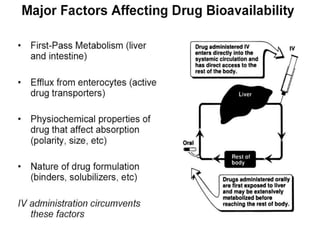
• First Pass Effect
Bioavailability
Dose
Destroyed
in gut
Not
absorbed
Destroyed
by gut wall
Destroyed
by liver
to
systemic
circulation
PRINCIPLE
For drugs taken by routes other than the
i.v. route, the extent of absorption and
the bioavailability must be understood
in order to determine what dose will
induce the desired therapeutic effect. It
will also explain why the same dose
may cause a therapeutic effect by one
route but a toxic or no effect by
another.
Distribution
• Drug distributes into various body
compartments
• Distribution depends on a variety of factors
all related to the drug
• Causes a drop in the serum levels of the
drug
• Certain sites of distribution act as stores
Distribution
• Membrane permeability
– cross membranes to site of action
• Plasma protein binding
– bound drugs do not cross membranes
• Lipophilicity of drug
– lipophilic drugs accumulate in adipose tissue
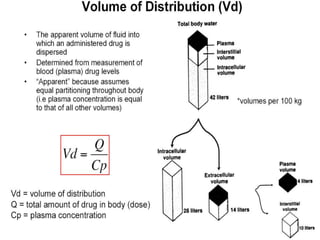
• Volume of distribution
Drugs appear to distribute in the body as if it
were a single compartment. The magnitude of
the drug’s distribution is given by the apparent
volume of distribution (Vd).
Vd = Amount of drug in body ÷ Concentration in Plasma
PRINCIPLE
(Apparent) Volume of Distribution:
Volume into which a drug appears to distribute with
a concentration equal to its plasma concentration
Volume of Distribution
• “the volume that would accommodate all the
drug in the body, if the concentration throughout
was the same as in plasma”
• It is the total volume in which the drug appears
to have been dissolved
• Used for predicting serum levels of the drug
• Denoted as “aVd”
• aVd = Dose of the drug/Conc. of drug
Drug Distribution
• Process by which a drug reversibly leaves the
site of administration and is distributed
throughout the tissues of the body
• Extent is dependent upon various factors
– Blood flow (lung, kidney, liver > brain, skeletal
muscle > adipose, bone)
– Ability of drug to traverse biological membranes
– Degree of binding to blood proteins (e.g. serum
albumin)
• Distribution of drug to target organ/site is a
critical requirement
• for achieving a therapeutic benefit
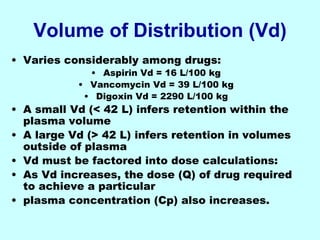
Volume of Distribution (Vd)
• Varies considerably among drugs:
• Aspirin Vd = 16 L/100 kg
• Vancomycin Vd = 39 L/100 kg
• Digoxin Vd = 2290 L/100 kg
• A small Vd (< 42 L) infers retention within the
plasma volume
• A large Vd (> 42 L) infers retention in volumes
outside of plasma
• Vd must be factored into dose calculations:
• As Vd increases, the dose (Q) of drug required
to achieve a particular
• plasma concentration (Cp) also increases.
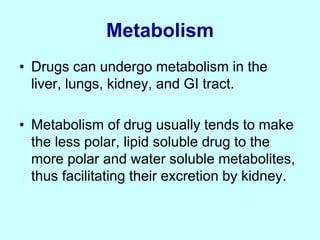
Metabolism
• Drugs can undergo metabolism in the
liver, lungs, kidney, and GI tract.
• Metabolism of drug usually tends to make
the less polar, lipid soluble drug to the
more polar and water soluble metabolites,
thus facilitating their excretion by kidney.
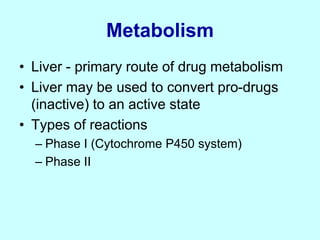
Metabolism
• Liver - primary route of drug metabolism
• Liver may be used to convert pro-drugs
(inactive) to an active state
• Types of reactions
– Phase I (Cytochrome P450 system)
– Phase II
Phase I reactions
• Cytochrome P450 system
• Located within the endoplasmic reticulum
of hepatocytes
• Through electron transport chain, a drug
bound to the CYP450 system undergoes
oxidation or reduction
• Enzyme induction
• Drug interactions
Phase I reactions types
• Hydrolysis
• Oxidation
• Reduction
• Demethylation
• Methylation
• Alcohol dehydrogenase metabolism
Phase II reactions
• Polar group is conjugated to the drug
• Results in increased polarity of the drug
• Types of reactions
– Glycine conjugation
– Glucuronide conjugation
– Sulfate conjugation
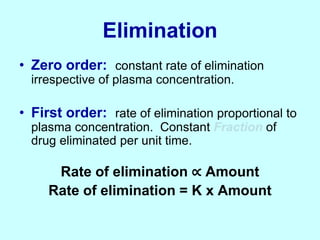
Elimination
• Zero order: constant rate of elimination
irrespective of plasma concentration.
• First order: rate of elimination proportional to
plasma concentration. Constant Fraction of
drug eliminated per unit time.
Rate of elimination ∝ Amount
Rate of elimination = K x Amount
Plasma Concentration Profile
after a Single I.V. Injection
Time
Plasma
Concentration
0 1 2 3 4 5 6
1
10
100
1000
10000
C0
Distribution equilibrium
Elimination only
Distribution and Elimination
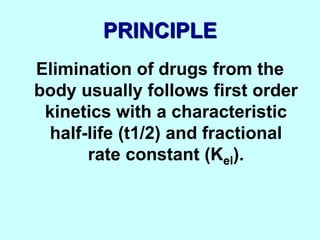
PRINCIPLE
Elimination of drugs from the
body usually follows first order
kinetics with a characteristic
half-life (t1/2) and fractional
rate constant (Kel).
First Order Elimination
• Clearance: volume of plasma cleared of drug
per unit time.
Clearance = Rate of elimination ÷ plasma
conc.
• Half-life of elimination: time for plasma
conc. to decrease by half.
Useful in estimating:
- time to reach steady state concentration.
- time for plasma concentration to fall after
dosing is stopped.
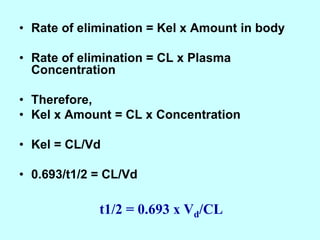
• Rate of elimination = Kel x Amount in body
• Rate of elimination = CL x Plasma
Concentration
• Therefore,
• Kel x Amount = CL x Concentration
• Kel = CL/Vd
• 0.693/t1/2 = CL/Vd
t1/2 = 0.693 x Vd/CL
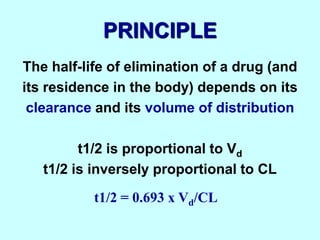
PRINCIPLE
The half-life of elimination of a drug (and
its residence in the body) depends on its
clearance and its volume of distribution
t1/2 is proportional to Vd
t1/2 is inversely proportional to CL
t1/2 = 0.693 x Vd/CL
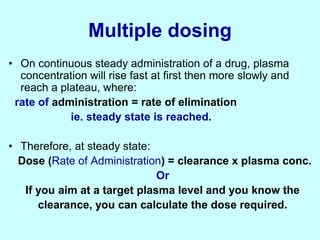
Multiple dosing
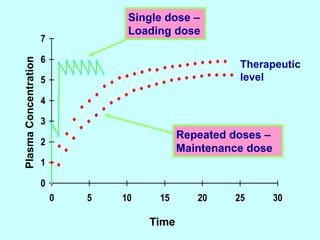
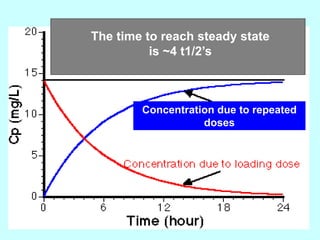
• On continuous steady administration of a drug, plasma
concentration will rise fast at first then more slowly and
reach a plateau, where:
rate of administration = rate of elimination
ie. steady state is reached.
• Therefore, at steady state:
Dose (Rate of Administration) = clearance x plasma conc.
Or
If you aim at a target plasma level and you know the
clearance, you can calculate the dose required.
Pharmacokinetic Principles
• Steady State: the amount of drug
administered is equal to the amount of
drug eliminated within one dosing interval
resulting in a plateau or constant serum
drug level
• Drugs with short half-life reach steady
state rapidly; drugs with long half-life take
days to weeks to reach steady state
0
1
2
3
4
5
6
7
0 5 10 15 20 25 30
Time
Plasma
Concentration
Repeated doses –
Maintenance dose
Therapeutic
level
Single dose –
Loading dose
Concentration due to repeated
doses
The time to reach steady state
is ~4 t1/2’s
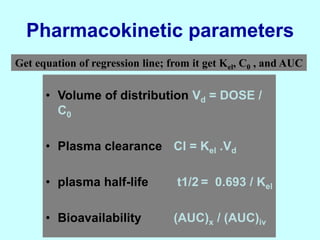
Pharmacokinetic parameters
Get equation of regression line; from it get Kel, C0 , and AUC
• Volume of distribution Vd = DOSE /
C0
• Plasma clearance Cl = Kel .Vd
• plasma half-life t1/2 = 0.693 / Kel
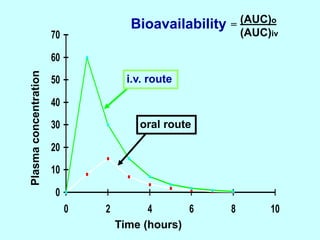
• Bioavailability (AUC)x / (AUC)iv
0
10
20
30
40
50
60
70
0 2 4 6 8 10
Plasma
concentration
Time (hours)
Bioavailability (AUC)o
(AUC)iv
=
i.v. route
oral route
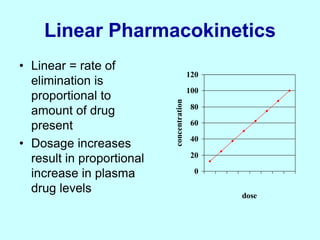
Linear Pharmacokinetics
• Linear = rate of
elimination is
proportional to
amount of drug
present
• Dosage increases
result in proportional
increase in plasma
drug levels
0
20
40
60
80
100
120
dose
concentration
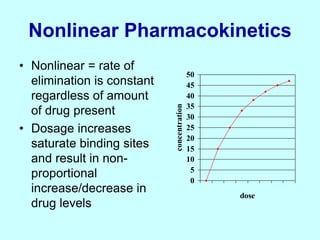
Nonlinear Pharmacokinetics
• Nonlinear = rate of
elimination is constant
regardless of amount
of drug present
• Dosage increases
saturate binding sites
and result in non-
proportional
increase/decrease in
drug levels
0
5
10
15
20
25
30
35
40
45
50
dose
concentration
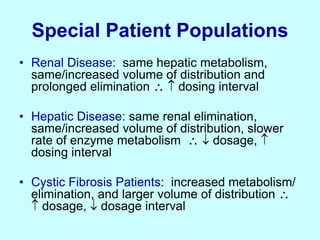
Special Patient Populations
• Renal Disease: same hepatic metabolism,
same/increased volume of distribution and
prolonged elimination   dosing interval
• Hepatic Disease: same renal elimination,
same/increased volume of distribution, slower
rate of enzyme metabolism   dosage, 
dosing interval
• Cystic Fibrosis Patients: increased metabolism/
elimination, and larger volume of distribution 
 dosage,  dosage interval
PRINCIPLE
The absorption, distribution and
elimination of a drug are qualitatively
similar in all individuals. However, for
several reasons, the quantitative
aspects may differ considerably. Each
person must be considered individually
and doses adjusted accordingly.
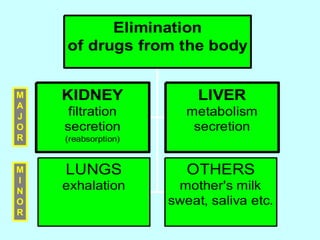
KIDNEY
filtration
secretion
(reabsorption)
LIVER
metabolism
secretion
LUNGS
exhalation
OTHERS
mother's milk
sweat, saliva etc.
Elimination
of drugs from the body
M
A
J
O
R
M
I
N
O
R
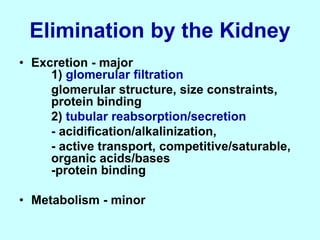
Elimination by the Kidney
• Excretion - major
1) glomerular filtration
glomerular structure, size constraints,
protein binding
2) tubular reabsorption/secretion
- acidification/alkalinization,
- active transport, competitive/saturable,
organic acids/bases
-protein binding
• Metabolism - minor
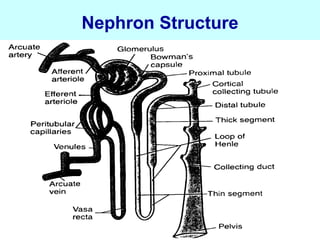
Nephron Structure
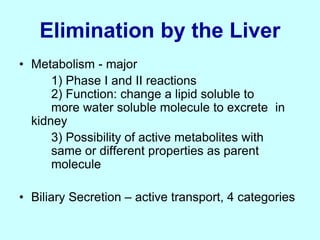
Elimination by the Liver
• Metabolism - major
1) Phase I and II reactions
2) Function: change a lipid soluble to
more water soluble molecule to excrete in
kidney
3) Possibility of active metabolites with
same or different properties as parent
molecule
• Biliary Secretion – active transport, 4 categories
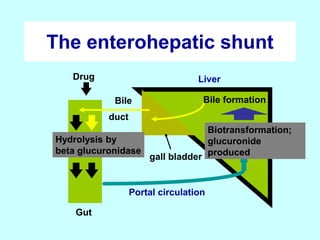
The enterohepatic shunt
Portal circulation
Liver
gall bladder
Gut
Bile
duct
Drug
Biotransformation;
glucuronide
produced
Bile formation
Hydrolysis by
beta glucuronidase
EXCRETION BY OTHER ROUTES
• LUNG - For gases and volatile liquids by diffusion.
Excretion rate depends on partial pressure of gas
and blood:air partition coefficient.
• MOTHER’S MILK
a) By simple diffusion mostly. Milk has high lipid
content and is more acidic than plasma (traps
alkaline fat soluble substances).
b) Important for 2 reasons: transfer to baby, transfer
from animals to humans.
• OTHER SECRETIONS – sweat, saliva, etc..
minor contribution
Pharmacodynamics
• Study of the biochemical and physiologic
processes underlying drug action
– Mechanism of drug action
• Drug-receptor interaction
– Efficacy
– Safety profile
Pharmacodynamics Objectives
1. Define receptor, dissociation constant, affinity, intrinsic activity
2. Describe 4 signal transduction pathways
3. Draw a dose response curve and a log dose response
curve.
4. From these curves, point out potency and intrinsic activity.
5. Distinguish between potency and affinity.
6. Define spare receptors.
7. Define agonist, antagonist (competitive and non-competitive),
partial agonist and understand the concepts of their
interactions
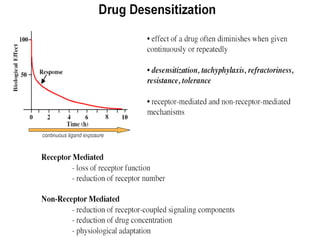
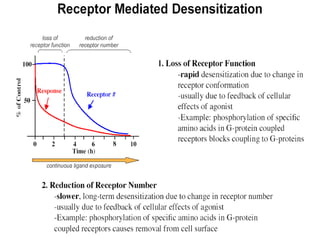
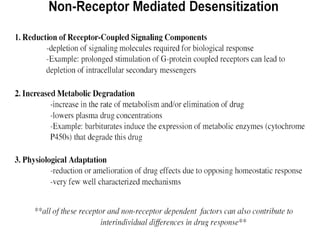
8. Define desensitization, upregulation and understand their
clinical significance
9. Draw a quantal log dose response curve
10. Define therapeutic index
Pharmacodynamics
• “What the drug does to the body”
• It may act on any one of the following
levels
– Molecular
– Cellular
– General
Physical Action
• Some drugs act by their physical
properties
– Adsorption of toxins by charcoal
– Osmotic changes induced by mannitol
– Barrier protection by Band Aid
Chemical Action
• Some drugs produce their effect purely
due to their chemical properties
– Neutralization of acid by antacids
– Chelating iron with desferoximine
– Combating acidosis by bicarbonate
– Combating superoxide by antioxidants
Drug Actions
• Most drugs bind to cellular receptors
– Initiate biochemical reactions
– Pharmacological effect is due to the alteration
of an intrinsic physiologic process and not the
creation of a new process
Drug Receptors
• Proteins or glycoproteins
– Present on cell surface, on an organelle within
the cell, or in the cytoplasm
– Finite number of receptors in a given cell
• Receptor mediated responses plateau upon
saturation of all receptors
Drug Receptors
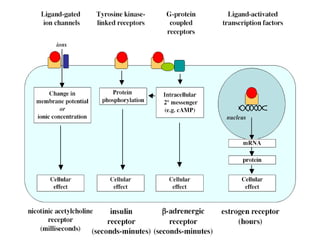
• Action occurs when drug binds to receptor
and this action may be:
– Ion channel is opened or closed
– Second messenger is activated
• cAMP, cGMP, Ca++, inositol phosphates, etc.
• Initiates a series of chemical reactions
– Normal cellular function is physically inhibited
– Cellular function is “turned on”
Drug Receptor
• Affinity
– Refers to the strength of binding between a drug and
receptor
– Number of occupied receptors is a function of a
balance between bound and free drug
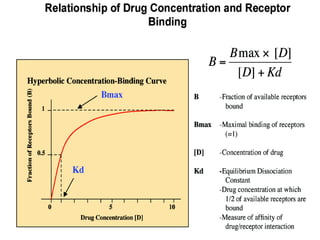
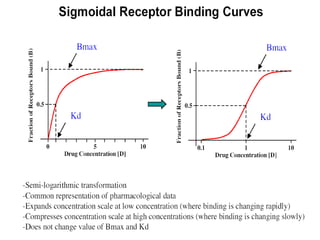
• Dissociation constant (KD)
– Measure of a drug’s affinity for a given receptor
– Defined as the concentration of drug required in
solution to achieve 50% occupancy of its receptors
Drug Receptors
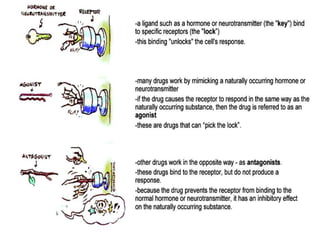
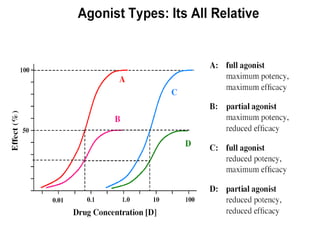
• Agonist
– Drugs which alter the physiology of a cell by
binding to plasma membrane or intracellular
receptors
• Partial agonist
– A drug which does not produce maximal
effect even when all of the receptors are
occupied
Drug Receptors
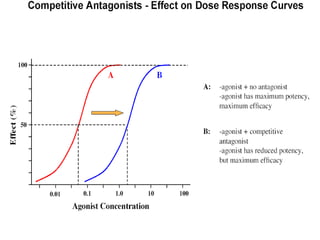
• Antagonists
– Inhibit or block responses caused by agonists
• Competitive antagonist
– Competes with an agonist for receptors
– High doses of an agonist can generally
overcome antagonist
Drug Receptors
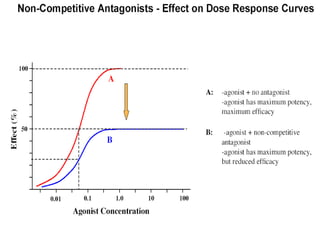
• Noncompetitive antagonist
– Binds to a site other than the agonist-binding domain
– Induces a conformation change in the receptor such
that the agonist no longer “recognizes” the agonist
binding site.
– High doses of an agonist do not overcome the
antagonist in this situation
• Irreversible Antagonist
– Bind permanently to the receptor binding site
therefore they can not be overcome with agonist
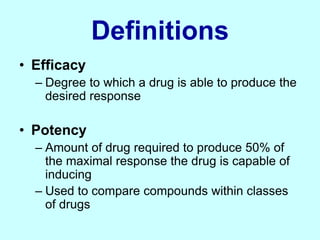
Definitions
• Efficacy
– Degree to which a drug is able to produce the
desired response
• Potency
– Amount of drug required to produce 50% of
the maximal response the drug is capable of
inducing
– Used to compare compounds within classes
of drugs
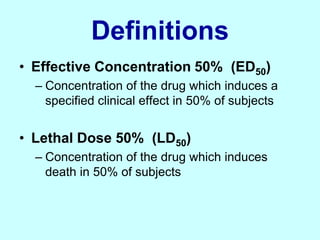
Definitions
• Effective Concentration 50% (ED50)
– Concentration of the drug which induces a
specified clinical effect in 50% of subjects
• Lethal Dose 50% (LD50)
– Concentration of the drug which induces
death in 50% of subjects
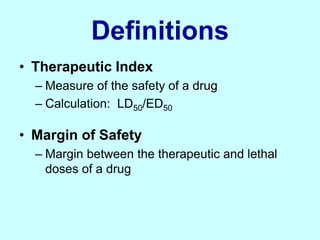
Definitions
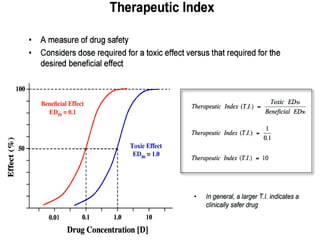
• Therapeutic Index
– Measure of the safety of a drug
– Calculation: LD50/ED50
• Margin of Safety
– Margin between the therapeutic and lethal
doses of a drug
Dose-Response Relationship
• Dose: the amount of drug required to elicit a
biologic response.
• Dose-response relationship: the intensity of
the response elicited by a drug is proportional to
the dose administration.
• Drug induced responses are not an “all or none”
phenomenon
• Increase in dose may:
– Increase therapeutic response
– Increase risk of toxicity
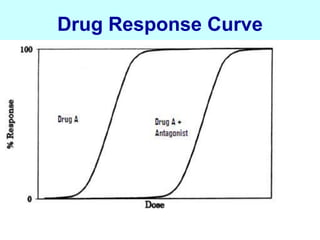
Drug Response Curve
Effect of Disease on PD
• Upregulation of receptors
• Downregulation of receptors
– Decreased number of drug receptors
• Altered endogenous production of a
substance may affect the receptors
• Altered response due to:
– Acid-base status
– Electrolyte abnormalities
– Altered intravascular volume
Effect of Disease on Drug
Disposition
• Absorption
– PO/NG administered drugs may have altered
absorption due to:
• Alterations in pH
• Edema of GI mucosa
• Delayed or enhanced gastric emptying
• Alterations in blood flow
• Presence of an ileus
• Coadministration with formulas (I.e. Phenytoin)
Effect of Disease on Drug
Disposition
• Drug distribution may be affected:
– Altered organ perfusion due to hemodynamic
changes
• May effect delivery to site of action, site of
metabolism and site of elimination
• Inflammation and changes in capillary permeability
may enhance delivery of drug to a site
– Hypoxemia affecting organ function
• Altered hepatic function and drug metabolism
Effect of Disease on Drug
Disposition
– Alterations in protein synthesis
• If serum albumin and other protein levels are low,
there is altered Vd of free fraction of drugs that
typically are highly protein bound therefore a
higher free concentration of drug
– Substrate deficiencies
• Exhaustion of stores
• Metabolic stress
Clinical Practice
What must one consider when one is
prescribing drugs to a critically ill infant or
child???
Clinical Practice
• Select appropriate drug for clinical
indication
• Select appropriate dose
– Consider pathophysiologic processes in
patient such as hepatic or renal dysfunction
– Consider developmental and maturational
changes in organ systems and the
subsequent effect on PK and PD
Clinical Practice
• Select appropriate formulation and route of
administration
• Determine anticipated length of therapy
• Monitor for efficacy and toxicity
• Pharmacogenetics
– Will play a larger role in the future
Clinical Practice
• Other factors
– Drug-drug interaction
• Altered absorption
• Inhibition of metabolism
• Enhanced metabolism
• Protein binding competition
• Altered excretion
Clinical Practice
• Other factors (con’t)
– Drug-food interaction
• NG or NJ feeds
– Continuous vs. intermittent
– Site of optimal drug absorption in GI tract must be
considered
Management of Drug Therapy
• “Target-effect” strategy
– Pre-determined efficacy endpoint
– Titrate drug to desired effect
• Monitor for efficacy
– If plateau occurs, may need to add additional drug or
choose alternative agent
• Monitor for toxicity
– May require decrease in dose or alternative agent
Management of Drug Therapy
• “Target-concentration” strategy
– Pre-determined concentration goal
• Based on population-based PK
• Target concentration based on efficacy or toxicity
– Know the PK of the drug you are prescribing
• Presence of an active metabolite?
• Should the level of the active metabolite be
measured?
• Zero-order or first-order kinetics?
– Does it change with increasing serum concentrations?
Management of Drug Therapy
– Critical aspects of “target-concentration” therapy
• Know indications for monitoring serum concentrations
– AND when you do not need to monitor levels
• Know the appropriate time to measure the concentration
• If the serum concentration is low, know how to safely achieve
the desired level
• Be sure the level is not drawn from the same line in which the
drug is administered
• Be sure drug is administered over the appropriate time
• AND Treat the patient, not the drug level
Clinical pharmacokinetics &amp; pharmacodynamics 1

Clinical pharmacokinetics &amp; pharmacodynamics 1

  • 1.
    Bhushan S. Surana M.pharmacy (Pharmacology)
  • 2.
    Why Study Pharmacokinetics(PK) and Pharmacodynamics (PD)? • Individualize patient drug therapy • Monitor medications with a narrow therapeutic index • Decrease the risk of adverse effects while maximizing pharmacologic response of medications • Evaluate PK/PD as a diagnostic tool for underlying disease states
  • 3.
    PHARMACOKINETICS what the bodydoes to the drug PHARMACODYNAMICS what the drug does to the body
  • 4.
    Clinical Pharmacokinetics • Absorption,distribution, metabolism and excretion all involve the passage of drugs across cell membranes. • Physicochemical properties of the drug and the membrane influence this transfer • Various characteristics of the drug can help predict this movement of the drug molecules.
  • 5.
    Absorption • Must beable to get medications into the patient’s body • Drug characteristics that affect absorption: – Molecular weight, ionization, solubility, & formulation • Factors affecting drug absorption related to patients: – Route of administration, gastric pH, contents of GI tract
  • 6.
    Bound Free FreeBound LOCUS OFACTION “RECEPTORS” TISSUE RESERVOIRS SYSTEMIC CIRCULATION Free Drug Bound Drug BIOTRANSFORMATION EXCRETION ABSORPTION
  • 7.
    Time to PeakConcentration 0 10 20 30 40 50 60 70 80 90 100 0 5 10 20 30 60 120 180 minutes concentration IV Oral Rectal
  • 8.
    Dose Plasma Concentration 0 1 23 4 5 6 7 8 9 0 2 4 6 8 10 12 TOXIC RANGE THERAPEUTIC RANGE SUB-THERAPEUTIC
  • 9.
    Bioavailability • Definition: thefraction of the administered • dose reaching the systemic circulation • for i.v.: 100% • for non i.v.: ranges from 0 to 100% • e.g. lidocaine bioavailability 35% due to • destruction in gastric acid and liver metabolism • First Pass Effect
  • 10.
    Bioavailability Dose Destroyed in gut Not absorbed Destroyed by gutwall Destroyed by liver to systemic circulation
  • 11.
    PRINCIPLE For drugs takenby routes other than the i.v. route, the extent of absorption and the bioavailability must be understood in order to determine what dose will induce the desired therapeutic effect. It will also explain why the same dose may cause a therapeutic effect by one route but a toxic or no effect by another.
  • 13.
    Distribution • Drug distributesinto various body compartments • Distribution depends on a variety of factors all related to the drug • Causes a drop in the serum levels of the drug • Certain sites of distribution act as stores
  • 14.
    Distribution • Membrane permeability –cross membranes to site of action • Plasma protein binding – bound drugs do not cross membranes • Lipophilicity of drug – lipophilic drugs accumulate in adipose tissue • Volume of distribution
  • 15.
    Drugs appear todistribute in the body as if it were a single compartment. The magnitude of the drug’s distribution is given by the apparent volume of distribution (Vd). Vd = Amount of drug in body ÷ Concentration in Plasma PRINCIPLE (Apparent) Volume of Distribution: Volume into which a drug appears to distribute with a concentration equal to its plasma concentration
  • 16.
    Volume of Distribution •“the volume that would accommodate all the drug in the body, if the concentration throughout was the same as in plasma” • It is the total volume in which the drug appears to have been dissolved • Used for predicting serum levels of the drug • Denoted as “aVd” • aVd = Dose of the drug/Conc. of drug
  • 17.
    Drug Distribution • Processby which a drug reversibly leaves the site of administration and is distributed throughout the tissues of the body • Extent is dependent upon various factors – Blood flow (lung, kidney, liver > brain, skeletal muscle > adipose, bone) – Ability of drug to traverse biological membranes – Degree of binding to blood proteins (e.g. serum albumin) • Distribution of drug to target organ/site is a critical requirement • for achieving a therapeutic benefit
  • 19.
    Volume of Distribution(Vd) • Varies considerably among drugs: • Aspirin Vd = 16 L/100 kg • Vancomycin Vd = 39 L/100 kg • Digoxin Vd = 2290 L/100 kg • A small Vd (< 42 L) infers retention within the plasma volume • A large Vd (> 42 L) infers retention in volumes outside of plasma • Vd must be factored into dose calculations: • As Vd increases, the dose (Q) of drug required to achieve a particular • plasma concentration (Cp) also increases.
  • 20.
    Metabolism • Drugs canundergo metabolism in the liver, lungs, kidney, and GI tract. • Metabolism of drug usually tends to make the less polar, lipid soluble drug to the more polar and water soluble metabolites, thus facilitating their excretion by kidney.
  • 21.
    Metabolism • Liver -primary route of drug metabolism • Liver may be used to convert pro-drugs (inactive) to an active state • Types of reactions – Phase I (Cytochrome P450 system) – Phase II
  • 22.
    Phase I reactions •Cytochrome P450 system • Located within the endoplasmic reticulum of hepatocytes • Through electron transport chain, a drug bound to the CYP450 system undergoes oxidation or reduction • Enzyme induction • Drug interactions
  • 23.
    Phase I reactionstypes • Hydrolysis • Oxidation • Reduction • Demethylation • Methylation • Alcohol dehydrogenase metabolism
  • 24.
    Phase II reactions •Polar group is conjugated to the drug • Results in increased polarity of the drug • Types of reactions – Glycine conjugation – Glucuronide conjugation – Sulfate conjugation
  • 25.
    Elimination • Zero order:constant rate of elimination irrespective of plasma concentration. • First order: rate of elimination proportional to plasma concentration. Constant Fraction of drug eliminated per unit time. Rate of elimination ∝ Amount Rate of elimination = K x Amount
  • 26.
    Plasma Concentration Profile aftera Single I.V. Injection Time Plasma Concentration 0 1 2 3 4 5 6 1 10 100 1000 10000 C0 Distribution equilibrium Elimination only Distribution and Elimination
  • 27.
    PRINCIPLE Elimination of drugsfrom the body usually follows first order kinetics with a characteristic half-life (t1/2) and fractional rate constant (Kel).
  • 28.
    First Order Elimination •Clearance: volume of plasma cleared of drug per unit time. Clearance = Rate of elimination ÷ plasma conc. • Half-life of elimination: time for plasma conc. to decrease by half. Useful in estimating: - time to reach steady state concentration. - time for plasma concentration to fall after dosing is stopped.
  • 29.
    • Rate ofelimination = Kel x Amount in body • Rate of elimination = CL x Plasma Concentration • Therefore, • Kel x Amount = CL x Concentration • Kel = CL/Vd • 0.693/t1/2 = CL/Vd t1/2 = 0.693 x Vd/CL
  • 30.
    PRINCIPLE The half-life ofelimination of a drug (and its residence in the body) depends on its clearance and its volume of distribution t1/2 is proportional to Vd t1/2 is inversely proportional to CL t1/2 = 0.693 x Vd/CL
  • 31.
    Multiple dosing • Oncontinuous steady administration of a drug, plasma concentration will rise fast at first then more slowly and reach a plateau, where: rate of administration = rate of elimination ie. steady state is reached. • Therefore, at steady state: Dose (Rate of Administration) = clearance x plasma conc. Or If you aim at a target plasma level and you know the clearance, you can calculate the dose required.
  • 32.
    Pharmacokinetic Principles • SteadyState: the amount of drug administered is equal to the amount of drug eliminated within one dosing interval resulting in a plateau or constant serum drug level • Drugs with short half-life reach steady state rapidly; drugs with long half-life take days to weeks to reach steady state
  • 33.
    0 1 2 3 4 5 6 7 0 5 1015 20 25 30 Time Plasma Concentration Repeated doses – Maintenance dose Therapeutic level Single dose – Loading dose
  • 34.
    Concentration due torepeated doses The time to reach steady state is ~4 t1/2’s
  • 35.
    Pharmacokinetic parameters Get equationof regression line; from it get Kel, C0 , and AUC • Volume of distribution Vd = DOSE / C0 • Plasma clearance Cl = Kel .Vd • plasma half-life t1/2 = 0.693 / Kel • Bioavailability (AUC)x / (AUC)iv
  • 36.
    0 10 20 30 40 50 60 70 0 2 46 8 10 Plasma concentration Time (hours) Bioavailability (AUC)o (AUC)iv = i.v. route oral route
  • 37.
    Linear Pharmacokinetics • Linear= rate of elimination is proportional to amount of drug present • Dosage increases result in proportional increase in plasma drug levels 0 20 40 60 80 100 120 dose concentration
  • 38.
    Nonlinear Pharmacokinetics • Nonlinear= rate of elimination is constant regardless of amount of drug present • Dosage increases saturate binding sites and result in non- proportional increase/decrease in drug levels 0 5 10 15 20 25 30 35 40 45 50 dose concentration
  • 39.
    Special Patient Populations •Renal Disease: same hepatic metabolism, same/increased volume of distribution and prolonged elimination   dosing interval • Hepatic Disease: same renal elimination, same/increased volume of distribution, slower rate of enzyme metabolism   dosage,  dosing interval • Cystic Fibrosis Patients: increased metabolism/ elimination, and larger volume of distribution   dosage,  dosage interval
  • 40.
    PRINCIPLE The absorption, distributionand elimination of a drug are qualitatively similar in all individuals. However, for several reasons, the quantitative aspects may differ considerably. Each person must be considered individually and doses adjusted accordingly.
  • 41.
  • 42.
    Elimination by theKidney • Excretion - major 1) glomerular filtration glomerular structure, size constraints, protein binding 2) tubular reabsorption/secretion - acidification/alkalinization, - active transport, competitive/saturable, organic acids/bases -protein binding • Metabolism - minor
  • 43.
  • 44.
    Elimination by theLiver • Metabolism - major 1) Phase I and II reactions 2) Function: change a lipid soluble to more water soluble molecule to excrete in kidney 3) Possibility of active metabolites with same or different properties as parent molecule • Biliary Secretion – active transport, 4 categories
  • 45.
    The enterohepatic shunt Portalcirculation Liver gall bladder Gut Bile duct Drug Biotransformation; glucuronide produced Bile formation Hydrolysis by beta glucuronidase
  • 46.
    EXCRETION BY OTHERROUTES • LUNG - For gases and volatile liquids by diffusion. Excretion rate depends on partial pressure of gas and blood:air partition coefficient. • MOTHER’S MILK a) By simple diffusion mostly. Milk has high lipid content and is more acidic than plasma (traps alkaline fat soluble substances). b) Important for 2 reasons: transfer to baby, transfer from animals to humans. • OTHER SECRETIONS – sweat, saliva, etc.. minor contribution
  • 48.
    Pharmacodynamics • Study ofthe biochemical and physiologic processes underlying drug action – Mechanism of drug action • Drug-receptor interaction – Efficacy – Safety profile
  • 49.
    Pharmacodynamics Objectives 1. Definereceptor, dissociation constant, affinity, intrinsic activity 2. Describe 4 signal transduction pathways 3. Draw a dose response curve and a log dose response curve. 4. From these curves, point out potency and intrinsic activity. 5. Distinguish between potency and affinity. 6. Define spare receptors. 7. Define agonist, antagonist (competitive and non-competitive), partial agonist and understand the concepts of their interactions 8. Define desensitization, upregulation and understand their clinical significance 9. Draw a quantal log dose response curve 10. Define therapeutic index
  • 50.
    Pharmacodynamics • “What thedrug does to the body” • It may act on any one of the following levels – Molecular – Cellular – General
  • 51.
    Physical Action • Somedrugs act by their physical properties – Adsorption of toxins by charcoal – Osmotic changes induced by mannitol – Barrier protection by Band Aid
  • 52.
    Chemical Action • Somedrugs produce their effect purely due to their chemical properties – Neutralization of acid by antacids – Chelating iron with desferoximine – Combating acidosis by bicarbonate – Combating superoxide by antioxidants
  • 53.
    Drug Actions • Mostdrugs bind to cellular receptors – Initiate biochemical reactions – Pharmacological effect is due to the alteration of an intrinsic physiologic process and not the creation of a new process
  • 54.
    Drug Receptors • Proteinsor glycoproteins – Present on cell surface, on an organelle within the cell, or in the cytoplasm – Finite number of receptors in a given cell • Receptor mediated responses plateau upon saturation of all receptors
  • 55.
    Drug Receptors • Actionoccurs when drug binds to receptor and this action may be: – Ion channel is opened or closed – Second messenger is activated • cAMP, cGMP, Ca++, inositol phosphates, etc. • Initiates a series of chemical reactions – Normal cellular function is physically inhibited – Cellular function is “turned on”
  • 58.
    Drug Receptor • Affinity –Refers to the strength of binding between a drug and receptor – Number of occupied receptors is a function of a balance between bound and free drug • Dissociation constant (KD) – Measure of a drug’s affinity for a given receptor – Defined as the concentration of drug required in solution to achieve 50% occupancy of its receptors
  • 59.
    Drug Receptors • Agonist –Drugs which alter the physiology of a cell by binding to plasma membrane or intracellular receptors • Partial agonist – A drug which does not produce maximal effect even when all of the receptors are occupied
  • 60.
    Drug Receptors • Antagonists –Inhibit or block responses caused by agonists • Competitive antagonist – Competes with an agonist for receptors – High doses of an agonist can generally overcome antagonist
  • 61.
    Drug Receptors • Noncompetitiveantagonist – Binds to a site other than the agonist-binding domain – Induces a conformation change in the receptor such that the agonist no longer “recognizes” the agonist binding site. – High doses of an agonist do not overcome the antagonist in this situation • Irreversible Antagonist – Bind permanently to the receptor binding site therefore they can not be overcome with agonist
  • 62.
    Definitions • Efficacy – Degreeto which a drug is able to produce the desired response • Potency – Amount of drug required to produce 50% of the maximal response the drug is capable of inducing – Used to compare compounds within classes of drugs
  • 63.
    Definitions • Effective Concentration50% (ED50) – Concentration of the drug which induces a specified clinical effect in 50% of subjects • Lethal Dose 50% (LD50) – Concentration of the drug which induces death in 50% of subjects
  • 64.
    Definitions • Therapeutic Index –Measure of the safety of a drug – Calculation: LD50/ED50 • Margin of Safety – Margin between the therapeutic and lethal doses of a drug
  • 74.
    Dose-Response Relationship • Dose:the amount of drug required to elicit a biologic response. • Dose-response relationship: the intensity of the response elicited by a drug is proportional to the dose administration. • Drug induced responses are not an “all or none” phenomenon • Increase in dose may: – Increase therapeutic response – Increase risk of toxicity
  • 75.
  • 76.
    Effect of Diseaseon PD • Upregulation of receptors • Downregulation of receptors – Decreased number of drug receptors • Altered endogenous production of a substance may affect the receptors • Altered response due to: – Acid-base status – Electrolyte abnormalities – Altered intravascular volume
  • 77.
    Effect of Diseaseon Drug Disposition • Absorption – PO/NG administered drugs may have altered absorption due to: • Alterations in pH • Edema of GI mucosa • Delayed or enhanced gastric emptying • Alterations in blood flow • Presence of an ileus • Coadministration with formulas (I.e. Phenytoin)
  • 78.
    Effect of Diseaseon Drug Disposition • Drug distribution may be affected: – Altered organ perfusion due to hemodynamic changes • May effect delivery to site of action, site of metabolism and site of elimination • Inflammation and changes in capillary permeability may enhance delivery of drug to a site – Hypoxemia affecting organ function • Altered hepatic function and drug metabolism
  • 79.
    Effect of Diseaseon Drug Disposition – Alterations in protein synthesis • If serum albumin and other protein levels are low, there is altered Vd of free fraction of drugs that typically are highly protein bound therefore a higher free concentration of drug – Substrate deficiencies • Exhaustion of stores • Metabolic stress
  • 81.
    Clinical Practice What mustone consider when one is prescribing drugs to a critically ill infant or child???
  • 82.
    Clinical Practice • Selectappropriate drug for clinical indication • Select appropriate dose – Consider pathophysiologic processes in patient such as hepatic or renal dysfunction – Consider developmental and maturational changes in organ systems and the subsequent effect on PK and PD
  • 83.
    Clinical Practice • Selectappropriate formulation and route of administration • Determine anticipated length of therapy • Monitor for efficacy and toxicity • Pharmacogenetics – Will play a larger role in the future
  • 84.
    Clinical Practice • Otherfactors – Drug-drug interaction • Altered absorption • Inhibition of metabolism • Enhanced metabolism • Protein binding competition • Altered excretion
  • 85.
    Clinical Practice • Otherfactors (con’t) – Drug-food interaction • NG or NJ feeds – Continuous vs. intermittent – Site of optimal drug absorption in GI tract must be considered
  • 86.
    Management of DrugTherapy • “Target-effect” strategy – Pre-determined efficacy endpoint – Titrate drug to desired effect • Monitor for efficacy – If plateau occurs, may need to add additional drug or choose alternative agent • Monitor for toxicity – May require decrease in dose or alternative agent
  • 87.
    Management of DrugTherapy • “Target-concentration” strategy – Pre-determined concentration goal • Based on population-based PK • Target concentration based on efficacy or toxicity – Know the PK of the drug you are prescribing • Presence of an active metabolite? • Should the level of the active metabolite be measured? • Zero-order or first-order kinetics? – Does it change with increasing serum concentrations?
  • 88.
    Management of DrugTherapy – Critical aspects of “target-concentration” therapy • Know indications for monitoring serum concentrations – AND when you do not need to monitor levels • Know the appropriate time to measure the concentration • If the serum concentration is low, know how to safely achieve the desired level • Be sure the level is not drawn from the same line in which the drug is administered • Be sure drug is administered over the appropriate time • AND Treat the patient, not the drug level