BCS CLASSIFICATION SYSTEM
- RESHMA FATHIMA.K
INTRODUCTION
The oral route of drug administration is the
route of choice for the formulators and
continues to dominate the area of drug
delivery technologies. However, though
popular, this route is not free from
limitations of absorption and bioavailability
in the milieu of gastrointestinal tract
The drug in the dosage form is released and
dissolves in the surrounding gastrointestinal fluid
to form a solution. This process is solubility
limited
Once the drug is in the solution form, it passes
across the membranes of the cells lining the
Gastro-Intestinal tract. This process is permeability
limited. Then onwards the drug is absorbed into
systemic circulation. In short, the oral absorption
and hence bioavailability of drug is determined by
the extent of drug solubility and permeability
• The BCS is a scientific framework for
classifying drug substances based on their
aqueous solubility as related to dose and
intestinal permeability.
• When combined with the dissolution of the
drug product, the BCS takes into account
three major factors that govern the rate and
extent of drug absorption from IR solid oral
dosage forms: dissolution, solubility, and
intestinal permeability.
• The objective of the BCS is : to predict in vivo performance of drug
products from in vitro measurements
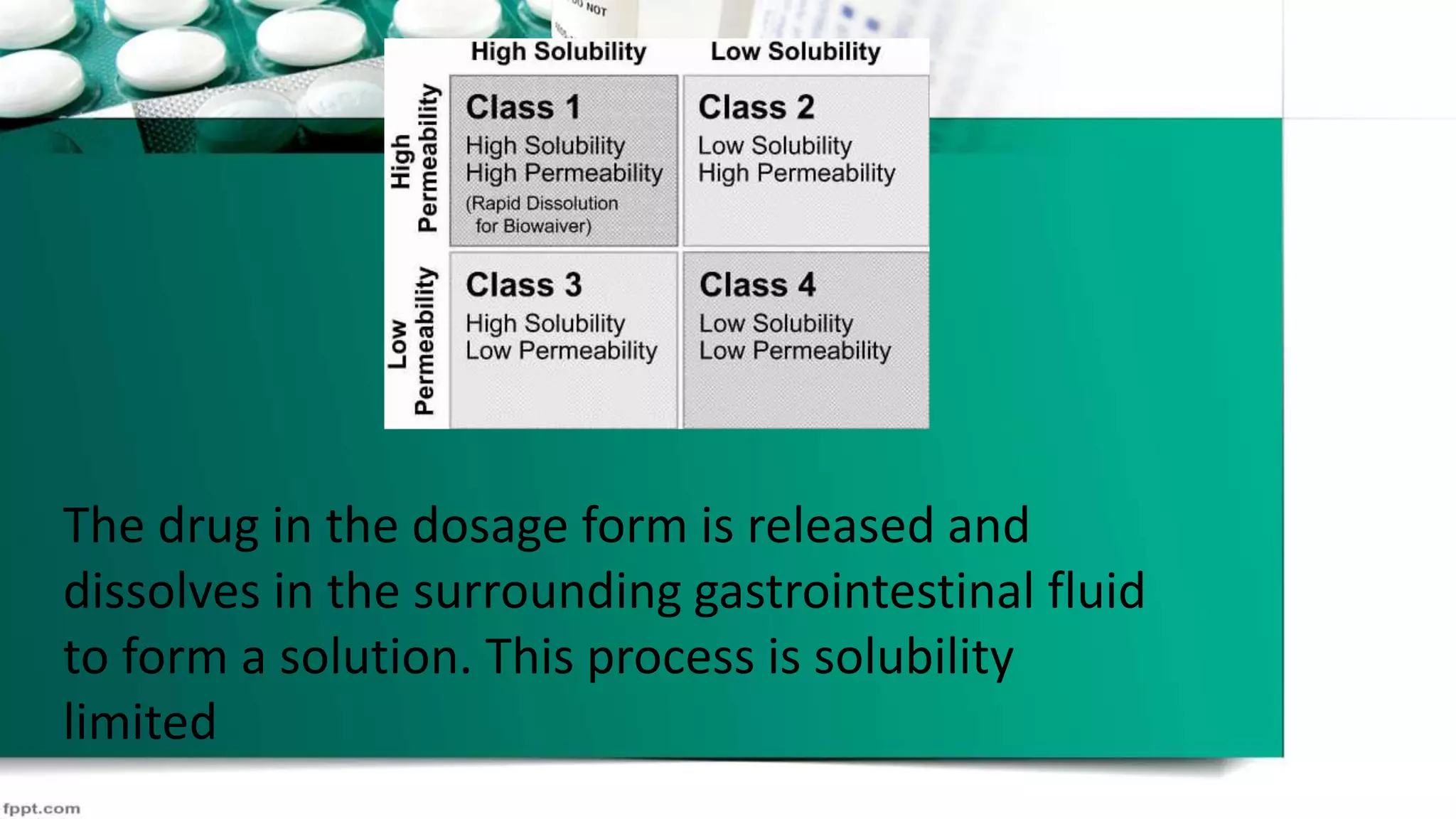
• According to the BCS, drug substances are classified as follows:
• Class 1: High Solubility - High Permeability
• Class 2: Low Solubility - High Permeability
• Class 3: High Solubility - Low Permeability
• Class 4: Low Solubility - Low Permeability of permeability and
solubility.
Class I drugs exhibit a high absorption number and a
high dissolution number. The rate limiting step is drug
dissolution and if dissolution is very rapid then gastric
emptying rate becomes the rate determining step. Rate
of absorption is higher than rate of excretion. e.g.
Metoprolol, Diltiazem, Verapamil, Propranolol.
Class II drugs have a high absorption number but a
low dissolution number. In vivo drug dissolution is
then a rate limiting step for absorption except at a
very high dose number. The absorption for class II
drugs is usually slower than class I and occurs over a
longer period of time. In vitro- In vivo correlation
(IVIVC) is usually excepted for class I and class II
drugs. e.g. Phenytoin, Danazol, Ketoconazole,
Mefenamic acid, Nifedipine.
For Class III drugs, permeability is rate limiting step for
drug absorption. These drugs exhibit a high variation in
the rate and extent of drug absorption. Since the
dissolution is rapid, the variation is attributable to
alteration of physiology and membrane permeability
rather than the dosage form factors. e.g. Cimetidine,
Acyclovir, Neomycin B, Captopril.
Class IV drugs exhibit a lot of problems for
effective oral administration. Fortunately,
extreme examples of class IV compounds are
the exception rather than the rule and are
rarely developed and reach the market.
Nevertheless a number of class IV drugs do
exist. e.g. Taxol, Griseofulvin.
SIGNIFICANCE
• Solubility determination
• Permeability determination
• Determination of dissolution profile similarity
• Biowavers
Bcs classification system

Bcs classification system

  • 1.
  • 2.
    INTRODUCTION The oral routeof drug administration is the route of choice for the formulators and continues to dominate the area of drug delivery technologies. However, though popular, this route is not free from limitations of absorption and bioavailability in the milieu of gastrointestinal tract
  • 3.
    The drug inthe dosage form is released and dissolves in the surrounding gastrointestinal fluid to form a solution. This process is solubility limited
  • 4.
    Once the drugis in the solution form, it passes across the membranes of the cells lining the Gastro-Intestinal tract. This process is permeability limited. Then onwards the drug is absorbed into systemic circulation. In short, the oral absorption and hence bioavailability of drug is determined by the extent of drug solubility and permeability
  • 5.
    • The BCSis a scientific framework for classifying drug substances based on their aqueous solubility as related to dose and intestinal permeability. • When combined with the dissolution of the drug product, the BCS takes into account three major factors that govern the rate and extent of drug absorption from IR solid oral dosage forms: dissolution, solubility, and intestinal permeability.
  • 6.
    • The objectiveof the BCS is : to predict in vivo performance of drug products from in vitro measurements • According to the BCS, drug substances are classified as follows: • Class 1: High Solubility - High Permeability • Class 2: Low Solubility - High Permeability • Class 3: High Solubility - Low Permeability • Class 4: Low Solubility - Low Permeability of permeability and solubility.
  • 7.
    Class I drugsexhibit a high absorption number and a high dissolution number. The rate limiting step is drug dissolution and if dissolution is very rapid then gastric emptying rate becomes the rate determining step. Rate of absorption is higher than rate of excretion. e.g. Metoprolol, Diltiazem, Verapamil, Propranolol.
  • 8.
    Class II drugshave a high absorption number but a low dissolution number. In vivo drug dissolution is then a rate limiting step for absorption except at a very high dose number. The absorption for class II drugs is usually slower than class I and occurs over a longer period of time. In vitro- In vivo correlation (IVIVC) is usually excepted for class I and class II drugs. e.g. Phenytoin, Danazol, Ketoconazole, Mefenamic acid, Nifedipine.
  • 9.
    For Class IIIdrugs, permeability is rate limiting step for drug absorption. These drugs exhibit a high variation in the rate and extent of drug absorption. Since the dissolution is rapid, the variation is attributable to alteration of physiology and membrane permeability rather than the dosage form factors. e.g. Cimetidine, Acyclovir, Neomycin B, Captopril.
  • 10.
    Class IV drugsexhibit a lot of problems for effective oral administration. Fortunately, extreme examples of class IV compounds are the exception rather than the rule and are rarely developed and reach the market. Nevertheless a number of class IV drugs do exist. e.g. Taxol, Griseofulvin.
  • 11.
    SIGNIFICANCE • Solubility determination •Permeability determination • Determination of dissolution profile similarity • Biowavers