Ovarian Cancer Screening Mati Zolti M.D. Department of Obstetrics & Gynaecology Sheba Medical Center  Tel Hashomer, Israel
Ovarian Cancer: Burden of suffering 4 th  leading cause of cancer death in women in the U.S. (after lung, breast and colon) Overall 5-year survival rate is 35% The “silent killer”:  asymptomatic in early stages 75% diagnosed with advanced stage disease; 5-year survival only 10-28% Woman’s lifetime risk of dying from ovarian cancer is 1.1%
Ovarian Cancer in Israel New Cases   : 220 Death : 95 Median age    : 51 (2XXX)
Ovarian Cancer Symptoms of ovarian cancer : asymptomatic Lower abdominal pain/pressure  mass Abdominal enlargement Vaginal bleeding Urinary/bowel symptoms
Types of Ovarian Tumors Functional Follicle cyst Corpus luteum cyst Theca lutein cyst  Inflammatory Tubo-ovarian abscess Benign tumors/cysts * Endometriotic cyst Brenner tumor Benign teratoma (dermoid cyst) Fibroma *Rare or very rare potential for malignancy Malignant (or malignant potential) Malignant teratoma Endometrioid carcinoma Dygerminoma Secondary ovarian tumor Cystadenoma, cystadenocarcinoma (>50% for serous, ~5% for mucinous) Granulosa cell tumor (15-20%) Arrhenoblastoma (<20%) Theca cell tumor (<1%)
Epithelial Ovarian Cancer Overall 5-year survival rate is 75-95% if cancer confined to ovaries; decreases to 10-17% if distant metastases Survival improved when cancer detected in early stage  Only 25% diagnosed in Stage I
Early Detection and Mortality No direct evidence that women with early stage cancer found on screening have lower mortality than women with more advanced disease Indirect evidence supports benefits of early detection: Most important prognostic factor in patients with advanced ovarian cancer is tumor burden after initial debulking Surgical debulking and chemo more effective when cancer detected early
The challenge Natural history of ovarian cancer not well understood No well-defined precursor lesion Length of time from localized tumor to dissemination is unknown Multiple efforts underway to develop effective screening method for early detection
Risk factors The majority of women with ovarian cancer have no known risk factors Most significant risk factor is genetic predisposition
Risk factors:  Heredity Up to 10% of epithelial ovarian cancer cases are familial 3 familial syndromes familial breast-ovarian cancer syndrome site-specific ovarian cancer cancer family syndrome (Lynch type II) Familial breast-ovarian cancer and site-specific ovarian cancer syndromes both associated with mutations of the BRCA1 suppressor gene; account for 90% of familial ovarian cancers Rollins,G. Ann Int Med 2000;133:1021-1024
Additional Risk Factors Age Women over age 50 account for ~80% of all cases   (ave. age at dx is 61) Reproductive history early menarche, nulliparity or age >30 at first child-bearing, and late menopause Fertility drugs prolonged use of Clomid, especially without achieving pregnancy Personal history of breast cancer Hormone replacement therapy > 10 years May be associated with 30% increased risk Talcum powder Some studies have shown slightly increased risk in women who use talc powder on genital area American Cancer Society, 2001
Protective factors Multiparity:  First pregnancy before age 30 Oral contraceptives:  5 years of use cuts risk  nearly in half Tubal ligation Hysterectomy Lactation Bilateral oopherectomy
Delays in Diagnosis Lack of severity and specificity of early symptoms  Early signs/symptoms may include bloating, gas, indigestion, abdominal fullness or discomfort, constipation,  pelvic pressure, urinary frequency, abnormal vaginal bleeding, fatigue, back pain, leg pain Early stage tumors difficult to detect on pelvic exam
Diagnostic tools History Pelvic Exam (including rectal) Transvaginal Ultrasound – detection of masses  and mass characteristics Tumor markers – CA-125, LPA (plasma    lysophosphatidic acid) CT – assess spread to LN, pelvic and abdominal  structures MRI – best for distinguishing malignant from    benign tumors
Work-up of Adnexal Mass Age Size of mass Unilateral vs. bilateral CA-125 levels Ultrasound configuration Color-flow Doppler flow Presence of symptoms Must first categorize as functional, benign neoplastic or potentially malignant Diagnostic approach depends on:
Diagnostic approach If premenopausal and asymptomatic, with unilateral, mobile, simple cystic mass <8-10cm and no family history, can observe for 4-6 weeks and then repeat TVUS and pelvic exam. If resolved,  no further work-up necessary If larger or unchanged, or if character of mass has changed on TVUS, surgical evaluation required
Diagnostic Approach If postmenopausal and asymptomatic, with unilateral simple cyst <5cm AND normal CA-125, can follow closely with repeat TVUS All other postmenopausal women with ovarian mass require surgical evaluation
Surgical Evaluation Refer to Gyn-Onc specialist Exploratory laparotomy has been the gold standard and includes: Peritoneal washings for cytology Evaluation of frozen section Complete staging procedure if borderline or  malignant tumor on frozen section
Surgical Evaluation Laparoscopy can be considered in premenopausal woman with ovarian mass small enough to remove via laparoscopic approach; not recommended if high suspicion for malignancy
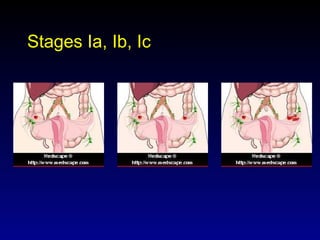
Stages Ia, Ib, Ic
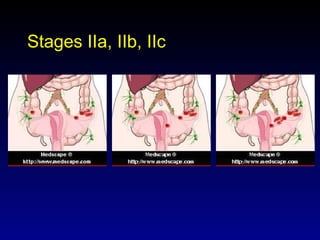
Stages IIa, IIb, IIc
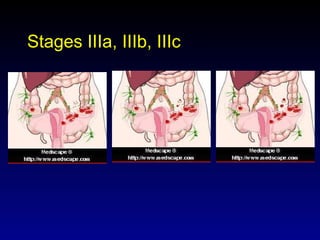
Stages IIIa, IIIb, IIIc
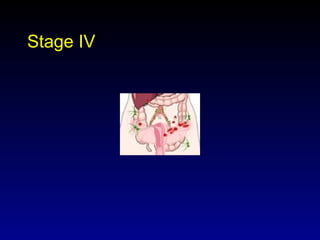
Stage IV
Treatment Depends on staging, tumor type, age, desire for future fertility Can include surgery, chemotherapy and/or radiation therapy Clinical trials are ongoing
Surgical treatment Primary debulking and cytoreduction; may include: Bilateral salpingo-oopherectomy Hysterectomy Lymphadenectomy (para-aortic, inguinal) Omentectomy “brushing” of diaphragm, examination of liver
Chemotherapy and Radiation Usually 6 cycles of chemotherapy Cisplatin (or Carboplatin) plus Paclitaxel most commonly used combination therapy XRT
Why screening for ovarian cancer is so difficult? Anatomic location of the ovary, not easily accesible Lack well defined precursor lesion and has poorly defined natural history Low prevalence, need exquisite specificity to avoid unnecessary intervention Lack of a good method
Screening Strategies Ultrasound (transvaginal vs transabdominal) Color-flow doppler CA-125 Other tumor markers
Ultrasound Both tranabdominal and transvaginal  techniques identify enlarged ovaries or abnormal morphology; TVUS has better resolution One large study of TVUS underway has reported sensivity of 81% and specificity of 98.9% Major limitations are poor PPV in asymptomatic women and inability to detect malignances when ovaries are normal size Allows earlier stage detection
Color-flow Doppler Used in conjunction with TVUS Measures resistance in blood vessels supplying the ovaries May provide additional information to help distinguish malignant from benign masses
CA-125 Sustained elevation in 82% of women with advanced ovarian cancer, but fewer than 1% of healthy women Poor sensitivity (elevated in only 50% of women with Stage I disease) Poor specificity (elevated in many gynecologic and non-gynecologic malignancies as well as benign conditions)
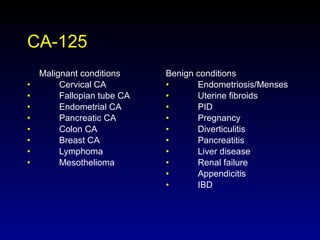
CA-125  Malignant conditions Cervical CA Fallopian tube CA Endometrial CA Pancreatic CA Colon CA Breast CA Lymphoma Mesothelioma Benign conditions Endometriosis/Menses Uterine fibroids PID Pregnancy Diverticulitis Pancreatitis Liver disease Renal failure Appendicitis IBD
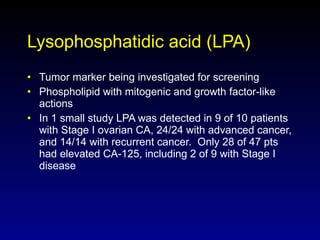
Lysophosphatidic acid (LPA) Tumor marker being investigated for screening Phospholipid with mitogenic and growth factor-like actions In 1 small study LPA was detected in 9 of 10 patients with Stage I ovarian CA, 24/24 with advanced cancer, and 14/14 with recurrent cancer.  Only 28 of 47 pts had elevated CA-125, including 2 of 9 with Stage I disease
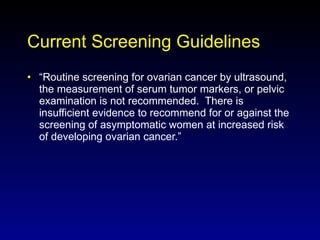
Current Screening Guidelines “ Routine screening for ovarian cancer by ultrasound, the measurement of serum tumor markers, or pelvic examination is not recommended.  There is insufficient evidence to recommend for or against the screening of asymptomatic women at increased risk of developing ovarian cancer.”
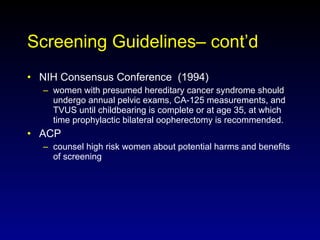
Screening Guidelines– cont’d NIH Consensus Conference  (1994) women with presumed hereditary cancer syndrome should undergo annual pelvic exams, CA-125 measurements, and TVUS until childbearing is complete or at age 35, at which time prophylactic bilateral oopherectomy is recommended. ACP  counsel high risk women about potential harms and benefits of screening
Screening, cont’d American Cancer Society, AAFP and ACOG do not recommend screening for ovarian cancer in the general population Canadian Task Force on Periodic Health Examination  “insufficient evidence to recommend for or against screening in high-risk women”
Where do we go from here? Several strategies for screening currently under investigation TVUS as primary screening method Multimodal strategy using CA-125 as initial indicator and if elevated, TVUS used for secondary testing LPA (phospholipid with mitogenic and GF-like actions) may be more sensitive than CA-125 in detecting early stage cancers
Ovarian Cancer Screening Trials The United Kingdom Collaborative Trial of Ovarian Cancer Screening:  will compare TVUS and multimodal screening to control The European Study: RCT to screen women with TVUS at 18-month or 3-year intervals The NIH Prostate, Lung, Colorectal, and Ovarian Cancer Screening Trial: 10-year study using multimodal strategy
Take home points Screening not indicated at this time  ASK about family history of cancers LISTEN when women present with non-specific GI complaints; include OC in DDx DO perform careful bimanual exam and rectal exam as part of pelvic exam Refer women with + Family Hx to GynOnc
Marker Updates - Ca 125 •  Approved marker to test for recurrence •  Remains the single most sensitive and specific marker for ovarian cancer to date •  Addition of other markers might improve sensitivity and specificity •  Longitudinal assessment may also improve sensitivity and specificity
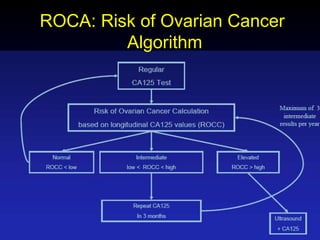
ROCA: Risk of Ovarian Cancer Algorithm
Marker Updates—OvaCheck In 2002, a paper in Lancet described an approach to ovarian cancer screening using mass spectrometry to create protein patterns from blood and computer software to find patterns associated with disease. In 2003, the software developer announced it would market a test called OvaCheck for screening high risk populations. The test would be offered as a “homebrew” diagnostic circumventing the need for premarket review. In July 2004, the FDA ruled that the computer software was, in fact, a medical device and would require review. In 2004 and 2005, the developer announces partnerships with several hospitals to further validate the assay and patents “A process for distinguishing between biological states based upon hidden patterns from biological data.”
Marker Updates—Ciphergen Panel Collaborating with several academic centers, Ciphergen has sought to combine mass spectrometry with Protein Chip arrays including some antibody-based chips In 2004, a paper in Cancer Research identified three biomarkers:Apoliporotein A1 and transthyretin (both downregulated), and a fragment of inter-α-trypsin (up-regulated) in ovarian cancer. The three markers plus CA 125 had a sensitivity of 74% for early stage disease and specificity of 97%. An update in 2006 CEBP, found somewhat lower sensitivity and specificity when benign disease included. Testing is underway on a panel of 7 markers.
Marker Updates - Yale’s Panel In a paper in PNAS in 2004, a group led by Yale investigators used antibody microarrays to identify four proteins that distinguished ovarian cancer: leptin, prolactin, osteopontin, and insulin-like growth factor II. The combination had a sensitivity of 95% and specificityof 95% for distinguishing ovarian cancer, all stages. In 2006, Yale announced it would partner with a Chinese diagnostics company to develop this panel as a screening test for ovarian cancer.
Marker Updates - Luminex Panel In an AACR abstract, Lokshin et al from the Univ. of Pittsburgh used the “bead-based” Luminex system for multiplexing many antibody-based assays to distinguish ovarian cancer cases from controls. Eight biomarkers had the highest diagnostic power including: CA 125, CA 19-9, EGFR, G-CSF, Eotaxin, IL-2r, cVCAM, and MIF. For postmenopausal ovarian cancer the sensitivity was 100% at a specificity of 98.6%. Has partnered with Pittsburgh biostatisticians to develop an algorithm to combine the markers.

mati

  • 1.
    Ovarian Cancer ScreeningMati Zolti M.D. Department of Obstetrics & Gynaecology Sheba Medical Center Tel Hashomer, Israel
  • 2.
    Ovarian Cancer: Burdenof suffering 4 th leading cause of cancer death in women in the U.S. (after lung, breast and colon) Overall 5-year survival rate is 35% The “silent killer”: asymptomatic in early stages 75% diagnosed with advanced stage disease; 5-year survival only 10-28% Woman’s lifetime risk of dying from ovarian cancer is 1.1%
  • 3.
    Ovarian Cancer inIsrael New Cases : 220 Death : 95 Median age : 51 (2XXX)
  • 4.
    Ovarian Cancer Symptomsof ovarian cancer : asymptomatic Lower abdominal pain/pressure mass Abdominal enlargement Vaginal bleeding Urinary/bowel symptoms
  • 5.
    Types of OvarianTumors Functional Follicle cyst Corpus luteum cyst Theca lutein cyst Inflammatory Tubo-ovarian abscess Benign tumors/cysts * Endometriotic cyst Brenner tumor Benign teratoma (dermoid cyst) Fibroma *Rare or very rare potential for malignancy Malignant (or malignant potential) Malignant teratoma Endometrioid carcinoma Dygerminoma Secondary ovarian tumor Cystadenoma, cystadenocarcinoma (>50% for serous, ~5% for mucinous) Granulosa cell tumor (15-20%) Arrhenoblastoma (<20%) Theca cell tumor (<1%)
  • 6.
    Epithelial Ovarian CancerOverall 5-year survival rate is 75-95% if cancer confined to ovaries; decreases to 10-17% if distant metastases Survival improved when cancer detected in early stage Only 25% diagnosed in Stage I
  • 7.
    Early Detection andMortality No direct evidence that women with early stage cancer found on screening have lower mortality than women with more advanced disease Indirect evidence supports benefits of early detection: Most important prognostic factor in patients with advanced ovarian cancer is tumor burden after initial debulking Surgical debulking and chemo more effective when cancer detected early
  • 8.
    The challenge Naturalhistory of ovarian cancer not well understood No well-defined precursor lesion Length of time from localized tumor to dissemination is unknown Multiple efforts underway to develop effective screening method for early detection
  • 9.
    Risk factors Themajority of women with ovarian cancer have no known risk factors Most significant risk factor is genetic predisposition
  • 10.
    Risk factors: Heredity Up to 10% of epithelial ovarian cancer cases are familial 3 familial syndromes familial breast-ovarian cancer syndrome site-specific ovarian cancer cancer family syndrome (Lynch type II) Familial breast-ovarian cancer and site-specific ovarian cancer syndromes both associated with mutations of the BRCA1 suppressor gene; account for 90% of familial ovarian cancers Rollins,G. Ann Int Med 2000;133:1021-1024
  • 11.
    Additional Risk FactorsAge Women over age 50 account for ~80% of all cases (ave. age at dx is 61) Reproductive history early menarche, nulliparity or age >30 at first child-bearing, and late menopause Fertility drugs prolonged use of Clomid, especially without achieving pregnancy Personal history of breast cancer Hormone replacement therapy > 10 years May be associated with 30% increased risk Talcum powder Some studies have shown slightly increased risk in women who use talc powder on genital area American Cancer Society, 2001
  • 12.
    Protective factors Multiparity: First pregnancy before age 30 Oral contraceptives: 5 years of use cuts risk nearly in half Tubal ligation Hysterectomy Lactation Bilateral oopherectomy
  • 13.
    Delays in DiagnosisLack of severity and specificity of early symptoms Early signs/symptoms may include bloating, gas, indigestion, abdominal fullness or discomfort, constipation, pelvic pressure, urinary frequency, abnormal vaginal bleeding, fatigue, back pain, leg pain Early stage tumors difficult to detect on pelvic exam
  • 14.
    Diagnostic tools HistoryPelvic Exam (including rectal) Transvaginal Ultrasound – detection of masses and mass characteristics Tumor markers – CA-125, LPA (plasma lysophosphatidic acid) CT – assess spread to LN, pelvic and abdominal structures MRI – best for distinguishing malignant from benign tumors
  • 15.
    Work-up of AdnexalMass Age Size of mass Unilateral vs. bilateral CA-125 levels Ultrasound configuration Color-flow Doppler flow Presence of symptoms Must first categorize as functional, benign neoplastic or potentially malignant Diagnostic approach depends on:
  • 16.
    Diagnostic approach Ifpremenopausal and asymptomatic, with unilateral, mobile, simple cystic mass <8-10cm and no family history, can observe for 4-6 weeks and then repeat TVUS and pelvic exam. If resolved, no further work-up necessary If larger or unchanged, or if character of mass has changed on TVUS, surgical evaluation required
  • 17.
    Diagnostic Approach Ifpostmenopausal and asymptomatic, with unilateral simple cyst <5cm AND normal CA-125, can follow closely with repeat TVUS All other postmenopausal women with ovarian mass require surgical evaluation
  • 18.
    Surgical Evaluation Referto Gyn-Onc specialist Exploratory laparotomy has been the gold standard and includes: Peritoneal washings for cytology Evaluation of frozen section Complete staging procedure if borderline or malignant tumor on frozen section
  • 19.
    Surgical Evaluation Laparoscopycan be considered in premenopausal woman with ovarian mass small enough to remove via laparoscopic approach; not recommended if high suspicion for malignancy
  • 20.
  • 21.
  • 22.
  • 23.
  • 24.
    Treatment Depends onstaging, tumor type, age, desire for future fertility Can include surgery, chemotherapy and/or radiation therapy Clinical trials are ongoing
  • 25.
    Surgical treatment Primarydebulking and cytoreduction; may include: Bilateral salpingo-oopherectomy Hysterectomy Lymphadenectomy (para-aortic, inguinal) Omentectomy “brushing” of diaphragm, examination of liver
  • 26.
    Chemotherapy and RadiationUsually 6 cycles of chemotherapy Cisplatin (or Carboplatin) plus Paclitaxel most commonly used combination therapy XRT
  • 27.
    Why screening forovarian cancer is so difficult? Anatomic location of the ovary, not easily accesible Lack well defined precursor lesion and has poorly defined natural history Low prevalence, need exquisite specificity to avoid unnecessary intervention Lack of a good method
  • 28.
    Screening Strategies Ultrasound(transvaginal vs transabdominal) Color-flow doppler CA-125 Other tumor markers
  • 29.
    Ultrasound Both tranabdominaland transvaginal techniques identify enlarged ovaries or abnormal morphology; TVUS has better resolution One large study of TVUS underway has reported sensivity of 81% and specificity of 98.9% Major limitations are poor PPV in asymptomatic women and inability to detect malignances when ovaries are normal size Allows earlier stage detection
  • 30.
    Color-flow Doppler Usedin conjunction with TVUS Measures resistance in blood vessels supplying the ovaries May provide additional information to help distinguish malignant from benign masses
  • 31.
    CA-125 Sustained elevationin 82% of women with advanced ovarian cancer, but fewer than 1% of healthy women Poor sensitivity (elevated in only 50% of women with Stage I disease) Poor specificity (elevated in many gynecologic and non-gynecologic malignancies as well as benign conditions)
  • 32.
    CA-125 Malignantconditions Cervical CA Fallopian tube CA Endometrial CA Pancreatic CA Colon CA Breast CA Lymphoma Mesothelioma Benign conditions Endometriosis/Menses Uterine fibroids PID Pregnancy Diverticulitis Pancreatitis Liver disease Renal failure Appendicitis IBD
  • 33.
    Lysophosphatidic acid (LPA)Tumor marker being investigated for screening Phospholipid with mitogenic and growth factor-like actions In 1 small study LPA was detected in 9 of 10 patients with Stage I ovarian CA, 24/24 with advanced cancer, and 14/14 with recurrent cancer. Only 28 of 47 pts had elevated CA-125, including 2 of 9 with Stage I disease
  • 34.
    Current Screening Guidelines“ Routine screening for ovarian cancer by ultrasound, the measurement of serum tumor markers, or pelvic examination is not recommended. There is insufficient evidence to recommend for or against the screening of asymptomatic women at increased risk of developing ovarian cancer.”
  • 35.
    Screening Guidelines– cont’dNIH Consensus Conference (1994) women with presumed hereditary cancer syndrome should undergo annual pelvic exams, CA-125 measurements, and TVUS until childbearing is complete or at age 35, at which time prophylactic bilateral oopherectomy is recommended. ACP counsel high risk women about potential harms and benefits of screening
  • 36.
    Screening, cont’d AmericanCancer Society, AAFP and ACOG do not recommend screening for ovarian cancer in the general population Canadian Task Force on Periodic Health Examination “insufficient evidence to recommend for or against screening in high-risk women”
  • 37.
    Where do wego from here? Several strategies for screening currently under investigation TVUS as primary screening method Multimodal strategy using CA-125 as initial indicator and if elevated, TVUS used for secondary testing LPA (phospholipid with mitogenic and GF-like actions) may be more sensitive than CA-125 in detecting early stage cancers
  • 38.
    Ovarian Cancer ScreeningTrials The United Kingdom Collaborative Trial of Ovarian Cancer Screening: will compare TVUS and multimodal screening to control The European Study: RCT to screen women with TVUS at 18-month or 3-year intervals The NIH Prostate, Lung, Colorectal, and Ovarian Cancer Screening Trial: 10-year study using multimodal strategy
  • 39.
    Take home pointsScreening not indicated at this time ASK about family history of cancers LISTEN when women present with non-specific GI complaints; include OC in DDx DO perform careful bimanual exam and rectal exam as part of pelvic exam Refer women with + Family Hx to GynOnc
  • 40.
    Marker Updates -Ca 125 • Approved marker to test for recurrence • Remains the single most sensitive and specific marker for ovarian cancer to date • Addition of other markers might improve sensitivity and specificity • Longitudinal assessment may also improve sensitivity and specificity
  • 41.
    ROCA: Risk ofOvarian Cancer Algorithm
  • 42.
    Marker Updates—OvaCheck In2002, a paper in Lancet described an approach to ovarian cancer screening using mass spectrometry to create protein patterns from blood and computer software to find patterns associated with disease. In 2003, the software developer announced it would market a test called OvaCheck for screening high risk populations. The test would be offered as a “homebrew” diagnostic circumventing the need for premarket review. In July 2004, the FDA ruled that the computer software was, in fact, a medical device and would require review. In 2004 and 2005, the developer announces partnerships with several hospitals to further validate the assay and patents “A process for distinguishing between biological states based upon hidden patterns from biological data.”
  • 43.
    Marker Updates—Ciphergen PanelCollaborating with several academic centers, Ciphergen has sought to combine mass spectrometry with Protein Chip arrays including some antibody-based chips In 2004, a paper in Cancer Research identified three biomarkers:Apoliporotein A1 and transthyretin (both downregulated), and a fragment of inter-α-trypsin (up-regulated) in ovarian cancer. The three markers plus CA 125 had a sensitivity of 74% for early stage disease and specificity of 97%. An update in 2006 CEBP, found somewhat lower sensitivity and specificity when benign disease included. Testing is underway on a panel of 7 markers.
  • 44.
    Marker Updates -Yale’s Panel In a paper in PNAS in 2004, a group led by Yale investigators used antibody microarrays to identify four proteins that distinguished ovarian cancer: leptin, prolactin, osteopontin, and insulin-like growth factor II. The combination had a sensitivity of 95% and specificityof 95% for distinguishing ovarian cancer, all stages. In 2006, Yale announced it would partner with a Chinese diagnostics company to develop this panel as a screening test for ovarian cancer.
  • 45.
    Marker Updates -Luminex Panel In an AACR abstract, Lokshin et al from the Univ. of Pittsburgh used the “bead-based” Luminex system for multiplexing many antibody-based assays to distinguish ovarian cancer cases from controls. Eight biomarkers had the highest diagnostic power including: CA 125, CA 19-9, EGFR, G-CSF, Eotaxin, IL-2r, cVCAM, and MIF. For postmenopausal ovarian cancer the sensitivity was 100% at a specificity of 98.6%. Has partnered with Pittsburgh biostatisticians to develop an algorithm to combine the markers.

Editor's Notes

  • #12 Half of all ovarian cancers are diagnosed in women &gt; 65yo
  • #21 Stage I: confined to ovary or ovaries IA: unilateral, capsule intact, no tumor on ext surface. No ascites. IB: bilateral, same as above IC: 1 or both ovaries with ruptured capsule, surface tumor, + ascites or + peritoneal washing
  • #22 Stage II: Pelvic extension IIA: involvement of uterus or fallopian tubes, (-) peritoneal washings IIB: involvement of other pelvic tissues (bladder, sigmoid colon, rectum), (-) peritoneal washings IIC: IIA or IIB with ruptured capsule, surface tumor, + peritoneal washings or ascites
  • #23 Stage III: Peritoneal implants outside pelvis or + retroperitoneal or inguinal LN IIIA: grossly limited to true pelvis with microscopic seeding of abdom peritoneum IIIB: Implants on abdom peritoneum &lt; or = 2cm diam IIIC: Implants on abdom peritoneum &gt; 2cm or + retroperitoneal or inguinal LN
  • #24 Stage IV: distant mets (liver, lungs), + pleural fluid
  • #32 CA-125 elevated in: Malignant conditions Ovarian CA of various types Cervical CA Fallopian tube CA Endometrial CA Pancreatic CA Colon CA Breast CA Lymphoma Mesothelioma Benign conditions: Endometriosis Uterine fibroids PID Pregnancy Diverticulitis Pancreatitis Liver disease Renal failure Menstruation Appendicitis Inflammatory bowel disease