

Evaluation of Incidental Lesions Discovered at Imaging   Radiology   Associates   of   Indianapolis Richard L Scales MD
Indeterminate Lesions Current Discussion Thyroid nodule Adrenal nodule Future Discussion Pulmonary Nodule Renal Mass Hepatic Mass Ovarian Mass
Perspective on Incidentalomas Common  Occasional clinical significance Ambiguity of results creates patient anxiety Inconsistent interpretations and recommendations frustrate referring physicians and patients Imaging overutilization = unnecessary cost & conflict of interest for imagers
Goals Optimize  patient safety and cost effectiveness   Determine  which lesions require further imaging  Select  a study with the highest probability of identifying the lesion Utilize  a standard protocol with a clear endpoint
Thyroid Incidentalomas   Often discovered on CT or MRI of neck or chest, or on carotid US Present in 50% of adult population at ultrasound Equal malignant potential for palpable and non palpable nodules Less than 7% of nodules are malignant Require evaluation with high resolution US
US Features of Benign Thyroid Nodules Diagnostic: Pure Cyst = benign Solid nodule with absent internal flow = benign Suggestive: Cystic component Peripheral Halo (thin and uniform) around nodule Colloid crystals
Copyright ©Radiological Society of North America, 2005 Frates, M. C. et al. Radiology 2005;237:794-800 Figure 1b. Punctate echogenicities in thyroid nodules
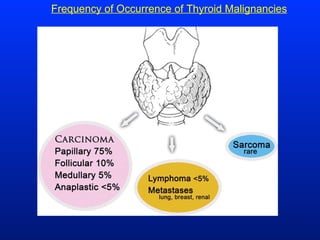
Malignant Thyroid Nodules No clear evidence that treatment of thyroid cancers of < 1 cm alters life expectancy Most thyroid cancers: papillary or follicular histology with excellent prognosis Risk of malignancy greater for patients < 20 years and > 60 years of age  Higher risk with previous radiation exposure Cancer risk of 10 - 13%  whether thyroid contains solitary or multiple nodules
Frequency of Occurrence of Thyroid Malignancies
US Features of Malignant Thyroid Nodules Microcalcifications Taller than wide Marked hypoechogenicity (less than adjacent strap muscles) Coarse internal calcifications Microlobulations Irregular margins Internal blood flow Solid composition
Malignant Thyroid Nodule
Nodule Selection for FNA Imaging features suggest neoplasm Substantial growth since prior examination  Abnormal lymph nodes: direct node biopsy and biopsy of ipsilateral thyroid nodule Nodule size = Poor predictor of malignancy: one third of thyroid cancer occurs in a nondominant nodule
Consensus Statement Society of Radiologists in Ultrasound RSNA 2005
Thyroid Nodule Evaluation Ultrasound  identifies suspicious lesions requiring US guided FNA FNA  confirms lesions as malignant, benign, or nondiagnostic Repeat FNA  for nondiagnostic histology (15 - 20%) I 123  Radionuclide Scan  for selected cases with persistent nondiagnostic FNA  or Surgical Excision
Nondiagnostic FNA 15 - 20 % of thyroid FNA nondiagnostic Rebiopsy with US guidance: target solid components, foci with increased flow, microcalcifications Consider I 123  radionuclide scan for persistent nondiagnostic FNA: “hot” nodule = benign Surgical excision for “cold” nodule with persistent nondiagnostic FNA
 
Summary Evaluate incidental (nonpalpable) thyroid nodules with high resolution ultrasound Consideration for biopsy rests on clinical & ultrasound features of each nodule  Persistent nondiagnostic FNA requires radionuclide scan or excision
Indeterminate Adrenal Nodules   “ Incidentalomas”
Incidentally Discovered Adrenal Lesions Asymptomatic adult No history of malignancy Unilateral or bilateral
Adrenal Adenomas Vast majority of  “incidentalomas” Benign Discovered on CT, US, or MRI  > 99% nonfunctioning 1 - 9% of population Increased incidence: with ageing, DM, HTN < 1% (benign) hyperfunctioning
Imaging  Features of Adrenal Adenomas Smoothly marginated, homogeneous  Unilateral or bilateral Can be visibly low attenuating on CT Range from a few millimeters to 10 cm  Stable or enlarge slowly
Copyright © 2007 by the American Roentgen Ray Society Dunnick, N. R. et al. Am. J. Roentgenol. 2002;179:559-568 --Lipid-rich adenoma in 74-year-old woman
Adrenal Lesion Size Asymptomatic Adult without History of Malignancy < 3 cm  very   rarely   malignant 3 cm to 5 cm  rarely  malignant > 5 cm  increasing   incidence  of malignancy
Diagnosis of Adrenal “Incidentaloma” Positive diagnosis on imaging Imaging stability over 1 year Clinically asymptomatic over 2 years
Song, et al. AJR2007;189:1119-1123 321 incidentally discovered adrenal masses in 291 patients.  All lesions with  CT numbers >10 HU Smoothly marginated, homogeneous lesions with average size of 2.1 cm ( range 0.5 - 6.0 cm ) Stable for one year on imaging followup or two years of clinical stability
Song, et al No malignancies 3 benign  Subclinical Hyperfunctioning Adenomas (SHA):  2 pheochromocytomas & 1 cortisol producing adenoma All SHA identifiable biochemically Each SHA abnormal on adrenal CT & chemical shift MRI
ACR Imaging Recommendations Standard Noncontrasted CT (NCCT)  NCCT with Histogram Analysis Contrasted CT with relative percentage washout MRI with Chemical Shift Imaging (CSI)
 
 
Adrenal Imaging: Physicochemical Basis Fat Nonfunctioning adenomas composed of lipid rich, hyperplastic adrenal cortex Diminished attenuation (fat density) on NCCT: < 10 HU  Signal drop out on out-of-phase MRI sequences (CSI): signal cancellation in fat and water containing lesion
Adrenal Imaging: Physicochemical Basis Washout Nonfunctioning adenomas enhance & washout rapidly Malignancies enhance rapidly & washout slowly CCT with relative percentage washout: > 50% washout diagnostic for benign adenoma
Copyright ©Radiological Society of North America, 2001 Mayo-Smith, W. W. et al. Radiographics 2001;21:995-1012 Figure 15a. Indeterminate right adrenal mass found at CT in a 45-year-old woman with breast cancer
Copyright ©Radiological Society of North America, 2001 Mayo-Smith, W. W. et al. Radiographics 2001;21:995-1012 Figure 15b. Indeterminate right adrenal mass found at CT in a 45-year-old woman with breast cancer
Positive Diagnosis of Benign Adrenal Nodule (Adenoma) NCCT : average HU <10 NCCT with Histogram Analysis : > 5 % of pixels with HU <0 CCT with relative percentage washout : > 50% washout at 15 minutes MRI with CSI : signal drop out on out of phase imaging
Hyperfunctioning Adrenal Adenomas Benign Asymptomatic (Subclinical):  laboratory testing diagnostic, consider for all lesions > 4 cm Symptomatic:  clinical diagnosis - HTN (pheochromocytoma) - Cushing’s syndrome (cortisol) - Conn’s syndrome (hyperaldosterone) Imaging:  may mimic nonfunctioning adenoma
Other Benign Adrenal Lesions Adrenal cyst Myelolipoma Hemorrhage Chronic granulomatous disease
Adrenal Pseudocyst Thin, smooth wall < 3 mm thickness Homogeneous, near water density Nonenhancing Usually diagnosed on initial imaging examination - no further evaluation
Copyright © 2007 by the American Roentgen Ray Society Dunnick, N. R. et al. Am. J. Roentgenol. 2002;179:559-568 --Adrenal pseudocyst in 35-year-old woman
Myelolipoma Benign  Composed of bone marrow elements Smoothly marginated Pathognomonic finding: grossly visible fat Usually diagnosed on initial imaging examination - no further workup
Copyright ©Radiological Society of North America, 2001 Mayo-Smith, W. W. et al. Radiographics 2001;21:995-1012 Figure 26. Bilateral myelolipomas in a 79-year-old man
Chronic Inflammatory Disease Usually histoplasmosis or tuberculosis Bilateral or rarely unilateral Diffuse adrenal enlargement  Preservation of adreniform morphology May require further evaluation - including biopsy - to establish diagnosis
Copyright © 2007 by the American Roentgen Ray Society Dunnick, N. R. et al. Am. J. Roentgenol. 2002;179:559-568 --Histoplasmosis in 68-year-old man
Adrenal Hemorrhage Hyperintense lesion on CT Clinical setting -trauma or anticoagulaton therapy - aids in establishing diagnosis May require followup imaging to exclude other entities
Copyright © 2007 by the American Roentgen Ray Society Dunnick, N. R. et al. Am. J. Roentgenol. 2002;179:559-568 --Adrenal hematoma in 75-year-old woman
“ Incidentaloma” Workup Categorize Lesions Benign Potentially malignant Stratify Risk of Malignancy   low risk  Intermediate & high risk
Benign Adrenal Lesions Pathognomonic findings of a benign lesion Or Smoothly marginated, homogeneous,  < 3 cm lesion in asymptomatic patient with no history of malignancy
Indeterminate Adrenal Lesions Low Risk Asymptomatic No history of malignancy Benign morphology Lesion size between 3 - 5 cm Intermediate Risk Benign morphology Lesion size > 5 cm High Risk Symptomatic  or History of malignancy  or Abnormal morphology  or Size > 6 cm
“ Incidentaloma” Evaluation Benign lesion: no further workup  Low risk: 6 month followup NCCT Intermediate risk & high risk: pursue imaging algorithm to establish diagnosis
 
Advanced Adrenal Imaging PET/CT:  diagnose adrenal metastases & other malignancies I 131  MIBG &  In 111 octreotide:  localize and identify   pheochromocytomas Adrenal Biopsy:  gold standard but indeterminate results in about 15% of cases
Adrenal Metastases Patients with known history of malignancy Unilateral or bilateral Often irregularly marginated, hyperattenuating & nonhomogeneous May demonstrate necrosis & dystrophic calcification
Copyright © 2006 by the American Roentgen Ray Society Dunnick, N. R. et al. Am. J. Roentgenol. 2002;179:559-568 --Metastases from adenocarcinoma of lung in 34-year-old woman
Adrenal Carcinoma Rare : 2 cases/ million/ year Present Clinically : abdominal pain, palpable mass, or endocrinologic syndrome Hormonally active : > 50% endocrinologically active - Cushing’s Syndrome, Conn's syndrome, virilization or feminization
Imaging Features of Adrenal Carcinoma Most  > 6 cm  in size Inhomogeneous, irregular margins, central necrosis, calcification in 20 - 30% May invade IVC and adrenal veins Irregular enhancement with slow washout
Copyright ©Radiological Society of North America, 2001 Mayo-Smith, W. W. et al. Radiographics 2001;21:995-1012 Figure 25. Adrenal carcinoma in a patient who presented with left flank pain
Summary Adrenal Incidentaloma Common lesion Usually benign Workup algorithms evolving Can use more cost effective imaging Clear endpoint for most patients
www.rai-imaging.com PowerPoint presentation, Handout, and PDF files of bibliography on RAI website for your reference Click  hyperlinked  title of article in bibliography to download PDF file for review and printing

IncidentalomaTalk

  • 1.
    Evaluation of IncidentalLesions Discovered at Imaging Radiology Associates of Indianapolis Richard L Scales MD
  • 2.
    Indeterminate Lesions CurrentDiscussion Thyroid nodule Adrenal nodule Future Discussion Pulmonary Nodule Renal Mass Hepatic Mass Ovarian Mass
  • 3.
    Perspective on IncidentalomasCommon Occasional clinical significance Ambiguity of results creates patient anxiety Inconsistent interpretations and recommendations frustrate referring physicians and patients Imaging overutilization = unnecessary cost & conflict of interest for imagers
  • 4.
    Goals Optimize patient safety and cost effectiveness Determine which lesions require further imaging Select a study with the highest probability of identifying the lesion Utilize a standard protocol with a clear endpoint
  • 5.
    Thyroid Incidentalomas Often discovered on CT or MRI of neck or chest, or on carotid US Present in 50% of adult population at ultrasound Equal malignant potential for palpable and non palpable nodules Less than 7% of nodules are malignant Require evaluation with high resolution US
  • 6.
    US Features ofBenign Thyroid Nodules Diagnostic: Pure Cyst = benign Solid nodule with absent internal flow = benign Suggestive: Cystic component Peripheral Halo (thin and uniform) around nodule Colloid crystals
  • 7.
    Copyright ©Radiological Societyof North America, 2005 Frates, M. C. et al. Radiology 2005;237:794-800 Figure 1b. Punctate echogenicities in thyroid nodules
  • 8.
    Malignant Thyroid NodulesNo clear evidence that treatment of thyroid cancers of < 1 cm alters life expectancy Most thyroid cancers: papillary or follicular histology with excellent prognosis Risk of malignancy greater for patients < 20 years and > 60 years of age Higher risk with previous radiation exposure Cancer risk of 10 - 13% whether thyroid contains solitary or multiple nodules
  • 9.
    Frequency of Occurrenceof Thyroid Malignancies
  • 10.
    US Features ofMalignant Thyroid Nodules Microcalcifications Taller than wide Marked hypoechogenicity (less than adjacent strap muscles) Coarse internal calcifications Microlobulations Irregular margins Internal blood flow Solid composition
  • 11.
  • 12.
    Nodule Selection forFNA Imaging features suggest neoplasm Substantial growth since prior examination Abnormal lymph nodes: direct node biopsy and biopsy of ipsilateral thyroid nodule Nodule size = Poor predictor of malignancy: one third of thyroid cancer occurs in a nondominant nodule
  • 13.
    Consensus Statement Societyof Radiologists in Ultrasound RSNA 2005
  • 14.
    Thyroid Nodule EvaluationUltrasound identifies suspicious lesions requiring US guided FNA FNA confirms lesions as malignant, benign, or nondiagnostic Repeat FNA for nondiagnostic histology (15 - 20%) I 123 Radionuclide Scan for selected cases with persistent nondiagnostic FNA or Surgical Excision
  • 15.
    Nondiagnostic FNA 15- 20 % of thyroid FNA nondiagnostic Rebiopsy with US guidance: target solid components, foci with increased flow, microcalcifications Consider I 123 radionuclide scan for persistent nondiagnostic FNA: “hot” nodule = benign Surgical excision for “cold” nodule with persistent nondiagnostic FNA
  • 16.
  • 17.
    Summary Evaluate incidental(nonpalpable) thyroid nodules with high resolution ultrasound Consideration for biopsy rests on clinical & ultrasound features of each nodule Persistent nondiagnostic FNA requires radionuclide scan or excision
  • 18.
    Indeterminate Adrenal Nodules “ Incidentalomas”
  • 19.
    Incidentally Discovered AdrenalLesions Asymptomatic adult No history of malignancy Unilateral or bilateral
  • 20.
    Adrenal Adenomas Vastmajority of “incidentalomas” Benign Discovered on CT, US, or MRI > 99% nonfunctioning 1 - 9% of population Increased incidence: with ageing, DM, HTN < 1% (benign) hyperfunctioning
  • 21.
    Imaging Featuresof Adrenal Adenomas Smoothly marginated, homogeneous Unilateral or bilateral Can be visibly low attenuating on CT Range from a few millimeters to 10 cm Stable or enlarge slowly
  • 22.
    Copyright © 2007by the American Roentgen Ray Society Dunnick, N. R. et al. Am. J. Roentgenol. 2002;179:559-568 --Lipid-rich adenoma in 74-year-old woman
  • 23.
    Adrenal Lesion SizeAsymptomatic Adult without History of Malignancy < 3 cm very rarely malignant 3 cm to 5 cm rarely malignant > 5 cm increasing incidence of malignancy
  • 24.
    Diagnosis of Adrenal“Incidentaloma” Positive diagnosis on imaging Imaging stability over 1 year Clinically asymptomatic over 2 years
  • 25.
    Song, et al.AJR2007;189:1119-1123 321 incidentally discovered adrenal masses in 291 patients. All lesions with CT numbers >10 HU Smoothly marginated, homogeneous lesions with average size of 2.1 cm ( range 0.5 - 6.0 cm ) Stable for one year on imaging followup or two years of clinical stability
  • 26.
    Song, et alNo malignancies 3 benign Subclinical Hyperfunctioning Adenomas (SHA): 2 pheochromocytomas & 1 cortisol producing adenoma All SHA identifiable biochemically Each SHA abnormal on adrenal CT & chemical shift MRI
  • 27.
    ACR Imaging RecommendationsStandard Noncontrasted CT (NCCT) NCCT with Histogram Analysis Contrasted CT with relative percentage washout MRI with Chemical Shift Imaging (CSI)
  • 28.
  • 29.
  • 30.
    Adrenal Imaging: PhysicochemicalBasis Fat Nonfunctioning adenomas composed of lipid rich, hyperplastic adrenal cortex Diminished attenuation (fat density) on NCCT: < 10 HU Signal drop out on out-of-phase MRI sequences (CSI): signal cancellation in fat and water containing lesion
  • 31.
    Adrenal Imaging: PhysicochemicalBasis Washout Nonfunctioning adenomas enhance & washout rapidly Malignancies enhance rapidly & washout slowly CCT with relative percentage washout: > 50% washout diagnostic for benign adenoma
  • 32.
    Copyright ©Radiological Societyof North America, 2001 Mayo-Smith, W. W. et al. Radiographics 2001;21:995-1012 Figure 15a. Indeterminate right adrenal mass found at CT in a 45-year-old woman with breast cancer
  • 33.
    Copyright ©Radiological Societyof North America, 2001 Mayo-Smith, W. W. et al. Radiographics 2001;21:995-1012 Figure 15b. Indeterminate right adrenal mass found at CT in a 45-year-old woman with breast cancer
  • 34.
    Positive Diagnosis ofBenign Adrenal Nodule (Adenoma) NCCT : average HU <10 NCCT with Histogram Analysis : > 5 % of pixels with HU <0 CCT with relative percentage washout : > 50% washout at 15 minutes MRI with CSI : signal drop out on out of phase imaging
  • 35.
    Hyperfunctioning Adrenal AdenomasBenign Asymptomatic (Subclinical): laboratory testing diagnostic, consider for all lesions > 4 cm Symptomatic: clinical diagnosis - HTN (pheochromocytoma) - Cushing’s syndrome (cortisol) - Conn’s syndrome (hyperaldosterone) Imaging: may mimic nonfunctioning adenoma
  • 36.
    Other Benign AdrenalLesions Adrenal cyst Myelolipoma Hemorrhage Chronic granulomatous disease
  • 37.
    Adrenal Pseudocyst Thin,smooth wall < 3 mm thickness Homogeneous, near water density Nonenhancing Usually diagnosed on initial imaging examination - no further evaluation
  • 38.
    Copyright © 2007by the American Roentgen Ray Society Dunnick, N. R. et al. Am. J. Roentgenol. 2002;179:559-568 --Adrenal pseudocyst in 35-year-old woman
  • 39.
    Myelolipoma Benign Composed of bone marrow elements Smoothly marginated Pathognomonic finding: grossly visible fat Usually diagnosed on initial imaging examination - no further workup
  • 40.
    Copyright ©Radiological Societyof North America, 2001 Mayo-Smith, W. W. et al. Radiographics 2001;21:995-1012 Figure 26. Bilateral myelolipomas in a 79-year-old man
  • 41.
    Chronic Inflammatory DiseaseUsually histoplasmosis or tuberculosis Bilateral or rarely unilateral Diffuse adrenal enlargement Preservation of adreniform morphology May require further evaluation - including biopsy - to establish diagnosis
  • 42.
    Copyright © 2007by the American Roentgen Ray Society Dunnick, N. R. et al. Am. J. Roentgenol. 2002;179:559-568 --Histoplasmosis in 68-year-old man
  • 43.
    Adrenal Hemorrhage Hyperintenselesion on CT Clinical setting -trauma or anticoagulaton therapy - aids in establishing diagnosis May require followup imaging to exclude other entities
  • 44.
    Copyright © 2007by the American Roentgen Ray Society Dunnick, N. R. et al. Am. J. Roentgenol. 2002;179:559-568 --Adrenal hematoma in 75-year-old woman
  • 45.
    “ Incidentaloma” WorkupCategorize Lesions Benign Potentially malignant Stratify Risk of Malignancy low risk Intermediate & high risk
  • 46.
    Benign Adrenal LesionsPathognomonic findings of a benign lesion Or Smoothly marginated, homogeneous, < 3 cm lesion in asymptomatic patient with no history of malignancy
  • 47.
    Indeterminate Adrenal LesionsLow Risk Asymptomatic No history of malignancy Benign morphology Lesion size between 3 - 5 cm Intermediate Risk Benign morphology Lesion size > 5 cm High Risk Symptomatic or History of malignancy or Abnormal morphology or Size > 6 cm
  • 48.
    “ Incidentaloma” EvaluationBenign lesion: no further workup Low risk: 6 month followup NCCT Intermediate risk & high risk: pursue imaging algorithm to establish diagnosis
  • 49.
  • 50.
    Advanced Adrenal ImagingPET/CT: diagnose adrenal metastases & other malignancies I 131 MIBG & In 111 octreotide: localize and identify pheochromocytomas Adrenal Biopsy: gold standard but indeterminate results in about 15% of cases
  • 51.
    Adrenal Metastases Patientswith known history of malignancy Unilateral or bilateral Often irregularly marginated, hyperattenuating & nonhomogeneous May demonstrate necrosis & dystrophic calcification
  • 52.
    Copyright © 2006by the American Roentgen Ray Society Dunnick, N. R. et al. Am. J. Roentgenol. 2002;179:559-568 --Metastases from adenocarcinoma of lung in 34-year-old woman
  • 53.
    Adrenal Carcinoma Rare: 2 cases/ million/ year Present Clinically : abdominal pain, palpable mass, or endocrinologic syndrome Hormonally active : > 50% endocrinologically active - Cushing’s Syndrome, Conn's syndrome, virilization or feminization
  • 54.
    Imaging Features ofAdrenal Carcinoma Most > 6 cm in size Inhomogeneous, irregular margins, central necrosis, calcification in 20 - 30% May invade IVC and adrenal veins Irregular enhancement with slow washout
  • 55.
    Copyright ©Radiological Societyof North America, 2001 Mayo-Smith, W. W. et al. Radiographics 2001;21:995-1012 Figure 25. Adrenal carcinoma in a patient who presented with left flank pain
  • 56.
    Summary Adrenal IncidentalomaCommon lesion Usually benign Workup algorithms evolving Can use more cost effective imaging Clear endpoint for most patients
  • 57.
    www.rai-imaging.com PowerPoint presentation,Handout, and PDF files of bibliography on RAI website for your reference Click hyperlinked title of article in bibliography to download PDF file for review and printing