
Ovarian Cancer Priya Gopalan 3/16/07
Epidemiology 8th most common cancer type in women (estimated 22,430 new cases ) 5th most common cause of cancer death in women (estimated 15,280 deaths ) Average lifetime risk for women:  1 in 70 Median age 60 68% are metastatic at time of diagnosis 45% 5-yr survival rate for all stages (10-30% for metastatic disease) From:  Jemal et al., CA Cancer J Clin 2007; 57:43-66
Risk factors Family history of ovarian/breast cancer  Personal history of breast cancer (esp. at young age) Infertility/nulliparity/uninterrupted ovulation OCP use, pregnancy, lactation and tubal ligation reduce risk
Genetics of ovarian cancer Genetic syndromes account for 10-15% of ovarian cancers BRCA1 Germline mutation - in women, confers lifetime risk of: ovarian cancer:  16-44% breast cancer:  56-87% BRCA2 Germline mutation - in women, confers lifetime risk of: ovarian cancer:  10% breast cancer:  ~60-85%
Genetics Lynch syndrome II HNPCC (hereditary nonpolyposis colorectal cancer) Also have endometrial, ovarian, GU, other GI cancers Germline mutations in DNA mismatch repair genes, such as MSH2 or MLH1
Symptoms Nonspecific Lower abdominal discomfort, nausea, bloating, constipation, lower back pain, fatigue Abdominal fullness, increased abdominal girth, early satiety Dyspnea  Pelvic pain Sx of small bowel obstruction Sx of urinary tract obstruction, hydronephrosis
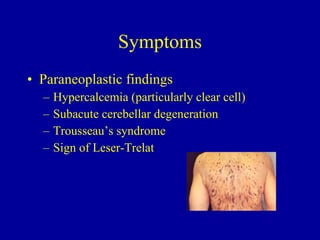
Symptoms Paraneoplastic findings Hypercalcemia (particularly clear cell) Subacute cerebellar degeneration  Trousseau’s syndrome  Sign of Leser-Trelat
Physical Exam Solid, fixed, irregular pelvic mass Ascites
Work-up of Ovarian Mass Pelvic ultrasound  CBC, LFTs CT abdomen/pelvis CXR Tumor markers NO NEEDLE BIOPSIES - risk of tumor spillage into peritoneal cavity
Tumor Markers CA-125  Elevated in 50% of stage I and 80-90% of stage II- IV tumors Non-specific increase in benign ovarian tumors, fibroids, adenocarcinomas (e.g. breast) Follow for efficacy of treatment, to detect recurrence CA 15-3
Tumor Markers  FP (alpha fetoprotein)- in germ cell tumors  -hCG (human chorionic gonadotropin)- in germ cell tumors Inhibin - in stromal tumors YKL-40 - secreted glycoprotein Elevated in 36/50 CA pts, while 23/50 had elevated CA125 (p<0.008)* *Dupont JCO 2004
Screening Routine CA-125 and endovaginal ultrasound not useful for screening of general population * UK pilot study **  - 20,000 women- survival for those detected with ovarian CA:  73 mo (screened) vs. 43 mo (unscreened) F/U study with 200,000 women - CA125 (then U/S) has PPV 21% OS? * NIH consensus conf. JAMA 1995 ** Jacobs et al., Lancet 1999
Screening/prevention in high-risk patients BRCA-1 and BRCA-2 germline mutation prophylactic BSO Also reduces risk of breast CA Can still be at risk for primary peritoneal carcinoma  oral contraceptives - controversial  close screening (not proven to be effective in high-risk patients) Frequent pelvic exams CA125 q6-12 mo Transvaginal Ultrasound q6-12 mo HNPCC prophylactic TAH/BSO
Pathology From Up-to-date 3 main histological types Pap. (90%)
Psammoma Body From:  Indiana University Dept. of Pathology and Laboratory Medicine (erl.pathology.iupui.edu)
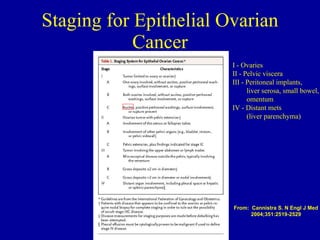
Staging for Epithelial Ovarian Cancer From:  Cannistra S. N Engl J Med 2004;351:2519-2529 I - Ovaries II - Pelvic viscera III - Peritoneal implants,  liver serosa, small bowel,  omentum IV - Distant mets (liver parenchyma)
Treatment Exploratory Laparotomy - Diagnosis, Staging and Treatment Goal:  Maximal debulking (try to remove all visible disease) Optimal debulking = No tumor mass > 1cm Suboptimal debulking Follow GOG surgical protocol to definitively stage Best done in an “expert center”
Surgery TAH/BSO Visual examination of all peritoneal surfaces Visual inspection/palpation of liver Omentectomy Para-aortic lymph node biopsy Peritoneal washings Random biopsies of clinically uninvolved areas
Surgical debulking of advanced disease Meta-analysis of 53 studies published 1989-1998 Patients were stages III/IV Underwent initial cytoreduction (debulking), followed by platinum-based chemo Maximal cytoreduction occurred if residual   disease measured  ≤ 3 cm in largest diameter Bristow RE et al.  JCO 2002, 20:1248-59.
Bristow, R. E. et al. J Clin Oncol 2002; 20:1248-1259.
Favorable Prognostic Factors Age (< 65) Good performance status Stage (I or II) No ascites Optimal surgical debulking   Non-clear cell type Well-differentiated (Grade I or II) Diploid tumor (no aneuploidy) Low post-op CA125
Adjuvant chemotherapy Standard chemo regimens Carboplatin(AUC 5-6)/paclitaxel (175mg/m2) q21d x 6 cycles Cisplatin (75mg/m2)/paclitaxel (135mg/m2) q21d x 6 cycles Carboplatin (AUC 5-6)/docetaxel (60-75mg/m2) q21d x 6 cycles *Ozols et al. JCO 2003, 21:3194-3200. **Vasey et al. JNCI 2004, 96:1682-91.
Adjuvant Chemotherapy Cisplatin and carboplatin have equal efficacy in combination with paclitaxel * Paclitaxel and docetaxel have equal efficacy in combination with carboplatin ** *Ozols et al. JCO 2003, 21:3194-3200. **Vasey et al. JNCI 2004, 96:1682-91.
Alternative Adjuvant Chemo Platinum/cyclophosphamide Doxorubin/cyclophosphamide  3-drug combinations  Two phase III trials comparing 3 drugs to carbo/taxol showed no additional benefit (Bookman ASCO 2006, Scarfone ASCO 2006)
Current controversies in chemo First-line intraperitoneal chemotherapy Chemo in “high-risk” early stage disease Maintenance chemotherapy
Intraperitoneal chemotherapy Rationale:  Since the peritoneal cavity is the principal site of disease, direct administration of chemo into the peritoneum will permit exposure to high concentrations of chemo for a prolonged period of time, while reducing generalized toxicities from intravenous administration.
Phase III trials of intraperitoneal cisplatin/paclitaxel Alberts et al, NEJM 1996 Markman et al, JCO 2001 Armstrong et al, NEJM 2006 IV taxol +  IP cis, IP taxol on d8 IV carbo x 2,  IV taxol +  IP cis IV cytoxan  + IP cis Chemo-study 42% got 6 IP (41% ≤ 2 IP) IV:50 mo IP:66 mo (p=0.03) IV:18 mo IP:24 mo (p=0.05) IV taxol + IV cis Armstrong 18% ≤ 2 IP IV:52 mo IP:63 mo (p=0.05) IV:22 mo IP:28 mo (p=0.01) IV taxol + IV cis Markman 18% ≤ 2 IP IV:41 mo IP:49 mo (p=0.02) --- IV cytoxan + IV cis Alberts %receiving IP OS PFS Chemo-control Trial
Intraperitoneal chemo Grade 3 and 4 toxicities more common in IP group Pain, fatigue, myelotoxicity, GI, neurologic Quality of life worse in IP group during and immediately after treatment, but equivalent at one year Rec:  Consider in women with stage III tumor and small-volume residual disease after maximal debulking Taxol 135 mg/m2 IV + Cis 100mg/m2 IP + (day 8) Taxol 60mg/m2 IP
Chemo in “high-risk” early stage patients Stage IA or IB with grade 2 or 3, stage IC, stage IIA, stage I-IIA clear-cell ICON1 trial and EORTC-ACTION trial  After surgery, randomized to platinum-based chemo or observation ACTION trial had strict guidelines on patient eligibility, surgical staging and chemo Improved PFS and OS with chemo Most effective in suboptimally debulked patients ICON1.  JNCI, 2003, 95:125-32. Trimbos et al. JNCI, 2003, 95:113-124.
Copyright restrictions may apply. Trimbos, J. B. et al. J. Natl. Cancer Inst. 2003 95:113-125. Copyright restrictions may apply. OS, optim. debulked OS, suboptim. debulked RFS, optim. debulked RFS, suboptim. debulked * *
Maintenance Chemotherapy Single-agent paclitaxel Enrolled women with complete response to platinum/paclitaxel combination - 262 evaluable Received 3 vs. 12 additional cycles of paclitaxel (175 mg/m2) q28d  Closed early because of significant diff. in PFS (21 for 3 cycles vs. 28 months for 12 cycles, p=0.0023) No difference in OS at time of study closure Rec:  Discuss results of this trial and give pt. option of receiving maintenance paclitaxel Markman et al. JCO 2003, 21:2460-65.
Role of radiation No longer used as part of primary treatment in U.S. May be used in platinum-resistant disease Occasionally used for large pelvic recurrences, brain and bone mets  NCCN guidelines:  option for microscopic Stage III disease (category 3 recommendation)
Stage I Favorable prognostic factors (Stage IA and IB, grade 1 and ?2) Treat with surgery alone (5-yr. survival 90-95%) Unfavorable prognostic factors (grade ?2 and 3, stage IC) Surgery then 6 cycles of chemo
Stage II Favorable prognostic factors Surgery then chemo (?3-4 cycles) Unfavorable prognostic factors Surgery then 6 cycles of chemo
Stages III, IV Surgery then 6 cycles of chemo ?Maintenance therapy - 12 cycles of paclitaxel
Routine Monitoring >50% patients with surgery and chemo get complete CR (normal exam, CA125 and CT) Monitor with exams and CA125 Use of “second-look” laparotomy not supported (Ozols JCO 2003)
Recurrent/persistent disease Majority of patients with advanced disease relapse Often see tumor marker increase ~ 3 months before clinical/radiological detection “ Secondary cytoreduction” might be helpful in patients with >6-12 month first remission (Hoskins Gynecol Oncol 1989) Usually responds to series of different chemo regiments Response rate to each drug 10-20% Can see 5-10 yr. survivals after recurrence, with good quality of life
Treatment of asymptomatic recurrence Consider tamoxifen or aromatase inhibitor for patients with asymptomatic recurrence (tumor marker-only recurrence) Markman M et al. Gynecol Oncol 1996;  Bowman et al. Clin Cancer Res 2002) Fewer than 20% have response to hormonal therapy, but occ. see marked decrease in CA125 and prolonged stable disease
2nd Line Chemotherapy Usually single agent chemo Clinical trial Carbo/cis if platinum-sensitive (≥ 6 months since last dose) Response rate ≥ 30% (Cannistra et al. JCO 2002) >60% response rate if ≥ 2 years since prior treatment (Cannistra et al. JCO 2002, Markman et al. JCO 1991) Add taxol, if taxane-sensitive
2nd line Chemotherapy (cont’d) Liposomal doxorubicin Topotecan Gemcitabine Taxotere, paclitaxel 5-FU Oral etoposide Vinorelbine Hexamethylmelamine (alkylating agent)
Biological agents Trials with VEGF and EGFR inhibitors in progress Newly-diagnosed disease Tumor marker-only relapse Several phase II trials with bevacizumab as 2+ line therapy in advanced disease
Summary Surgery is important for diagnosis, staging and treatment. Surgery is initial treatment for all stages (even metastatic). Platinum/taxane combinations are standard regimen, usually for 6 weeks. “ High risk” early stage disease benefits from chemo if suboptimally debulked. Intraperitoneal chemotherapy is beneficial, and used routinely for stage III patients.
Treatment of non-epithelial cancers Germ cell tumors - Surgery, then… Stage I dysgerminoma/Stage I (Grade 1) immature teratoma - OBSERVE Everything else - CHEMO (BEP = Bleo, Etoposide, Cis) Stromal tumors - Surgery, then… Stage I low risk - OBSERVE Stage I high risk (Stage IC or grade 3) - Observe or cis-based chemo or RT Stage II-IV -  Limited disease - RT Otherwise, platinum-based chemo (BEP or carbo/taxol or etoposide/carbo ± doxorubicin)

gopalan031607

  • 1.
    Ovarian Cancer PriyaGopalan 3/16/07
  • 2.
    Epidemiology 8th mostcommon cancer type in women (estimated 22,430 new cases ) 5th most common cause of cancer death in women (estimated 15,280 deaths ) Average lifetime risk for women: 1 in 70 Median age 60 68% are metastatic at time of diagnosis 45% 5-yr survival rate for all stages (10-30% for metastatic disease) From: Jemal et al., CA Cancer J Clin 2007; 57:43-66
  • 3.
    Risk factors Familyhistory of ovarian/breast cancer Personal history of breast cancer (esp. at young age) Infertility/nulliparity/uninterrupted ovulation OCP use, pregnancy, lactation and tubal ligation reduce risk
  • 4.
    Genetics of ovariancancer Genetic syndromes account for 10-15% of ovarian cancers BRCA1 Germline mutation - in women, confers lifetime risk of: ovarian cancer: 16-44% breast cancer: 56-87% BRCA2 Germline mutation - in women, confers lifetime risk of: ovarian cancer: 10% breast cancer: ~60-85%
  • 5.
    Genetics Lynch syndromeII HNPCC (hereditary nonpolyposis colorectal cancer) Also have endometrial, ovarian, GU, other GI cancers Germline mutations in DNA mismatch repair genes, such as MSH2 or MLH1
  • 6.
    Symptoms Nonspecific Lowerabdominal discomfort, nausea, bloating, constipation, lower back pain, fatigue Abdominal fullness, increased abdominal girth, early satiety Dyspnea Pelvic pain Sx of small bowel obstruction Sx of urinary tract obstruction, hydronephrosis
  • 7.
    Symptoms Paraneoplastic findingsHypercalcemia (particularly clear cell) Subacute cerebellar degeneration Trousseau’s syndrome Sign of Leser-Trelat
  • 8.
    Physical Exam Solid,fixed, irregular pelvic mass Ascites
  • 9.
    Work-up of OvarianMass Pelvic ultrasound CBC, LFTs CT abdomen/pelvis CXR Tumor markers NO NEEDLE BIOPSIES - risk of tumor spillage into peritoneal cavity
  • 10.
    Tumor Markers CA-125 Elevated in 50% of stage I and 80-90% of stage II- IV tumors Non-specific increase in benign ovarian tumors, fibroids, adenocarcinomas (e.g. breast) Follow for efficacy of treatment, to detect recurrence CA 15-3
  • 11.
    Tumor Markers FP (alpha fetoprotein)- in germ cell tumors  -hCG (human chorionic gonadotropin)- in germ cell tumors Inhibin - in stromal tumors YKL-40 - secreted glycoprotein Elevated in 36/50 CA pts, while 23/50 had elevated CA125 (p<0.008)* *Dupont JCO 2004
  • 12.
    Screening Routine CA-125and endovaginal ultrasound not useful for screening of general population * UK pilot study ** - 20,000 women- survival for those detected with ovarian CA: 73 mo (screened) vs. 43 mo (unscreened) F/U study with 200,000 women - CA125 (then U/S) has PPV 21% OS? * NIH consensus conf. JAMA 1995 ** Jacobs et al., Lancet 1999
  • 13.
    Screening/prevention in high-riskpatients BRCA-1 and BRCA-2 germline mutation prophylactic BSO Also reduces risk of breast CA Can still be at risk for primary peritoneal carcinoma oral contraceptives - controversial close screening (not proven to be effective in high-risk patients) Frequent pelvic exams CA125 q6-12 mo Transvaginal Ultrasound q6-12 mo HNPCC prophylactic TAH/BSO
  • 14.
    Pathology From Up-to-date3 main histological types Pap. (90%)
  • 15.
    Psammoma Body From: Indiana University Dept. of Pathology and Laboratory Medicine (erl.pathology.iupui.edu)
  • 16.
    Staging for EpithelialOvarian Cancer From: Cannistra S. N Engl J Med 2004;351:2519-2529 I - Ovaries II - Pelvic viscera III - Peritoneal implants, liver serosa, small bowel, omentum IV - Distant mets (liver parenchyma)
  • 17.
    Treatment Exploratory Laparotomy- Diagnosis, Staging and Treatment Goal: Maximal debulking (try to remove all visible disease) Optimal debulking = No tumor mass > 1cm Suboptimal debulking Follow GOG surgical protocol to definitively stage Best done in an “expert center”
  • 18.
    Surgery TAH/BSO Visualexamination of all peritoneal surfaces Visual inspection/palpation of liver Omentectomy Para-aortic lymph node biopsy Peritoneal washings Random biopsies of clinically uninvolved areas
  • 19.
    Surgical debulking ofadvanced disease Meta-analysis of 53 studies published 1989-1998 Patients were stages III/IV Underwent initial cytoreduction (debulking), followed by platinum-based chemo Maximal cytoreduction occurred if residual disease measured ≤ 3 cm in largest diameter Bristow RE et al. JCO 2002, 20:1248-59.
  • 20.
    Bristow, R. E.et al. J Clin Oncol 2002; 20:1248-1259.
  • 21.
    Favorable Prognostic FactorsAge (< 65) Good performance status Stage (I or II) No ascites Optimal surgical debulking Non-clear cell type Well-differentiated (Grade I or II) Diploid tumor (no aneuploidy) Low post-op CA125
  • 22.
    Adjuvant chemotherapy Standardchemo regimens Carboplatin(AUC 5-6)/paclitaxel (175mg/m2) q21d x 6 cycles Cisplatin (75mg/m2)/paclitaxel (135mg/m2) q21d x 6 cycles Carboplatin (AUC 5-6)/docetaxel (60-75mg/m2) q21d x 6 cycles *Ozols et al. JCO 2003, 21:3194-3200. **Vasey et al. JNCI 2004, 96:1682-91.
  • 23.
    Adjuvant Chemotherapy Cisplatinand carboplatin have equal efficacy in combination with paclitaxel * Paclitaxel and docetaxel have equal efficacy in combination with carboplatin ** *Ozols et al. JCO 2003, 21:3194-3200. **Vasey et al. JNCI 2004, 96:1682-91.
  • 24.
    Alternative Adjuvant ChemoPlatinum/cyclophosphamide Doxorubin/cyclophosphamide 3-drug combinations Two phase III trials comparing 3 drugs to carbo/taxol showed no additional benefit (Bookman ASCO 2006, Scarfone ASCO 2006)
  • 25.
    Current controversies inchemo First-line intraperitoneal chemotherapy Chemo in “high-risk” early stage disease Maintenance chemotherapy
  • 26.
    Intraperitoneal chemotherapy Rationale: Since the peritoneal cavity is the principal site of disease, direct administration of chemo into the peritoneum will permit exposure to high concentrations of chemo for a prolonged period of time, while reducing generalized toxicities from intravenous administration.
  • 27.
    Phase III trialsof intraperitoneal cisplatin/paclitaxel Alberts et al, NEJM 1996 Markman et al, JCO 2001 Armstrong et al, NEJM 2006 IV taxol + IP cis, IP taxol on d8 IV carbo x 2, IV taxol + IP cis IV cytoxan + IP cis Chemo-study 42% got 6 IP (41% ≤ 2 IP) IV:50 mo IP:66 mo (p=0.03) IV:18 mo IP:24 mo (p=0.05) IV taxol + IV cis Armstrong 18% ≤ 2 IP IV:52 mo IP:63 mo (p=0.05) IV:22 mo IP:28 mo (p=0.01) IV taxol + IV cis Markman 18% ≤ 2 IP IV:41 mo IP:49 mo (p=0.02) --- IV cytoxan + IV cis Alberts %receiving IP OS PFS Chemo-control Trial
  • 28.
    Intraperitoneal chemo Grade3 and 4 toxicities more common in IP group Pain, fatigue, myelotoxicity, GI, neurologic Quality of life worse in IP group during and immediately after treatment, but equivalent at one year Rec: Consider in women with stage III tumor and small-volume residual disease after maximal debulking Taxol 135 mg/m2 IV + Cis 100mg/m2 IP + (day 8) Taxol 60mg/m2 IP
  • 29.
    Chemo in “high-risk”early stage patients Stage IA or IB with grade 2 or 3, stage IC, stage IIA, stage I-IIA clear-cell ICON1 trial and EORTC-ACTION trial After surgery, randomized to platinum-based chemo or observation ACTION trial had strict guidelines on patient eligibility, surgical staging and chemo Improved PFS and OS with chemo Most effective in suboptimally debulked patients ICON1. JNCI, 2003, 95:125-32. Trimbos et al. JNCI, 2003, 95:113-124.
  • 30.
    Copyright restrictions mayapply. Trimbos, J. B. et al. J. Natl. Cancer Inst. 2003 95:113-125. Copyright restrictions may apply. OS, optim. debulked OS, suboptim. debulked RFS, optim. debulked RFS, suboptim. debulked * *
  • 31.
    Maintenance Chemotherapy Single-agentpaclitaxel Enrolled women with complete response to platinum/paclitaxel combination - 262 evaluable Received 3 vs. 12 additional cycles of paclitaxel (175 mg/m2) q28d Closed early because of significant diff. in PFS (21 for 3 cycles vs. 28 months for 12 cycles, p=0.0023) No difference in OS at time of study closure Rec: Discuss results of this trial and give pt. option of receiving maintenance paclitaxel Markman et al. JCO 2003, 21:2460-65.
  • 32.
    Role of radiationNo longer used as part of primary treatment in U.S. May be used in platinum-resistant disease Occasionally used for large pelvic recurrences, brain and bone mets NCCN guidelines: option for microscopic Stage III disease (category 3 recommendation)
  • 33.
    Stage I Favorableprognostic factors (Stage IA and IB, grade 1 and ?2) Treat with surgery alone (5-yr. survival 90-95%) Unfavorable prognostic factors (grade ?2 and 3, stage IC) Surgery then 6 cycles of chemo
  • 34.
    Stage II Favorableprognostic factors Surgery then chemo (?3-4 cycles) Unfavorable prognostic factors Surgery then 6 cycles of chemo
  • 35.
    Stages III, IVSurgery then 6 cycles of chemo ?Maintenance therapy - 12 cycles of paclitaxel
  • 36.
    Routine Monitoring >50%patients with surgery and chemo get complete CR (normal exam, CA125 and CT) Monitor with exams and CA125 Use of “second-look” laparotomy not supported (Ozols JCO 2003)
  • 37.
    Recurrent/persistent disease Majorityof patients with advanced disease relapse Often see tumor marker increase ~ 3 months before clinical/radiological detection “ Secondary cytoreduction” might be helpful in patients with >6-12 month first remission (Hoskins Gynecol Oncol 1989) Usually responds to series of different chemo regiments Response rate to each drug 10-20% Can see 5-10 yr. survivals after recurrence, with good quality of life
  • 38.
    Treatment of asymptomaticrecurrence Consider tamoxifen or aromatase inhibitor for patients with asymptomatic recurrence (tumor marker-only recurrence) Markman M et al. Gynecol Oncol 1996; Bowman et al. Clin Cancer Res 2002) Fewer than 20% have response to hormonal therapy, but occ. see marked decrease in CA125 and prolonged stable disease
  • 39.
    2nd Line ChemotherapyUsually single agent chemo Clinical trial Carbo/cis if platinum-sensitive (≥ 6 months since last dose) Response rate ≥ 30% (Cannistra et al. JCO 2002) >60% response rate if ≥ 2 years since prior treatment (Cannistra et al. JCO 2002, Markman et al. JCO 1991) Add taxol, if taxane-sensitive
  • 40.
    2nd line Chemotherapy(cont’d) Liposomal doxorubicin Topotecan Gemcitabine Taxotere, paclitaxel 5-FU Oral etoposide Vinorelbine Hexamethylmelamine (alkylating agent)
  • 41.
    Biological agents Trialswith VEGF and EGFR inhibitors in progress Newly-diagnosed disease Tumor marker-only relapse Several phase II trials with bevacizumab as 2+ line therapy in advanced disease
  • 42.
    Summary Surgery isimportant for diagnosis, staging and treatment. Surgery is initial treatment for all stages (even metastatic). Platinum/taxane combinations are standard regimen, usually for 6 weeks. “ High risk” early stage disease benefits from chemo if suboptimally debulked. Intraperitoneal chemotherapy is beneficial, and used routinely for stage III patients.
  • 43.
    Treatment of non-epithelialcancers Germ cell tumors - Surgery, then… Stage I dysgerminoma/Stage I (Grade 1) immature teratoma - OBSERVE Everything else - CHEMO (BEP = Bleo, Etoposide, Cis) Stromal tumors - Surgery, then… Stage I low risk - OBSERVE Stage I high risk (Stage IC or grade 3) - Observe or cis-based chemo or RT Stage II-IV - Limited disease - RT Otherwise, platinum-based chemo (BEP or carbo/taxol or etoposide/carbo ± doxorubicin)

Editor's Notes

  • #32 PFS 16 mo for subopt. debulking/stage IV, 24 mo for opt. debulking