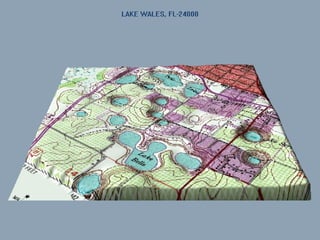
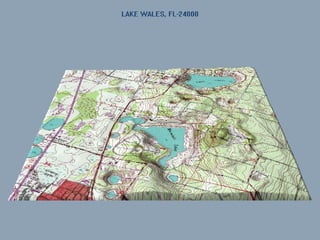
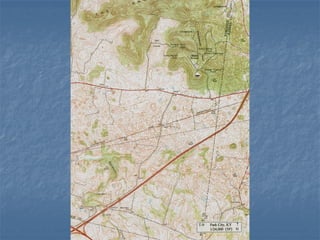
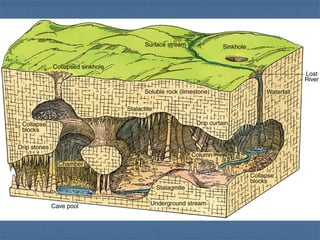
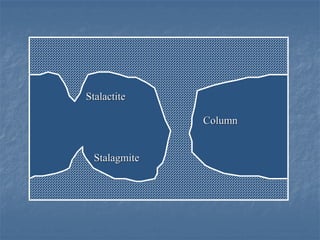
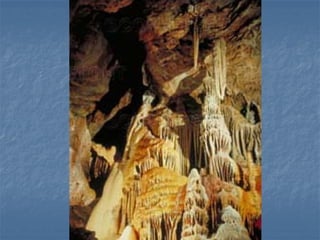
Karst topography is a type of landscape formed by the dissolution of limestone and dolostone by groundwater. It requires water, limestone that is at least 80% calcium carbonate, and a network of joints and fractures for water to flow through. Features include sinkholes, caves, and disappearing streams. Sinkholes form where water drains through joints in the limestone, collapsing the surface. Caves form near the water table and contain formations like stalactites, stalagmites, and columns.

![Karst Topography
A form of landform denudation based almost
exclusively on carbonation (chemical
weathering)
Chemical weathering of joints and fractures can create
huge subsurface cavities
Requirements for formation [Note connection
to hydrologic cycle]
Water
Limestone must be at least 80% calcium carbonate
(CaCO3)
Limestone must have a complex network of joints for
water to pass through
A zone of aeration (allows for water to flow)
Vegetation cover providing different acids](https://image.slidesharecdn.com/karsttopography-091115010604-phpapp01/85/Karst-Topography-2-320.jpg)