JURASSIC
OF
KUTCH
Presented by :-
MAYANK MAHAWAR
M.Sc 2nd sem
KUTCH
• The Mesozoic rocks ranging in age from
Middle Jurassic to Lower Cretaceous are
particularly well developed in Kutch.
• These rocks are regarded as the oldest and the
most important stratigraphical formation
in Kutch.
• These sedimentary rocks represent a phase
of marine transgression along the western
part of India during the Jurassic Period.
JURASSIC OF KUTCH
• The western margin of indian penninsular
sheild is affected by rifting along major
proterozoic orogenic trends viz. Aravalli-Delhi
and satpura mobile belts
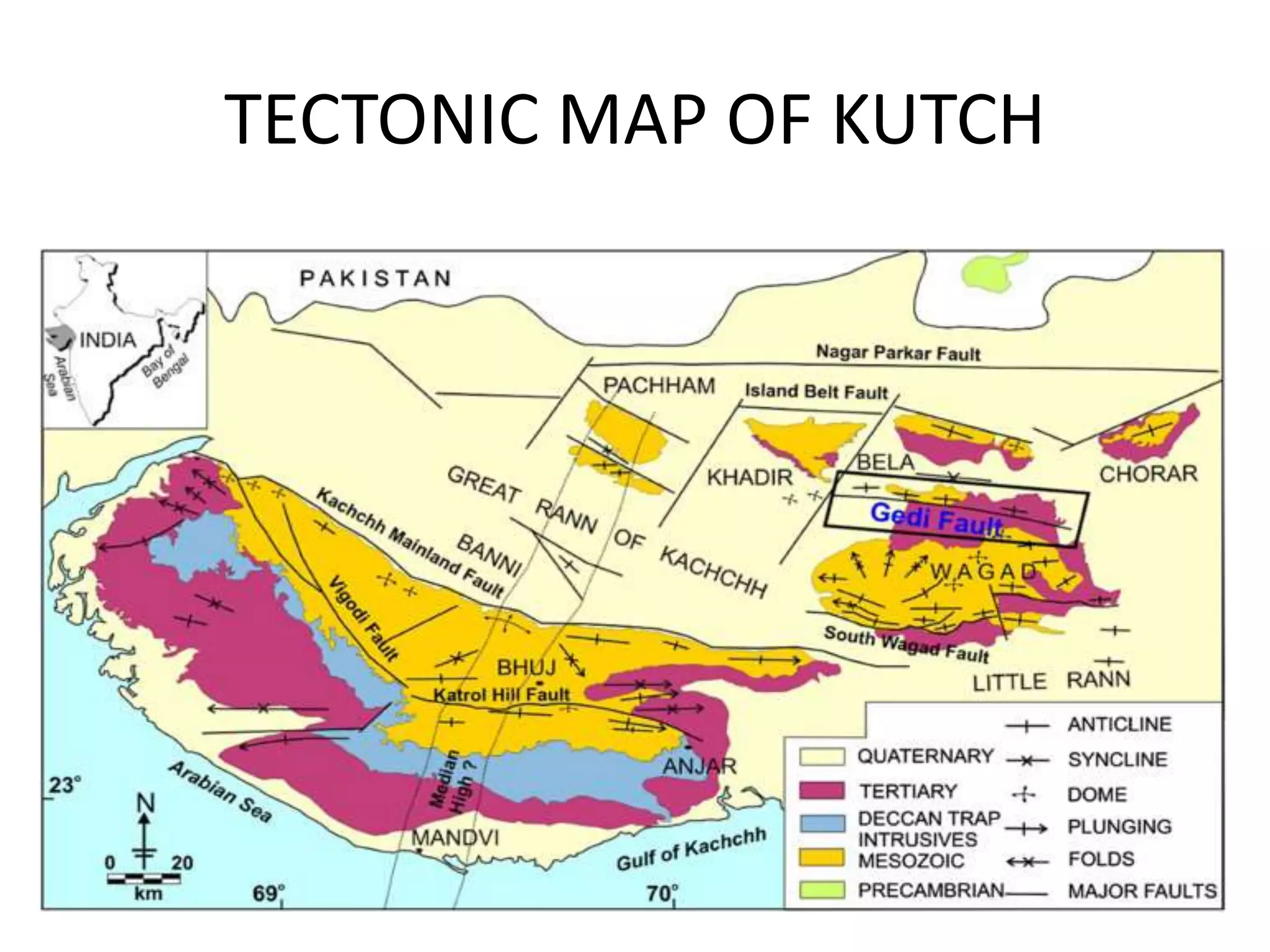
• Kutch rift is the northern most pericontinental
embayed basin suitated between the
subsurface Nagar Parkar Uplift (NPU) in the
north,Radhanpur-Barmer arch in the east and
Kathiawar Uplift in the south.
• The kutch basin evolved in the two stages:
1. Rift stage: basin subsidence along normal
faults and
2. Inversion stage: uplifts along the same faults
by reverse movements.
TECTONIC MAP OF KUTCH
Mesozoic Stratigraphy of kutch
PACHCHAM FORMATION
• Sub-division –callovian to Bathonian.
• The formation is named after the type section,
the Patcham Island of the Rann.
• The rocks are bestexposed in the Patcham, Khan
and Bela Islands of the Great Rann of Kutch.
• The thickness of the pachcham formation is
300m.
• It is made up of principally of limestones ,coral
beds and shale.
• Fossils –
macrophalites,montlivalita,trigonia,corbula etc.
PACHCHAM FORMATION
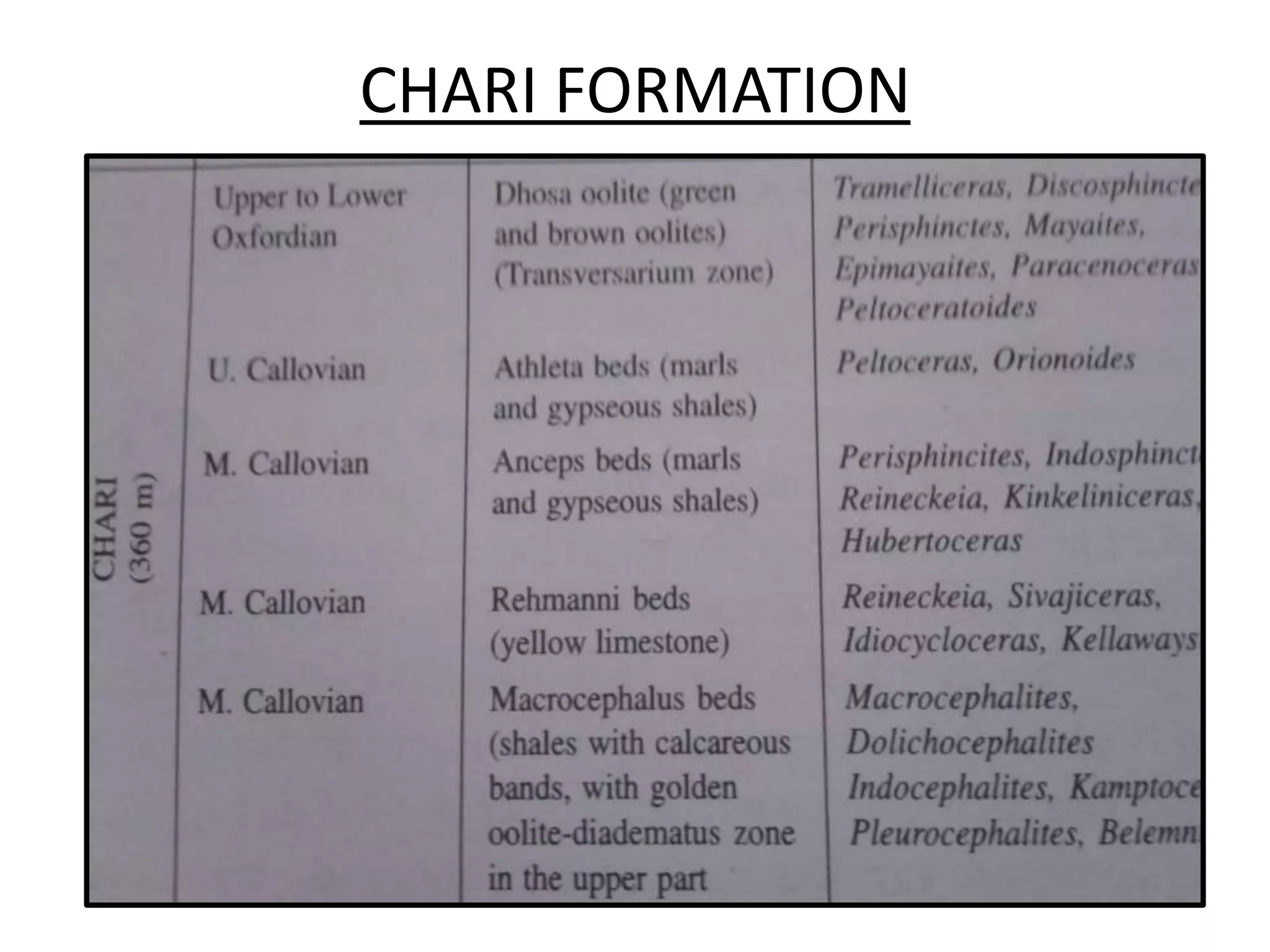
CHARI FORMATION
• Sub division – Upper oxfordian to M.
Callovian.
• This formation takes its name from a village
50km NW of Bhuj.
• The thickness of chari formation is 360km.
• Chari formation mainly contain sandy
limestones, marls, calcareous and sandyshales
and oolitic limestones.
• Fossils –
tramelliceras,mayaites,peltoceras,orionoides,
belemnites etc.
CHARI FORMATION
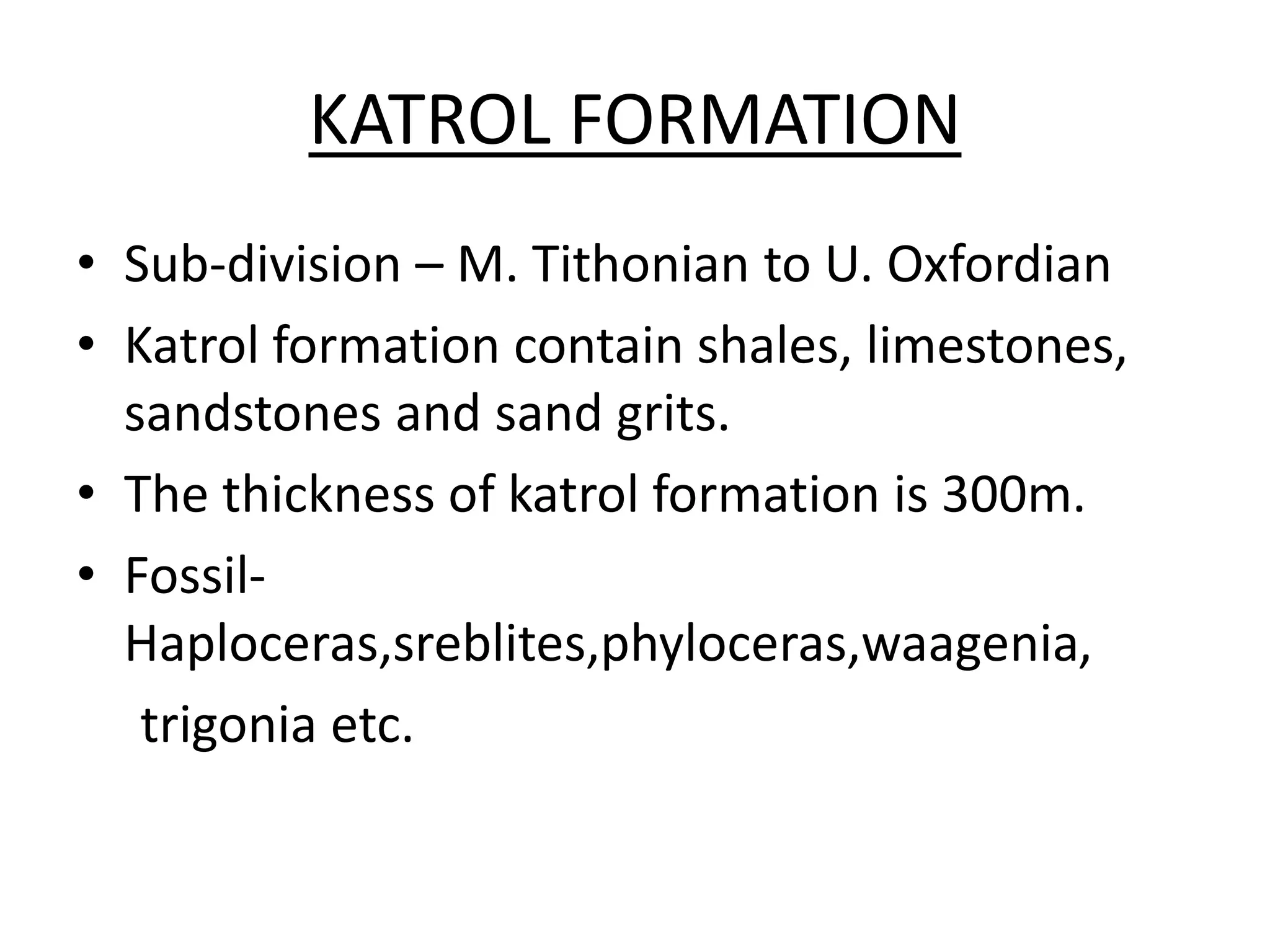
KATROL FORMATION
• Sub-division – M. Tithonian to U. Oxfordian
• Katrol formation contain shales, limestones,
sandstones and sand grits.
• The thickness of katrol formation is 300m.
• Fossil-
Haploceras,sreblites,phyloceras,waagenia,
trigonia etc.
KATROL FORMATION
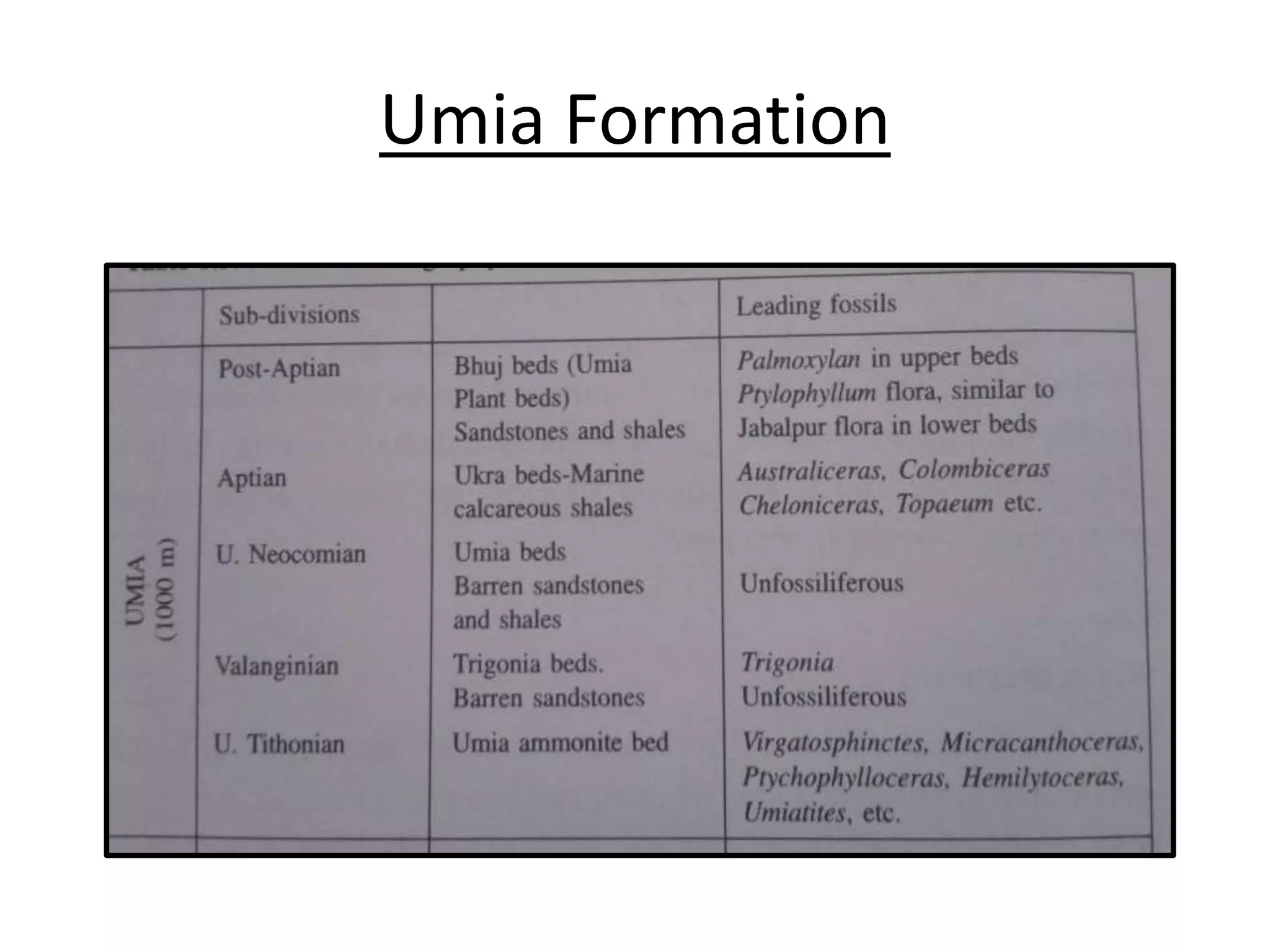
UMIA FORMATION
• Sub-division - aptian to U. Tithonian.
• The thickness of umia formation is 1000m.
• Umia Formation mainly contain
sandstone,shale and conglomerate.
• fossils –
colombiceras,topaeum,trigonia,australiceras
etc.
Umia Formation
Reference
• By internet
• Geology of India - M.Ramakrishnan and
R.Vaidyanadhan.
Thank you…

Jurassic of kutch presentation1

  • 1.
  • 2.
    KUTCH • The Mesozoicrocks ranging in age from Middle Jurassic to Lower Cretaceous are particularly well developed in Kutch. • These rocks are regarded as the oldest and the most important stratigraphical formation in Kutch. • These sedimentary rocks represent a phase of marine transgression along the western part of India during the Jurassic Period.
  • 3.
    JURASSIC OF KUTCH •The western margin of indian penninsular sheild is affected by rifting along major proterozoic orogenic trends viz. Aravalli-Delhi and satpura mobile belts • Kutch rift is the northern most pericontinental embayed basin suitated between the subsurface Nagar Parkar Uplift (NPU) in the north,Radhanpur-Barmer arch in the east and Kathiawar Uplift in the south.
  • 4.
    • The kutchbasin evolved in the two stages: 1. Rift stage: basin subsidence along normal faults and 2. Inversion stage: uplifts along the same faults by reverse movements.
  • 5.
  • 6.
  • 7.
    PACHCHAM FORMATION • Sub-division–callovian to Bathonian. • The formation is named after the type section, the Patcham Island of the Rann. • The rocks are bestexposed in the Patcham, Khan and Bela Islands of the Great Rann of Kutch. • The thickness of the pachcham formation is 300m. • It is made up of principally of limestones ,coral beds and shale. • Fossils – macrophalites,montlivalita,trigonia,corbula etc.
  • 8.
  • 9.
    CHARI FORMATION • Subdivision – Upper oxfordian to M. Callovian. • This formation takes its name from a village 50km NW of Bhuj. • The thickness of chari formation is 360km. • Chari formation mainly contain sandy limestones, marls, calcareous and sandyshales and oolitic limestones.
  • 10.
  • 11.
  • 12.
    KATROL FORMATION • Sub-division– M. Tithonian to U. Oxfordian • Katrol formation contain shales, limestones, sandstones and sand grits. • The thickness of katrol formation is 300m. • Fossil- Haploceras,sreblites,phyloceras,waagenia, trigonia etc.
  • 13.
  • 14.
    UMIA FORMATION • Sub-division- aptian to U. Tithonian. • The thickness of umia formation is 1000m. • Umia Formation mainly contain sandstone,shale and conglomerate. • fossils – colombiceras,topaeum,trigonia,australiceras etc.
  • 15.
  • 16.
    Reference • By internet •Geology of India - M.Ramakrishnan and R.Vaidyanadhan.
  • 17.