Roll # 02
Group Roll No. (1 to 8 )
BS-Geology 4th Semester
Aamir Asghar
Sabz Ali Khan & Malli Khan Institute Of
Earthsciences
PRIMARY FEATURES
OF
MARINE
SEDIMENTARY ROCKS
Contents:
1. Ripple mark:
2. Cross bedding:
3. Mud Crack:
4. Graded Budding:
5. Warm Tracks:
6. Leaf Prints:
7. Rip up:
8. Rain Prints:
9. Volcanic clast:
10. Sole Marks:
PRIMARY FEATURES
OF
MARINE
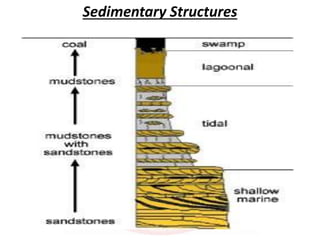
SEDIMENTARY STRUCTURES
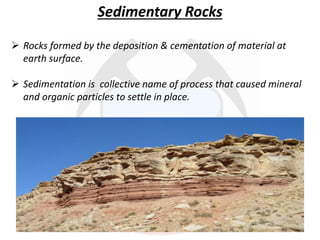
Sedimentary Rocks
 Rocks formed by the deposition & cementation of material at
earth surface.
 Sedimentation is collective name of process that caused mineral
and organic particles to settle in place.
Sedimentary Structures
 The majority of structure form by physical process before,
during and after sedimentation.
 Sedimentary structure have variety of uses:
1. For interpreting the depositional environment in term of water
depth and wind strength.
2. For determining the the way of rock succession in area of
complex folding.
3. For determining the paleocurrent pattern and paleogeographic
.
Sedimentary Structures
Depositional Sedimentary structure
 When sediments erroded & transported in response to
unidirectional aquous flow such a flow of river,tidal,or stream
current.
 A wide range of sedimentary structure arises from water flowing
overall sedimentary surface.
 With tidal current the flood produce further sedimentary
structure.
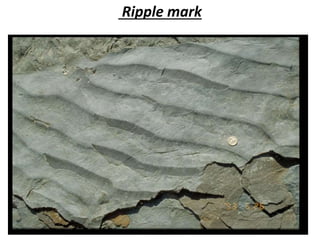
 Ripple mark
 Ripple and dunes are Asymmetric bed form that gradually moved
down stream as sediment is transported to erosion of upstream faces
and its deposition on downstream faces.
 Ripple marks usually form in conditions with flowing water, in the
lower part of the Flow Regime.
 There are two types of ripple marks
1. Symmetrical ripple marks:
2. Asymmetrical ripple marks:
Ripple mark
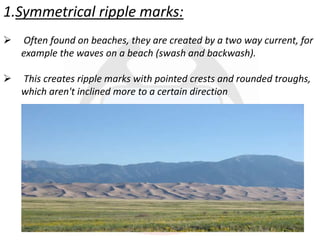
1.Symmetrical ripple marks:
 Often found on beaches, they are created by a two way current, for
example the waves on a beach (swash and backwash).
 This creates ripple marks with pointed crests and rounded troughs,
which aren't inclined more to a certain direction
2. Asymmetrical ripple marks:
 These are created by a one way current, for example in a river, or
the wind in a desert. This creates ripple marks with still pointed
crests and rounded troughs
 But which are inclined more strongly in the direction of the current.
formed on an ancient
beach
formed on modern
beach
 Cross Bedding
. Cross bedding include ripples and
dunes, or any cross stratification
caused by currents.
 The "cross" refers to the angle
between flat bedding and the
inclined bedding of the cross bed,
typically about 34 degrees.
 Paleocurrents are best found from cross
bedding
Mud Cracks
 Mud cracks are common in fine
grain sediments and form
through breakup of rocks due
to hydrolic pressure of water.
 They are commonly in tidal
flate species.
 As the water is lost the volume
is reduced and clay mineral pull
apart developing cracks in
surface under sub aerial
condition.
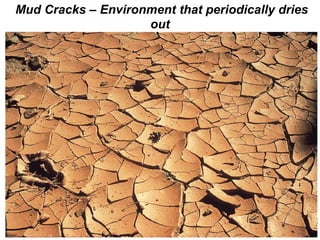
 a poly gonal pattern of cracks
develop when muddy sediments
dries completely .
 These are desiccation cracks the
spacing of desiccation cracks
depends upon the thickness of
layer of wet mud.
Mud Cracks
Mud Cracks – Environment that periodically dries
out
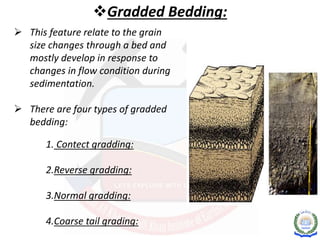
Gradded Bedding:
 This feature relate to the grain
size changes through a bed and
mostly develop in response to
changes in flow condition during
sedimentation.
 There are four types of gradded
bedding:
1. Contect gradding:
2.Reverse gradding:
3.Normal gradding:
4.Coarse tail grading:
Gradded Bedding
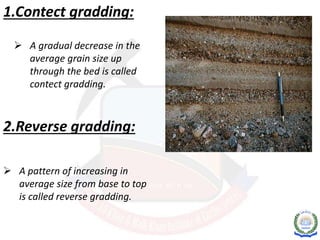
1.Contect gradding:
 A gradual decrease in the
average grain size up
through the bed is called
contect gradding.
2.Reverse gradding:
 A pattern of increasing in
average size from base to top
is called reverse gradding.
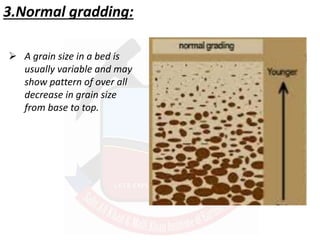
3.Normal gradding:
 A grain size in a bed is
usually variable and may
show pattern of over all
decrease in grain size
from base to top.
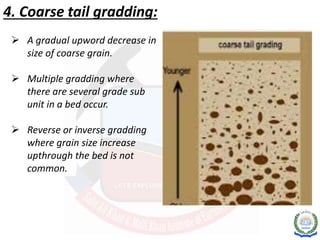
4. Coarse tail gradding:
 A gradual upword decrease in
size of coarse grain.
 Multiple gradding where
there are several grade sub
unit in a bed occur.
 Reverse or inverse gradding
where grain size increase
upthrough the bed is not
common.
Warm Tracks:
 A fossil is remain of living
plants and animals that were
preserved in rocks and other
material .
 That organism lived for short
period of time in many areas
these are called warm tracks.
 Specific index fossil found in
different layer in different
rocks.
 They are used to describe fossil
fuel like oil,coal and petroleum.
Warm Tracks:
 Fossilization and preservation of organism can occured in
several way:
1) Preservation without change:
2) Complete replacement by mineral:
3) Formation of imprints:
4) Formation of thin film of carbon:
5) Filling of holospace by mineral:
 Leaf Prints:
 In fine grain sedimentary rocks
some prints of leaf are
preserved due to some
activities like earthquake.
 There preserved parts are
known as fossil.
 These preserved bodies are
used to identify the older and
younger rocks.
 Rip up:
 When over there was deposition of sand stone a particle of clay
is eroded and preserved in sand stone.
 Rip up are also known as shot rock that are used
to armor shore line.
 A foundation or wall of stone or concrete thrown
together without order as in deep water make
slope to erosion
 Rip up:
 Sole Marks:
 Small scale erosion feature on the bed surface are referred as sole
marks.
 They are preserved in the rock record when an other layer of
sediments is deposit on the top leaving the feature on bedding
plane.
 Sole mark may be divided into those that form as a result of
turbulance in water causing erosion.
Sole Marks:
 Rain Prints:
 Rain print are commonly formed in mud rocks of continental
and shore line environment.
 Raindrop impressions form on exposed sediment by raindrop
impacts.
 Volcanic clast:
 Claustic sedimentary rocks are
rock composed of broken
pieces or claust of older
weathered and eroded rock.
 A claustic rock composed of
fragments and clast of
preexisting minerals and rock .
 A clast is fragment of broken
rock that are form by
weathering.
Importance
Of
Field Study
 Geological field work require to be properly organised even if
the visit is for a short duration.
 The extent of preparation and planning will depend on the
nature of the project.
 But there are certain basic things which must be attended to
for making it a success.
 Geological field work is a serious exercise and any casual
approach may affect its accuracy and therefore its usefulness.
Field study is designed to provide student with the opportunity
to examine social problems.
Evaluate the merit of ideas presented in the classroom.
Learn and practice method of naturalistic field research,data
collection,theory testing or program evaluation & social
intervention.
Develop interpersonal and professional skills & technical
competencies.
Participate in the ongoing activities of an organization.
Through field study upper division student and faculty engage
with our community to study issues,build capacity & impact social
change.
THANKS

Primary Sedimentary Structures

  • 2.
    Roll # 02 GroupRoll No. (1 to 8 ) BS-Geology 4th Semester Aamir Asghar Sabz Ali Khan & Malli Khan Institute Of Earthsciences
  • 3.
  • 4.
    Contents: 1. Ripple mark: 2.Cross bedding: 3. Mud Crack: 4. Graded Budding: 5. Warm Tracks: 6. Leaf Prints: 7. Rip up: 8. Rain Prints: 9. Volcanic clast: 10. Sole Marks: PRIMARY FEATURES OF MARINE SEDIMENTARY STRUCTURES
  • 5.
    Sedimentary Rocks  Rocksformed by the deposition & cementation of material at earth surface.  Sedimentation is collective name of process that caused mineral and organic particles to settle in place.
  • 6.
    Sedimentary Structures  Themajority of structure form by physical process before, during and after sedimentation.  Sedimentary structure have variety of uses: 1. For interpreting the depositional environment in term of water depth and wind strength. 2. For determining the the way of rock succession in area of complex folding. 3. For determining the paleocurrent pattern and paleogeographic .
  • 7.
  • 8.
    Depositional Sedimentary structure When sediments erroded & transported in response to unidirectional aquous flow such a flow of river,tidal,or stream current.  A wide range of sedimentary structure arises from water flowing overall sedimentary surface.  With tidal current the flood produce further sedimentary structure.
  • 9.
     Ripple mark Ripple and dunes are Asymmetric bed form that gradually moved down stream as sediment is transported to erosion of upstream faces and its deposition on downstream faces.  Ripple marks usually form in conditions with flowing water, in the lower part of the Flow Regime.  There are two types of ripple marks 1. Symmetrical ripple marks: 2. Asymmetrical ripple marks:
  • 10.
  • 11.
    1.Symmetrical ripple marks: Often found on beaches, they are created by a two way current, for example the waves on a beach (swash and backwash).  This creates ripple marks with pointed crests and rounded troughs, which aren't inclined more to a certain direction
  • 12.
    2. Asymmetrical ripplemarks:  These are created by a one way current, for example in a river, or the wind in a desert. This creates ripple marks with still pointed crests and rounded troughs  But which are inclined more strongly in the direction of the current.
  • 13.
    formed on anancient beach formed on modern beach
  • 14.
     Cross Bedding .Cross bedding include ripples and dunes, or any cross stratification caused by currents.  The "cross" refers to the angle between flat bedding and the inclined bedding of the cross bed, typically about 34 degrees.
  • 15.
     Paleocurrents arebest found from cross bedding
  • 16.
    Mud Cracks  Mudcracks are common in fine grain sediments and form through breakup of rocks due to hydrolic pressure of water.  They are commonly in tidal flate species.  As the water is lost the volume is reduced and clay mineral pull apart developing cracks in surface under sub aerial condition.
  • 17.
     a polygonal pattern of cracks develop when muddy sediments dries completely .  These are desiccation cracks the spacing of desiccation cracks depends upon the thickness of layer of wet mud. Mud Cracks
  • 18.
    Mud Cracks –Environment that periodically dries out
  • 19.
    Gradded Bedding:  Thisfeature relate to the grain size changes through a bed and mostly develop in response to changes in flow condition during sedimentation.  There are four types of gradded bedding: 1. Contect gradding: 2.Reverse gradding: 3.Normal gradding: 4.Coarse tail grading:
  • 20.
  • 21.
    1.Contect gradding:  Agradual decrease in the average grain size up through the bed is called contect gradding. 2.Reverse gradding:  A pattern of increasing in average size from base to top is called reverse gradding.
  • 22.
    3.Normal gradding:  Agrain size in a bed is usually variable and may show pattern of over all decrease in grain size from base to top.
  • 23.
    4. Coarse tailgradding:  A gradual upword decrease in size of coarse grain.  Multiple gradding where there are several grade sub unit in a bed occur.  Reverse or inverse gradding where grain size increase upthrough the bed is not common.
  • 24.
    Warm Tracks:  Afossil is remain of living plants and animals that were preserved in rocks and other material .  That organism lived for short period of time in many areas these are called warm tracks.  Specific index fossil found in different layer in different rocks.  They are used to describe fossil fuel like oil,coal and petroleum.
  • 25.
    Warm Tracks:  Fossilizationand preservation of organism can occured in several way: 1) Preservation without change: 2) Complete replacement by mineral: 3) Formation of imprints: 4) Formation of thin film of carbon: 5) Filling of holospace by mineral:
  • 26.
     Leaf Prints: In fine grain sedimentary rocks some prints of leaf are preserved due to some activities like earthquake.  There preserved parts are known as fossil.  These preserved bodies are used to identify the older and younger rocks.
  • 27.
     Rip up: When over there was deposition of sand stone a particle of clay is eroded and preserved in sand stone.  Rip up are also known as shot rock that are used to armor shore line.  A foundation or wall of stone or concrete thrown together without order as in deep water make slope to erosion
  • 28.
  • 29.
     Sole Marks: Small scale erosion feature on the bed surface are referred as sole marks.  They are preserved in the rock record when an other layer of sediments is deposit on the top leaving the feature on bedding plane.  Sole mark may be divided into those that form as a result of turbulance in water causing erosion.
  • 30.
  • 31.
     Rain Prints: Rain print are commonly formed in mud rocks of continental and shore line environment.  Raindrop impressions form on exposed sediment by raindrop impacts.
  • 32.
     Volcanic clast: Claustic sedimentary rocks are rock composed of broken pieces or claust of older weathered and eroded rock.  A claustic rock composed of fragments and clast of preexisting minerals and rock .  A clast is fragment of broken rock that are form by weathering.
  • 33.
  • 34.
     Geological fieldwork require to be properly organised even if the visit is for a short duration.  The extent of preparation and planning will depend on the nature of the project.  But there are certain basic things which must be attended to for making it a success.  Geological field work is a serious exercise and any casual approach may affect its accuracy and therefore its usefulness.
  • 35.
    Field study isdesigned to provide student with the opportunity to examine social problems. Evaluate the merit of ideas presented in the classroom. Learn and practice method of naturalistic field research,data collection,theory testing or program evaluation & social intervention. Develop interpersonal and professional skills & technical competencies.
  • 36.
    Participate in theongoing activities of an organization. Through field study upper division student and faculty engage with our community to study issues,build capacity & impact social change.
  • 37.

Editor's Notes