Presenter :
Omer M. Ahmed
University of Kerala, India,
2015.
 The name ophiolite derived from Greek root which
means
 Ophio : snake or serpent Litho : Stone
 The green colour, structure and texture of sheared
ultramafic rocks is similar to some serpents
 The term ophiolite was initially given to dark
green shiny outcrops which composed of
serpentines (serpentinite rocks)
 later on become used not only to a single
rock , but also to an association of related
rock types which are found as a consistent
of upper mantle rocks and oceanic crust.
Ophiolite
Ophiolite Sequence
 Sediments
 Pillow Lavas
 sheeted Dykes
 Gabbros
 Layered Gabbro
 Layered Peridotite
 Upper mantle Robin Gil
2010
 The above sequences has been emplaced on
subduction zone.
 and subsequently pushed up on to continents by
thrusting a long narrow belts or it can extend more
than 1000 km .
 Depends on thrust angle either moving al members
(Allochthonous or intact ophiolite ) or missing some other
members (autochthonous ophiolite).
Ophiolite
 These metamorphic rocks represent upper
mantle.
 They shows sharp contact with cumulates.
 With variable size in some outcrops over
thousands of square kilometers.
 The ranges from lherzolite (CPX, OPX, Olivine and MG spinel)
to harzburgite (OPX and olivine) and dunite (olivine).
 These components of ophiolite are generally
the most prominent because they record
mantle history of subduction zone.
Metamorphic Peridotite
 Many ophiolites occurring within the folded
mountain belts have repeated deformation and
metamorphism which transforms the layered
fragments into tectonic mixture or Mélange.
 It can be interpreted as a remnant of an ancient
subduction zone during emplacement of ophiolite.
 Transitional zone between the oceanic crust and
mantle.
Mélange
o They are represent oceanic crust and usually occurred
as deformed, sheared, and highly serpentinized.
o Consist of Peridotites (olivine , CPX ± plagioclase), pyroxenites
and layered gabbros.
o The layering is maybe result of crystal settling (by
density) during the crystallization, which allowed
accumulation or a segregation process related to the
chemical stability of minerals.
o The cumulate complexes are made of four minerals
OPX, CPX, Olivine, and plagioclase (dominant in
layered), with important amounts of chromite.
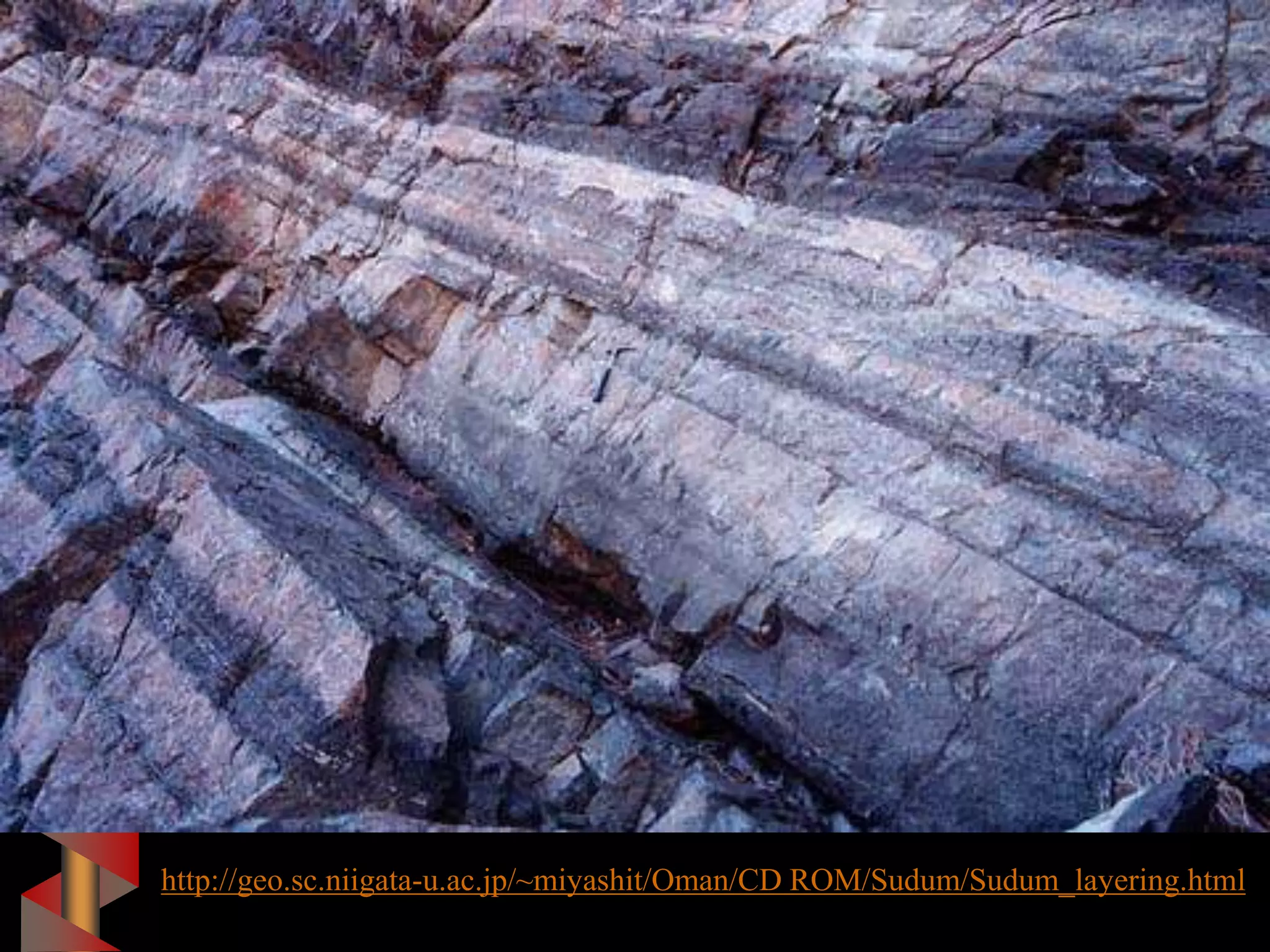
Cumulates
http://geo.sc.niigata-u.ac.jp/~miyashit/Oman/CD ROM/Sudum/Sudum_layering.html
 The occurrence of leucocratic rocks in ophiolites
known as plagiogranites.
 It is late-stage of magmatic products in
formation of the main ophiolitic crust.
 These plagiogranites consist mainly of quartz
and plagioclase with only minor amounts of
ferromagnesian minerals.
plagiogranites
 They occur as minor dykes
 Within the upper part of some ophiolite sequences with variable
thickness.
 They formed by continuous injection of basaltic liquid along the
extension zones it could be mid oceanic ridge, marginal basin, or
small restricted ocean basin like Red Sea.
 The chemistry of the dykes indicates derivation from a differentiating
mafic magma.
 Minerals are plagioclase (zoned), CPX, magnetite or ilmenite and
accessory hornblende, these minerals show fine to medium grains
with ophitic texture.
Sheeted Dykes
http://www.esc.cam.ac.uk/research/research-groups/terrestrial-
geochemistry/ocean-ridge-hydrothermal-fluxes
o Include pillow lavas, massive lavas and pillow
breccia.
o generally dismembered by several thrust faults,
shear zones and overturned folds.
o Pillow lavas provide direct evidence that they
developed in the water.
o There are some intrusive rocks associated with
pillows: sills, dykes and sometime irregular masses.
The volcanic sequences
Pillow lava
o Pillow lavas show chilled margins and glassy material.
o The most common crystallites in the chilled margin
are Plagioclase (sometime zoned), CPX and phenocrysts
of olivine.
o It shows sub-ophitic texture away from the chilled
margins.
o Pillow lavas have normative hypersthene and quartz.
o pillow lava and sheeted dykes are characteristic of
ophiolite
http://www.amusingplanet.com/2015/12/the-pillow-lavas-of-oman-ophiolite.html
 The deep oceanic sediments deposited on oceanic
crust have provided us information about materials
resting directly on the oceanic crust and
interlayered with the pillow lavas.
 Cherts, greywackes and shales are the most
common types of these sediments.
 They contain organic remnants like radiolaria, that
clearly demonstrate their deep ocean origin.
Sediment
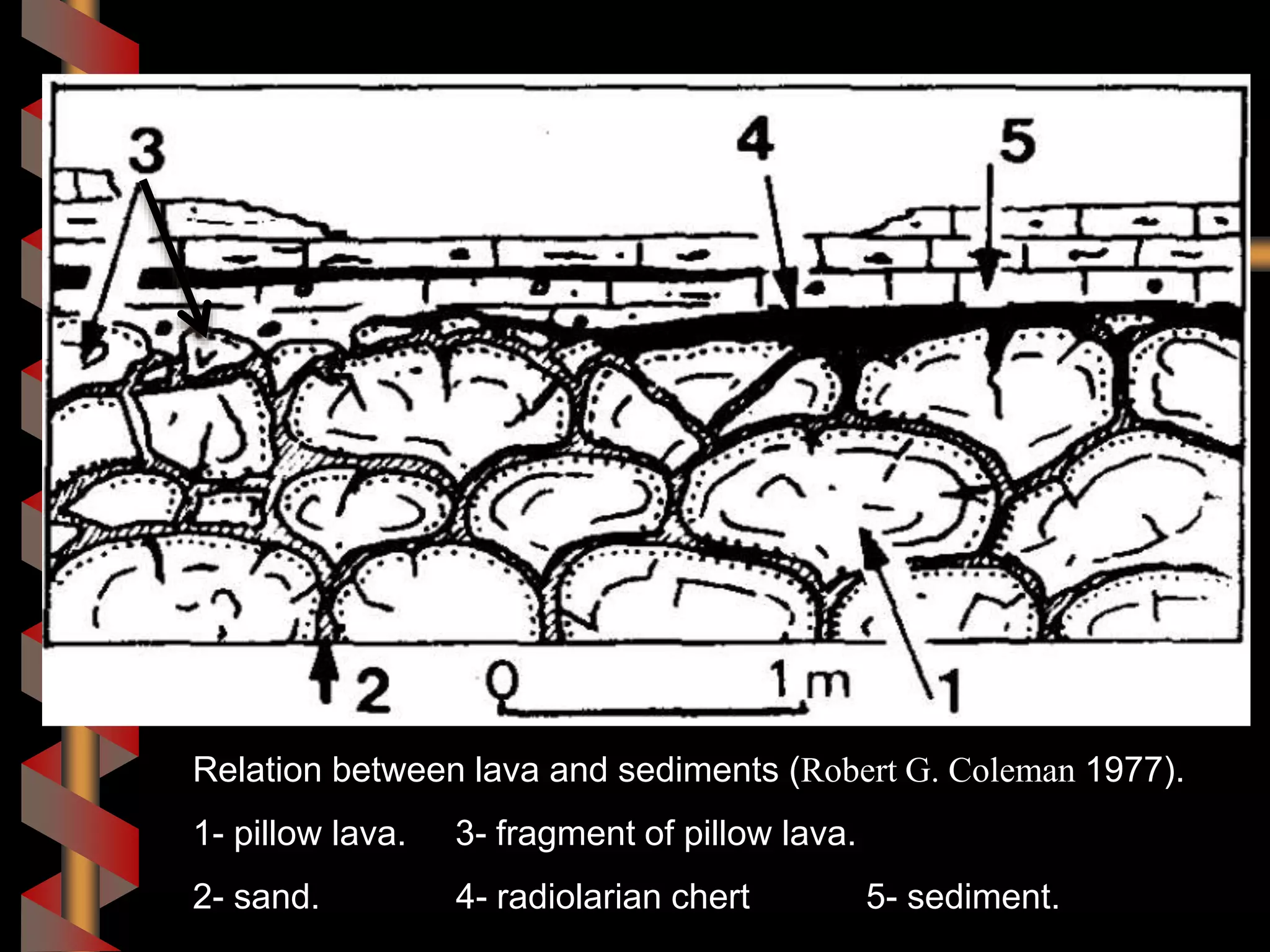
Relation between lava and sediments (Robert G. Coleman 1977).
1- pillow lava. 3- fragment of pillow lava.
2- sand. 4- radiolarian chert 5- sediment.
Geochemistry
 The ophiolite consist of variable rocks types:
mafic, ultramafic, acidic, metamorphic and
fossiliferous sediments.
 These association show a wide range of
chemical composition.
 Rajesh K. Srivastava has done a geochemistry
analysis for three samples in Naga Hills
ophiolite.
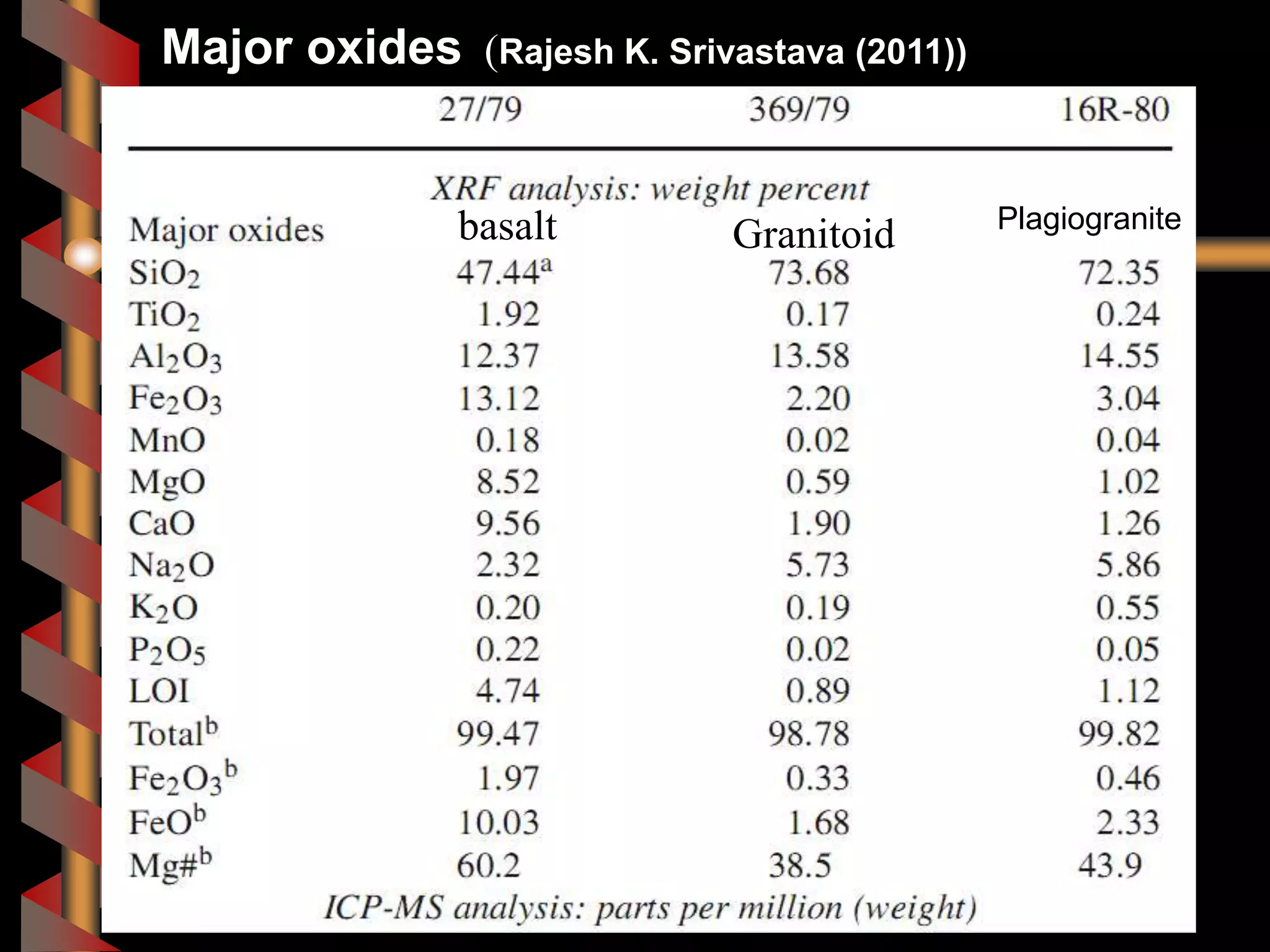
 Bulk compositions of basalt and felsic rocks
(Granitoids and Plagiogranite) for major oxides
and trace elements.
Major oxides (Rajesh K. Srivastava (2011))
basalt Granitoid Plagiogranite
Trace elements
Ophiolites are recognized in many areas around the world.
 Oman (semail)
 Sudan (Nubba mountains)
 Cyprus (Troodos island)
 Albania (Mirdita )
 Northern California
Occurrences of Ophiolites in the world
 Naga Hills in North east India
 An important feature at Naga Hills is the
occurrence of late-granitoids.
 presence of two feldspars plagioclase and
potash feldspar, and amphibole.
 Mineralization base-metal and sulfide.
Occurrences of ophiolite in India
 Massive Sulphide
It founded within pillow lava most of massive Sulphide
associated in Ophiolites have well developed Gossans
(bright colored iron oxide, hydroxides, and sulfides) which
is very rich in gold.
 Chromite
Stratiform (be tabular or pencil shape) or podiform
(irregular shape) within ultra-mafic rocks.
Other deposits are developed on serpentinite peridotite
 Laterites (nickel and iron)
 Asbestos
 Talc
 Magenesite
Economic value
Ophiolites are association of mafic and ultra
mafic rocks within mantle and oceanic crust.
With relation between Metamorphic, Igneous and
Sedimentary rocks.
Involved several tectonic process
Ophiolites are key to detecting old subduction
zones, gives clues of earth history.
Minerals wealth.
Conclusion
References
 Coleman R G (1977), Ophiolite, Springer-Verlag Berlin Heidelberg New
York, 229 P.
 DILEK,Y and ROBINSON, R T (2003) , ophiolites in Earth History,
Published by the Geological Society London, 700P.
 Gill, R (2010), Igneous Rocks and Processes A Practical Guide, John
Wiley & Sons Ltd, 428 P.
 Gupta A K.Alok (1998) ,Igneous rocks, Allied Publishers Limited 690 P.
 Srivastava R K (2011), Dyke Swarms: Keys for Geodynamic
Interpretation, Springer-Verlag Berlin Heidelberg, 605 P.
Ophiolite

Ophiolite

  • 1.
    Presenter : Omer M.Ahmed University of Kerala, India, 2015.
  • 2.
     The nameophiolite derived from Greek root which means  Ophio : snake or serpent Litho : Stone  The green colour, structure and texture of sheared ultramafic rocks is similar to some serpents
  • 3.
     The termophiolite was initially given to dark green shiny outcrops which composed of serpentines (serpentinite rocks)  later on become used not only to a single rock , but also to an association of related rock types which are found as a consistent of upper mantle rocks and oceanic crust. Ophiolite
  • 4.
    Ophiolite Sequence  Sediments Pillow Lavas  sheeted Dykes  Gabbros  Layered Gabbro  Layered Peridotite  Upper mantle Robin Gil 2010
  • 5.
     The abovesequences has been emplaced on subduction zone.  and subsequently pushed up on to continents by thrusting a long narrow belts or it can extend more than 1000 km .  Depends on thrust angle either moving al members (Allochthonous or intact ophiolite ) or missing some other members (autochthonous ophiolite). Ophiolite
  • 6.
     These metamorphicrocks represent upper mantle.  They shows sharp contact with cumulates.  With variable size in some outcrops over thousands of square kilometers.  The ranges from lherzolite (CPX, OPX, Olivine and MG spinel) to harzburgite (OPX and olivine) and dunite (olivine).  These components of ophiolite are generally the most prominent because they record mantle history of subduction zone. Metamorphic Peridotite
  • 7.
     Many ophiolitesoccurring within the folded mountain belts have repeated deformation and metamorphism which transforms the layered fragments into tectonic mixture or Mélange.  It can be interpreted as a remnant of an ancient subduction zone during emplacement of ophiolite.  Transitional zone between the oceanic crust and mantle. Mélange
  • 8.
    o They arerepresent oceanic crust and usually occurred as deformed, sheared, and highly serpentinized. o Consist of Peridotites (olivine , CPX ± plagioclase), pyroxenites and layered gabbros. o The layering is maybe result of crystal settling (by density) during the crystallization, which allowed accumulation or a segregation process related to the chemical stability of minerals. o The cumulate complexes are made of four minerals OPX, CPX, Olivine, and plagioclase (dominant in layered), with important amounts of chromite. Cumulates
  • 9.
  • 10.
     The occurrenceof leucocratic rocks in ophiolites known as plagiogranites.  It is late-stage of magmatic products in formation of the main ophiolitic crust.  These plagiogranites consist mainly of quartz and plagioclase with only minor amounts of ferromagnesian minerals. plagiogranites
  • 11.
     They occuras minor dykes  Within the upper part of some ophiolite sequences with variable thickness.  They formed by continuous injection of basaltic liquid along the extension zones it could be mid oceanic ridge, marginal basin, or small restricted ocean basin like Red Sea.  The chemistry of the dykes indicates derivation from a differentiating mafic magma.  Minerals are plagioclase (zoned), CPX, magnetite or ilmenite and accessory hornblende, these minerals show fine to medium grains with ophitic texture. Sheeted Dykes
  • 12.
  • 13.
    o Include pillowlavas, massive lavas and pillow breccia. o generally dismembered by several thrust faults, shear zones and overturned folds. o Pillow lavas provide direct evidence that they developed in the water. o There are some intrusive rocks associated with pillows: sills, dykes and sometime irregular masses. The volcanic sequences
  • 14.
    Pillow lava o Pillowlavas show chilled margins and glassy material. o The most common crystallites in the chilled margin are Plagioclase (sometime zoned), CPX and phenocrysts of olivine. o It shows sub-ophitic texture away from the chilled margins. o Pillow lavas have normative hypersthene and quartz. o pillow lava and sheeted dykes are characteristic of ophiolite
  • 15.
  • 16.
     The deepoceanic sediments deposited on oceanic crust have provided us information about materials resting directly on the oceanic crust and interlayered with the pillow lavas.  Cherts, greywackes and shales are the most common types of these sediments.  They contain organic remnants like radiolaria, that clearly demonstrate their deep ocean origin. Sediment
  • 17.
    Relation between lavaand sediments (Robert G. Coleman 1977). 1- pillow lava. 3- fragment of pillow lava. 2- sand. 4- radiolarian chert 5- sediment.
  • 18.
    Geochemistry  The ophioliteconsist of variable rocks types: mafic, ultramafic, acidic, metamorphic and fossiliferous sediments.  These association show a wide range of chemical composition.  Rajesh K. Srivastava has done a geochemistry analysis for three samples in Naga Hills ophiolite.  Bulk compositions of basalt and felsic rocks (Granitoids and Plagiogranite) for major oxides and trace elements.
  • 19.
    Major oxides (RajeshK. Srivastava (2011)) basalt Granitoid Plagiogranite
  • 20.
  • 21.
    Ophiolites are recognizedin many areas around the world.  Oman (semail)  Sudan (Nubba mountains)  Cyprus (Troodos island)  Albania (Mirdita )  Northern California Occurrences of Ophiolites in the world
  • 22.
     Naga Hillsin North east India  An important feature at Naga Hills is the occurrence of late-granitoids.  presence of two feldspars plagioclase and potash feldspar, and amphibole.  Mineralization base-metal and sulfide. Occurrences of ophiolite in India
  • 23.
     Massive Sulphide Itfounded within pillow lava most of massive Sulphide associated in Ophiolites have well developed Gossans (bright colored iron oxide, hydroxides, and sulfides) which is very rich in gold.  Chromite Stratiform (be tabular or pencil shape) or podiform (irregular shape) within ultra-mafic rocks. Other deposits are developed on serpentinite peridotite  Laterites (nickel and iron)  Asbestos  Talc  Magenesite Economic value
  • 24.
    Ophiolites are associationof mafic and ultra mafic rocks within mantle and oceanic crust. With relation between Metamorphic, Igneous and Sedimentary rocks. Involved several tectonic process Ophiolites are key to detecting old subduction zones, gives clues of earth history. Minerals wealth. Conclusion
  • 25.
    References  Coleman RG (1977), Ophiolite, Springer-Verlag Berlin Heidelberg New York, 229 P.  DILEK,Y and ROBINSON, R T (2003) , ophiolites in Earth History, Published by the Geological Society London, 700P.  Gill, R (2010), Igneous Rocks and Processes A Practical Guide, John Wiley & Sons Ltd, 428 P.  Gupta A K.Alok (1998) ,Igneous rocks, Allied Publishers Limited 690 P.  Srivastava R K (2011), Dyke Swarms: Keys for Geodynamic Interpretation, Springer-Verlag Berlin Heidelberg, 605 P.