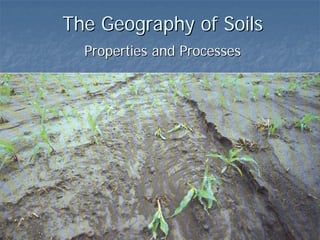
The Geography of Soils
  Properties and Processes
Overview
Soil: Definition, Description,
Characteristics
Soil Properties
Soil Chemistry
Soil Biology
Soil Formation
Soil Taxonomy
Soil Issues
Soil
Soil is a mixture of both mineral and organic matter
  Maintained by microscopic lifeforms
Soil Profiles                              Erosion: eluviation
  Pedon, Polydedon                         Transport: leaching
                                           Deposition: illuviation
  Horizons
     O: Organic matter: litter and humus: soil moisture retention,
     mobilization of nutrients, provision of nutrients
     A: Humus and clays (water retention of humus limits eluviation)
     E: Sand and silt (clays and other oxides eluviated down to B)
     B: Clays and oxides illuviated from E deposited here
     C: Weathered bedrock, exclusive of the bedrock, not affected by
     biota
     R: Bedrock
Soil Properties
Color
  Soils rich in organic matter are dark or black
  Iron and Aluminum oxides give soil a reddish color
Texture
  Gravel
  Sand          2mm
  Silt          50 μm
  Clay          2 μm

Structure
Consistency (wet, moist and dry)
Porosity:
  affects inflitration
  improved by biotic action
  harmed by compaction (increases runoff)
Soil Moisture
Texture
Structure
Soil Moisture
Soil moisture related to
  Organic matter content
  Texture (esp. to fine particles)
Loss of organic matter can lead to
  Loss of soil moisture retention
  Loss of A horizon to E horizon
    Eluviation of fine particles from E
    Illuviation of fine particles to B
    Further loss of soil moisture retention
% Soil
Moisture


           % Fine Particles   % Organic matter
Soil Chemistry
Soil Atmosphere (N2, CO2)
Nutrients take the form of ions
  Cations: Na+, K+, Mg2+, Ca2+, NH4+
  Anions: NO3-
Colloids acts as nutrient storage
  soil particles (especially clay)
  organic matter
Soil moisture acts as a transport agent by
solution
Root hairs have a slight negative character
and attract positive ions
Cation Exchange Capacity (CEC) is a measure
of how easily nutrients pass between colloids
Acidity and pH
Acidity refers to the concentration of
Hydrogen ions (H+)
H+ ions occupy colloidal spaces, crowding
out other nutrients and lowering fertility
pH = -log[H+]
  pH < 7, acidic
  pH = 7, neutral, water
  pH > 7, basic (alkaline)
Soil Biology
Critical for cycling nutrients
  Performed largely by bacteria
  Fungae, nematodes, springtails, earthworms, etc. (form
  food chains)
Nitrogen cycle, Carbon cycle
Sources of Nitrogen
  Atmosphere (N2)
  Litter,
     Through decomposition, also biological, provides NH4+ from organic
     compounds
  Inorganic fertilizer (NPK)
Utilizability of Nitrogen
  Nitrogen gas, inert, unusable by plants
  Nitrite, toxic to plants
  Nitrate and Ammonium utilizable by plants
Nitrogen Cycle
Plants must rely on soil microbiota to process
nitrogen into a form it can use
  Nitrogen fixation: bacteria change atmospheric N
  into various nitrogen compounds
     legumes
  Nitrification: Ammonium changed into nitrite by
  “Type I” organisms (nitrosomona); nitrite turned
  into nitrate by “Type II” organisms (nitrobacter)
  Denitrification: nitrogen compounds turned back
  into nitrogen gas by bacteria (20 – 40% of
  fertilizer is wasted this way)
Plants return nitrogen to the cycle through
leaf litter and decomposition
A diverse soil biota is necessary for proper
functioning
Carbon Cycle
Plants take in carbon dioxide, add it to
their tissues
  Other nutrients, including N, are taken in
Tissues becomes deposited in soil
through leaf litter
  Builds up soil organic matter
    Acts as a form of carbon storage
  Contributes N to the soil
Soil Formation
Dynamic factors
  Climatic – weathering of parent material; texture;
  pedogenic regimes
  Biologic – organic matter additions
Passive factors
  parent material: affects nutrient availability
  topography and relief: accumulation and depth
  time
     Lots of it (hundreds to thousands of years), under stable
     conditions
     Paleosols
Human factor
  Rapid loss of soil
Classification of Soil Types
Pedogenic regimes
  An earlier system of classification based on
  climatic factors
  Replaced earlier texture classification system with
  one that was more focused on development
USDA Soil Taxonomy
  Replaced pedogenic regimes as a system, but
  includes them as a diagnostic feature
  Uses diagnostic horizons to classify soils
     epipedon: Upper most surface layers, exclusive of C and
     R
     diagnostic subsurface horizons: A and B horizons
  Twelve orders and multiple suborders
Pedogenic Regimes
Relates soil
formation to
climate
Soil types are
closely related
to these
regimes
  climate is not
  the sole factor
  in determining
  soil type,
  however
Soil Taxonomy: Orders
      Oxisols
      Aridisols
      Mollisols
      Alfisols
      Ultisols
      Spodosols
      Entisols
      Inceptisols
      Vertisols
      Histosols
      Andisols
      Gelisols
Oxisols
Tropical soils
Laterization
  Iron and aluminum oxides (oxidation; reddish color)
  Heavily leached A horizon (leaching occurs throughout the
  year)
  Loss of nutrients and colloidal material
  poor fertility and low CEC
Exposure to air and water creates hardpan (plinthite,
laterite)
Rainforest soil
Can be farmed sustainably
  slash and burn, with long fallow (low demand)
Vulnerable to erosion if activities not done right
(1000s of tons per sq. km per year)
Aridisols
Desert soils (arid climates)
  shallow horizons
  poor colloidal structure (fewer fine
  particles)
  lacking in organic matter
  poor water retention
    contributes to flash flooding
    leaching highly seasonal
  High evapotranspiration
Salinization
  Evaporation deposits salts near the soil
  surface
Mollisols
Grassland soils
  world’s richest soil type
  deep and rich organic layer (humus) due to
  deep grass roots
Calcification
  More CO2 in the soil atmosphere causes
  leaching of calcium and magnesium
  carbonates
  illuviation into B and C horizons
    caliche, kunkur
Alfisols
Name taken from Aluminum and Iron
content (Al, Fe)
Moderately weathered forest soil
Considered to be a moist version of
mollisols
Note similarities to Oxisols
Ultisols

Highly weathered forest soils
Heavily leached A horizon with residual Fe
and Al oxides
Intermediate between Oxisols and Alfisols
Spodosols
Northern coniferous forest soils
Humid continental mild summer
  cool, moist climates
Humus and fine particles eluviated from A
horizon
Uppermost horizon lacks clay and humus,
tends to have a sandy texture and has a light
color
Podzolization
  Low pH (acidic)
  leaching of fine particles and nutrients
Entisols
recENT soils
Not climate dependent
Insufficient time passage to develop
horizons
  Insufficient weathering of parent material
    lacking fine particles and nutrients
Occurence: areas of recent deposition
  slopes, floodplains, tidal mudflats, dune
  and desert sands
Inceptisols

Soils in earliest stages of development
Eluviation and illuviation are evident, but
distinct horizons have not yet formed
Low fertility
Gelisols
Cold and frozen soils
  the presence of permafrost is a defining characteristic
Form very slowly due to low temperatures
slowing chemical and physical weathering
  disturbance to these soils has long lasting effects
cryoturbation
  freeze-thaw cycle of frost tends to churn the soil
Andisols

Named after the Andes
Volcanic parent material
  pyroclastic material
Rapidly weather into colloidal material
  high fertility, high CEC
Distributed around subduction zones
  Pacific Ring of Fire especially
Vertisols
Expandable clay soils
  At least 30% expandable clay (shrink and swell)
Climatic variables
  Subhumid to semi-arid moisture, moderate to high
  temperature
  Regions with highly variable seasonal moisture
  balances
  Distinct dry season following wet season
Form under tropical and subtropical
grasslands and savanna
Disastrous for construction (don’t buy a house
built on vertisols)
Histosols
Organic soils
Formed from the accumulation of
organic matter
  lakebeds > bogs, marsh and peat >
  histosols
  Poor drainage
Human-Environment
 Interaction Issues with Soils
Irrigation and Salinization
  More common in arid environments
  The accumulation and evaporation of irrigated
  water causes salts to build up in the soils, and
  ultimately ruins its fertility
  Drainage tiles
  Groundwater issues, Colorado River Basin
  issues
Soil degradation
  results from various practices that destroy agriculturally
  viable land
     agricultural practices that leave soil vulnerable to erosion
         overgrazing, vegetation removal, over exploitation
         20% drop in yield over next 20 years at moderate erosion rates
     Urbanization
  3 – 5 million acres of US farmland are lost each year
  38% decrease in world’s farmable land since 1950
     1380 million acres
     12 – 15 million acres per year
  Agriculturally viable soil takes hundreds to thousands of
  years to form
     Soil as a non-renewable resource?
     Agriculture as soil mining?

Soils

  • 1.
    The Geography ofSoils Properties and Processes
  • 2.
    Overview Soil: Definition, Description, Characteristics SoilProperties Soil Chemistry Soil Biology Soil Formation Soil Taxonomy Soil Issues
  • 3.
    Soil Soil is amixture of both mineral and organic matter Maintained by microscopic lifeforms Soil Profiles Erosion: eluviation Pedon, Polydedon Transport: leaching Deposition: illuviation Horizons O: Organic matter: litter and humus: soil moisture retention, mobilization of nutrients, provision of nutrients A: Humus and clays (water retention of humus limits eluviation) E: Sand and silt (clays and other oxides eluviated down to B) B: Clays and oxides illuviated from E deposited here C: Weathered bedrock, exclusive of the bedrock, not affected by biota R: Bedrock
  • 7.
    Soil Properties Color Soils rich in organic matter are dark or black Iron and Aluminum oxides give soil a reddish color Texture Gravel Sand 2mm Silt 50 μm Clay 2 μm Structure Consistency (wet, moist and dry) Porosity: affects inflitration improved by biotic action harmed by compaction (increases runoff) Soil Moisture
  • 8.
  • 9.
  • 10.
    Soil Moisture Soil moisturerelated to Organic matter content Texture (esp. to fine particles) Loss of organic matter can lead to Loss of soil moisture retention Loss of A horizon to E horizon Eluviation of fine particles from E Illuviation of fine particles to B Further loss of soil moisture retention
  • 12.
    % Soil Moisture % Fine Particles % Organic matter
  • 13.
    Soil Chemistry Soil Atmosphere(N2, CO2) Nutrients take the form of ions Cations: Na+, K+, Mg2+, Ca2+, NH4+ Anions: NO3- Colloids acts as nutrient storage soil particles (especially clay) organic matter Soil moisture acts as a transport agent by solution Root hairs have a slight negative character and attract positive ions Cation Exchange Capacity (CEC) is a measure of how easily nutrients pass between colloids
  • 15.
    Acidity and pH Acidityrefers to the concentration of Hydrogen ions (H+) H+ ions occupy colloidal spaces, crowding out other nutrients and lowering fertility pH = -log[H+] pH < 7, acidic pH = 7, neutral, water pH > 7, basic (alkaline)
  • 16.
    Soil Biology Critical forcycling nutrients Performed largely by bacteria Fungae, nematodes, springtails, earthworms, etc. (form food chains) Nitrogen cycle, Carbon cycle Sources of Nitrogen Atmosphere (N2) Litter, Through decomposition, also biological, provides NH4+ from organic compounds Inorganic fertilizer (NPK) Utilizability of Nitrogen Nitrogen gas, inert, unusable by plants Nitrite, toxic to plants Nitrate and Ammonium utilizable by plants
  • 20.
    Nitrogen Cycle Plants mustrely on soil microbiota to process nitrogen into a form it can use Nitrogen fixation: bacteria change atmospheric N into various nitrogen compounds legumes Nitrification: Ammonium changed into nitrite by “Type I” organisms (nitrosomona); nitrite turned into nitrate by “Type II” organisms (nitrobacter) Denitrification: nitrogen compounds turned back into nitrogen gas by bacteria (20 – 40% of fertilizer is wasted this way) Plants return nitrogen to the cycle through leaf litter and decomposition A diverse soil biota is necessary for proper functioning
  • 21.
    Carbon Cycle Plants takein carbon dioxide, add it to their tissues Other nutrients, including N, are taken in Tissues becomes deposited in soil through leaf litter Builds up soil organic matter Acts as a form of carbon storage Contributes N to the soil
  • 22.
    Soil Formation Dynamic factors Climatic – weathering of parent material; texture; pedogenic regimes Biologic – organic matter additions Passive factors parent material: affects nutrient availability topography and relief: accumulation and depth time Lots of it (hundreds to thousands of years), under stable conditions Paleosols Human factor Rapid loss of soil
  • 25.
    Classification of SoilTypes Pedogenic regimes An earlier system of classification based on climatic factors Replaced earlier texture classification system with one that was more focused on development USDA Soil Taxonomy Replaced pedogenic regimes as a system, but includes them as a diagnostic feature Uses diagnostic horizons to classify soils epipedon: Upper most surface layers, exclusive of C and R diagnostic subsurface horizons: A and B horizons Twelve orders and multiple suborders
  • 26.
    Pedogenic Regimes Relates soil formationto climate Soil types are closely related to these regimes climate is not the sole factor in determining soil type, however
  • 27.
    Soil Taxonomy: Orders Oxisols Aridisols Mollisols Alfisols Ultisols Spodosols Entisols Inceptisols Vertisols Histosols Andisols Gelisols
  • 28.
    Oxisols Tropical soils Laterization Iron and aluminum oxides (oxidation; reddish color) Heavily leached A horizon (leaching occurs throughout the year) Loss of nutrients and colloidal material poor fertility and low CEC Exposure to air and water creates hardpan (plinthite, laterite) Rainforest soil Can be farmed sustainably slash and burn, with long fallow (low demand) Vulnerable to erosion if activities not done right (1000s of tons per sq. km per year)
  • 30.
    Aridisols Desert soils (aridclimates) shallow horizons poor colloidal structure (fewer fine particles) lacking in organic matter poor water retention contributes to flash flooding leaching highly seasonal High evapotranspiration Salinization Evaporation deposits salts near the soil surface
  • 31.
    Mollisols Grassland soils world’s richest soil type deep and rich organic layer (humus) due to deep grass roots Calcification More CO2 in the soil atmosphere causes leaching of calcium and magnesium carbonates illuviation into B and C horizons caliche, kunkur
  • 34.
    Alfisols Name taken fromAluminum and Iron content (Al, Fe) Moderately weathered forest soil Considered to be a moist version of mollisols Note similarities to Oxisols
  • 35.
    Ultisols Highly weathered forestsoils Heavily leached A horizon with residual Fe and Al oxides Intermediate between Oxisols and Alfisols
  • 36.
    Spodosols Northern coniferous forestsoils Humid continental mild summer cool, moist climates Humus and fine particles eluviated from A horizon Uppermost horizon lacks clay and humus, tends to have a sandy texture and has a light color Podzolization Low pH (acidic) leaching of fine particles and nutrients
  • 39.
    Entisols recENT soils Not climatedependent Insufficient time passage to develop horizons Insufficient weathering of parent material lacking fine particles and nutrients Occurence: areas of recent deposition slopes, floodplains, tidal mudflats, dune and desert sands
  • 40.
    Inceptisols Soils in earlieststages of development Eluviation and illuviation are evident, but distinct horizons have not yet formed Low fertility
  • 41.
    Gelisols Cold and frozensoils the presence of permafrost is a defining characteristic Form very slowly due to low temperatures slowing chemical and physical weathering disturbance to these soils has long lasting effects cryoturbation freeze-thaw cycle of frost tends to churn the soil
  • 42.
    Andisols Named after theAndes Volcanic parent material pyroclastic material Rapidly weather into colloidal material high fertility, high CEC Distributed around subduction zones Pacific Ring of Fire especially
  • 43.
    Vertisols Expandable clay soils At least 30% expandable clay (shrink and swell) Climatic variables Subhumid to semi-arid moisture, moderate to high temperature Regions with highly variable seasonal moisture balances Distinct dry season following wet season Form under tropical and subtropical grasslands and savanna Disastrous for construction (don’t buy a house built on vertisols)
  • 44.
    Histosols Organic soils Formed fromthe accumulation of organic matter lakebeds > bogs, marsh and peat > histosols Poor drainage
  • 47.
    Human-Environment Interaction Issueswith Soils Irrigation and Salinization More common in arid environments The accumulation and evaporation of irrigated water causes salts to build up in the soils, and ultimately ruins its fertility Drainage tiles Groundwater issues, Colorado River Basin issues
  • 48.
    Soil degradation results from various practices that destroy agriculturally viable land agricultural practices that leave soil vulnerable to erosion overgrazing, vegetation removal, over exploitation 20% drop in yield over next 20 years at moderate erosion rates Urbanization 3 – 5 million acres of US farmland are lost each year 38% decrease in world’s farmable land since 1950 1380 million acres 12 – 15 million acres per year Agriculturally viable soil takes hundreds to thousands of years to form Soil as a non-renewable resource? Agriculture as soil mining?