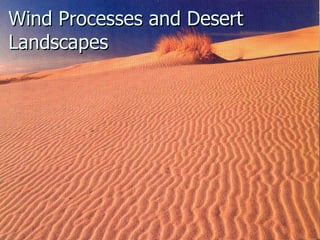
Wind Processes and Desert Landscapes
Overview Eolian (Aeolian) processes Erosion deflation and abrasion Transport saltation and surface creep Deposition sand dunes and loess Desert landscapes
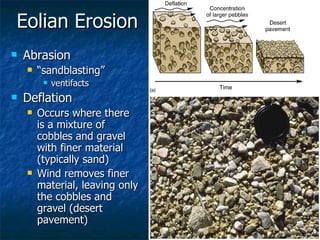
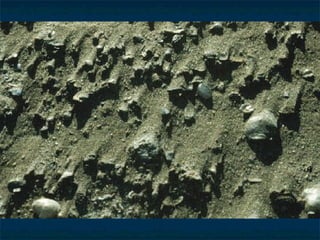
Eolian Erosion Abrasion “ sandblasting” ventifacts Deflation Occurs where there is a mixture of cobbles and gravel with finer material (typically sand) Wind removes finer material, leaving only the cobbles and gravel (desert pavement)
 
 
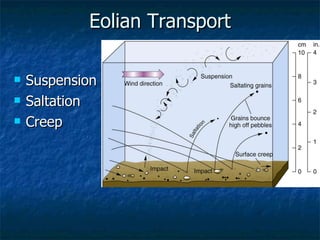
Eolian Transport Suspension Saltation Creep
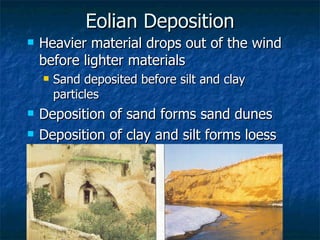
Eolian Deposition Heavier material drops out of the wind before lighter materials Sand deposited before silt and clay particles Deposition of sand forms sand dunes Deposition of clay and silt forms loess
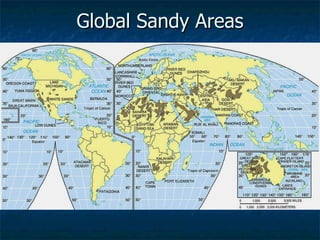
Global Sandy Areas
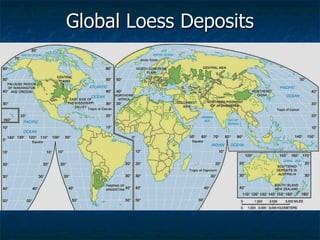
Global Loess Deposits
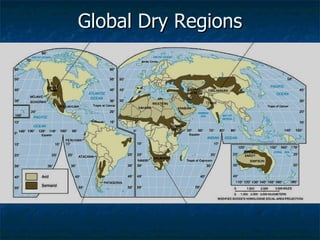
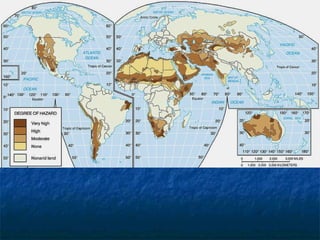
Global Dry Regions
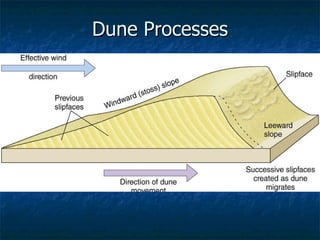
Dune Processes
Types of Sand Dunes Several factors influence the formation of the various sand dune landforms Strength of the wind Prevailing wind vs. shifting winds Presence of vegetation Amount of sand present Movement Free Dunes Tied Dunes
 
 
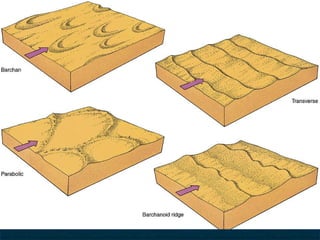
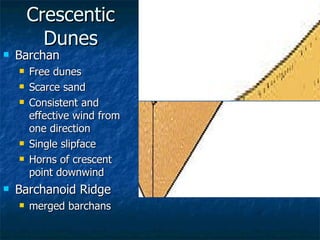
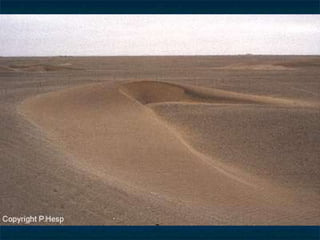
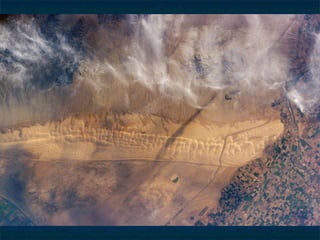
Crescentic Dunes Barchan Free dunes Scarce sand Consistent and effective wind from one direction Single slipface Horns of crescent point downwind Barchanoid Ridge merged barchans


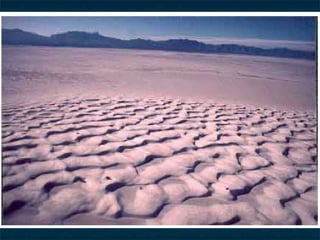
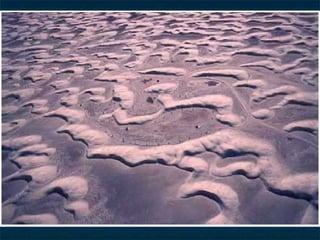
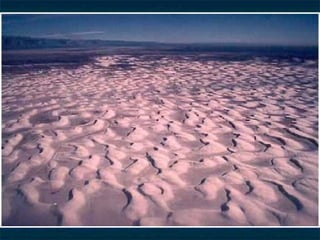
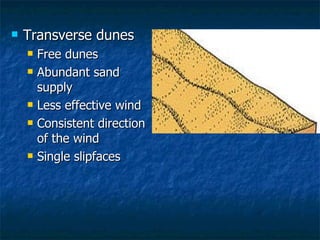
Transverse dunes Free dunes Abundant sand supply Less effective wind Consistent direction of the wind Single slipfaces
 
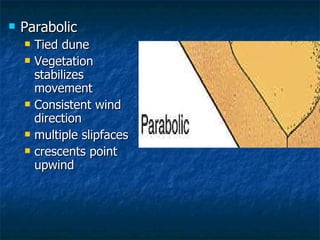
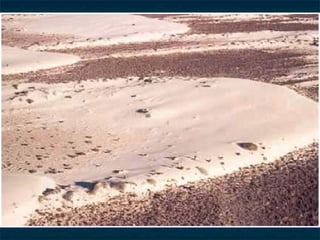
Parabolic Tied dune Vegetation stabilizes movement Consistent wind direction multiple slipfaces crescents point upwind
 
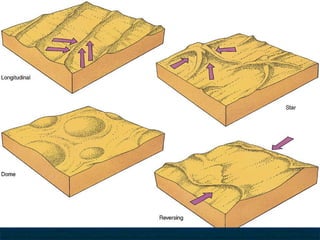
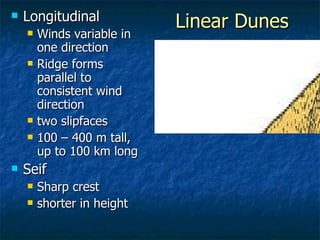
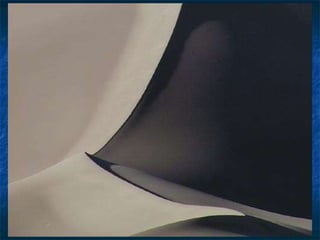
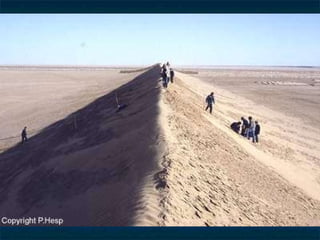
Linear Dunes Longitudinal Winds variable in one direction Ridge forms parallel to consistent wind direction two slipfaces 100 – 400 m tall, up to 100 km long Seif Sharp crest shorter in height


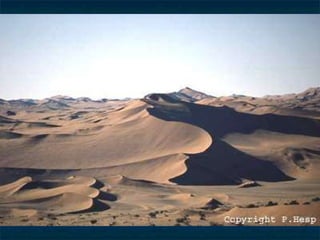
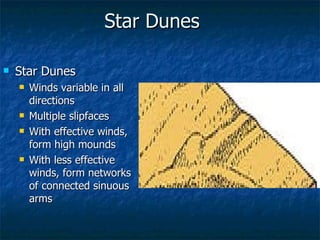
Star Dunes Star Dunes Winds variable in all directions Multiple slipfaces With effective winds, form high mounds With less effective winds, form networks of connected sinuous arms


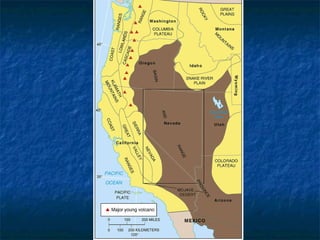
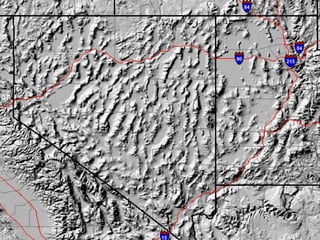
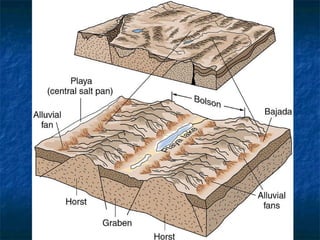
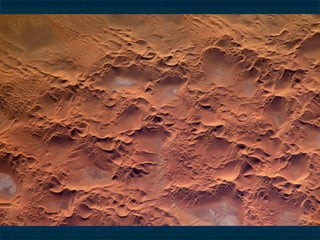
Desert Landscapes Arid areas are the largest climatic region on earth (35% of earth’s surface) Fluvial features Flash flooding Washes, arroyos, wadis Bursts of vegetation growth Playas interior drainage salinization Alluvial fans bajadas Landscape features Adapted vegetation Basin and Range Province Horst and Graben, interior drainage, playas, alluvial fans


Colorado River Issues Headwaters originate in the Rocky Mountains High levels of rainfall Snow melt Flows through an extremely arid area with few feeding tributaries High demand on water means that often no water actually makes it to the sea Flows through seven states, into Mexico Beliefs on the river’s capacity based on a 400 year high mark (greatly overestimated) Subject to a variety of political treaties and agreements regulating its flow In many cases, quotas are exceeded, esp. with California
Desertification Refers to the expansion of desert biomes due to a combination of poor agricultural practices and climate change grazing has been identified as a major cause As a global phenomenon, this idea has largely been falsified Areas identified as “desertifying” were simply experiencing drought-like conditions, in conjunction with ENSO cycles; many have recovered There are some areas where desertification has occurred, but it is not a global phenomenon
 

Eolian

  • 1.
    Wind Processes andDesert Landscapes
  • 2.
    Overview Eolian (Aeolian)processes Erosion deflation and abrasion Transport saltation and surface creep Deposition sand dunes and loess Desert landscapes
  • 3.
    Eolian Erosion Abrasion“ sandblasting” ventifacts Deflation Occurs where there is a mixture of cobbles and gravel with finer material (typically sand) Wind removes finer material, leaving only the cobbles and gravel (desert pavement)
  • 4.
  • 5.
  • 6.
  • 7.
    Eolian Deposition Heaviermaterial drops out of the wind before lighter materials Sand deposited before silt and clay particles Deposition of sand forms sand dunes Deposition of clay and silt forms loess
  • 8.
  • 9.
  • 10.
  • 11.
  • 12.
    Types of SandDunes Several factors influence the formation of the various sand dune landforms Strength of the wind Prevailing wind vs. shifting winds Presence of vegetation Amount of sand present Movement Free Dunes Tied Dunes
  • 13.
  • 14.
  • 15.
    Crescentic Dunes BarchanFree dunes Scarce sand Consistent and effective wind from one direction Single slipface Horns of crescent point downwind Barchanoid Ridge merged barchans
  • 16.
  • 17.
  • 18.
  • 19.
  • 20.
    Transverse dunes Freedunes Abundant sand supply Less effective wind Consistent direction of the wind Single slipfaces
  • 21.
  • 22.
    Parabolic Tied duneVegetation stabilizes movement Consistent wind direction multiple slipfaces crescents point upwind
  • 23.
  • 24.
    Linear Dunes LongitudinalWinds variable in one direction Ridge forms parallel to consistent wind direction two slipfaces 100 – 400 m tall, up to 100 km long Seif Sharp crest shorter in height
  • 25.
  • 26.
  • 27.
  • 28.
    Star Dunes StarDunes Winds variable in all directions Multiple slipfaces With effective winds, form high mounds With less effective winds, form networks of connected sinuous arms
  • 29.
  • 30.
  • 31.
  • 32.
    Desert Landscapes Aridareas are the largest climatic region on earth (35% of earth’s surface) Fluvial features Flash flooding Washes, arroyos, wadis Bursts of vegetation growth Playas interior drainage salinization Alluvial fans bajadas Landscape features Adapted vegetation Basin and Range Province Horst and Graben, interior drainage, playas, alluvial fans
  • 33.
  • 34.
  • 35.
  • 36.
  • 37.
    Colorado River IssuesHeadwaters originate in the Rocky Mountains High levels of rainfall Snow melt Flows through an extremely arid area with few feeding tributaries High demand on water means that often no water actually makes it to the sea Flows through seven states, into Mexico Beliefs on the river’s capacity based on a 400 year high mark (greatly overestimated) Subject to a variety of political treaties and agreements regulating its flow In many cases, quotas are exceeded, esp. with California
  • 38.
    Desertification Refers tothe expansion of desert biomes due to a combination of poor agricultural practices and climate change grazing has been identified as a major cause As a global phenomenon, this idea has largely been falsified Areas identified as “desertifying” were simply experiencing drought-like conditions, in conjunction with ENSO cycles; many have recovered There are some areas where desertification has occurred, but it is not a global phenomenon
  • 39.