This document defines and describes different types of unconformities in geology. It begins by defining an unconformity as a break or gap in the geological record representing a period of erosion or non-deposition. It then describes the major types of unconformities, including angular, disconformity, non-conformity, and local unconformities. Finally, it outlines several ways that unconformities provide significance, such as indicating time intervals missing from the geological record, structural discordances between rock layers, evidence of past topography, and signs of weathering at the contact surface.
It isone of the most common Geological structure
found in rocks.
Unconformity = Gaps in rock layers
• From when layers of rocks are removed by erosion.
• From when a period of time passes without any new
deposition to produce new layer of rock.
Introduction
4.
Definition
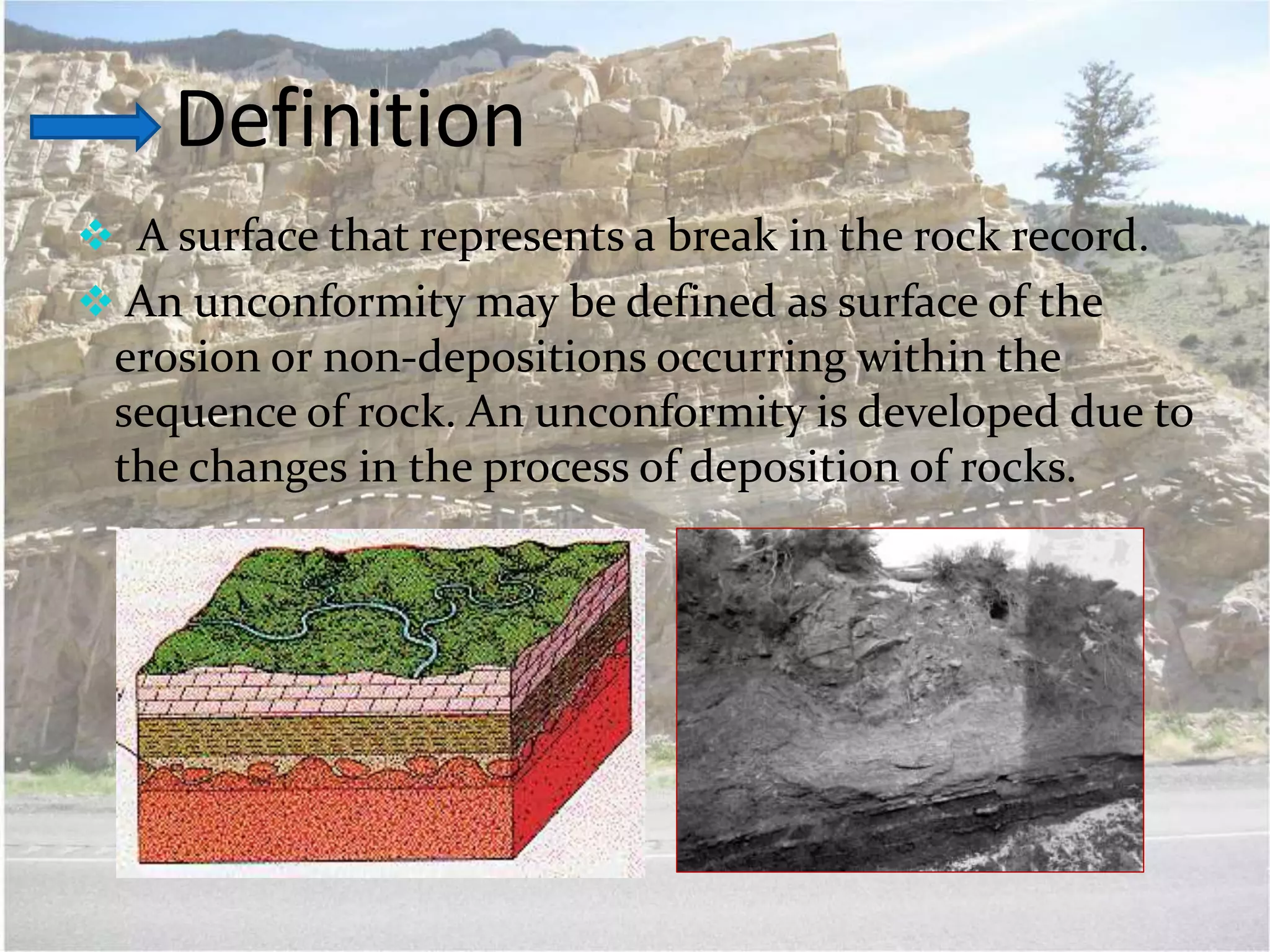
A surfacethat represents a break in the rock record.
An unconformity may be defined as surface of the
erosion or non-depositions occurring within the
sequence of rock. An unconformity is developed due to
the changes in the process of deposition of rocks.
5.
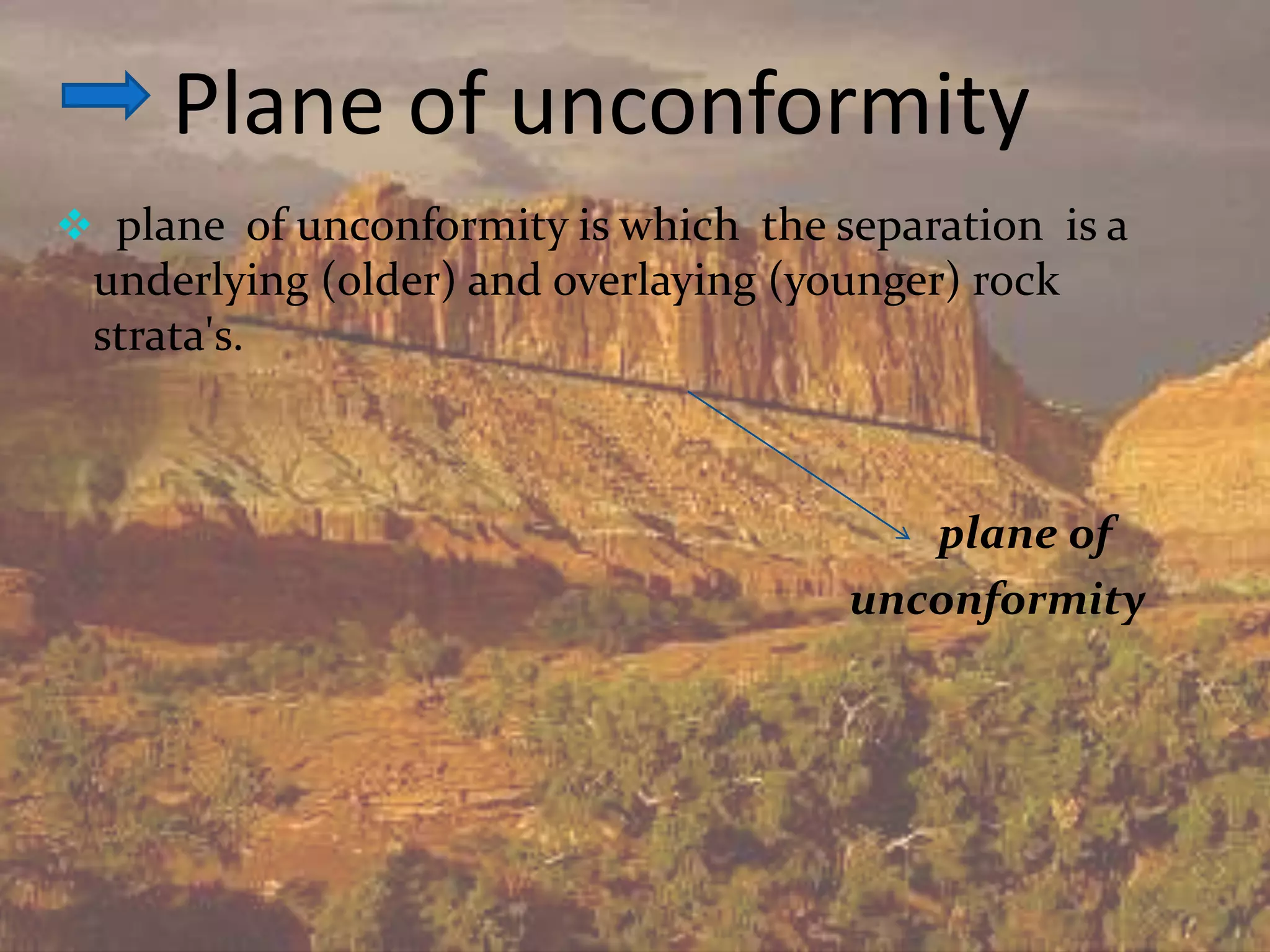
Plane of unconformity
plane of unconformity is which the separation is a
underlying (older) and overlaying (younger) rock
strata's.
plane of
unconformity
6.
Types of unconformities
Angular Unconformity.
Dis -conformity.
Non-conformity.
Local unconformity.
Blended unconformity
Para conformity
Buttress unconformity
7.
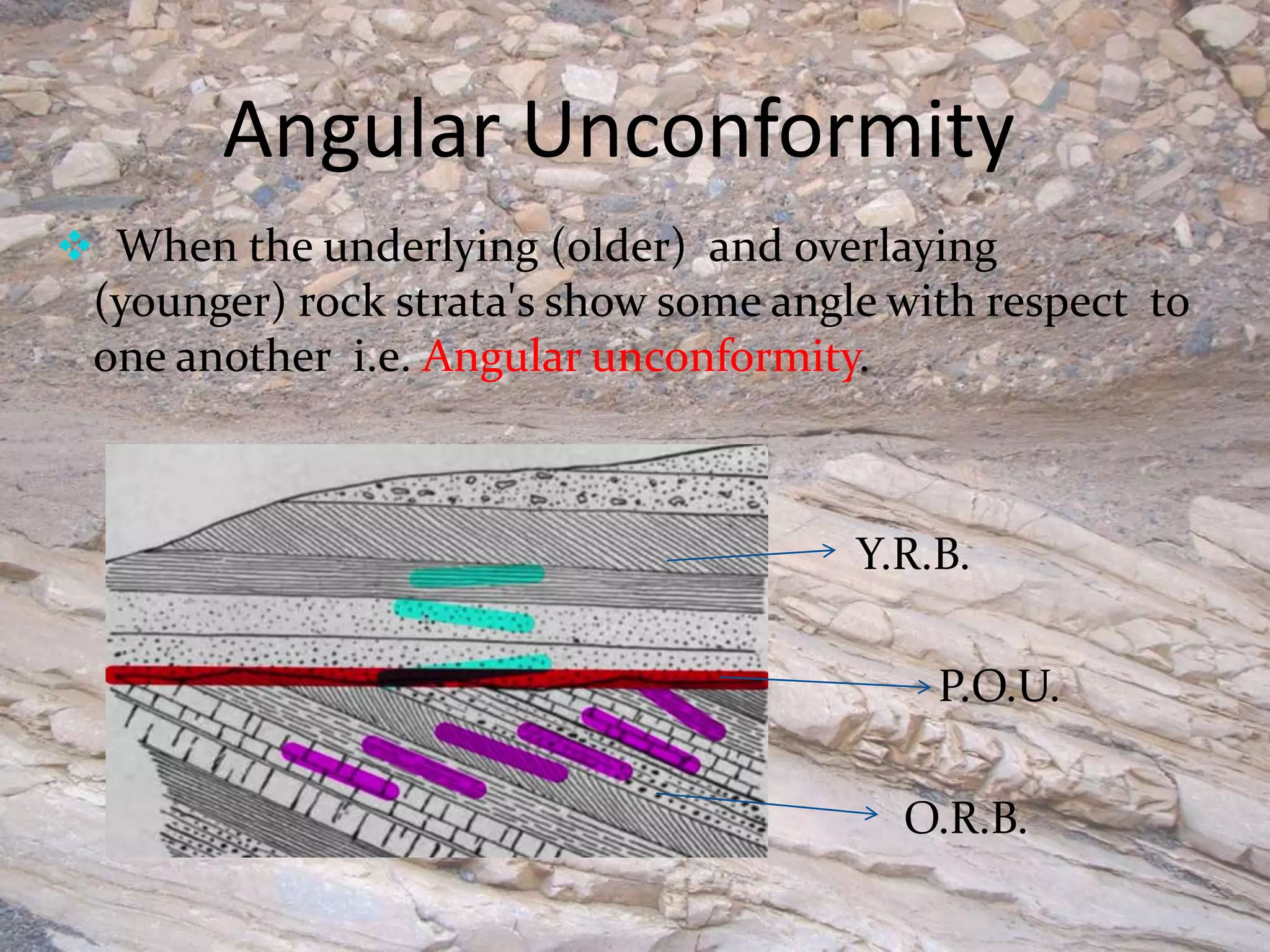
Angular Unconformity
Whenthe underlying (older) and overlaying
(younger) rock strata's show some angle with respect to
one another i.e. Angular unconformity.
Y.R.B.
P.O.U.
O.R.B.
8.
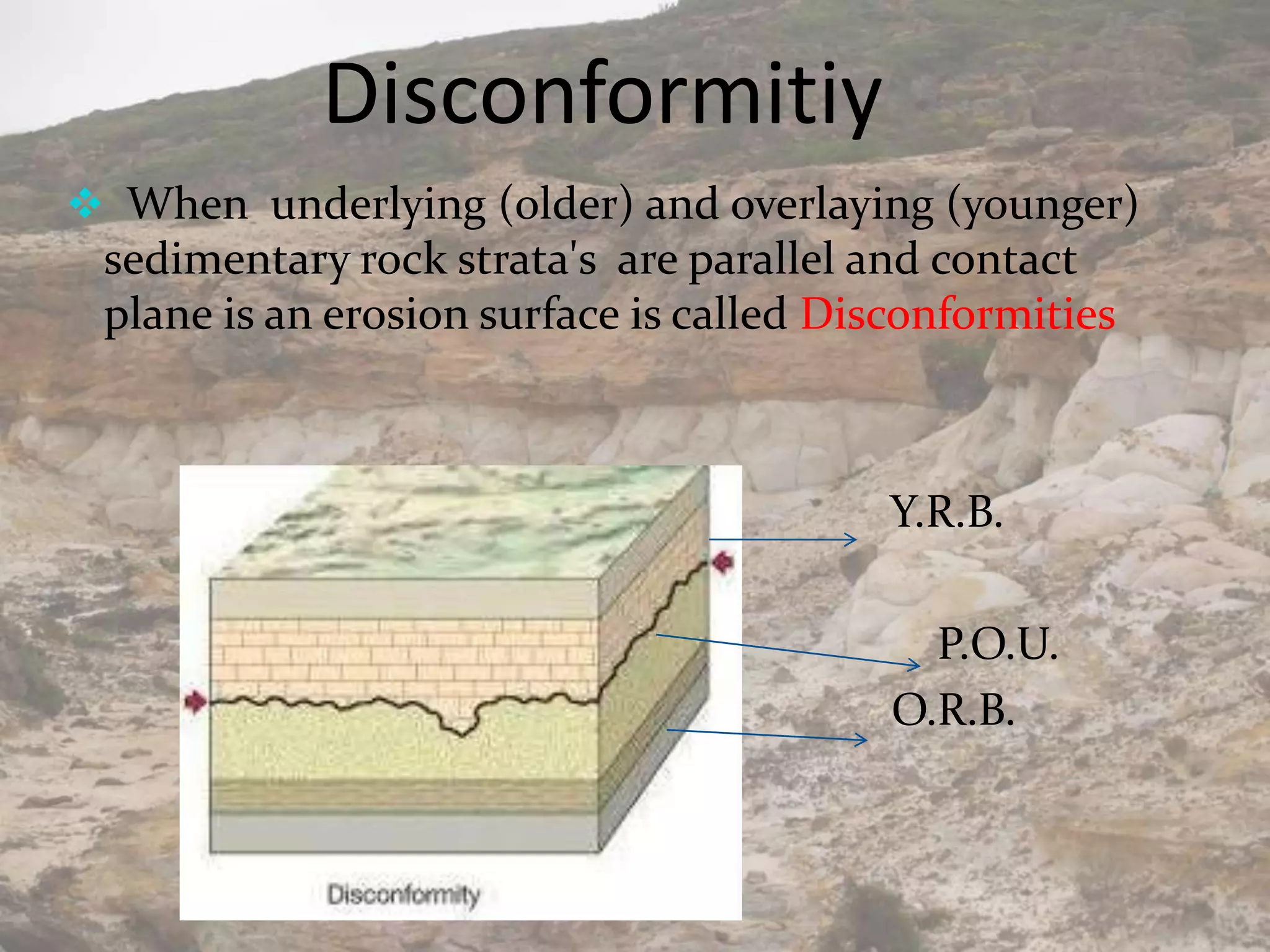
Disconformitiy
When underlying(older) and overlaying (younger)
sedimentary rock strata's are parallel and contact
plane is an erosion surface is called Disconformities
Y.R.B.
P.O.U.
O.R.B.
9.
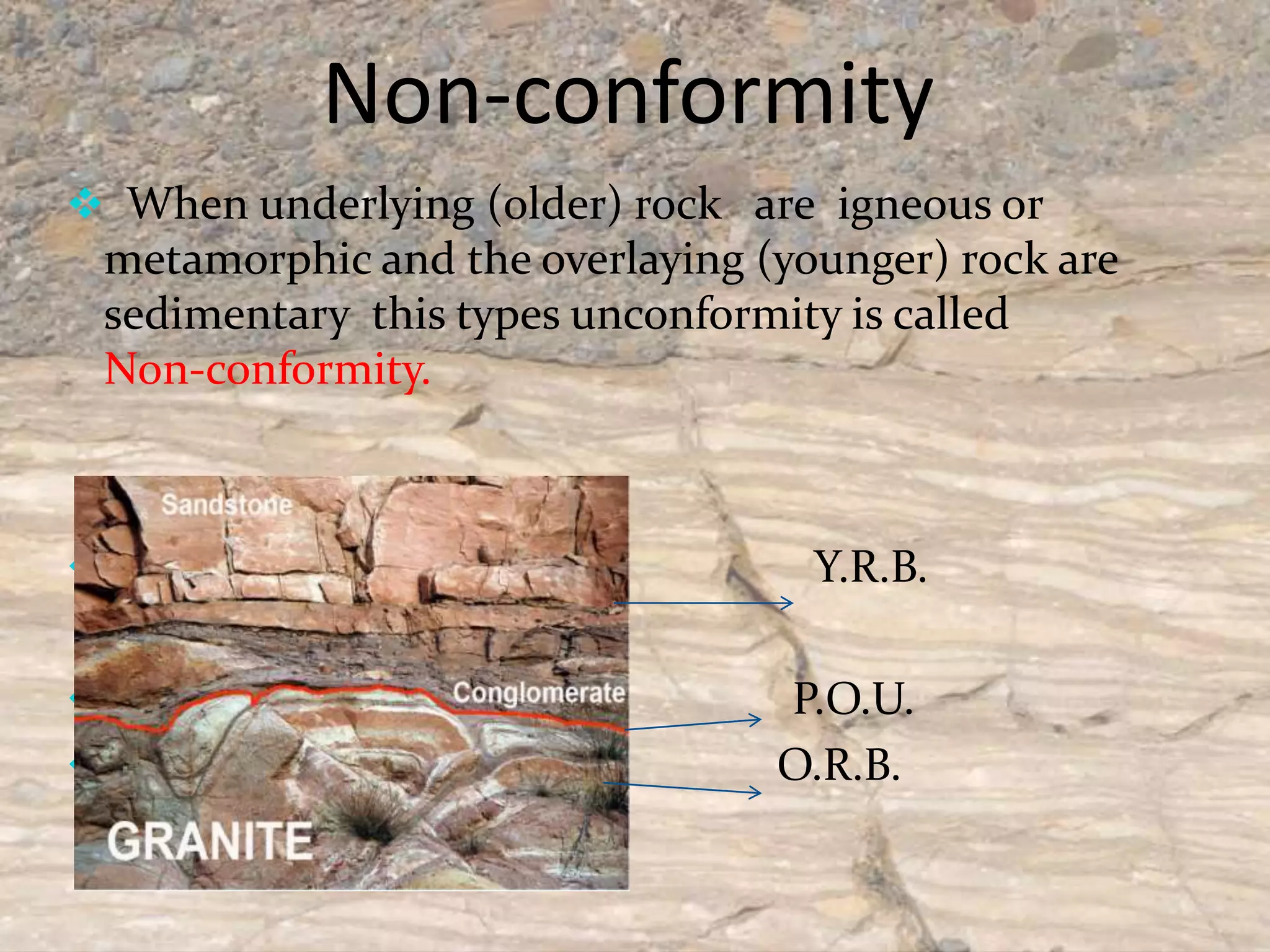
Non-conformity
When underlying(older) rock are igneous or
metamorphic and the overlaying (younger) rock are
sedimentary this types unconformity is called
Non-conformity.
Y.R.B.
P.O.U.
P.O.U. O.R.B.
10.
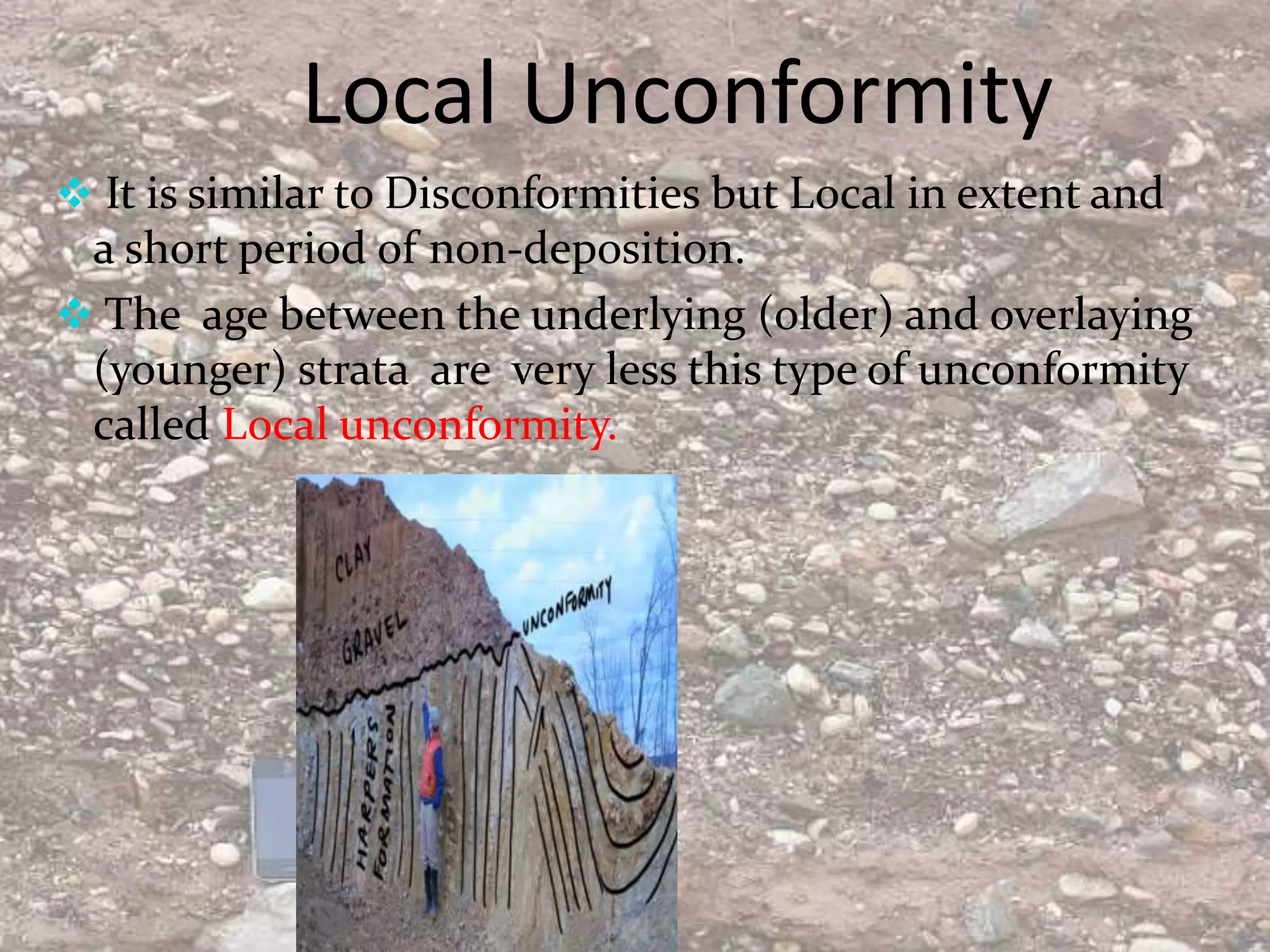
Local Unconformity
Itis similar to Disconformities but Local in extent and
a short period of non-deposition.
The age between the underlying (older) and overlaying
(younger) strata are very less this type of unconformity
called Local unconformity.
11.
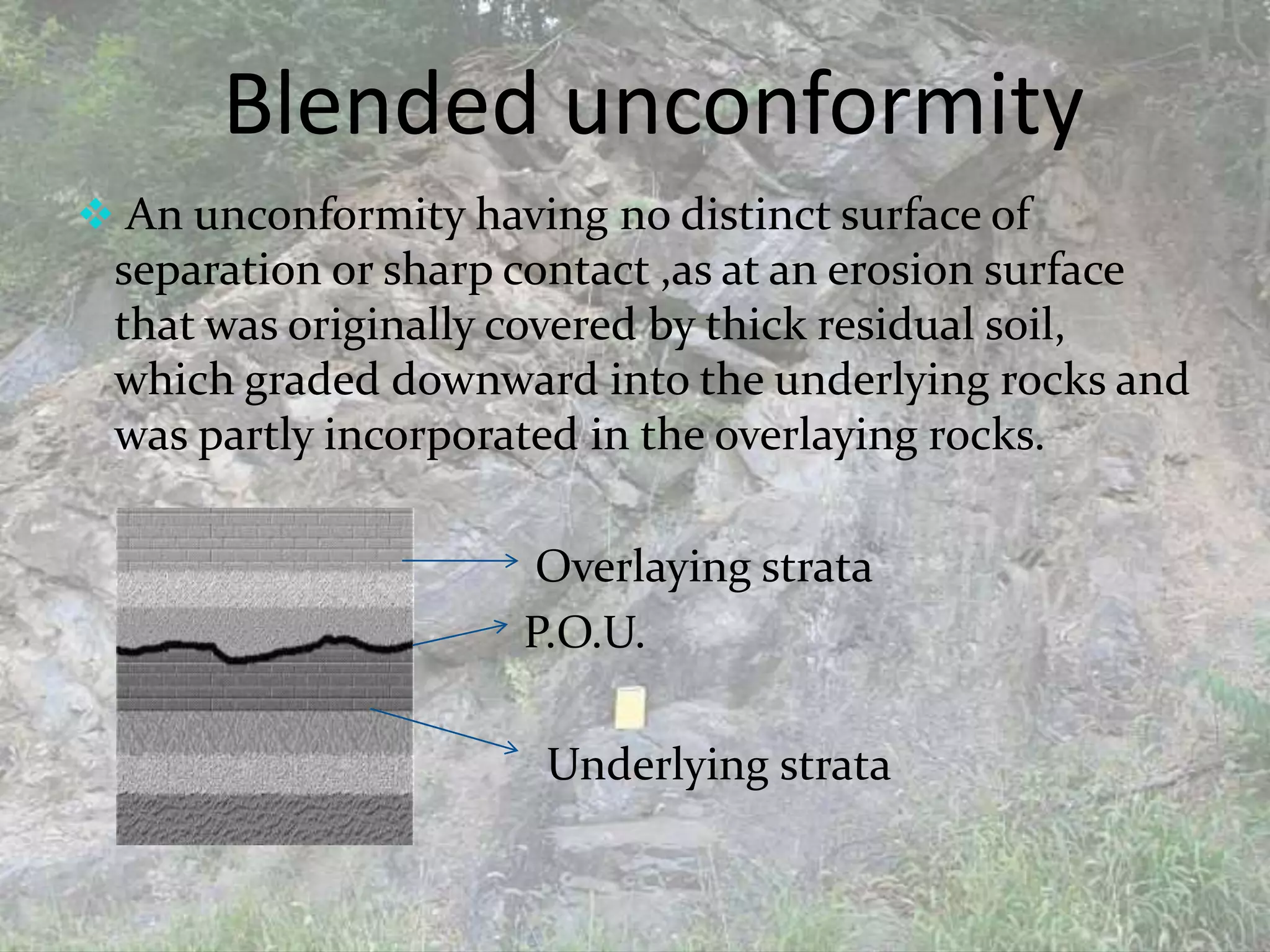
Blended unconformity
Anunconformity having no distinct surface of
separation or sharp contact ,as at an erosion surface
that was originally covered by thick residual soil,
which graded downward into the underlying rocks and
was partly incorporated in the overlaying rocks.
Overlaying strata
P.O.U.
Underlying strata
12.
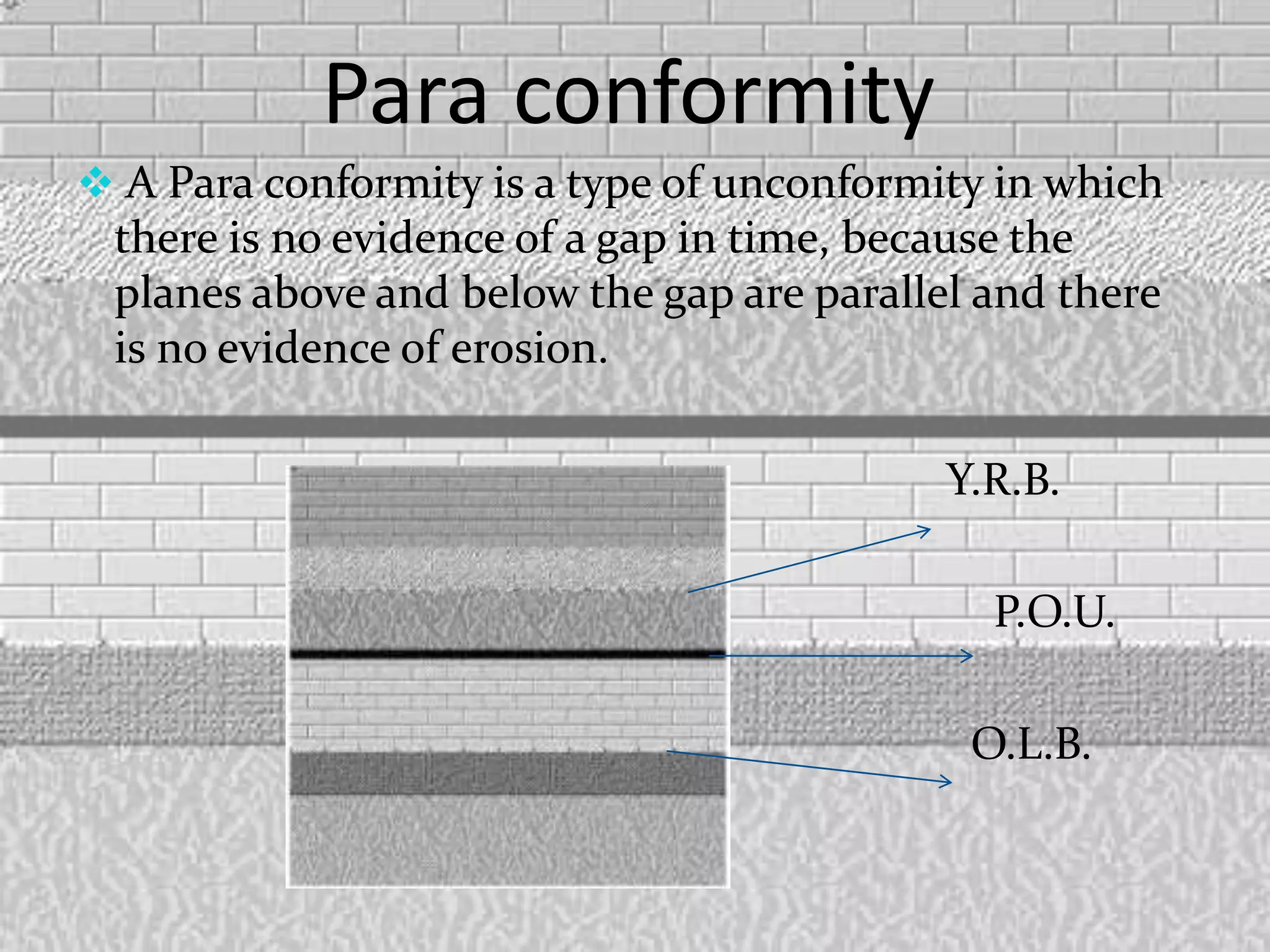
Para conformity
APara conformity is a type of unconformity in which
there is no evidence of a gap in time, because the
planes above and below the gap are parallel and there
is no evidence of erosion.
Y.R.B.
P.O.U.
O.L.B.
13.
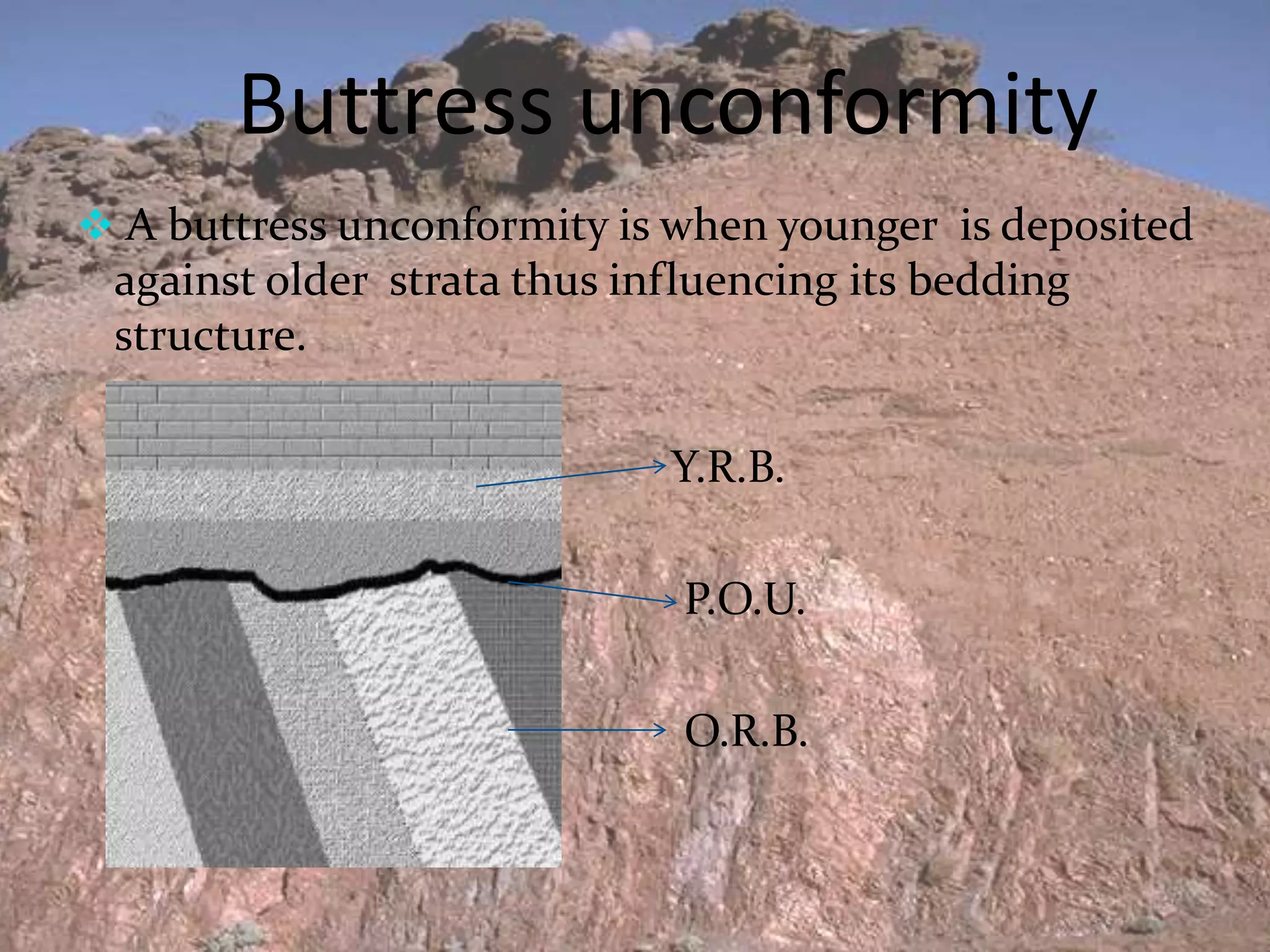
Buttress unconformity
Abuttress unconformity is when younger is deposited
against older strata thus influencing its bedding
structure.
Y.R.B.
P.O.U.
O.R.B.
14.
Signification of Unconformity
Time interval
Structural discordance
Topographic relief
Evidence of weathering at the unconformable surface
15.
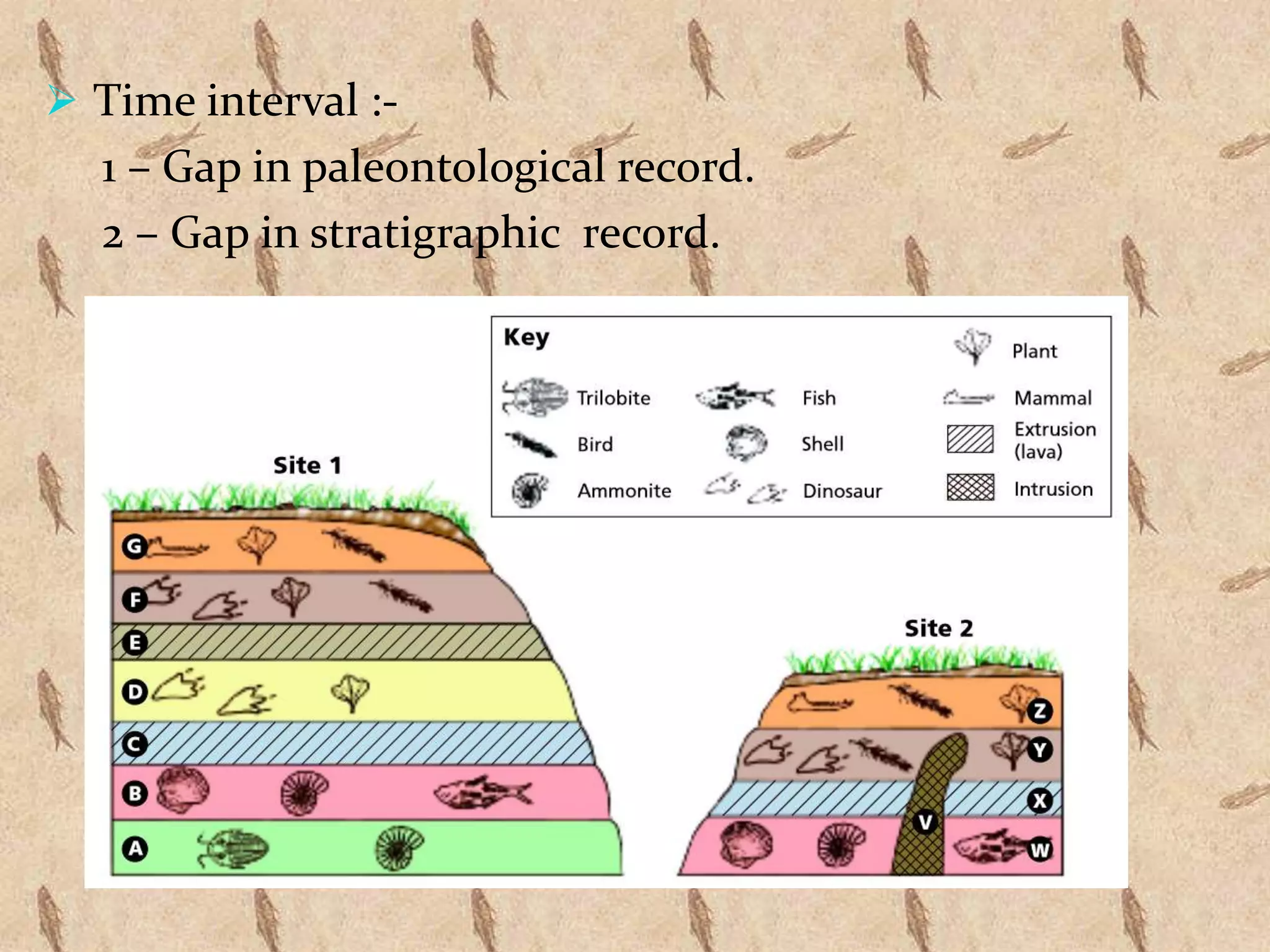
Time interval:-
1 – Gap in paleontological record.
2 – Gap in stratigraphic record.
17.
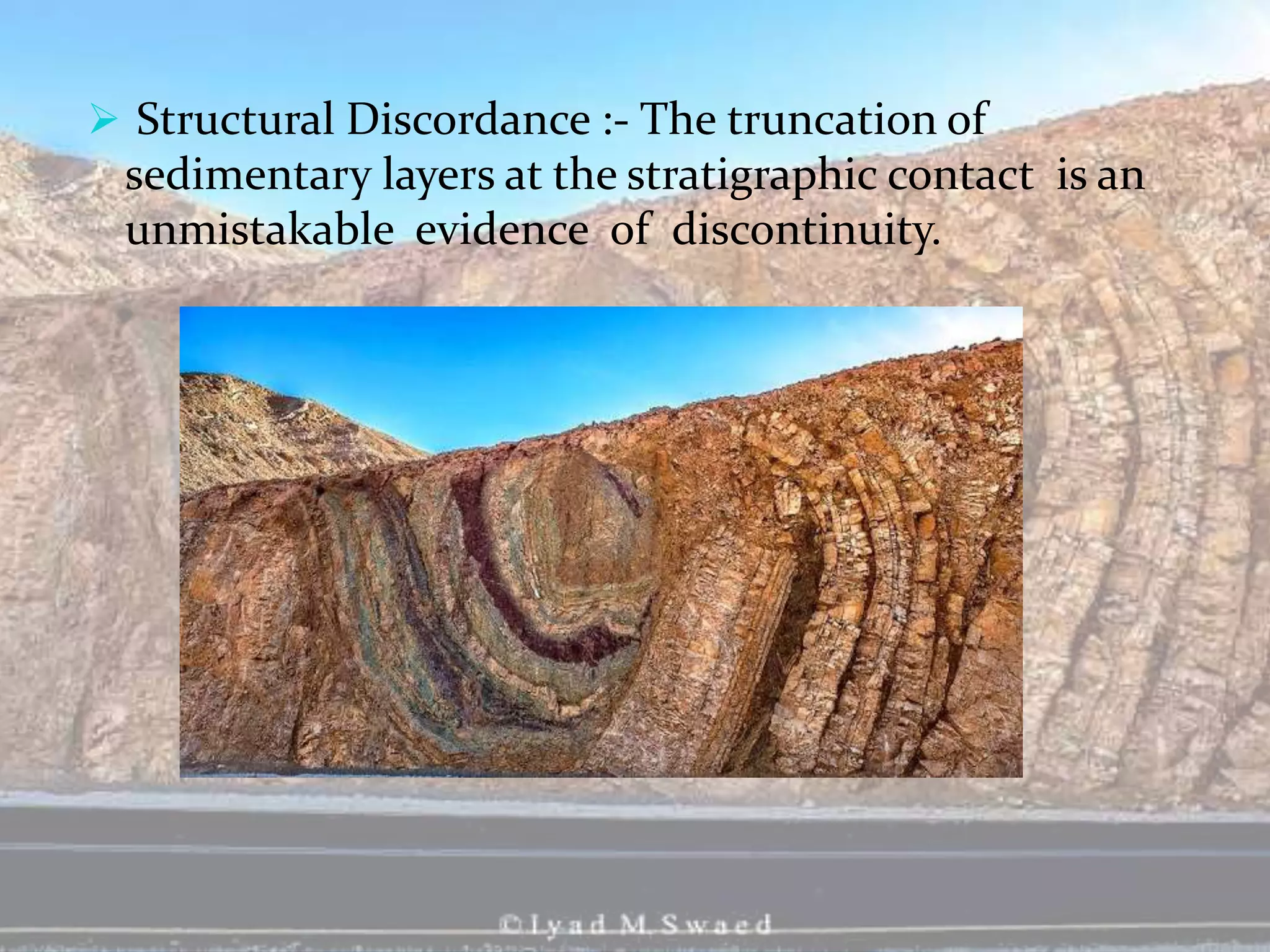
Structural Discordance:- The truncation of
sedimentary layers at the stratigraphic contact is an
unmistakable evidence of discontinuity.
18.
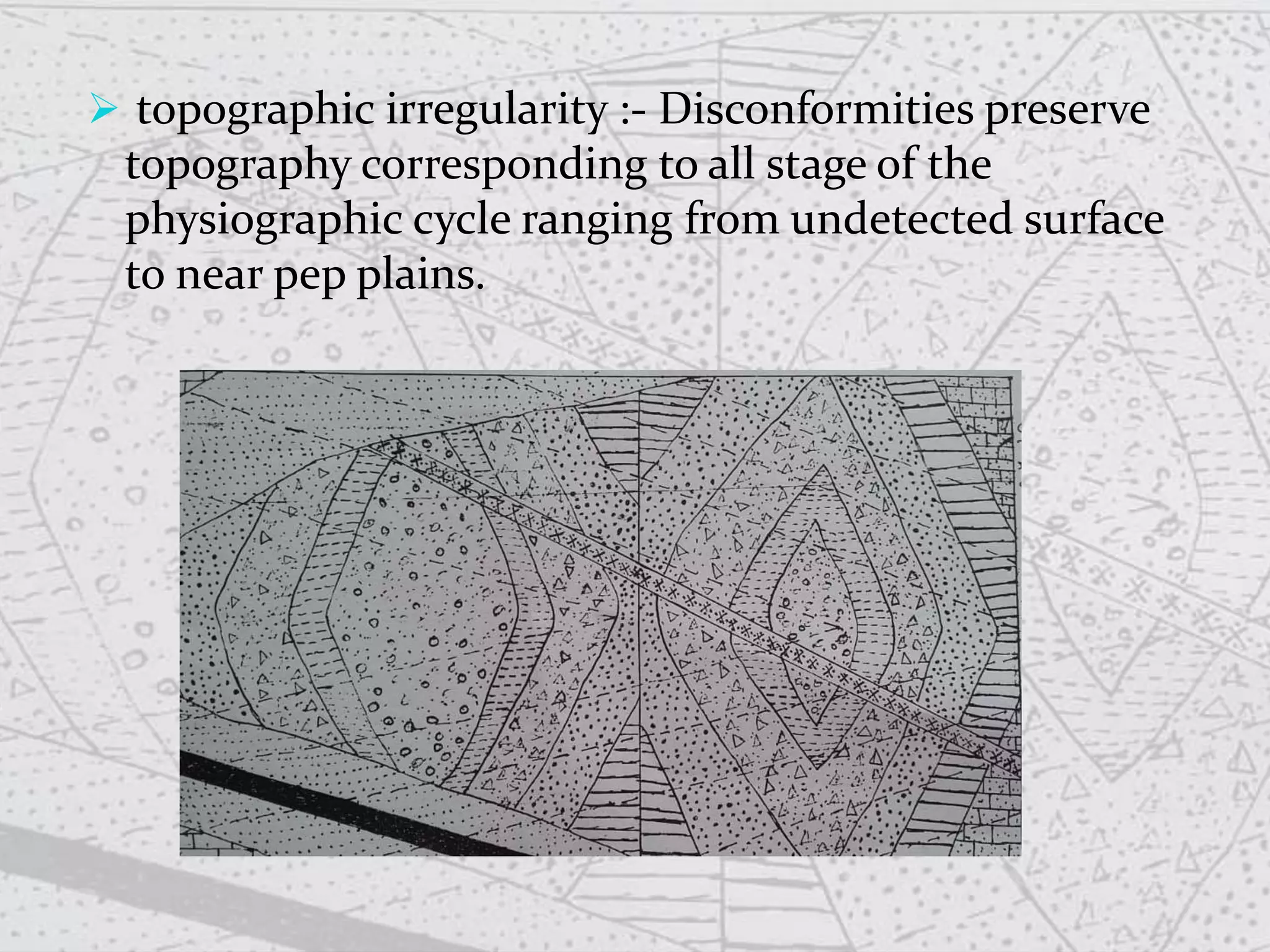
topographic irregularity:- Disconformities preserve
topography corresponding to all stage of the
physiographic cycle ranging from undetected surface
to near pep plains.
19.
Sharp contrastin the degree of indurations between
the underlying and overlying rocks.
Difference in the grade of regional metamorphism of
the underlying and overlaying rocks.
Presence of basal conglomerate horizon suggest the
existence of an unconformity.