A
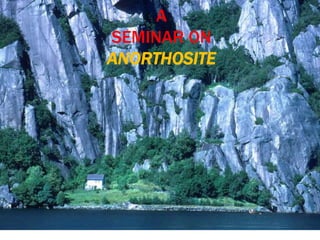
SEMINAR ON
ANORTHOSITE
CONTENTS
1. Introduction
2. Mineralogy
3. Texture
4. Classification
5. Proteroic anorthosite
6. Archean anorthosite
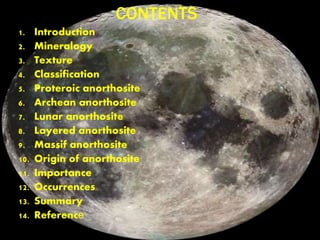
7. Lunar anorthosite
8. Layered anorthosite
9. Massif anorthosite
10. Origin of anorthosite
11. Importance
12. Occurrences
13. Summary
14. Reference
INTRODUCTION
• Anorthosite is a phaneritic, intrusive igneous rock
characterised by a predominance of plagioclase
feldspar (90-100%) and a minimal mafic component
(0-10).
• Pyroxene,ilmenite,magnetite,and olivine are the
mafic mineral commonly present.
• Anorthosite is important in academic and economic
fields.
MINERALOGY
• Anorthosite typically consist of 90-100% of
plagioclase in the andesine-labradorite range.
• Mafic minerals never exceed 10% of the rock.
• Some of the plagioclase is overgrown by later
crystallization of plagioclase, pyroxene or
ilmenite magnetite, producing very large
poiklitic grains.
• The finer interstitial grains are more mafic rich
containing bronzite-hypersthene and
titaniferous magnetite and ilmenite.
TEXTURE
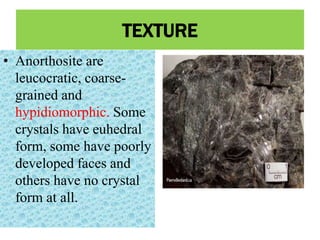
• Anorthosite are
leucocratic, coarse-
grained and
hypidiomorphic. Some
crystals have euhedral
form, some have poorly
developed faces and
others have no crystal
form at all.
Textures
CLASSIFICATION
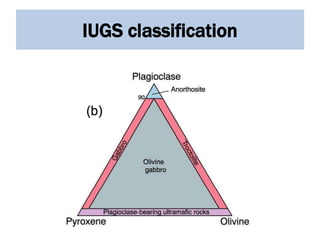
• Anorthosite can be classified on the
following three ways :
1) IUGS (International Union of Geological
Society)
2) Age of the formation
3) Their occurrence and association
 According to the age of the formation rock,
they are classiflied as Proteroic anorthosite
and Archean anorthosite.
 According to the occurance, they are
classified as Lunar, Massif, and Layered
anorthosite.
IUGS classification
Proteroic anorthosite
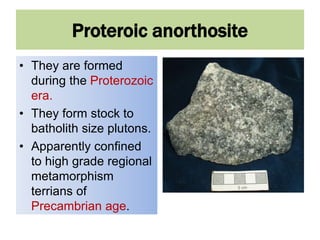
• They are formed
during the Proterozoic
era.
• They form stock to
batholith size plutons.
• Apparently confined
to high grade regional
metamorphism
terrians of
Precambrian age.
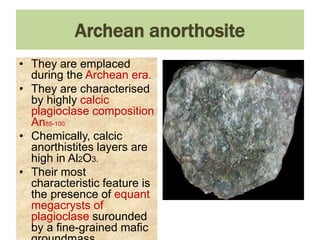
Archean anorthosite
• They are emplaced
during the Archean era.
• They are characterised
by highly calcic
plagioclase composition
An85-100.
• Chemically, calcic
anorthistites layers are
high in Al2O3.
• Their most
characteristic feature is
the presence of equant
megacrysts of
plagioclase surounded
by a fine-grained mafic
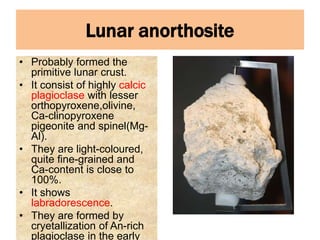
Lunar anorthosite
• Probably formed the
primitive lunar crust.
• It consist of highly calcic
plagioclase with lesser
orthopyroxene,olivine,
Ca-clinopyroxene
pigeonite and spinel(Mg-
Al).
• They are light-coloured,
quite fine-grained and
Ca-content is close to
100%.
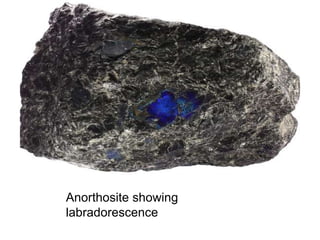
• It shows
labradorescence.
• They are formed by
cryetallization of An-rich
plagioclase in the early
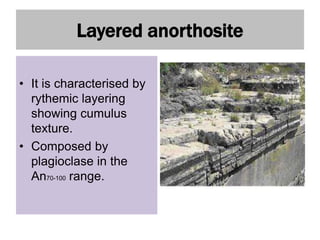
Layered anorthosite
• It is characterised by
rythemic layering
showing cumulus
texture.
• Composed by
plagioclase in the
An70-100 range.
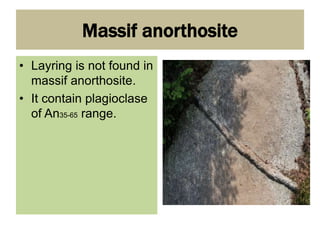
Massif anorthosite
• Layring is not found in
massif anorthosite.
• It contain plagioclase
of An35-65 range.
ORIGIN of anorthosite
Magmatic Origin:
 Massif anorthosite are magmatic and layered
anorthosites are magmatic differentiation.
• It has been derived from a basic magma either
grabbroic or dioritic in compsition.
• They are originated from early crystallisation and
accumulation of anorthite-rich plagioclase and
their staining off by filter pressing process.
Metasomatism:
• Process of metasomatic replacement attendant
with higher grades of metamorphism is also an
originating way of anorthosite.
IMPORTANCE
• Aorthosites have economic value that it
has titanium-bearing oxide ilmenite. However,
some Proterozoic anorthosite bodies have large
amounts of labradorite, which is quarried for its
value as both a gemstone and a building
material.
• Archean anorthosites, because they
are calcium-rich, have large amounts
of aluminium substituting for silicon; a few of
these bodies are mined as ores of aluminium.
• Anorthosite was prominently represented in rock
samples brought back from the Moon, and is
important in investigations of Mars, Venus,
and meteorites.
OCCURRENCE
 Anorthosite are occurred in different parts of
the world. Some of them are listed below:
1. Sandford lake, New York.
2. Allard Lake, Southern Quebec.
3. Ukraine of USSR.
4. Oaxaca, Mexico.
5. Norway.
6. Rainy lake area of Western Ontario.
7. West Greenland, southeast Greenland.
8. The Lewisian of northwest Scotland.
Indian occurrence
1. Sittampundi,Oddanchatram, Kadavur
areas of Tamil Nadu.
2. Karaput, Rambha, Banpur, Kalahandi
area of Orissa.
3. Kondapalli of Andhra Pradesh.
4. Mayurbhanj of Rajasthan.
5. Bankura of Bengal.
SUMMARY
• Anorthosite is a phaneritic, intrusive igneous rock
that contain more amount of plagioclase feldspar,
nearly 100%.
• They are mainly classified as Proteroic anorthosite,
Archean anorthosite, Lunar anorthosite and Layered
anorthosite.
• Proteroic anorthosite also known as massif
anorthosite are formed during Proterozoic era and
are characterised by plagioclase feldspar.
• Archean anorthosite are formed during the Archean
era and are charaterised by Calsic Plagioclase.
• Anorthosites are major sources of Titanium and
some extent Iron. Lunar anorthosite is important in
investigation of mars, venus and meteorites.They
also have gem rock quality.
Reference
• Donald W.Hyndman(1985), “Petrology of
igneous and metamorphic rock”, Pg no. 333
to 346.
• S.Subramanian, “ Petrology I”, Pg no. 154
to158.
• Walter T.Huang,(2012) “Petrology”,Pg no.145
to 146, 135, 136.
• www.en.wikipedia.org
Closer veiw of the stickingly paired
couplets of thin and thick anorthosite
layers with intervening dark pyroxene
Orthopyroxene megacrystal in anorthosite
Anorthosite showing
labradorescence
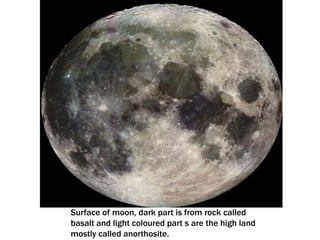
Surface of moon, dark part is from rock called
basalt and light coloured part s are the high land
mostly called anorthosite.
Anorthosite rocks used as gems
THANK YOU

Anorthosite

  • 1.
  • 2.
    CONTENTS 1. Introduction 2. Mineralogy 3.Texture 4. Classification 5. Proteroic anorthosite 6. Archean anorthosite 7. Lunar anorthosite 8. Layered anorthosite 9. Massif anorthosite 10. Origin of anorthosite 11. Importance 12. Occurrences 13. Summary 14. Reference
  • 3.
    INTRODUCTION • Anorthosite isa phaneritic, intrusive igneous rock characterised by a predominance of plagioclase feldspar (90-100%) and a minimal mafic component (0-10). • Pyroxene,ilmenite,magnetite,and olivine are the mafic mineral commonly present. • Anorthosite is important in academic and economic fields.
  • 4.
    MINERALOGY • Anorthosite typicallyconsist of 90-100% of plagioclase in the andesine-labradorite range. • Mafic minerals never exceed 10% of the rock. • Some of the plagioclase is overgrown by later crystallization of plagioclase, pyroxene or ilmenite magnetite, producing very large poiklitic grains. • The finer interstitial grains are more mafic rich containing bronzite-hypersthene and titaniferous magnetite and ilmenite.
  • 5.
    TEXTURE • Anorthosite are leucocratic,coarse- grained and hypidiomorphic. Some crystals have euhedral form, some have poorly developed faces and others have no crystal form at all.
  • 6.
  • 7.
    CLASSIFICATION • Anorthosite canbe classified on the following three ways : 1) IUGS (International Union of Geological Society) 2) Age of the formation 3) Their occurrence and association  According to the age of the formation rock, they are classiflied as Proteroic anorthosite and Archean anorthosite.  According to the occurance, they are classified as Lunar, Massif, and Layered anorthosite.
  • 8.
  • 9.
    Proteroic anorthosite • Theyare formed during the Proterozoic era. • They form stock to batholith size plutons. • Apparently confined to high grade regional metamorphism terrians of Precambrian age.
  • 10.
    Archean anorthosite • Theyare emplaced during the Archean era. • They are characterised by highly calcic plagioclase composition An85-100. • Chemically, calcic anorthistites layers are high in Al2O3. • Their most characteristic feature is the presence of equant megacrysts of plagioclase surounded by a fine-grained mafic
  • 11.
    Lunar anorthosite • Probablyformed the primitive lunar crust. • It consist of highly calcic plagioclase with lesser orthopyroxene,olivine, Ca-clinopyroxene pigeonite and spinel(Mg- Al). • They are light-coloured, quite fine-grained and Ca-content is close to 100%. • It shows labradorescence. • They are formed by cryetallization of An-rich plagioclase in the early
  • 12.
    Layered anorthosite • Itis characterised by rythemic layering showing cumulus texture. • Composed by plagioclase in the An70-100 range.
  • 13.
    Massif anorthosite • Layringis not found in massif anorthosite. • It contain plagioclase of An35-65 range.
  • 14.
    ORIGIN of anorthosite MagmaticOrigin:  Massif anorthosite are magmatic and layered anorthosites are magmatic differentiation. • It has been derived from a basic magma either grabbroic or dioritic in compsition. • They are originated from early crystallisation and accumulation of anorthite-rich plagioclase and their staining off by filter pressing process. Metasomatism: • Process of metasomatic replacement attendant with higher grades of metamorphism is also an originating way of anorthosite.
  • 15.
    IMPORTANCE • Aorthosites haveeconomic value that it has titanium-bearing oxide ilmenite. However, some Proterozoic anorthosite bodies have large amounts of labradorite, which is quarried for its value as both a gemstone and a building material. • Archean anorthosites, because they are calcium-rich, have large amounts of aluminium substituting for silicon; a few of these bodies are mined as ores of aluminium. • Anorthosite was prominently represented in rock samples brought back from the Moon, and is important in investigations of Mars, Venus, and meteorites.
  • 16.
    OCCURRENCE  Anorthosite areoccurred in different parts of the world. Some of them are listed below: 1. Sandford lake, New York. 2. Allard Lake, Southern Quebec. 3. Ukraine of USSR. 4. Oaxaca, Mexico. 5. Norway. 6. Rainy lake area of Western Ontario. 7. West Greenland, southeast Greenland. 8. The Lewisian of northwest Scotland.
  • 17.
    Indian occurrence 1. Sittampundi,Oddanchatram,Kadavur areas of Tamil Nadu. 2. Karaput, Rambha, Banpur, Kalahandi area of Orissa. 3. Kondapalli of Andhra Pradesh. 4. Mayurbhanj of Rajasthan. 5. Bankura of Bengal.
  • 18.
    SUMMARY • Anorthosite isa phaneritic, intrusive igneous rock that contain more amount of plagioclase feldspar, nearly 100%. • They are mainly classified as Proteroic anorthosite, Archean anorthosite, Lunar anorthosite and Layered anorthosite. • Proteroic anorthosite also known as massif anorthosite are formed during Proterozoic era and are characterised by plagioclase feldspar. • Archean anorthosite are formed during the Archean era and are charaterised by Calsic Plagioclase. • Anorthosites are major sources of Titanium and some extent Iron. Lunar anorthosite is important in investigation of mars, venus and meteorites.They also have gem rock quality.
  • 19.
    Reference • Donald W.Hyndman(1985),“Petrology of igneous and metamorphic rock”, Pg no. 333 to 346. • S.Subramanian, “ Petrology I”, Pg no. 154 to158. • Walter T.Huang,(2012) “Petrology”,Pg no.145 to 146, 135, 136. • www.en.wikipedia.org
  • 20.
    Closer veiw ofthe stickingly paired couplets of thin and thick anorthosite layers with intervening dark pyroxene
  • 21.
  • 22.
  • 23.
    Surface of moon,dark part is from rock called basalt and light coloured part s are the high land mostly called anorthosite.
  • 24.
  • 25.