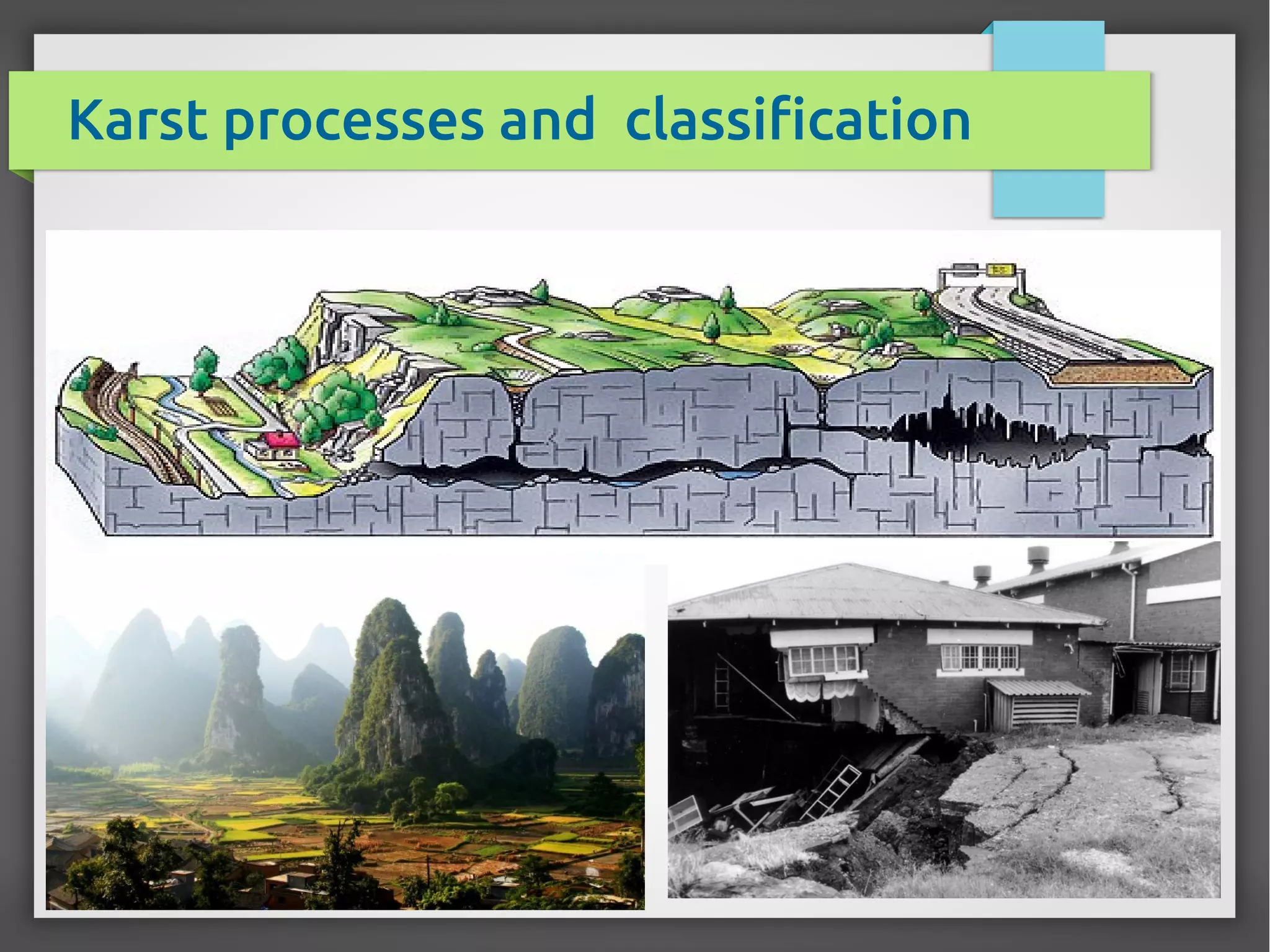
Karst processes and classification
Karst
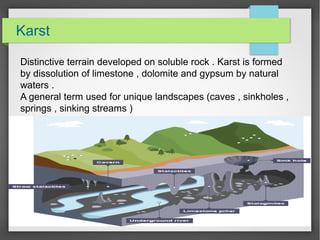
Distinctive terrain developed on soluble rock . Karst is formed
by dissolution of limestone , dolomite and gypsum by natural
waters .
A general term used for unique landscapes (caves , sinkholes ,
springs , sinking streams )
Karst
Karst processes
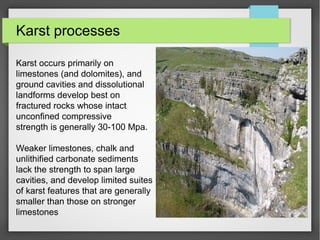
Karst occurs primarily on
limestones (and dolomites), and
ground cavities and dissolutional
landforms develop best on
fractured rocks whose intact
unconfined compressive
strength is generally 30-100 Mpa.
Weaker limestones, chalk and
unlithified carbonate sediments
lack the strength to span large
cavities, and develop limited suites
of karst features that are generally
smaller than those on stronger
limestones
Karst processes
Gypsum karst has many features comparable with those on limestone,
but is distinguished by wider development of greater numbers of
breccia pipes and it does not mature through to cone karst or tower
karst .
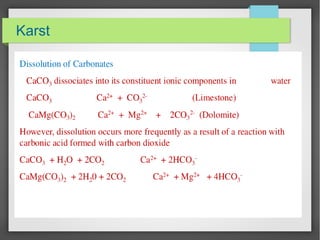
Dissolution of calcium carbonate in water is primarily dependant on the
availability of biogenic carbon dioxide, which occurs at the highest
concentrations in deep soils and in tropical areas .
The most mature karst occurs in wet tropical environments. Limestone
dissolution is reduced in temperate regions, and is minimal in arid,
periglacial and glacial regimes .
Karst processes
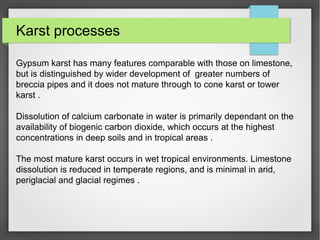
Limestone dissolution is slow. Surface lowering and wall retreat within
fissures and caves are no more than a few millimetres per 100 years,
though may be faster in fissures under very high flow conditions
created by dam leakage .
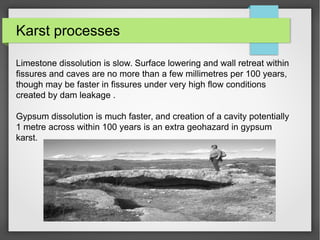
Gypsum dissolution is much faster, and creation of a cavity potentially
1 metre across within 100 years is an extra geohazard in gypsum
karst.
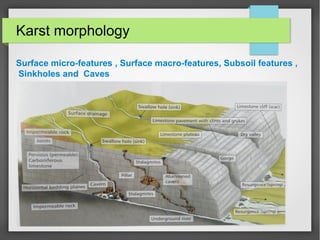
Karst morphology
Surface micro-features , Surface macro-features, Subsoil features ,
Sinkholes and Caves
Karst morphology
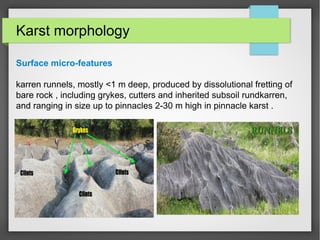
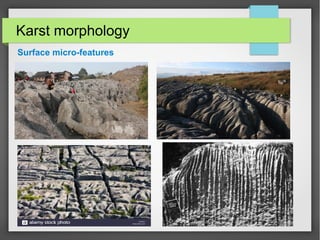
Surface micro-features
karren runnels, mostly <1 m deep, produced by dissolutional fretting of
bare rock , including grykes, cutters and inherited subsoil rundkarren,
and ranging in size up to pinnacles 2-30 m high in pinnacle karst .
Karst morphology
Surface micro-features
Karst morphology
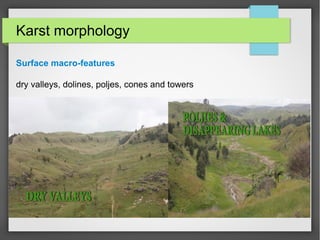
Surface macro-features
dry valleys, dolines, poljes, cones and towers
Karst morphology
Surface Macro-features
Karst morphology
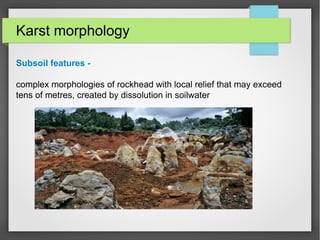
Subsoil features -
complex morphologies of rockhead with local relief that may exceed
tens of metres, created by dissolution in soilwater
Karst morphology
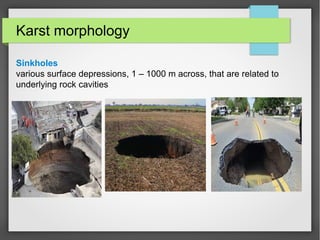
Sinkholes
various surface depressions, 1 – 1000 m across, that are related to
underlying rock cavities
Karst morphology
Caves
cavities typically metres or tens of metres across formed within the rock
by its dissolution, and left empty or filled with sediment
Karst types
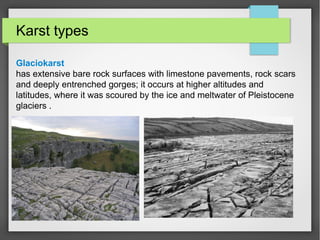
Glaciokarst
has extensive bare rock surfaces with limestone pavements, rock scars
and deeply entrenched gorges; it occurs at higher altitudes and
latitudes, where it was scoured by the ice and meltwater of Pleistocene
glaciers .
Karst types
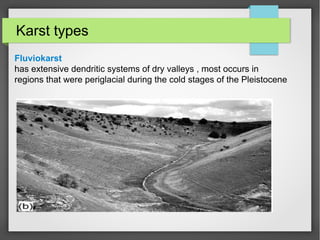
Fluviokarst
has extensive dendritic systems of dry valleys , most occurs in
regions that were periglacial during the cold stages of the Pleistocene
Karst types
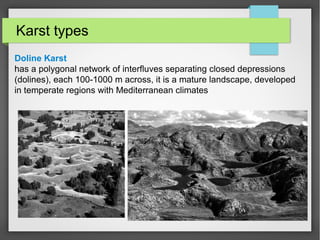
Doline Karst
has a polygonal network of interfluves separating closed depressions
(dolines), each 100-1000 m across, it is a mature landscape, developed
in temperate regions with Mediterranean climates
Karst types
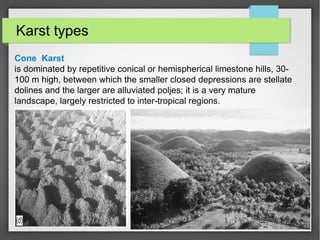
Cone Karst
is dominated by repetitive conical or hemispherical limestone hills, 30-
100 m high, between which the smaller closed depressions are stellate
dolines and the larger are alluviated poljes; it is a very mature
landscape, largely restricted to inter-tropical regions.
Karst types
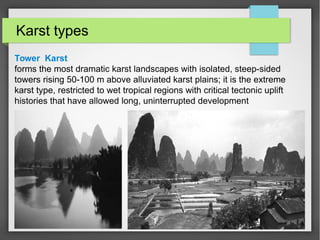
Tower Karst
forms the most dramatic karst landscapes with isolated, steep-sided
towers rising 50-100 m above alluviated karst plains; it is the extreme
karst type, restricted to wet tropical regions with critical tectonic uplift
histories that have allowed long, uninterrupted development
Caves in karst
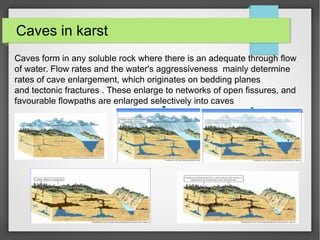
Caves form in any soluble rock where there is an adequate through flow
of water. Flow rates and the water's aggressiveness mainly determine
rates of cave enlargement, which originates on bedding planes
and tectonic fractures . These enlarge to networks of open fissures, and
favourable flowpaths are enlarged selectively into caves
Caves in karst
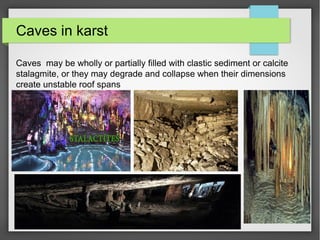
Caves may be wholly or partially filled with clastic sediment or calcite
stalagmite, or they may degrade and collapse when their dimensions
create unstable roof spans
Caves in Karst
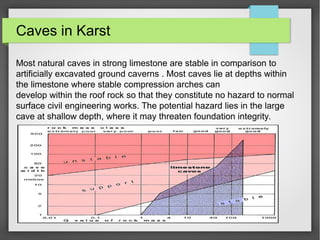
Most natural caves in strong limestone are stable in comparison to
artificially excavated ground caverns . Most caves lie at depths within
the limestone where stable compression arches can
develop within the roof rock so that they constitute no hazard to normal
surface civil engineering works. The potential hazard lies in the large
cave at shallow depth, where it may threaten foundation integrity.
Sinkholes in karst
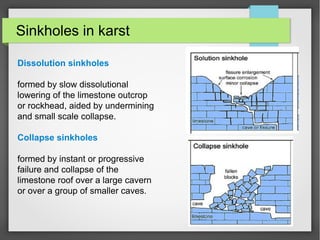
Dissolution sinkholes
formed by slow dissolutional
lowering of the limestone outcrop
or rockhead, aided by undermining
and small scale collapse.
Collapse sinkholes
formed by instant or progressive
failure and collapse of the
limestone roof over a large cavern
or over a group of smaller caves.
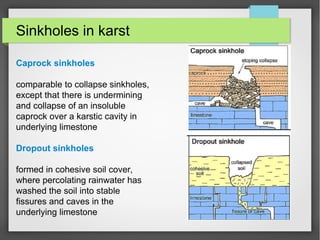
Sinkholes in karst
Caprock sinkholes
comparable to collapse sinkholes,
except that there is undermining
and collapse of an insoluble
caprock over a karstic cavity in
underlying limestone
Dropout sinkholes
formed in cohesive soil cover,
where percolating rainwater has
washed the soil into stable
fissures and caves in the
underlying limestone
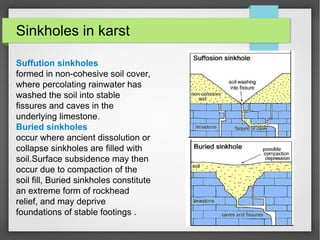
Sinkholes in karst
Suffution sinkholes
formed in non-cohesive soil cover,
where percolating rainwater has
washed the soil into stable
fissures and caves in the
underlying limestone.
Buried sinkholes
occur where ancient dissolution or
collapse sinkholes are filled with
soil.Surface subsidence may then
occur due to compaction of the
soil fill, Buried sinkholes constitute
an extreme form of rockhead
relief, and may deprive
foundations of stable footings .
Sinkholes hazards
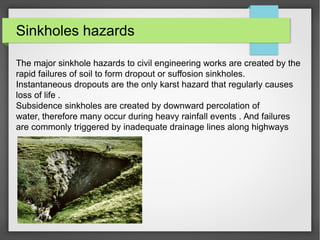
The major sinkhole hazards to civil engineering works are created by the
rapid failures of soil to form dropout or suffosion sinkholes.
Instantaneous dropouts are the only karst hazard that regularly causes
loss of life .
Subsidence sinkholes are created by downward percolation of
water, therefore many occur during heavy rainfall events . And failures
are commonly triggered by inadequate drainage lines along highways
Rockhead in karst
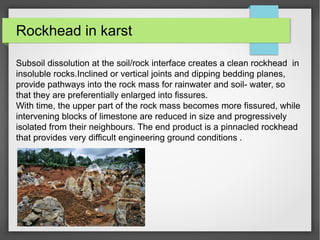
Subsoil dissolution at the soil/rock interface creates a clean rockhead in
insoluble rocks.Inclined or vertical joints and dipping bedding planes,
provide pathways into the rock mass for rainwater and soil- water, so
that they are preferentially enlarged into fissures.
With time, the upper part of the rock mass becomes more fissured, while
intervening blocks of limestone are reduced in size and progressively
isolated from their neighbours. The end product is a pinnacled rockhead
that provides very difficult engineering ground conditions .
Rockhead in karst
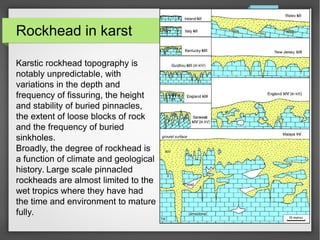
Karstic rockhead topography is
notably unpredictable, with
variations in the depth and
frequency of fissuring, the height
and stability of buried pinnacles,
the extent of loose blocks of rock
and the frequency of buried
sinkholes.
Broadly, the degree of rockhead is
a function of climate and geological
history. Large scale pinnacled
rockheads are almost limited to the
wet tropics where they have had
the time and environment to mature
fully.
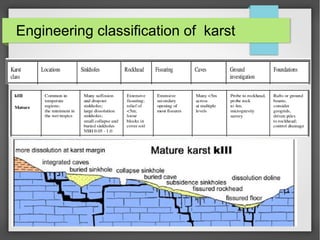
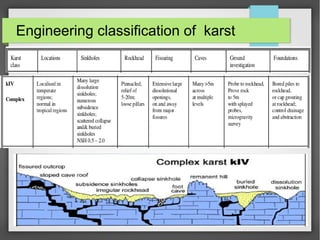
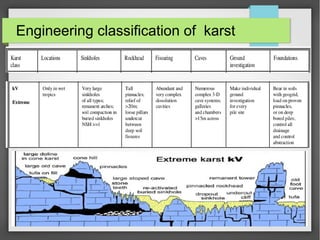
Engineering classification of karst
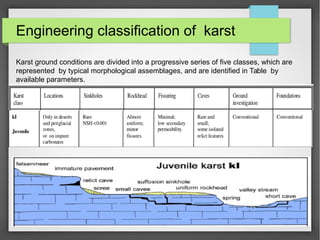
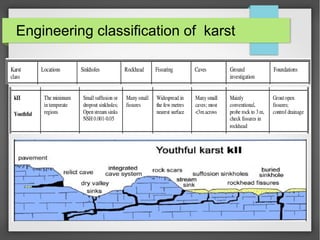
Karst ground conditions are divided into a progressive series of five classes, which are
represented by typical morphological assemblages, and are identified in Table by
available parameters.
Engineering classification of karst
Ground Investigation
Geophysical identification of ground voids has not produced
consistently reliable interpretations, but technology is advancing, and
there are techniques that can produce useful results in certain
Situations .
Microgravity surveys identify missing mass(negative anomalies
represent the missing data) within the ground and produce good
data .
Seismic velocities decrease in more fissured and more cavernous
ground; they correlate with engineering classifications of rock mass,
and could perhaps be used to characterise karst classes.
Resistivity surveys are used for rockhead profiling but deeply
pinnacled rockheads in karst of classes kIV and kV are too complex
to be resolved by surface geophysics.
Ground Investigation
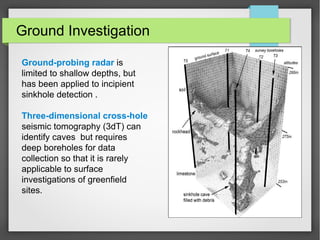
Ground-probing radar is
limited to shallow depths, but
has been applied to incipient
sinkhole detection .
Three-dimensional cross-hole
seismic tomography (3dT) can
identify caves but requires
deep boreholes for data
collection so that it is rarely
applicable to surface
investigations of greenfield
sites.
Ground Engineering
Foundation over rockheads
Karst of class kI provides rockhead that may require response during
construction.
Rockhead of class kII karst generally creates only minor problems.
Installation of piles may require longer elements for some parts
of a site and reinforced ground beams ..
In class kIII karst, rafts or groundbeams may bridge cavities , rafts or
preparatory grouting are preferred where new sinkholes are recorded
locally at rates above 0.05/km 2 /year .
Pinnacled rockheads of karst classes kIV and kV generally require
that structures are founded on sound limestone by piling to rockhead
bored piles are preferred. Each pile tip is probed to ensure lack of
voids beneath .
Ground Engineering
Foundations over caves
Caves are unpredictable. Every site in karst has to be assessed
individually . Local records and observations may indicate typical and
maximum cave sizes.
Caves typically reach widths of 10 m in karst of class kIV, so probing
to 7 m is appropriate in limestone.
Caves at critical locations under planned foundations, are normally
filled with mass concrete .
Piles that are preformed or cast in geotextile sleeves can transfer
load to a solid cave floor .
prevention of sinkhole failure
The key to minimising sinkhole failures in karst is proper control of
water flows.
Design specifications for a karst site should include a ban on
soakaway drains . Dry wells are acceptable where they are sealed
onto open fissures and cased below rockhead .
Control of water abstraction is also critical, especially where
the water table is close above rockhead.
Grout sealing of rockhead fissures is problematical, but may be
appropriate on any karst except that of class kI; pinnacled rockheads
of classes kIV and kV require elaborate 'cap grouting'
Compaction grouting (with slump <25 mm) has been used to
remediate sinkholes over pinnacled rockheads of classes kII -kIV .
Conclusion
Karst frequently presents "difficult ground conditions" to engineers, an
improved classification is presented to provide starting points in
recognising the scale of karst geohazards in widely varying terrains.
A proper understanding of karst is essential to good practice in
ground engineering.
References
Engineering classification of karst ground conditions A. C. Waltham 1 and P. G. Fookes 2
Karst Processes and Landscapes Dr. Mike Caudill
Karst Processes and Landforms
Karst Hydrogeology and Geomorphology Derek Ford, McMaster University, Canada
and Paul Williams, University of Auckland, New Zealand
Sinkholes and Subsidence - Karst and Cavernous Rocks in Engineering and Construction Tony
Waltham , Fred Bell and Martin Culshaw
http://www.limestone-pavements.org.uk/geology.html
https://www.youtube.com/watch?v=XMgattdqc_I
https://www.youtube.com/watch?v=GoZElGPzoXs
https://www.youtube.com/watch?v=pa-jnsT8lL4
https://www.youtube.com/watch?v=BB7a5KReUmE
Best regards ,
Amr Elgabri
linkedin.com/in/amrelgabry
amrelgabry@gstd.sci.cu.edu.eg
gabora2004@gmail.com

Karst processes and engineering classification

  • 1.
    Karst processes andclassification
  • 2.
    Karst Distinctive terrain developedon soluble rock . Karst is formed by dissolution of limestone , dolomite and gypsum by natural waters . A general term used for unique landscapes (caves , sinkholes , springs , sinking streams )
  • 3.
  • 4.
    Karst processes Karst occursprimarily on limestones (and dolomites), and ground cavities and dissolutional landforms develop best on fractured rocks whose intact unconfined compressive strength is generally 30-100 Mpa. Weaker limestones, chalk and unlithified carbonate sediments lack the strength to span large cavities, and develop limited suites of karst features that are generally smaller than those on stronger limestones
  • 5.
    Karst processes Gypsum karsthas many features comparable with those on limestone, but is distinguished by wider development of greater numbers of breccia pipes and it does not mature through to cone karst or tower karst . Dissolution of calcium carbonate in water is primarily dependant on the availability of biogenic carbon dioxide, which occurs at the highest concentrations in deep soils and in tropical areas . The most mature karst occurs in wet tropical environments. Limestone dissolution is reduced in temperate regions, and is minimal in arid, periglacial and glacial regimes .
  • 6.
    Karst processes Limestone dissolutionis slow. Surface lowering and wall retreat within fissures and caves are no more than a few millimetres per 100 years, though may be faster in fissures under very high flow conditions created by dam leakage . Gypsum dissolution is much faster, and creation of a cavity potentially 1 metre across within 100 years is an extra geohazard in gypsum karst.
  • 7.
    Karst morphology Surface micro-features, Surface macro-features, Subsoil features , Sinkholes and Caves
  • 8.
    Karst morphology Surface micro-features karrenrunnels, mostly <1 m deep, produced by dissolutional fretting of bare rock , including grykes, cutters and inherited subsoil rundkarren, and ranging in size up to pinnacles 2-30 m high in pinnacle karst .
  • 9.
  • 10.
    Karst morphology Surface macro-features dryvalleys, dolines, poljes, cones and towers
  • 11.
  • 12.
    Karst morphology Subsoil features- complex morphologies of rockhead with local relief that may exceed tens of metres, created by dissolution in soilwater
  • 13.
    Karst morphology Sinkholes various surfacedepressions, 1 – 1000 m across, that are related to underlying rock cavities
  • 14.
    Karst morphology Caves cavities typicallymetres or tens of metres across formed within the rock by its dissolution, and left empty or filled with sediment
  • 15.
    Karst types Glaciokarst has extensivebare rock surfaces with limestone pavements, rock scars and deeply entrenched gorges; it occurs at higher altitudes and latitudes, where it was scoured by the ice and meltwater of Pleistocene glaciers .
  • 16.
    Karst types Fluviokarst has extensivedendritic systems of dry valleys , most occurs in regions that were periglacial during the cold stages of the Pleistocene
  • 17.
    Karst types Doline Karst hasa polygonal network of interfluves separating closed depressions (dolines), each 100-1000 m across, it is a mature landscape, developed in temperate regions with Mediterranean climates
  • 18.
    Karst types Cone Karst isdominated by repetitive conical or hemispherical limestone hills, 30- 100 m high, between which the smaller closed depressions are stellate dolines and the larger are alluviated poljes; it is a very mature landscape, largely restricted to inter-tropical regions.
  • 19.
    Karst types Tower Karst formsthe most dramatic karst landscapes with isolated, steep-sided towers rising 50-100 m above alluviated karst plains; it is the extreme karst type, restricted to wet tropical regions with critical tectonic uplift histories that have allowed long, uninterrupted development
  • 20.
    Caves in karst Cavesform in any soluble rock where there is an adequate through flow of water. Flow rates and the water's aggressiveness mainly determine rates of cave enlargement, which originates on bedding planes and tectonic fractures . These enlarge to networks of open fissures, and favourable flowpaths are enlarged selectively into caves
  • 21.
    Caves in karst Cavesmay be wholly or partially filled with clastic sediment or calcite stalagmite, or they may degrade and collapse when their dimensions create unstable roof spans
  • 22.
    Caves in Karst Mostnatural caves in strong limestone are stable in comparison to artificially excavated ground caverns . Most caves lie at depths within the limestone where stable compression arches can develop within the roof rock so that they constitute no hazard to normal surface civil engineering works. The potential hazard lies in the large cave at shallow depth, where it may threaten foundation integrity.
  • 23.
    Sinkholes in karst Dissolutionsinkholes formed by slow dissolutional lowering of the limestone outcrop or rockhead, aided by undermining and small scale collapse. Collapse sinkholes formed by instant or progressive failure and collapse of the limestone roof over a large cavern or over a group of smaller caves.
  • 24.
    Sinkholes in karst Caprocksinkholes comparable to collapse sinkholes, except that there is undermining and collapse of an insoluble caprock over a karstic cavity in underlying limestone Dropout sinkholes formed in cohesive soil cover, where percolating rainwater has washed the soil into stable fissures and caves in the underlying limestone
  • 25.
    Sinkholes in karst Suffutionsinkholes formed in non-cohesive soil cover, where percolating rainwater has washed the soil into stable fissures and caves in the underlying limestone. Buried sinkholes occur where ancient dissolution or collapse sinkholes are filled with soil.Surface subsidence may then occur due to compaction of the soil fill, Buried sinkholes constitute an extreme form of rockhead relief, and may deprive foundations of stable footings .
  • 26.
    Sinkholes hazards The majorsinkhole hazards to civil engineering works are created by the rapid failures of soil to form dropout or suffosion sinkholes. Instantaneous dropouts are the only karst hazard that regularly causes loss of life . Subsidence sinkholes are created by downward percolation of water, therefore many occur during heavy rainfall events . And failures are commonly triggered by inadequate drainage lines along highways
  • 27.
    Rockhead in karst Subsoildissolution at the soil/rock interface creates a clean rockhead in insoluble rocks.Inclined or vertical joints and dipping bedding planes, provide pathways into the rock mass for rainwater and soil- water, so that they are preferentially enlarged into fissures. With time, the upper part of the rock mass becomes more fissured, while intervening blocks of limestone are reduced in size and progressively isolated from their neighbours. The end product is a pinnacled rockhead that provides very difficult engineering ground conditions .
  • 28.
    Rockhead in karst Karsticrockhead topography is notably unpredictable, with variations in the depth and frequency of fissuring, the height and stability of buried pinnacles, the extent of loose blocks of rock and the frequency of buried sinkholes. Broadly, the degree of rockhead is a function of climate and geological history. Large scale pinnacled rockheads are almost limited to the wet tropics where they have had the time and environment to mature fully.
  • 29.
    Engineering classification ofkarst Karst ground conditions are divided into a progressive series of five classes, which are represented by typical morphological assemblages, and are identified in Table by available parameters.
  • 30.
  • 31.
  • 32.
  • 33.
  • 34.
    Ground Investigation Geophysical identificationof ground voids has not produced consistently reliable interpretations, but technology is advancing, and there are techniques that can produce useful results in certain Situations . Microgravity surveys identify missing mass(negative anomalies represent the missing data) within the ground and produce good data . Seismic velocities decrease in more fissured and more cavernous ground; they correlate with engineering classifications of rock mass, and could perhaps be used to characterise karst classes. Resistivity surveys are used for rockhead profiling but deeply pinnacled rockheads in karst of classes kIV and kV are too complex to be resolved by surface geophysics.
  • 35.
    Ground Investigation Ground-probing radaris limited to shallow depths, but has been applied to incipient sinkhole detection . Three-dimensional cross-hole seismic tomography (3dT) can identify caves but requires deep boreholes for data collection so that it is rarely applicable to surface investigations of greenfield sites.
  • 36.
    Ground Engineering Foundation overrockheads Karst of class kI provides rockhead that may require response during construction. Rockhead of class kII karst generally creates only minor problems. Installation of piles may require longer elements for some parts of a site and reinforced ground beams .. In class kIII karst, rafts or groundbeams may bridge cavities , rafts or preparatory grouting are preferred where new sinkholes are recorded locally at rates above 0.05/km 2 /year . Pinnacled rockheads of karst classes kIV and kV generally require that structures are founded on sound limestone by piling to rockhead bored piles are preferred. Each pile tip is probed to ensure lack of voids beneath .
  • 37.
    Ground Engineering Foundations overcaves Caves are unpredictable. Every site in karst has to be assessed individually . Local records and observations may indicate typical and maximum cave sizes. Caves typically reach widths of 10 m in karst of class kIV, so probing to 7 m is appropriate in limestone. Caves at critical locations under planned foundations, are normally filled with mass concrete . Piles that are preformed or cast in geotextile sleeves can transfer load to a solid cave floor .
  • 38.
    prevention of sinkholefailure The key to minimising sinkhole failures in karst is proper control of water flows. Design specifications for a karst site should include a ban on soakaway drains . Dry wells are acceptable where they are sealed onto open fissures and cased below rockhead . Control of water abstraction is also critical, especially where the water table is close above rockhead. Grout sealing of rockhead fissures is problematical, but may be appropriate on any karst except that of class kI; pinnacled rockheads of classes kIV and kV require elaborate 'cap grouting' Compaction grouting (with slump <25 mm) has been used to remediate sinkholes over pinnacled rockheads of classes kII -kIV .
  • 39.
    Conclusion Karst frequently presents"difficult ground conditions" to engineers, an improved classification is presented to provide starting points in recognising the scale of karst geohazards in widely varying terrains. A proper understanding of karst is essential to good practice in ground engineering.
  • 40.
    References Engineering classification ofkarst ground conditions A. C. Waltham 1 and P. G. Fookes 2 Karst Processes and Landscapes Dr. Mike Caudill Karst Processes and Landforms Karst Hydrogeology and Geomorphology Derek Ford, McMaster University, Canada and Paul Williams, University of Auckland, New Zealand Sinkholes and Subsidence - Karst and Cavernous Rocks in Engineering and Construction Tony Waltham , Fred Bell and Martin Culshaw http://www.limestone-pavements.org.uk/geology.html https://www.youtube.com/watch?v=XMgattdqc_I https://www.youtube.com/watch?v=GoZElGPzoXs https://www.youtube.com/watch?v=pa-jnsT8lL4 https://www.youtube.com/watch?v=BB7a5KReUmE
  • 41.
    Best regards , AmrElgabri linkedin.com/in/amrelgabry amrelgabry@gstd.sci.cu.edu.eg gabora2004@gmail.com