Presentation
On
Karst Topography
Presented
By
Ahmad Raza
Y18251003
(M.Tech 1st Sem)
Under the Guidance
Of
Prof. P.K. Kathal
Department of Applied Geology
Dr. Harisingh Gour Vishwavidyalaya, Sagar (M.P.)
CONTENTS
Dr. Harisingh Gour Vishwavidalaya, Sagar
• What is Karst topography?
• World Distribution of Karst
• Factors Affecting Karst
• Condition Essential to Development
• Erosional Landforms
• Depositional Landforms
• Karst Cycle of Erosion
• Why Karst is Important ?
• References
WHAT IS KARST TOPOGRAPHY ?
Dr. Harisingh Gour Vishwavidalaya, Sagar
• The word ‘Karst’ is a comprehensive term applied to limestone or dolomite areas that possess a
topography fixed to and dependent upon underground solution and diversion of surface waters to
underground routes.
• The term comes from the narrow strip of limestone plateau in Yugoslavia and adjacent portion of
Italy bordering the Adriatic sea (Wray, 1992).
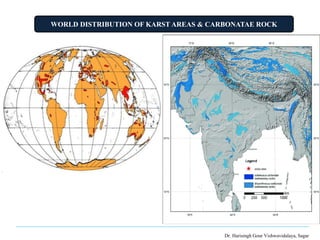
WORLD DISTRIBUTION OF KARST AREAS & CARBONATAE ROCK
Dr. Harisingh Gour Vishwavidalaya, Sagar
WORLD DISTRIBUTION OF KARST AREAS & CARBONATAE ROCK
Dr. Harisingh Gour Vishwavidalaya, Sagar
• Important Karst Areas
 All State Of United States
 Southern France
 Spanish Andularia
 Yuctan In Mexico
 Jamaica
 Western Cuba
 South East Asia
 Western Australia
• Karst Area In India
 In Himalyan Area
 Tapkeswer Temple In Deharadun
 Bheemkund, Arjunkund & Pachmarhi In Mp
 Bastar District ,Chhattisgarh
 Yana Uttarakanada District Of Karnataka
 Mawsmai Cave At Cherrapunji
CONDITIONS ESSENTIAL TO FULL DEVELOPMENT OF KARST
Dr. Harisingh Gour Vishwavidalaya, Sagar
• Presence of soluble rock preferably limestone at or near the ground surface .
• The soluble rock should be massive, dense, highly jointed and preferably thinly bedded.
• Existence of entrenched valley below uplands underlain by soluble and well jointed rocks.
• The region must support moderate to abundant rainfall.
• The position of soluble rock(limestone) must be above the ground water table, so that surface
drainage may disappear through sink.
• Considerable relief so that water is capable of circulation to cause typical karst topography.
FACTORS AFFECTING KARST TOPOGRAPHY
Dr. Harisingh Gour Vishwavidalaya, Sagar
• Lithology – solubility ,nature of resistance and
widespread distribution.
• Structure – secondary permeability e.g. joints ,
fractures.
• Relief .
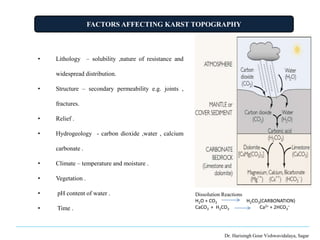
• Hydrogeology - carbon dioxide ,water , calcium
carbonate .
• Climate – temperature and moisture .
• Vegetation .
• pH content of water .
• Time .
Dissolution Reactions
H2O + CO2 H2CO3(CARBONATION)
CaCO3 + H2CO3 Ca2+ + 2HCO3
–
EROSIONAL LANDFORMS OF KARST
Dr. Harisingh Gour Vishwavidalaya, Sagar
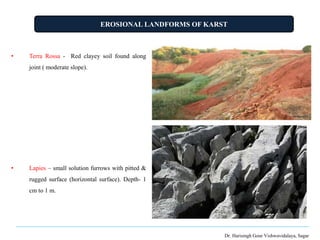
• Terra Rossa - Red clayey soil found along
joint ( moderate slope).
• Lapies – small solution furrows with pitted &
rugged surface (horizontal surface). Depth- 1
cm to 1 m.
EROSIONAL LANDFORMS OF KARST
Dr. Harisingh Gour Vishwavidalaya, Sagar
• Sinkholes - Shallow depressions, funnel
shaped, 10 feet – 30 feet.
• Dolines – circular solution depressions,
formed along intersection joints (solution
sinks) .
• Solution pan – large width but shallow
dolines.
EROSIONAL LANDFORMS OF KARST
Dr. Harisingh Gour Vishwavidalaya, Sagar
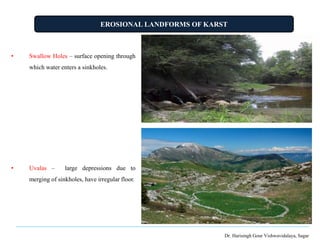
• Swallow Holes – surface opening through
which water enters a sinkholes.
• Uvalas – large depressions due to
merging of sinkholes, have irregular floor.
EROSIONAL LANDFORMS OF KARST
Dr. Harisingh Gour Vishwavidalaya, Sagar
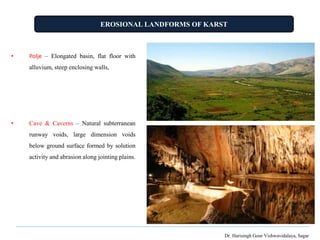
• Polje – Elongated basin, flat floor with
alluvium, steep enclosing walls,
• Cave & Caverns – Natural subterranean
runway voids, large dimension voids
below ground surface formed by solution
activity and abrasion along jointing plains.
EROSIONAL LANDFORMS OF KARST
Dr. Harisingh Gour Vishwavidalaya, Sagar
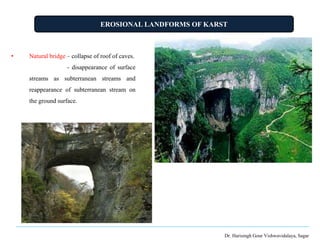
• Natural bridge – collapse of roof of caves.
- disappearance of surface
streams as subterranean streams and
reappearance of subterranean stream on
the ground surface.
DEPOSITIONAL LANDFORMS
Dr. Harisingh Gour Vishwavidalaya, Sagar
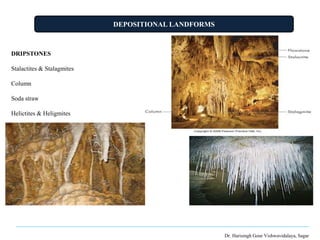
DRIPSTONES
Stalactites & Stalagmites
Column
Soda straw
Helictites & Heligmites
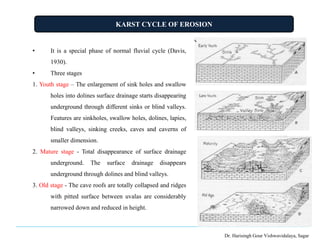
KARST CYCLE OF EROSION
Dr. Harisingh Gour Vishwavidalaya, Sagar
• It is a special phase of normal fluvial cycle (Davis,
1930).
• Three stages
1. Youth stage – The enlargement of sink holes and swallow
holes into dolines surface drainage starts disappearing
underground through different sinks or blind valleys.
Features are sinkholes, swallow holes, dolines, lapies,
blind valleys, sinking creeks, caves and caverns of
smaller dimension.
2. Mature stage - Total disappearance of surface drainage
underground. The surface drainage disappears
underground through dolines and blind valleys.
3. Old stage - The cave roofs are totally collapsed and ridges
with pitted surface between uvalas are considerably
narrowed down and reduced in height.
WHY KARST IS IMPORTANT ?
Dr. Harisingh Gour Vishwavidalaya, Sagar
• Geotechnical studies – construction of towns,
roadways, railways, bridges, buildings etc.
• Water movements studies – underground drainage
systems, drinking water springs.
• Paleoclimatic studies – karst topography reflects
a particular settings of climatic conditions
mention earlier.
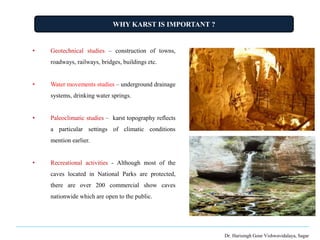
• Recreational activities - Although most of the
caves located in National Parks are protected,
there are over 200 commercial show caves
nationwide which are open to the public.
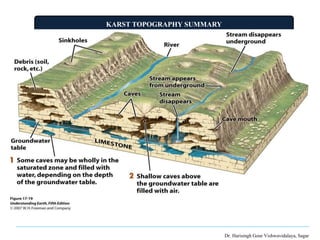
KARST TOPOGRAPHY SUMMARY
Dr. Harisingh Gour Vishwavidalaya, Sagar
References
Dr. Harisingh Gour Vishwavidalaya, Sagar
1. Principles of Geomorphology 2nd edition- William D. Thornbury
2. Fundamental of Geomorphology 4th edition- Richard John Huggett
3. https://www.alamy.es/curiosamente-en-forma-de-cascada-de-estalactitas-y-estalagmitas-en-
cueva-de-estalactita-en-cheow-lago-leman-de-tailandia-phuket-khao-sok-np-
image283717376.html
4. https://www.researchgate.net/figure/First-karst-aquifer-map-of-the-Indian-subcontinent-and-
the-Himalaya-region-with-location_fig2_327769477
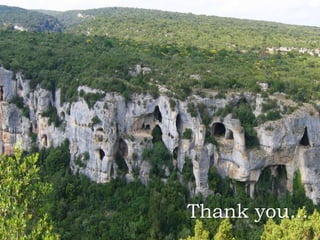
Thank you...

Karst topography

  • 1.
    Presentation On Karst Topography Presented By Ahmad Raza Y18251003 (M.Tech1st Sem) Under the Guidance Of Prof. P.K. Kathal Department of Applied Geology Dr. Harisingh Gour Vishwavidyalaya, Sagar (M.P.)
  • 2.
    CONTENTS Dr. Harisingh GourVishwavidalaya, Sagar • What is Karst topography? • World Distribution of Karst • Factors Affecting Karst • Condition Essential to Development • Erosional Landforms • Depositional Landforms • Karst Cycle of Erosion • Why Karst is Important ? • References
  • 4.
    WHAT IS KARSTTOPOGRAPHY ? Dr. Harisingh Gour Vishwavidalaya, Sagar • The word ‘Karst’ is a comprehensive term applied to limestone or dolomite areas that possess a topography fixed to and dependent upon underground solution and diversion of surface waters to underground routes. • The term comes from the narrow strip of limestone plateau in Yugoslavia and adjacent portion of Italy bordering the Adriatic sea (Wray, 1992).
  • 5.
    WORLD DISTRIBUTION OFKARST AREAS & CARBONATAE ROCK Dr. Harisingh Gour Vishwavidalaya, Sagar
  • 6.
    WORLD DISTRIBUTION OFKARST AREAS & CARBONATAE ROCK Dr. Harisingh Gour Vishwavidalaya, Sagar • Important Karst Areas  All State Of United States  Southern France  Spanish Andularia  Yuctan In Mexico  Jamaica  Western Cuba  South East Asia  Western Australia • Karst Area In India  In Himalyan Area  Tapkeswer Temple In Deharadun  Bheemkund, Arjunkund & Pachmarhi In Mp  Bastar District ,Chhattisgarh  Yana Uttarakanada District Of Karnataka  Mawsmai Cave At Cherrapunji
  • 7.
    CONDITIONS ESSENTIAL TOFULL DEVELOPMENT OF KARST Dr. Harisingh Gour Vishwavidalaya, Sagar • Presence of soluble rock preferably limestone at or near the ground surface . • The soluble rock should be massive, dense, highly jointed and preferably thinly bedded. • Existence of entrenched valley below uplands underlain by soluble and well jointed rocks. • The region must support moderate to abundant rainfall. • The position of soluble rock(limestone) must be above the ground water table, so that surface drainage may disappear through sink. • Considerable relief so that water is capable of circulation to cause typical karst topography.
  • 8.
    FACTORS AFFECTING KARSTTOPOGRAPHY Dr. Harisingh Gour Vishwavidalaya, Sagar • Lithology – solubility ,nature of resistance and widespread distribution. • Structure – secondary permeability e.g. joints , fractures. • Relief . • Hydrogeology - carbon dioxide ,water , calcium carbonate . • Climate – temperature and moisture . • Vegetation . • pH content of water . • Time . Dissolution Reactions H2O + CO2 H2CO3(CARBONATION) CaCO3 + H2CO3 Ca2+ + 2HCO3 –
  • 9.
    EROSIONAL LANDFORMS OFKARST Dr. Harisingh Gour Vishwavidalaya, Sagar • Terra Rossa - Red clayey soil found along joint ( moderate slope). • Lapies – small solution furrows with pitted & rugged surface (horizontal surface). Depth- 1 cm to 1 m.
  • 10.
    EROSIONAL LANDFORMS OFKARST Dr. Harisingh Gour Vishwavidalaya, Sagar • Sinkholes - Shallow depressions, funnel shaped, 10 feet – 30 feet. • Dolines – circular solution depressions, formed along intersection joints (solution sinks) . • Solution pan – large width but shallow dolines.
  • 11.
    EROSIONAL LANDFORMS OFKARST Dr. Harisingh Gour Vishwavidalaya, Sagar • Swallow Holes – surface opening through which water enters a sinkholes. • Uvalas – large depressions due to merging of sinkholes, have irregular floor.
  • 12.
    EROSIONAL LANDFORMS OFKARST Dr. Harisingh Gour Vishwavidalaya, Sagar • Polje – Elongated basin, flat floor with alluvium, steep enclosing walls, • Cave & Caverns – Natural subterranean runway voids, large dimension voids below ground surface formed by solution activity and abrasion along jointing plains.
  • 13.
    EROSIONAL LANDFORMS OFKARST Dr. Harisingh Gour Vishwavidalaya, Sagar • Natural bridge – collapse of roof of caves. - disappearance of surface streams as subterranean streams and reappearance of subterranean stream on the ground surface.
  • 14.
    DEPOSITIONAL LANDFORMS Dr. HarisinghGour Vishwavidalaya, Sagar DRIPSTONES Stalactites & Stalagmites Column Soda straw Helictites & Heligmites
  • 15.
    KARST CYCLE OFEROSION Dr. Harisingh Gour Vishwavidalaya, Sagar • It is a special phase of normal fluvial cycle (Davis, 1930). • Three stages 1. Youth stage – The enlargement of sink holes and swallow holes into dolines surface drainage starts disappearing underground through different sinks or blind valleys. Features are sinkholes, swallow holes, dolines, lapies, blind valleys, sinking creeks, caves and caverns of smaller dimension. 2. Mature stage - Total disappearance of surface drainage underground. The surface drainage disappears underground through dolines and blind valleys. 3. Old stage - The cave roofs are totally collapsed and ridges with pitted surface between uvalas are considerably narrowed down and reduced in height.
  • 16.
    WHY KARST ISIMPORTANT ? Dr. Harisingh Gour Vishwavidalaya, Sagar • Geotechnical studies – construction of towns, roadways, railways, bridges, buildings etc. • Water movements studies – underground drainage systems, drinking water springs. • Paleoclimatic studies – karst topography reflects a particular settings of climatic conditions mention earlier. • Recreational activities - Although most of the caves located in National Parks are protected, there are over 200 commercial show caves nationwide which are open to the public.
  • 17.
    KARST TOPOGRAPHY SUMMARY Dr.Harisingh Gour Vishwavidalaya, Sagar
  • 18.
    References Dr. Harisingh GourVishwavidalaya, Sagar 1. Principles of Geomorphology 2nd edition- William D. Thornbury 2. Fundamental of Geomorphology 4th edition- Richard John Huggett 3. https://www.alamy.es/curiosamente-en-forma-de-cascada-de-estalactitas-y-estalagmitas-en- cueva-de-estalactita-en-cheow-lago-leman-de-tailandia-phuket-khao-sok-np- image283717376.html 4. https://www.researchgate.net/figure/First-karst-aquifer-map-of-the-Indian-subcontinent-and- the-Himalaya-region-with-location_fig2_327769477
  • 19.