Depositional Environments
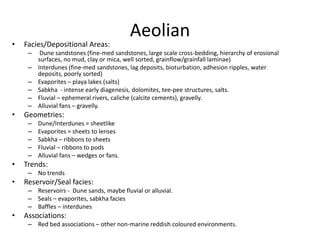
Aeolian
• Facies/Depositional Areas:
– Dune sandstones (fine-med sandstones, large scale cross-bedding, hierarchy of erosional
surfaces, no mud, clay or mica, well sorted, grainflow/grainfall laminae)
– Interdunes (fine-med sandstones, lag deposits, bioturbation, adhesion ripples, water
deposits, poorly sorted)
– Evaporites – playa lakes (salts)
– Sabkha - intense early diagenesis, dolomites, tee-pee structures, salts.
– Fluvial – ephemeral rivers, caliche (calcite cements), gravelly.
– Alluvial fans – gravelly.
• Geometries:
– Dune/Interdunes = sheetlike
– Evaporites = sheets to lenses
– Sabkha – ribbons to sheets
– Fluvial – ribbons to pods
– Alluvial fans – wedges or fans.
• Trends:
– No trends
• Reservoir/Seal facies:
– Reservoirs - Dune sands, maybe fluvial or alluvial.
– Seals – evaporites, sabkha facies
– Baffles – interdunes
• Associations:
– Red bed associations – other non-marine reddish coloured environments.
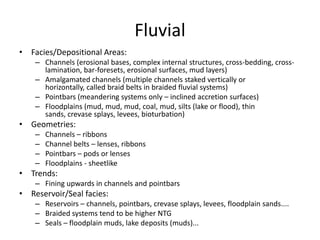
Fluvial
• Facies/Depositional Areas:
– Channels (erosional bases, complex internal structures, cross-bedding, cross-
lamination, bar-foresets, erosional surfaces, mud layers)
– Amalgamated channels (multiple channels staked vertically or
horizontally, called braid belts in braided fluvial systems)
– Pointbars (meandering systems only – inclined accretion surfaces)
– Floodplains (mud, mud, mud, coal, mud, silts (lake or flood), thin
sands, crevase splays, levees, bioturbation)
• Geometries:
– Channels – ribbons
– Channel belts – lenses, ribbons
– Pointbars – pods or lenses
– Floodplains - sheetlike
• Trends:
– Fining upwards in channels and pointbars
• Reservoir/Seal facies:
– Reservoirs – channels, pointbars, crevase splays, levees, floodplain sands....
– Braided systems tend to be higher NTG
– Seals – floodplain muds, lake deposits (muds)...
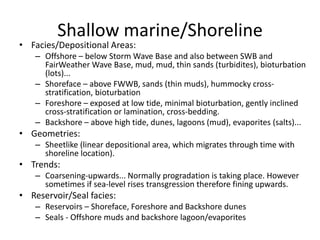
Shallow marine/Shoreline
• Facies/Depositional Areas:
– Offshore – below Storm Wave Base and also between SWB and
FairWeather Wave Base, mud, mud, thin sands (turbidites), bioturbation
(lots)...
– Shoreface – above FWWB, sands (thin muds), hummocky cross-
stratification, bioturbation
– Foreshore – exposed at low tide, minimal bioturbation, gently inclined
cross-stratification or lamination, cross-bedding.
– Backshore – above high tide, dunes, lagoons (mud), evaporites (salts)...
• Geometries:
– Sheetlike (linear depositional area, which migrates through time with
shoreline location).
• Trends:
– Coarsening-upwards... Normally progradation is taking place. However
sometimes if sea-level rises transgression therefore fining upwards.
• Reservoir/Seal facies:
– Reservoirs – Shoreface, Foreshore and Backshore dunes
– Seals - Offshore muds and backshore lagoon/evaporites
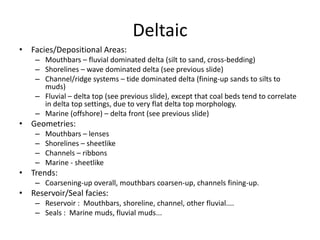
Deltaic
• Facies/Depositional Areas:
– Mouthbars – fluvial dominated delta (silt to sand, cross-bedding)
– Shorelines – wave dominated delta (see previous slide)
– Channel/ridge systems – tide dominated delta (fining-up sands to silts to
muds)
– Fluvial – delta top (see previous slide), except that coal beds tend to correlate
in delta top settings, due to very flat delta top morphology.
– Marine (offshore) – delta front (see previous slide)
• Geometries:
– Mouthbars – lenses
– Shorelines – sheetlike
– Channels – ribbons
– Marine - sheetlike
• Trends:
– Coarsening-up overall, mouthbars coarsen-up, channels fining-up.
• Reservoir/Seal facies:
– Reservoir : Mouthbars, shoreline, channel, other fluvial....
– Seals : Marine muds, fluvial muds...
Deep Marine
• Facies/Depositional Areas:
– Turbidites (sequence of sedimentary structures
(massive, laminated, cross-laminated or convolute laminated, laminated
grading up to bioturbated mud), sharp or erosive based, fining
upwards, grain alignment)
– Gravity flow deposits – debris flows... Very poorly sorted, mud matrix
– Marine mud (pelagic).
– Oozes – biogenic muds, siliceous or carbonate, chert or limestone.
• Geometries:
– Sheets (turbidites, marine mud, oozes)
– Fans (submarine fans), channel ribbons (channelized turbidites)
• Trends:
– Fining upwards in turbidites...
• Reservoir/Seal facies:
– Reservoir : Turbidites
– Seal : Mud, oozes, debris flows.
Carbonates
• Facies/Depositional Areas:
– Reef (corals, framework carbonates, breccia of framework
carbonate grains)
– Ramp (shoals, bars, mounds)
– Carbonate mud fields
• Geometries:
– Reef – lenses, wedges
– Ramps – sheets, lenses, pods
– Carbonate mud - sheet
• Trends:
– Not much – coarsening-upwards in shoal and mound systems.
• Reservoir/Seal facies:
– Reservoirs: frameworks carbonates, packstones...
– Seals: carbonate muds
– Secondary diagenesis... Fractured reservoirs and dissolution....
Depositional environments

Depositional environments

  • 1.
  • 2.
    Aeolian • Facies/Depositional Areas: –Dune sandstones (fine-med sandstones, large scale cross-bedding, hierarchy of erosional surfaces, no mud, clay or mica, well sorted, grainflow/grainfall laminae) – Interdunes (fine-med sandstones, lag deposits, bioturbation, adhesion ripples, water deposits, poorly sorted) – Evaporites – playa lakes (salts) – Sabkha - intense early diagenesis, dolomites, tee-pee structures, salts. – Fluvial – ephemeral rivers, caliche (calcite cements), gravelly. – Alluvial fans – gravelly. • Geometries: – Dune/Interdunes = sheetlike – Evaporites = sheets to lenses – Sabkha – ribbons to sheets – Fluvial – ribbons to pods – Alluvial fans – wedges or fans. • Trends: – No trends • Reservoir/Seal facies: – Reservoirs - Dune sands, maybe fluvial or alluvial. – Seals – evaporites, sabkha facies – Baffles – interdunes • Associations: – Red bed associations – other non-marine reddish coloured environments.
  • 3.
    Fluvial • Facies/Depositional Areas: –Channels (erosional bases, complex internal structures, cross-bedding, cross- lamination, bar-foresets, erosional surfaces, mud layers) – Amalgamated channels (multiple channels staked vertically or horizontally, called braid belts in braided fluvial systems) – Pointbars (meandering systems only – inclined accretion surfaces) – Floodplains (mud, mud, mud, coal, mud, silts (lake or flood), thin sands, crevase splays, levees, bioturbation) • Geometries: – Channels – ribbons – Channel belts – lenses, ribbons – Pointbars – pods or lenses – Floodplains - sheetlike • Trends: – Fining upwards in channels and pointbars • Reservoir/Seal facies: – Reservoirs – channels, pointbars, crevase splays, levees, floodplain sands.... – Braided systems tend to be higher NTG – Seals – floodplain muds, lake deposits (muds)...
  • 4.
    Shallow marine/Shoreline • Facies/DepositionalAreas: – Offshore – below Storm Wave Base and also between SWB and FairWeather Wave Base, mud, mud, thin sands (turbidites), bioturbation (lots)... – Shoreface – above FWWB, sands (thin muds), hummocky cross- stratification, bioturbation – Foreshore – exposed at low tide, minimal bioturbation, gently inclined cross-stratification or lamination, cross-bedding. – Backshore – above high tide, dunes, lagoons (mud), evaporites (salts)... • Geometries: – Sheetlike (linear depositional area, which migrates through time with shoreline location). • Trends: – Coarsening-upwards... Normally progradation is taking place. However sometimes if sea-level rises transgression therefore fining upwards. • Reservoir/Seal facies: – Reservoirs – Shoreface, Foreshore and Backshore dunes – Seals - Offshore muds and backshore lagoon/evaporites
  • 5.
    Deltaic • Facies/Depositional Areas: –Mouthbars – fluvial dominated delta (silt to sand, cross-bedding) – Shorelines – wave dominated delta (see previous slide) – Channel/ridge systems – tide dominated delta (fining-up sands to silts to muds) – Fluvial – delta top (see previous slide), except that coal beds tend to correlate in delta top settings, due to very flat delta top morphology. – Marine (offshore) – delta front (see previous slide) • Geometries: – Mouthbars – lenses – Shorelines – sheetlike – Channels – ribbons – Marine - sheetlike • Trends: – Coarsening-up overall, mouthbars coarsen-up, channels fining-up. • Reservoir/Seal facies: – Reservoir : Mouthbars, shoreline, channel, other fluvial.... – Seals : Marine muds, fluvial muds...
  • 6.
    Deep Marine • Facies/DepositionalAreas: – Turbidites (sequence of sedimentary structures (massive, laminated, cross-laminated or convolute laminated, laminated grading up to bioturbated mud), sharp or erosive based, fining upwards, grain alignment) – Gravity flow deposits – debris flows... Very poorly sorted, mud matrix – Marine mud (pelagic). – Oozes – biogenic muds, siliceous or carbonate, chert or limestone. • Geometries: – Sheets (turbidites, marine mud, oozes) – Fans (submarine fans), channel ribbons (channelized turbidites) • Trends: – Fining upwards in turbidites... • Reservoir/Seal facies: – Reservoir : Turbidites – Seal : Mud, oozes, debris flows.
  • 7.
    Carbonates • Facies/Depositional Areas: –Reef (corals, framework carbonates, breccia of framework carbonate grains) – Ramp (shoals, bars, mounds) – Carbonate mud fields • Geometries: – Reef – lenses, wedges – Ramps – sheets, lenses, pods – Carbonate mud - sheet • Trends: – Not much – coarsening-upwards in shoal and mound systems. • Reservoir/Seal facies: – Reservoirs: frameworks carbonates, packstones... – Seals: carbonate muds – Secondary diagenesis... Fractured reservoirs and dissolution....