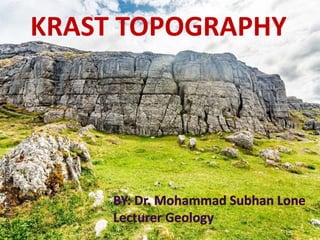
KRAST TOPOGRAPHY
Introduction
• In simple words, the term karst describes a
distinctive topography that indicates
dissolution of underlying soluble rocks by
surface water or ground water.
• Although commonly associated with
carbonate rocks (limestone and dolomite)
other highly soluble rocks such as evaporates
(gypsum and rock salt) can be sculpted into
karst terrain.
Essential conditions
• Relatively thick massive soluble rock, i.e.,
limestone, dolomite, or chalk.
• Carbonate rocks should be very close to the
ground surface.
• Limestone should be highly folded, faulted or
fractured.
• Considerable relief so that water is capable of
circulation to cause typical karst topography.
• Moderate to heavy rainfall to cause solution
of rocks.
Development of Karst terrain
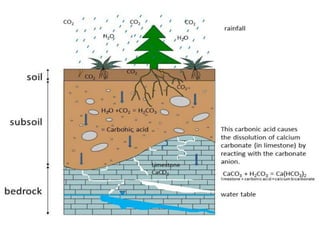
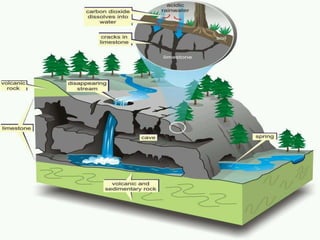
• As rain falls through the atmosphere it picks
up carbon dioxide (CO2).
• When this rain reaches the ground and
passes through the soil it picks up more CO2
and forms a weak solution of carbonic acid.
• As the acidified rain water trickles down
through cracks in the limestone, it begins to
dissolve the rock.
• Over time it progressively enlarges the cracks
and openings in the ground an underground
drainage system starts to develop.
SURFACE FEATURES
• Examples of some of the most common
surface karst features encountered are as
follows:
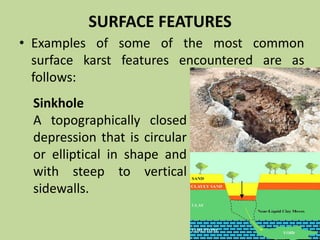
Sinkhole
A topographically closed
depression that is circular
or elliptical in shape and
with steep to vertical
sidewalls.
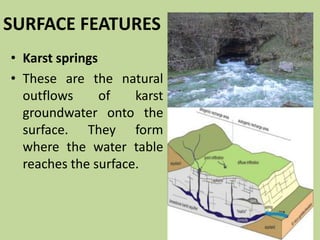
• Karst springs
• These are the natural
outflows of karst
groundwater onto the
surface. They form
where the water table
reaches the surface.
SURFACE FEATURES
SURFACE FEATURES
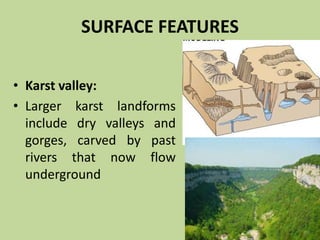
• Karst valley:
• Larger karst landforms
include dry valleys and
gorges, carved by past
rivers that now flow
underground
SURFACE FEATURES
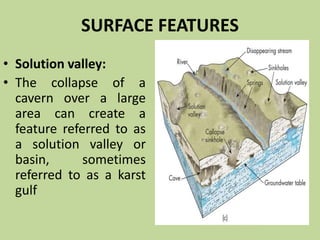
• Solution valley:
• The collapse of a
cavern over a large
area can create a
feature referred to as
a solution valley or
basin, sometimes
referred to as a karst
gulf
SURFACE FEATURES
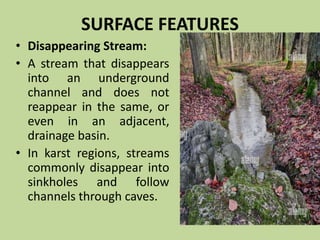
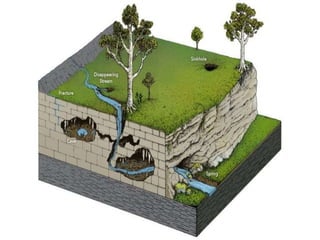
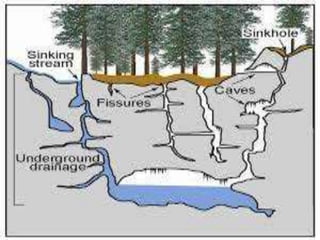
• Disappearing Stream:
• A stream that disappears
into an underground
channel and does not
reappear in the same, or
even in an adjacent,
drainage basin.
• In karst regions, streams
commonly disappear into
sinkholes and follow
channels through caves.
SUBSURFACE FEATURES
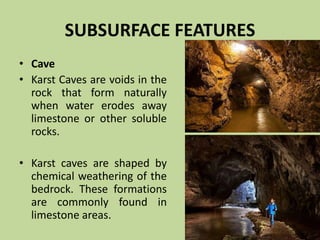
• Cave
• Karst Caves are voids in the
rock that form naturally
when water erodes away
limestone or other soluble
rocks.
• Karst caves are shaped by
chemical weathering of the
bedrock. These formations
are commonly found in
limestone areas.
SUBSURFACE FEATURES
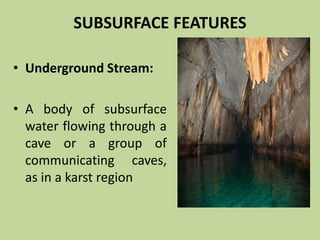
• Underground Stream:
• A body of subsurface
water flowing through a
cave or a group of
communicating caves,
as in a karst region
SUBSURFACE FEATURES
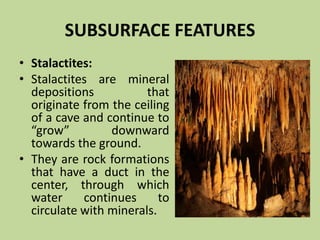
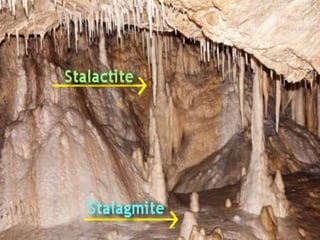
• Stalactites:
• Stalactites are mineral
depositions that
originate from the ceiling
of a cave and continue to
“grow” downward
towards the ground.
• They are rock formations
that have a duct in the
center, through which
water continues to
circulate with minerals.
SUBSURFACE FEATURES
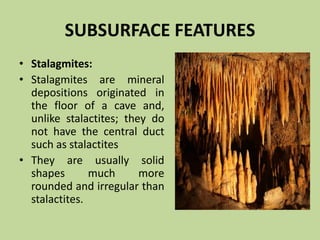
• Stalagmites:
• Stalagmites are mineral
depositions originated in
the floor of a cave and,
unlike stalactites; they do
not have the central duct
such as stalactites
• They are usually solid
shapes much more
rounded and irregular than
stalactites.
___________The End

KRAST TOPOGRAPHY.pptx

  • 1.
  • 2.
    Introduction • In simplewords, the term karst describes a distinctive topography that indicates dissolution of underlying soluble rocks by surface water or ground water. • Although commonly associated with carbonate rocks (limestone and dolomite) other highly soluble rocks such as evaporates (gypsum and rock salt) can be sculpted into karst terrain.
  • 3.
    Essential conditions • Relativelythick massive soluble rock, i.e., limestone, dolomite, or chalk. • Carbonate rocks should be very close to the ground surface. • Limestone should be highly folded, faulted or fractured. • Considerable relief so that water is capable of circulation to cause typical karst topography. • Moderate to heavy rainfall to cause solution of rocks.
  • 4.
    Development of Karstterrain • As rain falls through the atmosphere it picks up carbon dioxide (CO2). • When this rain reaches the ground and passes through the soil it picks up more CO2 and forms a weak solution of carbonic acid. • As the acidified rain water trickles down through cracks in the limestone, it begins to dissolve the rock. • Over time it progressively enlarges the cracks and openings in the ground an underground drainage system starts to develop.
  • 6.
    SURFACE FEATURES • Examplesof some of the most common surface karst features encountered are as follows: Sinkhole A topographically closed depression that is circular or elliptical in shape and with steep to vertical sidewalls.
  • 7.
    • Karst springs •These are the natural outflows of karst groundwater onto the surface. They form where the water table reaches the surface. SURFACE FEATURES
  • 8.
    SURFACE FEATURES • Karstvalley: • Larger karst landforms include dry valleys and gorges, carved by past rivers that now flow underground
  • 9.
    SURFACE FEATURES • Solutionvalley: • The collapse of a cavern over a large area can create a feature referred to as a solution valley or basin, sometimes referred to as a karst gulf
  • 10.
    SURFACE FEATURES • DisappearingStream: • A stream that disappears into an underground channel and does not reappear in the same, or even in an adjacent, drainage basin. • In karst regions, streams commonly disappear into sinkholes and follow channels through caves.
  • 12.
    SUBSURFACE FEATURES • Cave •Karst Caves are voids in the rock that form naturally when water erodes away limestone or other soluble rocks. • Karst caves are shaped by chemical weathering of the bedrock. These formations are commonly found in limestone areas.
  • 13.
    SUBSURFACE FEATURES • UndergroundStream: • A body of subsurface water flowing through a cave or a group of communicating caves, as in a karst region
  • 15.
    SUBSURFACE FEATURES • Stalactites: •Stalactites are mineral depositions that originate from the ceiling of a cave and continue to “grow” downward towards the ground. • They are rock formations that have a duct in the center, through which water continues to circulate with minerals.
  • 17.
    SUBSURFACE FEATURES • Stalagmites: •Stalagmites are mineral depositions originated in the floor of a cave and, unlike stalactites; they do not have the central duct such as stalactites • They are usually solid shapes much more rounded and irregular than stalactites.
  • 19.