Employee Motivation
Job Redesign Changing / restructuring the elements of a job making it more motivating for the performer. Enhancing motivational potential of a job by altering core job dimensions.
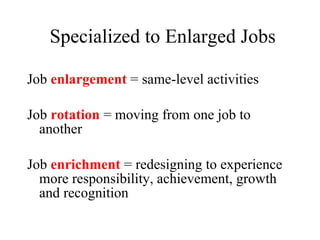
Specialized to Enlarged Jobs Job  enlargement  = same-level activities Job  rotation  = moving from one job to another Job  enrichment  = redesigning to experience more responsibility, achievement, growth and recognition
Example Controlling Doing Controlling Doing Before vertical enrichment After vertical enrichment
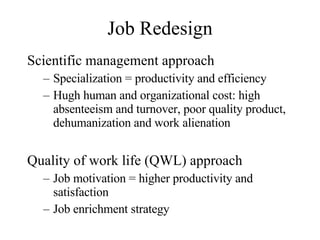
Job Redesign Scientific management approach Specialization = productivity and efficiency Hugh human and organizational cost: high absenteeism and turnover, poor quality product, dehumanization and work alienation Quality of work life (QWL) approach Job motivation = higher productivity and satisfaction Job enrichment strategy
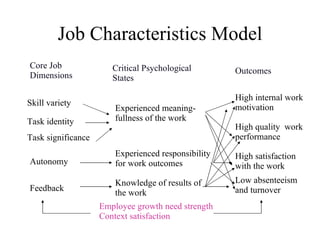
Job Characteristics Model Core Job   Dimensions Critical Psychological States Outcomes Skill variety Task identity Task significance Autonomy Feedback Experienced meaning-  fullness of the work Experienced responsibility for work outcomes  Knowledge of results of the work High internal work motivation High quality  work performance High satisfaction with the work Low absenteeism and turnover Employee growth need strength  Context satisfaction
Motivational Differences in Jobs SV TI TS AU FE Low Moderate High 1 2 3 4 5 6 7 Job characteristics 0 40 80 120 160 200 240 Job 280 320 360 A B MPS
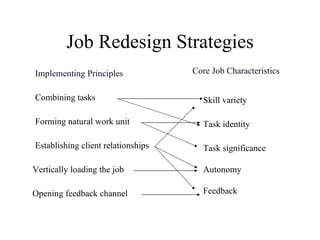
Job Redesign Strategies Implementing Principles Core   Job   Characteristics Combining tasks Forming natural work unit Establishing client relationships Vertically loading the job Opening feedback channel Skill variety Task identity Task significance Autonomy Feedback
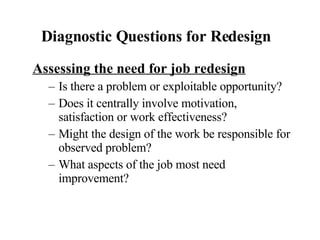
Diagnostic Questions for Redesign Assessing the need for job redesign Is there a problem or exploitable opportunity? Does it centrally involve motivation, satisfaction or work effectiveness? Might the design of the work be responsible for observed problem? What aspects of the job most need improvement?
Diagnostic Questions for Redesign Determining the feasibility of job redesign How ready are the employees for change? How hospitable are organizational systems to needed change?
Enabling Conditions  Reward systems facilitating implementation Supervisory training for facilitating redesign Organizational climate facilitating implementation
Alternatives to Job Redesign Flexitime Job sharing Compressed work week

Job Redesign=10

  • 1.
  • 2.
    Job Redesign Changing/ restructuring the elements of a job making it more motivating for the performer. Enhancing motivational potential of a job by altering core job dimensions.
  • 3.
    Specialized to EnlargedJobs Job enlargement = same-level activities Job rotation = moving from one job to another Job enrichment = redesigning to experience more responsibility, achievement, growth and recognition
  • 4.
    Example Controlling DoingControlling Doing Before vertical enrichment After vertical enrichment
  • 5.
    Job Redesign Scientificmanagement approach Specialization = productivity and efficiency Hugh human and organizational cost: high absenteeism and turnover, poor quality product, dehumanization and work alienation Quality of work life (QWL) approach Job motivation = higher productivity and satisfaction Job enrichment strategy
  • 6.
    Job Characteristics ModelCore Job Dimensions Critical Psychological States Outcomes Skill variety Task identity Task significance Autonomy Feedback Experienced meaning- fullness of the work Experienced responsibility for work outcomes Knowledge of results of the work High internal work motivation High quality work performance High satisfaction with the work Low absenteeism and turnover Employee growth need strength Context satisfaction
  • 7.
    Motivational Differences inJobs SV TI TS AU FE Low Moderate High 1 2 3 4 5 6 7 Job characteristics 0 40 80 120 160 200 240 Job 280 320 360 A B MPS
  • 8.
    Job Redesign StrategiesImplementing Principles Core Job Characteristics Combining tasks Forming natural work unit Establishing client relationships Vertically loading the job Opening feedback channel Skill variety Task identity Task significance Autonomy Feedback
  • 9.
    Diagnostic Questions forRedesign Assessing the need for job redesign Is there a problem or exploitable opportunity? Does it centrally involve motivation, satisfaction or work effectiveness? Might the design of the work be responsible for observed problem? What aspects of the job most need improvement?
  • 10.
    Diagnostic Questions forRedesign Determining the feasibility of job redesign How ready are the employees for change? How hospitable are organizational systems to needed change?
  • 11.
    Enabling Conditions Reward systems facilitating implementation Supervisory training for facilitating redesign Organizational climate facilitating implementation
  • 12.
    Alternatives to JobRedesign Flexitime Job sharing Compressed work week