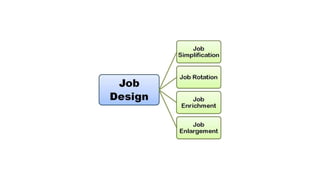
Job Design
What is job design?
• Job design may be defined as the methods that management uses to
develop the content of a job, including all relevant tasks, as well as
the processes by which jobs are constructed and revised.
Why?
• Organizations want to attract, motivate, and retain valued employees
owing to skill shortages in several key job categories.
• Blurring of the distinction between on-work and off-work time.
• Many employees are working longer hours, enduring longer
commutes, and traveling more days out of each month and, as a
result, may need flexible work arrangements to maintain and
preserve their home life.
• Rising number of telecommuting jobs or teleworking, in which the
employee performs substantial amounts of work at home.
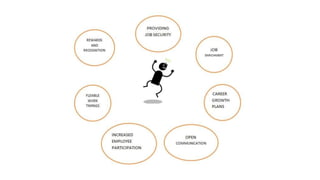
Quality of work life (QWL)
“A philosophy of management that enhances the dignity of all workers;
introduces changes in an organization’s culture; and improves the
physical and emotional well-being of employees (e.g., providing
opportunities for growth and development).”
Indicators of quality of work life
• Accident rates
• Sick leave usage,
• Employee turnover
• Number of grievances filed
QWL programs - some intentions
• Increase employee trust
• Productivity
• Involvement
• Retention
• Problem solving so as to increase both worker satisfaction and
organizational effectiveness.
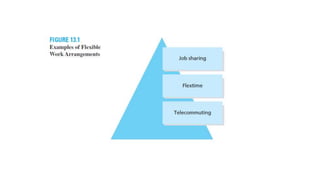
Job sharing
• Job sharing (sometimes referred to as “work sharing”) is a work
arrangement in which two or more employees divide a job’s
responsibilities, hours, salary, and benefits among themselves.
• Steps that are critical to success of job sharing
• Identifying those jobs that can be shared
• Understanding employees’ individual sharing style
• Matching “partners” who have complementary scheduling needs and skills.
Telecommuting
• Telecommuting refers to the work arrangement that allows
employees to work in their homes part or full time, maintaining their
connection and communication with the office through a smart
phone, laptop, texting, instant messaging, videoconference meeting
software, and e-mail.
Job Rotation
• Simplest form of job design
• Moving employees from one relatively simple job to another after
short time periods
• The odds of injury are reduced
• As employees learn sets of tasks, they are more flexible and able to
cover for someone who is absent or who quits.
• Supervisors who are promoted from the ranks know more about how
the entire operation works.
• Eg. For example, at McDonald’s, an employee may cook French fries one day,
fry hamburgers the next, wait on the front counter during the next shift, and
draw soft drinks the next.
• Disadvantages of job rotation
• Individual task eventually becomes as boring as the rest of the simple tasks.
• Job satisfaction and/or performance may decline.
• Advantages of job rotation
• cross-training and developing employees for broadened responsibilities.
• better alternative to job design than doing nothing.
Job Analysis
Job rotation and job enlargement
Job analysis
• Providing a description of how one job differs from another in terms
of demands, activities, and skills required.
• The purpose of a job analysis is to provide an objective description of
the job itself and to provide important information for use in a variety
of human resource areas in organizations.
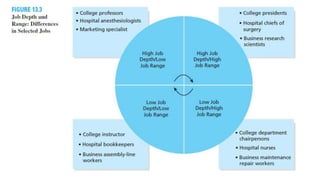
Range and depth of Job
• Job range refers to the number of tasks a job holder performs.
• The individual who performs eight tasks to complete a job has a wider
job range than a person performing four tasks. In most instances, the
greater the number of tasks performed, the longer it takes to
complete the job.
• Job depth is the amount of discretion an individual has to decide job
activities and job outcomes.
• Job depth relates to personal influence as well as delegated authority
To design the job range we use
job rotation and job enlargement
Job Rotation
• Simplest form of job design
• Moving employees from one relatively simple job to another after
short time periods
• The odds of injury are reduced
• As employees learn sets of tasks, they are more flexible and able to
cover for someone who is absent or who quits.
• Supervisors who are promoted from the ranks know more about how
the entire operation works.
• Eg. For example, at McDonald’s, an employee may cook French fries one day,
fry hamburgers the next, wait on the front counter during the next shift, and
draw soft drinks the next.
• Disadvantages of job rotation
• Individual task eventually becomes as boring as the rest of the simple tasks.
• Job satisfaction and/or performance may decline.
• Advantages of job rotation
• cross-training and developing employees for broadened responsibilities.
• better alternative to job design than doing nothing.
Job Enlargement
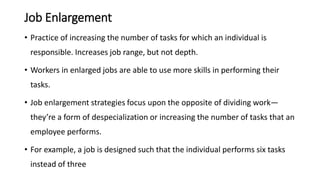
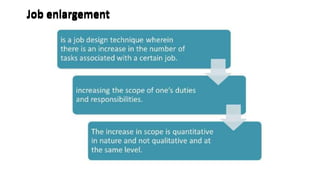
• Practice of increasing the number of tasks for which an individual is
responsible. Increases job range, but not depth.
• Workers in enlarged jobs are able to use more skills in performing their
tasks.
• Job enlargement strategies focus upon the opposite of dividing work—
they’re a form of despecialization or increasing the number of tasks that an
employee performs.
• For example, a job is designed such that the individual performs six tasks
instead of three
Job enlargementJob enlargement
Designing Job Depth: Job
Enrichment
Job enrichment
• The impetus for designing job depth was provided by Herzberg’s two-
factor theory of motivation. The basis of his theory is that factors that

meet individuals’ need for psychological growth (especially
responsibility, job challenge, and achievement) must be characteristic
of their jobs. The application of his theory is termed job enrichment .
Total Quality Management
and Job Design
(TQM)
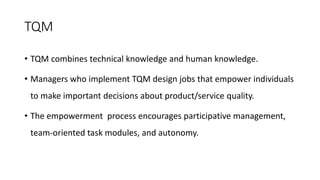
TQM
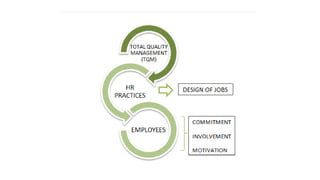
• TQM combines technical knowledge and human knowledge.
• Managers who implement TQM design jobs that empower individuals
to make important decisions about product/service quality.
• The empowerment process encourages participative management,
team-oriented task modules, and autonomy.
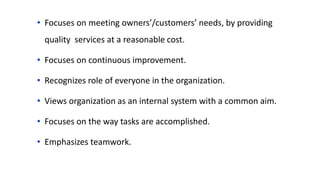
• Focuses on meeting owners’/customers’ needs, by providing
quality services at a reasonable cost.
• Focuses on continuous improvement.
• Recognizes role of everyone in the organization.
• Views organization as an internal system with a common aim.
• Focuses on the way tasks are accomplished.
• Emphasizes teamwork.
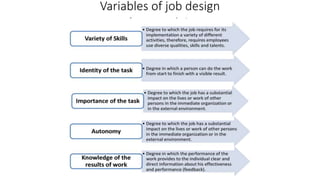
Variables of job design
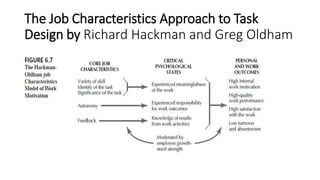
The Job Characteristics Approach to Task
Design by Richard Hackman and Greg Oldham
Summary
• Job design involves managerial decisions and actions that specify
objective job depth, range, and relationships to satisfy organizational
requirements as well as the social and personal requirements of
jobholders.
• Contemporary managers must consider the issue of quality of work
life when designing jobs. This issue reflects society’s concern for work
experiences that contribute to employees’ personal growth and
development.
• Strategies for increasing jobs’ potential to satisfy the social and
personal requirements of jobholders have gone through an
evolutionary process. Initial efforts were directed toward job rotation
and job enlargement. These strategies produced some gains in job
satisfaction but didn’t change primary motivators such as
responsibility, achievement, and autonomy.
• During the 1960s, job enrichment became a widely recognized
strategy for improving quality of work/life factors. This strategy is
based on Herzberg’s motivation theory and involves increasing jobs’
depth through greater delegation of authority to jobholders.
• Despite some major successes, job enrichment isn’t universally
applicable because it doesn’t consider individual differences.
• Individual differences are now recognized as crucial variables to
consider when designing jobs. Experience, cognitive complexity,
needs, values, valences, and perceptions of equity are some of the
individual differences influencing jobholders’ reactions to the scope
and relationships of their jobs. When individual differences are
combined with environmental, situational, and managerial
differences, job design decisions become increasingly complex.
• Although measurements of individual differences remain a problem,
managers should be encouraged to examine ways to increase positive
perceptions of variety, identity, significance, autonomy, and feedback.
By doing so, the potential for high-quality work performance and high
job satisfaction is increased.
• Managers must diagnose their own situations to determine the
applicability of job design in their organizations.
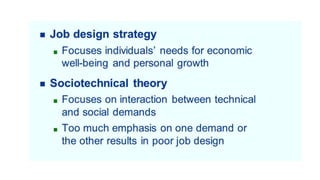
• Sociotechnical theory combines technological and social issues in job
design practice. Sociotechnical theory is compatible with job design
strategy and in fact emphasizes the practical necessity to design jobs
that provide autonomy, feedback, significance, identity, and variety.
• Total quality management (TQM) combines the ideas of job
enrichment and sociotechnical theory. Managers who implement
TQM design jobs that empower individuals to make important
decisions about product/service quality. The empowerment process
encourages participative management, team-oriented task modules,
and autonomy.

Job design and analysis

  • 1.
  • 2.
    What is jobdesign? • Job design may be defined as the methods that management uses to develop the content of a job, including all relevant tasks, as well as the processes by which jobs are constructed and revised.
  • 3.
    Why? • Organizations wantto attract, motivate, and retain valued employees owing to skill shortages in several key job categories. • Blurring of the distinction between on-work and off-work time. • Many employees are working longer hours, enduring longer commutes, and traveling more days out of each month and, as a result, may need flexible work arrangements to maintain and preserve their home life. • Rising number of telecommuting jobs or teleworking, in which the employee performs substantial amounts of work at home.
  • 4.
    Quality of worklife (QWL) “A philosophy of management that enhances the dignity of all workers; introduces changes in an organization’s culture; and improves the physical and emotional well-being of employees (e.g., providing opportunities for growth and development).”
  • 6.
    Indicators of qualityof work life • Accident rates • Sick leave usage, • Employee turnover • Number of grievances filed
  • 7.
    QWL programs -some intentions • Increase employee trust • Productivity • Involvement • Retention • Problem solving so as to increase both worker satisfaction and organizational effectiveness.
  • 9.
    Job sharing • Jobsharing (sometimes referred to as “work sharing”) is a work arrangement in which two or more employees divide a job’s responsibilities, hours, salary, and benefits among themselves. • Steps that are critical to success of job sharing • Identifying those jobs that can be shared • Understanding employees’ individual sharing style • Matching “partners” who have complementary scheduling needs and skills.
  • 11.
    Telecommuting • Telecommuting refersto the work arrangement that allows employees to work in their homes part or full time, maintaining their connection and communication with the office through a smart phone, laptop, texting, instant messaging, videoconference meeting software, and e-mail.
  • 12.
    Job Rotation • Simplestform of job design • Moving employees from one relatively simple job to another after short time periods • The odds of injury are reduced • As employees learn sets of tasks, they are more flexible and able to cover for someone who is absent or who quits. • Supervisors who are promoted from the ranks know more about how the entire operation works. • Eg. For example, at McDonald’s, an employee may cook French fries one day, fry hamburgers the next, wait on the front counter during the next shift, and draw soft drinks the next.
  • 13.
    • Disadvantages ofjob rotation • Individual task eventually becomes as boring as the rest of the simple tasks. • Job satisfaction and/or performance may decline. • Advantages of job rotation • cross-training and developing employees for broadened responsibilities. • better alternative to job design than doing nothing.
  • 14.
    Job Analysis Job rotationand job enlargement
  • 15.
    Job analysis • Providinga description of how one job differs from another in terms of demands, activities, and skills required. • The purpose of a job analysis is to provide an objective description of the job itself and to provide important information for use in a variety of human resource areas in organizations.
  • 16.
    Range and depthof Job • Job range refers to the number of tasks a job holder performs. • The individual who performs eight tasks to complete a job has a wider job range than a person performing four tasks. In most instances, the greater the number of tasks performed, the longer it takes to complete the job. • Job depth is the amount of discretion an individual has to decide job activities and job outcomes. • Job depth relates to personal influence as well as delegated authority
  • 19.
    To design thejob range we use job rotation and job enlargement
  • 20.
    Job Rotation • Simplestform of job design • Moving employees from one relatively simple job to another after short time periods • The odds of injury are reduced • As employees learn sets of tasks, they are more flexible and able to cover for someone who is absent or who quits. • Supervisors who are promoted from the ranks know more about how the entire operation works. • Eg. For example, at McDonald’s, an employee may cook French fries one day, fry hamburgers the next, wait on the front counter during the next shift, and draw soft drinks the next.
  • 21.
    • Disadvantages ofjob rotation • Individual task eventually becomes as boring as the rest of the simple tasks. • Job satisfaction and/or performance may decline. • Advantages of job rotation • cross-training and developing employees for broadened responsibilities. • better alternative to job design than doing nothing.
  • 22.
    Job Enlargement • Practiceof increasing the number of tasks for which an individual is responsible. Increases job range, but not depth. • Workers in enlarged jobs are able to use more skills in performing their tasks. • Job enlargement strategies focus upon the opposite of dividing work— they’re a form of despecialization or increasing the number of tasks that an employee performs. • For example, a job is designed such that the individual performs six tasks instead of three
  • 23.
  • 26.
    Designing Job Depth:Job Enrichment
  • 27.
    Job enrichment • Theimpetus for designing job depth was provided by Herzberg’s two- factor theory of motivation. The basis of his theory is that factors that meet individuals’ need for psychological growth (especially responsibility, job challenge, and achievement) must be characteristic of their jobs. The application of his theory is termed job enrichment .
  • 31.
  • 32.
    TQM • TQM combinestechnical knowledge and human knowledge. • Managers who implement TQM design jobs that empower individuals to make important decisions about product/service quality. • The empowerment process encourages participative management, team-oriented task modules, and autonomy.
  • 33.
    • Focuses onmeeting owners’/customers’ needs, by providing quality services at a reasonable cost. • Focuses on continuous improvement. • Recognizes role of everyone in the organization. • Views organization as an internal system with a common aim. • Focuses on the way tasks are accomplished. • Emphasizes teamwork.
  • 36.
  • 37.
    The Job CharacteristicsApproach to Task Design by Richard Hackman and Greg Oldham
  • 38.
  • 39.
    • Job designinvolves managerial decisions and actions that specify objective job depth, range, and relationships to satisfy organizational requirements as well as the social and personal requirements of jobholders. • Contemporary managers must consider the issue of quality of work life when designing jobs. This issue reflects society’s concern for work experiences that contribute to employees’ personal growth and development.
  • 40.
    • Strategies forincreasing jobs’ potential to satisfy the social and personal requirements of jobholders have gone through an evolutionary process. Initial efforts were directed toward job rotation and job enlargement. These strategies produced some gains in job satisfaction but didn’t change primary motivators such as responsibility, achievement, and autonomy.
  • 41.
    • During the1960s, job enrichment became a widely recognized strategy for improving quality of work/life factors. This strategy is based on Herzberg’s motivation theory and involves increasing jobs’ depth through greater delegation of authority to jobholders. • Despite some major successes, job enrichment isn’t universally applicable because it doesn’t consider individual differences.
  • 42.
    • Individual differencesare now recognized as crucial variables to consider when designing jobs. Experience, cognitive complexity, needs, values, valences, and perceptions of equity are some of the individual differences influencing jobholders’ reactions to the scope and relationships of their jobs. When individual differences are combined with environmental, situational, and managerial differences, job design decisions become increasingly complex.
  • 43.
    • Although measurementsof individual differences remain a problem, managers should be encouraged to examine ways to increase positive perceptions of variety, identity, significance, autonomy, and feedback. By doing so, the potential for high-quality work performance and high job satisfaction is increased. • Managers must diagnose their own situations to determine the applicability of job design in their organizations.
  • 44.
    • Sociotechnical theorycombines technological and social issues in job design practice. Sociotechnical theory is compatible with job design strategy and in fact emphasizes the practical necessity to design jobs that provide autonomy, feedback, significance, identity, and variety. • Total quality management (TQM) combines the ideas of job enrichment and sociotechnical theory. Managers who implement TQM design jobs that empower individuals to make important decisions about product/service quality. The empowerment process encourages participative management, team-oriented task modules, and autonomy.