Person Job Fit Person Variables
Person Job Fit Concept  􀂄 Matching of  personal  characteristics  with the requirements of job. Importance Positive performance/behavioral outcomes (higher performance, greater satisfaction, lower absenteeism and turnover, more organization citizenship behavior, less stress etc). Process Person profiling and job profiling.
Major dimensions 􀂄 Personal/ biographical characteristics (age, gender,  marital status, tenure)  􀂄 Ability 􀂄 Values 􀂄 Personality 􀂄 Perception and attribution 􀂄 Attitudes 􀂄 Learning Person Profiling
Popular belief: performance declines with age  Positive qualities:  experience, judgement, a strong work ethic and commitment to quality Negative qualities:  lack of flexibility and resistant to technology Age & Job Performance
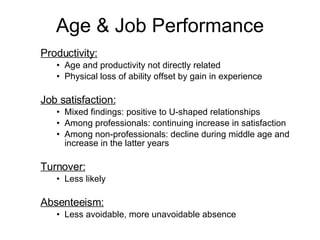
Productivity: Age and productivity not directly related Physical loss of ability offset by gain in experience Job satisfaction: Mixed findings: positive to U-shaped relationships Among professionals: continuing increase in satisfaction Among non-professionals: decline during middle age and increase in the latter years Turnover:   Less likely Absenteeism:   Less avoidable, more unavoidable absence Age & Job Performance
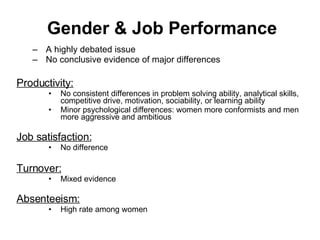
Gender & Job Performance A highly debated issue No conclusive evidence of major differences Productivity: No consistent differences in problem solving ability, analytical skills, competitive drive, motivation, sociability, or learning ability Minor psychological differences: women more conformists and men more aggressive and ambitious Job satisfaction: No difference Turnover:   Mixed evidence Absenteeism:   High rate among women
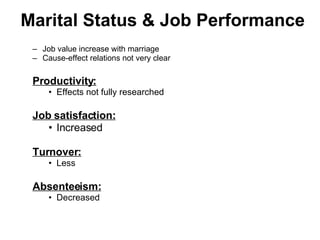
Marital Status & Job Performance Job value increase with marriage Cause-effect relations not very clear Productivity: Effects not fully researched Job satisfaction: Increased Turnover: Less Absenteeism: Decreased
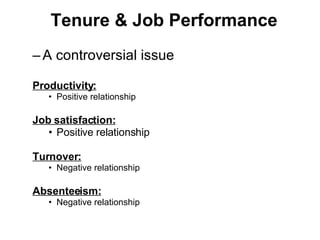
Tenure & Job Performance A controversial issue  Productivity: Positive relationship Job satisfaction: Positive relationship Turnover: Negative relationship Absenteeism: Negative relationship
Ability Fact: People differ in terms of their abilities Issue: How abilities differ in people Ability: 􀂄 A person’s capacity to perform various tasks in a job Types of ability 􀂄 Intellectual:  cognitive, practical and emotional intelligence 􀂄 Physical
Intellectual Ability Cognitive intelligence: The ability to understand complex ideas, adapt effectively to the environment, learn from experience, engage in various forms of reasoning, and overcome obstacles by careful thought Core dimensions: 􀂊 Number aptitude 􀂊 Verbal comprehension 􀂊 Perceptual speed 􀂊 Inductive reasoning 􀂊 Deductive reasoning 􀂊 Spatial visualization 􀂊 Memory
Intellectual Ability Cognitive intelligence: Individuals possess these dimensions in varying proportion Different jobs place different demands with respect to these dimensions for successful performance Measurement through IQ and GMAT A high IQ not a prerequisite for all jobs (routine work) Tests involving assessment of verbal, numerical, spatial and perceptual abilities are valid predictors at all levels of jobs Uses in selection, placement, promotion and training
Intellectual Ability Practical intelligence ( doing smart ): Adeptness at solving the practical problems of everyday life Ability to devise effective ways of getting things done More important than IQ in business setting Tacit knowledge (knowing how to get things done) as opposed to formal academic knowledge 􀂊 Action oriented 􀂊 Practically useful
Physical Abilities The capacity to engage in the physical tasks required to perform a job such as: 􀂄 Strength 􀂄 Flexibility 􀂄 Stamina 􀂄 Speed Individual and job differences in these abilities
Ability Job Fit A high ability-job fit necessary for improved job performance Need for identifying abilities requirements of the job for adequate performance and for measuring those abilities in individuals to establish the fit Lack of fit leads to performance problems If, Ability < Job Requirements basic cause of poor performance  Ability > Job Requirements organizational inefficiency and job dissatisfaction
Value & Value System Value The most stable or enduring human characteristic A fundamental conviction that a specific mode of conduct or end-state of existence is personally or socially preferable Contains a judgemental element: right or wrong Has content (a mode of conduct or end-state is important) and intensity (how important is it) attributes Value system 􀂄 Ranking of values in terms of their intensity
Value & Value System Identification Determines behaviors Has emotive/ feeling base Contributes to human identity Is relatively permanent Has common/ universal applications Importance Drives, motivates and governs the way people think, behave, and relate to other people and the society Basis for understanding attitudes, motivation and perception
Value & Value System Rokeach’s values types Terminal values Desirable end-states of existence Instrumental values Preferable modes of behaviors (means of achieving terminal values)
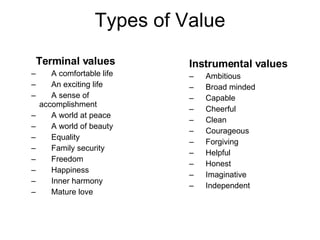
Types of Value Terminal values 􀂄 A comfortable life 􀂄 An exciting life 􀂄 A sense of accomplishment 􀂄 A world at peace 􀂄 A world of beauty 􀂄 Equality 􀂄 Family security 􀂄 Freedom 􀂄 Happiness 􀂄 Inner harmony 􀂄 Mature love Instrumental values 􀂄 Ambitious 􀂄 Broad minded 􀂄 Capable 􀂄 Cheerful  􀂄 Clean 􀂄 Courageous 􀂄 Forgiving 􀂄 Helpful 􀂄 Honest 􀂄 Imaginative 􀂄 Independent
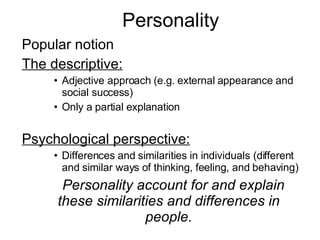
Personality Popular notion The descriptive: Adjective approach (e.g. external appearance and social success) Only a partial explanation Psychological perspective: Differences and similarities in individuals (different and similar ways of thinking, feeling, and behaving) 􀂄 Personality account for and explain these similarities and differences in people.
Personality Concepts How people affect others, how they understand and view themselves, their pattern of inner and outer measurable traits, and the person-situation interaction. The unique and relatively stable pattern of behaviors, thoughts and emotions of individuals in response to a situation. Role of personality in OB Helps in understanding and predicting how people are likely to behave in various situations.
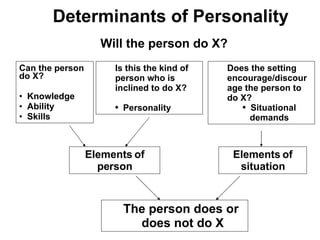
Determinants of Personality Can the person do X? Knowledge Ability Skills Is this the kind of person who is inclined to do X?   Personality Elements of person The person does or  does not do X Will the person do X? Does the setting encourage/discourage the person to do X? Situational demands Elements of situation
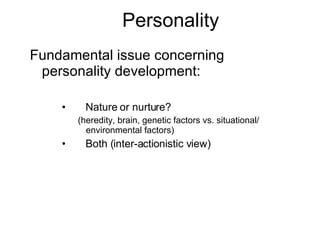
Personality Fundamental issue concerning personality development: 􀂄 Nature or nurture?  (heredity, brain, genetic factors vs. situational/ environmental factors) 􀂄 Both (inter-actionistic view)
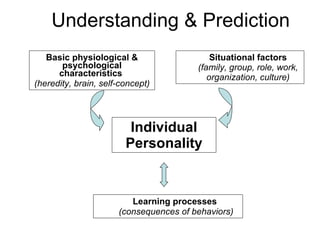
Understanding & Prediction Basic physiological & psychological characteristics   (heredity, brain, self-concept) Situational factors   (family, group, role, work, organization, culture) Individual Personality Learning processes  (consequences of behaviors)
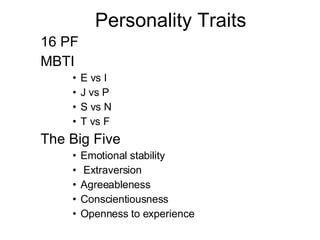
Personality Traits 16 PF MBTI E vs I J vs P S vs N T vs F The Big Five Emotional stability Extraversion Agreeableness Conscientiousness Openness to experience
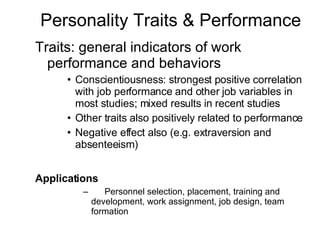
Personality Traits & Performance Traits: general indicators of work performance and behaviors Conscientiousness: strongest positive correlation with job performance and other job variables in most studies; mixed results in recent studies Other traits also positively related to performance  Negative effect also (e.g. extraversion and absenteeism) Applications 􀂄 Personnel selection, placement, training and development, work assignment, job design, team formation

Person Job Fit1=3

  • 1.
    Person Job FitPerson Variables
  • 2.
    Person Job FitConcept 􀂄 Matching of personal characteristics with the requirements of job. Importance Positive performance/behavioral outcomes (higher performance, greater satisfaction, lower absenteeism and turnover, more organization citizenship behavior, less stress etc). Process Person profiling and job profiling.
  • 3.
    Major dimensions 􀂄Personal/ biographical characteristics (age, gender, marital status, tenure) 􀂄 Ability 􀂄 Values 􀂄 Personality 􀂄 Perception and attribution 􀂄 Attitudes 􀂄 Learning Person Profiling
  • 4.
    Popular belief: performancedeclines with age Positive qualities: experience, judgement, a strong work ethic and commitment to quality Negative qualities: lack of flexibility and resistant to technology Age & Job Performance
  • 5.
    Productivity: Age andproductivity not directly related Physical loss of ability offset by gain in experience Job satisfaction: Mixed findings: positive to U-shaped relationships Among professionals: continuing increase in satisfaction Among non-professionals: decline during middle age and increase in the latter years Turnover: Less likely Absenteeism: Less avoidable, more unavoidable absence Age & Job Performance
  • 6.
    Gender & JobPerformance A highly debated issue No conclusive evidence of major differences Productivity: No consistent differences in problem solving ability, analytical skills, competitive drive, motivation, sociability, or learning ability Minor psychological differences: women more conformists and men more aggressive and ambitious Job satisfaction: No difference Turnover: Mixed evidence Absenteeism: High rate among women
  • 7.
    Marital Status &Job Performance Job value increase with marriage Cause-effect relations not very clear Productivity: Effects not fully researched Job satisfaction: Increased Turnover: Less Absenteeism: Decreased
  • 8.
    Tenure & JobPerformance A controversial issue Productivity: Positive relationship Job satisfaction: Positive relationship Turnover: Negative relationship Absenteeism: Negative relationship
  • 9.
    Ability Fact: Peoplediffer in terms of their abilities Issue: How abilities differ in people Ability: 􀂄 A person’s capacity to perform various tasks in a job Types of ability 􀂄 Intellectual: cognitive, practical and emotional intelligence 􀂄 Physical
  • 10.
    Intellectual Ability Cognitiveintelligence: The ability to understand complex ideas, adapt effectively to the environment, learn from experience, engage in various forms of reasoning, and overcome obstacles by careful thought Core dimensions: 􀂊 Number aptitude 􀂊 Verbal comprehension 􀂊 Perceptual speed 􀂊 Inductive reasoning 􀂊 Deductive reasoning 􀂊 Spatial visualization 􀂊 Memory
  • 11.
    Intellectual Ability Cognitiveintelligence: Individuals possess these dimensions in varying proportion Different jobs place different demands with respect to these dimensions for successful performance Measurement through IQ and GMAT A high IQ not a prerequisite for all jobs (routine work) Tests involving assessment of verbal, numerical, spatial and perceptual abilities are valid predictors at all levels of jobs Uses in selection, placement, promotion and training
  • 12.
    Intellectual Ability Practicalintelligence ( doing smart ): Adeptness at solving the practical problems of everyday life Ability to devise effective ways of getting things done More important than IQ in business setting Tacit knowledge (knowing how to get things done) as opposed to formal academic knowledge 􀂊 Action oriented 􀂊 Practically useful
  • 13.
    Physical Abilities Thecapacity to engage in the physical tasks required to perform a job such as: 􀂄 Strength 􀂄 Flexibility 􀂄 Stamina 􀂄 Speed Individual and job differences in these abilities
  • 14.
    Ability Job FitA high ability-job fit necessary for improved job performance Need for identifying abilities requirements of the job for adequate performance and for measuring those abilities in individuals to establish the fit Lack of fit leads to performance problems If, Ability < Job Requirements basic cause of poor performance Ability > Job Requirements organizational inefficiency and job dissatisfaction
  • 15.
    Value & ValueSystem Value The most stable or enduring human characteristic A fundamental conviction that a specific mode of conduct or end-state of existence is personally or socially preferable Contains a judgemental element: right or wrong Has content (a mode of conduct or end-state is important) and intensity (how important is it) attributes Value system 􀂄 Ranking of values in terms of their intensity
  • 16.
    Value & ValueSystem Identification Determines behaviors Has emotive/ feeling base Contributes to human identity Is relatively permanent Has common/ universal applications Importance Drives, motivates and governs the way people think, behave, and relate to other people and the society Basis for understanding attitudes, motivation and perception
  • 17.
    Value & ValueSystem Rokeach’s values types Terminal values Desirable end-states of existence Instrumental values Preferable modes of behaviors (means of achieving terminal values)
  • 18.
    Types of ValueTerminal values 􀂄 A comfortable life 􀂄 An exciting life 􀂄 A sense of accomplishment 􀂄 A world at peace 􀂄 A world of beauty 􀂄 Equality 􀂄 Family security 􀂄 Freedom 􀂄 Happiness 􀂄 Inner harmony 􀂄 Mature love Instrumental values 􀂄 Ambitious 􀂄 Broad minded 􀂄 Capable 􀂄 Cheerful 􀂄 Clean 􀂄 Courageous 􀂄 Forgiving 􀂄 Helpful 􀂄 Honest 􀂄 Imaginative 􀂄 Independent
  • 19.
    Personality Popular notionThe descriptive: Adjective approach (e.g. external appearance and social success) Only a partial explanation Psychological perspective: Differences and similarities in individuals (different and similar ways of thinking, feeling, and behaving) 􀂄 Personality account for and explain these similarities and differences in people.
  • 20.
    Personality Concepts Howpeople affect others, how they understand and view themselves, their pattern of inner and outer measurable traits, and the person-situation interaction. The unique and relatively stable pattern of behaviors, thoughts and emotions of individuals in response to a situation. Role of personality in OB Helps in understanding and predicting how people are likely to behave in various situations.
  • 21.
    Determinants of PersonalityCan the person do X? Knowledge Ability Skills Is this the kind of person who is inclined to do X? Personality Elements of person The person does or does not do X Will the person do X? Does the setting encourage/discourage the person to do X? Situational demands Elements of situation
  • 22.
    Personality Fundamental issueconcerning personality development: 􀂄 Nature or nurture? (heredity, brain, genetic factors vs. situational/ environmental factors) 􀂄 Both (inter-actionistic view)
  • 23.
    Understanding & PredictionBasic physiological & psychological characteristics (heredity, brain, self-concept) Situational factors (family, group, role, work, organization, culture) Individual Personality Learning processes (consequences of behaviors)
  • 24.
    Personality Traits 16PF MBTI E vs I J vs P S vs N T vs F The Big Five Emotional stability Extraversion Agreeableness Conscientiousness Openness to experience
  • 25.
    Personality Traits &Performance Traits: general indicators of work performance and behaviors Conscientiousness: strongest positive correlation with job performance and other job variables in most studies; mixed results in recent studies Other traits also positively related to performance Negative effect also (e.g. extraversion and absenteeism) Applications 􀂄 Personnel selection, placement, training and development, work assignment, job design, team formation