Designing Organizational Frameworks  for High Performance
Organizational Processes for high performance Communication Decision Making Team Work
Communication I speak you hear I speak you see I speak  you understand I speak  you respond A perfect communication is when a thought or idea was transmitted so that the mental picture perceived by the receiver was exactly as envisioned by the sender Communication helps us: To sort out, categorize, understand and interpret messages we receive from others.  To understand, interpret and create our own responses to messages we have received.
Functions of Communication Information : provides the information that individuals and groups need to make decisions Control : acts to control member behavior Motivation : fosters motivation by clarifying the employees what is to be done to improve performance Emotional expression : provides a release for emotional expression of feelings and frustrations.
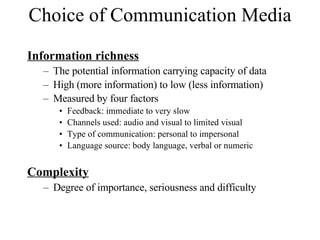
Choice of Communication Media Information richness   The potential information carrying capacity of data High (more information) to low (less information) Measured by four factors Feedback: immediate to very slow Channels used: audio and visual to limited visual Type of communication: personal to impersonal Language source: body language, verbal or numeric Complexity Degree of importance, seriousness and difficulty
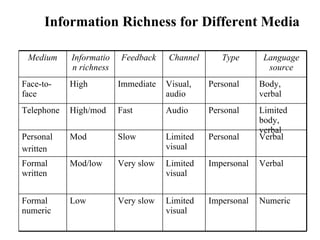
Information Richness for Different Media Medium Information richness Feedback Channel Type Language source Face-to-face High Immediate Visual, audio Personal  Body, verbal Telephone High/mod Fast Audio Personal Limited body, verbal Personal written Mod Slow Limited visual Personal Verbal Formal written Mod/low Very slow Limited visual Impersonal Verbal Formal numeric Low Very slow Limited visual Impersonal Numeric
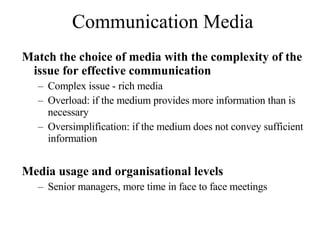
Communication Media Match the choice of media with the complexity of the issue for effective communication Complex issue - rich media Overload: if the medium provides more information than is necessary Oversimplification: if the medium does not convey sufficient information Media usage and organisational levels Senior managers, more time in face to face meetings
Directions of Communication Downward Communication Upward Communication Sideward Communication (For details refer to seminar)
Grapevine An informal channel of sharing information of interest between employees with no reporting responsibility  Fast, often accurate, efficient, and fulfils employees’ social, security, and esteem needs Can be used to spread false rumours and destructive information but also effectively supplements the formal channels of communication
Interactive Behavior Categories  Study on Verbal Communication carried out by Research Team in UK in late ‘80s  13 major interactive behavior categories Proposing : putting forward a new concept, suggestion, course of action, plan etc. Building : extending or developing a proposal which has been made by another person. Supporting : a conscious and direct declaration of agreement or support for another person or his ideas.
Interactive Behavior Categories Disagreeing :  a conscious, direct and reasoned declaration of different of opinion or criticism of another person's ideas. Defending/attacking : attacking another person or defensively strengthening own position. Blocking :  placing a difficulty or blocking in the path of a proposal without offering any alternative. Testing understanding :  seeking to establish whether or nor an earlier contribution has been understood.
Interactive Behavior Categories Summarising : restating in a compact form, the content of previous discussions.  Seeking information : seeking facts, opinions or clarifications from others. Giving information : offering facts, opinions or clarifications to others Bringing in : a direct and positive attempt to involve others. Shutting out : excluding or attempting to exclude others. Encouraging : expressing the feeling of being friendly to others.
Effective Verbal Communication Use initiating, responding and clarifying/ seeking verbal behavior in a balanced way Avoid strong negative responding behaviors Avoid negative behavior spirals and behavior chaining Flag positive verbal behaviors Use positive supportive behaviors
Decision & Decision Making Decision A choice of a course of action Decision making A process of choosing among alternatives in relation to a situation Decision making process  Intelligence activity (searching the environment for conditions calling for decision making) Design activity (inventing, developing and analysing possible courses of action) Choice activity (selecting a particular course of action)
Organizational Decisions Programmed decisions Decisions made according to  pre-established routines and procedures Non-programmed decisions Decisions made about novel, non-recurring problems for which there are no pre-specified courses of action Strategic decisions Non-programmed decisions, typically made by high level executives, regarding the direction the organisation should take to achieve its
Criteria for Decision Effectiveness Quality Desired outcome while meeting relevant criteria and constraints Timeliness Closer to the time when a response to the situation is required Acceptance Ownership of the decision and willingness to take responsibility to implement it Ethical appropriateness Within the boundary of moral and legal norms
Decision Rationality Rationality: the key basis for making decision:  Choosing a means to reach a desired end The degree of rationality determined by the degree of appropriateness of the means chosen Ideally, decisions should be fully objective and logical (i.e. rational), made with complete knowledge In actuality, decisions are made with varying degrees of rationality
Types of Rationality Objective rationality : if a decision maximises given values in a given situation Subjective rationality : if a decision maximises attainment relative to knowledge of the given subject Conscious rationality : if a decision involves a  conscious process in making adjustment of means to end Deliberate rationality : if a decision involves a deliberate adjustment of means to end Organisational rationality : if a decision is aimed at the organisational goals Personal rationality : if a decision is aimed at the individual’s goals
Models of behavioral decision making Economic Rationality Model Social Rationality Model Bounded Rationality Model Judgemental Heuristic and Bias Model For details, refer to seminar slides
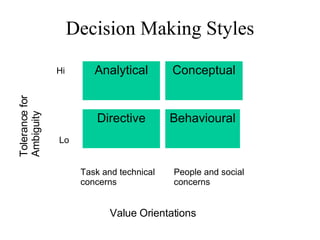
Decision Making Styles Analytical Conceptual Directive Behavioural Hi Lo Tolerance for Ambiguity Task and technical concerns People and social concerns Value Orientations
Decision Making Styles Directive style Efficient, pragmatic and systematic in problem solving Focus on facts and quick accomplishment  Action oriented, short run focus, autocratic leadership style Analytical style  Analyse situations in detail and evaluate more information and alternatives May take a long time to reach a decision Respond well to new or uncertain situations Also autocratic leadership style
Decision Making Styles Conceptual style Take a broad perspective in problem solving and consider many options Discuss to gather information and then use intuition to decide Good at taking risks and generating creative solutions May also foster an idealistic, indecisive approach Behavioural style   Work well with others and like opinion sharing Receptive to suggestions, supportive Avoid conflicts and prefer verbal communication Difficulty in saying no and making tough decisions
Participative Decision Making Concepts Participation, a key theme in decision making Unit: individuals or teams Structure: formal or informal Type: intellectual, emotional and physical involvement Degree: no participation to full participation
Participative Decision Making Individual participation techniques Those in which a subordinate makes an input or somehow affects the decision making of a superior Team participation techniques Range between consultative and democratic Evaluation of participative techniques Effectiveness influenced by leadership styles and personality of the parties involved as well as situational, contextual and ideological factors Different outcomes of different forms of participative techniques (e.g. informal: productivity and satisfaction, representative: only satisfaction, short-term: no outcomes)
Participative Decision Making Problems Time consuming Participation sought but not allowed to be intellectually and emotionally involved or suggestions not utilised
Group Decision Making Social schemes to predict outcomes of group decision making The majority - wins scheme (initial majority position, when no objectively correct decision) The truth - wins scheme (recognition of one objectively correct approach with more information/ discussion) The two - thirds majority scheme (initial favour of two-thirds) The first - shift rule (decision that reflects the first shift in opinion) Status quo tendency Group resistance to change
Group Decision Making Delphi technique A panel of experts, no face-to-face interaction Anonymous prediction or inputs into the problem Anonymous feedback from all other members Another round of inputs For an agreed upon number of times or until the composite feedback remains the same Evaluation Anonymity encourages flexibility and concern for good decision Time consuming, costly and lack of scientific basis
Group Decision Making Nominal group technique A group in name only: no verbal exchanges initially Silent generation of ideas in writing Round-robin feedback from group members Discussion of each recorded idea for clarification and evaluation Individual voting on priority ideas
Importance of Group An important sociological unit of analysis for studying organisational behaviour Organisational goals generally achieved by groups A growing emphasis on team approach to improving organisational performance and productivity Considerable influence on individual behaviours and performance  Group dynamics is concerned with How groups form Their structure and processes How they function and affect members, other groups and the organisation
Theories of Group of Formation Propinquity theory Balance theory Exchange theory (for details, refer to seminar slides)
Stages of Group Development Forming:  marked by uncertainty; group members not sure about the purpose, structure, task, or leadership of the group Storming:  characterised by conflict, disagreement, and confrontation among group members about group and task roles Norming:  determination of behaviour rules and beginning of shared responsibility, cohesion, and collaboration Performing:  fully functioning group devoted to effectively accomplishing the tasks agreed upon; increased collaboration, and problem solving Adjourning:  task completion and disbanding or new composition of group
Types of Groups Primary groups Feelings of comradeship, loyalty, and a common sense of values (family, peer group, also work group) Coalitions (very powerful groups in organisation) Interacting group of individuals Constructed deliberately for a specific purpose Independent of formal organisation structure Lacking a formal internal structure Mutual perception of membership Issues oriented to advance purposes of members Concerted member action
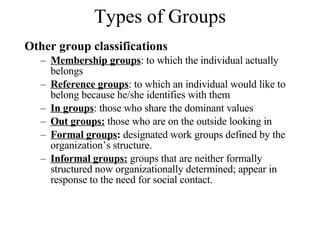
Types of Groups Other group classifications Membership groups : to which the individual actually belongs Reference groups : to which an individual would like to belong because he/she identifies with them In groups : those who share the dominant values Out groups:  those who are on the outside looking in Formal groups :  designated work groups defined by the organization’s structure. Informal groups:   groups that are neither formally structured now organizationally determined; appear in response to the need for social contact.
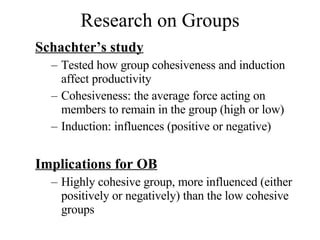
Research on Groups Schachter’s study Tested how group cohesiveness and induction affect productivity Cohesiveness: the average force acting on members to remain in the group (high or low) Induction: influences (positive or negative) Implications for OB Highly cohesive group, more influenced (either positively or negatively) than the low cohesive groups
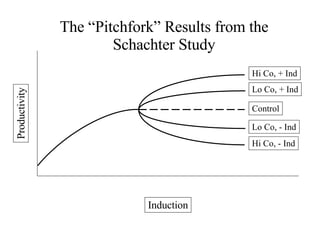
The “Pitchfork” Results from the Schachter Study Control Hi Co, - Ind Lo Co, + Ind Lo Co, - Ind Hi Co, + Ind Productivity Induction
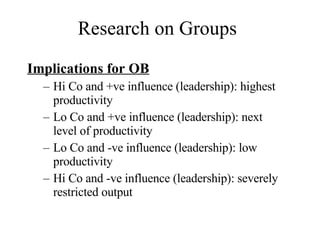
Research on Groups Implications for OB Hi Co and +ve influence (leadership): highest productivity Lo Co and +ve influence (leadership): next level of productivity Lo Co and -ve influence (leadership): low productivity Hi Co and -ve influence (leadership): severely restricted output
Group Effectiveness Use of groups to enhance satisfaction and performance Organising work around intact groups Having group charged with selection, training and rewarding members Using group norms for enforcement of behaviours Distributing resources on a group rather than an individual basis Promoting intergroup rivalry to build within group cohesiveness
Group Effectiveness Factors determining group effectiveness Task interdependence (how closely group members work together) Outcome interdependence (whether, and how, group performance is rewarded) Potency (members’ belief that the group can be effective) Factors determining success level of group The type of task being performed The formation and composition of the group The group’s ability to adapt to change
The Dysfunctions of Groups Violation of group norms  : result in antisocial behaviour Role ambiguity:  unclear about what to do Role conflict:  requirement for conflicting tasks or different values Groupthink:  in a highly cohesive group, from pressure to conform Social loafing : reduction in efforts and performance as a group member
Work Teams The most important group phenomenon in organisations Project teams, parallel teams, permanent work teams  Teams go beyond traditional formal work groups by having shared leadership roles, collective decision making, and synergistic effect.
Work Teams Cross-functional team as result of a move toward horizontal organisational design Individuals from various departments or functional specialists To improve coordination Choose team members effectively Clearly establish the purpose of the team Ensure everyone understands how the team will function Conduct intensive team building up front so that everyone learns how to interact  effectively Achieve noticeable results for morale
Work Teams Virtual team a result of advances in IT Individuals interacting and working from a distance Effective because they are flexible and driven by information and skills rather than time and location Limited by task nature
Work Teams Self managed team A group of employees empowered to manage and perform technical tasks that result in a product or service being delivered to a customer Increased job satisfaction, improved customer service and stringer organisational commitment
Team Effectiveness Supportive environment Reward systems, communication systems and physical space allow to work in a productive atmosphere Design of interdependent tasks Selection of members based on motivation and competence Encouragement of team cohesion
Team Effectiveness Model Team building Establishes a sense of partnership and allows members to see the team as a unit and attractive work arrangement Succeeds when individuals share collective intelligence and experience a sense of empowerment To fit with the corporate culture Collaboration Learning how to improve interpersonal interactions in group settings with committing to a common goal
Team Effectiveness Model Group leadership How members are selected What tactics are used to affect those members Understanding of culture and diversity issues Learning how to improve interpersonal interactions in group settings with committing to a common goal

Organizational Processes=18

  • 1.
  • 2.
    Organizational Processes forhigh performance Communication Decision Making Team Work
  • 3.
    Communication I speakyou hear I speak you see I speak you understand I speak you respond A perfect communication is when a thought or idea was transmitted so that the mental picture perceived by the receiver was exactly as envisioned by the sender Communication helps us: To sort out, categorize, understand and interpret messages we receive from others. To understand, interpret and create our own responses to messages we have received.
  • 4.
    Functions of CommunicationInformation : provides the information that individuals and groups need to make decisions Control : acts to control member behavior Motivation : fosters motivation by clarifying the employees what is to be done to improve performance Emotional expression : provides a release for emotional expression of feelings and frustrations.
  • 5.
    Choice of CommunicationMedia Information richness The potential information carrying capacity of data High (more information) to low (less information) Measured by four factors Feedback: immediate to very slow Channels used: audio and visual to limited visual Type of communication: personal to impersonal Language source: body language, verbal or numeric Complexity Degree of importance, seriousness and difficulty
  • 6.
    Information Richness forDifferent Media Medium Information richness Feedback Channel Type Language source Face-to-face High Immediate Visual, audio Personal Body, verbal Telephone High/mod Fast Audio Personal Limited body, verbal Personal written Mod Slow Limited visual Personal Verbal Formal written Mod/low Very slow Limited visual Impersonal Verbal Formal numeric Low Very slow Limited visual Impersonal Numeric
  • 7.
    Communication Media Matchthe choice of media with the complexity of the issue for effective communication Complex issue - rich media Overload: if the medium provides more information than is necessary Oversimplification: if the medium does not convey sufficient information Media usage and organisational levels Senior managers, more time in face to face meetings
  • 8.
    Directions of CommunicationDownward Communication Upward Communication Sideward Communication (For details refer to seminar)
  • 9.
    Grapevine An informalchannel of sharing information of interest between employees with no reporting responsibility Fast, often accurate, efficient, and fulfils employees’ social, security, and esteem needs Can be used to spread false rumours and destructive information but also effectively supplements the formal channels of communication
  • 10.
    Interactive Behavior Categories Study on Verbal Communication carried out by Research Team in UK in late ‘80s 13 major interactive behavior categories Proposing : putting forward a new concept, suggestion, course of action, plan etc. Building : extending or developing a proposal which has been made by another person. Supporting : a conscious and direct declaration of agreement or support for another person or his ideas.
  • 11.
    Interactive Behavior CategoriesDisagreeing : a conscious, direct and reasoned declaration of different of opinion or criticism of another person's ideas. Defending/attacking : attacking another person or defensively strengthening own position. Blocking : placing a difficulty or blocking in the path of a proposal without offering any alternative. Testing understanding : seeking to establish whether or nor an earlier contribution has been understood.
  • 12.
    Interactive Behavior CategoriesSummarising : restating in a compact form, the content of previous discussions. Seeking information : seeking facts, opinions or clarifications from others. Giving information : offering facts, opinions or clarifications to others Bringing in : a direct and positive attempt to involve others. Shutting out : excluding or attempting to exclude others. Encouraging : expressing the feeling of being friendly to others.
  • 13.
    Effective Verbal CommunicationUse initiating, responding and clarifying/ seeking verbal behavior in a balanced way Avoid strong negative responding behaviors Avoid negative behavior spirals and behavior chaining Flag positive verbal behaviors Use positive supportive behaviors
  • 14.
    Decision & DecisionMaking Decision A choice of a course of action Decision making A process of choosing among alternatives in relation to a situation Decision making process Intelligence activity (searching the environment for conditions calling for decision making) Design activity (inventing, developing and analysing possible courses of action) Choice activity (selecting a particular course of action)
  • 15.
    Organizational Decisions Programmeddecisions Decisions made according to pre-established routines and procedures Non-programmed decisions Decisions made about novel, non-recurring problems for which there are no pre-specified courses of action Strategic decisions Non-programmed decisions, typically made by high level executives, regarding the direction the organisation should take to achieve its
  • 16.
    Criteria for DecisionEffectiveness Quality Desired outcome while meeting relevant criteria and constraints Timeliness Closer to the time when a response to the situation is required Acceptance Ownership of the decision and willingness to take responsibility to implement it Ethical appropriateness Within the boundary of moral and legal norms
  • 17.
    Decision Rationality Rationality:the key basis for making decision: Choosing a means to reach a desired end The degree of rationality determined by the degree of appropriateness of the means chosen Ideally, decisions should be fully objective and logical (i.e. rational), made with complete knowledge In actuality, decisions are made with varying degrees of rationality
  • 18.
    Types of RationalityObjective rationality : if a decision maximises given values in a given situation Subjective rationality : if a decision maximises attainment relative to knowledge of the given subject Conscious rationality : if a decision involves a conscious process in making adjustment of means to end Deliberate rationality : if a decision involves a deliberate adjustment of means to end Organisational rationality : if a decision is aimed at the organisational goals Personal rationality : if a decision is aimed at the individual’s goals
  • 19.
    Models of behavioraldecision making Economic Rationality Model Social Rationality Model Bounded Rationality Model Judgemental Heuristic and Bias Model For details, refer to seminar slides
  • 20.
    Decision Making StylesAnalytical Conceptual Directive Behavioural Hi Lo Tolerance for Ambiguity Task and technical concerns People and social concerns Value Orientations
  • 21.
    Decision Making StylesDirective style Efficient, pragmatic and systematic in problem solving Focus on facts and quick accomplishment Action oriented, short run focus, autocratic leadership style Analytical style Analyse situations in detail and evaluate more information and alternatives May take a long time to reach a decision Respond well to new or uncertain situations Also autocratic leadership style
  • 22.
    Decision Making StylesConceptual style Take a broad perspective in problem solving and consider many options Discuss to gather information and then use intuition to decide Good at taking risks and generating creative solutions May also foster an idealistic, indecisive approach Behavioural style Work well with others and like opinion sharing Receptive to suggestions, supportive Avoid conflicts and prefer verbal communication Difficulty in saying no and making tough decisions
  • 23.
    Participative Decision MakingConcepts Participation, a key theme in decision making Unit: individuals or teams Structure: formal or informal Type: intellectual, emotional and physical involvement Degree: no participation to full participation
  • 24.
    Participative Decision MakingIndividual participation techniques Those in which a subordinate makes an input or somehow affects the decision making of a superior Team participation techniques Range between consultative and democratic Evaluation of participative techniques Effectiveness influenced by leadership styles and personality of the parties involved as well as situational, contextual and ideological factors Different outcomes of different forms of participative techniques (e.g. informal: productivity and satisfaction, representative: only satisfaction, short-term: no outcomes)
  • 25.
    Participative Decision MakingProblems Time consuming Participation sought but not allowed to be intellectually and emotionally involved or suggestions not utilised
  • 26.
    Group Decision MakingSocial schemes to predict outcomes of group decision making The majority - wins scheme (initial majority position, when no objectively correct decision) The truth - wins scheme (recognition of one objectively correct approach with more information/ discussion) The two - thirds majority scheme (initial favour of two-thirds) The first - shift rule (decision that reflects the first shift in opinion) Status quo tendency Group resistance to change
  • 27.
    Group Decision MakingDelphi technique A panel of experts, no face-to-face interaction Anonymous prediction or inputs into the problem Anonymous feedback from all other members Another round of inputs For an agreed upon number of times or until the composite feedback remains the same Evaluation Anonymity encourages flexibility and concern for good decision Time consuming, costly and lack of scientific basis
  • 28.
    Group Decision MakingNominal group technique A group in name only: no verbal exchanges initially Silent generation of ideas in writing Round-robin feedback from group members Discussion of each recorded idea for clarification and evaluation Individual voting on priority ideas
  • 29.
    Importance of GroupAn important sociological unit of analysis for studying organisational behaviour Organisational goals generally achieved by groups A growing emphasis on team approach to improving organisational performance and productivity Considerable influence on individual behaviours and performance Group dynamics is concerned with How groups form Their structure and processes How they function and affect members, other groups and the organisation
  • 30.
    Theories of Groupof Formation Propinquity theory Balance theory Exchange theory (for details, refer to seminar slides)
  • 31.
    Stages of GroupDevelopment Forming: marked by uncertainty; group members not sure about the purpose, structure, task, or leadership of the group Storming: characterised by conflict, disagreement, and confrontation among group members about group and task roles Norming: determination of behaviour rules and beginning of shared responsibility, cohesion, and collaboration Performing: fully functioning group devoted to effectively accomplishing the tasks agreed upon; increased collaboration, and problem solving Adjourning: task completion and disbanding or new composition of group
  • 32.
    Types of GroupsPrimary groups Feelings of comradeship, loyalty, and a common sense of values (family, peer group, also work group) Coalitions (very powerful groups in organisation) Interacting group of individuals Constructed deliberately for a specific purpose Independent of formal organisation structure Lacking a formal internal structure Mutual perception of membership Issues oriented to advance purposes of members Concerted member action
  • 33.
    Types of GroupsOther group classifications Membership groups : to which the individual actually belongs Reference groups : to which an individual would like to belong because he/she identifies with them In groups : those who share the dominant values Out groups: those who are on the outside looking in Formal groups : designated work groups defined by the organization’s structure. Informal groups: groups that are neither formally structured now organizationally determined; appear in response to the need for social contact.
  • 34.
    Research on GroupsSchachter’s study Tested how group cohesiveness and induction affect productivity Cohesiveness: the average force acting on members to remain in the group (high or low) Induction: influences (positive or negative) Implications for OB Highly cohesive group, more influenced (either positively or negatively) than the low cohesive groups
  • 35.
    The “Pitchfork” Resultsfrom the Schachter Study Control Hi Co, - Ind Lo Co, + Ind Lo Co, - Ind Hi Co, + Ind Productivity Induction
  • 36.
    Research on GroupsImplications for OB Hi Co and +ve influence (leadership): highest productivity Lo Co and +ve influence (leadership): next level of productivity Lo Co and -ve influence (leadership): low productivity Hi Co and -ve influence (leadership): severely restricted output
  • 37.
    Group Effectiveness Useof groups to enhance satisfaction and performance Organising work around intact groups Having group charged with selection, training and rewarding members Using group norms for enforcement of behaviours Distributing resources on a group rather than an individual basis Promoting intergroup rivalry to build within group cohesiveness
  • 38.
    Group Effectiveness Factorsdetermining group effectiveness Task interdependence (how closely group members work together) Outcome interdependence (whether, and how, group performance is rewarded) Potency (members’ belief that the group can be effective) Factors determining success level of group The type of task being performed The formation and composition of the group The group’s ability to adapt to change
  • 39.
    The Dysfunctions ofGroups Violation of group norms : result in antisocial behaviour Role ambiguity: unclear about what to do Role conflict: requirement for conflicting tasks or different values Groupthink: in a highly cohesive group, from pressure to conform Social loafing : reduction in efforts and performance as a group member
  • 40.
    Work Teams Themost important group phenomenon in organisations Project teams, parallel teams, permanent work teams Teams go beyond traditional formal work groups by having shared leadership roles, collective decision making, and synergistic effect.
  • 41.
    Work Teams Cross-functionalteam as result of a move toward horizontal organisational design Individuals from various departments or functional specialists To improve coordination Choose team members effectively Clearly establish the purpose of the team Ensure everyone understands how the team will function Conduct intensive team building up front so that everyone learns how to interact effectively Achieve noticeable results for morale
  • 42.
    Work Teams Virtualteam a result of advances in IT Individuals interacting and working from a distance Effective because they are flexible and driven by information and skills rather than time and location Limited by task nature
  • 43.
    Work Teams Selfmanaged team A group of employees empowered to manage and perform technical tasks that result in a product or service being delivered to a customer Increased job satisfaction, improved customer service and stringer organisational commitment
  • 44.
    Team Effectiveness Supportiveenvironment Reward systems, communication systems and physical space allow to work in a productive atmosphere Design of interdependent tasks Selection of members based on motivation and competence Encouragement of team cohesion
  • 45.
    Team Effectiveness ModelTeam building Establishes a sense of partnership and allows members to see the team as a unit and attractive work arrangement Succeeds when individuals share collective intelligence and experience a sense of empowerment To fit with the corporate culture Collaboration Learning how to improve interpersonal interactions in group settings with committing to a common goal
  • 46.
    Team Effectiveness ModelGroup leadership How members are selected What tactics are used to affect those members Understanding of culture and diversity issues Learning how to improve interpersonal interactions in group settings with committing to a common goal