Porter and Lawler Model
MOTIVATION
• Motivation is the inner state causing an
individual to behave in a way that ensures
accomplishment of some goal.
• When managers understand what motivates
different individuals, they can better influence
their employees to accomplish organizational
objectives.
• Motivation explains why people behave the
way they do.
Expectancy Theory
• Motivation depends on how much we want
something and how likely we are to get it.
• Assumes that:
– Behavior is determined by a combination of personal
and environmental forces.
– People make decisions about their own behavior in
organizations.
– Different people have different types of needs,
desires, and goals.
– People choose among alternatives of behaviors in
selecting one that that leads to a desired outcome.
Introduction to Porter and Lawler
Model
• Porter and Lawler used Victor Vroom’s
expectancy theory as a foundation to develop
their expectancy model. Similar to Vroom’s
theory, Porter and Lawler concluded that an
individual’s motivation to complete a task is
affected by the reward they expect to receive
for completing the task. However Porter and
Lawler introduced additional aspects to the
expectancy theory.
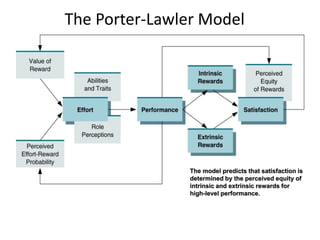
The Porter-Lawler Model

The model predicts that satisfaction is
determined by the perceived equity of
intrinsic and extrinsic rewards for
high-level performance.
Relevance of Porter and Lawler Model
The Porter-Lawler theory is a more complete
theory because it stresses:
(1) intrinsic and extrinsic rewards,
(2) task requirements and ability, and
(3) the perceived fairness of rewards.

Porter and lawler model

  • 1.
  • 2.
    MOTIVATION • Motivation isthe inner state causing an individual to behave in a way that ensures accomplishment of some goal. • When managers understand what motivates different individuals, they can better influence their employees to accomplish organizational objectives. • Motivation explains why people behave the way they do.
  • 3.
    Expectancy Theory • Motivationdepends on how much we want something and how likely we are to get it. • Assumes that: – Behavior is determined by a combination of personal and environmental forces. – People make decisions about their own behavior in organizations. – Different people have different types of needs, desires, and goals. – People choose among alternatives of behaviors in selecting one that that leads to a desired outcome.
  • 4.
    Introduction to Porterand Lawler Model • Porter and Lawler used Victor Vroom’s expectancy theory as a foundation to develop their expectancy model. Similar to Vroom’s theory, Porter and Lawler concluded that an individual’s motivation to complete a task is affected by the reward they expect to receive for completing the task. However Porter and Lawler introduced additional aspects to the expectancy theory.
  • 5.
    The Porter-Lawler Model Themodel predicts that satisfaction is determined by the perceived equity of intrinsic and extrinsic rewards for high-level performance.
  • 6.
    Relevance of Porterand Lawler Model The Porter-Lawler theory is a more complete theory because it stresses: (1) intrinsic and extrinsic rewards, (2) task requirements and ability, and (3) the perceived fairness of rewards.