Appraising Performance
Performance Appraisal A process of determining how well employees do their jobs compared to a set of standards to improve their performance effectiveness. Appraisal involves : Setting work standards Assessing actual performance vs set standards Identifying conditions influencing performance Discussing with the employees and giving feedback
Why Appraise Performance? Play an integral role in the employer’s performance management process. Help in planning for correcting deficiencies and reinforce things done correctly. Useful for career planning in identifying employee strengths and weaknesses. Affect the employer’s salary raise decisions.
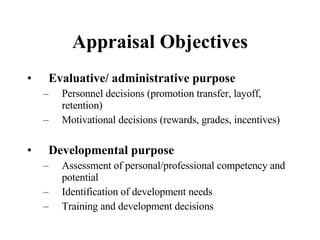
Appraisal Objectives Evaluative/ administrative purpose Personnel decisions (promotion transfer, layoff, retention) Motivational decisions (rewards, grades, incentives) Developmental purpose Assessment of personal/professional competency and potential Identification of development needs Training and development decisions
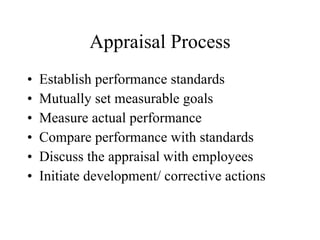
Appraisal Process Establish performance standards Mutually set measurable goals Measure actual performance Compare performance with standards Discuss the appraisal with employees Initiate development/ corrective actions
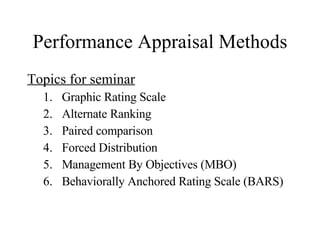
Performance Appraisal Methods Topics for seminar Graphic Rating Scale Alternate Ranking Paired comparison Forced Distribution Management By Objectives (MBO) Behaviorally Anchored Rating Scale (BARS)
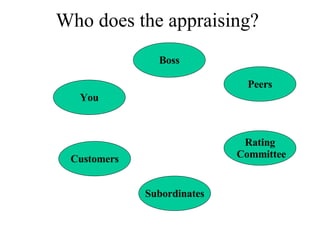
Who does the appraising? Customers Rating Committee You Peers Boss Subordinates
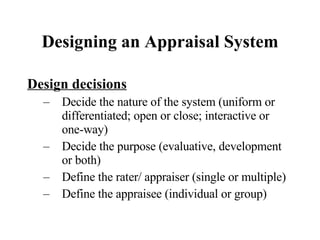
Designing an Appraisal System Design decisions Decide the nature of the system (uniform or differentiated; open or close; interactive or one-way) Decide the purpose (evaluative, development or both) Define the rater/ appraiser (single or multiple) Define the appraisee (individual or group)
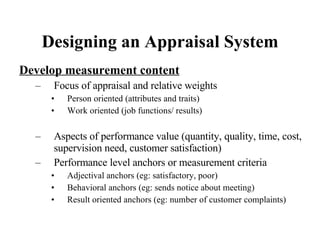
Designing an Appraisal System Develop measurement content Focus of appraisal and relative weights Person oriented (attributes and traits) Work oriented (job functions/ results) Aspects of performance value (quantity, quality, time, cost, supervision need, customer satisfaction) Performance level anchors or measurement criteria Adjectival anchors (eg: satisfactory, poor) Behavioral anchors (eg: sends notice about meeting) Result oriented anchors (eg: number of customer complaints)
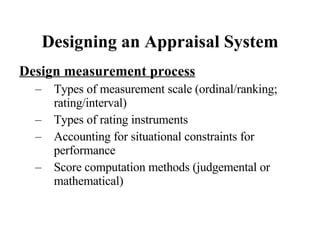
Designing an Appraisal System Design measurement process Types of measurement scale (ordinal/ranking; rating/interval) Types of rating instruments Accounting for situational constraints for performance Score computation methods (judgemental or mathematical)
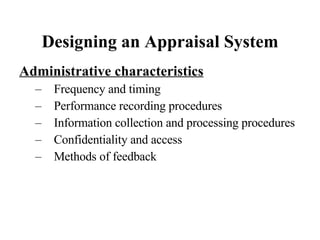
Designing an Appraisal System Administrative characteristics Frequency and timing Performance recording procedures Information collection and processing procedures Confidentiality and access Methods of feedback
Rating Errors Primacy and recency effect Halo and horn effect Central tendency Leniency/ strictness Non-performance factor Stereotyping Hostility Self-comparison/ compatibility
Avoiding Rating Errors Awareness of errors/ problems and their likely effects Use of right appraisal tools  Training of appraisers Use of diaries
Effective Appraisal System Use behaviour/ outcome based measures Monitor and documents performance records Provide on-going feedback Avoid perceptual errors Have both interactive (interview) and written (form) structure Have multiple raters Involve the employee in the appraisal process Train appraisers
Issues of Performance Appraisal in Nepal Limited purpose (promotion-oriented) +lack of defined goals Informal and subjective criteria  Lack of transparency in evaluation Current performance-oriented (No consideration of potentialities o the performer) Appraisal not as motivational tools Poor infrastructure (e.g., lack of job description, goal setting, etc.)  Lack of performance-based reward and development system Unfavorable organizational or administrative culture Ritual practice

Appraising Performance=12

  • 1.
  • 2.
    Performance Appraisal Aprocess of determining how well employees do their jobs compared to a set of standards to improve their performance effectiveness. Appraisal involves : Setting work standards Assessing actual performance vs set standards Identifying conditions influencing performance Discussing with the employees and giving feedback
  • 3.
    Why Appraise Performance?Play an integral role in the employer’s performance management process. Help in planning for correcting deficiencies and reinforce things done correctly. Useful for career planning in identifying employee strengths and weaknesses. Affect the employer’s salary raise decisions.
  • 4.
    Appraisal Objectives Evaluative/administrative purpose Personnel decisions (promotion transfer, layoff, retention) Motivational decisions (rewards, grades, incentives) Developmental purpose Assessment of personal/professional competency and potential Identification of development needs Training and development decisions
  • 5.
    Appraisal Process Establishperformance standards Mutually set measurable goals Measure actual performance Compare performance with standards Discuss the appraisal with employees Initiate development/ corrective actions
  • 6.
    Performance Appraisal MethodsTopics for seminar Graphic Rating Scale Alternate Ranking Paired comparison Forced Distribution Management By Objectives (MBO) Behaviorally Anchored Rating Scale (BARS)
  • 7.
    Who does theappraising? Customers Rating Committee You Peers Boss Subordinates
  • 8.
    Designing an AppraisalSystem Design decisions Decide the nature of the system (uniform or differentiated; open or close; interactive or one-way) Decide the purpose (evaluative, development or both) Define the rater/ appraiser (single or multiple) Define the appraisee (individual or group)
  • 9.
    Designing an AppraisalSystem Develop measurement content Focus of appraisal and relative weights Person oriented (attributes and traits) Work oriented (job functions/ results) Aspects of performance value (quantity, quality, time, cost, supervision need, customer satisfaction) Performance level anchors or measurement criteria Adjectival anchors (eg: satisfactory, poor) Behavioral anchors (eg: sends notice about meeting) Result oriented anchors (eg: number of customer complaints)
  • 10.
    Designing an AppraisalSystem Design measurement process Types of measurement scale (ordinal/ranking; rating/interval) Types of rating instruments Accounting for situational constraints for performance Score computation methods (judgemental or mathematical)
  • 11.
    Designing an AppraisalSystem Administrative characteristics Frequency and timing Performance recording procedures Information collection and processing procedures Confidentiality and access Methods of feedback
  • 12.
    Rating Errors Primacyand recency effect Halo and horn effect Central tendency Leniency/ strictness Non-performance factor Stereotyping Hostility Self-comparison/ compatibility
  • 13.
    Avoiding Rating ErrorsAwareness of errors/ problems and their likely effects Use of right appraisal tools Training of appraisers Use of diaries
  • 14.
    Effective Appraisal SystemUse behaviour/ outcome based measures Monitor and documents performance records Provide on-going feedback Avoid perceptual errors Have both interactive (interview) and written (form) structure Have multiple raters Involve the employee in the appraisal process Train appraisers
  • 15.
    Issues of PerformanceAppraisal in Nepal Limited purpose (promotion-oriented) +lack of defined goals Informal and subjective criteria Lack of transparency in evaluation Current performance-oriented (No consideration of potentialities o the performer) Appraisal not as motivational tools Poor infrastructure (e.g., lack of job description, goal setting, etc.) Lack of performance-based reward and development system Unfavorable organizational or administrative culture Ritual practice