WORK REDESIGN
J. Maria Andria Crescilda
II MSW – HRM
Department of Social Work (SFS)
Madras Christian College
Staff Advisor
Dr. Sankaranarayanan
Asst. Professor
Department of Social Work (SFS)
Madras Christian College
INTRODUCTION
Restructuring the elements including tasks, duties and responsibilities
of a specific job in order to make it more encouraging and inspiring
for the employees or workers is known as job or work redesigning.
It is the process of determining what is currently happening within
the position, what should happen in the future and implementing any
necessary changes to bridge the gap.
OBJECTIVES
• To place the right person in the right job.
• To improve the fit between individual skills and the demands of the
job.
• To get maximum output while increasing the employee’s level of
satisfaction.
INTERDISCIPLINARY PERSPECTIVES ON
JOB REDESIGN
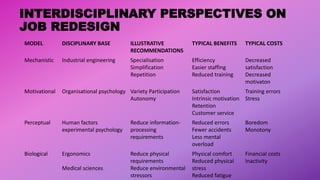
MODEL DISCIPLINARY BASE ILLUSTRATIVE
RECOMMENDATIONS
TYPICAL BENEFITS TYPICAL COSTS
Mechanistic Industrial engineering Specialisation
Simplification
Repetition
Efficiency
Easier staffing
Reduced training
Decreased
satisfaction
Decreased
motivaton
Motivational Organisational psychology Variety Participation
Autonomy
Satisfaction
Intrinsic motivation
Retention
Customer service
Training errors
Stress
Perceptual Human factors
experimental psychology
Reduce information-
processing
requirements
Reduced errors
Fewer accidents
Less mental
overload
Boredom
Monotony
Biological Ergonomics
Medical sciences
Reduce physical
requirements
Reduce environmental
stressors
Physical comfort
Reduced physical
stress
Reduced fatigue
Financial costs
Inactivity
PROCESS OF WORK REDESIGN
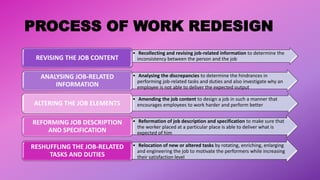
• Recollecting and revising job-related information to determine the
inconsistency between the person and the jobREVISING THE JOB CONTENT
• Analysing the discrepancies to determine the hindrances in
performing job-related tasks and duties and also investigate why an
employee is not able to deliver the expected output
ANALYSING JOB-RELATED
INFORMATION
• Amending the job content to design a job in such a manner that
encourages employees to work harder and perform betterALTERING THE JOB ELEMENTS
• Reformation of job description and specification to make sure that
the worker placed at a particular place is able to deliver what is
expected of him
REFORMING JOB DESCRIPTION
AND SPECIFICATION
• Relocation of new or altered tasks by rotating, enriching, enlarging
and engineering the job to motivate the performers while increasing
their satisfaction level
RESHUFFLING THE JOB-RELATED
TASKS AND DUTIES
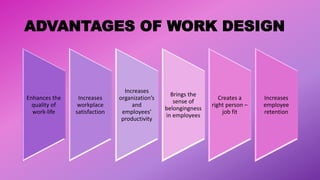
ADVANTAGES OF WORK DESIGN
Enhances the
quality of
work-life
Increases
workplace
satisfaction
Increases
organization’s
and
employees’
productivity
Brings the
sense of
belongingness
in employees
Creates a
right person –
job fit
Increases
employee
retention
OBSTACLES OF WORK REDESIGN
Long-term
effects may
differ from
short-term
effects
New jobs
need to be
created as
part of
growth or
downsizing
Job
enlargement
can occur
without job
enrichment
Individual
differences
complicate
job
redesign
Difficult to
predict the
nature of
the job
before it
exists
Difficulty in
choosing an
appropriate
unit of
analysis
Trade-offs
between
different
work-
design
approaches
Influences
multiple
outcomes
CONCLUSION
There are advantages as well as obstacles in implementing work
redesign. The pitfalls can be avoided and job redesign can be
implemented successfully as a structural intervention by the
practitioners for organizational development.
THANK YOU!

Work redesign

  • 1.
    WORK REDESIGN J. MariaAndria Crescilda II MSW – HRM Department of Social Work (SFS) Madras Christian College Staff Advisor Dr. Sankaranarayanan Asst. Professor Department of Social Work (SFS) Madras Christian College
  • 2.
    INTRODUCTION Restructuring the elementsincluding tasks, duties and responsibilities of a specific job in order to make it more encouraging and inspiring for the employees or workers is known as job or work redesigning. It is the process of determining what is currently happening within the position, what should happen in the future and implementing any necessary changes to bridge the gap.
  • 3.
    OBJECTIVES • To placethe right person in the right job. • To improve the fit between individual skills and the demands of the job. • To get maximum output while increasing the employee’s level of satisfaction.
  • 4.
    INTERDISCIPLINARY PERSPECTIVES ON JOBREDESIGN MODEL DISCIPLINARY BASE ILLUSTRATIVE RECOMMENDATIONS TYPICAL BENEFITS TYPICAL COSTS Mechanistic Industrial engineering Specialisation Simplification Repetition Efficiency Easier staffing Reduced training Decreased satisfaction Decreased motivaton Motivational Organisational psychology Variety Participation Autonomy Satisfaction Intrinsic motivation Retention Customer service Training errors Stress Perceptual Human factors experimental psychology Reduce information- processing requirements Reduced errors Fewer accidents Less mental overload Boredom Monotony Biological Ergonomics Medical sciences Reduce physical requirements Reduce environmental stressors Physical comfort Reduced physical stress Reduced fatigue Financial costs Inactivity
  • 5.
    PROCESS OF WORKREDESIGN • Recollecting and revising job-related information to determine the inconsistency between the person and the jobREVISING THE JOB CONTENT • Analysing the discrepancies to determine the hindrances in performing job-related tasks and duties and also investigate why an employee is not able to deliver the expected output ANALYSING JOB-RELATED INFORMATION • Amending the job content to design a job in such a manner that encourages employees to work harder and perform betterALTERING THE JOB ELEMENTS • Reformation of job description and specification to make sure that the worker placed at a particular place is able to deliver what is expected of him REFORMING JOB DESCRIPTION AND SPECIFICATION • Relocation of new or altered tasks by rotating, enriching, enlarging and engineering the job to motivate the performers while increasing their satisfaction level RESHUFFLING THE JOB-RELATED TASKS AND DUTIES
  • 6.
    ADVANTAGES OF WORKDESIGN Enhances the quality of work-life Increases workplace satisfaction Increases organization’s and employees’ productivity Brings the sense of belongingness in employees Creates a right person – job fit Increases employee retention
  • 7.
    OBSTACLES OF WORKREDESIGN Long-term effects may differ from short-term effects New jobs need to be created as part of growth or downsizing Job enlargement can occur without job enrichment Individual differences complicate job redesign Difficult to predict the nature of the job before it exists Difficulty in choosing an appropriate unit of analysis Trade-offs between different work- design approaches Influences multiple outcomes
  • 8.
    CONCLUSION There are advantagesas well as obstacles in implementing work redesign. The pitfalls can be avoided and job redesign can be implemented successfully as a structural intervention by the practitioners for organizational development.
  • 9.