Job
Design
JOB DESIGN
Job design integrates work content(task,
functions, relationships), the rewards (extrinsic
and intrinsic), and the qualifications required
(skills, knowledge, abilities) for each job in a
way that meets the needs of employees and the
organisation.
Job Design
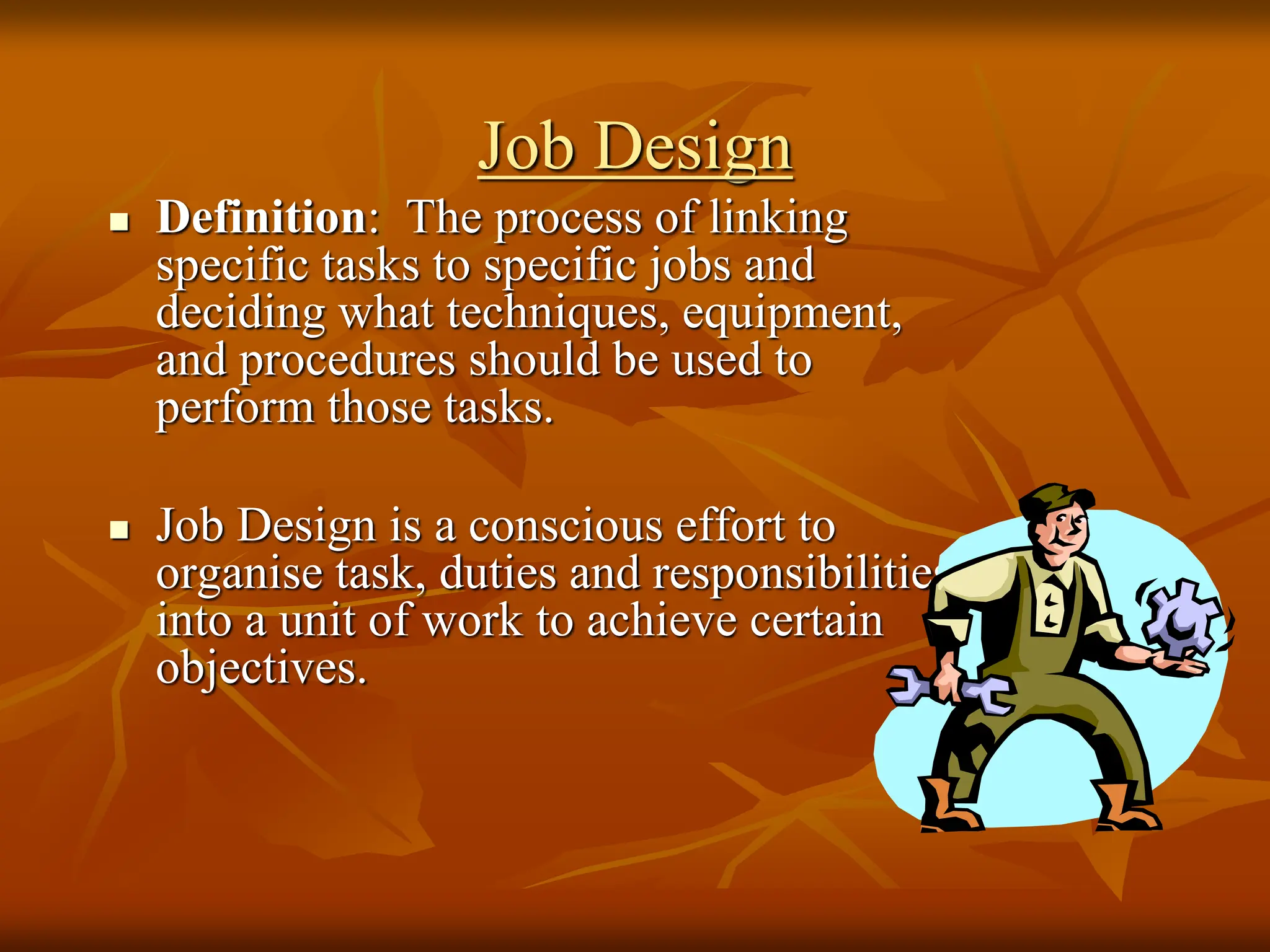
 Definition: The process of linking
specific tasks to specific jobs and
deciding what techniques, equipment,
and procedures should be used to
perform those tasks.
 Job Design is a conscious effort to
organise task, duties and responsibilities
into a unit of work to achieve certain
objectives.
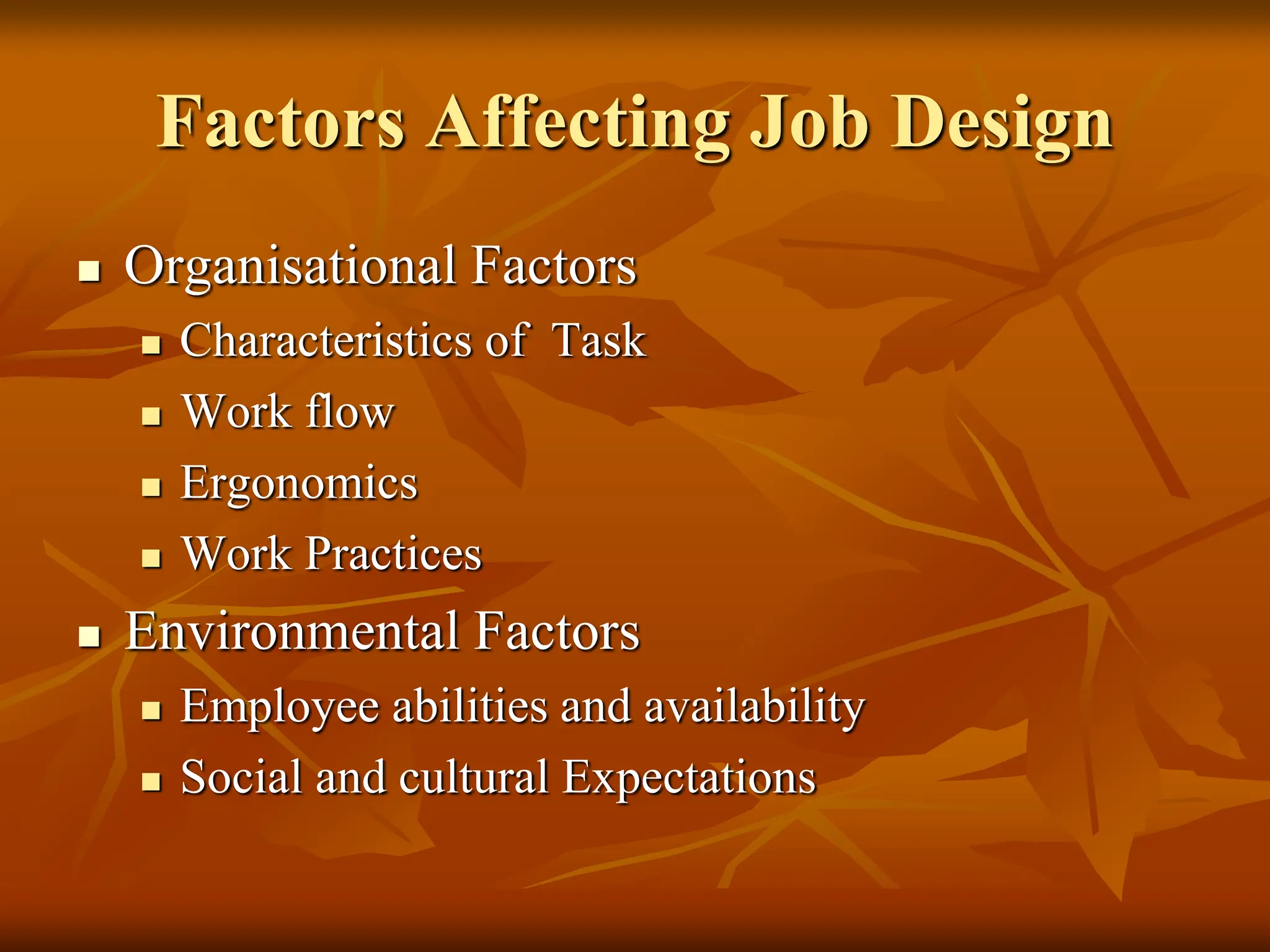
Factors Affecting Job Design
 Organisational Factors
 Characteristics of Task
 Work flow
 Ergonomics
 Work Practices
 Environmental Factors
 Employee abilities and availability
 Social and cultural Expectations
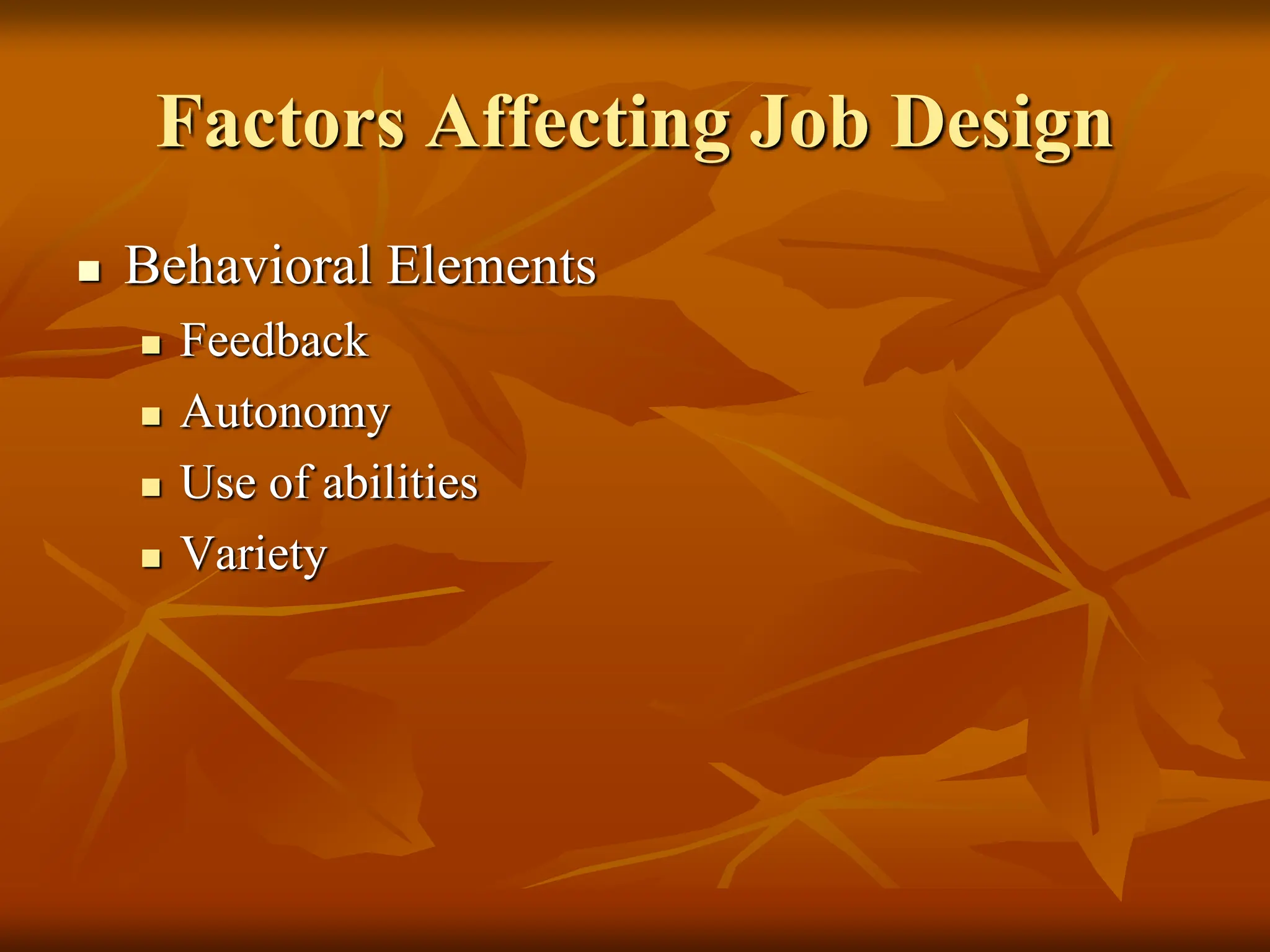
Factors Affecting Job Design
 Behavioral Elements
 Feedback
 Autonomy
 Use of abilities
 Variety
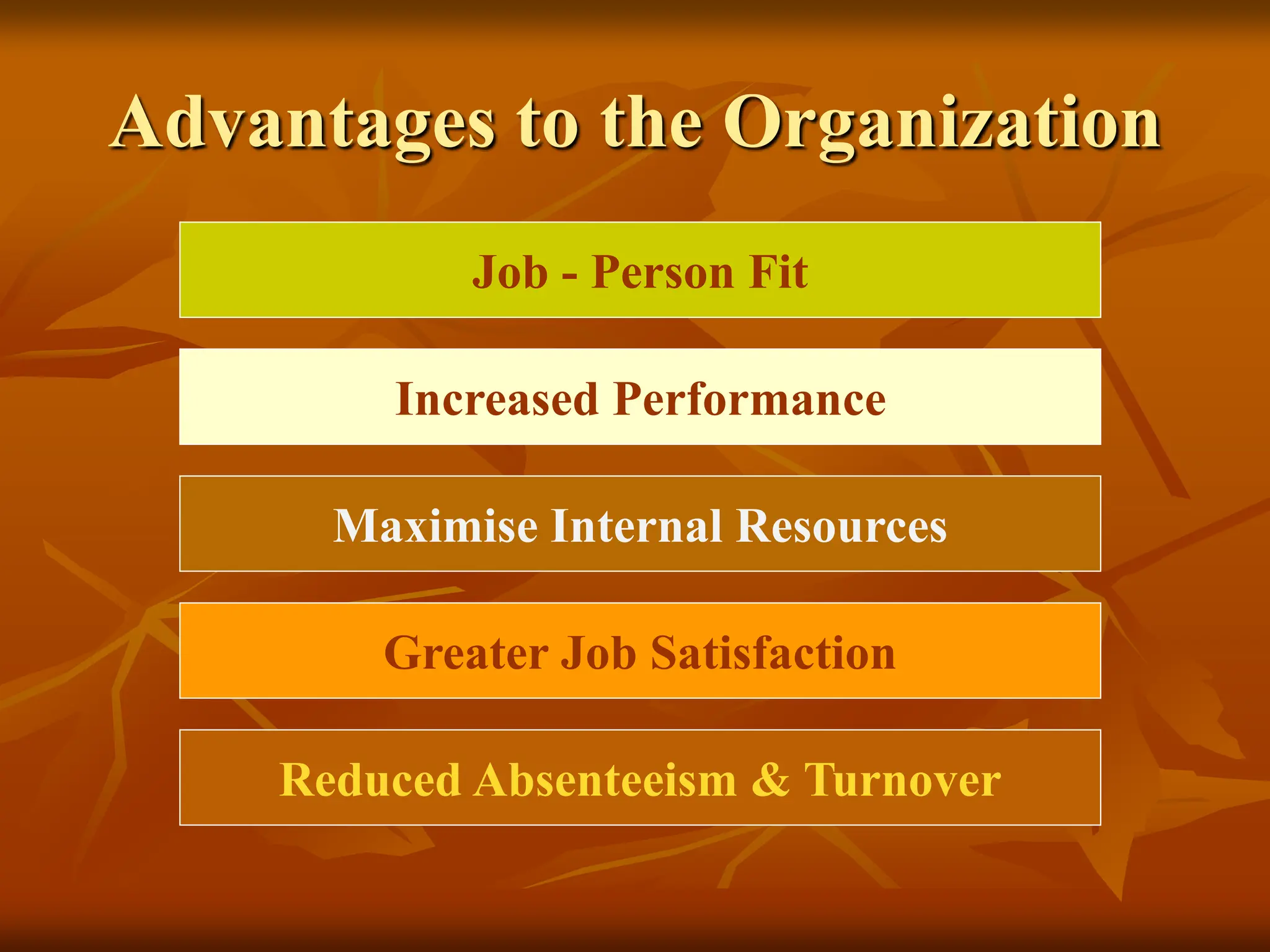
Advantages to the Organization
Job - Person Fit
Increased Performance
Maximise Internal Resources
Greater Job Satisfaction
Reduced Absenteeism & Turnover
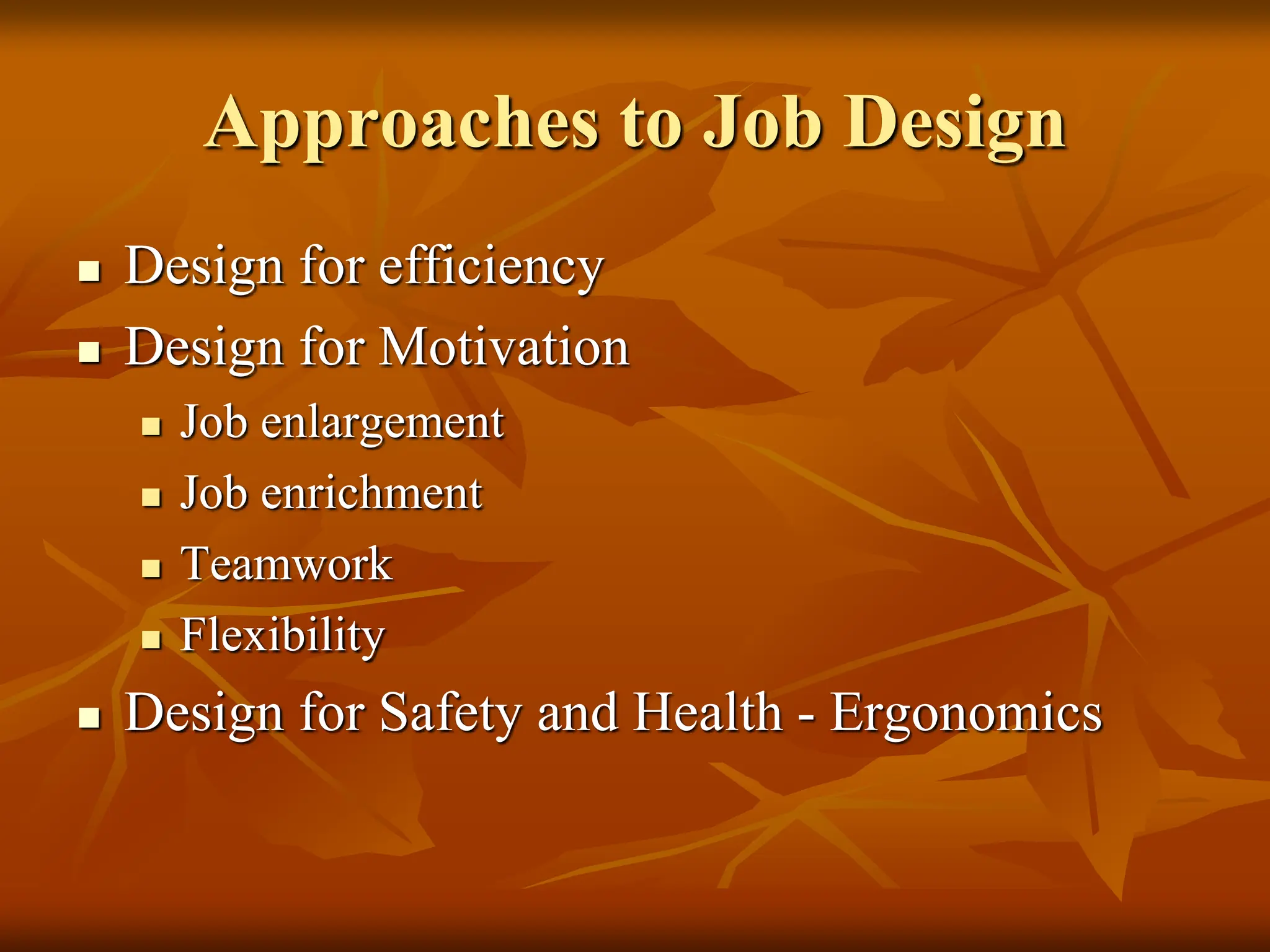
Approaches to Job Design
 Design for efficiency
 Design for Motivation
 Job enlargement
 Job enrichment
 Teamwork
 Flexibility
 Design for Safety and Health - Ergonomics
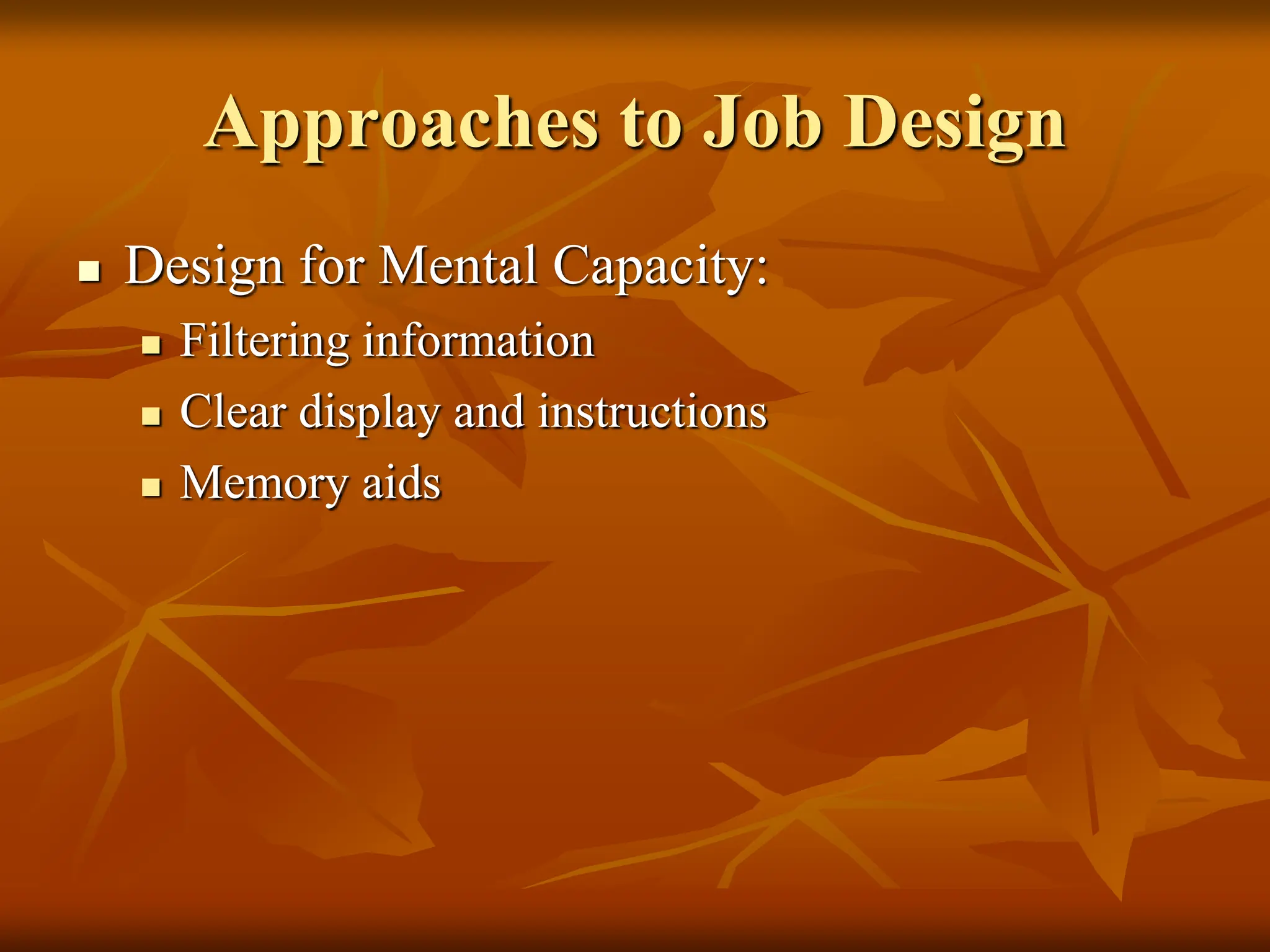
Approaches to Job Design
 Design for Mental Capacity:
 Filtering information
 Clear display and instructions
 Memory aids
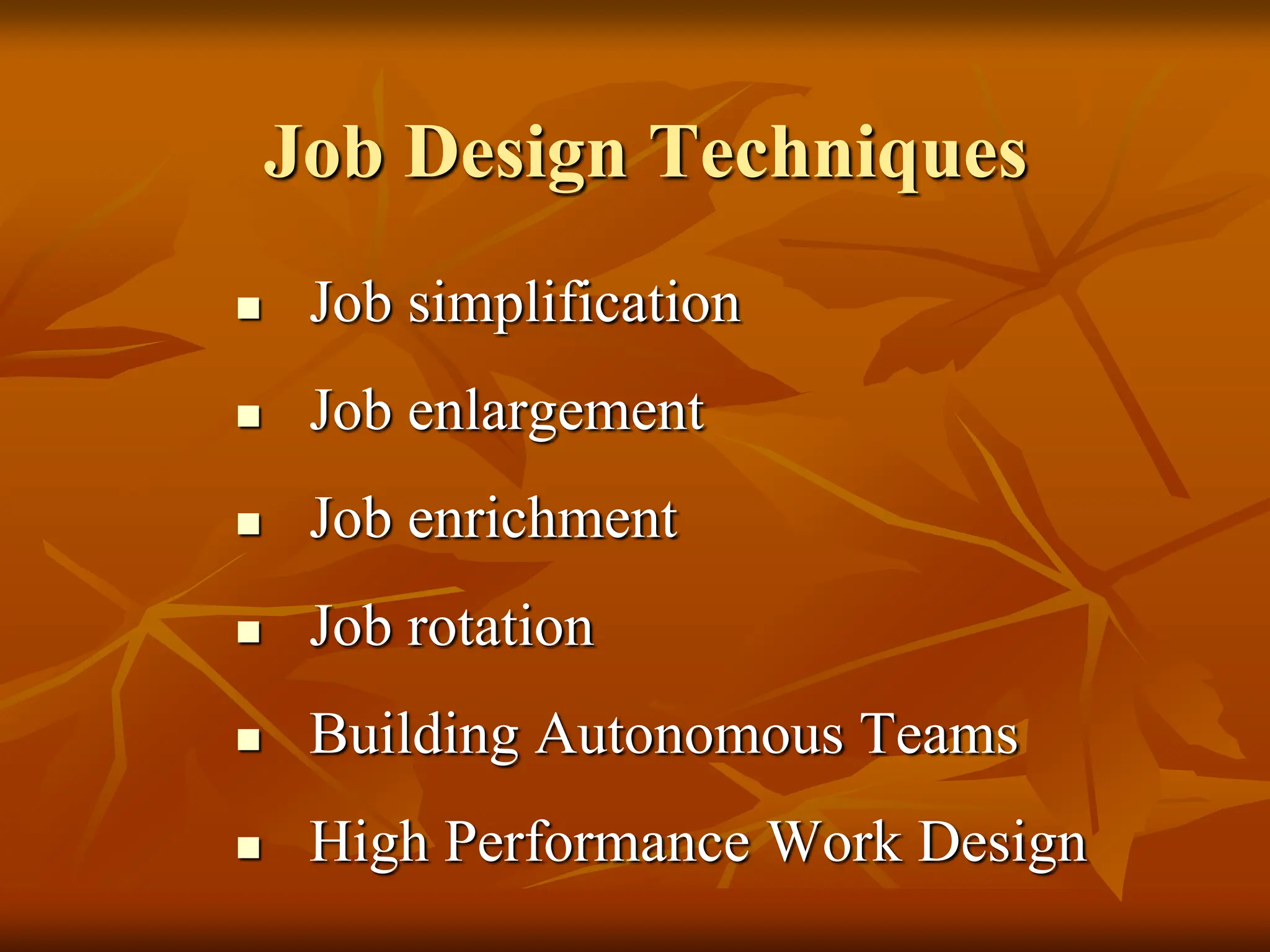
Job Design Techniques
 Job simplification
 Job enlargement
 Job enrichment
 Job rotation
 Building Autonomous Teams
 High Performance Work Design
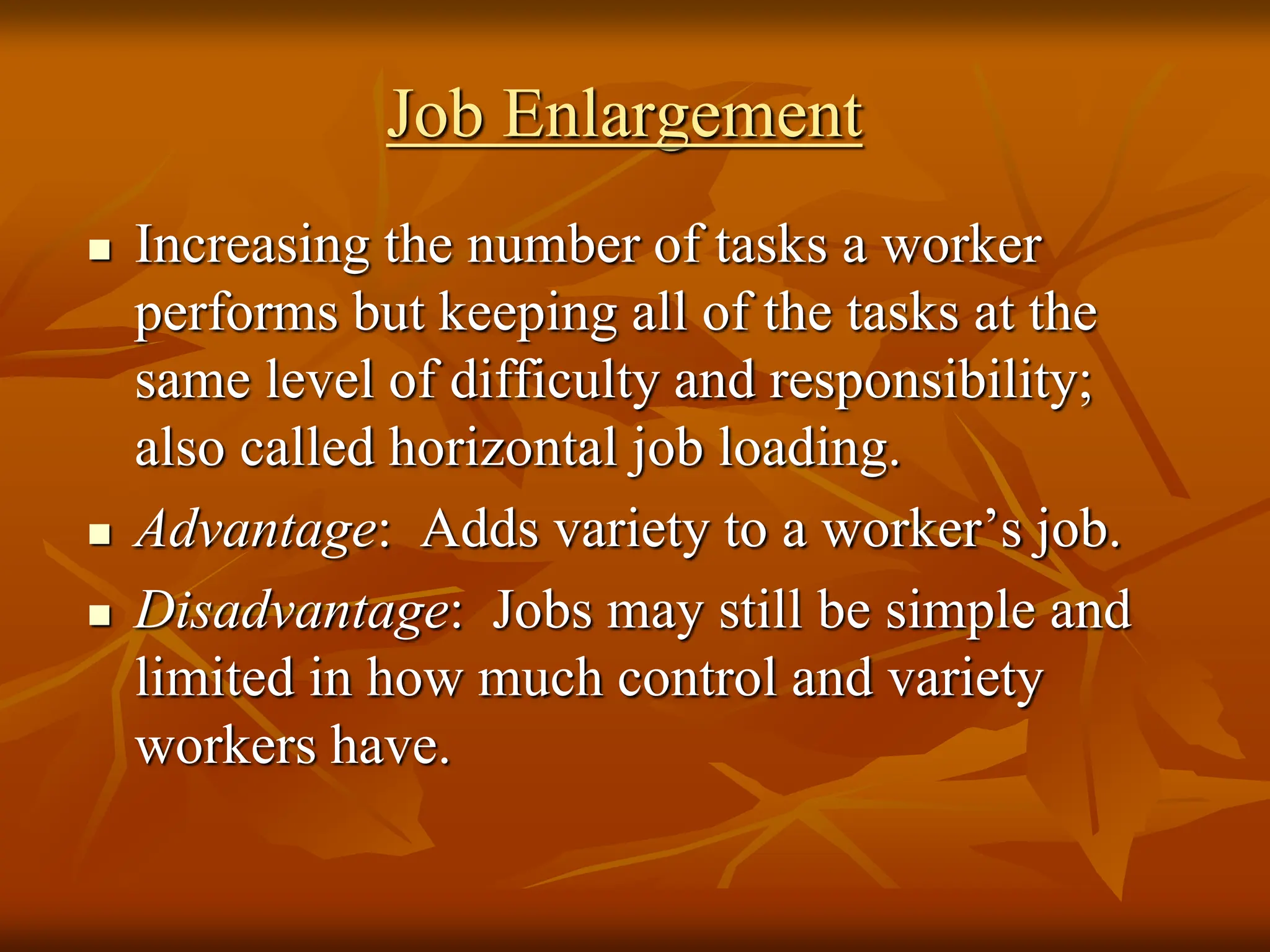
Job Enlargement
 Increasing the number of tasks a worker
performs but keeping all of the tasks at the
same level of difficulty and responsibility;
also called horizontal job loading.
 Advantage: Adds variety to a worker’s job.
 Disadvantage: Jobs may still be simple and
limited in how much control and variety
workers have.
Job Enrichment
 Increasing a worker’s responsibility and control over his
or her work; also called vertical job loading.
 Ways of enriching jobs:
 Allow workers to plan their own work schedules.
 Allow workers to decide how the work should be performed.
 Allow workers to check their own work.
 Allow workers to learn new skills.
 Advantage: Gives workers more autonomy,
responsibility, and control.
 Disadvantages
 Not all workers want enriched jobs
 May be expensive and/or inefficient
Job Simplification
In this method jobs are simplified or specialised.
A given job is broken into small sub-parts and
each part is assigned to one individual. It
involves:
 Mechanical pacing of work
 Repetitive work process
 Working on only one part of product
 Predetermining tools and techniques
 Restricting interaction among employees
 Few skills required
Job Rotation
Movement of employees from job to job, of
same nature.
Job rotation increases intrinsic potential of a job
because of different skills and abilities needed
to perform.
It improves the workers self-image, provides
personal growth
Autonomous or Self Directed
Teams
Self directed teams are composed of groups of
committed individuals who trust each other,
have a clear sense of purpose about their work,
are effective communicators within and
outside teams, follows a process that help them
plan, make decisions and ensures the quality of
work.
High Performance Work Design
Works in an environment of high rate of
innovation and operational freedom.
It is needed for employees to gain and apply new
skills quickly with minimum supervision .
Flexible Work Schedules
 Flexi Time : A scheduling policy in which full-
time employees may choose starting and
ending times within guidelines specified by the
organisation.
 Job Sharing: a work option in which two-part
time employees carry out the tasks associated
with a single job.
 Tele work / Work from Home
 Alternate work-patterns
 Techno stress
The Job Characteristics Model
 An approach to job design that aims to
identify characteristics that make jobs
intrinsically motivating and to specify the
consequences of those characteristics.
 Four key components
 Core job dimensions
 Motivating potential score
 Critical psychological states
 Consequences: work and personal outcomes
 Individual differences
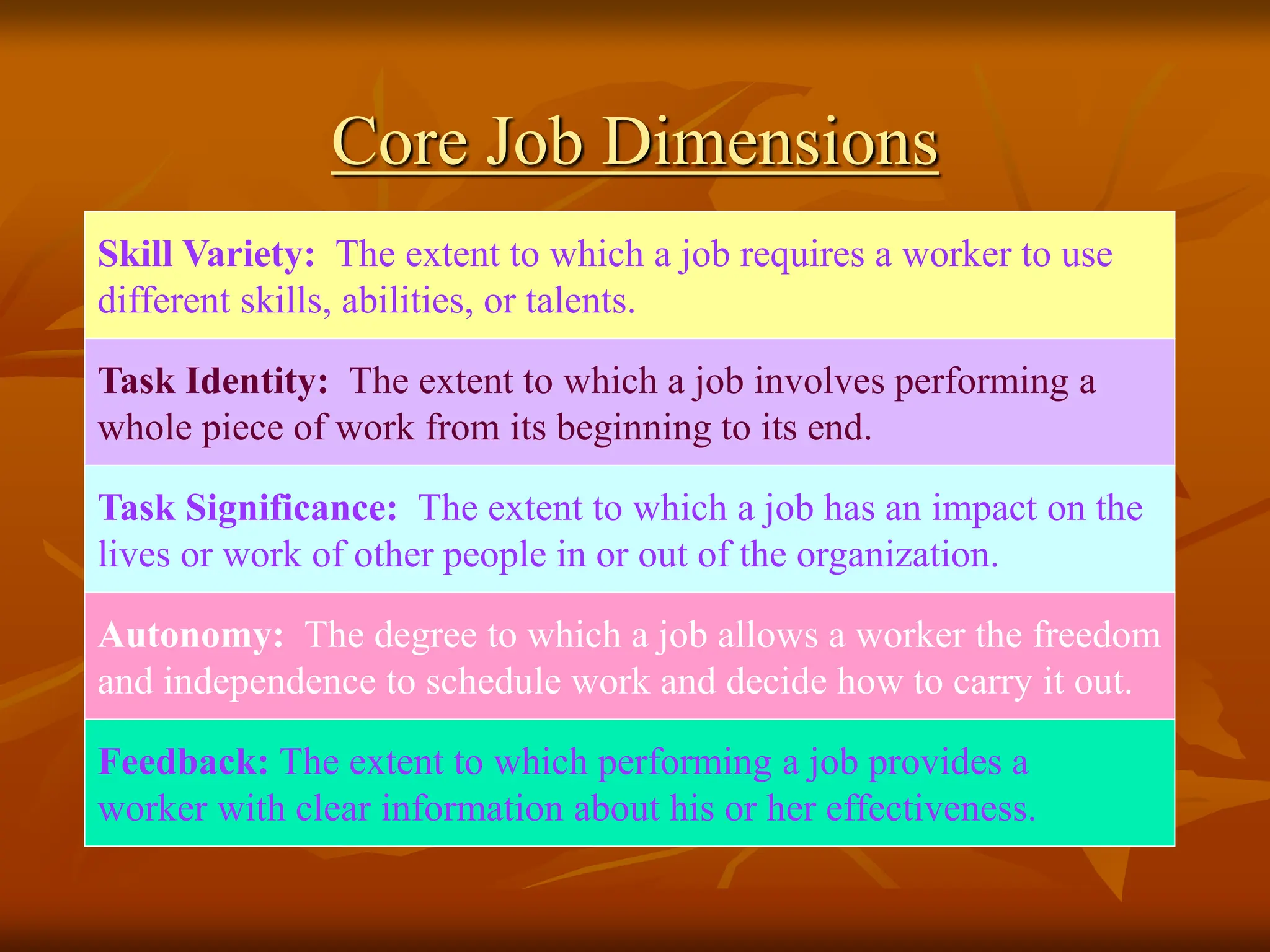
Skill Variety: The extent to which a job requires a worker to use
different skills, abilities, or talents.
Task Identity: The extent to which a job involves performing a
whole piece of work from its beginning to its end.
Task Significance: The extent to which a job has an impact on the
lives or work of other people in or out of the organization.
Autonomy: The degree to which a job allows a worker the freedom
and independence to schedule work and decide how to carry it out.
Feedback: The extent to which performing a job provides a
worker with clear information about his or her effectiveness.
Core Job Dimensions
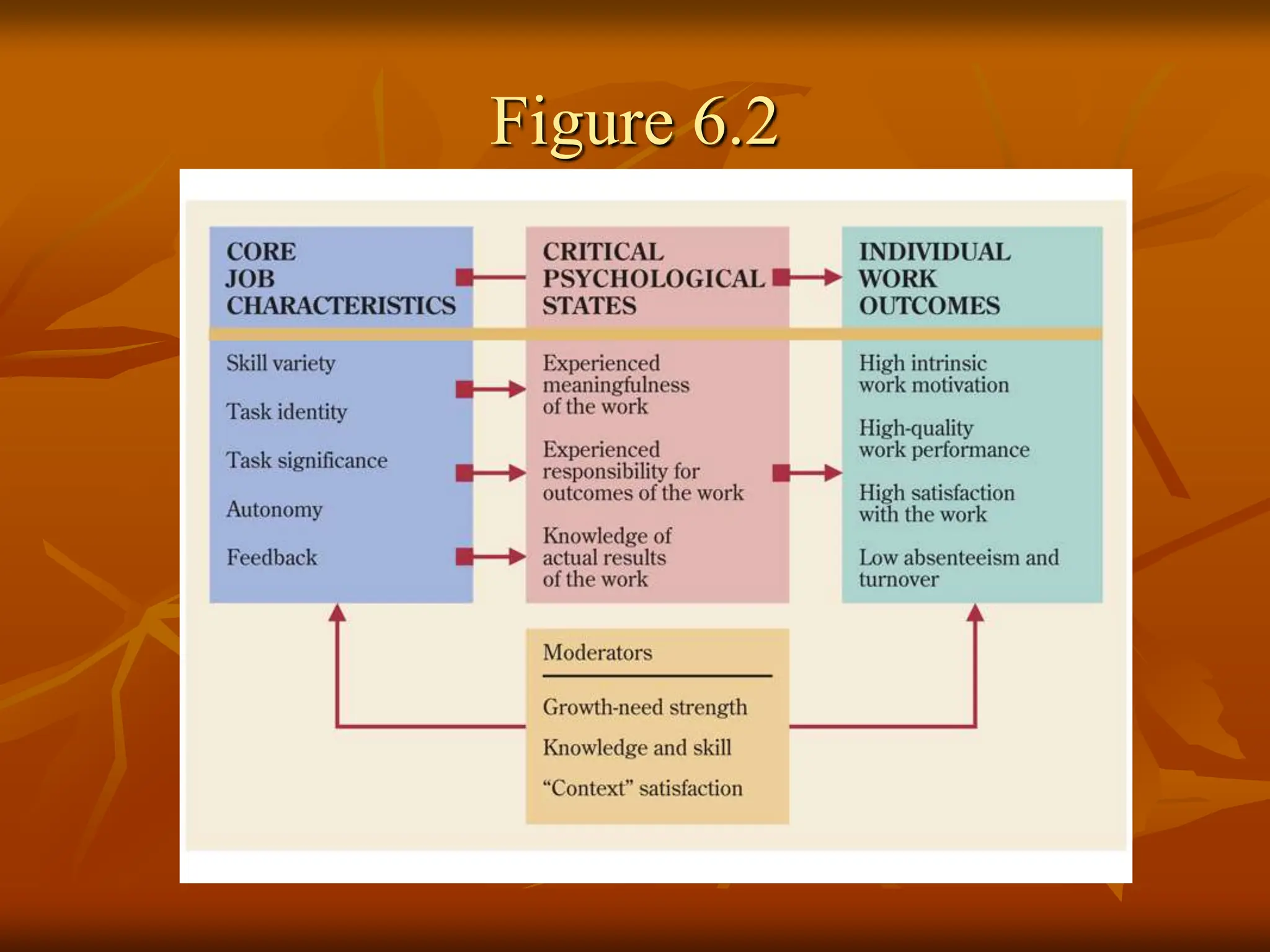
Figure 6.2
Motivating Potential Score (MPS)
 A measure of the overall potential of a job
to foster intrinsic motivation.
 The score is a computational combination
of the measures of skill variety, task
identity, task significance, autonomy, and
feedback.

 Formula (see Fig. 7.2)
MPS = ((SV + TI + TS)/3)*A*F
 MPS scores can range from 1 to 343. The
average MPS for jobs in the US is around
128.
The Social Information Processing Model
 An approach to job design based on the idea that
information from other people and workers’ own
past behaviors influence workers’ perceptions of and
responses to the design of their jobs.
 The social environment (i.e., the other individuals
with whom workers come in contact) provides
information about which aspects of their jobs
workers should pay attention to and which they
should ignore.
 The social environment also provides workers with
information about how they should evaluate their
jobs and work outcomes.
Human Resource Management Job design .ppt

Human Resource Management Job design .ppt

  • 1.
  • 2.
    JOB DESIGN Job designintegrates work content(task, functions, relationships), the rewards (extrinsic and intrinsic), and the qualifications required (skills, knowledge, abilities) for each job in a way that meets the needs of employees and the organisation.
  • 3.
    Job Design  Definition:The process of linking specific tasks to specific jobs and deciding what techniques, equipment, and procedures should be used to perform those tasks.  Job Design is a conscious effort to organise task, duties and responsibilities into a unit of work to achieve certain objectives.
  • 4.
    Factors Affecting JobDesign  Organisational Factors  Characteristics of Task  Work flow  Ergonomics  Work Practices  Environmental Factors  Employee abilities and availability  Social and cultural Expectations
  • 5.
    Factors Affecting JobDesign  Behavioral Elements  Feedback  Autonomy  Use of abilities  Variety
  • 6.
    Advantages to theOrganization Job - Person Fit Increased Performance Maximise Internal Resources Greater Job Satisfaction Reduced Absenteeism & Turnover
  • 7.
    Approaches to JobDesign  Design for efficiency  Design for Motivation  Job enlargement  Job enrichment  Teamwork  Flexibility  Design for Safety and Health - Ergonomics
  • 8.
    Approaches to JobDesign  Design for Mental Capacity:  Filtering information  Clear display and instructions  Memory aids
  • 9.
    Job Design Techniques Job simplification  Job enlargement  Job enrichment  Job rotation  Building Autonomous Teams  High Performance Work Design
  • 10.
    Job Enlargement  Increasingthe number of tasks a worker performs but keeping all of the tasks at the same level of difficulty and responsibility; also called horizontal job loading.  Advantage: Adds variety to a worker’s job.  Disadvantage: Jobs may still be simple and limited in how much control and variety workers have.
  • 11.
    Job Enrichment  Increasinga worker’s responsibility and control over his or her work; also called vertical job loading.  Ways of enriching jobs:  Allow workers to plan their own work schedules.  Allow workers to decide how the work should be performed.  Allow workers to check their own work.  Allow workers to learn new skills.  Advantage: Gives workers more autonomy, responsibility, and control.  Disadvantages  Not all workers want enriched jobs  May be expensive and/or inefficient
  • 12.
    Job Simplification In thismethod jobs are simplified or specialised. A given job is broken into small sub-parts and each part is assigned to one individual. It involves:  Mechanical pacing of work  Repetitive work process  Working on only one part of product  Predetermining tools and techniques  Restricting interaction among employees  Few skills required
  • 13.
    Job Rotation Movement ofemployees from job to job, of same nature. Job rotation increases intrinsic potential of a job because of different skills and abilities needed to perform. It improves the workers self-image, provides personal growth
  • 14.
    Autonomous or SelfDirected Teams Self directed teams are composed of groups of committed individuals who trust each other, have a clear sense of purpose about their work, are effective communicators within and outside teams, follows a process that help them plan, make decisions and ensures the quality of work.
  • 15.
    High Performance WorkDesign Works in an environment of high rate of innovation and operational freedom. It is needed for employees to gain and apply new skills quickly with minimum supervision .
  • 16.
    Flexible Work Schedules Flexi Time : A scheduling policy in which full- time employees may choose starting and ending times within guidelines specified by the organisation.  Job Sharing: a work option in which two-part time employees carry out the tasks associated with a single job.  Tele work / Work from Home  Alternate work-patterns  Techno stress
  • 17.
    The Job CharacteristicsModel  An approach to job design that aims to identify characteristics that make jobs intrinsically motivating and to specify the consequences of those characteristics.  Four key components  Core job dimensions  Motivating potential score  Critical psychological states  Consequences: work and personal outcomes  Individual differences
  • 18.
    Skill Variety: Theextent to which a job requires a worker to use different skills, abilities, or talents. Task Identity: The extent to which a job involves performing a whole piece of work from its beginning to its end. Task Significance: The extent to which a job has an impact on the lives or work of other people in or out of the organization. Autonomy: The degree to which a job allows a worker the freedom and independence to schedule work and decide how to carry it out. Feedback: The extent to which performing a job provides a worker with clear information about his or her effectiveness. Core Job Dimensions
  • 19.
  • 20.
    Motivating Potential Score(MPS)  A measure of the overall potential of a job to foster intrinsic motivation.  The score is a computational combination of the measures of skill variety, task identity, task significance, autonomy, and feedback.  Formula (see Fig. 7.2) MPS = ((SV + TI + TS)/3)*A*F  MPS scores can range from 1 to 343. The average MPS for jobs in the US is around 128.
  • 21.
    The Social InformationProcessing Model  An approach to job design based on the idea that information from other people and workers’ own past behaviors influence workers’ perceptions of and responses to the design of their jobs.  The social environment (i.e., the other individuals with whom workers come in contact) provides information about which aspects of their jobs workers should pay attention to and which they should ignore.  The social environment also provides workers with information about how they should evaluate their jobs and work outcomes.