JOB DESIGN
JOB DESIGN
1
Job Design
Job design is also referred to as work design or task
design) is a core function of human resource management and
it is related to the specification of contents, methods and
relationship of jobs in order to satisfy technological and
organizational requirements as well as the social and personal
requirements of the job holder or the employee
2
Objectives of job design
The main objectives of job design in human resource
management include various points like
1. Work / Rest Breaks
2. Task Variety
3. Provide Training
4. Allowance for an Adjustment Period
5. Vary Mental Activities
3
1. Work / Rest Breaks:
Rest or work breaks help to reduce the problem of inevitable repetitive
movements or static-body positions. More frequent but small-time breaks are
sometimes preferable top fewer long breaks.
At the time of work breaks, motivate employees to change the body structure
and to exercise. It is very essential that employees use and stretch different
muscle groups.
4
2. Task Variety:
To reduce weariness, avoid both repetitive movements and excessive static-
body positions. Designing of a job is required to have a variety of works that
require changes in mental activities, body positions, and others. Two methods
are job rotation and job enlargement.
For Example, If a worker normally assembles parts, the job may be enlarged
to involve new tasks such as quality control, work planning, and maintenance.
5
3. Provide Training:
Training is a very essential part to develop the potential of any
employee or worker. Through this, the workers easily
understand what is expected of them and how to work
potentially or safely.
It should be consistent, organized, and ongoing.
6
Allowance for an Adjustment Period:
When work demands physical effort, have an adjustment time of
new workers and for all workers after layoffs, holidays, or
illnesses. Allow time to become normal to the physical demands
of work by gradually “getting in shape”.
Workers, who work in extra cold or hot conditions, also, need
time to accommodate.
7
Vary Mental Activities:
Works should be coordinated so that they are balanced during
the day for the single worker as well as balanced among a group
of workers. You may want to allow the worker some degree of
choice as to what kinds of mental tasks they want to do and
when.
This choice will allow the worker to do works when best suited
to their ‘alertness’ patterns during the day. Some individual may
prefer regular tasks or works in the morning (such as checklists
in forms).
8
Process of Job Design:
1. Assessment of current work practices
2. Task analysis
3. Design the job.
4. Implement the new job design gradually
5. Re-evaluate job design on a continual basis
9
1. Assessment of current work practices:
Is job design feasible or needed? Discuss the process with the
workers and supervisors involved and be clear about the
procedure, or any changes or training that will be involved.
10
2. Task analysis:
Analyze the job and determine exactly what the tasks are.
Determine what equipment and workstation features are
important for completing the works or tasks.
11
3. Design the job:
Examine the methods for doing the work, rest/work schedules,
equipment facilities, training requirements, and workplace
changes. Combine the various tasks so each one differs mental
activities and body position. Be careful not to overload the job
12
4. Implement the new job design
gradually:
You may want to start on a small level or with a big level or
project. Train workers in the new procedures and use of various
equipment. Allow for an adjustment period and time to earn
experience with the new job design.
13
5. Re-evaluate job design on a continual
basis:
Make any important adjustments. You have also wanted to
found a committee to represent the various groups involved. Job
design should involved unions, workers, the health and safety
committee and manager during the whole process. Involvement
of all parties increases communication and understanding also.
14
Benefits of Job Design:
1. Give workers a sense of achievement.
2. Allows for worker input. Workers should have the option to differ activities
according to work habits, personal needs, and the circumstances in the workplace.
3. Includes training facilities so the worker knows what tasks to do and how to do
them properly.
4. Provides rest schedules or good work.
5. Provides feedback to the workers about their performance.
6. Allows for an adjustment period for physically demanding jobs.
.
Job design is a continuous process. The goal is to make adjustments as tasks or
conditions chnage within the workplace or work field.
15
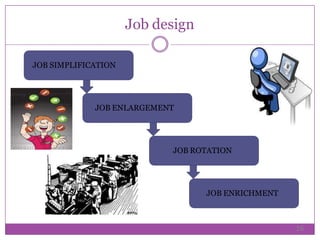
Job design
JOB SIMPLIFICATION
JOB ENLARGEMENT
JOB ROTATION
JOB ENRICHMENT
16
JOB SIMPLIFICATION
jobs are broken down into very small parts where a fragment called “task”
is repeatedly done over and over again by the same individual.
•ADVANTAGES
•Employee therefore is paid
higher rewards.
•the productivity is high.
•Achieves specialization.
•Training cost to the
organization is practically
negligible.
•DISADVANTAGES
•a worker is likely to get bored and
remain absent frequently.
•Quality and quantity may suffer in
the long run due to frustration.
•Organization may have to attract
workers by offering higher wages
17
JOB ENLARGEMENT
Job Enlargement means where two or more simple tasks are
combined and allotted to an employee
 Eg: As in the case of vehicle driver, apart from driving he can undertake
the job of maintenance of the vehicle.
Increases job range, but not depth
Advantage :
 more variety in a job
 acquiring additional proficiency.
 Dissatisfaction of employees can not be avoided after a long period due
to boredom.
18
JOB ENRICHMENT
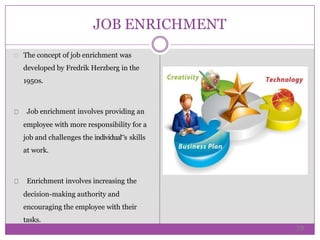
The concept of job enrichment was
developed by Fredrik Herzberg in the
1950s.
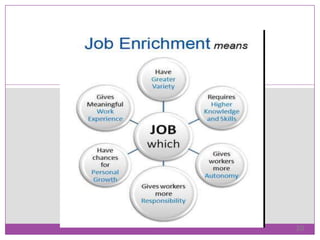
Job enrichment involves providing an
employee with more responsibility for a
job and challenges the individual‟s skills
at work.
Enrichment involves increasing the
decision-making authority and
encouraging the employee with their
tasks.
19
20
FEATURES OF JOB ENRICHMENT
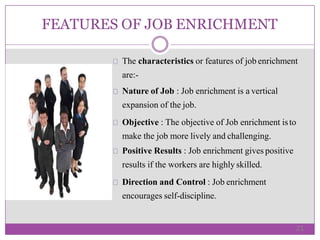
The characteristics or features of job enrichment
are:-
Nature of Job : Job enrichment is a vertical
expansion of the job.
Objective : The objective of Job enrichment isto
make the job more lively and challenging.
Positive Results : Job enrichment gives positive
results if the workers are highly skilled.
Direction and Control : Job enrichment
encourages self-discipline.
21
ADVANTAGES
The importance or merits or advantages of job enrichmentare:-
 Job enrichment is useful to both the workers and theorganization.
 The worker gets achievement, recognition and self-actualization.
 The worker gets a sense of belonging to the organization.
 The worker finds the job meaningful.
 Job enrichment reduces absenteeism, labour-turnover and grievances.
 It motivates the workers to give best performance.
22
LIMITATIONS
The shortcomings or demerits or limitations of job enrichmentare:-
 In many cases, job enrichment does not give the expected results.
 It makes many changes in the job. So many workers oppose it.
 It has limited use for highly skilled managers and professionals.
 The consent of workers is not taken before implementing job enrichment.
 Managers force the workers to accept job enrichment, which is notgood.
23
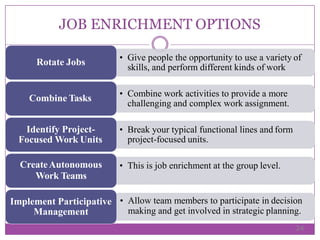
JOB ENRICHMENT OPTIONS
• Give people the opportunity to use a variety of
skills, and perform different kinds of work
Rotate Jobs
• Combine work activities to provide a more
challenging and complex work assignment.
Combine Tasks
• Break your typical functional lines and form
project-focused units.
Identify Project-
Focused Work Units
• This is job enrichment at the group level.CreateAutonomous
Work Teams
• Allow team members to participate in decision
making and get involved in strategic planning.
Implement Participative
Management
24
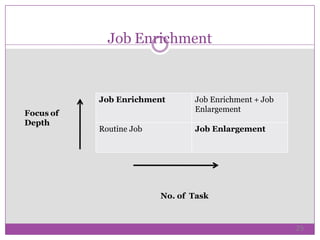
Job Enrichment
Job Enrichment Job Enrichment + Job
Enlargement
Routine Job Job Enlargement
No. of Task
Focus of
Depth
25
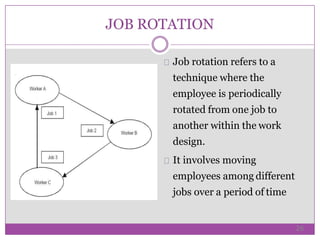
JOB ROTATION
Job rotation refers to a
technique where the
employee is periodically
rotated from one job to
another within the work
design.
It involves moving
employees among different
jobs over a period of time
26
1) Meaningfulness of work:
Skill variety:
Using an appropriate variety of your skills and talents:
 Task Identity:
Being able to identify with the work at hand as more whole and
complete,.
 Task Significance:
Being able to identify the task as contributing to something
wider, to society or a group over and beyond the self.
Characteristic of Job Rotation
27
1.Variety of skills:
o improve and increase the skills of the employee due to
organization as well as the individual benefit.
2.Improves earning capacity:
o Due to job enlargement the person learns many new activities.
o such people apply for jobs to other companies and can bargain
for more salary.
3.Wide range of activities:
o Since a single employee handles multiple activities the
company can try and reduce the number of employee‟s.
Advantages of Job Rotation
28
1. Frequent interruption:
o A person who is doing a particular job and get it comfortable
suddenly finds himself shifted to another job or department
this interrupts the work in both the departments
2. Reduces uniformity in quality:
o when a new worker I shifted or rotated in the department, he
takes time to learn the new job, makes mistakes in the process
and affects the quality of the job.
Disadvantages of Job Rotation
29

Job design

  • 1.
  • 2.
    Job Design Job designis also referred to as work design or task design) is a core function of human resource management and it is related to the specification of contents, methods and relationship of jobs in order to satisfy technological and organizational requirements as well as the social and personal requirements of the job holder or the employee 2
  • 3.
    Objectives of jobdesign The main objectives of job design in human resource management include various points like 1. Work / Rest Breaks 2. Task Variety 3. Provide Training 4. Allowance for an Adjustment Period 5. Vary Mental Activities 3
  • 4.
    1. Work /Rest Breaks: Rest or work breaks help to reduce the problem of inevitable repetitive movements or static-body positions. More frequent but small-time breaks are sometimes preferable top fewer long breaks. At the time of work breaks, motivate employees to change the body structure and to exercise. It is very essential that employees use and stretch different muscle groups. 4
  • 5.
    2. Task Variety: Toreduce weariness, avoid both repetitive movements and excessive static- body positions. Designing of a job is required to have a variety of works that require changes in mental activities, body positions, and others. Two methods are job rotation and job enlargement. For Example, If a worker normally assembles parts, the job may be enlarged to involve new tasks such as quality control, work planning, and maintenance. 5
  • 6.
    3. Provide Training: Trainingis a very essential part to develop the potential of any employee or worker. Through this, the workers easily understand what is expected of them and how to work potentially or safely. It should be consistent, organized, and ongoing. 6
  • 7.
    Allowance for anAdjustment Period: When work demands physical effort, have an adjustment time of new workers and for all workers after layoffs, holidays, or illnesses. Allow time to become normal to the physical demands of work by gradually “getting in shape”. Workers, who work in extra cold or hot conditions, also, need time to accommodate. 7
  • 8.
    Vary Mental Activities: Worksshould be coordinated so that they are balanced during the day for the single worker as well as balanced among a group of workers. You may want to allow the worker some degree of choice as to what kinds of mental tasks they want to do and when. This choice will allow the worker to do works when best suited to their ‘alertness’ patterns during the day. Some individual may prefer regular tasks or works in the morning (such as checklists in forms). 8
  • 9.
    Process of JobDesign: 1. Assessment of current work practices 2. Task analysis 3. Design the job. 4. Implement the new job design gradually 5. Re-evaluate job design on a continual basis 9
  • 10.
    1. Assessment ofcurrent work practices: Is job design feasible or needed? Discuss the process with the workers and supervisors involved and be clear about the procedure, or any changes or training that will be involved. 10
  • 11.
    2. Task analysis: Analyzethe job and determine exactly what the tasks are. Determine what equipment and workstation features are important for completing the works or tasks. 11
  • 12.
    3. Design thejob: Examine the methods for doing the work, rest/work schedules, equipment facilities, training requirements, and workplace changes. Combine the various tasks so each one differs mental activities and body position. Be careful not to overload the job 12
  • 13.
    4. Implement thenew job design gradually: You may want to start on a small level or with a big level or project. Train workers in the new procedures and use of various equipment. Allow for an adjustment period and time to earn experience with the new job design. 13
  • 14.
    5. Re-evaluate jobdesign on a continual basis: Make any important adjustments. You have also wanted to found a committee to represent the various groups involved. Job design should involved unions, workers, the health and safety committee and manager during the whole process. Involvement of all parties increases communication and understanding also. 14
  • 15.
    Benefits of JobDesign: 1. Give workers a sense of achievement. 2. Allows for worker input. Workers should have the option to differ activities according to work habits, personal needs, and the circumstances in the workplace. 3. Includes training facilities so the worker knows what tasks to do and how to do them properly. 4. Provides rest schedules or good work. 5. Provides feedback to the workers about their performance. 6. Allows for an adjustment period for physically demanding jobs. . Job design is a continuous process. The goal is to make adjustments as tasks or conditions chnage within the workplace or work field. 15
  • 16.
    Job design JOB SIMPLIFICATION JOBENLARGEMENT JOB ROTATION JOB ENRICHMENT 16
  • 17.
    JOB SIMPLIFICATION jobs arebroken down into very small parts where a fragment called “task” is repeatedly done over and over again by the same individual. •ADVANTAGES •Employee therefore is paid higher rewards. •the productivity is high. •Achieves specialization. •Training cost to the organization is practically negligible. •DISADVANTAGES •a worker is likely to get bored and remain absent frequently. •Quality and quantity may suffer in the long run due to frustration. •Organization may have to attract workers by offering higher wages 17
  • 18.
    JOB ENLARGEMENT Job Enlargementmeans where two or more simple tasks are combined and allotted to an employee  Eg: As in the case of vehicle driver, apart from driving he can undertake the job of maintenance of the vehicle. Increases job range, but not depth Advantage :  more variety in a job  acquiring additional proficiency.  Dissatisfaction of employees can not be avoided after a long period due to boredom. 18
  • 19.
    JOB ENRICHMENT The conceptof job enrichment was developed by Fredrik Herzberg in the 1950s. Job enrichment involves providing an employee with more responsibility for a job and challenges the individual‟s skills at work. Enrichment involves increasing the decision-making authority and encouraging the employee with their tasks. 19
  • 20.
  • 21.
    FEATURES OF JOBENRICHMENT The characteristics or features of job enrichment are:- Nature of Job : Job enrichment is a vertical expansion of the job. Objective : The objective of Job enrichment isto make the job more lively and challenging. Positive Results : Job enrichment gives positive results if the workers are highly skilled. Direction and Control : Job enrichment encourages self-discipline. 21
  • 22.
    ADVANTAGES The importance ormerits or advantages of job enrichmentare:-  Job enrichment is useful to both the workers and theorganization.  The worker gets achievement, recognition and self-actualization.  The worker gets a sense of belonging to the organization.  The worker finds the job meaningful.  Job enrichment reduces absenteeism, labour-turnover and grievances.  It motivates the workers to give best performance. 22
  • 23.
    LIMITATIONS The shortcomings ordemerits or limitations of job enrichmentare:-  In many cases, job enrichment does not give the expected results.  It makes many changes in the job. So many workers oppose it.  It has limited use for highly skilled managers and professionals.  The consent of workers is not taken before implementing job enrichment.  Managers force the workers to accept job enrichment, which is notgood. 23
  • 24.
    JOB ENRICHMENT OPTIONS •Give people the opportunity to use a variety of skills, and perform different kinds of work Rotate Jobs • Combine work activities to provide a more challenging and complex work assignment. Combine Tasks • Break your typical functional lines and form project-focused units. Identify Project- Focused Work Units • This is job enrichment at the group level.CreateAutonomous Work Teams • Allow team members to participate in decision making and get involved in strategic planning. Implement Participative Management 24
  • 25.
    Job Enrichment Job EnrichmentJob Enrichment + Job Enlargement Routine Job Job Enlargement No. of Task Focus of Depth 25
  • 26.
    JOB ROTATION Job rotationrefers to a technique where the employee is periodically rotated from one job to another within the work design. It involves moving employees among different jobs over a period of time 26
  • 27.
    1) Meaningfulness ofwork: Skill variety: Using an appropriate variety of your skills and talents:  Task Identity: Being able to identify with the work at hand as more whole and complete,.  Task Significance: Being able to identify the task as contributing to something wider, to society or a group over and beyond the self. Characteristic of Job Rotation 27
  • 28.
    1.Variety of skills: oimprove and increase the skills of the employee due to organization as well as the individual benefit. 2.Improves earning capacity: o Due to job enlargement the person learns many new activities. o such people apply for jobs to other companies and can bargain for more salary. 3.Wide range of activities: o Since a single employee handles multiple activities the company can try and reduce the number of employee‟s. Advantages of Job Rotation 28
  • 29.
    1. Frequent interruption: oA person who is doing a particular job and get it comfortable suddenly finds himself shifted to another job or department this interrupts the work in both the departments 2. Reduces uniformity in quality: o when a new worker I shifted or rotated in the department, he takes time to learn the new job, makes mistakes in the process and affects the quality of the job. Disadvantages of Job Rotation 29