Human resource Management II (HHRM 103)
Mudyiwa R.M
W
Nyamubarwa
Job design & redesign defined:
Job redesign refers to the restructuring of job elements including tasks, duties
and responsibilities of a specific job in order to make it more encouraging and
inspiring for the employees or workers.
Job Redesign Process:
 A job redesign effort would walk through the following steps:
 1. Clarify exactly what is being done today vs. the job description
and identify any difficulties in completing work.
 2. Determine skills of the employees and their level of fit with
their current positions.
 3. Re-allocate tasks so that employees have a better fit between
their skills, interests, and position requirements.
 4. Provide training, as needed, to get employees ready for their
new responsibilities.
 5. Implement the program through providing a new job description
to each employee and having them focus on their revised jobs.
 6. Revisit regularly to ensure that the person to job fit is
maintained
Why do we redesign Jobs
enhances the
quality of
work-life
Recreates
the Person-
Job tit
inculcates work
motivation
removes
overlapping in
responsibilities
Enhances Job
satisfaction
Job Satisfaction
Job satisfaction is defined the pleasurable emotional state
resulting from the appraisal of one’s job as achieving or
facilitating the achievement of one’s job values; and “the
extent to which people like (satisfaction) or dislike
(dissatisfaction) their jobs.
The Job Characteristics Model
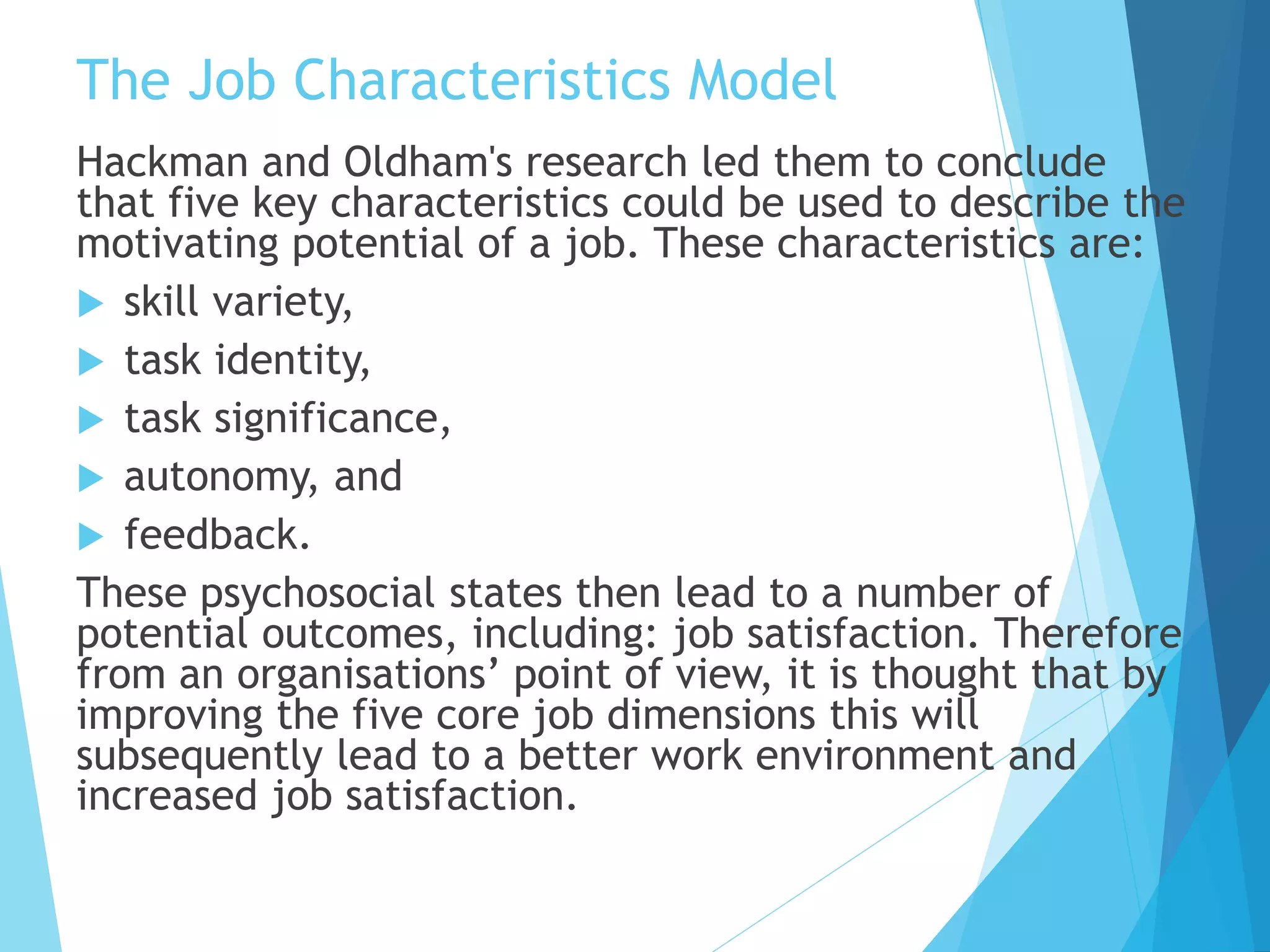
Hackman and Oldham's research led them to conclude
that five key characteristics could be used to describe the
motivating potential of a job. These characteristics are:
 skill variety,
 task identity,
 task significance,
 autonomy, and
 feedback.
These psychosocial states then lead to a number of
potential outcomes, including: job satisfaction. Therefore
from an organisations’ point of view, it is thought that by
improving the five core job dimensions this will
subsequently lead to a better work environment and
increased job satisfaction.
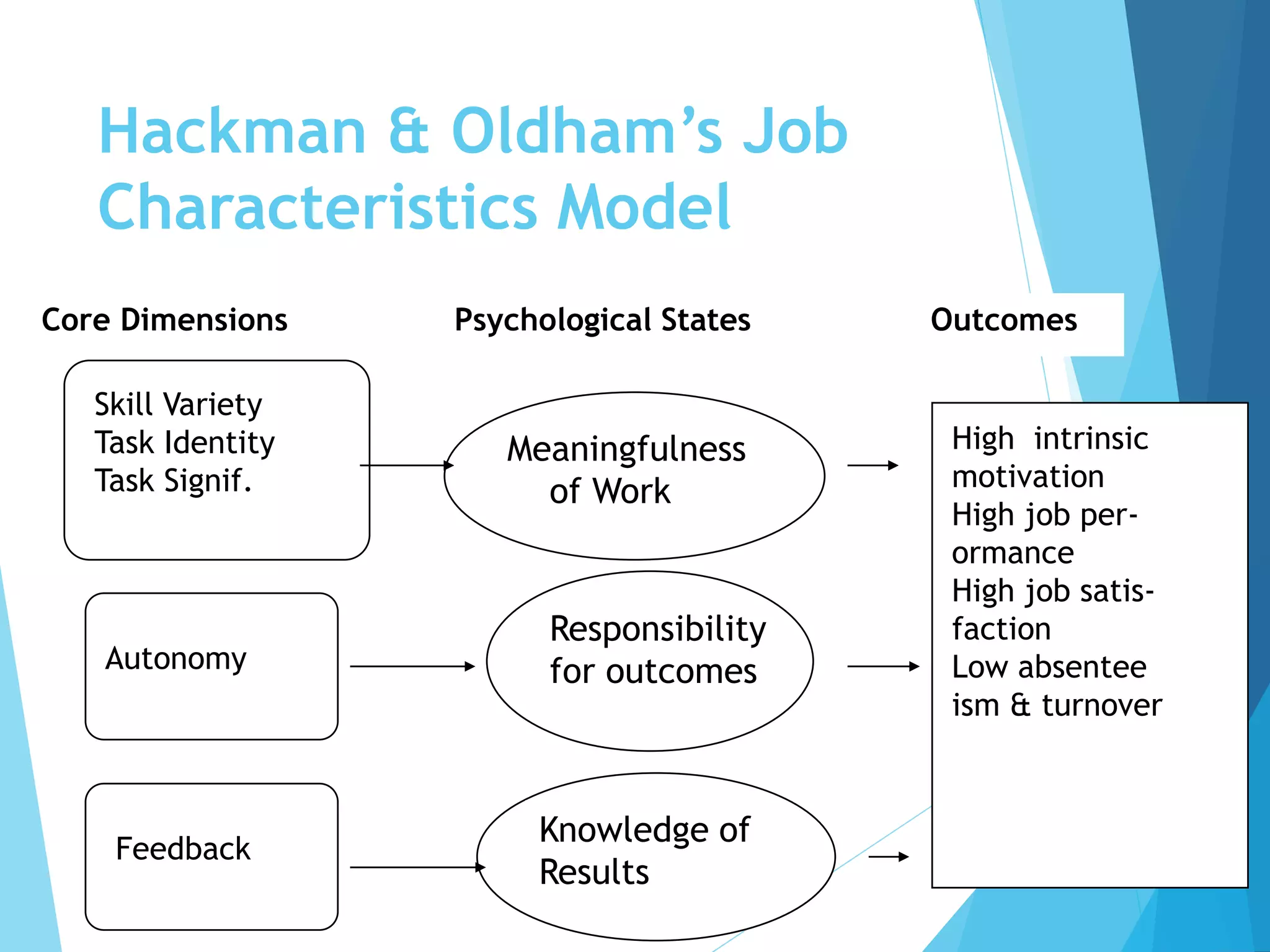
Hackman & Oldham’s Job
Characteristics Model
Core Dimensions Psychological States Outcomes
Skill Variety
Task Identity
Task Signif.
Autonomy
Feedback
Meaningfulness
of Work
Responsibility
for outcomes
Knowledge of
Results
High intrinsic
motivation
High job per-
ormance
High job satis-
faction
Low absentee
ism & turnover
Job Redesign methods
JR Methods
 Job enrichment
 Job enlargement
 Job rotation
 Teamwork
 High performance work
practices
 Work life balance
 Empowerment
Outcomes
Happy workers
Person to Job Fit
Employee motivation
High Production
Job Enrichment
Medium through which management can motivate self-driven employees by
assigning them additional responsibility normally reserved for higher level
employees. By doing this, the employees feel like their work has meaning and
is important to the company. It is done thru adding.
o Decision making power,
o Opportunity for learning,
o Autonomy
o Resource control
o Responsibility
o Feedback
Job Enlargement
Job enlargement is the horizontal expansion of jobs to
include more variety of tasks within the scope of the job.
o Motivates employees
o Reduces boredom.
o Enhances skill utilization.
o Increases employee efficiency
Task
Distinguish Job evaluation
from job enrichment.
Which method do you think
would be most appropriate
in the Zimbabwean labour
market? Justify your choice.
Job Rotation
Job rotation refers is to periodical shifting of an employee
from the existing job to another job at the same level of skill
requirements. It is also known as cross training. Leads to;
 Reduction of boredom and employee turnover.
 Better diversification and development of wide range
of skills.
 Greater challenges in the job leading to variety of
jobs.
 Increased flexibility of jobs.
 Greater adaptability to change
Teamwork
Organizations use teams because certain tasks are difficult
to be performed alone by the individuals.
Teams in organisations can either be formal or informal.
High Performance Work
Systems
High-performance work systems (HPWS) are a group of
separate but interconnected human resource (HR) practices
designed to enhance employee effectiveness.
In a high-performance work system, the elements
that must work together include organizational
structure, task design, people (the selection,
training, and development of employees), reward
systems, and information systems, and human
resource management.
Elements of a HPWS
Work–life balance
Practices are concerned with providing scope for employees
to balance what they do at work with the
responsibilities and interests they have outside work
and so reconcile the competing claims of work and
home by meeting their own needs as well as those of
their employers.
Work-Life Balance Systems
o Flexitime
o Home working
o Part-time working
Compressed weeks
o Job sharing
o Leave
o Career breaks
HR Policies & Procedures
A formal statement or a principle or rule that members of an organization
must follow.
HR policies define the philosophies and values of the organization on how
people should be treated, and from these are derived the principles upon
which managers are expected to act when dealing with HR matters
As a general rule, policies should be put in writing for the avoidance of doubt
o HR policies are linked with HR objectives hence making organisational
objectives more easily achievable.
o HR policies reflect the intentions of top management about the
workforce of the organisation. They describe management’s thinking,
actions and practices towards the employees.
o They are a means of defining the employment relationship and the
psychological contract.
o Ensures that employees understand their responsibilities and how they
should deal with various situations at the workplace.
o Provide guidelines on how key aspects of people management should
be handled.
o Guides employees to deal with a particular situation in a particular
manner.
o To ensure mutual confidence between the employer and the employees
and thereby avoid misunderstanding between them.
o Communicate values and expectations for how things are done at your
organization
Policy Formulation Process
 Identifying the need
 Developing appropriate strategies
 Drafting policy document
 Policy implementation
 Monitoring and evaluation

Job Redesign.pptx

  • 1.
    Human resource ManagementII (HHRM 103) Mudyiwa R.M W Nyamubarwa
  • 2.
    Job design &redesign defined: Job redesign refers to the restructuring of job elements including tasks, duties and responsibilities of a specific job in order to make it more encouraging and inspiring for the employees or workers. Job Redesign Process:  A job redesign effort would walk through the following steps:  1. Clarify exactly what is being done today vs. the job description and identify any difficulties in completing work.  2. Determine skills of the employees and their level of fit with their current positions.  3. Re-allocate tasks so that employees have a better fit between their skills, interests, and position requirements.  4. Provide training, as needed, to get employees ready for their new responsibilities.  5. Implement the program through providing a new job description to each employee and having them focus on their revised jobs.  6. Revisit regularly to ensure that the person to job fit is maintained
  • 3.
    Why do weredesign Jobs enhances the quality of work-life Recreates the Person- Job tit inculcates work motivation removes overlapping in responsibilities Enhances Job satisfaction
  • 4.
    Job Satisfaction Job satisfactionis defined the pleasurable emotional state resulting from the appraisal of one’s job as achieving or facilitating the achievement of one’s job values; and “the extent to which people like (satisfaction) or dislike (dissatisfaction) their jobs.
  • 5.
    The Job CharacteristicsModel Hackman and Oldham's research led them to conclude that five key characteristics could be used to describe the motivating potential of a job. These characteristics are:  skill variety,  task identity,  task significance,  autonomy, and  feedback. These psychosocial states then lead to a number of potential outcomes, including: job satisfaction. Therefore from an organisations’ point of view, it is thought that by improving the five core job dimensions this will subsequently lead to a better work environment and increased job satisfaction.
  • 6.
    Hackman & Oldham’sJob Characteristics Model Core Dimensions Psychological States Outcomes Skill Variety Task Identity Task Signif. Autonomy Feedback Meaningfulness of Work Responsibility for outcomes Knowledge of Results High intrinsic motivation High job per- ormance High job satis- faction Low absentee ism & turnover
  • 7.
    Job Redesign methods JRMethods  Job enrichment  Job enlargement  Job rotation  Teamwork  High performance work practices  Work life balance  Empowerment Outcomes Happy workers Person to Job Fit Employee motivation High Production
  • 8.
    Job Enrichment Medium throughwhich management can motivate self-driven employees by assigning them additional responsibility normally reserved for higher level employees. By doing this, the employees feel like their work has meaning and is important to the company. It is done thru adding. o Decision making power, o Opportunity for learning, o Autonomy o Resource control o Responsibility o Feedback
  • 9.
    Job Enlargement Job enlargementis the horizontal expansion of jobs to include more variety of tasks within the scope of the job. o Motivates employees o Reduces boredom. o Enhances skill utilization. o Increases employee efficiency
  • 10.
    Task Distinguish Job evaluation fromjob enrichment. Which method do you think would be most appropriate in the Zimbabwean labour market? Justify your choice.
  • 11.
    Job Rotation Job rotationrefers is to periodical shifting of an employee from the existing job to another job at the same level of skill requirements. It is also known as cross training. Leads to;  Reduction of boredom and employee turnover.  Better diversification and development of wide range of skills.  Greater challenges in the job leading to variety of jobs.  Increased flexibility of jobs.  Greater adaptability to change
  • 12.
    Teamwork Organizations use teamsbecause certain tasks are difficult to be performed alone by the individuals. Teams in organisations can either be formal or informal.
  • 13.
    High Performance Work Systems High-performancework systems (HPWS) are a group of separate but interconnected human resource (HR) practices designed to enhance employee effectiveness. In a high-performance work system, the elements that must work together include organizational structure, task design, people (the selection, training, and development of employees), reward systems, and information systems, and human resource management.
  • 14.
  • 15.
    Work–life balance Practices areconcerned with providing scope for employees to balance what they do at work with the responsibilities and interests they have outside work and so reconcile the competing claims of work and home by meeting their own needs as well as those of their employers.
  • 16.
    Work-Life Balance Systems oFlexitime o Home working o Part-time working Compressed weeks o Job sharing o Leave o Career breaks
  • 17.
    HR Policies &Procedures A formal statement or a principle or rule that members of an organization must follow. HR policies define the philosophies and values of the organization on how people should be treated, and from these are derived the principles upon which managers are expected to act when dealing with HR matters As a general rule, policies should be put in writing for the avoidance of doubt
  • 18.
    o HR policiesare linked with HR objectives hence making organisational objectives more easily achievable. o HR policies reflect the intentions of top management about the workforce of the organisation. They describe management’s thinking, actions and practices towards the employees. o They are a means of defining the employment relationship and the psychological contract. o Ensures that employees understand their responsibilities and how they should deal with various situations at the workplace. o Provide guidelines on how key aspects of people management should be handled. o Guides employees to deal with a particular situation in a particular manner. o To ensure mutual confidence between the employer and the employees and thereby avoid misunderstanding between them. o Communicate values and expectations for how things are done at your organization
  • 19.
    Policy Formulation Process Identifying the need  Developing appropriate strategies  Drafting policy document  Policy implementation  Monitoring and evaluation