Preparing for Academic &
Professional career…
S G Deshmukh
ABV-Indian Institute of Information Technology & Management, Gwalior
Research scholar’s conclave
8 Apr 2018
Acknowledgement..
 Thankful to Prof Abid Haleem(Jamia Milia )
for his insightful comments and observations
 Thanks to Prof Lajpat Rai for his value
adding comments
Speaking points..
 Changing landscape of academics
 Imperatives for preparation
 Methods of engagements
 Takeaways
Vision of an Academic /professional
Career
 Sense of academic freedom/autonomy
 Opportunity for continued quality learning, discovery
 Effective use of skills & abilities
 Ability to get connected with community
 Opportunity to impact others
 Improved quality of professional life
 Sense of accomplishment and self-satisfaction
Reality of an Academic Career
Typical ABSENCE of
 Guidance on comprehensible review of
work/performance
 Sense of community
 Sense of self-satisfaction /fulfillment
 Balanced, integrated wholesome life
Faculty
Member
Teaching
Research
Training
Know-How
Transfer
Unbundled Faculty Member
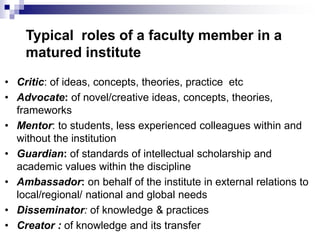
Typical roles of a faculty member in a
matured institute
• Critic: of ideas, concepts, theories, practice etc
• Advocate: of novel/creative ideas, concepts, theories,
frameworks
• Mentor: to students, less experienced colleagues within and
without the institution
• Guardian: of standards of intellectual scholarship and
academic values within the discipline
• Ambassador: on behalf of the institute in external relations to
local/regional/ national and global needs
• Disseminator: of knowledge & practices
• Creator : of knowledge and its transfer
Remarks..
 It takes a good incubation period for a typical
young faculty member to be really become
mature
 This period is to be taken as an investment
 This period is characterised by
The eco-system where you are working
The peer group
The competitive segment
Your own mental set up
9
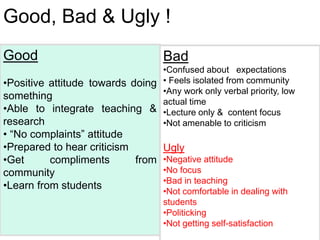
Good, Bad & Ugly !
Good
•Positive attitude towards doing
something
•Able to integrate teaching &
research
• “No complaints” attitude
•Prepared to hear criticism
•Get compliments from
community
•Learn from students
Bad
•Confused about expectations
• Feels isolated from community
•Any work only verbal priority, low
actual time
•Lecture only & content focus
•Not amenable to criticism
Ugly
•Negative attitude
•No focus
•Bad in teaching
•Not comfortable in dealing with
students
•Politicking
•Not getting self-satisfaction
What is expected for academic
and professional growth
 As a teacher
 As a researcher
 As a supervisor
 As a trainer
 As a consultant
 As a reviewer/As an examiner
 As a mentor for projects, coordinator with
industry/institute
 As an administrator
 As a member of a professional society
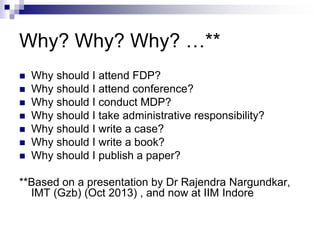
Why? Why? Why? …**
 Why should I attend FDP?
 Why should I attend conference?
 Why should I conduct MDP?
 Why should I take administrative responsibility?
 Why should I write a case?
 Why should I write a book?
 Why should I publish a paper?
**Based on a presentation by Dr Rajendra Nargundkar,
IMT (Gzb) (Oct 2013) , and now at IIM Indore
Menu for activities..
 Strengthen teaching abilities
 Connect with students
 Publish papers
 Conduct FDP/MDP/training programmes
 Conduct sponsored projects
 Take administrative responsibilities
 Write cases/books
 Do professional service
 Connect with industry , connect for CSR activities
 Pursue hobby(self- satisfaction)
Why should I attend FDP?
 To expose myself to new concepts
 To meet peer group from diverse background
 To understand alternative models of teaching,
research and extensions
 To act as a precursor to my Ph D/Guidance
for others
 To see what is being practiced in industry
 To see places !
Why should I attend conference?
 To present my research
 To meet and network with people
 To get exposed to what is happening around
 To get industry /other institute view
 To refresh myself
 To get new ideas !
 https://www.facebook.com/events/1768332443459786/
Why should I conduct MDP?
 To get exposure to new perception
 To understand practice
 To know industry people and networking
 To attract industry for further interaction
 To improve our T&P record
 To connect with industry
 https://www.iiitm.ac.in/images/News_2018/Feb_2018/FDP-on-DAMR-
2018_revised.pdf : FDP by Dr Manoj Dash/Dr Gaurav Agrawal, 2018
Why should I take administrative
responsibility?
 To understand administrative mechanisms
 To enhance my people skills
 To expose myself to various conflicts and
consequent resolution mechanisms
 To get practical exposure
 To improve decision making skills
 To improve resume !
Why should I write a book?
 To express myself
 To share and disseminate my knowledge base
 To widen my network
 To enhance my documentation skills
 To organize myself
 https://www.iiitm.ac.in/index.php/research/books-by-iiitm-faculty
Why should I publish?
 For academic pursuits
 For sharing my research and findings
 For enhancing my visibility
 For promotion /API purpose
 For stimulus
 For competitive spirit !!
 https://www.iiitm.ac.in/images/Research/SCOPUS%20Listed%20Papers%20as%20on%20
%20%2022-09-2015.pdf
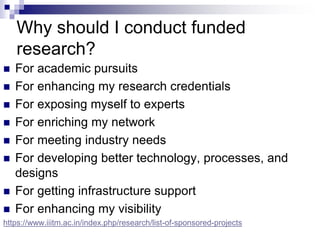
Why should I conduct funded
research?
 For academic pursuits
 For enhancing my research credentials
 For exposing myself to experts
 For enriching my network
 For meeting industry needs
 For developing better technology, processes, and
designs
 For getting infrastructure support
 For enhancing my visibility
https://www.iiitm.ac.in/index.php/research/list-of-sponsored-projects
Engagement of faculty for
professional growth
 Three parts
Institutional
Individual
Professional
Institutional engagement
 Curriculum development
 Administrative responsibility
In-charge of an activity
Member of a committee
Chairperson of an activity
Individual engagement
 Activities in which one is interested or gets
motivated
 Self interest
 Stimulating
 Mechanism to keep busy
Professional engagement
 Reviewing for a journal
 Editorial board
 Writing books/cases
 Member of a professional society (IEEE etc.)
Engagement mechanisms
 Interaction with others
 Social media (Research gate etc.)
 Book writing
 Notes writing
 Laboratory experiments
 Involving with community
 Mentoring others
Engagement by
 Sharing and collaborating
 Individual philosophical underpinnings
Motivation for engagement..
 No magic formula
 Cannot be standardized
 Identify your own motivational elements and
work on that
 Through students? Through peers ?Through
collaboration? Through role models ???
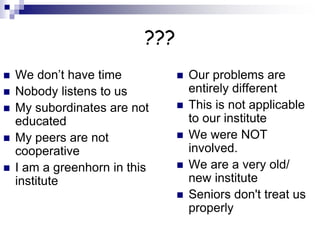
???
 We don’t have time
 Nobody listens to us
 My subordinates are not
educated
 My peers are not
cooperative
 I am a greenhorn in this
institute
 Our problems are
entirely different
 This is not applicable
to our institute
 We were NOT
involved.
 We are a very old/
new institute
 Seniors don't treat us
properly
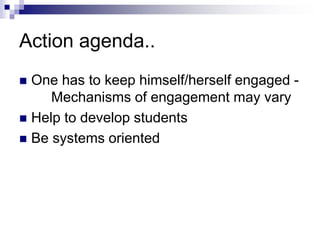
Action agenda..
 One has to keep himself/herself engaged -
Mechanisms of engagement may vary
 Help to develop students
 Be systems oriented
Visibility : Altmetrics
 Altmetrics Score are to be encouraged in impact measurement or
research evaluation
 Young faculty may create and maintain academic profiles (List of
Published Papers, Bibliographic Details and Hyperlinks ) on
 Academia.edu
 ResearchGate.net
 Linkedin.com
 Google Scholar profile
 Personal Blogs
 Slideshare.net
 Orcid.org
 Explore Kudos (https://www.growkudos.com/)
Altmetrics expand our view of what impact looks like, but also of
what’s making the impact. This matters because expressions of
scholarship are becoming more diverse.
from http://altmetrics.org/manifesto
Takeaways !
 Publish only in indexed journals
 Keep the network on
 Share and collaborate among yourself
 Seize every opportunity
Quantification of faculty efforts
Sn Heading Indicative
number of
activities
Total
Points
Earned
1 Teaching 8
2 Research 10
3 Extension/outreach 8
4 Academic Administration 12
5 Professional recognition 12
Remarks..
 A self-assessment template is presented to
quantify the efforts.
 The weightages for these activities may vary
from person to person
 The template will provide sensed of direction in
which career /professional growth is desired.
 It is envisaged to fill in this template every
semester
1. Teaching..
Sn Activity
Maximum
points
Points
earned
T.1 Feedback in Core/elective courses
T.2 Feedback in courses in
FDP/MDPs/QIP/AICTE sponsored
programmes
T.3 Development of Pedagogy (Case study,
Video/audio aids) for effective teaching
T.4 Development of a New course
T.5 Innovations in Teaching
T.6 Development of a New Lab
T.7 Development of online course
T.8 Development of teaching/evalustion notes
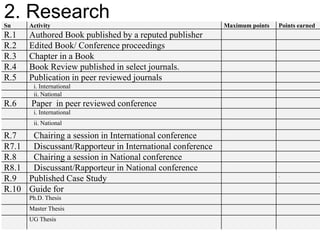
2. ResearchSn Activity Maximum points Points earned
R.1 Authored Book published by a reputed publisher
R.2 Edited Book/ Conference proceedings
R.3 Chapter in a Book
R.4 Book Review published in select journals.
R.5 Publication in peer reviewed journals
i. International
ii. National
R.6 Paper in peer reviewed conference
i. International
ii. National
R.7 Chairing a session in International conference
R7.1 Discussant/Rapporteur in International conference
R.8 Chairing a session in National conference
R8.1 Discussant/Rapporteur in National conference
R.9 Published Case Study .
R.10 Guide for
Ph.D. Thesis
Master Thesis
UG Thesis
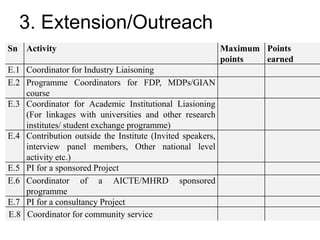
3. Extension/Outreach
Sn Activity Maximum
points
Points
earned
E.1 Coordinator for Industry Liaisoning
E.2 Programme Coordinators for FDP, MDPs/GIAN
course
E.3 Coordinator for Academic Institutional Liasioning
(For linkages with universities and other research
institutes/ student exchange programme)
E.4 Contribution outside the Institute (Invited speakers,
interview panel members, Other national level
activity etc.)
E.5 PI for a sponsored Project
E.6 Coordinator of a AICTE/MHRD sponsored
programme
E.7 PI for a consultancy Project
E.8 Coordinator for community service
4. Administration
Sn Activity Maximum
points Points earned
A.1 Admission Committee Chairperson
A.2 Programme Co-ordinator
A.3 Member Admission Committee
A.4 Alumni/Placement Coordinator
A.5 Coordinator for Networking/LAN
A.6 Coordinator, Library Committee
A.7 Coordinator, Employee grievances Committee
A.8 Member, Library Committee /Hindi Committee
A.9 Coordinator, Central Purchase committee
A.10 Member Purchase Committee
A.11 Warden/Asso warden
A.12 Coordinator , Women cell/SC/ST /Pwd Cell
5. Professional recognition
Sn Activity Maximum
points Points earned
P.1 Patent
P.2 Fellowship of in International Society
P.3 Fellowship of National Society
P.4 Member of an International Society
P.5 Member of a National Society
P.6 Editor of an International Journal
P.7 Editor of a National Journal
P.8 Best Paper Award in an Int. Conference
P.9 Best Paper Award in a national Conference
P.10 Reviewer of an International Journal
P.11 Reviewer of a National Journal
P.12 Medal/Prize
Recommended reading..
 https://www.amazon.in/Aladdin-Factor-Jack-
Canfield/dp/0425150755
http://infed.org/mobi/peter-senge-and-the-
learning-organization/
Useful material..
 How to Have a Bad Career In
Research/Academia: Prof David Patterson,
Berkeley
https://people.eecs.berkeley.edu/~pattrsn/talks/nontech.html
Thank you !
deshmukh.sg@gmail.com
https://www.slideshare.net/SanjeevDeshmukh/

Preparing for academic career

  • 1.
    Preparing for Academic& Professional career… S G Deshmukh ABV-Indian Institute of Information Technology & Management, Gwalior Research scholar’s conclave 8 Apr 2018
  • 2.
    Acknowledgement..  Thankful toProf Abid Haleem(Jamia Milia ) for his insightful comments and observations  Thanks to Prof Lajpat Rai for his value adding comments
  • 3.
    Speaking points..  Changinglandscape of academics  Imperatives for preparation  Methods of engagements  Takeaways
  • 4.
    Vision of anAcademic /professional Career  Sense of academic freedom/autonomy  Opportunity for continued quality learning, discovery  Effective use of skills & abilities  Ability to get connected with community  Opportunity to impact others  Improved quality of professional life  Sense of accomplishment and self-satisfaction
  • 5.
    Reality of anAcademic Career Typical ABSENCE of  Guidance on comprehensible review of work/performance  Sense of community  Sense of self-satisfaction /fulfillment  Balanced, integrated wholesome life
  • 6.
  • 7.
    Typical roles ofa faculty member in a matured institute • Critic: of ideas, concepts, theories, practice etc • Advocate: of novel/creative ideas, concepts, theories, frameworks • Mentor: to students, less experienced colleagues within and without the institution • Guardian: of standards of intellectual scholarship and academic values within the discipline • Ambassador: on behalf of the institute in external relations to local/regional/ national and global needs • Disseminator: of knowledge & practices • Creator : of knowledge and its transfer
  • 8.
    Remarks..  It takesa good incubation period for a typical young faculty member to be really become mature  This period is to be taken as an investment  This period is characterised by The eco-system where you are working The peer group The competitive segment Your own mental set up
  • 9.
    9 Good, Bad &Ugly ! Good •Positive attitude towards doing something •Able to integrate teaching & research • “No complaints” attitude •Prepared to hear criticism •Get compliments from community •Learn from students Bad •Confused about expectations • Feels isolated from community •Any work only verbal priority, low actual time •Lecture only & content focus •Not amenable to criticism Ugly •Negative attitude •No focus •Bad in teaching •Not comfortable in dealing with students •Politicking •Not getting self-satisfaction
  • 10.
    What is expectedfor academic and professional growth  As a teacher  As a researcher  As a supervisor  As a trainer  As a consultant  As a reviewer/As an examiner  As a mentor for projects, coordinator with industry/institute  As an administrator  As a member of a professional society
  • 11.
    Why? Why? Why?…**  Why should I attend FDP?  Why should I attend conference?  Why should I conduct MDP?  Why should I take administrative responsibility?  Why should I write a case?  Why should I write a book?  Why should I publish a paper? **Based on a presentation by Dr Rajendra Nargundkar, IMT (Gzb) (Oct 2013) , and now at IIM Indore
  • 12.
    Menu for activities.. Strengthen teaching abilities  Connect with students  Publish papers  Conduct FDP/MDP/training programmes  Conduct sponsored projects  Take administrative responsibilities  Write cases/books  Do professional service  Connect with industry , connect for CSR activities  Pursue hobby(self- satisfaction)
  • 13.
    Why should Iattend FDP?  To expose myself to new concepts  To meet peer group from diverse background  To understand alternative models of teaching, research and extensions  To act as a precursor to my Ph D/Guidance for others  To see what is being practiced in industry  To see places !
  • 14.
    Why should Iattend conference?  To present my research  To meet and network with people  To get exposed to what is happening around  To get industry /other institute view  To refresh myself  To get new ideas !  https://www.facebook.com/events/1768332443459786/
  • 15.
    Why should Iconduct MDP?  To get exposure to new perception  To understand practice  To know industry people and networking  To attract industry for further interaction  To improve our T&P record  To connect with industry  https://www.iiitm.ac.in/images/News_2018/Feb_2018/FDP-on-DAMR- 2018_revised.pdf : FDP by Dr Manoj Dash/Dr Gaurav Agrawal, 2018
  • 16.
    Why should Itake administrative responsibility?  To understand administrative mechanisms  To enhance my people skills  To expose myself to various conflicts and consequent resolution mechanisms  To get practical exposure  To improve decision making skills  To improve resume !
  • 17.
    Why should Iwrite a book?  To express myself  To share and disseminate my knowledge base  To widen my network  To enhance my documentation skills  To organize myself  https://www.iiitm.ac.in/index.php/research/books-by-iiitm-faculty
  • 18.
    Why should Ipublish?  For academic pursuits  For sharing my research and findings  For enhancing my visibility  For promotion /API purpose  For stimulus  For competitive spirit !!  https://www.iiitm.ac.in/images/Research/SCOPUS%20Listed%20Papers%20as%20on%20 %20%2022-09-2015.pdf
  • 19.
    Why should Iconduct funded research?  For academic pursuits  For enhancing my research credentials  For exposing myself to experts  For enriching my network  For meeting industry needs  For developing better technology, processes, and designs  For getting infrastructure support  For enhancing my visibility https://www.iiitm.ac.in/index.php/research/list-of-sponsored-projects
  • 20.
    Engagement of facultyfor professional growth  Three parts Institutional Individual Professional
  • 21.
    Institutional engagement  Curriculumdevelopment  Administrative responsibility In-charge of an activity Member of a committee Chairperson of an activity
  • 22.
    Individual engagement  Activitiesin which one is interested or gets motivated  Self interest  Stimulating  Mechanism to keep busy
  • 23.
    Professional engagement  Reviewingfor a journal  Editorial board  Writing books/cases  Member of a professional society (IEEE etc.)
  • 24.
    Engagement mechanisms  Interactionwith others  Social media (Research gate etc.)  Book writing  Notes writing  Laboratory experiments  Involving with community  Mentoring others
  • 25.
    Engagement by  Sharingand collaborating  Individual philosophical underpinnings
  • 26.
    Motivation for engagement.. No magic formula  Cannot be standardized  Identify your own motivational elements and work on that  Through students? Through peers ?Through collaboration? Through role models ???
  • 27.
    ???  We don’thave time  Nobody listens to us  My subordinates are not educated  My peers are not cooperative  I am a greenhorn in this institute  Our problems are entirely different  This is not applicable to our institute  We were NOT involved.  We are a very old/ new institute  Seniors don't treat us properly
  • 28.
    Action agenda..  Onehas to keep himself/herself engaged - Mechanisms of engagement may vary  Help to develop students  Be systems oriented
  • 29.
    Visibility : Altmetrics Altmetrics Score are to be encouraged in impact measurement or research evaluation  Young faculty may create and maintain academic profiles (List of Published Papers, Bibliographic Details and Hyperlinks ) on  Academia.edu  ResearchGate.net  Linkedin.com  Google Scholar profile  Personal Blogs  Slideshare.net  Orcid.org  Explore Kudos (https://www.growkudos.com/) Altmetrics expand our view of what impact looks like, but also of what’s making the impact. This matters because expressions of scholarship are becoming more diverse. from http://altmetrics.org/manifesto
  • 30.
    Takeaways !  Publishonly in indexed journals  Keep the network on  Share and collaborate among yourself  Seize every opportunity
  • 31.
    Quantification of facultyefforts Sn Heading Indicative number of activities Total Points Earned 1 Teaching 8 2 Research 10 3 Extension/outreach 8 4 Academic Administration 12 5 Professional recognition 12
  • 32.
    Remarks..  A self-assessmenttemplate is presented to quantify the efforts.  The weightages for these activities may vary from person to person  The template will provide sensed of direction in which career /professional growth is desired.  It is envisaged to fill in this template every semester
  • 33.
    1. Teaching.. Sn Activity Maximum points Points earned T.1Feedback in Core/elective courses T.2 Feedback in courses in FDP/MDPs/QIP/AICTE sponsored programmes T.3 Development of Pedagogy (Case study, Video/audio aids) for effective teaching T.4 Development of a New course T.5 Innovations in Teaching T.6 Development of a New Lab T.7 Development of online course T.8 Development of teaching/evalustion notes
  • 34.
    2. ResearchSn ActivityMaximum points Points earned R.1 Authored Book published by a reputed publisher R.2 Edited Book/ Conference proceedings R.3 Chapter in a Book R.4 Book Review published in select journals. R.5 Publication in peer reviewed journals i. International ii. National R.6 Paper in peer reviewed conference i. International ii. National R.7 Chairing a session in International conference R7.1 Discussant/Rapporteur in International conference R.8 Chairing a session in National conference R8.1 Discussant/Rapporteur in National conference R.9 Published Case Study . R.10 Guide for Ph.D. Thesis Master Thesis UG Thesis
  • 35.
    3. Extension/Outreach Sn ActivityMaximum points Points earned E.1 Coordinator for Industry Liaisoning E.2 Programme Coordinators for FDP, MDPs/GIAN course E.3 Coordinator for Academic Institutional Liasioning (For linkages with universities and other research institutes/ student exchange programme) E.4 Contribution outside the Institute (Invited speakers, interview panel members, Other national level activity etc.) E.5 PI for a sponsored Project E.6 Coordinator of a AICTE/MHRD sponsored programme E.7 PI for a consultancy Project E.8 Coordinator for community service
  • 36.
    4. Administration Sn ActivityMaximum points Points earned A.1 Admission Committee Chairperson A.2 Programme Co-ordinator A.3 Member Admission Committee A.4 Alumni/Placement Coordinator A.5 Coordinator for Networking/LAN A.6 Coordinator, Library Committee A.7 Coordinator, Employee grievances Committee A.8 Member, Library Committee /Hindi Committee A.9 Coordinator, Central Purchase committee A.10 Member Purchase Committee A.11 Warden/Asso warden A.12 Coordinator , Women cell/SC/ST /Pwd Cell
  • 37.
    5. Professional recognition SnActivity Maximum points Points earned P.1 Patent P.2 Fellowship of in International Society P.3 Fellowship of National Society P.4 Member of an International Society P.5 Member of a National Society P.6 Editor of an International Journal P.7 Editor of a National Journal P.8 Best Paper Award in an Int. Conference P.9 Best Paper Award in a national Conference P.10 Reviewer of an International Journal P.11 Reviewer of a National Journal P.12 Medal/Prize
  • 38.
  • 39.
    Useful material..  Howto Have a Bad Career In Research/Academia: Prof David Patterson, Berkeley https://people.eecs.berkeley.edu/~pattrsn/talks/nontech.html
  • 40.