The document explains kanban as a visual tool for managing workflow, improving efficiency by reducing waste and optimizing inventory levels. It describes kaizen as a philosophy of continuous improvement involving teamwork and gradual changes to enhance processes and eliminate waste in production systems. The document concludes with the benefits and successes of implementing both kanban and kaizen methodologies in various industries.
WHAT IS KANBAN
•The word “Kan” means “visual” and the word “ban” means
“card”.
So, Kanban refers to visual cards.
• What is a visual card? It is a visual aid that triggers action.
• A system of continuous supply of components, parts and
supplies, such that workers have what they need, where
they need it, when they need it.
3.
• Kanban isa tool for managing the flow of materials or
information (or whatever) in a process.
• Not having the materials, whether it is a part, a document,
or customer information, at the time you need it causes
delay and waste.
• On the other hand, having too many parts on hand or too
much work in process (WIP) is also a form of waste.
• Kanban is a tool to learn and manage an optimal flow of
work within the process.
4.
HOW DOES KANBANWORK?
Visualize the workflow
Split the work into pieces, write each item on a card
and put on the wall
Use named columns to illustrate where each item is in
the workflow.
Limit WIP (work in progress) –Get more done by doing
less. There is a limit to the number of things you can be
working on and still do them well.
Measure the lead time (average time to complete one
item, sometimes called cycle time) optimize the
process to make lead time as small and predictable as
possible.
5.
BENEFITS
• Bottlenecks becomeclearly visible in real-time. This
leads people to collaborate to optimize the whole
value chain rather than just their part.
• Useful for situations where operations and support
teams have a high rate of uncertainty and variability.
6.
REDUCE INVENTORY
• Kanbanwill reduce inventory, on average, by 25 to 75%. This saves
any company significantly in terms of rent, electricity, and storage
space.
• In addition, all of the space freed by the implementation of a
kanban system can be used for future expansions or new
opportunities.
• Improves responsiveness to changes in demand
7.
IMPROVE WORK FLOW
•The visually organized environment ensures all parts are
easily found and continually stocked.
• The speed of moving from one task to another is
significantly increased by the creation of clearly marked
flow lanes, kanban cards, and clearly marked labels.
8.
PREVENT OVERPRODUCTION
Because partsare only created at the visual signal by
the kanban label (link), inventory is much less likely to
be overproduced. Resulting in significant savings in the
holding of stock.
9.
KANBAN CARD
• Aphysical card with information conveys message to move or make
• Card is passed from customer to supplier, includes necessary information - Part
details, quantity and location.
Examples
• Note in check book box, “Time To Re-Order”
• Card sent to stock room to send more of part “X” to production
WHAT IS KAIZEN?
•Kai is an idea of change or the action to correct.
• Zen means “good”.
• Kaizen means “change for the better’’ and can be linked to
continuous improvement
• This change for the better can result in gradual improvement of
products, workplace efficiency, customer service, and reduction of
waste.
13.
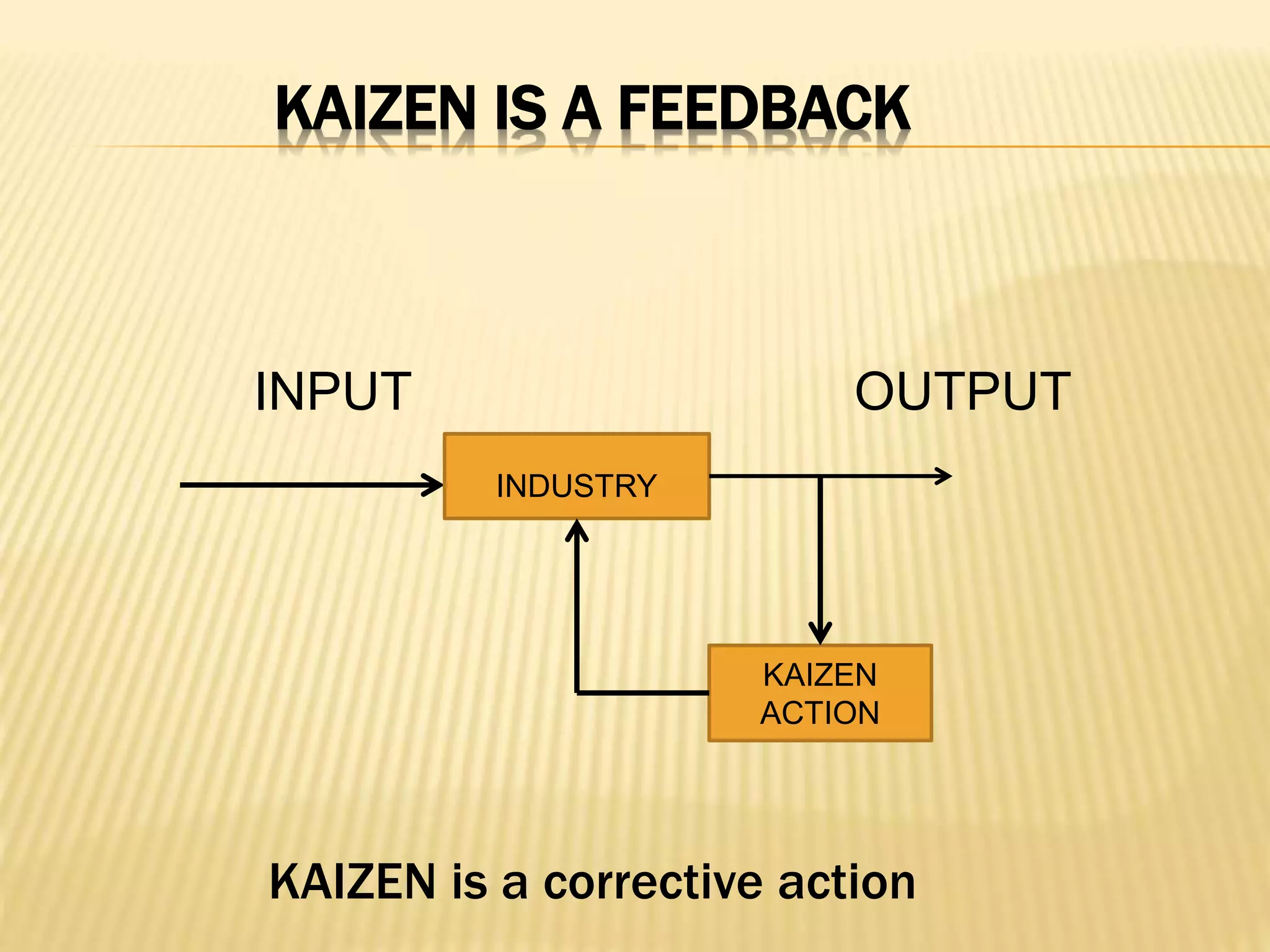
KAIZEN IS AFEEDBACK
INPUT OUTPUT
KAIZEN is a corrective action
INDUSTRY
INDUSTRY
KAIZEN
ACTION
14.
BASIC PRINCIPLE OFKAIZEN
People are the most important asset. Teamwork provides results
and gives everyone a feeling of accomplishment. A dozen heads
are better than one.
Everyone must be open to change and improvements. Ideas
from workers, management, suppliers, and customers can lead
to new, better and easier ways of doing things.
Gradual changes are easier to accept than complete overhauls
and employees are more likely to accept gradual change. Small
changes will demonstrate how a tiny improvement can provide
real results.
KAIZEN’S EVENT PURPOSE
The purpose for holding a Kaizen event is basically to identify waste
in a manufacturing process and to eliminate it, thereby improving
production.
A Kaizen event is Team Oriented, as it gathers the managers,
operators, and owners of a process in a specific place to analyze, and
map out the existing methods of the operation.
It is also a forum for developing, discussing, and allowing changes to
be made to improve the process.
21.
There are fourstages that a Kaizen Team undertakes.
• Step One: Analyze and map the current processes of a
specific area of the plant.
• Step Two: Identify the problems and the opportunities
for improvement.
• Step Three: Implement changes to the process that
allow for improved workflow.
• Step Four: Evaluate the changes made and follow up,
with adjustments as required.
22.
SEVEN TYPICAL WASTESIN
PRODUCTION SYSTEMS
• Over-production Waste - occurs when products are produced at a faster
rate than is required. Causes may be a lack of communication, anticipating
demand, poor scheduling, and production management.
• Excessive Inventory Waste – is any inventory that is more that what the
customer ordered. Inventory that sits in storage areas waiting for an order
is a waste of material, money tied up, and the use of valuable factory
space.
• Time Delays Waste - machine wait time or human wait time contributes to
waste within a company.
23.
• Transportation Wastes– such as unnecessary handling or
movement of materials, numerous storage areas, and excessive
moving equipment
• Processing Errors - are wastes that occur during the process
manufacturing stage. They can be human error, machine-caused
defects or quality problems.
• Corrections/Defects/Rework Waste - the time it takes to correct,
inspect, scrap or rework is a major waste that must be avoided.
• Excess Motion Waste - any unnecessary human bending,
reaching, walking or movement during a manufacturing process
is a waste such as looking for tools and material too far from
work areas.
24.
5S KAIZEN
It isa tool for organizing your workplace in a
clean, efficient, and safe manner to enhance
your productivity, visual management and to
ensure the introduction of standardized
working.
26.
SEIRI= SORT, CLEARING,CLASSIFY
To distinguish between necessary things and
unnecessary things, and getting rid of what
you do not need.
27.
SEITON = STRAIGHTEN,SIMPLIFY, SET IN
ORDER, CONFIGURE
It is the process of taking the required items that are
left after the removal of clutter and arranging them
in a efficient manner through the use of ergonomic
principles and ensuring that every item has a place
and that everything is in its place.
28.
SEISO = SWEEP,CLEANING
Itis a thorough cleaning of the area, tools,
machines and other equipment to ensure
that everything is returned to a newly new
status.
Example: oil leak from a machine onto a
bright, newly painted clean floor.
29.
SEIKETSU = STANDARDIZE,CONFORMITY
Keeping things organized, neat, and clean, even in
personal and environment aspects. Here we follow
common standards and way of working.
THE BENEFITS OFKAIZEN
• Kaizen is a philosophy to promote improvement
• Kaizen follows the idea that small changes in the
workplace can result in increased profits, lower employee
safety risks, and better utilization of resources.
• Kaizen in all forms has been shown to improve working
environments – saving companies millions of dollars
while making employees healthier and happier.
• Kaizen is about enacting change clearly and concisely. It
gives employees a real sense of accomplishment as a
million tiny steps lead to a massive change – in safety, in
structure, and in profits.
• It is a long term process, not a one time event.
33.
SUCCESSES WITH KAIZEN
•The goal of kaizen - continual improvement - is
obviously desirable.
• Businesses dotting the globe have implemented this
methodology to augment profits, improve safety,
increase customer satisfaction employee
satisfaction.
• Sony's Kaizen Success: Sony used kaizen to increase
its production efficiency by 7,000%.
• Fleetwood's Kaizen Success: Chicago-
born Fleetwood has used kaizen to reduce cycle time
and waste and increase profit and customer base.