Pedagogical challenges in digital
environment
S G Deshmukh
ABV-Indian Institute of Information Technology &
Management, Gwalior
Deshmukh.sg@gmail.com
STTP on : Quality enhancement of teaching-learning
processes (27 Feb 2017) at MITS Gwalior
Speaking points..
 Opening remarks..
 Prevailing digital environment
 Its implications
 Challenges for teacher
 Strategies to address these challenges
 Personal experiences
 Closing remarks..
Opening..
 Information
 Facts, comments, opinions expressed
through word, images, sounds
 It can be stored, retrieved…
 Knowledge
 Output of the reconstruction of information by
a person, according to his/her history and
context.
Information can be transmitted,
Knowledge must be acquired, constructed
Our job is to..
 Act as knowledge disseminator
 Act as a facilitator to convert this
knowledge into practice !
 Act as a conduit for betterment of society
at large !
All pervading digital environment
 Laptop
 Mobile
 Tablets
 Ipod,MP3, and other
gadgets
 YouTube, Blogger
 SlideShare, Myspace
5
 Social media
 Facebook,
LinkedIn,
 WhatsApp
Characteristics of digital
environment
 Ubiquitous
 Mobility
 Lighter and Smaller
 High speed
 Smartness
 Multiple functions
Disturbing statements..
 Engineering curriculum and the teaching and learning
strategies have been around for over a couple of years.
Unfortunately , engineering faculty today aren’t taught how to
teach ! That’s where pedagogy comes into picture .
 Professor Emeritus Richard Felder:
“Do unto your students as had been done unto you !”
 Typical teaching method : prepare detailed lecture notes,
transcribe them onto the board for students to copy,
sometimes ask questions, occasionally get answers from a
few of the more fearless students, give tests.
Source: http://www4.ncsu.edu/unity/lockers/users/f/felder/public/
Who are we teaching to:
Generation Y student
 Uses mobile on and off the class room
 Very comfortable in a WiFi environment
 Frequently watches YouTube
 Listens to popular songs via iPod/MP3
 Participates in blog discussions
 Hooked to Facebook , or LinkedIn
 Gets motivated by “Likes”..
 Downloads material from the web
 Adept in Cut and Paste mode
 Addicted to WhatsApp
 Reluctant to acknowledge teacher !!
What is teaching?
 Teaching is a process intended for
learning by inducing a behavioural change
in the taught.
 It is an art of communicating a message
with impact on audience.
 Pedagogy is an art or profession of
teaching.
Why teaching ?
 Practical view: It is our job !
 Professional view: Teaching creates
knowledge awareness and feelings
in the taught and brings about
behavioral change.
 Personal view: It depends !!
Some assertions..
A1: Good teaching is essential for all.
A2: Quality means making the students learn by
stimulating their interest in the topic, by
challenging their capabilities, and by encouraging
active participation and ‘doing’
A3: Learning means more than rote memorization of
facts; hence teachers are expected to enhance students
analytical, critical, and independent thinking abilities.
Some assumptions about
teaching
 Teaching is a process not an event
 There is no one right way to teach, but there
are many ways to teach better
 Both teachers AND students are responsible
for learning
 Learning is more likely to occur if the process
has been planned
 Learning occurs best in a relevant context
And most importantly...
 Teachers want to teach better
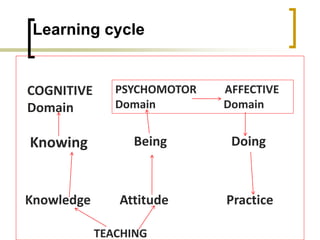
Learning cycle
COGNITIVE
Domain
Knowing
Knowledge Attitude Practice
PSYCHOMOTOR AFFECTIVE
Domain Domain
Being Doing
TEACHING
Types of learning..
 More than one type of learning through three
domains
 Cognitive
 Psychomotor
 Affective
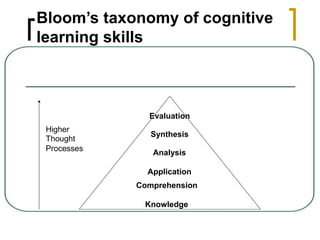
Bloom developed a taxonomy based on the
above..“Allows educators to evaluate learning of
students systematically [Bloom, 1994]”
14
Evaluation
Higher
Thought
Processes
Synthesis
Analysis
Application
Comprehension
Knowledge
Bloom’s taxonomy of cognitive
learning skills
Bloom’s Taxonomy ..1..
 Knowledge: repeating verbatim(list, state, describe)
 Comprehension: demonstrating understanding of
terms in own words(interpret),
 Application: applying learned information to a problem
(solve, calculate)
Bloom’s Taxonomy ..2..
 Analysis: breaking things down into their
elements, formulating theoretical explanations
or mathematical or logical models for observed
phenomena(derive, explain)
 Synthesis: creating something, combining
elements in novel ways(formulate, make up,
design)
 Evaluation: making and justifying value
judgments or selections from among
alternatives(determine, select, critique)
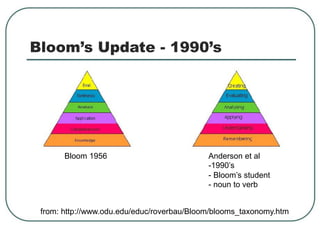
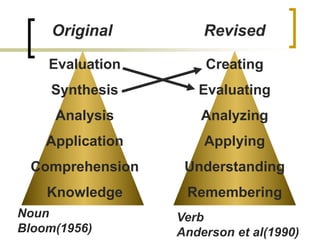
Bloom’s Update - 1990’s
Bloom 1956 Anderson et al
-1990’s
- Bloom’s student
- noun to verb
from: http://www.odu.edu/educ/roverbau/Bloom/blooms_taxonomy.htm
Evaluation
Synthesis
Analysis
Application
Comprehension
Knowledge
Creating
Evaluating
Analyzing
Applying
Understanding
Remembering
Original Revised
Noun
Bloom(1956)
Verb
Anderson et al(1990)
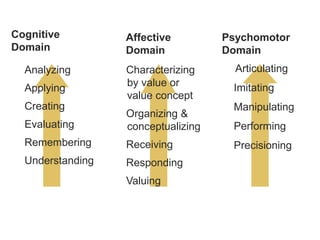
Cognitive
Domain
Analyzing
Applying
Creating
Evaluating
Remembering
Understanding
Characterizing
by value or
value concept
Organizing &
conceptualizing
Receiving
Responding
Valuing
Affective
Domain
Psychomotor
Domain
Articulating
Imitating
Manipulating
Performing
Precisioning
Application to Engineering
Education
 Creativity is very important for the engineering
profession [Goel, 2004]
 Creativity requires higher thought processes (Bloom :items 4-
6: Analysis, Synthesis, Evaluation) [Felder et al., 2004]
 In many cases lectures and homework assignments focus
exclusively on Bloom item 3: Application [Felder et al., 2004]
 “Then, if they put a high-level question on exam and
the students do poorly on it, they blame the students’
lack of ability or poor study habits.”
 Need to include high-level tasks in learning (educational)
objectives
Interesting fact..
Teacher learns while
teaching
Digital Learning ..1..
 …. is "learning facilitated by technology that gives students
some element of control over time, place, path and/or
pace."[1]
[1] : Source : Definition from Digital Learning Now! and the Florida Virtual School.
 Time: Learning is no longer restricted to the college day or
academic year. The Internet and a proliferation of Internet
access devices have given students the ability to learn
anytime.
 Place: Learning is no longer restricted within the walls of a
classroom. The Internet and a proliferation of Internet
access devices have given students the ability to learn
anywhere and everywhere.
Digital learning.. 2..
 Path: Learning is no longer restricted to the pedagogy used by
the teacher. Interactive and adaptive software allows students
to learn in their own style, making learning personal and
engaging. New learning technologies provide realtime data
that gives teachers the information they need to adjust
instruction to meet the unique needs of each student.
 Pace: Learning is no longer restricted to the pace of an entire
classroom of students. Interactive and adaptive software
allows students to learn at their own pace, spending more or
less time on lessons or subjects to achieve the same level of
learning.
Critical ingredients.. 1..
 Technology: Technology is the mechanism
that delivers content. It facilitates how
students receive content. It includes Internet
access and hardware, which can be any
Internet access device – from a desktop to a
laptop to an iPad to a smartphone.
Technology is the tool, not the instruction.
Critical ingredients.. 2..
 Digital Content: Digital content is the high quality
academic material which is delivered through technology. It
is what students learn. It ranges from new engaging,
interactive and adaptive software to classic literature to
video lectures to games.
 Instruction: Teachers are essential to digital learning.
Technology may change the role of the teacher. With
digital learning, teachers will be able to provide the
personalized guidance and assistance to ensure students
learn and stay on track.
source: https://gosa.georgia.gov/what-digital-learning#_ftnref1
Global context & some non-
ignorable trends ...
 The rapid rise of open online resources, in general,
and MOOCs, in particular (open access,
eBooks,Nptel, khan academy etc. …)
 The slower but consistent rise in online degree
enrolments, and the emergence of higher quality for-
fee online programs, especially in USA/Europe
 Increasingly pervasive and more inclusive mobile
connectivity. Look at the statistics in India !!
 The “unbundling” of higher education
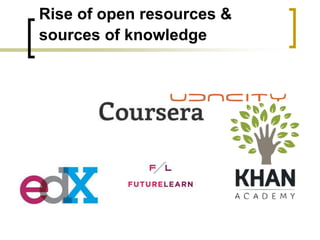
The rise of open resources and coursesRise of open resources &
sources of knowledge
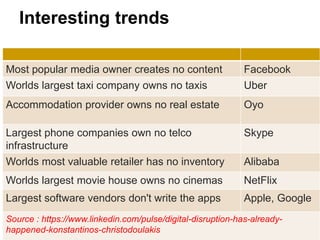
Interesting trends
Most popular media owner creates no content Facebook
Worlds largest taxi company owns no taxis Uber
Accommodation provider owns no real estate Oyo
Largest phone companies own no telco
infrastructure
Skype
Worlds most valuable retailer has no inventory Alibaba
Worlds largest movie house owns no cinemas NetFlix
Largest software vendors don't write the apps Apple, Google
Source : https://www.linkedin.com/pulse/digital-disruption-has-already-
happened-konstantinos-christodoulakis
Digital disruption..
 “Today, almost in every field, there is a
disruptive digital innovation which has helped
collapse the distribution and delivery channel”:
examples: Flipkart/Snapdeal/Amazon/Netflix
etc.
 Vinayak Garg (Entrepreneur, at a session
Infotsav, IIITMG, Oct 2015)
30
Basic assumptions challenged?
 Teacher to student ratio
 Sacrosanct class room teaching, and
restricted class room interaction; and
 Emphasis on single medium (such as black
board): Today the medium is laced with
multi-media based content!!
31
Forces responsible for
digital disruption
 Social media
 Mobile
 AI & Robotics
 Cloud computing
Implication: Teacher to assume digital
competency !!
32
Comment..
 “Everything is connected to everything else “
 Connected world view
 Enabled by intrinsic desire to be “connected”
 Enabled by teaching ?
 Enabled by IT
Two views..
 Classical view
 Teaching in
isolation
 Teaching is
compartmentalized
 No sharing
 Student need to be
taught !
 Contemporary view
 Teacher is connected
 Teaching cannot be
done in isolation
 Student as co-producer
 Teaching Vs learning
 Teacher be connected
to society?
Positives of Lecture Mode
 Time, cost and energy efficiency.
 Up-to-date information based on home work
 Summaries of material/ view points from a
variety of experts and printed sources,
 A pattern for organization of material which
helps the students to read more effectively
 Effective use of pedagogy and material
Some Negatives of Lecture Mode
 Very large classes
 Lack of adequate/ desired facilities.
 Difference in students teacher's expectations.
 Lack of accountability.
 Lack of visible recognition
 Preoccupation with completing the course work.
 Heterogeneity of students
 Not able to retain student attention span
 Monotony of daily routine.
 Boring commanding position
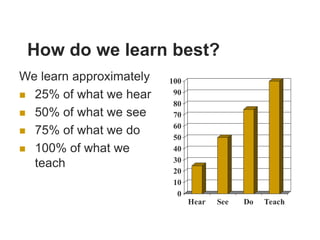
How do we learn best?
We learn approximately
 25% of what we hear
 50% of what we see
 75% of what we do
 100% of what we
teach
0
10
20
30
40
50
60
70
80
90
100
Hear See Do Teach
Model 1: Traditional –I
 Teachers tend to look at the student differences,
i.e. the ‘good’ students and the ‘bad’ students
 The teacher is responsible for the content so in
order to learn the students must;
 Attend lectures/classes, Listen carefully
 Take full notes, Regulate the information in exams and
assessments
 It is a ‘blame the student’ approach based on
student deficits including; motivation, intelligence,
attitude, study skills and aptitude etc
Biggs and Tang, 2007
Model 2: Traditional –II
( Teacher led )
 Teachers try to ‘manage’ learning by using a
battery of strategies (a ‘how to’ approach)
by;
 Establishing procedural rules
 Ensuring clarity – voice, visuals, board work, ...
 Using a wide variety of strategies
 It’s a ‘blame the teacher’ approach as it
assumes that teaching involves the
application of a range of strategies and
competencies which are easy to quantify.
Model 3: Student centric
 The focus is on approaches that cause and
support student learning and it will include a
range of strategies
 Assisting students to understand facts,
concepts and principles (use technology for this )
 Using appropriate teaching/learning activities
(use a blended methodology )
 Engaging students on tasks focused on the
learning outcomes(use IT/social media centric
tools)
What should be our goal?
 Students hearing a concept (through webinar )
 Students seeing a demonstration (through
Youtube/movie)
 Students doing a problem (paper/pencil)
 Students teaching themselves or
others(through interactive media)/ (peer to
peer group)” Example :AASF forum in IIITM
Roles of a teacher
1. Resource provider
2. Instructional
specialist
3. Curriculum
specialist
4. Classroom
supporter
5. Learning facilitator
6. Mentor
7. Leader
8. Data coach
9. Catalysts for change
10. Learner
 Source
http://www.slideshare.net/alexlegar
a1/ten-roles-for-teacher-leaders42
Appreciate students as..
 consumers,
 consultants,
 partners,
 stakeholders,
 change agents,
 producers,
 researchers,
 apprentices, the list goes on…
Prevailing environment
 Digital devises
 Digital technology
 Social media
 Hyper connectedness
 Googalisd world view
 Low attention/retention span
44
Challenges …
 Multiple modes of learning
 Not relying on classroom teaching OR teacher
alone..
 Teacher competing with technology
 Constantly bombarded with onslaught of digital
technology
 Teaching Vs Learning ?
 Knowledge dissemination vs Knowledge
application
45
Comments..
 A powerful push-pull factor in institutions.
 The push factor is that institute is increasingly
boring for students and alienating for teachers.
The pull factor is that the exploding and alluring
digital world is irresistible, but not necessarily
productive in its raw form. The push-pull
dynamic makes it inevitable that disruptive
changes will occur.
 one thing worse than being bored and that is
“having to teach the bored.”!!
Reasons for engaging with
MOOCs
Universities
• As a means of overcoming “Faculty shortage”
• Educational innovation
• Revenue (or cost reduction) opportunity
Learners
• Satisfactory learning experiences
• Curiosity
• Learning, rather than an award of mere degree
*UK Department for Business Innovation and Skills, Research Paper No 130, September 2012
Technology enhanced set of Learning
and Teaching possibilities
 Online v. face-to-face
 Free v. fee
 Awards and degrees v. certificates
and badges
 Open v. restricted
 Self-paced v. in-session
 Synchronous v. asynchronous
 Group- v. individual-based
 Instructor- v. peer-based
 Institution- v. student-focused
 Generative v. analytical
 Immersive and rich v. abstract and
idealised
 Personalised v. standardised
 Credential- v. challenge-based entry
 Interactive v. passive
 Problem- v. content-structured
 Adaptive v. fixed
 Experiential v. ‘abstracted’
 Reflective v. programmatic
 Mobile v. location-dependent
 Evidence-based v. tradition-based
 Immediate v. delayed feedback
 Mastery v. threshold
Digital characteristics
 Interactivity
 Symbolic flexibility
 Vast sources of knowledge &
experience
Challenge # 1
 How to complement traditional teaching
methods with digital environment?
Strategy to counter Challenge # 1
How to complement traditional
teaching methods with digital
environment?
Use combination of both based on the
context, culture and the avalaibilyyty
of resources.
Challenge # 2
 How to build effective ‘in class’ activities
that realise engaged enquiry in a blended
learning environment?
Strategy to counter Challenge # 2
 How to build effective ‘in class’ activities that
realise engaged enquiry in a blended
learning environment?
Use technology, use social media and
use contextual factors..
Use Blended pedagogy !!
Blended learning..
 Active learning that bridge learning & practice
 Activities that promote student-student interactions
 Learning experiences need to be well designed and
effective
 These experiences also need to be innovative.
 Feedback on effectiveness for learning is vital for
teachers (for improvement), for students ( guided
learning) and for stakeholders for broad assurance of
targeted outcomes
Blended learning ..
 A synergistic combo of classroom AND
digital media
 Role of a teacher as a facilitator
 Role as an enabler
55
Engagement
 Typical span is 12-15 minutes
 A class of say 55 minutes
 One should be able to introduce 4 to 5 packets
of concepts/ideas interspersed with multi-
media content
 Make use of
 Youtube videos
 TED talks
 Films/documentary 56
Implication : Interactivity
 Interactivity through social media
 Enables to understand student better
 Establishes long term relationships with both
student and teacher
 Helps in understanding student and add-
ons by close interaction
57
Wisdom in the social crowd:
Quora
 Interesting forum
 As an interaction forum
 As a status symbol for student community?
 Prolific contributors like: Prof Dheeraj
Sanghi (IIIT Delhi ) !
Quora
 Quora, it is a “collection of questions and
answers created, edited, and organized by
everyone who uses it.” (About Quora, 2011).
 The site combines the features of an online Q&A
site and those of social media, permitting users to
ask, answer and rate content while also allowing a
community of members to conduct private
communication if they chose to.
 Research Question: How is knowledge
created through CoP on Quora?
TED talks..
 TED Talks have been a driving force of inspiration,
information and innovation since their inception in 2006.
Born out of the TED (Technology, Entertainment,
Design) Conference, the talks have become a global, viral
sensation.
 Stephanie Lo, Director of TED-Ed Programs,
advises teachers to use TED videos as a way to
get students thinking. She recommends that
teachers check out Ed.TED.com, which is packed
full of short, animated lessons created specifically
for students.
Ted Talks
 Bill Gates on Teaching
https://www.youtube.com/watch?v=81Ub0SMxZQo
Measures of Teaching (MET) project
Ways to Sustain Student
Motivation
 Make students partners in the teaching- learning
process. They are co-producers according to
TQM perspective
 Be sensitive about student needs.
 Provide extrinsic motivation
 Allow some quiet time/Time for meditation?
Example..
 Setting: Visionary Leaders for Manufacturing (VLFM)
programme of IIM Kolkata, IIT Kanpur and IIT
Madras
 A joint initiative of CII and GoI
 Audience: Students with industry experience
 A module on SCM
 Tried in Jul 2015, Aug 2016
 Classroom sessions interspersed with Youtube /Ted
talks 63
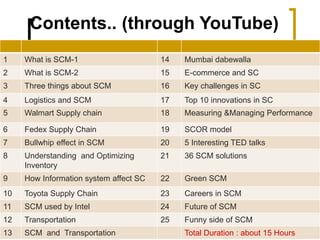
Contents.. (through YouTube)
1 What is SCM-1 14 Mumbai dabewalla
2 What is SCM-2 15 E-commerce and SC
3 Three things about SCM 16 Key challenges in SC
4 Logistics and SCM 17 Top 10 innovations in SC
5 Walmart Supply chain 18 Measuring &Managing Performance
6 Fedex Supply Chain 19 SCOR model
7 Bullwhip effect in SCM 20 5 Interesting TED talks
8 Understanding and Optimizing
Inventory
21 36 SCM solutions
9 How Information system affect SC 22 Green SCM
10 Toyota Supply Chain 23 Careers in SCM
11 SCM used by Intel 24 Future of SCM
12 Transportation 25 Funny side of SCM
13 SCM and Transportation Total Duration : about 15 Hours
What is SCM..1..
SCM
Supply Chain
Management
 WP carey Business
School of Arizona
State University
 https://www.youtube.c
om/watch?v=Mi1QBx
VjZAw
Duration: 8.04 Minutes
Five Interesting TED talks on
SCM
 http://blog.staylinked.com/5-eye-
opening-ted-talks-every-supply-chain-
professional-needs-to-watch
 Total time : about 65 Minutes (each
about 12.5 to 14 Minutes)
36 SCM Solutions to be
learned from TED talks …
 If you work in any field related to warehousing
and the supply chain, you have to watch these
36 TED Talks for some life-changing supply
chain solutions uploaded by Mr Jim Laverty
 http://www.irms360.com/blog_post/36_supply_
chain_solutions_you_can_learn_ted_talks
 Total duration : about 8 Hours (480 Minutes)
SCM through TED talks
 Talk by industry professionals
 This encouraged discussion and debate
and also brought element of practice ..
Observations..
 Connectivity was established
 Adept use of technology bridged the
Generation gap !
 Interesting content motivated students
 Facebook and blogs also helped to extend the
reach of content
 Session interspersed with video content made
the sessions interesting
 It was Model -3 (Student Centric )
Teaching/learning
 Student interaction with faculty and other
students is an essential characteristic and is
facilitated in a variety of ways, including
facebook, email, e-groups.
 Feedback to students on assignments and
questions is constructive and provided in a
timely manner.
Quality is about systemic change.
Motivate students to act as change catalysts
Insights..`
 Student does not only consume the final product (therefore,
are customers), but also participate in its production (therefore,
is co-producer). Digital environment enables this !
 The student may not be the product. The real product is the
learning of the students and the consequent change in
behavior. That is where outcomes matter !
 Learning as a team effort between teacher and the student.
This is where digitalization helps !
 Jointly, they produce a product that is learning of the student.
Both parties are responsible participants in that process.
Ownership established !!
Summary..
 Becoming Tech Savvy
 Practice and acquire competency
 Crowdsource Respect and Common Values
 Digital forums for open debate , interaction , feedback etc.
 Don’t Just Transfer, Transpose
 Not only to disseminate/transfer knowledge, but also to show its
application, practice
 The Empathy Factor
 Establish emotional connectivity. Our job is not only intellectual development BUT
emotional development also
Source https://blog.tophat.com/how-professors-can-best-use-technology/
Interesting development..
UoPeople: University of People
http://www.uopeople.edu/
World’s first Tuition free , accredited online
university
Started in 2009
UC Berkeley partnered with UoPeople in
2016
End quote..
 “Technology matters, but good
teachers and good teaching
practices, matter more”.
74
https://www.slideshare.net/SanjeevDeshmukh/
Thanks a lot…

Pedagogy challenges-sgd

  • 1.
    Pedagogical challenges indigital environment S G Deshmukh ABV-Indian Institute of Information Technology & Management, Gwalior Deshmukh.sg@gmail.com STTP on : Quality enhancement of teaching-learning processes (27 Feb 2017) at MITS Gwalior
  • 2.
    Speaking points..  Openingremarks..  Prevailing digital environment  Its implications  Challenges for teacher  Strategies to address these challenges  Personal experiences  Closing remarks..
  • 3.
    Opening..  Information  Facts,comments, opinions expressed through word, images, sounds  It can be stored, retrieved…  Knowledge  Output of the reconstruction of information by a person, according to his/her history and context. Information can be transmitted, Knowledge must be acquired, constructed
  • 4.
    Our job isto..  Act as knowledge disseminator  Act as a facilitator to convert this knowledge into practice !  Act as a conduit for betterment of society at large !
  • 5.
    All pervading digitalenvironment  Laptop  Mobile  Tablets  Ipod,MP3, and other gadgets  YouTube, Blogger  SlideShare, Myspace 5  Social media  Facebook, LinkedIn,  WhatsApp
  • 6.
    Characteristics of digital environment Ubiquitous  Mobility  Lighter and Smaller  High speed  Smartness  Multiple functions
  • 7.
    Disturbing statements..  Engineeringcurriculum and the teaching and learning strategies have been around for over a couple of years. Unfortunately , engineering faculty today aren’t taught how to teach ! That’s where pedagogy comes into picture .  Professor Emeritus Richard Felder: “Do unto your students as had been done unto you !”  Typical teaching method : prepare detailed lecture notes, transcribe them onto the board for students to copy, sometimes ask questions, occasionally get answers from a few of the more fearless students, give tests. Source: http://www4.ncsu.edu/unity/lockers/users/f/felder/public/
  • 8.
    Who are weteaching to: Generation Y student  Uses mobile on and off the class room  Very comfortable in a WiFi environment  Frequently watches YouTube  Listens to popular songs via iPod/MP3  Participates in blog discussions  Hooked to Facebook , or LinkedIn  Gets motivated by “Likes”..  Downloads material from the web  Adept in Cut and Paste mode  Addicted to WhatsApp  Reluctant to acknowledge teacher !!
  • 9.
    What is teaching? Teaching is a process intended for learning by inducing a behavioural change in the taught.  It is an art of communicating a message with impact on audience.  Pedagogy is an art or profession of teaching.
  • 10.
    Why teaching ? Practical view: It is our job !  Professional view: Teaching creates knowledge awareness and feelings in the taught and brings about behavioral change.  Personal view: It depends !!
  • 11.
    Some assertions.. A1: Goodteaching is essential for all. A2: Quality means making the students learn by stimulating their interest in the topic, by challenging their capabilities, and by encouraging active participation and ‘doing’ A3: Learning means more than rote memorization of facts; hence teachers are expected to enhance students analytical, critical, and independent thinking abilities.
  • 12.
    Some assumptions about teaching Teaching is a process not an event  There is no one right way to teach, but there are many ways to teach better  Both teachers AND students are responsible for learning  Learning is more likely to occur if the process has been planned  Learning occurs best in a relevant context And most importantly...  Teachers want to teach better
  • 13.
    Learning cycle COGNITIVE Domain Knowing Knowledge AttitudePractice PSYCHOMOTOR AFFECTIVE Domain Domain Being Doing TEACHING
  • 14.
    Types of learning.. More than one type of learning through three domains  Cognitive  Psychomotor  Affective Bloom developed a taxonomy based on the above..“Allows educators to evaluate learning of students systematically [Bloom, 1994]” 14
  • 15.
  • 16.
    Bloom’s Taxonomy ..1.. Knowledge: repeating verbatim(list, state, describe)  Comprehension: demonstrating understanding of terms in own words(interpret),  Application: applying learned information to a problem (solve, calculate)
  • 17.
    Bloom’s Taxonomy ..2.. Analysis: breaking things down into their elements, formulating theoretical explanations or mathematical or logical models for observed phenomena(derive, explain)  Synthesis: creating something, combining elements in novel ways(formulate, make up, design)  Evaluation: making and justifying value judgments or selections from among alternatives(determine, select, critique)
  • 18.
    Bloom’s Update -1990’s Bloom 1956 Anderson et al -1990’s - Bloom’s student - noun to verb from: http://www.odu.edu/educ/roverbau/Bloom/blooms_taxonomy.htm
  • 19.
  • 20.
    Cognitive Domain Analyzing Applying Creating Evaluating Remembering Understanding Characterizing by value or valueconcept Organizing & conceptualizing Receiving Responding Valuing Affective Domain Psychomotor Domain Articulating Imitating Manipulating Performing Precisioning
  • 21.
    Application to Engineering Education Creativity is very important for the engineering profession [Goel, 2004]  Creativity requires higher thought processes (Bloom :items 4- 6: Analysis, Synthesis, Evaluation) [Felder et al., 2004]  In many cases lectures and homework assignments focus exclusively on Bloom item 3: Application [Felder et al., 2004]  “Then, if they put a high-level question on exam and the students do poorly on it, they blame the students’ lack of ability or poor study habits.”  Need to include high-level tasks in learning (educational) objectives
  • 22.
  • 23.
    Digital Learning ..1.. …. is "learning facilitated by technology that gives students some element of control over time, place, path and/or pace."[1] [1] : Source : Definition from Digital Learning Now! and the Florida Virtual School.  Time: Learning is no longer restricted to the college day or academic year. The Internet and a proliferation of Internet access devices have given students the ability to learn anytime.  Place: Learning is no longer restricted within the walls of a classroom. The Internet and a proliferation of Internet access devices have given students the ability to learn anywhere and everywhere.
  • 24.
    Digital learning.. 2.. Path: Learning is no longer restricted to the pedagogy used by the teacher. Interactive and adaptive software allows students to learn in their own style, making learning personal and engaging. New learning technologies provide realtime data that gives teachers the information they need to adjust instruction to meet the unique needs of each student.  Pace: Learning is no longer restricted to the pace of an entire classroom of students. Interactive and adaptive software allows students to learn at their own pace, spending more or less time on lessons or subjects to achieve the same level of learning.
  • 25.
    Critical ingredients.. 1.. Technology: Technology is the mechanism that delivers content. It facilitates how students receive content. It includes Internet access and hardware, which can be any Internet access device – from a desktop to a laptop to an iPad to a smartphone. Technology is the tool, not the instruction.
  • 26.
    Critical ingredients.. 2.. Digital Content: Digital content is the high quality academic material which is delivered through technology. It is what students learn. It ranges from new engaging, interactive and adaptive software to classic literature to video lectures to games.  Instruction: Teachers are essential to digital learning. Technology may change the role of the teacher. With digital learning, teachers will be able to provide the personalized guidance and assistance to ensure students learn and stay on track. source: https://gosa.georgia.gov/what-digital-learning#_ftnref1
  • 27.
    Global context &some non- ignorable trends ...  The rapid rise of open online resources, in general, and MOOCs, in particular (open access, eBooks,Nptel, khan academy etc. …)  The slower but consistent rise in online degree enrolments, and the emergence of higher quality for- fee online programs, especially in USA/Europe  Increasingly pervasive and more inclusive mobile connectivity. Look at the statistics in India !!  The “unbundling” of higher education
  • 28.
    The rise ofopen resources and coursesRise of open resources & sources of knowledge
  • 29.
    Interesting trends Most popularmedia owner creates no content Facebook Worlds largest taxi company owns no taxis Uber Accommodation provider owns no real estate Oyo Largest phone companies own no telco infrastructure Skype Worlds most valuable retailer has no inventory Alibaba Worlds largest movie house owns no cinemas NetFlix Largest software vendors don't write the apps Apple, Google Source : https://www.linkedin.com/pulse/digital-disruption-has-already- happened-konstantinos-christodoulakis
  • 30.
    Digital disruption..  “Today,almost in every field, there is a disruptive digital innovation which has helped collapse the distribution and delivery channel”: examples: Flipkart/Snapdeal/Amazon/Netflix etc.  Vinayak Garg (Entrepreneur, at a session Infotsav, IIITMG, Oct 2015) 30
  • 31.
    Basic assumptions challenged? Teacher to student ratio  Sacrosanct class room teaching, and restricted class room interaction; and  Emphasis on single medium (such as black board): Today the medium is laced with multi-media based content!! 31
  • 32.
    Forces responsible for digitaldisruption  Social media  Mobile  AI & Robotics  Cloud computing Implication: Teacher to assume digital competency !! 32
  • 33.
    Comment..  “Everything isconnected to everything else “  Connected world view  Enabled by intrinsic desire to be “connected”  Enabled by teaching ?  Enabled by IT
  • 34.
    Two views..  Classicalview  Teaching in isolation  Teaching is compartmentalized  No sharing  Student need to be taught !  Contemporary view  Teacher is connected  Teaching cannot be done in isolation  Student as co-producer  Teaching Vs learning  Teacher be connected to society?
  • 35.
    Positives of LectureMode  Time, cost and energy efficiency.  Up-to-date information based on home work  Summaries of material/ view points from a variety of experts and printed sources,  A pattern for organization of material which helps the students to read more effectively  Effective use of pedagogy and material
  • 36.
    Some Negatives ofLecture Mode  Very large classes  Lack of adequate/ desired facilities.  Difference in students teacher's expectations.  Lack of accountability.  Lack of visible recognition  Preoccupation with completing the course work.  Heterogeneity of students  Not able to retain student attention span  Monotony of daily routine.  Boring commanding position
  • 37.
    How do welearn best? We learn approximately  25% of what we hear  50% of what we see  75% of what we do  100% of what we teach 0 10 20 30 40 50 60 70 80 90 100 Hear See Do Teach
  • 38.
    Model 1: Traditional–I  Teachers tend to look at the student differences, i.e. the ‘good’ students and the ‘bad’ students  The teacher is responsible for the content so in order to learn the students must;  Attend lectures/classes, Listen carefully  Take full notes, Regulate the information in exams and assessments  It is a ‘blame the student’ approach based on student deficits including; motivation, intelligence, attitude, study skills and aptitude etc Biggs and Tang, 2007
  • 39.
    Model 2: Traditional–II ( Teacher led )  Teachers try to ‘manage’ learning by using a battery of strategies (a ‘how to’ approach) by;  Establishing procedural rules  Ensuring clarity – voice, visuals, board work, ...  Using a wide variety of strategies  It’s a ‘blame the teacher’ approach as it assumes that teaching involves the application of a range of strategies and competencies which are easy to quantify.
  • 40.
    Model 3: Studentcentric  The focus is on approaches that cause and support student learning and it will include a range of strategies  Assisting students to understand facts, concepts and principles (use technology for this )  Using appropriate teaching/learning activities (use a blended methodology )  Engaging students on tasks focused on the learning outcomes(use IT/social media centric tools)
  • 41.
    What should beour goal?  Students hearing a concept (through webinar )  Students seeing a demonstration (through Youtube/movie)  Students doing a problem (paper/pencil)  Students teaching themselves or others(through interactive media)/ (peer to peer group)” Example :AASF forum in IIITM
  • 42.
    Roles of ateacher 1. Resource provider 2. Instructional specialist 3. Curriculum specialist 4. Classroom supporter 5. Learning facilitator 6. Mentor 7. Leader 8. Data coach 9. Catalysts for change 10. Learner  Source http://www.slideshare.net/alexlegar a1/ten-roles-for-teacher-leaders42
  • 43.
    Appreciate students as.. consumers,  consultants,  partners,  stakeholders,  change agents,  producers,  researchers,  apprentices, the list goes on…
  • 44.
    Prevailing environment  Digitaldevises  Digital technology  Social media  Hyper connectedness  Googalisd world view  Low attention/retention span 44
  • 45.
    Challenges …  Multiplemodes of learning  Not relying on classroom teaching OR teacher alone..  Teacher competing with technology  Constantly bombarded with onslaught of digital technology  Teaching Vs Learning ?  Knowledge dissemination vs Knowledge application 45
  • 46.
    Comments..  A powerfulpush-pull factor in institutions.  The push factor is that institute is increasingly boring for students and alienating for teachers. The pull factor is that the exploding and alluring digital world is irresistible, but not necessarily productive in its raw form. The push-pull dynamic makes it inevitable that disruptive changes will occur.  one thing worse than being bored and that is “having to teach the bored.”!!
  • 47.
    Reasons for engagingwith MOOCs Universities • As a means of overcoming “Faculty shortage” • Educational innovation • Revenue (or cost reduction) opportunity Learners • Satisfactory learning experiences • Curiosity • Learning, rather than an award of mere degree *UK Department for Business Innovation and Skills, Research Paper No 130, September 2012
  • 48.
    Technology enhanced setof Learning and Teaching possibilities  Online v. face-to-face  Free v. fee  Awards and degrees v. certificates and badges  Open v. restricted  Self-paced v. in-session  Synchronous v. asynchronous  Group- v. individual-based  Instructor- v. peer-based  Institution- v. student-focused  Generative v. analytical  Immersive and rich v. abstract and idealised  Personalised v. standardised  Credential- v. challenge-based entry  Interactive v. passive  Problem- v. content-structured  Adaptive v. fixed  Experiential v. ‘abstracted’  Reflective v. programmatic  Mobile v. location-dependent  Evidence-based v. tradition-based  Immediate v. delayed feedback  Mastery v. threshold
  • 49.
    Digital characteristics  Interactivity Symbolic flexibility  Vast sources of knowledge & experience
  • 50.
    Challenge # 1 How to complement traditional teaching methods with digital environment?
  • 51.
    Strategy to counterChallenge # 1 How to complement traditional teaching methods with digital environment? Use combination of both based on the context, culture and the avalaibilyyty of resources.
  • 52.
    Challenge # 2 How to build effective ‘in class’ activities that realise engaged enquiry in a blended learning environment?
  • 53.
    Strategy to counterChallenge # 2  How to build effective ‘in class’ activities that realise engaged enquiry in a blended learning environment? Use technology, use social media and use contextual factors.. Use Blended pedagogy !!
  • 54.
    Blended learning..  Activelearning that bridge learning & practice  Activities that promote student-student interactions  Learning experiences need to be well designed and effective  These experiences also need to be innovative.  Feedback on effectiveness for learning is vital for teachers (for improvement), for students ( guided learning) and for stakeholders for broad assurance of targeted outcomes
  • 55.
    Blended learning .. A synergistic combo of classroom AND digital media  Role of a teacher as a facilitator  Role as an enabler 55
  • 56.
    Engagement  Typical spanis 12-15 minutes  A class of say 55 minutes  One should be able to introduce 4 to 5 packets of concepts/ideas interspersed with multi- media content  Make use of  Youtube videos  TED talks  Films/documentary 56
  • 57.
    Implication : Interactivity Interactivity through social media  Enables to understand student better  Establishes long term relationships with both student and teacher  Helps in understanding student and add- ons by close interaction 57
  • 58.
    Wisdom in thesocial crowd: Quora  Interesting forum  As an interaction forum  As a status symbol for student community?  Prolific contributors like: Prof Dheeraj Sanghi (IIIT Delhi ) !
  • 59.
    Quora  Quora, itis a “collection of questions and answers created, edited, and organized by everyone who uses it.” (About Quora, 2011).  The site combines the features of an online Q&A site and those of social media, permitting users to ask, answer and rate content while also allowing a community of members to conduct private communication if they chose to.  Research Question: How is knowledge created through CoP on Quora?
  • 60.
    TED talks..  TEDTalks have been a driving force of inspiration, information and innovation since their inception in 2006. Born out of the TED (Technology, Entertainment, Design) Conference, the talks have become a global, viral sensation.  Stephanie Lo, Director of TED-Ed Programs, advises teachers to use TED videos as a way to get students thinking. She recommends that teachers check out Ed.TED.com, which is packed full of short, animated lessons created specifically for students.
  • 61.
    Ted Talks  BillGates on Teaching https://www.youtube.com/watch?v=81Ub0SMxZQo Measures of Teaching (MET) project
  • 62.
    Ways to SustainStudent Motivation  Make students partners in the teaching- learning process. They are co-producers according to TQM perspective  Be sensitive about student needs.  Provide extrinsic motivation  Allow some quiet time/Time for meditation?
  • 63.
    Example..  Setting: VisionaryLeaders for Manufacturing (VLFM) programme of IIM Kolkata, IIT Kanpur and IIT Madras  A joint initiative of CII and GoI  Audience: Students with industry experience  A module on SCM  Tried in Jul 2015, Aug 2016  Classroom sessions interspersed with Youtube /Ted talks 63
  • 64.
    Contents.. (through YouTube) 1What is SCM-1 14 Mumbai dabewalla 2 What is SCM-2 15 E-commerce and SC 3 Three things about SCM 16 Key challenges in SC 4 Logistics and SCM 17 Top 10 innovations in SC 5 Walmart Supply chain 18 Measuring &Managing Performance 6 Fedex Supply Chain 19 SCOR model 7 Bullwhip effect in SCM 20 5 Interesting TED talks 8 Understanding and Optimizing Inventory 21 36 SCM solutions 9 How Information system affect SC 22 Green SCM 10 Toyota Supply Chain 23 Careers in SCM 11 SCM used by Intel 24 Future of SCM 12 Transportation 25 Funny side of SCM 13 SCM and Transportation Total Duration : about 15 Hours
  • 65.
    What is SCM..1.. SCM SupplyChain Management  WP carey Business School of Arizona State University  https://www.youtube.c om/watch?v=Mi1QBx VjZAw Duration: 8.04 Minutes
  • 66.
    Five Interesting TEDtalks on SCM  http://blog.staylinked.com/5-eye- opening-ted-talks-every-supply-chain- professional-needs-to-watch  Total time : about 65 Minutes (each about 12.5 to 14 Minutes)
  • 67.
    36 SCM Solutionsto be learned from TED talks …  If you work in any field related to warehousing and the supply chain, you have to watch these 36 TED Talks for some life-changing supply chain solutions uploaded by Mr Jim Laverty  http://www.irms360.com/blog_post/36_supply_ chain_solutions_you_can_learn_ted_talks  Total duration : about 8 Hours (480 Minutes)
  • 68.
    SCM through TEDtalks  Talk by industry professionals  This encouraged discussion and debate and also brought element of practice ..
  • 69.
    Observations..  Connectivity wasestablished  Adept use of technology bridged the Generation gap !  Interesting content motivated students  Facebook and blogs also helped to extend the reach of content  Session interspersed with video content made the sessions interesting  It was Model -3 (Student Centric )
  • 70.
    Teaching/learning  Student interactionwith faculty and other students is an essential characteristic and is facilitated in a variety of ways, including facebook, email, e-groups.  Feedback to students on assignments and questions is constructive and provided in a timely manner. Quality is about systemic change. Motivate students to act as change catalysts
  • 71.
    Insights..`  Student doesnot only consume the final product (therefore, are customers), but also participate in its production (therefore, is co-producer). Digital environment enables this !  The student may not be the product. The real product is the learning of the students and the consequent change in behavior. That is where outcomes matter !  Learning as a team effort between teacher and the student. This is where digitalization helps !  Jointly, they produce a product that is learning of the student. Both parties are responsible participants in that process. Ownership established !!
  • 72.
    Summary..  Becoming TechSavvy  Practice and acquire competency  Crowdsource Respect and Common Values  Digital forums for open debate , interaction , feedback etc.  Don’t Just Transfer, Transpose  Not only to disseminate/transfer knowledge, but also to show its application, practice  The Empathy Factor  Establish emotional connectivity. Our job is not only intellectual development BUT emotional development also Source https://blog.tophat.com/how-professors-can-best-use-technology/
  • 73.
    Interesting development.. UoPeople: Universityof People http://www.uopeople.edu/ World’s first Tuition free , accredited online university Started in 2009 UC Berkeley partnered with UoPeople in 2016
  • 74.
    End quote..  “Technologymatters, but good teachers and good teaching practices, matter more”. 74
  • 75.