1Basics of Supply Chain Management
2Definitions
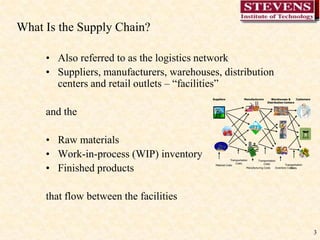
3SuppliersManufacturersWarehouses &Distribution CentersCustomersTransportationCostsTransportationCostsTransportationCostsMaterial CostsManufacturing CostsInventory CostsWhat Is the Supply Chain? Also referred to as the logistics networkSuppliers, manufacturers, warehouses, distribution centers and retail outlets – “facilities”and theRaw materialsWork-in-process (WIP) inventoryFinished productsthat flow between the facilities
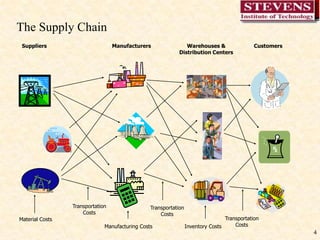
4SuppliersManufacturersWarehouses &Distribution CentersCustomersTransportationCostsTransportationCostsTransportationCostsMaterial CostsInventory CostsManufacturing CostsThe Supply Chain
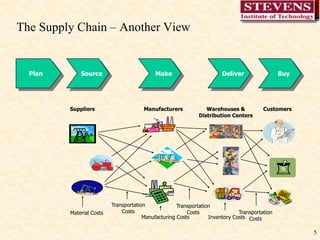
5SuppliersManufacturersWarehouses &Distribution CentersCustomersTransportationCostsTransportationCostsTransportationCostsMaterial CostsManufacturing CostsInventory CostsThe Supply Chain – Another ViewPlan    Source    Make    Deliver    Buy
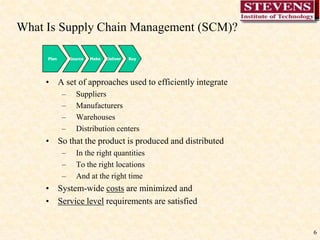
6Plan    Source    Make    Deliver    BuyWhat Is Supply Chain Management (SCM)? A set of approaches used to efficiently integrateSuppliersManufacturersWarehousesDistribution centersSo that the product is produced and distributedIn the right quantitiesTo the right locationsAnd at the right timeSystem-wide costs are minimized andService level requirements are satisfied
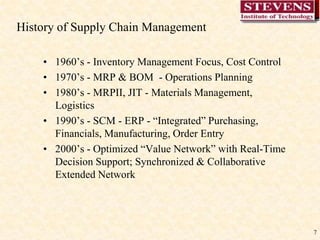
7History of Supply Chain Management1960’s - Inventory Management Focus, Cost Control1970’s - MRP & BOM  - Operations Planning1980’s - MRPII, JIT - Materials Management, Logistics1990’s - SCM - ERP - “Integrated” Purchasing, Financials, Manufacturing, Order Entry2000’s - Optimized “Value Network” with Real-Time Decision Support; Synchronized & Collaborative Extended Network
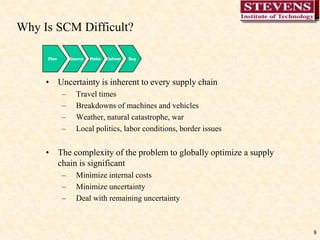
8Plan    Source    Make    Deliver    BuyWhy Is SCM Difficult? Uncertainty is inherent to every supply chainTravel timesBreakdowns of machines and vehiclesWeather, natural catastrophe, warLocal politics, labor conditions, border issuesThe complexity of the problem to globally optimize a supply chain is significantMinimize internal costsMinimize uncertaintyDeal with remaining uncertainty
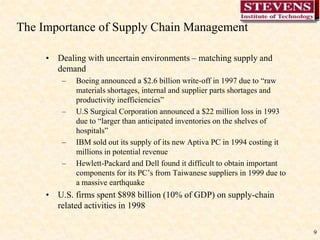
9The Importance of Supply Chain Management Dealing with uncertain environments – matching supply and demandBoeing announced a $2.6 billion write-off in 1997 due to “raw materials shortages, internal and supplier parts shortages and productivity inefficiencies”U.S Surgical Corporation announced a $22 million loss in 1993 due to “larger than anticipated inventories on the shelves of hospitals”IBM sold out its supply of its new Aptiva PC in 1994 costing it millions in potential revenueHewlett-Packard and Dell found it difficult to obtain important components for its PC’s from Taiwanese suppliers in 1999 due to a massive earthquakeU.S. firms spent $898 billion (10% of GDP) on supply-chain related activities in 1998
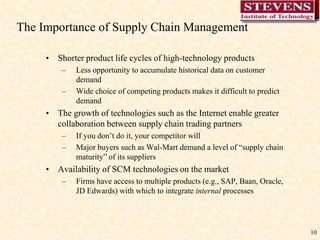
10The Importance of Supply Chain Management Shorter product life cycles of high-technology productsLess opportunity to accumulate historical data on customer demandWide choice of competing products makes it difficult to predict demandThe growth of technologies such as the Internet enable greater collaboration between supply chain trading partnersIf you don’t do it, your competitor willMajor buyers such as Wal-Mart demand a level of “supply chain maturity” of its suppliersAvailability of SCM technologies on the marketFirms have access to multiple products (e.g., SAP, Baan, Oracle, JD Edwards) with which to integrate internal processes
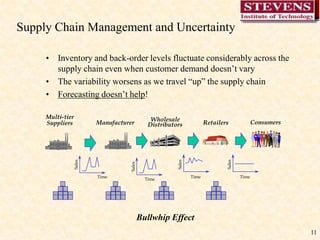
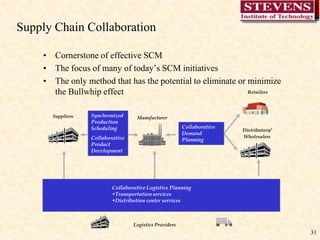
11Multi-tierSuppliersWholesale DistributorsConsumersManufacturerRetailersSalesSalesSalesSalesTimeTimeTimeTimeBullwhip EffectSupply Chain Management and UncertaintyInventory and back-order levels fluctuate considerably across the supply chain even when customer demand doesn’t varyThe variability worsens as we travel “up” the supply chainForecasting doesn’t help!
12Factors Contributing to the Bullwhip Demand forecasting practicesMin-max inventory management (reorder points to bring inventory up to predicted levels)Lead timeLonger lead times lead to greater variability in estimates of average demand, thus increasing variability and safety stock costsBatch orderingPeaks and valleys in ordersFixed ordering costsImpact of transportation costs (e.g., fuel costs)Sales quotasPrice fluctuationsPromotion and discount policiesLack of centralized information
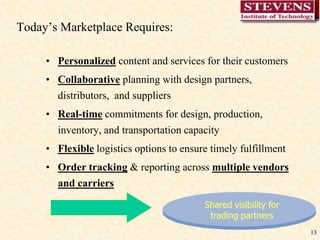
13Today’s Marketplace Requires: Personalized content and services for their customersCollaborativeplanning with design partners, distributors,  and suppliersReal-time commitments for design, production, inventory, and transportation capacityFlexiblelogistics options to ensure timely fulfillmentOrder tracking & reporting across multiple vendors and carriersShared visibility for trading partners
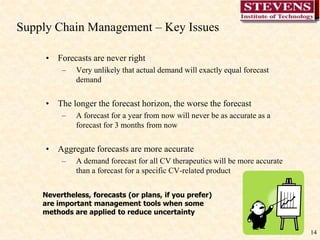
14Supply Chain Management – Key IssuesForecasts are never rightVery unlikely that actual demand will exactly equal forecast demandThe longer the forecast horizon, the worse the forecastA forecast for a year from now will never be as accurate as a forecast for 3 months from nowAggregate forecasts are more accurateA demand forecast for all CV therapeutics will be more accurate than a forecast for a specific CV-related productNevertheless, forecasts (or plans, if you prefer) are important management tools when some methods are applied to reduce uncertainty
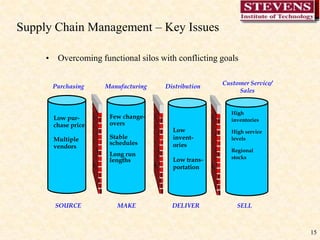
15PurchasingManufacturingDistributionCustomer Service/SalesLow pur-chase priceMultiple vendorsFew change- oversStable schedulesLong run lengthsHigh inventoriesHigh service levelsRegional stocksLow invent-oriesLow trans-portationSOURCEMAKEDELIVERSELLSupply Chain Management – Key IssuesOvercoming functional silos with conflicting goals
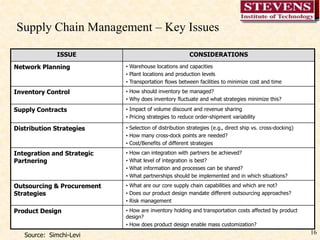
16Supply Chain Management – Key IssuesSource:  Simchi-Levi
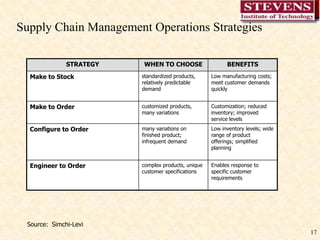
17Supply Chain Management Operations StrategiesSource:  Simchi-Levi
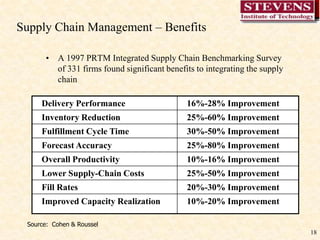
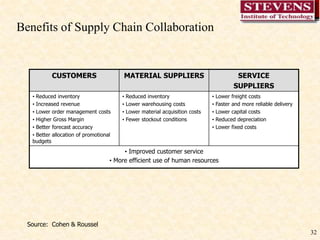
18Supply Chain Management – BenefitsA 1997 PRTM Integrated Supply Chain Benchmarking Survey of 331 firms found significant benefits to integrating the supply chainSource:  Cohen & Roussel
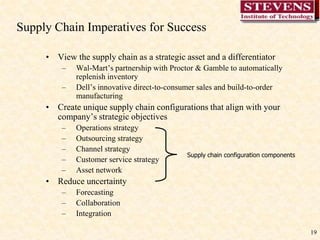
19Supply Chain Imperatives for SuccessView the supply chain as a strategic asset and a differentiatorWal-Mart’s partnership with Proctor & Gamble to automatically replenish inventoryDell’s innovative direct-to-consumer sales and build-to-order manufacturingCreate unique supply chain configurations that align with your company’s strategic objectivesOperations strategyOutsourcing strategyChannel strategyCustomer service strategyAsset networkReduce uncertaintyForecastingCollaborationIntegrationSupply chain configuration components
20Value of Informationand SCM
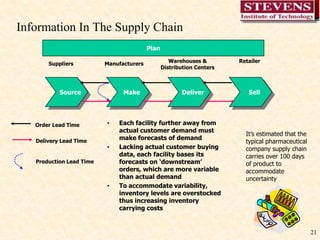
21Order Lead TimeDelivery Lead TimeProduction Lead TimeInformation In The Supply ChainPlanWarehouses &Distribution CentersRetailerSuppliersManufacturers    Source    Make    Deliver    SellEach facility further away from actual customer demand must make forecasts of demandLacking actual customer buying data, each facility bases its forecasts on ‘downstream’ orders, which are more variable than actual demandTo accommodate variability, inventory levels are overstocked thus increasing inventory carrying costsIt’s estimated that the typical pharmaceutical company supply chain carries over 100 days of product to accommodate uncertainty
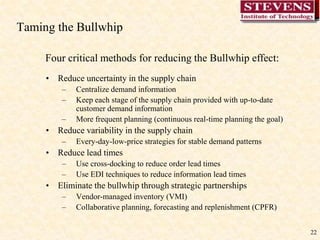
22Taming the BullwhipFour critical methods for reducing the Bullwhip effect:Reduce uncertainty in the supply chainCentralize demand informationKeep each stage of the supply chain provided with up-to-date customer demand informationMore frequent planning (continuous real-time planning the goal) Reduce variability in the supply chainEvery-day-low-price strategies for stable demand patternsReduce lead timesUse cross-docking to reduce order lead timesUse EDI techniques to reduce information lead timesEliminate the bullwhip through strategic partnershipsVendor-managed inventory (VMI)Collaborative planning, forecasting and replenishment (CPFR)
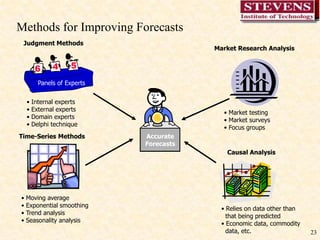
23Methods for Improving ForecastsJudgment MethodsMarket Research AnalysisPanels of Experts Internal experts
 External experts
 Domain experts
 Delphi technique
 Market testing
 Market surveys
 Focus groupsAccurateForecastsTime-Series MethodsCausal Analysis Moving average
 Exponential smoothing
 Trend analysis
 Seasonality analysis
 Relies on data other than 	that being predicted
 Economic data, commodity 	data, etc.24The Evolving Supply Chain
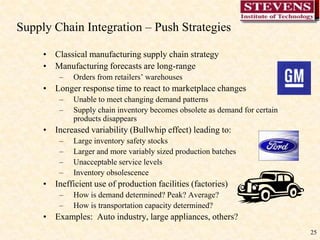
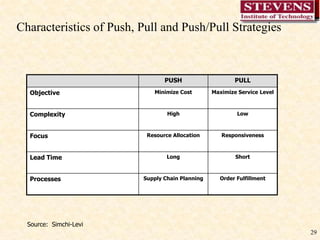
25Supply Chain Integration – Push StrategiesClassical manufacturing supply chain strategyManufacturing forecasts are long-range Orders from retailers’ warehousesLonger response time to react to marketplace changes Unable to meet changing demand patternsSupply chain inventory becomes obsolete as demand for certain products disappearsIncreased variability (Bullwhip effect) leading to:Large inventory safety stocksLarger and more variably sized production batchesUnacceptable service levelsInventory obsolescenceInefficient use of production facilities (factories)How is demand determined? Peak? Average? How is transportation capacity determined?Examples:  Auto industry, large appliances, others?
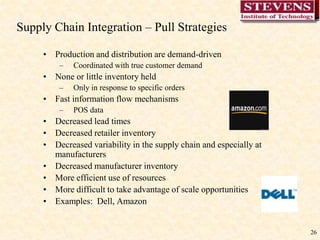
26Supply Chain Integration – Pull StrategiesProduction and distribution are demand-drivenCoordinated with true customer demandNone or little inventory heldOnly in response to specific ordersFast information flow mechanismsPOS dataDecreased lead timesDecreased retailer inventoryDecreased variability in the supply chain and especially at manufacturersDecreased manufacturer inventoryMore efficient use of resourcesMore difficult to take advantage of scale opportunitiesExamples:  Dell, Amazon
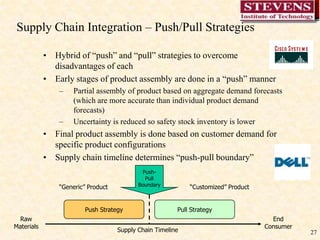
27Supply Chain Integration – Push/Pull StrategiesHybrid of “push” and “pull” strategies to overcome disadvantages of eachEarly stages of product assembly are done in a “push” mannerPartial assembly of product based on aggregate demand forecasts (which are more accurate than individual product demand forecasts)Uncertainty is reduced so safety stock inventory is lowerFinal product assembly is done based on customer demand for specific product configurationsSupply chain timeline determines “push-pull boundary”Push-PullBoundary“Generic” Product“Customized” ProductPush StrategyPull StrategyRawMaterialsEndConsumerSupply Chain Timeline
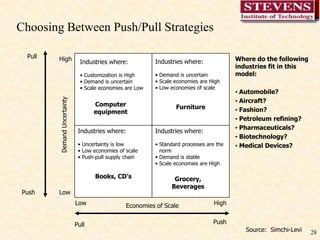
28Choosing Between Push/Pull StrategiesPullHighWhere do the following industries fit in this model: Automobile? Aircraft? Fashion? Petroleum refining? Pharmaceuticals? Biotechnology? Medical Devices?Industries where: Demand is uncertain
 Scale economies are High
 Low economies of scaleIndustries where: Customization is High
 Demand is uncertain
 Scale economies are LowComputer equipmentFurnitureDemand UncertaintyIndustries where: Standard processes are the 	norm
 Demand is stable
 Scale economies are HighIndustries where: Uncertainty is low

Supply chain management

  • 1.
    1Basics of SupplyChain Management
  • 2.
  • 3.
    3SuppliersManufacturersWarehouses &Distribution CentersCustomersTransportationCostsTransportationCostsTransportationCostsMaterialCostsManufacturing CostsInventory CostsWhat Is the Supply Chain? Also referred to as the logistics networkSuppliers, manufacturers, warehouses, distribution centers and retail outlets – “facilities”and theRaw materialsWork-in-process (WIP) inventoryFinished productsthat flow between the facilities
  • 4.
  • 5.
    5SuppliersManufacturersWarehouses &Distribution CentersCustomersTransportationCostsTransportationCostsTransportationCostsMaterialCostsManufacturing CostsInventory CostsThe Supply Chain – Another ViewPlan Source Make Deliver Buy
  • 6.
    6Plan Source Make Deliver BuyWhat Is Supply Chain Management (SCM)? A set of approaches used to efficiently integrateSuppliersManufacturersWarehousesDistribution centersSo that the product is produced and distributedIn the right quantitiesTo the right locationsAnd at the right timeSystem-wide costs are minimized andService level requirements are satisfied
  • 7.
    7History of SupplyChain Management1960’s - Inventory Management Focus, Cost Control1970’s - MRP & BOM - Operations Planning1980’s - MRPII, JIT - Materials Management, Logistics1990’s - SCM - ERP - “Integrated” Purchasing, Financials, Manufacturing, Order Entry2000’s - Optimized “Value Network” with Real-Time Decision Support; Synchronized & Collaborative Extended Network
  • 8.
    8Plan Source Make Deliver BuyWhy Is SCM Difficult? Uncertainty is inherent to every supply chainTravel timesBreakdowns of machines and vehiclesWeather, natural catastrophe, warLocal politics, labor conditions, border issuesThe complexity of the problem to globally optimize a supply chain is significantMinimize internal costsMinimize uncertaintyDeal with remaining uncertainty
  • 9.
    9The Importance ofSupply Chain Management Dealing with uncertain environments – matching supply and demandBoeing announced a $2.6 billion write-off in 1997 due to “raw materials shortages, internal and supplier parts shortages and productivity inefficiencies”U.S Surgical Corporation announced a $22 million loss in 1993 due to “larger than anticipated inventories on the shelves of hospitals”IBM sold out its supply of its new Aptiva PC in 1994 costing it millions in potential revenueHewlett-Packard and Dell found it difficult to obtain important components for its PC’s from Taiwanese suppliers in 1999 due to a massive earthquakeU.S. firms spent $898 billion (10% of GDP) on supply-chain related activities in 1998
  • 10.
    10The Importance ofSupply Chain Management Shorter product life cycles of high-technology productsLess opportunity to accumulate historical data on customer demandWide choice of competing products makes it difficult to predict demandThe growth of technologies such as the Internet enable greater collaboration between supply chain trading partnersIf you don’t do it, your competitor willMajor buyers such as Wal-Mart demand a level of “supply chain maturity” of its suppliersAvailability of SCM technologies on the marketFirms have access to multiple products (e.g., SAP, Baan, Oracle, JD Edwards) with which to integrate internal processes
  • 11.
    11Multi-tierSuppliersWholesale DistributorsConsumersManufacturerRetailersSalesSalesSalesSalesTimeTimeTimeTimeBullwhip EffectSupplyChain Management and UncertaintyInventory and back-order levels fluctuate considerably across the supply chain even when customer demand doesn’t varyThe variability worsens as we travel “up” the supply chainForecasting doesn’t help!
  • 12.
    12Factors Contributing tothe Bullwhip Demand forecasting practicesMin-max inventory management (reorder points to bring inventory up to predicted levels)Lead timeLonger lead times lead to greater variability in estimates of average demand, thus increasing variability and safety stock costsBatch orderingPeaks and valleys in ordersFixed ordering costsImpact of transportation costs (e.g., fuel costs)Sales quotasPrice fluctuationsPromotion and discount policiesLack of centralized information
  • 13.
    13Today’s Marketplace Requires:Personalized content and services for their customersCollaborativeplanning with design partners, distributors, and suppliersReal-time commitments for design, production, inventory, and transportation capacityFlexiblelogistics options to ensure timely fulfillmentOrder tracking & reporting across multiple vendors and carriersShared visibility for trading partners
  • 14.
    14Supply Chain Management– Key IssuesForecasts are never rightVery unlikely that actual demand will exactly equal forecast demandThe longer the forecast horizon, the worse the forecastA forecast for a year from now will never be as accurate as a forecast for 3 months from nowAggregate forecasts are more accurateA demand forecast for all CV therapeutics will be more accurate than a forecast for a specific CV-related productNevertheless, forecasts (or plans, if you prefer) are important management tools when some methods are applied to reduce uncertainty
  • 15.
    15PurchasingManufacturingDistributionCustomer Service/SalesLow pur-chasepriceMultiple vendorsFew change- oversStable schedulesLong run lengthsHigh inventoriesHigh service levelsRegional stocksLow invent-oriesLow trans-portationSOURCEMAKEDELIVERSELLSupply Chain Management – Key IssuesOvercoming functional silos with conflicting goals
  • 16.
    16Supply Chain Management– Key IssuesSource: Simchi-Levi
  • 17.
    17Supply Chain ManagementOperations StrategiesSource: Simchi-Levi
  • 18.
    18Supply Chain Management– BenefitsA 1997 PRTM Integrated Supply Chain Benchmarking Survey of 331 firms found significant benefits to integrating the supply chainSource: Cohen & Roussel
  • 19.
    19Supply Chain Imperativesfor SuccessView the supply chain as a strategic asset and a differentiatorWal-Mart’s partnership with Proctor & Gamble to automatically replenish inventoryDell’s innovative direct-to-consumer sales and build-to-order manufacturingCreate unique supply chain configurations that align with your company’s strategic objectivesOperations strategyOutsourcing strategyChannel strategyCustomer service strategyAsset networkReduce uncertaintyForecastingCollaborationIntegrationSupply chain configuration components
  • 20.
  • 21.
    21Order Lead TimeDeliveryLead TimeProduction Lead TimeInformation In The Supply ChainPlanWarehouses &Distribution CentersRetailerSuppliersManufacturers Source Make Deliver SellEach facility further away from actual customer demand must make forecasts of demandLacking actual customer buying data, each facility bases its forecasts on ‘downstream’ orders, which are more variable than actual demandTo accommodate variability, inventory levels are overstocked thus increasing inventory carrying costsIt’s estimated that the typical pharmaceutical company supply chain carries over 100 days of product to accommodate uncertainty
  • 22.
    22Taming the BullwhipFourcritical methods for reducing the Bullwhip effect:Reduce uncertainty in the supply chainCentralize demand informationKeep each stage of the supply chain provided with up-to-date customer demand informationMore frequent planning (continuous real-time planning the goal) Reduce variability in the supply chainEvery-day-low-price strategies for stable demand patternsReduce lead timesUse cross-docking to reduce order lead timesUse EDI techniques to reduce information lead timesEliminate the bullwhip through strategic partnershipsVendor-managed inventory (VMI)Collaborative planning, forecasting and replenishment (CPFR)
  • 23.
    23Methods for ImprovingForecastsJudgment MethodsMarket Research AnalysisPanels of Experts Internal experts
  • 24.
  • 25.
  • 26.
  • 27.
  • 28.
  • 29.
    Focus groupsAccurateForecastsTime-SeriesMethodsCausal Analysis Moving average
  • 30.
  • 31.
  • 32.
  • 33.
    Relies ondata other than that being predicted
  • 34.
    Economic data,commodity data, etc.24The Evolving Supply Chain
  • 35.
    25Supply Chain Integration– Push StrategiesClassical manufacturing supply chain strategyManufacturing forecasts are long-range Orders from retailers’ warehousesLonger response time to react to marketplace changes Unable to meet changing demand patternsSupply chain inventory becomes obsolete as demand for certain products disappearsIncreased variability (Bullwhip effect) leading to:Large inventory safety stocksLarger and more variably sized production batchesUnacceptable service levelsInventory obsolescenceInefficient use of production facilities (factories)How is demand determined? Peak? Average? How is transportation capacity determined?Examples: Auto industry, large appliances, others?

  • 36.
    26Supply Chain Integration– Pull StrategiesProduction and distribution are demand-drivenCoordinated with true customer demandNone or little inventory heldOnly in response to specific ordersFast information flow mechanismsPOS dataDecreased lead timesDecreased retailer inventoryDecreased variability in the supply chain and especially at manufacturersDecreased manufacturer inventoryMore efficient use of resourcesMore difficult to take advantage of scale opportunitiesExamples: Dell, Amazon
  • 37.
    27Supply Chain Integration– Push/Pull StrategiesHybrid of “push” and “pull” strategies to overcome disadvantages of eachEarly stages of product assembly are done in a “push” mannerPartial assembly of product based on aggregate demand forecasts (which are more accurate than individual product demand forecasts)Uncertainty is reduced so safety stock inventory is lowerFinal product assembly is done based on customer demand for specific product configurationsSupply chain timeline determines “push-pull boundary”Push-PullBoundary“Generic” Product“Customized” ProductPush StrategyPull StrategyRawMaterialsEndConsumerSupply Chain Timeline
  • 38.
    28Choosing Between Push/PullStrategiesPullHighWhere do the following industries fit in this model: Automobile? Aircraft? Fashion? Petroleum refining? Pharmaceuticals? Biotechnology? Medical Devices?Industries where: Demand is uncertain
  • 39.
  • 40.
    Low economiesof scaleIndustries where: Customization is High
  • 41.
    Demand isuncertain
  • 42.
    Scale economiesare LowComputer equipmentFurnitureDemand UncertaintyIndustries where: Standard processes are the norm
  • 43.
  • 44.
    Scale economiesare HighIndustries where: Uncertainty is low